What's inside
- Key Takeaways
- Quick Picks
- How Did We Choose Slim Doorbells Without Inventing Numbers?
- How Do You Measure a Door Frame for a Doorbell?
- Which Slim Doorbell Fits Your Frame — and Your Household?
- How Do You Mount a Slim Doorbell So It Stays Slim?
- What Mistakes Do Narrow-Frame Buyers Make?
- What About Storm Doors, Screen Doors and Porch Enclosures?
- How Does a Slim Doorbell Age on an Old Frame?
- What If the House Is Listed, Landmarked or Simply Loved?
- How Should You Live With a Slim Doorbell Across the Seasons?
- Comparison Table
- Final Recommendation
- Frequently Asked Questions
- Related Guides
As an Amazon Associate I earn from qualifying purchases. This post may contain affiliate links at no extra cost to you.
gizmoverdict.com is reader-supported. When you buy through links on our site, we may earn an affiliate commission.
Where to buy: Every doorbell below is a verified listing from this site’s product pool, chosen because its body belongs to the narrow school of doorbell design. This guide does not invent measurements: where a listing does not print a width, the review describes the model’s shape honestly rather than guessing at millimetres.
The best slim doorbell cameras exist for a piece of architecture most buying guides never mention: the narrow door frame. Millions of front doors are flanked not by broad, welcoming trim but by a slim strip of wood or uPVC, a sidelight’s edge, a brick return, or a frame shared with a storm door — a mounting surface measured in a few centimetres of usable width, into which the modern video doorbell, a device that has grown steadily plumper as it has grown cleverer, simply does not fit. Owners of such doors know the moment well: the flagship doorbell comes out of its box, is offered up to the frame, and overhangs on both sides like a wardrobe in a doorway. This guide is for that moment, and for the tape measure that should have preceded it.
“Slim” in this article means a specific, physical thing: a narrow body that sits within a tight frame without overhang, without angled bodges, and without forcing the household to choose between a watched door and a door that still looks like a door. It does not mean thin in the phone sense, and it does not mean small in capability. The six picks below are the narrow-bodied citizens of the current category — a wired Wyze that keeps a slender profile, Blink’s compact battery design, eufy’s C31, Tapo’s D205, Ring’s battery model at the slimmer end of its famous family, and Arlo’s original Essential with its famously wide eye in a comparatively trim body. Each is assessed first as a piece of frame furniture and only then as a camera, because that is the order in which a narrow door will judge them.
One honesty note before the picks, offered in the spirit this site applies to the whole category: dual-camera flagships and other wide-bodied flagships — the eufy E340 praised elsewhere in this batch, with its two lenses and onboard storage — are not slim devices, and no amount of admiration makes them so. If your frame is narrow, they are the wrong shape, and this guide will not pretend otherwise to keep a favourite on the list. Shape is the brief. The six below honour it, each in its own way, and the differences between them — power, storage, ecosystem, view — are the differences that should decide among the ones that fit.
Key Takeaways
- Slim here means a narrow body for tight frames — measure your trim’s usable width before any other specification.
- The Wyze v2 leads for wired homes: a slender wired body with 2K video and microSD local recording.
- Blink’s battery doorbell is the compact cordless option, with its storage arrangement stated plainly in its review.
- eufy’s C31 pairs a trim body with battery-or-wired power and no-subscription recording.
- Tapo’s D205 wraps the widest view in this set — 160 degrees — in a body built for real frames.
- Wide dual-camera flagships are not slim; if the frame is tight, shape outranks features, every time.
Quick Picks
| Pick | Badge | Why it earns its place |
|---|---|---|
| Wyze Wired Doorbell Camera v2 | Best slim wired | A narrow wired body with 2K video, colour night vision and card-based local history. |
| Blink Battery Doorbell 2K+ | Best slim battery | Blink’s compact battery design with 2K video and its Sync Module Core in the box. |
| eufy Video Doorbell C31 | Best slim all-rounder | Battery or wired power and fee-free recording in a body that respects a narrow frame. |
| Tapo 2K Wireless Doorbell D205 | Best slim wide view | A 160-degree eye and subscription-free local storage for corner doors and shallow porches. |
| Ring Battery Doorbell 2K | Best slim ecosystem pick | The slimmer end of Ring’s line, with the ecosystem’s polish and its plan terms stated openly. |
| Arlo Essential Video Doorbell | Best slim wide-angle classic | A 180-degree view in a comparatively trim body, wire-free or wired, no hub required. |
How Did We Choose Slim Doorbells Without Inventing Numbers?
By respecting a distinction the rest of the internet blurs. A doorbell’s slimness is a property of its body design — the narrow school versus the wide school — and it can be judged faithfully from a model’s design lineage and form factor without fabricating a spec sheet. What this guide will not do is print precise widths its sources do not state. Where a listing gives numbers — resolutions, fields of view, storage capacities — they are used and attributed. Where it does not, the review speaks of shape the way a carpenter would: this body sits within a frame; that flagship overhangs it; measure yours before ordering either. Readers with a tape measure and a specific frame should treat their own measurement as the final authority, because frames vary more than doorbells do.
The six were then spread across the category’s real divisions so that “slim” never becomes a synonym for one compromise. There is a wired-only pick and battery picks; local-storage picks and ecosystem picks; a 180-degree classic and a 160-degree modern; the Alexa world’s two citizens and the local-first school. If a household’s frame is narrow, its other loyalties — power, custody, assistants — should still get their vote. The set was built so that they can.
Finally, the exclusions were treated as content. The wide-bodied dual-camera models this site admires elsewhere were left out by shape, and the introduction says so in plain words, because a slim guide that smuggles in a wide flagship has failed before its first review. What remains is the honest narrow shelf of the current market — which turns out, on inspection, to be a better shelf than its size suggests.
How Do You Measure a Door Frame for a Doorbell?
Measure the flat, usable width of the surface the doorbell will actually sit on — not the whole trim, but the uninterrupted flat run between the door’s edge or weather seal and whatever interrupts the frame: a sidelight’s bead, a brick return, the storm door’s closer. Note the interruptions above and below too, because a doorbell needs a vertical run as well as a width, and a frame interrupted by a protruding handle-side moulding can defeat a body that the width alone would have welcomed. Work in daylight, with the door closed, and write the numbers down; this guide’s whole philosophy is that written measurements outlive optimistic memories.
Then think about the door’s swing and the storm door’s temper. A doorbell mounted on the frame must survive the door’s daily life — the storm door’s closer arm sweeping its arc, the main door’s edge passing close, a wreath’s seasonal occupation of the same real estate. Slim bodies earn their keep here twice over: they fit the width, and they present less of a target to everything that moves around a working doorway. If the flat run is truly too narrow for any body in this guide, the honest fallbacks are a wedge mount on the adjacent wall angled toward the step, or a door-frame mount designed for renters that grips the door’s edge itself — both preferable to a wide doorbell screwed defiantly across a sidelight, a sight this guide has seen and declines to recommend.
Placement height interacts with narrowness in one more way. On a slim frame, the doorbell often sits slightly further from the door’s centreline than a wide-frame installation would, which angles its world a few degrees sideways. The wide-view picks in this set — Tapo’s 160 degrees, Arlo’s 180 — forgive that offset generously, and the head-to-toe designs keep the step in frame regardless. Choose the view with the offset in mind, walk the approach as a visitor once the unit is up, and the narrow door will see as well as any in the street.
Which Slim Doorbell Fits Your Frame — and Your Household?
The reviews follow the household logic this batch has used throughout. The wired pick comes first because permanence flatters a narrow frame — fit once, never handle again. The battery and flexible picks follow for the doors wiring cannot reach, then the wide-view specialists for offset frames, then the ecosystem citizen for households whose digital loyalty is already sworn. Read the verdicts against two measurements: the width of your frame, and the shape of your household’s habits. A doorbell must satisfy both, and in that order.

Wyze Wired Doorbell Camera v2 — Best slim wired
The Wyze v2 is the narrow frame’s best friend among wired doorbells, because its design brief reads like the frame’s own: a slender body that asks little width of the trim, 2K video, colour night vision, two-way audio and a package monitor per its listing, and microSD local recording keeping the archive in the house. Wired power flatters a slim installation doubly — there is no battery to fatten the body and no recurring removal for charging, so the doorbell is fitted once, flush and forgotten, which is exactly the relationship a tight frame wants with anything mounted on it. The listing’s one condition is stated in its title: existing doorbell wiring is required.
That condition divides the audience cleanly, and this guide respects the division. Houses with a working bell circuit — a great many of the older, narrower-framed houses this article exists for — get the category’s neatest bargain: a slim, always-awake witness with fee-free card history and Alexa and Google Assistant support per the listing. Houses without wiring should not grieve; they should scroll to the battery picks, which were chosen for them. What the Wyze asks in return for its thrift is the card discipline common to local storage — an endurance-rated microSD, formatted in the device, checked after the first day’s events — a small liturgy its owners perform gladly at this price of admission.
On the frame itself, the wired Wyze has one more quiet virtue: permanence changes how a mounting feels. A battery doorbell on a narrow frame is handled at every charge, its mount flexed and its screws’ patience tested across years; a wired unit’s mount is disturbed never, and on old wood or uPVC trim that has already lived a life, never is a genuinely kinder number. For the wired narrow house, this is the guide’s first and easiest recommendation.
- Power: existing doorbell wiring required per listing
- Video: 2K HD per listing
- Storage: microSD local recording
- Night vision: colour per listing
- Monitoring: package monitor per listing
- Assistants: Alexa and Google Assistant per listing
Strengths
- A slender wired body that fits tight trim and is never disturbed for charging.
- Local card history with no subscription anywhere in the arrangement.
- The lowest ongoing cost in the set: a card, replaced on a years-long rhythm.
Trade-offs
- The wiring requirement excludes unwired doors outright — battery picks serve those.
- Card health and capacity are the owner’s small, permanent responsibility.
- Its value-tier ecosystem is app-centred rather than flagship-polished.
Best for: wired homes with narrow frames wanting a fit-and-forget local doorbell. Not suited for: renters without wiring, or households wanting a battery unit’s placement freedom.

Blink Battery Doorbell 2K+ — Best slim battery
Blink’s design heritage is smallness with patience — compact bodies, frugal batteries — and its battery doorbell in 2K+ form is the narrow frame’s cordless default. The listing describes 2K video with enhanced audio in a wireless battery design, with the Sync Module Core included in the box as the system’s hub. On a tight frame, the Blink’s compact footprint sits where wider flagships overhang, and its battery life philosophy suits the reality of a doorbell that must be taken down to charge: the fewer the occasions, the better the marriage with a delicate frame and its much-handled mount.
Blink’s storage terms get the same plain statement here as in this batch’s other guides, because consistency is what honesty looks like across a site: reviewing recorded clips runs through Blink’s subscription plan, with a local route available only through separate sync-module storage hardware rather than through the doorbell itself. Households already inside Blink will have settled that question; new buyers on narrow frames should settle it before the purchase, not after the first missed clip. The live fundamentals — alerts, live view, two-way talk — ask for no plan at all, and for some quiet doors they are genuinely the whole requirement.
As frame furniture, the Blink asks the least of any battery pick here: compact, light in spirit, and content on doors whose traffic is modest. Busy doors will charge it more often and should weigh the C31’s flexibility or a wired route instead. But for the classic narrow-frame problem — a rented door, no wiring, a trim strip that rejects the flagships — the Blink is the two-word answer the category has offered for years, now with a 2K eye: small, patient.
- Video: 2K per listing
- Power: wireless battery per listing
- Audio: enhanced audio per listing
- In the box: Sync Module Core included per listing
- Recorded clips: subscription plan, or separate local-storage hardware
- Finish: White system per listing
Strengths
- A compact body that respects narrow trim where flagships overhang.
- Battery frugality minimises handling of a delicate frame’s mount.
- The included hub completes the system without a second purchase.
Trade-offs
- Clip review depends on a plan or on local hardware beyond the doorbell.
- Busy doors will shorten the celebrated battery intervals considerably.
- Its white finish is the only livery on offer in this listing.
Best for: narrow, quiet, unwired doors — especially rented ones — needing compact cordless coverage. Not suited for: busy doors, or buyers wanting fee-free recorded history from the box.

eufy Video Doorbell C31 — Best slim all-rounder
The C31 is the slim set’s most adaptable citizen: a trim single-lens body carrying 2K video with a head-to-toe view, battery or wired power, no-subscription recording, live video calling on a press, human and motion detection, and readiness for the maker’s HomeBase S380 — every one of those phrases taken from its listing. On a narrow frame, that adaptability has a specific value: the doorbell can be fitted today on battery, in the twenty minutes a rented or unwired door allows, and can graduate to wired permanence later without the frame being re-drilled for a different body. One mounting, two lives.
Its recording character splits by power in the way this batch has noted before, and narrow-frame buyers should choose their side knowingly. On battery, the C31 is an event witness, waking for the door’s incidents; wired, its listing’s 24/7 recording becomes a realistic proposition and the doorbell turns into a continuous one. Either way, the archive’s terms are the local school’s: no monthly fee, with the HomeBase route offering indoor storage for households that want the clips kept off the doorstep device itself — an arrangement that suits a slim doorbell particularly, since the body on the frame can stay minimal while the memory lives indoors.
Against its own dual-camera sibling, the C31’s single lens is precisely why it is in this guide: the second camera and its housing are what width costs, and the narrow frame cannot pay it. What the C31 proves is how much doorbell remains when the width is spent wisely instead — the full head-to-toe frame, the detection, the flexible power, the fee-free archive. For the majority of narrow doors, this is not the compromised version of the flagship. It is the correct instrument, and the flagship is simply the wrong shape.
- Video: 2K FHD, head-to-toe view per listing
- Power: battery or wired per listing
- Recording: 24/7 recording stated in listing
- Subscription: none, no monthly fee per listing
- Ecosystem: HomeBase S380 ready per listing
- Calls: live video call on press per listing
Strengths
- Battery-now, wired-later flexibility means one mounting serves two chapters of a house.
- Fee-free recording with an indoor-storage growth path via HomeBase.
- A trim single-lens body that keeps the head-to-toe view the frame’s owners need.
Trade-offs
- No downward second camera; parcel framing rests on the single lens’s geometry.
- Continuous recording is a wired life; battery running remains event-based.
- The full base-station vision may mean a later purchase beyond the doorbell.
Best for: narrow frames wanting one adaptable, fee-free doorbell for now and for later. Not suited for: buyers who specifically want dual-camera parcel coverage and have the width for it elsewhere.

Tapo 2K Wireless Doorbell D205 — Best slim wide view
Narrow frames rarely enjoy ideal geometry. The doorbell sits offset from the door’s centre, sometimes hard against a sidelight, and the approach path crosses its view at an angle a wide-frame installation never faces. The Tapo D205 is this guide’s answer to that geometry: a wireless doorbell whose listing leads with a 160-degree ultra-wide view — the widest in the slim set bar one — wrapped in a body sized for real frames. Width of view, in other words, compensating for narrowness of body: the slimmer the trim forces the doorbell’s position to be, the more a generous lens forgives it.
Its storage sentence remains the one this site keeps quoting with approval: subscription-free local storage, with cloud as an optional extra, per the listing. The archive lives on your microSD card, under your custody, at a capacity you choose — the local school’s whole philosophy in one product — joined by person detection, two-way talk with a ring-call presentation, and night vision for the step’s dark hours. For a corner door or a shallow porch, where visitors materialise at the frame’s edge, the combination of the wide eye and the owned archive is the most complete narrow-door proposition among the battery picks.
The battery caveats are the class’s usual ones — traffic and winter set the charging rhythm — and the card caveats are the local school’s: endurance-rated media, formatted in the device, its health checked now and then. Neither diminishes the D205’s specific gift. Plenty of doorbells fit a narrow frame; this is the one that also sees around the corner the frame forced it into, and that pairing of fit and forgiveness is why it holds the wide-view title in a guide where width, of every kind, is the subject.
- View: 160-degree ultra-wide per listing
- Video: 2K per listing
- Storage: subscription-free local storage, optional cloud per listing
- Detection: person detection per listing
- Talk: two-way, with ring call per listing
- Power: wireless (battery) per listing
Strengths
- The wide lens forgives the offset positions narrow frames impose.
- Card-based local storage keeps history owned, capacious and fee-free.
- Person detection keeps a wide view’s alerts from narrating the whole street.
Trade-offs
- Wide lenses stretch subjects at the extreme edges; check the frame after mounting.
- Battery rhythm follows doorstep traffic and cold, as with all wireless picks.
- Card discipline — endurance media, formatting, checks — belongs to the owner.
Best for: offset, corner and shallow-porch doors needing width of view in a frame-friendly body. Not suited for: households wanting zero storage chores, or a wired unit’s continuous watch.

Ring Battery Doorbell 2K — Best slim ecosystem pick
Ring’s line has grown in capability and, across the years, in physical presence — which is why the household with a narrow frame and an Alexa loyalty should meet this model first: the newest Battery Doorbell 2K, in Speckled Gray per its listing, sits at the more frame-friendly end of the family’s current shapes while carrying the modern brief — retinal wide-angle video with up to 6x enhanced zoom and two-way talk on a built-in battery. For the Alexa household, the citizenship is the argument: announcements on the house’s Echo devices, live view by voice, the doorbell as a native of the system the home already speaks.
The terms receive this site’s standard plain statement, identical in every guide where this model appears: Ring’s recorded video history is a subscription feature. Live view, alerts and conversation are free and excellent; reviewing yesterday requires the paid plan, and no phrasing in this review, its table or the FAQ should be read otherwise. The Alexa household that accepts the plan knowingly gets the category’s most polished ecosystem doorbell in a body its narrow frame can host. The household that does not should take the C31 or the Tapo above, with this guide’s blessing and without a flicker of regret.
One practical note belongs to the frame itself. A built-in battery means the whole unit comes down to charge, mount and all patience included, so narrow-frame owners should fit the mount with the care of people who will be using it as a docking ritual for years: screws sound, alignment true, the release motion practised once in daylight. Do that, and the Ring’s recurring chore becomes a minute’s work rather than a frame-wearing struggle — the difference between a slim doorbell that suits a delicate trim and one that slowly argues with it.
- Video: wide-angle, up to 6x enhanced zoom per listing
- Power: built-in battery per listing
- Talk: two-way per listing
- Recorded history: requires a paid Ring plan
- Ecosystem: Alexa-centred
- Finish: Speckled Gray per listing
Strengths
- The frame-friendliest route into Ring’s current line for Alexa households.
- Ecosystem polish — announcements, voice live view, routines — in full.
- Modern wide-angle video with a generous enhanced zoom for long paths.
Trade-offs
- Recorded history is paywalled; the plan is part of this doorbell’s true price.
- The built-in battery means the whole unit travels to the charger each cycle.
- Google-centred and local-first households are better served elsewhere in this set.
Best for: Alexa households whose narrow frames exclude Ring’s larger flagships. Not suited for: subscription-averse buyers, or anyone wanting a removable battery pack’s convenience.
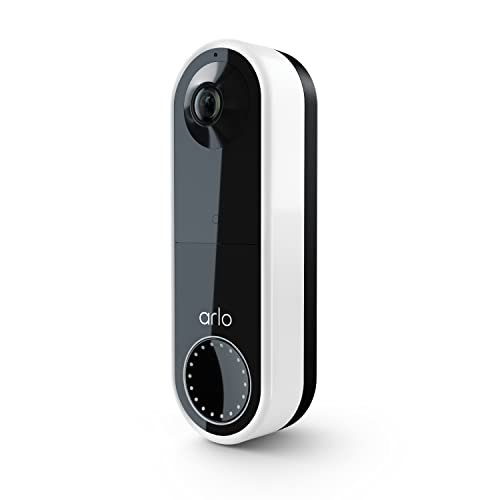
Arlo Essential Video Doorbell — Best slim wide-angle classic
The original Arlo Essential closes the set as the elder statesman of wide seeing in a trim body. Its listing’s brief is the one that defined the type: HD video with a 180-degree view — still the widest angle in this guide — night vision, two-way audio, direct-to-Wi-Fi connection with no hub required, and a choice of wire-free or wired installation. That 180 degrees deserves its emphasis in a slim guide specifically: on an offset narrow frame, the Arlo’s hemisphere of a lens does not merely forgive the position, it abolishes the problem, taking in the step, the path and the parcel zone in a single panoramic testimony.
Age brings the honest caveats. HD is not 2K, and households who zoom into faces across a long path will feel the difference the newer picks exist to close; the Essential’s proposition is breadth over sharpness, and it should be bought as that, knowingly. Its ecosystem is Arlo’s independent platform, with the maker’s plan structure governing its richer history features in the manner this batch has consistently flagged — judge the included arrangements as arrangements, calendar any trial, and let the hardware’s wide, hub-free simplicity make its own case.
What keeps the Essential in a 2026 slim guide is the combination nothing newer quite replicates: the widest eye, a comparatively trim body, no hub to house, and power flexibility that lets the same unit begin wireless on a rented frame and end wired on an owned one. For the narrow door whose geometry is genuinely awkward — the corner, the deep reveal, the frame that shares its wall with a downpipe — the classic’s panorama remains, some years on, the most forgiving witness the slim shelf offers.
- View: 180 degrees per listing
- Video: HD per listing
- Connection: direct to Wi-Fi, no hub needed per listing
- Power: wire-free or wired per listing
- Night vision: stated in listing
- Audio: two-way per listing
Strengths
- The widest view here turns offset narrow-frame geometry into a non-issue.
- No hub required keeps the installation and the shelf equally uncluttered.
- Wire-free-or-wired flexibility spans rented and owned chapters of a door’s life.
Trade-offs
- HD resolution concedes fine detail to the set’s several 2K models.
- Its richer history features live in Arlo’s plan world; read the terms first.
- As the elder design, its app experience trails the newest platforms’ polish.
Best for: genuinely awkward narrow geometry needing maximum width and zero hub. Not suited for: buyers who zoom often and need 2K detail, or the deepest ecosystem integrations.
How Do You Mount a Slim Doorbell So It Stays Slim?
The mounting craft for narrow frames is mostly a refusal to improvise. Use the maker’s bracket and screws as designed; on old or soft trim, pre-drill and consider whether the frame’s soundest wood is where the template wants to be, because a slim doorbell’s mount carries the unit’s whole life — including, for battery models, the repeated small violence of removal and return. Keep the body plumb: a doorbell tilted by a careless screw looks wrong on a narrow frame in a way a wide frame would forgive, and its motion zones tilt with it. Route any wired connection through the frame’s existing bell path where one exists, rather than carving new geography into old trim.
For renters and the drill-averse, the alternatives deserve their dignity: adhesive and clamp-style door mounts exist for exactly this problem, gripping the door’s edge or the frame without screws, and several picks here — the battery Blink, C31 and Tapo — are light enough in spirit to live on such mounts happily. Judge the mount by the door’s closing force and the household’s traffic; a door slammed by teenagers all day wants screws, while a gentle flat door can carry an adhesive mount for a tenancy. What no household should do is force a wide doorbell onto a narrow frame with optimism and longer screws. The frame will lose that argument slowly and then all at once.
Finish, as always in this batch, with the walk-through: approach the door as a courier at noon and as a neighbour at midnight, check the frame on the phone, confirm the step and the face are both in the picture, and only then call the installation done. A slim doorbell’s whole purpose is to disappear into a difficult frame while seeing everything the frame’s owner needs. The walk-through is how you know it has.
What Mistakes Do Narrow-Frame Buyers Make?
The first is buying by camera and discovering by frame — ordering the celebrated flagship and meeting its width at the doorstep, tape measure in hand, a week too late. The second is its mirror image: assuming slim means weak, and overlooking how much of the modern doorbell — 2K video, head-to-toe framing, local archives, detection — the narrow school in this guide carries without compromise. The third is measuring the trim’s full width rather than its flat, usable run, forgetting the sidelight bead and the storm-door closer that will spend years negotiating with the doorbell’s edges.
The fourth mistake is forgetting the door’s own motion: a body that clears the frame statically can still be clipped by a storm door’s swing or a wreath’s hook, and the time to discover that is the walk-through, not the first storm. And the fifth is the category’s universal one, repeated here because narrow frames do not exempt anyone: skipping the storage sentence. Slim describes a body, not an archive — the Ring and Blink picks carry their plans, the local picks their cards and onboard stores — and the household that reads that sentence before ordering will be as satisfied with its doorbell’s memory as with its fit.
What About Storm Doors, Screen Doors and Porch Enclosures?
The narrow frame rarely travels alone; it brings a storm door, and the storm door rewrites the installation in three ways. First, space: a storm door’s frame and closer consume part of the very trim the doorbell wanted, which is why the usable-run measurement in this guide insists on accounting for the closer’s arc. Second, sight: a doorbell mounted behind a glass storm door watches the world through a second pane, with reflections at night that can halve its usefulness — the correct home for the doorbell is outside the storm door’s envelope, on the frame’s outer face, where slim bodies again earn their keep by fitting the narrow landing that position offers. Third, sound and signal: the extra door muffles the press’s world and adds a layer between the doorbell and the house’s Wi-Fi, one more reason the signal test should be run with every door closed, in the configuration the doorbell will actually live in.
Screen doors in summer complicate the same story seasonally. A doorbell tuned in winter, when the storm pane is in, may find its view crossed by a screen’s mesh and its motion sense courted by insects the warmer months bring to the porch light. The households that cope best treat the change of door seasons as a five-minute doorbell appointment: check the frame on the phone, nudge a zone, wipe the lens. It is a small liturgy, and it belongs to the same calendar as the battery rhythm and the card check — the modest, predictable attentions by which a well-chosen doorbell repays its household for years.
How Does a Slim Doorbell Age on an Old Frame?
Old frames are soft, painted, sun-worked and precious, and a doorbell’s decade on one is a relationship worth designing. Slim bodies help by concentrating their mounting into a small, honest footprint — two screws in sound wood rather than a wide plate bridging trim that was never flat. Battery models ask the mount to work as a dock, and the kindest arrangement for old wood is the one this guide recommended at the Ring pick: fit the bracket once, perfectly, so that a hundred removals travel through the bracket’s mechanism rather than through the frame’s screw holes. Wired models are kinder still, asking the frame for nothing after the first afternoon, which is why the Wyze v2’s permanence keeps surfacing in this guide as a narrow-frame virtue and not merely an electrical one.
There is also the question of the house’s face. A narrow frame is usually a period frame, and a doorbell that respects its proportions — sitting within the trim’s lines, finished in a colour that does not shout — preserves the thing the household actually owns, which is the door’s appearance as much as its security. The slim school exists, at bottom, because doorbells should join a house’s architecture rather than interrupt it. Choose the body that your frame would have chosen for itself, and the technology will look, from the street, like it was always there.
What If the House Is Listed, Landmarked or Simply Loved?
Some frames may not be drilled at all — conservation rules, a landlord’s clause, or a household’s own reverence for original woodwork — and the slim category serves those doors better than any other, because its lightest battery citizens can live on clamp and grip mounts that leave the frame untouched. The Blink and the Tapo, carried on a door-edge clamp, give a protected doorway a watched step with zero screw holes to answer for later; the C31 on a grip mount does the same with the local archive aboard. The discipline is to match the mount’s grip to the door’s closing habits, as the mounting chapter advised, and to accept a slightly less monastic silhouette as the price of reversibility. A doorbell that can be removed without a trace is, for a certain kind of house, the only acceptable kind — and it is a genuine pleasure of this category that its narrowest members are also its most reversible.
The same reversibility serves the merely cautious: the household unsure whether a video doorbell suits its life can begin with a clamped battery pick, live with it for a season, and commit to screws — or to wiring — only when the doorbell has earned its permanence. Few household technologies offer so graceful a trial. The narrow frame, which began this article as a problem, ends it as an unexpected advantage: it forces a household to choose deliberately, by shape and by habit, and deliberate choices are the ones that last.
How Should You Live With a Slim Doorbell Across the Seasons?
A slim doorbell’s year has a rhythm the wide-frame world shares but feels more keenly, because everything about a narrow installation is closer to the weather. Spring asks for the lens wipe and the zone check as the street wakes up and the light changes its angle. Summer brings the screen door, the insects at the porch light, and the delivery season’s peak — the months when the parcel framing earns its keep daily and the battery rhythm shortens with the traffic. Autumn is the wedge-check season: doors swell and settle with the damp, storm panes go back in, and a mount that was true in July deserves one confirming glance. Winter is the battery’s examination and the illuminator’s longest shift, when colour night vision and a clean lens divide the doorbells that witness from the doorbells that merely attend.
None of this is burdensome; it totals perhaps an hour across a year, and it is the same hour the rest of this batch’s doorbell guides prescribe in their own dialects. What the slim household gets in return is disproportionate: a difficult frame, watched as well as any in the street, by a body that looks like it grew there. Keep the small appointments, and the little doorbell on the narrow trim will out-serve neighbours’ flagships that never fitted their doors half as honestly.
Comparison Table
| Pick | Power | View | History arrangement | Choose it when |
|---|---|---|---|---|
| Wyze v2 | Wired only | 2K framing | microSD local | Wiring exists and the frame is tight |
| Blink Battery 2K+ | Battery | 2K framing | Plan, or separate local hardware | Compact cordless on a quiet door |
| eufy C31 | Battery or wired | Head-to-toe | Local, no fee | One mounting must serve two chapters |
| Tapo D205 | Battery | 160-degree | microSD local | Offset frame needs a wide eye |
| Ring Battery 2K | Battery | Wide-angle | Cloud, plan for history | Alexa loyalty meets a narrow frame |
| Arlo Essential | Battery or wired | 180-degree | Arlo plan arrangement | Maximum width, no hub wanted |
Final Recommendation
Measure the frame, then let the household’s loyalties choose among the bodies that fit it. The wired narrow house should take the Wyze v2 and enjoy the category’s neatest disappearing act. The unwired house should take the eufy C31 for its two-chapter flexibility, or the Tapo D205 where the frame’s offset demands the wide eye, or Blink’s compact battery unit where the door is quiet and the tenancy is temporary. The Alexa household takes Ring’s frame-friendliest model with its plan understood; the awkward-geometry house takes Arlo’s panoramic classic. What none should do is force a wide flagship onto a narrow frame and call the overhang a compromise. A slim doorbell, rightly chosen, is not the lesser doorbell. It is the one that belongs to your door — and a doorbell that belongs is the only kind worth bolting to a hundred-year-old frame.
Frequently Asked Questions
How narrow is “slim” for a doorbell?
Slim names a school of body design — the narrow models in this guide — rather than a single certified width, and this article deliberately prints no measurements its sources do not state. The practical test is your own: measure the flat, usable run of your frame, compare it honestly against the body of the model you are considering in person or by its stated dimensions where the maker publishes them, and leave a margin for the storm door’s moving parts. Your tape measure, applied to your frame, outranks any adjective in any guide — including this one.
Are slim doorbells weaker than full-size ones?
No — they are narrower, which is a different sentence. This set includes 2K video, head-to-toe framing, colour night vision, package detection and fee-free local recording, in bodies a frame can host. What the slim school genuinely concedes is the second camera of the wide dual-lens flagships and, in some models, battery capacity. For a narrow door those are not concessions at all, because the flagships’ extra width was never available to spend.
Why isn’t the eufy E340 in this guide?
Because it is not slim, and this guide’s first duty is to the frame. The E340 is a dual-camera flagship whose body belongs to the wide school; on a broad frame it is an excellent doorbell, as this site’s other guides argue in detail. On a narrow frame it would overhang, and a slim guide that included it anyway would be advertising, not advice. Shape is the brief, and the E340’s shape answers a different brief.
Can I fit a doorbell if my frame is too narrow for all six?
Very likely, by changing the mounting rather than the doorbell: a wedge on the adjacent wall angled toward the step, or a clamp mount that grips the door’s edge itself, can host several of the lighter battery picks here. What the frame cannot host, the wall beside it often can. The option to avoid is screwing a wide body across trim and sidelight alike — a solution that damages the frame, dates the house’s face, and still leaves the doorbell at the wrong angle.
Does a slim doorbell need a chime?
It needs an announcement route, as every doorbell in this batch does: an existing mechanical chime where wiring provides one, a plug-in chime, a phone notification, or a smart speaker doing the honours. Narrow frames change nothing about that arithmetic except to make the planning easier to forget amid the geometry. Decide how the press will sound inside the house before the unit goes up, and the slim doorbell’s manners will match its fit.
Will a slim doorbell work on a uPVC frame?
Yes, with the material’s own courtesies observed. uPVC trim offers a flat, weatherproof mounting face that slim bodies sit on happily, but its screws want pilot holes and a gentle hand — overtightened fixings crack or creep in plastic where wood would merely complain — and adhesive mounts should be the kind rated for smooth plastic surfaces. The reward is a frame that will never rot around the mount and a doorbell whose narrow footprint leaves the frame’s clean lines almost entirely themselves. As with wood, measure the flat run between the door seal and the sidelight bead, because uPVC frames are, if anything, the narrowest of all.
What colour should a slim doorbell be?
The colour that the frame would choose: dark bodies disappear against dark-stained and painted trim, pale ones against the white uPVC that dominates newer narrow frames, and the finishes named in this set’s listings — white systems, Speckled Gray — cover the common cases. The deeper principle is that a slim doorbell’s aesthetic job is discretion. It should read, from the street, as a doorbell-sized part of the door’s furniture rather than as a gadget applied to it, and the narrow body already does most of that work before colour is even considered.
What if my door opens outward onto the frame?
Then the clearance conversation gains a moving part, and it must be rehearsed before any screws: open and close the door through its full travel with a template of the doorbell held in place, and watch the arcs — the door’s edge, the storm door’s closer, the handle’s swing — because a body that clears the frame at rest can still be struck daily by the door’s own furniture in motion. Outward-opening doors often push the installation toward the adjacent wall and a wedge, which several picks here serve happily, or toward the slimmest body mounted as high in the frame’s quiet zone as the lens’s view allows. The rehearsal takes three minutes and is the difference between a doorbell that ages with the house and one that is knocked off it, literally, by the house itself.
Should I centre the doorbell on the frame or offset it?
Centre it on the usable run, not on the trim’s full width, and then judge by the picture rather than the tape: the frame on the phone is the installation’s true portrait. A slight offset forced by a sidelight bead is normal in this category and is precisely what the wide-view picks exist to forgive; a deliberate offset to dodge a sound patch of wood is also legitimate carpentry. What matters is that the lens ends up looking at the approach and the step with the visitor’s face inside the frame at conversational distance — a condition the walk-through verifies in a minute and no amount of symmetrical intention can substitute for. Houses are not drawings, and the doorbells that serve them best are the ones fitted to the building as it stands — its beads and closers, its swollen summer timber and its shrunken winter gaps — rather than to the elevation in anyone’s imagination, however handsome that elevation may be. Fit the doorbell to the house you have, in the season you have it, with the frame measured and the walk-through walked, and the result will look — as all good joinery looks — inevitable, as though the narrow trim had been waiting a century for exactly this small, bright, narrow-eyed addition to its furniture. That inevitability, earned by measurement and patience, is the slim category’s whole reward — and it is available, as this guide has shown six times over, at every level of budget, wiring and ecosystem loyalty a household can bring to its front door. Bring yours, tape measure first and assumptions last, and the narrow frame that looked like the street’s hardest doorstep problem will turn out to have been a specification — one that six good doorbells were, all along, quietly designed to meet. Meet them halfway — with the measurement written down, the mount fitted true, the zones drawn tight and the walk-through walked at noon and midnight — and the partnership between a century-old frame and a thoroughly modern witness will hold, season after season, without either party ever needing to raise its voice. That is the whole ambition of the slim doorbell, stated as plainly as the frame allows: to watch a difficult door beautifully, to belong to the house it guards, and to be forgotten — between the parcels, the visitors and the seasons — by everyone except the household it serves. Choose the body that fits, in every sense of that small and decisive word, and the forgetting can begin — which is to say, the doorbell can finally start doing the job it was bought for, quietly, narrowly, and entirely on your door’s own terms. Terms, after all, are what this entire guide has been negotiating — between a frame and a camera, a household and a subscription, a century of joinery and a decade of software — and the households that read them carefully, measure them honestly and choose them deliberately are the ones whose doorbells, slim or otherwise, are still being forgotten, gratefully, a decade from now. Forgotten, that is, in the way of all good household servants — present at every arrival, invisible at every other moment, and missed, profoundly and immediately, on the single day they are ever absent from their post. Keep yours at its post — mounted true, lens clean, battery fed, zones honest — and the narrow frame at the front of your house will never again be the reason a visitor, a parcel or a moment went unwitnessed by the household that lives behind it. That, in the end, is all any doorbell has ever promised — slim or wide, wired or free, local or cloud — and the narrow door, fitted with the right narrow witness, keeps that promise as completely as any door in the whole long street, in any town, in any season, in any year you care to name at all, ever, anywhere, for anyone, at any door.
Related Guides
The storage questions behind several picks here are investigated in full in Best 1080 IP Webcams: IP Cameras vs USB Webcams — Two Meanings, Separated, and the wider doorbell landscape is mapped in Best 1080p Smart TVs for the screens these cameras report to. Readers furnishing a whole entrance may also enjoy Best 1080p TVs with Low Input Lag for the hall display that shows the live view.
Related guides
- Best 1080p IP Cameras: PoE Domes, Turrets, Bullets and a PTZ That Earn Their Cable
- Best 43 1080p TVs: Why 43 Inches Went 4K — and Where True Full HD Survives
- Best Doorbell Cameras No Subscription: Local Storage Picks, and the Ring/Blink Truth
- Best AC Powered Wireless Security Cameras: Wi-Fi Data, Mains Power, Zero Sleep


