What's inside
- Key Takeaways
- Quick Picks: Gaming Headsets in the $50 Frame at a Glance
- How Did We Assemble This Tier’s Shortlist?
- What Honestly Gets Worse at This Price — and What Surprisingly Doesn’t?
- Console or PC: Does the Platform Change the Pick?
- How Do the Six Stack Up Against Each Other?
- How Do You Set Up a Budget Headset for Clear Team Voice?
- What Mistakes Do Buyers in This Tier Make?
- How Long Do Budget Headsets Really Last — and How Do You Extend It?
- How Should You Test a New Budget Headset Inside the Return Window?
- Headset or Headphones Plus a Separate Microphone?
- A Translator for This Tier’s Listing Language
- Equipping a Whole Household: Does the Maths Change?
- Why Is There No Wireless Pick in This Tier?
- Final Recommendation
- Frequently Asked Questions
- Related Guides
As an Amazon Associate I earn from qualifying purchases. This post may contain affiliate links at no extra cost to you.
gizmoverdict.com is reader-supported. When you buy through links on our site, we may earn an affiliate commission.
Where to buy: the five linked headsets below go to their Amazon listings, where you can check the current price on Amazon and confirm the platform variant and colour in the title. One pick, the EKSA E900, is covered in prose only, so search its name at your retailer and check which version of it is currently listed.
The best 50 dollar gaming headsets are where gaming audio becomes a commodity, and the fifty in the keyword is the budget frame for the whole class — this guide never pins that figure to an individual model, because at this level prices wobble constantly and the honest unit of comparison is the tier, not the tag. What the tier offers, stated without decoration: a headset that plays your games in full, carries your voice to your team, plugs into everything you own, and survives a reasonable life of being knocked off desks. What it does not offer: the driver refinement, microphone polish and material quality of the class above. Every pick below is a different answer to the same negotiation — which of those sacrifices to make, and which to refuse.
The field divides into two nations. In one, Turtle Beach fields the Recon line, the closest thing console gaming has to a default headset, sold in game shops everywhere and built to a brand’s standard of adequacy. In the other, a crowd of ambitious generic makers — NUBWO, BENGOO, Ozeino and their kin — compete on features-per-box: bigger claimed drivers, lights, surround badges, braided cables. The nations are not enemies; they are answers for different buyers. The brand headsets are the safer primary purchase. The generics are the gambler’s value and the household spare. This guide ranks all six together but never pretends the border between them is invisible.
One truth governs the whole tier and deserves its own paragraph before any names: the surround sound advertised across these listings is virtual. Every headset here has two drivers, one per ear, and the spaciousness on offer comes from software processing — sometimes in a bundled dongle, more often in the console or PC itself. That is not a scandal; good virtual processing is genuinely useful in games. But it means the “7.1” badge is the least informative words on any of these boxes, and the reviews below spend their attention where the real differences live: microphones, fit, build, and the honesty of the basics.
Key Takeaways
- Turtle Beach’s Recon 70 is the tier’s anchor: a genuine brand headset with a flip-to-mute microphone and multiplatform wiring that simply works everywhere.
- The Recon Spark is the same philosophy in a white-and-purple finish, for players whose setup is not black-on-black.
- NUBWO’s HG04L is the generic tier’s serious entry — a lightweight frame, memory foam earmuffs and a clear unidirectional microphone brief.
- BENGOO G9000 and Ozeino are the decorated floor: lights, big claims, working basics, bought best as spares and starters.
- EKSA E900 is covered without a link because its listings rotate; when it is in stock it is the generic most often compared with the brands.
- At this level the winning strategy is expectation management: buy the basics done right and the tier delights; buy the badges and it disappoints.
Quick Picks: Gaming Headsets in the $50 Frame at a Glance
| Pick | Badge | Why it made the cut |
|---|---|---|
| Turtle Beach Recon 70 | Best Overall in the Tier | The console world’s default headset: flip-to-mute mic, 40mm drivers and wiring for every platform in the house. |
| Turtle Beach Recon Spark | Best Finished in White and Purple | Recon fundamentals in a light, bright colourway with the same multiplatform manners. |
| NUBWO HG04L | Best Generic Contender | A 250-gram frame with memory earmuffs and a unidirectional mic brief that reads like it was written by someone who plays. |
| BENGOO G9000 | Best Household Spare | The decade-old budget staple — in this tier it is a mid-pack citizen rather than the floor, and priced like a spare should be. |
| Ozeino Gaming Headset | Best for Young Players Who Want Lights | LED theatre and all-platform claims in a big padded shell that forgives rough handling and small budgets. |
| EKSA E900 | Best Prose-Only Wildcard | The generic brand most often cross-shopped against Turtle Beach; covered without a link because its listings come and go. |
How Did We Assemble This Tier’s Shortlist?
The selection started from ownership reality: which headsets do players in this budget actually end up with, and which of those still deserve the recommendation? Turtle Beach’s pair was automatic — the Recon line is the tier’s centre of gravity, and including both its sober and its colourful expression covers the two tastes the line serves. The generics were chosen for staying power rather than novelty: NUBWO, BENGOO and Ozeino have held listings and accumulated ownership history for years, while EKSA earned the prose-only seat as the name that surfaces whenever buyers ask whether a generic can match a brand.
Evaluation discipline at this tier means grading on the curve the tier itself sets. A microphone is judged against what fifty-dollar-frame buyers can reasonably expect — intelligibility and reliability — not against broadcast standards it never claimed. Build is judged on whether the plastics and joints suit the handling the headset will actually receive. And every surround, noise-cancelling and driver-size claim in every listing was translated into plain language before it was allowed into a review, because the gap between listing copy and lived experience is widest exactly here, where buyers have the least money to waste on the difference.
What Honestly Gets Worse at This Price — and What Surprisingly Doesn’t?
The sacrifices, in the order you will notice them. Materials go first: frames are simpler polymers, adjustment mechanisms are friction where the tier above uses detents, and cushion coverings are chosen for cost, so they age faster under daily use. Microphones go second: the capsules here are adequate rather than good, capturing a voice that is clear enough for callouts and noticeably thinner than a brand-tier boom when a teammate hears both in the same week. Driver refinement goes third: the sound is full and loud, with bass that pleases in explosions, but fine detail — the layered audio of a busy scene — compresses into a simpler picture.
Now the surprises. Compatibility does not get worse at all: every pick here plugs into every platform that matters, because analogue 3.5mm is democratic. Basic comfort, for average sessions, holds up better than the price suggests — the padding race among generics has genuinely improved the floor. And loudness, if anything, improves as you descend, because budget tuning chases impact. The tier’s real contract is this: the essentials of play are fully present, the refinements of ownership are trimmed, and a buyer who understands that contract in advance is the buyer this class makes happiest.
Console or PC: Does the Platform Change the Pick?
On console, this tier is in its natural home. The controller’s 3.5mm jack is the great leveller — every headset here connects identically, chat mixing is handled by the console itself, and the platform’s own spatial audio features do the surround work that listing badges advertise. A PlayStation or Xbox player should therefore choose almost entirely on fit, microphone gesture and looks, which is why the flip-to-mute Recons are so well adapted to their habitat: the mute you can perform without looking, mid-match, is worth more than any processing.
On PC the picture gains one wrinkle. A single combined jack serves modern laptops well, but desktop PCs with separate microphone and headphone sockets need the splitter cable that some of these headsets include and others leave as an exercise for the buyer — check the box contents on the listing before ordering, because a headset that arrives unable to speak to your tower is a small, avoidable tragedy. PC players also gain software options the consoles handle internally: chat applications’ noise suppression can lift a budget microphone noticeably, which narrows the practical gap between the generic tier and the brands for PC-first buyers willing to spend ten minutes in settings.

Turtle Beach Recon 70 — Best Overall in the Tier
The Recon 70 is what a budget headset looks like when a company that sells expensive headsets decides the cheap one must not embarrass it. The formula is disciplined: 40mm drivers tuned for clarity over spectacle, synthetic leather-wrapped cushions that seal decently, a headband with actual padding, and Turtle Beach’s signature flip-to-mute microphone — lift it and you are silent, a gesture so natural that returning to button-mutes feels like a downgrade. It connects by 3.5mm to PlayStation, Xbox, Switch, PC and mobile without adapters or opinions, and it behaves identically on all of them.
In this tier, that consistency is the luxury. Owners of Recon 70s describe the same experience across years: it works, the team hears them, the fit survives an evening. The sound will not trouble the class above — busy scenes simplify, and the microphone is honest rather than flattering — but nothing about it will ambush you either, which cannot be said of every decorated rival below. If this guide had to equip a hundred unknown players in this budget and answer for the outcome, it would buy a hundred Recon 70s and sleep soundly. That is what “best overall in the tier” means at this level: not excitement, but the absence of regret.
A note for glasses wearers and younger players, the two groups budget headsets most often fail quietly. The Recon 70’s cushions are plush enough to seal around most frames without the vice-grip that gives the tier its headaches, and its size range adjusts down honestly for smaller heads, because Turtle Beach sells heavily into the family market and designs accordingly. Neither virtue appears in its listing’s headline claims, which prefer to talk about drivers. It is a recurring lesson of this guide: in the budget tiers, the specifications that decide satisfaction are the ones the boxes mention last, and the Recon 70’s quiet competence in those unlisted areas is exactly why it anchors the ranking.
- Drivers: 40mm, per the listing
- Microphone: flip-to-mute, Turtle Beach’s signature gesture in this class
- Platforms: PS5, PS4, Xbox Series X|S, Xbox One, PC and mobile per the listing
- Connection: wired 3.5mm, no software or charging
Strengths
- The most predictable ownership experience in the tier, from a brand with a support desk.
- Flip-to-mute is the best mute interaction available at this level.
- Genuinely universal compatibility with zero setup on any platform.
Trade-offs
- Sound and microphone are competent rather than characterful; enthusiasts will hear the ceiling.
- Materials are honest plastic and synthetic leather, a step below the tier above.
- No detachable parts, so a cable failure retires the whole headset.
Best for: console players and gift buyers who want the tier’s safest primary headset. Not suited for: players ready to spend up for microphone quality, or anyone who wants wireless.

Turtle Beach Recon Spark — Best Finished in White and Purple
The Recon Spark exists because Turtle Beach noticed that not every player’s desk is a black monolith. Underneath the white-and-purple finish sits the Recon family’s familiar discipline — over-ear cushions with a glasses-relief channel in the design’s DNA, a flip-to-mute microphone, metal-reinforced headband construction in the line’s tradition, and 3.5mm wiring for Xbox, PlayStation, Switch, PC and mobile. It is, in substance, the colourful sibling of the tier’s anchor, and this guide treats it as such rather than inventing differences the hardware does not support.
Why give it its own row, then? Because at this budget, looks are a legitimate specification — the headset is worn on camera, carried to friends’ houses, and chosen by younger players for whom the object is part of the hobby’s joy — and because the Spark’s finish is executed with a brand’s restraint rather than the floor tier’s glitter. The white will ask more of its owner’s housekeeping than black does, and the purple accents will either delight or disqualify in the first glance; both reactions are the finish doing its job. Choose it when the Recon formula appeals and the standard colourway does not, and expect the same absence of regret with better photographs.
There is also a streaming footnote. Players who appear on camera — and at this budget that increasingly means young creators starting out — find the Spark photographs and films as a deliberate-looking piece of kit rather than a budget confession, and its microphone is honest enough for a beginner’s broadcast. Nobody should buy a fifty-dollar-frame headset as production equipment, but a first channel has been launched on less, and the Spark’s combination of presentable looks and serviceable voice makes it the tier’s most credible starter for that double life. The white finish, kept clean, reads as intentional on a webcam in a way that scuffed black plastic never quite manages.
- Finish: white and purple colourway, the tier’s most distinctive brand design
- Microphone: flip-to-mute, matching the Recon family’s gesture
- Platforms: Xbox, PlayStation, Nintendo Switch, PC and mobile per the listing
- Fit: over-ear cushions with glasses-friendly shaping
Strengths
- Brand-tier fundamentals in a finish that escapes the all-black default.
- The same foolproof mute gesture and universal wiring as the Recon 70.
- A gift-friendly design that younger and style-conscious players choose gladly.
Trade-offs
- White finishes show the evidence of daily life sooner than dark ones.
- Substance matches the Recon line’s adequacy ceiling; the premium here is appearance.
- Colour preference is binary — the purple accents will not grow on a sceptic.
Best for: players and gift buyers who want Turtle Beach reliability in a lighter, brighter design. Not suited for: anyone who finds white impractical, or who wants the money spent on audio instead of finish.
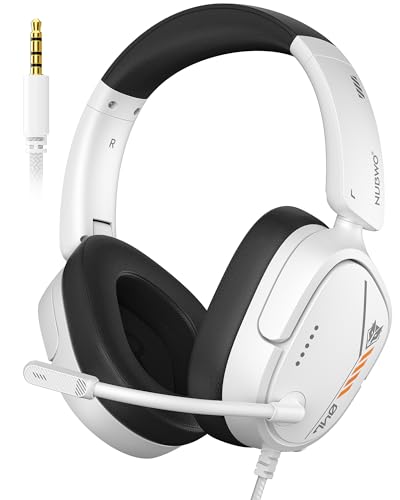
NUBWO HG04L — Best Generic Contender
NUBWO has spent years as the generic name that forum threads mention with a qualifier — “actually decent” — and the HG04L shows why. Its listing leads with the right details: 40mm speakers, a clear unidirectional microphone, a 250-gram weight, and soft memory earmuffs. Unidirectional is the telling word. It describes a microphone that listens from one direction — your mouth — and it is the correct, unglamorous technology for gaming voice, chosen over the omnidirectional capsules that make cheaper headsets sound like speakerphone calls from a stairwell. Somebody at NUBWO plays games, and the HG04L’s brief was written by them.
On the head it behaves like its specification promises: light, softly padded, and easy through a long session, with sound tuned toward the full and friendly rather than the analytical. The microphone performs at the top of the generic class, which still places it a step behind the brand booms in richness, but ahead of them in one respect buyers overlook — replacement economics. If a headset at this level is going to be consumed by a household rather than cherished by an enthusiast, the HG04L’s combination of competence and price is the rational shape of that consumption. It is the generic this guide would hand a sceptic, because it argues the tier’s case in the tier’s own language: the basics, done with unusual care.
NUBWO’s broader catalogue behaviour matters here too. The company iterates in public — its models revise visibly over the years, with listings that adjust to feedback about cables and cushions — which distinguishes it from the anonymous end of the generic market, where a model name is a costume worn by whatever ships that quarter. A buyer cannot audit a supply chain from a listing page, but they can prefer the maker whose products have a traceable history of small improvements. The HG04L benefits from that preference directly: it reads like the current state of a long conversation between a budget maker and its players, rather than a first attempt at their wallets.
- Drivers: 40mm speakers per the listing
- Microphone: unidirectional, positioned for voice clarity
- Weight: 250 grams per the listing
- Fit: soft memory earmuffs, lightweight frame
Strengths
- The most thoughtfully specified microphone brief in the generic tier.
- Light weight and memory foam make it an easy long-session wear.
- Multiplatform wiring across PC, PlayStation and Xbox per the listing.
Trade-offs
- Brand support and spare-part ecosystems cannot match Turtle Beach’s.
- Voice quality, while class-leading among generics, still trails the tier above.
- Listing revisions in this segment change quietly; verify the current version’s details.
Best for: value-focused players who want generic pricing with a serious microphone brief. Not suited for: buyers who prioritise brand warranty and support infrastructure.

BENGOO G9000 — Best Household Spare
In the hundred-dollar guide elsewhere on this site, the G9000 sits at the floor. Here, in its native budget, the same headset reads differently: it is a mid-pack citizen with a decade of service, priced at the tier’s lower edge, and that change of context is the most instructive thing about it. The hardware is what it has always been — large padded cups, LED lighting fed by a USB plug, a boom microphone with noise-cancelling ambitions in the copy, surround language in the listing, and a cable that ends in plugs for everything from a PS4 controller to a PC. Nothing about it is refined, and everything about it functions.
Its role in this tier is the spare and the starter. As a primary headset for a committed team player, the microphone’s thinness and the materials’ short horizon argue for the Recons above. As the headset that equips a guest, survives a child’s learning curve, or fills the month while a better headset is repaired, nothing in the guide beats its arithmetic. Households that game socially should own one the way they own a spare phone charger — unglamorous, universally compatible, and priceless on the one evening it is needed. Judged as that object, rather than as a failed flagship, the G9000 is not the tier’s embarrassment. It is the tier’s insurance policy.
- Positioning: stereo gaming headset with LED light and surround claims in the listing copy
- Platforms: PS4, PC, Xbox One, PS5 controller and more per the listing
- Fit: large padded over-ear cups, adjustable band
- Role in this tier: mid-pack staple and household spare
Strengths
- The lowest commitment in the guide to a working, everywhere-compatible headset.
- A decade of listings means no surprises: its limits are documented by an army of owners.
- Big, forgiving fit that accommodates a wide range of heads, including growing ones.
Trade-offs
- Microphone capture is the tier’s thinnest; sustained team play exposes it.
- The lighting’s USB arrangement adds a plug that some setups cannot usefully feed.
- Materials are built to a price and feel it within months of heavy use.
Best for: spares, starters, and households equipping several players at once. Not suited for: a committed player’s primary headset when a Recon is within reach.
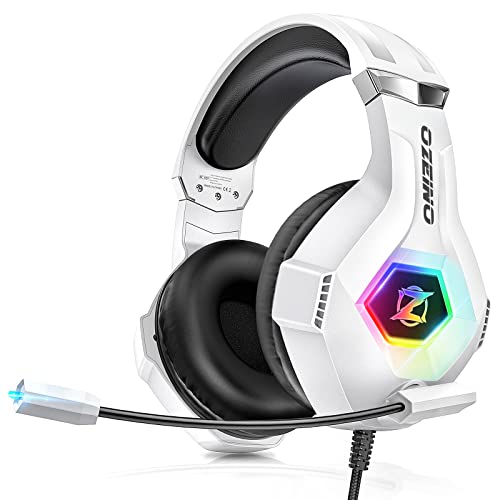
Ozeino Gaming Headset — Best for Young Players Who Want Lights
Ozeino sells the tier’s theatre: LED lighting, dramatic shell styling, 7.1 surround language and noise-cancelling microphone claims, all wrapped around a big padded headset that connects across PC, PlayStation and Xbox. In this guide’s framing the claims have already been translated — the surround is virtual and basic, the microphone is a standard budget capsule with intentions — and what survives translation is a cheerful, inexpensive headset whose real specification is the smile it produces on a young player who wanted their gear to look like the streamers’ gear. That is not a trivial specification. Enthusiasm is the fuel of the hobby, and this headset is very good at enthusiasm.
The adult calculus runs alongside. As a first headset for a child or teenager, the Ozeino’s compromises are well aimed: the fit is big and forgiving, the sound is loud and bass-forward in the way young ears request, and the price forgives the handling that learning involves. As a primary headset for an adult team player, the same compromises misfire — the microphone will make you the squad’s quietest citizen and the tuning will smear the detail competitive games reward. This guide places it fifth not because it fails its audience but because its audience is specific. Buy it for the player it was designed for, and it is one of the tier’s happiest purchases.
Parents evaluating it should know the practical shape of ownership: the headset is large, so on smaller heads the fit runs loose until the band is fully shortened, and the cable is long enough to need routing out of a chair’s way in a bedroom setup. The lighting, where the platform can power it, is the feature young owners show their friends; where it cannot, the headset simply looks like a bold-styled budget model, which it is. Neither fact diminishes the purchase for its intended audience, but both belong in the decision — this is a guide that believes the floor tier deserves the same honest footnotes as the flagship tier, because the money being spent is no less real for being less.
- Headline claims: virtual surround positioning, a noise-cancelling microphone brief, LED light show
- Compatibility as listed: PC, PS4, PS5 and Xbox families
- Shape: generously padded over-ear cups on a forgiving band
- Bought most often for: younger players and first headsets
Strengths
- The styling and lighting young players actually ask for, at a forgiving price.
- Works across every platform a household is likely to own.
- Big padded fit that tolerates a wide range of head sizes and rough handling.
Trade-offs
- Listing claims outrun the hardware in surround and microphone terms.
- Voice clarity is the weakest here alongside the BENGOO.
- Tuning favours impact over the detail that competitive play rewards.
Best for: first headsets for younger players and buyers who value the look as part of the gift. Not suited for: adult team players choosing a primary headset.
EKSA E900 — Best Prose-Only Wildcard
EKSA occupies the generic tier’s most interesting position: the brand that buyers name when they ask whether a non-brand headset can be a primary purchase rather than a spare. The E900 is its long-running answer, a wired over-ear design that has been sold in several revisions with detachable-microphone arrangements in some versions and a general brief aimed squarely at the Recon class rather than at the lighting crowd. Owners cross-shop it against Turtle Beach more than against BENGOO, which tells you where EKSA pitches its quality claims and where its prices sit within the tier.
It is covered in prose because its listings rotate — versions come and go, and the details that matter, from the microphone arrangement to the included cables, are exactly the ones that change between revisions. If you shop it, shop the current listing like a contract: confirm the microphone is detachable if that feature drew you, confirm the splitter cable is in the box if your PC needs one, and confirm the platform list covers your console. Verified that way, the E900 is the generic most likely to satisfy a buyer who wanted a brand headset and negotiated themselves down. Unverified, it is a lottery ticket in a category where the safe brand answer costs little more — which is precisely why this guide gives it a seat but not a link.
One more consideration separates EKSA from its generic neighbours: intent you can hear. The E900’s tuning, in its better-known revisions, aims for a balanced presentation rather than the bass-forward thump the floor tier defaults to, which suits the dialogue-and-footsteps reality of most games and ages better across a mixed library of play, film and music. If the revision you are examining describes itself in those terms and the detachable microphone is present, you are very likely looking at the version that built the model’s reputation. If the listing leads with lights and adjectives instead, you are looking at the costume, and the Recons are the safer money that week.
- Positioning: wired over-ear gaming headset aimed at the brand tier
- Microphone: detachable on some revisions — verify on the current listing
- Availability: listings rotate by version; covered prose-only for that reason
- Role: the generic most often compared directly with Turtle Beach
Strengths
- A quality brief aimed at primary-headset duty rather than spare duty.
- Detachable-microphone versions offer flexibility the Recons do not.
- Frequently the strongest generic value when a good revision is in stock.
Trade-offs
- Version drift makes the buyer’s verification homework unavoidable.
- Support and longevity still trail the established console brands.
- When its price creeps toward the Recons, the safe answer usually wins.
Best for: patient shoppers who will verify the current revision and want generic pricing with brand ambitions. Not suited for: buyers who want a known quantity delivered without homework.
How Do the Six Stack Up Against Each Other?
| Headset | Nation | Microphone story | Defining trait |
|---|---|---|---|
| Turtle Beach Recon 70 | Brand | Flip-to-mute, reliable and clear enough | The tier’s anchor |
| Turtle Beach Recon Spark | Brand | Flip-to-mute, same family discipline | The colourful Recon |
| NUBWO HG04L | Generic | Unidirectional, the generic class’s best brief | The serious contender |
| BENGOO G9000 | Generic | Basic boom, functional capture | The household spare |
| Ozeino Gaming Headset | Generic | Budget capsule under big claims | The theatre pick for young players |
| EKSA E900 | Generic | Detachable on some revisions | The wildcard with brand ambitions |
The pattern to carry away: the brand nation’s advantage is not any single specification but the distribution of outcomes — a Recon is a known quantity before the box opens. The generic nation’s advantage is price and, in NUBWO’s and EKSA’s cases, specifications chosen with real intelligence. Your own tolerance for variance is the tiebreaker, and it is a legitimate one: some households would rather save the difference and accept the lottery, others would rather never think about the purchase again.
How Do You Set Up a Budget Headset for Clear Team Voice?
Ten minutes of setup repays itself every session. On console, plug into the controller, then open the audio settings and balance game and chat so voices sit clearly above effects — most players run chat louder than instinct suggests, because callouts matter more than ambience. Set the microphone monitoring, if your platform offers it, to the lowest level that lets you hear yourself; sidetone stops you shouting without realising. On PC, choose the headset explicitly in both the system and the chat application, enable the application’s noise suppression, and record a test sentence at match volume to set the input level below distortion.
Then handle the physical side. Position the boom near the corner of your mouth, route the cable so it cannot be run over by your own chair — the leading cause of death in this tier — and if your PC needed a splitter, label it and keep it with the headset rather than in a drawer of anonymous cables. Finally, agree the mute discipline with your squad: flip-to-mute owners have the easiest version of this, but every headset here can be muted in software, and a team that knows everyone’s gesture argues less about who left a microphone open. None of this costs money. All of it is audible.
One more setting hides in plain sight: your own monitoring level. Players who cannot hear themselves tend to shout, fatigue their voices and blame the microphone, while a touch of sidetone — the console and PC chat settings both offer versions of it — keeps your voice at conversation level all evening. Budget microphones distort sooner than premium ones when driven hard, so the quieter, better-placed voice is not merely politer; on this tier’s capsules it is measurably clearer. Set the sidetone once, and every pick in this guide sounds a small class better than its price.
What Mistakes Do Buyers in This Tier Make?
The headline mistake is shopping the badges: choosing by surround claims, driver diameters and lighting over the microphone and fit that decide daily satisfaction. The second is platform blindness — discovering at unboxing that a desktop PC needs a splitter the box did not include, or that a lighting USB plug has nowhere useful to go on a console setup. The third is buying a primary headset with a spare’s budget logic, or a spare with a primary’s: the tier rewards matching the purchase to the role, because its products are honestly specialised by price in a way the tiers above can afford not to be.
Expectation errors complete the set. Buyers who arrive from a premium headset judge this tier’s microphones and materials as failures rather than as the terms of the class, and buyers who arrive from earbuds judge everything here as miraculous and stop reading settings menus that would double their voice clarity. Both would be better served by the same habit: judge the headset against its tier-mates and its job, run the ten-minute setup, and let it be what it is. At this level, that discipline is worth more than the difference between any two picks in this guide.
And a word against the opposite sin: over-researching the tier. These are honest, inexpensive tools, and the difference between the second-best and fifth-best pick here is smaller than the difference a good night’s familiarity with any one of them makes. A buyer who has read this far already knows the shape of the right answer — brand for certainty, NUBWO or EKSA for value with verification, the decorated pair for spares and starters. Choose the row that matches the role, run the setup ritual, and go and play. The tier’s final lesson is that at this price, decisiveness is a feature too, and the headset you are wearing beats the perfect one still open in a browser tab.
How Long Do Budget Headsets Really Last — and How Do You Extend It?
Honest lifespan talk, because this tier’s prices tempt buyers to treat headsets as disposable, which most are not. The failure order is remarkably consistent across brands and generics alike: the cable fails first, usually at the plug or where it exits the earcup, from being run over, yanked and wrapped; the cushions fail second, their coverings cracking after a year or two of skin oils and summer; the headband’s adjustment mechanism loosens third. The drivers themselves almost never die. A headset in this tier is therefore best understood as a sound engine with two consumable attachments, and its lifespan is decided by how the attachments are treated.
The care that matters is boring and total. Unplug by gripping the plug, never by hauling the cable. Store the headset on a hook or stand rather than on the chair it will be sat on. Wipe cushions with a barely damp cloth monthly, and keep the coiled cable’s route clear of the chair’s patrol area — or, simpler, route it behind the desk once and let it live there. Owners who do these things routinely get three or more years from brand picks in this tier and double the expected life from generics. Owners who do not will be shopping again by Christmas regardless of which row of the table they chose, which is why this guide keeps insisting that in this class, behaviour outearns budget.
How Should You Test a New Budget Headset Inside the Return Window?
The return window is the tier’s fitting room, and most buyers waste it. Use it deliberately. On day one, wear the headset for your longest typical session, not a five-minute trial: pressure points announce themselves at hour two, and a fit that fails then will fail forever. Record your voice in your actual chat application, at match volume, with your actual keyboard being typed on, and listen to the playback as your teammates will hear it — thin is acceptable in this tier, unintelligible is a return. Play the busiest audio scene you own and check whether dialogue stays separable from effects; that single scene predicts your satisfaction better than any music test.
Then test the logistics. Mute and unmute twenty times in the dark. Plug the headset into every device it was bought for, including the awkward one — the desktop that might need the splitter, the older controller, the laptop with the recessed jack. Coil and uncoil the cable and look at how it wants to kink. A headset that passes this week of scrutiny will very likely serve its whole life without surprising you; a headset that fails any line of it goes back while returning is still a errand rather than a negotiation. Budget buying done this carefully stops being a lottery, which is the entire secret of the players who swear this tier is all anyone needs.
Headset or Headphones Plus a Separate Microphone?
Every buyer in this tier should hear the alternative once. The money that buys a gaming headset also buys a decent pair of plain headphones and leaves a remainder toward a basic separate microphone, and for PC-only players who value music as much as games, that split can sound better per unit of currency. What it gives up is integration: the headset’s single cable, controller-native chat, flip-to-mute gesture and a microphone that is always exactly where your mouth is. On console the split barely functions at all, since controllers expect a headset, which is why this tier’s products are shaped the way they are.
The honest verdict is contextual. A desk-bound PC player with hi-fi leanings should at least price the split before buying. Everyone else — console players, laptop players, anyone who moves between devices, anyone buying for a young player — is better served by the integrated object, because the convenience is not a luxury tax; it is the product. This guide’s six picks assume the integrated answer, and the tier’s sales history suggests most households, having considered both, agree.
A Translator for This Tier’s Listing Language
Budget listings speak a dialect, and fluency is worth money. “7.1 surround” translates to two drivers plus processing of variable quality — sometimes a dongle, sometimes nothing but the claim and your console’s own spatial audio doing the work. “Noise cancelling microphone” translates to a directional capsule and perhaps some shaping; it means your voice is favoured, not that your room is silenced, and it never means the earcups cancel noise for you — that technology does not exist at this level. “Hi-fi” and “pro” are weather, not climate: ignore them entirely. “Braided cable” is a genuine, if modest, virtue, since braiding resists the kinking that kills budget cables. “Memory foam” is worth having and worth verifying, because the term stretches from true viscoelastic foam to ordinary foam with ambitions.
Two translations matter most. “Compatible with” followed by a platform list means the audio will work; whether chat works identically on each platform depends on the connector and the platform’s own rules, so read for the microphone’s sake, not the sound’s. And “for PS5 controller” phrasing on older models signals a headset designed in the previous console generation that continues to work through the same 3.5mm jack — compatibility is real, but the listing has not been rewritten for your console, so its other details deserve a fresh check too. A buyer fluent in this dialect can read any listing in the tier in ninety seconds and know more than the listing intended to tell them.
Equipping a Whole Household: Does the Maths Change?
Singular advice bends when the purchase is plural — three headsets for three siblings, a fleet for a youth club, spares for a shared console room. Plural buying rewards the tier’s known quantities and punishes its lotteries, because variance multiplies: one disappointing generic is an anecdote, three are a pattern and a returns queue. Households equipping several players at once usually do best standardising on the Recon 70 or Spark, accepting the modest premium per unit as the price of uniformity — every player gets the same fit, the same mute gesture, the same known microphone, and any headset can substitute for any other when one is inevitably mislaid.
The exception is the deliberately mixed fleet: a brand headset for the player who games socially every night, generics for the occasional players and the guest drawer. That mix spends the budget where hours accumulate and saves it where they do not, and it is how many experienced households actually solve the problem. Either way, buy the fleet in one decision rather than accreting it by accident; a household that plans its headsets owns a system, while a household that accumulates them owns a drawer of almost-compatible cables and one working microphone.
Why Is There No Wireless Pick in This Tier?
An honest absence deserves an explanation. Wireless headsets exist at the edges of this budget, but they spend the tier’s limited money on a radio, a battery and the electronics to run both, and the bill is paid by the drivers and the microphone — the two components this guide has ranked above all others. The result is a headset that is worse at being a headset in exchange for being free of a cable, and at this level that trade fails most players. The cable, meanwhile, brings gifts the listings never advertise: zero latency by physics rather than by engineering, no charging discipline, no battery ageing across the headset’s life, and one less thing to pair, update or troubleshoot before a match.
Buyers who know wireless is non-negotiable for their setup — a living-room console across the room, a player who paces — should treat that requirement as a reason to change tiers, not to compromise within this one; the affordable wireless class has its own guide on this site, built around the models where the radio stops eating the headset. Everyone else should take the hint the market is giving: at this budget, the industry’s best work is wired, and the picks above are that work.
Final Recommendation
Buy the Turtle Beach Recon 70 if you want this tier’s decision made for you, correctly: it is the headset with no surprises in either direction, and its flip-to-mute microphone is the single feature owners praise longest. Take the Recon Spark when the same discipline should come in a brighter finish. Take the NUBWO HG04L when you want the generic tier’s best argument — a thoughtful microphone and an easy fit — and the EKSA E900 when you find its current revision verified and priced kindly. Keep the BENGOO and the Ozeino for the roles they were born into, spares and starters and young players’ first theatre, and they will never disappoint you. The fifty-dollar frame does not buy excellence, and this guide has not pretended otherwise; what it buys, chosen with open eyes, is everything a game actually needs — your friends audible, your voice intelligible, your head comfortable — and for a great many players that is not a compromise at all, it is simply the best 50 dollar gaming headsets doing the job they were priced to do — tonight, with the squad, without a second thought about the money, which is the most underrated specification in this entire tier and the one these six headsets, each in its own way, were built to deliver.
Frequently Asked Questions
Are the surround sound claims on these headsets real?
The headsets have two drivers each, so the surround is virtual processing — from the console, the PC or bundled software — rather than physical speakers around your head. Virtual processing can genuinely help with direction in games, but the badge itself is marketing; judge these headsets on microphone, fit and basic sound instead.
Which is better for a child or teenager?
For a younger player’s primary headset, the Recon Spark combines brand durability with a finish young players choose willingly. For a first headset where the hobby itself is on trial, the Ozeino or BENGOO answer at a price that forgives every outcome, including the headset being outgrown or out-handled.
Do I need a splitter cable for PC?
Only if your PC has separate headphone and microphone sockets, which many desktops do. Laptops and controllers with a single combined jack work directly. Check your machine, then check the listing’s box contents, because inclusion varies across this tier — and if a splitter is missing, it is a small, standard accessory rather than a reason to return an otherwise suitable headset.
How big is the microphone gap between the brands and the generics here?
Noticeable but not disabling. The Recon microphones deliver a fuller, more reliable voice; the generics — NUBWO least of all — deliver an intelligible one. In a regular squad the difference is audible every session; in casual or solo play it may never matter, which is why the guide ranks by role rather than by a single score. PC players can narrow the gap further with their chat application’s noise suppression and careful gain setting, which lift a budget capsule noticeably — console players have less processing at their disposal, and for them the brand microphones’ advantage is closest to its full width.
Can these headsets be used for school or work calls?
Yes — they are ordinary wired headsets to a computer, and their microphones are entirely adequate for lessons and meetings; indeed, a boom microphone at mouth distance outperforms the built-in microphone of most laptops by a margin teachers and managers notice immediately. The gaming styling is the only consideration, and the Recon Spark’s lighter design or a microphone-free moment on camera solves most of it. Households that bought one of these for a console often find it quietly becomes the family’s call headset as well, which is another way this tier earns its keep beyond the games it was bought for.
Is a headset in this tier a false economy if I play every day?
For a daily team player, it can be: the microphone and materials gaps are felt every session, and the class above exists precisely for that user. For a daily solo player, or a social player a few evenings a week, the tier is no economy at all, false or otherwise — it is the correct spend. The deciding question is not how often you play but how much of your play is voice, because voice is where the money above this tier goes first.
How long will a headset in this tier last?
With kind handling, the brand picks serve for years; the generics should be bought with a shorter, cheerful horizon. In all cases the cable is the weak point — route it away from chair wheels and never wrap it tightly around the headset, and you will outlast the tier’s average by a wide margin. Cushions are the second clock: expect their coverings to show age before anything else does, and treat that as cosmetic unless the seal itself goes, at which point bass and isolation fade together and the headset is telling you its service is nearly done.
Related Guides
Step up or sideways with best 100 dollar headsets to see what the next tier adds, best affordable gaming headsets pc for the PC-specific shortlist, and best affordable wireless gaming headsets for the cable-free version of this budget conversation. If the same build also needs a card that runs from the slot alone, the best 75 watt graphics cards solve the power question. Commuters in the same reader group will want the best active noise cancelling headsets for the noisy half of the day.



[…] where boom microphones rule a different shelf. If your indoor listening deserves equal attention, our active noise cancelling headset guide covers the opposite philosophy — sealing the world out — and our look at gaming headsets with […]