What's inside
- Key Takeaways
- Quick Picks: Gaming Mice at a Glance
- How Did We Choose Six Mice From Hundreds?
- Why Does Grip Style Decide Everything?
- Does Sensor DPI Actually Matter When You Shop?
- The Six Gaming Mice, Reviewed in Detail
- How Do Switches, Wheels and Cables Change the Feel?
- Which Mouse Here Suits Which Kind of Player?
- How Do the Six Compare Side by Side?
- Can the Right Mouse Ease Hand and Wrist Strain?
- How Should You Test a Mouse During Its First Week?
- How Do You Dial In a New Gaming Mouse?
- Wired or Wireless: Which Should You Choose in Practice?
- What Mistakes Do Gaming Mouse Buyers Make Most Often?
- Does Your Monitor and Game Choice Change the Answer?
- How Long Will a Good Gaming Mouse Last You?
- What About Grip Tape, Replacement Feet and Other Small Upgrades?
- What Makes a Good First Gaming Mouse for a Younger Player?
- Can These Mice Serve Console and Cloud Players Too?
- Why Is There No Dedicated MMO Mouse in This Six?
- How Do the Software Ecosystems Compare?
- How Should You Read Other Reviews and Marketing Claims?
- What Should You Spend, and Where Does Extra Money Stop Helping?
- Final Recommendation
- Frequently Asked Questions
- Related Guides
As an Amazon Associate I earn from qualifying purchases. This post may contain affiliate links at no extra cost to you.
gizmoverdict.com is reader-supported. When you buy through links on our site, we may earn an affiliate commission.
Where to buy: each mouse below links out to its Amazon listing, so you can confirm the colourway, the cable or receiver included and the exact model variant before ordering; treat the listing as the place to check price on Amazon on the day you buy.
Ask a room of players to name the best gaming mouse and you will start an argument that outlives the evening, because the honest answer depends on the hand, the games and the grip of the person asking. What this guide can do is narrower and more useful: it gathers the six mice that dominate real desks right now, sorts them by the job each one does best, and explains the trade-offs in plain language. Two are esports instruments built to vanish under your fingers. Two are ergonomic shapes that cradle a palm through long campaigns. Two are the value legends that refuse to be replaced because they keep doing everything well for sensible money.
One warning before the picks. Gaming mice are marketed with enormous sensor numbers, and those numbers stopped mattering years ago. Every sensor in this guide tracks more accurately than a human hand can move, so the differences that decide your results are shape, weight, switch feel and whether the mouse disappears from your attention during play. Read for those qualities, skim the headline figures, and you will choose better than most buyers who shop by the biggest number on the box.
Key Takeaways
- Shape beats specifications: the mouse that fits your grip style will outperform a technically superior mouse that fights your hand.
- The two esports picks here weigh barely more than a tennis ball and exist for players whose aim style is all wrist and fingertip.
- Ergonomic mice trade a little flick speed for hours of palm comfort, which matters more than aim theory in long single-player sessions.
- Wireless performance at this level equals wired, so choose your connection by desk habits and charging tolerance, not by latency fear.
- The value picks are not consolation prizes; one of them has been a best-seller for years because its shape suits an enormous range of hands.
Quick Picks: Gaming Mice at a Glance
| Pick | Badge | Why it made the cut |
|---|---|---|
| Logitech G Pro X Superlight 2 Lightspeed Wireless Gaming Mouse | Esports benchmark | The shape professional players reach for when prize money is involved, refined with hybrid switches and a flagship sensor. |
| Razer Viper V3 Pro Wireless Esports Gaming Mouse | Featherweight flagship | At 54 grams it is the lightest serious wireless mouse here, built with direct input from competitive players. |
| Razer DeathAdder V3 Wired Gaming Mouse | Ergonomic speed | The beloved DeathAdder curve, stripped down to 59 grams and wired for players who palm their mouse and never charge anything. |
| Logitech G502 HERO Wired Gaming Mouse | Feature-packed classic | Eleven buttons, adjustable weights and a dual-mode scroll wheel on the most recognisable gaming mouse ever sold. |
| Razer Basilisk V3 Customizable RGB Wired Gaming Mouse | Comfort plus spectacle | An ergonomic shell with a tilting scroll wheel, rich lighting and enough buttons for hybrid gaming and working days. |
| Logitech G305 LIGHTSPEED Wireless Gaming Mouse | Value wireless champion | Reliable LIGHTSPEED wireless and marathon battery life in a compact shell that costs a fraction of the flagships. |
How Did We Choose Six Mice From Hundreds?
We began with the games people actually play rather than the mice companies most want to sell. Esports shooters demand light weight and a safe shape. Story-driven and strategy games demand comfort across three-hour evenings and enough buttons for inventories and abilities. MMO players demand many more buttons than that. Any final six that ignored one of those worlds would be a list for a narrower audience than this guide serves, so the selection deliberately spans three families: ultralight esports mice, ergonomic all-rounders and value designs with proven staying power.
The second filter was longevity of reputation. A gaming mouse is a tool you may use daily for years, and models that have survived multiple hardware generations have done so because their shapes work for thousands of different hands. Every pick here is either a current flagship with tournament presence or a design whose sales history amounts to a public referendum it keeps winning. Newcomers with exciting renders and no track record were left out, not from conservatism but because switches, coatings and cables reveal their quality over time, and time is the one test a launch review cannot fake.
Third came the honesty check on specifications. We recorded each sensor’s ceiling only to confirm it clears the bar of flawless tracking, then set the numbers aside. What we weighed instead: switch type and feel, whether the scroll wheel suits the games in question, cable quality on wired models, battery behaviour on wireless ones, and the maturity of each brand’s software. A mouse whose app crashes or whose settings vanish on a new PC will annoy you monthly; the six below come from ecosystems with those problems largely solved.
Why Does Grip Style Decide Everything?
Palm grip players rest their whole hand on the mouse and steer with the arm and wrist together. They need a shell tall and long enough to support that contact, which is why the ergonomic picks exist and why a 54-gram esports sliver can feel like holding a secret for them. Claw grip players arch their fingers and contact the mouse at fingertips and rear palm, gaining quick vertical control; they adapt to most shapes but suffer on shells too long for their knuckles to arch over. Fingertip players touch only with their fingers, steering in tiny corrections, and they are the natural constituency of the ultralight symmetrical designs.
None of these styles is superior, and most players blend two of them depending on the game. The mistake is buying against your blend. A palm player who buys an ultralight because a professional uses one will spend months wondering why their aim feels nervous; a fingertip player who buys a heavy ergonomic flagship will feel like they are steering furniture. If you do not know your grip, watch your hand during an ordinary match rather than posing it now: the truth is in the habit, not the intention.
Hand size interacts with grip in ways spec sheets flatten. Length from middle fingertip to wrist, and width across the knuckles, together decide which shells let your fingers land on the buttons without stretching. Medium hands are the industry’s default audience and can use nearly everything here. Small hands should look hardest at the G305 and the Viper V3 Pro. Large hands will find their home in the DeathAdder V3, the G502 HERO and the Basilisk V3, whose shells were drawn generously from the first sketch.
Does Sensor DPI Actually Matter When You Shop?
Mostly no, and understanding why will save you money. DPI describes how far the cursor travels for each inch the mouse moves. Players compete at settings in the hundreds or low thousands because control lives there; the tens of thousands advertised on boxes are headroom nobody uses, like a family car speedometer marked far beyond any road. What matters is that the sensor tracks without acceleration, smoothing or jitter at your chosen setting, and every sensor in this guide, from the G305’s HERO to the Viper’s flagship unit, passes that test with room to spare.
Where sensors genuinely differ today is in the extras: performance on glass or unusual surfaces, behaviour at very high polling rates, and efficiency that stretches battery life. Those are refinements, not revolutions. If two mice fit your hand equally, sensor generation can break the tie. If one fits and the other does not, no sensor ever made will close that gap, because your hand touches the shell thousands of times a day and consults the spec sheet never.
The Six Gaming Mice, Reviewed in Detail

Logitech G Pro X Superlight 2 Lightspeed Wireless Gaming Mouse — Esports benchmark
There is a reason so many professional players, free to use anything, end up holding this shape. The Superlight 2 keeps the safe, medium symmetrical shell of its predecessor and refines everything underneath: LIGHTFORCE hybrid switches that pair optical speed with a mechanical feel, the HERO 2 sensor tracking at up to 32,000 DPI, and LIGHTSPEED wireless with high polling support for players who chase the smoothest possible cursor path. Five programmable buttons keep the layout honest and focused; this is a mouse that does fewer things than the G502 and does its chosen things superbly.
The playing experience is defined by absence. Absence of cable drag, absence of weight calling attention to itself, absence of edges digging into fingers during a fourth hour of practice. The hybrid switches deserve their praise, delivering a decisive click that feels mechanical while actuating at optical speed, and the battery endurance stretches across many days of heavy use between charges. Players coming from heavier mice often need a week to recalibrate their stopping distance, because the Superlight keeps travelling where a heavier mouse would have settled. After that week, most do not go back.
- Connection: LIGHTSPEED 2.4GHz wireless
- Sensor: HERO 2, up to 32,000 DPI
- Switches: LIGHTFORCE hybrid optical-mechanical
- Buttons: five programmable
- Shell: medium symmetrical, ultralight class
Strengths
- A competition-proven shape that offends almost no hand or grip style.
- Hybrid switches combine a satisfying mechanical break with optical consistency.
- Wireless performance and battery life that remove every practical cable argument.
Trade-offs
- Only five buttons, which MMO and heavy macro players will find limiting.
- The minimalist shell offers palm players less support than ergonomic rivals.
- It sits at flagship pricing territory as a category, reflecting its tournament brief.
Best for: competitive shooter players and anyone who wants the reference ultralight wireless experience. Not suited for: button-hungry MMO players or strict palm grippers wanting a tall sculpted shell.

Razer Viper V3 Pro Wireless Esports Gaming Mouse — Featherweight flagship
Razer’s answer to the same tournament brief weighs 54 grams, and holding it for the first time is a small shock: a full-size wireless esports mouse that feels closer to a prop than a peripheral. The Focus Pro sensor reaches 35,000 DPI, a figure we mention once and dismiss, because the real story is tracking consistency married to that vanishing weight. Eight programmable controls give a little more binding room than Logitech’s five, and the third-generation optical switches actuate with a clean, hollow snap that suits rapid tapping.
Razer developed this shape with professional feedback, and it shows in the details: slightly raised main buttons that welcome claw fingers, smooth flanks without rubberised panels to peel, and a centred balance that keeps the mouse honest during lift-and-reset sweeps. Battery life is quoted in the region of a long working week of play, and the mouse supports very high polling for players equipped to use it. If the Superlight 2 is the establishment choice, the Viper V3 Pro is the insurgent that wins converts one scrim at a time, especially among fingertip players who count every gram.
- Connection: HyperSpeed 2.4GHz wireless
- Weight: 54 grams
- Sensor: optical, up to 35,000 DPI
- Switches: optical, third generation
- Controls: eight programmable
Strengths
- The lightest wireless flagship here, and it feels like it in every flick.
- Optical switches with a crisp response and no double-click degradation path.
- A shape refined with pro input that claw and fingertip players adopt instantly.
Trade-offs
- The smooth shell gives sweaty hands less purchase than textured rivals.
- Flagship-tier positioning, priced by its category rather than by its materials.
- Palm players may find the low profile leaves their hand under-supported.
Best for: fingertip and claw players chasing the lightest credible wireless mouse. Not suited for: players who want RGB, many buttons or a filled-out palm shape.

Razer DeathAdder V3 Wired Gaming Mouse — Ergonomic speed
The DeathAdder name has been on desks for well over a decade, and the V3 is its most disciplined incarnation: the famous ergonomic curve, lightened to 59 grams, wired, and stripped of everything that does not make it faster. The Focus Pro 30K sensor and third-generation optical switches come across from Razer’s flagships, and the wired connection supports an 8KHz polling rate for players whose systems and games can exploit it. Where the esports symmetrical mice feel neutral, the DeathAdder feels opinionated, cupping a right palm with a confidence that either suits you completely or not at all.
That opinion is its glory. Palm and relaxed claw players can rest into the shape and aim with the whole arm, spreading effort across larger muscles and longer sessions. The flared main buttons keep fingers located without looking, and the light body means the ergonomic comfort no longer costs the agility penalty that older DeathAdders carried. It is wired only, which will divide readers: those who see a cable as reliability will love it, and those who have tasted wireless freedom will not return for any shape. For the first group, this may be the single best mouse in the guide.
- Connection: wired USB, high polling supported
- Weight: 59 grams
- Sensor: Focus Pro optical, 30,000 DPI class
- Switches: optical, third generation
- Shell: right-handed ergonomic
Strengths
- An iconic ergonomic shape made genuinely light for the first time in its line.
- Flagship sensor and switches with a cable that never needs charging.
- Suits arm-aiming palm players better than any symmetrical pick here.
Trade-offs
- Right-handed only, with no mirrored variant for left-handed players.
- The cable, however light, still drags compared with the wireless flagships.
- Six-button layout is modest for players who bind heavily.
Best for: right-handed palm and claw players wanting ergonomic comfort at esports weight. Not suited for: left-handers, fingertip specialists or cable refuseniks.

Logitech G502 HERO Wired Gaming Mouse — Feature-packed classic
If the esports mice are racing bicycles, the G502 HERO is the beloved pickup truck: heavier, covered in controls, and owned by millions who would not swap it for anything. The HERO sensor tracks up to 25,600 DPI, eleven programmable buttons cover every binding a non-MMO player could want, and the dual-mode scroll wheel clicks through weapon selections or free-spins through long documents with a press of its toggle. Adjustable weights in the base let owners tune the heft and balance, an increasingly rare courtesy in an industry racing toward lightness.
Time has not dulled its appeal because the shape solves a real problem: long sessions across mixed use. The sculpted right-hand shell, thumb rest and sniper button suit players who game, edit, browse and work at the same desk and want one mouse fluent in all of it. The honest costs are weight and complexity. Competitive fingertip players will find it sluggish next to the Viper, and its many edges collect grime that smooth shells shrug off. Yet as a single-mouse household answer, especially for larger hands, the G502 HERO remains the default against which all-rounders are measured.
- Connection: wired USB
- Sensor: HERO, up to 25,600 DPI
- Buttons: eleven programmable
- Extras: adjustable weights, dual-mode scroll wheel, RGB
- Shell: large right-handed ergonomic
Strengths
- The most versatile button and wheel arrangement in this guide.
- Adjustable weight lets owners personalise balance instead of accepting ours.
- A proven shape for large hands across gaming and productivity alike.
Trade-offs
- Heavy by modern esports standards, and fingertip players will feel it.
- The busy shell has crevices that need occasional cleaning.
- Wired only, in a guide where wireless has largely won the argument.
Best for: all-rounders, larger hands and players who bind many actions to the mouse. Not suited for: ultralight seekers or competitive fingertip specialists.
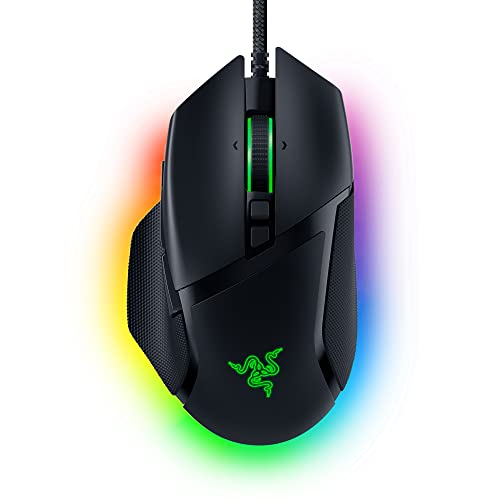
Razer Basilisk V3 Customizable RGB Wired Gaming Mouse — Comfort plus spectacle
The Basilisk V3 is Razer’s ergonomic crowd-pleaser, the mouse for players who want their comfort with a light show attached. Its right-handed shell carries eleven programmable buttons, a thumb paddle, and the cleverest wheel in this guide: a four-way tilt wheel whose resistance can shift between tactile steps and free spin, even switching automatically when you flick it hard. The optical sensor reaches 26,000 DPI, the switches are fast optical units, and the RGB underglow turns a desk into a small stage for those who enjoy that theatre.
Beneath the spectacle sits a genuinely thoughtful all-rounder. The shape supports palm and claw grips through long sessions, the textured sides keep their grip when hands warm up, and Razer’s software offers deep per-game profiles including a secondary function layer that effectively doubles the button count. Shooter purists will note the weight and the cable and move on; everyone else gets a mouse that handles a workday, a raid night and a spreadsheet with equal fluency. It is the extrovert of this line-up, and it backs the personality with substance.
- Connection: wired USB
- Sensor: optical, up to 26,000 DPI
- Buttons: eleven programmable, plus thumb paddle
- Wheel: four-way tilt, switchable resistance, smart free-spin
- Lighting: full Chroma RGB with underglow
Strengths
- The smart scroll wheel genuinely changes how long pages and weapon swaps feel.
- Ergonomic comfort with the deepest customisation software in this guide.
- Optical switches and a strong sensor keep its gaming credentials honest.
Trade-offs
- Heavier and busier than the esports picks, by deliberate design.
- Right-handed shell only, like most ergonomic designs.
- The lighting and features ask for Razer’s software to shine fully.
Best for: right-handed all-rounders who want comfort, buttons and personality in one mouse. Not suited for: minimalists, left-handers or ultralight competitors.

Logitech G305 LIGHTSPEED Wireless Gaming Mouse — Value wireless champion
Every category has a product that embarrasses the price ladder, and in gaming mice it is the G305. Logitech’s HERO sensor delivers accurate, efficient tracking, the LIGHTSPEED connection is the same wireless technology trusted further up the range, and a single AA battery can power months of ordinary play, with endurance quoted up to 250 hours. The compact symmetrical shell suits smaller hands and travel bags, and six programmable buttons cover the essentials without theatre. It has been the thinking player’s budget answer for years because almost nothing about it feels budget in the hand.
The compromises are visible and acceptable. The shell is small for large palm-grip hands, the switches are conventional rather than optical or hybrid, and there is no rechargeable cell, which some players count as a flaw and others, eyeing a drawer of AA batteries, count as freedom. In the context of this guide its role is clear: it is the mouse we recommend to new players, laptop gamers and anyone whose money is better spent on games than on peripherals. It will not win a spec-sheet duel with the Viper V3 Pro. It will win evenings.
- Connection: LIGHTSPEED 2.4GHz wireless
- Sensor: HERO, up to 12,000 DPI
- Battery: one AA, up to 250 hours
- Buttons: six programmable
- Shell: compact symmetrical
Strengths
- Wireless reliability and battery life that embarrass far pricier mice.
- A safe compact shape that suits students, travellers and smaller hands.
- Replaceable battery means no ageing internal cell to plan around.
Trade-offs
- Large hands in palm grip will find the shell cramped.
- No Bluetooth and no rechargeable battery for those who insist on either.
- Conventional switches lack the longevity edge of optical designs.
Best for: value hunters, laptop players and newcomers who want real wireless without flagship money. Not suited for: large-handed palm players or tournament specialists.
How Do Switches, Wheels and Cables Change the Feel?
The click is the sound of your gaming life, hundreds of thousands of repetitions a year, so switch character deserves more respect than it gets. Mechanical switches offer a familiar springy break and can, over years, develop inconsistent actuation. Optical switches register with light instead of metal contact, which removes that wear path and shaves the response to near-instant; their feel is crisper and sometimes hollower, which players either love or tolerate. Hybrid designs, as in the Superlight 2, try to keep the mechanical sensation while triggering optically, and in practice they land pleasingly close to that promise. None of this decides a match by itself, yet a click you enjoy is a small pleasure repeated so often that it becomes a large one.
Scroll wheels divide into philosophies. The stepped wheel gives each weapon or item a physical notch you can count without looking, which competitive players prize. The free-spinning wheel flies through documents, inventories and web pages, and the cleverest designs in this guide switch between the two personalities, one of them automatically when it senses a hard flick. Tilt inputs add horizontal scrolling that strategy players and video editors quietly adore. When you test a mouse, scroll through a long page and a weapon wheel in a game you know; five minutes of that tells you more than any review paragraph, including this one.
Cables, where they exist, have improved beyond recognition. The stiff braided cords of a decade ago have given way to soft, light leads that behave almost like no cable at all, especially paired with a bungee that holds the slack off the desk. Even so, a cable remains a cable: it has a direction it prefers and a corner of the desk it migrates toward. The wired picks here use the modern soft kind, and players at a fixed desk will rarely be annoyed. Players who rearrange, travel or share the mouse between machines will feel the wireless advantage daily, which is why three of our six picks cut the cord.
Which Mouse Here Suits Which Kind of Player?
Picture four evenings. In the first, a ranked shooter player warms up in an aim trainer, then queues with friends who take the ladder seriously. Her mouse must vanish: Superlight 2 or Viper V3 Pro, chosen by whether her grip is claw or fingertip and whether she prefers Logitech’s hybrid click or Razer’s optical snap. In the second evening, a father of two finally gets ninety minutes inside a sprawling role-playing game after bedtime. Comfort across that session and buttons for potions matter more than grams, and the DeathAdder V3 or Basilisk V3 will treat him better than any esports sliver could.
The third evening belongs to a student whose laptop is classroom, cinema and arcade in one. Her mouse rides in a backpack, pairs through a single receiver, and must survive being forgotten in a library. The G305 was born for that life, with its replaceable battery and shrug-it-off build. The fourth evening is a mixed household desk where a parent answers email, a teenager plays builders and battlers, and everyone shares one wired mouse that simply always works: that is the G502 HERO’s natural habitat, weights in, wheel clicking, outliving the games installed around it. Naming your evening honestly is the fastest shortcut through this entire guide.
How Do the Six Compare Side by Side?
| Mouse | Connection | Shape family | Character |
|---|---|---|---|
| Logitech G Pro X Superlight 2 | Wireless | Symmetrical medium | The tournament reference |
| Razer Viper V3 Pro | Wireless | Symmetrical medium | The lightest flagship |
| Razer DeathAdder V3 | Wired | Ergonomic | Palm comfort at speed |
| Logitech G502 HERO | Wired | Ergonomic large | Buttons and versatility |
| Razer Basilisk V3 | Wired | Ergonomic | Features and flair |
| Logitech G305 | Wireless | Symmetrical compact | Value without apology |
The table exposes the guide’s real structure: two mice compete for the esports crown, three serve right-handed comfort at different weights of feature load, and one proves that wireless gaming need not be expensive. Decide which row describes your evenings and the shortlist writes itself.
Can the Right Mouse Ease Hand and Wrist Strain?
A mouse cannot fix a bad desk, but the wrong mouse can absolutely worsen one. Strain usually announces itself as an ache along the forearm, tingling fingers or a shoulder that climbs toward your ear during play. Shape is the first lever: a shell that supports your natural grip lets the hand rest instead of hover, and hovering is silent exercise repeated for hours. Weight is the second lever, since a lighter mouse asks less of the small muscles that steer it, which is an underappreciated reason the ultralight trend helps more than aim. The third lever is not the mouse at all: pad position, chair height and breaks every hour matter more than any product in this guide, and any pain that persists deserves a professional’s opinion rather than a reviewer’s.
Players who already feel discomfort often do well with the ergonomic picks here, because the DeathAdder and Basilisk shapes rotate the hand into a more natural handshake-adjacent posture than a flat symmetrical shell. Others alternate between two mice across a week, changing the posture before it becomes a grievance. Treat comfort data from your own body as seriously as any benchmark: a mouse that scores perfectly and hurts is, for you, a bad mouse.
How Should You Test a Mouse During Its First Week?
Give the mouse a curriculum rather than a vibe. Day one belongs to setup: software installed, acceleration off, one sensitivity chosen and written down. Days two and three belong to low-stakes volume, cooperative games and aim trainers, where the new shape can teach your hand without ranked anxiety colouring the lesson. By day four, test the specific actions your main game demands under pressure: the wheel swaps, the side-button reach at full stretch, the lift-and-reset during a wide turn. Note clicks that feel tiring, edges that announce themselves and any moment you became aware of the mouse at all, because awareness is the symptom this category exists to eliminate.
Judge at day seven, not day one. Nearly every shape change feels wrong initially because your hand keeps voting for the old mouse it knows. The exception is pain, which is not a learning curve and should end the experiment immediately. If the mouse passes the week, stop shopping; the urge to keep comparing is a hobby in itself, and it quietly taxes the enjoyment the purchase was meant to serve.
How Do You Dial In a New Gaming Mouse?
Resist the urge to copy a professional’s settings wholesale. Their sensitivity reflects a decade of muscle memory and a monitor size that may not match yours. Instead, start from a sane middle setting, then use the classic test: from your pad’s centre, one comfortable swipe should turn your character roughly a half circle in a shooter, or cross most of the screen in a strategy game. Adjust in small steps across several days rather than chasing a perfect number in one evening, because your hand adapts to each change and confuses the experiment if you move too fast.
Turn off pointer acceleration in your operating system so the cursor’s travel depends only on distance, never on speed; consistency is the whole foundation of aim. Set the mouse’s own DPI in its software, store it on the device if it offers onboard memory, and then leave it alone for a fortnight. Configure the side buttons for the two actions you reach for most under pressure, not the six you might theoretically want, and practise them against bots until the reach is automatic. Finally, weigh the mouse in your routine honestly after a week: if your wrist aches or your grip keeps renegotiating, the shape is wrong no matter how celebrated it is, and an exchange now beats a year of quiet dissatisfaction.
Wired or Wireless: Which Should You Choose in Practice?
The latency debate is over at this level; modern wireless from the major makers responds as fast as a cable for every human purpose. What remains is lifestyle. Wired mice never need charging, weigh less for a given budget because they carry no battery, and suit players who game at one desk and dislike device management. Wireless mice free your aim from cable drag, travel between rooms and machines gracefully, and ask in return for a charging habit or a battery drawer. Tournament players have voted with their hands in recent years, and the wireless flagships in this guide exist because that vote was decisive.
Travellers should think about the receiver as a tiny item with an outsized talent for disappearing. Mice that store the receiver inside the body, or that can fall back to a cable when the dongle vanishes, save trips. If your gaming happens in hotel rooms and relatives’ houses, favour the designs here with onboard storage or wired fallback, and pair the mouse once at home so the road involves no setup rituals at all.
There is a middle consideration for households: receivers and cables multiply. A wireless mouse per person keeps a shared desk sane, while a wired mouse is the one that always works when a child or guest sits down. Many readers will sensibly own one of each across a household, the flagship wireless for the main rig and a G305-class mouse wandering between laptops. Choose per seat, not per ideology.
What Mistakes Do Gaming Mouse Buyers Make Most Often?
Shopping by DPI is the evergreen error, followed closely by copying a favourite streamer’s mouse without checking whether their hand size and grip resemble yours at all. A third mistake is ignoring the scroll wheel, which sounds trivial until you play a game that swaps weapons with it hourly; the Basilisk and G502 wheels exist because this component quietly matters. Fourth, players buy ultralight mice for games that do not reward lightness, then miss the buttons and heft that their actual favourite titles would have used daily.
Fifth, many buyers never open the software. They live with factory DPI stages, default lighting and unassigned side buttons, which is like buying a good bicycle and never adjusting the saddle. Sixth, and most expensive, is chasing the perfect mouse in a loop of returns while the real problem is a sensitivity setting that changes weekly or a pad the size of a postcard. Fix the variables in order: pad, settings, then hardware. The mouse is the last thing to blame and, chosen from a list like this one, rarely the thing at fault.
Does Your Monitor and Game Choice Change the Answer?
High-refresh monitors reward the smoother end of mouse performance, because a display updating several hundred times a second can actually show the finer cursor path that high polling provides. Players on standard-refresh screens lose nothing by choosing the simpler models here; their display, not their mouse, sets the visible smoothness. Game choice matters in the opposite direction as well. A slow, deliberate tactics title forgives any weight and rewards buttons and comfort, while a flick-heavy arena shooter exposes every gram and every cable tug. This is why the guide refuses to crown one winner: the same hand, playing two different games on two different screens, can honestly need two different mice, and the six above were chosen so that both of those needs live somewhere in the list.
Resolution plays a quiet role too. Players on very high-resolution or multi-monitor setups often raise their sensitivity for desktop travel and lower it inside games, which makes easy DPI switching a genuine feature rather than a gimmick. The mice here all offer multiple stages for exactly that juggling act, and setting two thoughtful stages beats cycling through five arbitrary ones.
How Long Will a Good Gaming Mouse Last You?
Expect several years from any pick here, with the scroll wheel and the main switches as the components most likely to age first. Optical and hybrid switches have largely removed the double-click failure that used to end mice early, which is one more reason the flagships adopted them. Glide feet are consumables; replacing them restores the factory glide for a small cost and is worth doing before concluding a mouse feels tired. Keep the sensor lens clean, keep drinks at a respectful distance, and a good mouse will outlast the PC it was bought for, which is more than most peripherals can claim.
What About Grip Tape, Replacement Feet and Other Small Upgrades?
A cottage industry of mouse accessories exists because small surfaces decide big feelings. Grip tape adds purchase to smooth shells in humid rooms or sweaty late matches, and it is the cheapest meaningful upgrade in this entire guide; several players in the Viper’s smooth-shell camp consider it practically mandatory. Replacement glide feet restore a worn mouse’s slide and can subtly change its speed, with aftermarket materials offering a faster or more controlled glide than stock. A cable bungee civilises any wired pick here for a few dollars, lifting the lead so it stops sawing across the desk edge. None of these purchases rescue a wrong shape, and all of them can perfect a right one, which is the correct order of operations: fit first, accessories second, and enjoy the rare hobby where the finishing touches cost less than the games.
What Makes a Good First Gaming Mouse for a Younger Player?
Parents shopping this category for a child face a gentler version of the same decisions. Size leads: a compact shell like the G305’s teaches a relaxed grip instead of a stretched one, and its wireless design removes the cable that younger players invariably wrap around chair legs and drinks. Durability follows, because school-age hardware gets dropped, loaned and occasionally used as a pretend microphone; the simpler mice in this guide tolerate that life better than the flagships, whose prices assume adult custody. Set expectations together: install the software yourself, choose one sensible sensitivity, bind the side buttons to something forgiving, and disable the lighting if homework shares the desk. A first gaming mouse should feel like a promotion from the bundled office mouse, not like a piece of laboratory equipment, and the value end of this list delivers exactly that feeling at a price a family can shrug about.
Can These Mice Serve Console and Cloud Players Too?
Increasingly, yes. Consoles that support mouse input in compatible titles will accept most wired USB mice here directly and many wireless ones through their receivers, though support varies by game rather than by hardware, so check your specific title before assuming. Cloud gaming services read a mouse exactly as a local PC does, which means a good mouse improves streamed play precisely as much as local play, with the service’s own latency added equally to every option. The practical advice mirrors the PC advice: choose by hand fit, keep a wired pick or a G305-class mouse near the television for couch sessions, and remember that a lap desk’s smaller surface favours higher sensitivity and a compact shell.
Why Is There No Dedicated MMO Mouse in This Six?
Readers who play massively multiplayer games may notice the absence of a twelve-button side-grid mouse, and the omission is deliberate rather than an oversight. Dedicated MMO mice are a specialised branch: wonderful for the players who need them, bewildering for everyone else, and honestly served by their own dedicated guides. Within this general list, the G502 HERO and Basilisk V3 carry the button flag with eleven programmable inputs each, which covers the binding needs of most hybrid players who raid on weekends and shoot on weekdays. If your evenings are ninety percent one MMO and your action bars overflow two rows, shop the specialist category with our blessing; if your gaming life is mixed, the all-rounders here will serve you better and weigh less on the wrist while doing it.
How Do the Software Ecosystems Compare?
You will live inside your mouse’s software occasionally, so its manners matter. Logitech’s suite is the steadier citizen: profiles save cleanly, onboard memory on supported models carries your settings between machines, and the interface explains itself. Razer’s environment is the more ambitious one, with per-game profiles, layered functions and lighting choreography that can consume an enthusiastic evening; its depth rewards players who enjoy configuring and occasionally overwhelms those who do not. Both brands let you set DPI stages, reassign buttons and disable lighting, which are the three tasks ninety percent of owners ever attempt. Whichever mouse you choose, spend the first session saving one clean profile to the device itself where supported, so a new PC or a borrowed laptop still meets the mouse you configured rather than a stranger wearing its shell.
How Should You Read Other Reviews and Marketing Claims?
Mouse marketing speaks a dialect worth translating. A sensor described with a five-digit DPI figure is telling you about a ceiling, not about quality at the settings humans use. Battery claims assume gentle office-style use unless stated otherwise, so treat the biggest endurance numbers as best-case weather. Weight figures sometimes exclude cables or receivers, which is fair for wireless and quietly flattering for wired models. Endorsements from professional players are meaningful only when the player is free to choose; a sponsored hand proves a contract, not a preference. The healthiest habit is to read reviews, including this one, for the facts about shape, switches and software, then to make the final call with your own hand during a return window. Reviewers can narrow six hundred mice to six. Only your palm can narrow six to one.
Also beware the review that tests a mouse for an afternoon. Clicks soften, coatings polish, cables develop opinions and software updates land, all on timescales a quick test cannot see. The models in this guide earned their places partly through the opposite evidence: long public ownership, in volumes large enough that recurring flaws would have surfaced loudly by now. Novelty is exciting and sometimes genuinely better, but for a tool you will click a million times, boring proof is a feature.
What Should You Spend, and Where Does Extra Money Stop Helping?
Gaming mice reward spending up to a point and then politely stop. The first step up from a basic office mouse buys a real gaming sensor and proper switches, and the improvement is dramatic. The next step buys wireless freedom and lighter construction, which most players feel every session. Beyond that, money chases refinements: hybrid switches, extreme polling, exotic shells shaving single grams. Those refinements are genuine, and competitive players may value them, yet they improve results by percentages rather than by transformation. This guide’s spread, from the G305 to the Viper V3 Pro, maps that curve honestly, and there is no shame in stopping wherever your own curve flattens.
Budget thinking should include the whole desk. A mid-priced mouse on a large, fresh pad will out-aim a flagship on a worn postcard of a mat, and a comfortable chair outranks both. Buy the mouse that fits your hand from this list at the tier your wallet enjoys, then spend remaining money on the unglamorous partners: pad, lighting for the room, and the games themselves. Hardware is a means. The evenings are the end.
Final Recommendation
For most competitive players the choice narrows to temperament: the Logitech G Pro X Superlight 2 for its proven shape and hybrid clicks, or the Razer Viper V3 Pro for the lightest wireless body in the class. Palm players should start with the DeathAdder V3 and only look elsewhere if its curve disagrees with their hand. The G502 HERO and Basilisk V3 remain the all-round champions for players whose desks host work and play in equal measure, and the G305 is the easiest recommendation in the entire guide for anyone watching their budget.
Whichever mouse earns your money, give it a fair fortnight at a fixed sensitivity before you judge it, because hands learn and first impressions of a new shape are mostly reports about your old one. Keep the packaging during that fortnight, play the games you actually bought it for rather than synthetic tests alone, and let one ordinary tired Tuesday evening cast a vote alongside the exciting first unboxing, since Tuesday evenings are what ownership mostly consists of. The best gaming mouse was never a single product; it is the one still feeling invisible in your hand during the final round of a long night, when the game is close, your aim is honest, and the hardware has long since stopped asking for your attention.
Frequently Asked Questions
Is a lighter mouse always better for shooters?
Lighter helps most players make faster corrections with less fatigue, which is why esports designs chase grams. But control matters too: some players aim more steadily with a little mass damping their hand’s tremor. The trend is real, yet your own scores across a week of testing outrank any trend.
Do I need a special mouse pad for these mice?
A large, consistent cloth pad is the best partner for every pick here. It gives optical sensors a predictable surface and gives your arm room for low-sensitivity play. Expensive pads refine glide at the margins; size and consistency are what transform aim.
Can I use a gaming mouse for office work?
Happily. The sensors, switches and shapes in this guide all serve spreadsheets and editing timelines well, and models like the G502 HERO and Basilisk V3 were practically designed for mixed days. Dim the lighting in software if your office prefers understatement.
How important is polling rate for casual players?
The standard rate on every mouse here already reports position a thousand times per second, far beyond casual needs. Higher rates offered by some picks smooth the cursor path for high-refresh competitive play. It is a refinement to enjoy, not a requirement to chase.
When should I replace a gaming mouse?
When a switch begins double-clicking, the wheel scrolls erratically, or the feet and coating have worn past what replacements can restore. Shape discomfort is also a legitimate reason: a mouse that hurts your hand has failed its main job regardless of its specifications. Before replacing, try the cheap resurrections in order: clean the sensor lens, replace the glide feet, try a fresh pad surface, and reinstall the software profile. A surprising share of tired mice are actually tired accessories, and the mouse itself has years left once its partners are renewed.
What sensitivity should a beginner start with?
Begin in the middle of the range your game allows, on a pad large enough for full turns, and change nothing for the first week. Beginners improve fastest when the setting holds still and the hand does the learning; the fine-tuning that professionals obsess over only becomes meaningful once basic tracking is consistent, which takes most new players a month of regular sessions rather than an evening of experiments.
Is it worth owning two different mice?
For players whose week mixes competitive shooters with long comfort gaming, two mice can be a rational luxury rather than indulgence: an ultralight for ranked nights and an ergonomic model for campaign evenings. The rest of us are better served by one well-chosen mouse used consistently, because aim is a habit and habits dislike rotating equipment. If you do run two, keep their sensitivities matched so your hand carries one calibration between them.
Related Guides
Complete the setup, and keep your settings notes somewhere you will find them after the next PC upgrade, with our companion pieces: our guide to ambidextrous mice for players of either hand, our roundup of mice that work wired and wireless and our budget mouse guide for players watching every coin.
Related guides
- Best Enterprise SATA SSDs: Endurance Classes, Power-Loss Protection and Fleet Sense
- Best Color Product Label Printers: Six Desktop Machines for Short-Run Product Labels
- Best Printers for Dental Practices
- Best 1440p 165Hz Monitors: One Native 165Hz Pick, Three 180Hz Upgrades, an Overclock Headline and a 160Hz Ultrawide


