What's inside
- Where to buy
- Key Takeaways
- Quick Picks
- How did we narrow down the affordable small-desk field?
- What does “affordable” honestly change about a desk?
- How do you keep a small desk feeling bigger than it is?
- How do the best affordable computer desks compare at a glance?
- How do you measure a small room for a desk properly?
- Which mistakes do buyers of small affordable desks repeat?
- What should you buy alongside a small affordable desk?
- How long should an affordable desk like these last?
- Final Recommendation
- Frequently Asked Questions
- Related Guides
As an Amazon Associate I earn from qualifying purchases. This post may contain affiliate links at no extra cost to you.
gizmoverdict.com is reader-supported. When you buy through links on our site, we may earn an affiliate commission.
Where to buy
Each of the six desks below is sold on Amazon in the United States, and the links inside the detailed sections point to the exact listings we reviewed, so the width, drawer layout and finish described in the text are the ones attached to that product rather than to a lookalike variant. Small desks are notorious for near-identical photography across different sellers, so arriving through the checked link is genuinely useful here.
People hunting for the best affordable computer desks are rarely furnishing a dedicated office. They are carving a workspace out of a bedroom corner, a dorm room measured in single strides, a studio flat where the desk also neighbours the sofa, or a child’s room that must hold homework now and a gaming monitor later. The desks that serve those spaces share a recognisable profile: widths between roughly thirty-one and forty-eight inches, frames built from light steel and engineered board, assembly measured in minutes rather than afternoons, and a price position — discussed qualitatively throughout this guide, never as a fixed figure — that leaves money in the budget for the chair, lamp and monitor the desk exists to support.
Honesty about this class matters more than enthusiasm. Affordable small desks trade in thinner tops, lighter frames and minimal extras, and no amount of cheerful copy changes the physics: a thirty-two-inch desk will not host a dual-monitor battlestation, and a lightweight frame will notice when you lean on it to stand up. What the good ones offer instead is proportion — enough surface for a laptop or a single monitor, enough stability for typing and writing, and a footprint that disappears into rooms that cannot spare a spare room. The six picks below were chosen for how gracefully they accept those limits, and each section names the trade-offs plainly so the desk you order matches the desk you imagined.
One distinction runs through the whole guide. Three of the picks are essentially honest slabs — a top, four legs, nothing pretending otherwise — while the other three spend part of their budget on drawers, trading a little surface simplicity for storage that small rooms desperately need. Neither philosophy is superior. A slab desk beside existing shelves beats a drawer desk whose drawers duplicate storage you already own, and the reverse is true in a bare rental room with one chest of drawers already full. Read the picks with your room, not a showroom, in mind.
Key Takeaways
- Widths in this roundup run from 31.5 to 48 inches, and that single measurement should be chosen against your wall before any other feature is compared.
- Drawer models from Lufeiya, 3IngSeagulls and Pamray suit rooms with no other storage; the plain DUMOS, Sweetcrispy and SHW tops suit rooms that already have shelves.
- Every desk here uses a light frame, so wobble at typing height stays modest while leaning, standing pushes and monitor arms exceed the design brief.
- The SHW Mission at 48 inches is the only pick that comfortably swallows a monitor, laptop and notebook at the same time.
- Assembly across this class is deliberately simple, making these desks realistic one-person, one-evening projects in small rooms.
Quick Picks
| Pick | Badge | Why it earns its place |
|---|---|---|
| DUMOS 31.5 Inch Small Computer Desk | Tiniest footprint | At 31.5 inches wide it fits alcoves and dorm corners where even a 40-inch desk would block a door swing. |
| Sweetcrispy 40-Inch Small Computer Desk | Balanced black slab | A sturdy-feeling metal frame under a plain 40-inch top, the straightforward middle of this whole category. |
| Lufeiya White Small Desk with Drawers | White finish with storage | Drawers and a bright finish make it the pick for bedrooms where the desk must look like furniture, not kit. |
| 3IngSeagulls Small Computer Desk with 4 Fabric Drawers | Most drawer space | Four fabric drawers give a small room a surprising amount of hidden storage for its footprint. |
| Pamray 32 Inch Computer Desk with 4 Drawers | Compact vintage look | Packs four drawers into a 32-inch frame with a warmer, vintage-styled finish than its black rivals. |
| SHW Mission 48-Inch Home Office Computer Desk | Widest work surface | The 48-inch top and long track record make it the grown-up end of the affordable small-desk class. |
How did we narrow down the affordable small-desk field?
We began by defining the room rather than the desk. Candidates had to fit the spaces this keyword actually serves: a clear width under four feet, a depth that leaves walking room in a small bedroom, and a design one person can carry up stairs and assemble without a second pair of hands or a workshop of tools. Desks that needed wall anchoring, weighed like wardrobes or assumed a dedicated study were cut early, however handsome they looked, because they answer a different shopper’s question.
The second filter was honesty of specification. Listings in this class often photograph a desk beside a giant plant and a tiny laptop to fake spaciousness, so we leaned on stated dimensions and drawer counts and treated lifestyle photography as decoration. Where a listing gave a clear width — 31.5, 32, 40 or 48 inches — that figure anchors its section below. Where a maker stayed vague, we describe the desk’s class rather than inventing measurements. We also favoured desks whose reviews and listings agree about what the product is: a simple study and writing table, not a workstation in disguise.
Finally, we spread the six across the class’s real decision points instead of picking six versions of the same black slab. Two widths anchor the extremes, the tiny end and the almost-full-size end. Two finishes — black and white — cover the rooms these desks actually land in. And the storage question gets three different answers: none, a modest drawer set, and a full bank of fabric drawers. A reader who knows their wall width and their storage situation can shortlist two picks within minutes, which is what a guide at this price level owes its audience.
What does “affordable” honestly change about a desk?
Start with the top. Budget desks use thinner engineered-board surfaces than premium furniture, and the difference shows up in specific, predictable ways: a heavy monitor arm clamped at the back edge is a risk rather than a plan, a dropped mug leaves a mark more readily, and the surface rewards coasters and desk mats. None of that prevents years of service — it simply means the top is a working surface to be used with ordinary care, not a slab of oak that shrugs off abuse. A large desk mat, incidentally, is the single cheapest upgrade in this whole category, protecting the finish while making mouse movement and writing noticeably smoother.
Frames follow the same logic. Light steel legs keep the price and the shipping weight down, and at sitting height, with the desk on a level floor, typing stability is perfectly adequate on every pick here. The limits appear at the extremes of behaviour: standing up by pushing on the top, perching on the edge, or mounting a heavy screen on a clamp arm. Judge these desks as seated furniture for one person’s daily work and they are honestly engineered; judge them as workshop benches and the disappointment is in the judging, not the desk.
Extras are the third trade. Cable trays, modesty panels, headphone hooks and height adjustment mostly live in pricier classes, so cable management here means a couple of adhesive clips and a power strip on the floor — a perfectly workable arrangement that takes ten minutes to set up neatly. What affordable desks rarely skimp on, to their credit, is the basic geometry: legroom is genuine, depths suit laptops and single monitors, and the simplicity that keeps them cheap also keeps them easy to move, resell or hand down when a bigger room eventually arrives.

DUMOS 31.5 Inch Small Computer Desk — Tiniest footprint
Thirty-one and a half inches is a width that changes where a desk can live. The DUMOS fits the alcove beside a wardrobe, the end of a hallway wide enough to matter, the dorm wall between a bed and a door — spaces that reject furniture entirely until something this narrow arrives. Its proposition is deliberately minimal: a black top on a simple frame, presented as a study, writing and light computer table for bedrooms and small home offices. There are no drawers auditioning for your attention and no gaming costume; it is a surface, honestly sized, and that honesty is the product.
Working at it means editing your desktop to essentials, and many owners find that discipline is the hidden benefit. A laptop, a notebook, a lamp — the desk holds a focused session beautifully, and the absence of storage pushes clutter back to shelves where it belongs. Students revising for exams and writers who work in sprints often prefer exactly this enforced minimalism. The limits are equally clear. A separate monitor plus a laptop side by side crowds the top into negotiation, a printer has no home here, and anyone over average height should check the legroom against their chair, because compact desks economise in every dimension, not just width.
Assembly and moving are where the little DUMOS quietly shines. Light parts, few decisions, and a finished desk one person can carry through a doorway without rotating it like a sofa in a stairwell — in rented rooms and dorms, that portability is a feature used more often than any drawer. Place it on a hard floor or a low rug, add a desk mat to protect the top and warm the look, and it settles into a room without announcing itself. It will not grow with a dual-monitor career, and it does not pretend otherwise; as the first desk of a first small room, its proportions are exactly right.
One more scenario deserves naming, because it is where desks this size quietly excel: the temporary workspace. A student home for the summer, a spare room hosting a relative who works remotely, a hallway nook pressed into service during a renovation — these setups need furniture that arrives fast, works immediately and stores flat or hands onward without drama. The DUMOS fits that brief so naturally that many owners buy it as a stopgap and then keep finding corners for it years after the stopgap ends. A desk that begins as a term-time solution often retires as a sewing table, a plant stand with ambitions, or the household’s permanent homework outpost, and that second life is part of its value story.
- Width: 31.5 inches, the narrowest top in this roundup
- Finish: black, in a modern minimalist style
- Storage: none built in — plan on nearby shelves or a caddy
- Frame: simple lightweight construction suited to frequent moves
- Typical duties: study, writing, laptop work and light gaming
Strengths
- Fits genuine dead spaces — alcoves, dorm walls, hallway ends — that reject wider desks outright.
- The bare-bones layout enforces a tidy desktop, which focused workers genuinely value.
- Light and simple enough for one person to assemble, carry and rearrange without help.
Trade-offs
- No drawers or shelves, so every accessory must live somewhere else in the room.
- A monitor and laptop together crowd the top beyond comfortable daily use.
- Taller users should verify legroom, since compact desks trim height as well as width.
Best for: dorm residents, first flats and anyone furnishing a corner narrower than forty inches. Not suited for: multi-screen setups, printer owners or households wanting storage inside the desk itself.

Sweetcrispy 40-Inch Small Computer Desk — Balanced black slab
If the DUMOS is the specialist for impossible corners, the Sweetcrispy is the generalist most small rooms actually need. Forty inches is the category’s natural middle: wide enough for a monitor on a stand with a keyboard in front and a notebook at your elbow, narrow enough to sit against a bedroom wall without reorganising the furniture around it. The listing emphasises a sturdy metal frame under the top, and the design keeps the plain black study-desk look that blends into bedrooms, spare rooms and student houses without demanding a matching anything.
Daily life on this desk is unremarkable in the best sense. Typing feels planted rather than percussive, the surface takes a laptop or a desktop monitor with equal indifference, and homework, gaming and work-from-home shifts rotate across it through a family day without the desk favouring any of them. There is no storage, so the top stays the whole story — which keeps the initial setup cheap and forces the useful question of where things live. A small rolling cart beside it or a wall shelf above it completes the station for most owners, and both cost less than the price step to a drawer model if the room already leans that way.
Choose the Sweetcrispy when your room already owns storage and lacks only a surface. It is also the easiest of the six to hand on: the neutral black slab suits a younger sibling’s room, a guest corner or a first job’s flat without a style argument. Its ceiling is the class ceiling — no drawers, no cable system, no arm-clamping heroics at the back edge — but within the brief of a compact modern desk for study and everyday computing, it covers the brief completely and asks very little money or floor in return. Shoppers torn between the tiniest desks and this one should measure their chair’s width; comfort usually argues for the forty.
Parents furnishing a first proper homework desk will recognise this pick’s virtues quickly. Forty inches gives a child room to spread a textbook beside a workbook — the actual geometry of homework — while the plain surface survives the glitter, glue and felt-tip era better than a fussy design would, especially under a desk mat. As the child grows into a laptop and then perhaps a monitor, the same desk keeps pace without an intermediate purchase, which is more than the themed children’s furniture it replaces can claim. In family terms the Sweetcrispy is the desk equivalent of a plain white t-shirt: unexciting in the shop, worn constantly, missed when it is gone.
- Width: 40 inches, the middle size of this six-desk comparison
- Finish: black top with a dark metal frame
- Storage: open design with no drawers or shelves attached
- Frame: metal construction the maker positions for everyday sturdiness
- Typical duties: study, writing, gaming and single-monitor computing
Strengths
- The 40-inch width fits a monitor, keyboard and notebook without the crowding of smaller tops.
- A plain, neutral design drops into almost any bedroom or student room unnoticed.
- Metal framing gives typing a steadier feel than the lightest desks in the class.
Trade-offs
- Zero built-in storage means a shelf or cart joins the shopping list for tidy workers.
- The black finish shows dust and fingerprints sooner than lighter surfaces do.
- Like all its classmates, it is a seated single-screen desk, not a battlestation foundation.
Best for: students and home workers with existing storage who need one dependable mid-size surface. Not suited for: buyers wanting drawers in the same box or a desk that hides cables by design.

Lufeiya White Small Desk with Drawers — White finish with storage
Colour is a functional choice in a small room, and the Lufeiya makes the case for white. A pale desk against a pale wall nearly disappears visually, which matters in the bedrooms and box rooms these desks furnish; the same footprint in black reads as furniture, while in white it reads as light. At forty inches with drawers included, this Lufeiya targets the buyer who wants the Sweetcrispy’s sensible width but refuses to live without somewhere to put pens, chargers and the notebook that would otherwise colonise the top. The listing pitches it squarely at small-space home offices and study writing, and the design follows through.
The drawers change the daily rhythm in a way owners consistently underestimate. Clearing the top at night takes seconds when everything has a slot beneath it, and starting work at a clean white surface is a small, repeatable pleasure. The storage is sized for the desk’s world — stationery, cables, a tablet, makeup beside a mirror in dual-duty bedrooms — rather than for files or textbooks, and judging it by that scale keeps expectations honest. The white finish asks for one habit in exchange: wipe spills promptly, because pale engineered surfaces remember coffee rings that black tops forgive, and use a mat under heavy writing to keep the sheen even.
Lufeiya also sells a larger reversible drawer desk that appears in our home-office roundup, and the family resemblance is clear — simple lines, fabric-style storage practicality, nothing ornamental. This forty-inch version is the one for the smaller room and the lighter workload. It suits vanity-desk double duty better than any black pick here, pairs naturally with the pale furniture of rented rooms, and gives a child’s bedroom a desk that can grow from colouring to homework. Buy it for the finish and the drawers together; either alone has rivals, but the combination at this width is this pick’s own territory.
Photographers of small rooms — which is to say, anyone who has tried to make a rental listing look airy — know why estate agents love white furniture, and the same trick works for your own morale. A white desk under a window seems to borrow the daylight, and video calls from a pale, tidy corner read as calm professionalism even when the rest of the room is negotiating with laundry. For remote workers whose bedroom doubles as their office backdrop, that visual quiet is worth real money, and the Lufeiya delivers it while still hiding the chargers and notebooks that would otherwise photobomb every meeting. Keep a microfibre cloth in the top drawer and the illusion maintains itself.
- Width: 40 inches with drawers fitted into the frame
- Finish: white, brightening small or north-facing rooms
- Storage: drawers sized for stationery, cables and small personal items
- Style: modern and simple, doubling comfortably as a vanity surface
- Typical duties: study writing, laptop work and bedroom getting-ready duty
Strengths
- White finish visually shrinks the desk, a real advantage in the smallest bedrooms.
- Drawers clear the top in seconds, keeping a small room looking calm by default.
- Doubles as a dressing table more gracefully than any black-framed rival here.
Trade-offs
- Pale surfaces show coffee rings and ink marks that darker tops would hide.
- Drawer capacity suits small items, not textbooks, files or bulky equipment.
- The bright look commits the corner’s styling; it will not vanish against dark furniture.
Best for: bedroom workspaces, vanity-desk double duty and anyone whose room needs light more than drama. Not suited for: heavy filing, messy craft work or buyers who know spills go unwiped for days.

3IngSeagulls Small Computer Desk with 4 Fabric Drawers — Most drawer space
Some small rooms do not lack a desk so much as they lack everywhere else. The 3IngSeagulls answers that version of the problem by hanging four fabric drawers on a compact study desk, turning the under-top void that slab desks waste into the room’s overflow storage. Fabric drawers are the budget class’s clever compromise: they weigh almost nothing, cost little to ship, slide quietly, and swallow soft, awkward things — cables, controllers, chargers, craft supplies, socks in a truly desperate dorm — that rigid drawers handle badly. For a kids’ study desk or a first flat, that capacity can replace a whole small chest of drawers.
Working at the top is standard compact-desk fare: a laptop or modest monitor, a notebook, and the current project, with the drawers absorbing everything else between sessions. The fabric construction sets its own rules. Heavy books and tools belong elsewhere, because fabric bottoms sag under real weight; sharp objects need a pouch before they meet the drawer walls; and a drawer stuffed past its shape stops sliding sweetly. Used within those rules, the system is genuinely practical, and the drawers can be pulled out entirely and carried to a shelf or bed when a project needs sorting — a trick no fixed wooden drawer offers.
This is the pick to measure against your clutter rather than your wall. If your current desk surface disappears under chargers, notebooks and game controllers by Wednesday, four drawers will change your week more than four extra inches of top would. If your belongings already live in wardrobes and shelves, the drawers duplicate what you own and a plain slab serves you better for less. The 3IngSeagulls also suits shared kids’ rooms, where each child can claim drawers of their own under one shared homework surface — a peace treaty written in fabric and steel.
There is also a sound argument here, in the literal sense. Fabric drawers are silent: no rattling runners, no wooden knock when a drawer closes during a call or beside a sleeping baby in a studio flat. Renters in thin-walled buildings and parents of light sleepers will understand why that registers as a feature rather than a footnote. Combined with the low overall weight — the whole desk can be shifted by one person when the room needs rethinking — the 3IngSeagulls suits the unsettled years of housing, when furniture gets rearranged quarterly and anything precious or ponderous becomes a liability. It is storage for people whose lives are still in motion.
- Storage: four fabric drawers, the largest count in this roundup
- Top: compact study surface for a laptop or single monitor
- Drawer character: light, quiet and removable, best with soft or light contents
- Frame: simple steel supports keeping overall weight low
- Typical duties: homework, everyday computing and clutter control in small rooms
Strengths
- Four drawers give a small room storage that slab desks simply never offer.
- Fabric drawers slide quietly and can be lifted out whole for sorting projects.
- Particularly good for children’s rooms, where two users can split the drawers fairly.
Trade-offs
- Fabric bottoms sag under books and tools, so heavy storage still needs real furniture.
- Sharp or leaking items need containers before they can live in these drawers.
- Overstuffed drawers lose their smooth slide and their tidy appearance together.
Best for: clutter-prone small rooms, kids’ homework stations and renters short on chests of drawers. Not suited for: heavy book storage, tool collections or buyers wanting rigid, lockable drawers.
Pamray 32 Inch Computer Desk with 4 Drawers — Compact vintage look
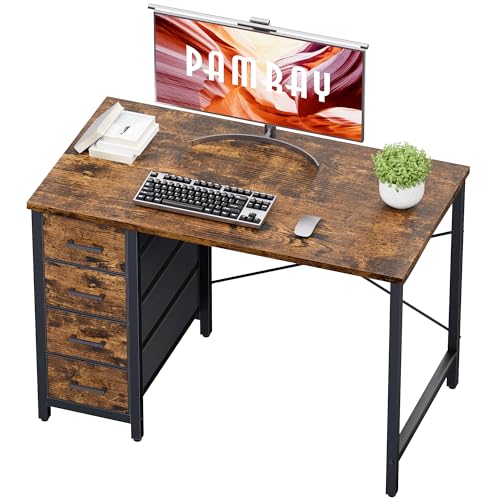
The Pamray performs a small magic trick: four drawers inside a thirty-two-inch desk. At a width barely larger than the DUMOS, it refuses the minimalist bargain and instead packs storage into nearly every inch under the top, finishing the result in a vintage style that warms up rooms where black steel looks like office surplus. For a bedroom corner that must serve as study, vanity and charging station in rotation, that density is the whole argument — the desk arrives as a piece of furniture with a job list, not a slab awaiting accessories.
Density has a geometry, though, and the Pamray’s is legroom. Four drawers around a seated user means the knee space is more sculpted than on an open-frame desk, and taller or broader users should think carefully about how they sit: straight-on with knees between the drawer banks works, sprawling sideways does not. The drawers themselves are small-room drawers — stationery, jewellery, chargers, notebooks — and the top holds a laptop and a lamp more happily than a wide monitor. Judge it as a personal nook rather than a workstation and every dimension starts making sense.
Styling is the tiebreaker that will sell this desk to its right owner. The vintage finish pairs with wooden floors, older wardrobes and the general aesthetic of rooms that never asked for a gaming desk, and in guest bedrooms it reads as intentional furniture rather than a compromise. Students in characterful rentals and anyone furnishing a cottage-style spare room will get more pleasure from this pick than from any black slab of similar size. Just go in clear-eyed: you are trading open legroom and top width for storage and charm, and on a thirty-two-inch desk that trade is the product.
Think of the Pamray as the answer to a very specific floor plan: the bedroom where the only free wall sits between a wardrobe and a window, measuring barely three feet, in a house whose other furniture predates flat-pack entirely. A black steel desk there looks like an apology; the Pamray looks like it was always meant to be there, and its drawers swallow the small chaos — hair ties, reading glasses, the good pen — that otherwise migrates across every surface in the room. Writers who compose longhand drafts before typing them up often fall for this desk hardest, because its scale and warmth suit paper work in a way production-line slabs never attempt.
- Width: 32 inches, near the smallest footprint in this comparison
- Storage: four drawers fitted around the seating space
- Finish: vintage styling warmer than the black steel norm
- Top: sized for a laptop, lamp and notebook rather than wide monitors
- Typical duties: study, writing, vanity duty and charging-station overflow
Strengths
- Packs real drawer storage into a footprint barely wider than the tiniest slab desk.
- The vintage finish suits traditional bedrooms where black frames look out of place.
- Works as a combined study and dressing nook in rooms serving several purposes.
Trade-offs
- Drawers shape the knee space, so tall users and sideways sitters should think twice.
- The top is laptop territory; a wide monitor leaves little room for anything else.
- Small drawers reward tidy owners and frustrate anyone hoping to file paperwork.
Best for: compact bedrooms wanting furniture character plus storage in one small footprint. Not suited for: tall users, wide-monitor setups or anyone who sits sprawled rather than straight.

SHW Mission 48-Inch Home Office Computer Desk — Widest work surface
The SHW Mission is the elder of this roundup — a 48-inch black desk that has been furnishing student rooms and first offices for years while trendier designs rotated around it. Its longevity is itself information: the formula of a generous top, a straightforward frame and no fragile extras survives because it matches what most people actually do at a desk. At forty-eight inches it is the only pick here that takes a monitor, an open laptop and a notebook in a row without any of them apologising, which makes it the natural ceiling of the affordable class and the bridge toward the home-office desks in our companion guide.
That width changes the working day more than any feature could. Reference material stays open beside the keyboard. A second person can pull up a chair for homework help or a shared form. The desk stops being a perch and becomes a small headquarters, while still fitting the wall of a modest bedroom that would reject a full-size office desk. The trade is floor: forty-eight inches plus a chair’s operating space is a real commitment in a small room, and buyers should tape the outline before ordering, because the SHW’s virtues only appear once it fits without bullying the bed or the door.
There are no drawers, and at this size that absence is a deliberate stance rather than a lack. The Mission assumes a room with a bookshelf, a filing box or a wardrobe to absorb storage, and in return it gives every inch of its budget to the surface and frame. Owners typically pair it with a monitor stand or a small desktop organiser and never miss built-in drawers. Choose it when your constraint is workload rather than floor — when the small-desk class attracts you for its simplicity and price position, but your days genuinely involve two screens’ worth of material spread out in front of you.
Second-hand markets tell the rest of this desk’s story. SHW desks circulate between students, siblings and flat-shares for years, because a simple top on a sound frame never becomes unusable — only unfashionable, briefly, until plain black comes back around, which it always does. Buying one new at the affordable end of the market is therefore less a purchase than an entry into a long relay, and owners who expect to move house twice in five years should weigh that durability of purpose heavily. Few products in this guide will still be somebody’s daily desk in a decade; the Mission’s design has already demonstrated, across years of listings, that it can be.
- Width: 48 inches, the broadest top among the six picks
- Finish: black, in the maker’s long-running Mission styling
- Storage: none built in, by design rather than omission
- Frame: simple, proven construction with a long sales history
- Typical duties: monitor plus laptop layouts, shared homework and paperwork
Strengths
- Real room for a monitor, laptop and papers side by side — unique in this roundup.
- A long-proven design with no experimental parts to surprise its owner.
- Two people can share the front edge for homework or form-filling sessions.
Trade-offs
- The footprint is a genuine commitment in the smallest bedrooms and dorms.
- Storage must come from elsewhere in the room, as with the other slab picks.
- Its plain looks will not satisfy buyers furnishing a room around a style theme.
Best for: heavier daily workloads, shared study and anyone whose wall can spare four full feet. Not suited for: alcoves, narrow dorms or rooms where the desk must also be the storage.
How do you keep a small desk feeling bigger than it is?
Light is the first lever. A small desk pushed against a wall under a shelf lives in shadow by afternoon, and shadow shrinks everything it touches. If the room allows it, place the desk so daylight crosses it from the side, and choose a lamp with a head you can aim rather than a fixed glow; the same forty inches feels twice as workable when it is evenly lit. Pale accessories help too — a light desk mat and a white keyboard visually extend a dark top, which is part of why the Lufeiya’s white finish punches above its dimensions.
The second lever is the wall. Everything that can live vertically should: headphones on a hook, the calendar above eye line, a narrow shelf for the printer paper and the reference books. Each object promoted to the wall returns its footprint to the work surface, and on a small desk those reclaimed inches are where the notebook opens and the elbows rest. The third lever is ritual. A two-minute reset at the end of the day — drawers loaded, cables coiled, surface bare — means every morning starts with the full width available, and a small desk that starts empty feels larger than a big desk that starts buried.
Chair choice quietly completes the illusion. A chair with a narrow back and no bulky armrests slides fully under the top when the day ends, returning the floor to the room and making the whole station read as a tidy block rather than scattered furniture. In the smallest bedrooms that nightly disappearance act is the difference between a room with a desk in it and a desk with a bed in it. Measure the chair’s width against the gap between the desk’s legs before buying either, because on compact frames that gap, not the top, is the dimension that decides whether the chair can tuck away.
How do the best affordable computer desks compare at a glance?
| Desk | Width | Storage | Finish | Room it suits |
|---|---|---|---|---|
| DUMOS Small Desk | 31.5 in | None | Black | Alcoves and dorm corners |
| Sweetcrispy 40-Inch | 40 in | None | Black | Student bedrooms |
| Lufeiya White Desk | 40 in | Drawers | White | Bright bedrooms, vanity duty |
| 3IngSeagulls Desk | Compact class | 4 fabric drawers | Neutral | Clutter-prone small rooms |
| Pamray 32 Inch | 32 in | 4 drawers | Vintage | Characterful bedroom nooks |
| SHW Mission | 48 in | None | Black | Heavier home workloads |
The pattern underneath the table is a fork with three tines. Width decides what fits on top, storage decides what the room must provide elsewhere, and finish decides whether the desk disappears or decorates. The three slab desks — DUMOS, Sweetcrispy and SHW — are one idea at three sizes, and choosing among them is purely a tape-measure exercise. The three drawer desks solve a different problem and should be compared against each other: Lufeiya for brightness, 3IngSeagulls for sheer drawer count, Pamray for compactness and character. Cross-shopping between the two families without first deciding whether you need drawers is how buyers end up with a beautiful desk and nowhere to put a pen.
How do you measure a small room for a desk properly?
Start with the wall, not the catalogue. Measure the clear stretch of wall in inches, then subtract the skirting board quirks, the radiator that protrudes, and the door swing that eats the corner you had in mind. The number left is your true maximum width, and it is almost always smaller than the room’s brochure dimensions suggest. Next, sit in the chair you will use and measure the depth the two of you occupy together: desk depth plus pulled-out chair plus the space your knees need is the real footprint, and in small bedrooms that total decides whether the wardrobe door still opens.
Then rehearse the work itself. Lay masking tape on the floor in the desk’s outline, place your laptop or monitor inside it, and spend one real session working in the taped zone with a chair. You will learn in an hour what photographs cannot tell you: whether your elbow hits the wall mid-sentence, whether the window glare lands on the screen at four o’clock, whether the room’s only socket is reachable without an extension lead crossing the doorway. Every desk in this guide is inexpensive enough that the measuring, not the money, is the investment that protects you.
Finally, plan the vertical dimension everyone forgets. Wall space above a small desk is free storage: one shelf at forehead height holds the books and boxes that would otherwise colonise the top, and a small pegboard or rail takes headphones, cables and scissors off the surface entirely. Slab-desk owners especially should budget an hour for this, because a forty-inch top above a well-organised wall outperforms a forty-eight-inch top under a bare one. The desk is the foundation of the station, not the whole building.
Which mistakes do buyers of small affordable desks repeat?
The most common error is buying the width that fits the wall and forgetting the chair that fits the human. A desk can clear its alcove by an inch while the chair, pulled out, blocks the only path to the door — a layout that lasts one week before the desk migrates somewhere worse. Second comes screen greed: ordering a thirty-two-inch desk for a monitor that needs a keyboard, a notebook and elbow room in front of it. The monitor’s diagonal is not its footprint, and stands plus keyboards routinely claim twenty inches of depth and width between them.
Third, buyers underestimate cable sprawl on desks with no management features. One laptop charger is tidy; add a monitor cable, a phone lead and a lamp, and the small top grows a wire garden that makes the whole room look stressed. Ten minutes with adhesive clips along the back edge prevents it permanently. Fourth is ignoring the floor: lightweight frames on uneven floors or thick rugs wobble in ways that feel like flimsiness but are really geography, cured by levelling the feet or moving the rug. And fifth, shoppers buy drawers for storage they do not have — or skip drawers they desperately need — because they shopped photographs instead of inventorying their own clutter first.
What should you buy alongside a small affordable desk?
Resist the urge to accessorise before the desk arrives, but expect three companions to earn their keep. A desk mat protects the thin top from pen pressure, mug heat and keyboard scuffs while making the whole surface feel more finished. A small lamp with an adjustable head matters more than its price suggests, because small desks usually sit in room corners the ceiling light forgets. And a power strip with a short lead, fixed to the wall or the desk’s back leg, turns the cable situation from a floor hazard into a single tidy drop. Together those three cost little and address the three complaints — marks, gloom and wires — that owners of budget desks actually report.
Beyond those, let the first month of use write the list. If the screen sits too low, a stand or a sturdy box solves it before a monitor arm should be considered on a thin top. If papers breed, a vertical file holder takes them upright in four inches of top instead of fourteen lying flat. If the chair is the problem — and in small-desk setups it very often is, since the chair budget was spent on the desk — save for the chair next rather than scattering money across desk gadgets. The station improves fastest when each purchase answers a friction you have personally felt at it.
How long should an affordable desk like these last?
With ordinary care, years — and the variables are mostly in the owner’s hands rather than the factory’s. Desks in this class die from a short list of causes: water left standing on the top until the surface swells, fixings that loosen and are ignored until the frame racks out of square, and moves where the assembled desk is dragged or carried by its top instead of being lifted by its frame or partly dismantled. Avoid those three and a light steel-and-board desk routinely outlasts the laptop it was bought for, which is why so many of them circulate second-hand between students.
Build two habits and the lifespan stretches further. Every few months, spend ninety seconds tightening the bolts you can reach; frames telegraph their looseness as a faint new wobble weeks before anything is damaged, and that wobble is the desk asking politely for attention. And when you move house, treat the desk as flat-pack again — half an hour of partial disassembly protects the joints that dragging an assembled frame around doorframes quietly destroys. Owners who do those two things are the ones whose budget desks still look unremarkable, in the best way, half a decade later.
Final Recommendation
Let your wall and your clutter decide, in that order. If the tape measure says forty inches and your shelves already handle storage, the Sweetcrispy is the calm centre of this category and the pick most buyers will live with happily for years. Shrink to the DUMOS only when the corner truly demands it, and stretch to the SHW Mission when your workload, not your room, is what runs large. If your belongings currently live on the floor, skip the slabs entirely: the 3IngSeagulls swallows the most, the Lufeiya brightens while it stores, and the Pamray charms its way into traditional rooms. A small desk chosen against a measured wall and an honest inventory will feel custom-built — and that feeling, not any single feature, is what makes a tiny workspace somewhere you actually want to sit down.
Frequently Asked Questions
Can a 40-inch desk really hold a monitor and a laptop?
Yes, with the monitor on its stand behind or slightly above the laptop, or with the laptop closed and docked to the side while the monitor takes centre stage. What a forty-inch top will not hold gracefully is two full screens side by side plus paperwork; that layout is the honest territory of the 48-inch SHW Mission in this roundup. If you regularly spread printed documents beside your keyboard, measure that habit honestly before choosing the smaller tops, because paper is the silent third screen in most people’s work.
Are fabric drawers durable enough for daily use?
For the loads they are designed around — cables, controllers, stationery, soft items — yes, and they have the advantage of sliding quietly and lifting out whole. They are the wrong tool for heavy books, tools or anything sharp without a container, because the fabric base and walls are built for lightness rather than load. Owners who respect that division typically report the drawers looking and sliding much the same after years of daily use, while drawers treated as book boxes sag within a season and take the desk’s tidy appearance down with them.
Will a lightweight desk wobble when I type?
On a level floor, typing on any pick here feels steady; these frames are engineered for seated work. Wobble usually traces back to uneven flooring, thick rugs or loose assembly bolts rather than the frame itself, so level the feet and re-check the fixings before blaming the desk. A simple test separates the causes: press each corner in turn, and if the movement rocks diagonally, the floor or feet are at fault; if the whole frame flexes under a firm push on the top’s edge, you are feeling the honest limit of a lightweight desk, which matters for leaning but not for typing.
Is a white desk harder to live with than a black one?
It shows different evidence. White reveals coffee rings, ink and scuffs; black reveals dust, fingerprints and every crumb. Owners who wipe as they go suit white beautifully, while low-maintenance households often find black’s dust easier to ignore between cleanings. A desk mat in a mid tone quietly solves the dilemma on either finish, which is why it appears in our advice for every pick here.
How long does assembly take on desks like these?
The class is designed for quick, one-person assembly with basic tools, typically well within an evening and often far less. The drawer models add steps over the plain slabs, so build those with the instructions fully open rather than improvising the order of parts. Two habits save most of the frustration owners report: lay every fitting out and count it before the first bolt turns, and leave all fixings finger-tight until the frame stands square, tightening in sequence at the end so the desk levels itself instead of locking in a twist.
Should I add a monitor arm to an affordable desk?
Be cautious. Thin tops and clamp arms are uneasy partners, because the clamp concentrates load on a small area of board, and a heavy screen on a long arm adds leverage every time the desk is bumped. A monitor stand or a stack of sturdy books achieves most of the ergonomic benefit without the risk, and keeps the desk’s warranty story simple. If an arm is non-negotiable, that requirement alone justifies stepping up to a sturdier desk class rather than gambling on the thinnest tops here.
Related Guides
When the small-desk brief grows, these companion roundups pick up the thread: best affordable home office desks for wider work-from-home surfaces, best affordable standing desks if sit-stand movement matters more than storage, and best 47 inch desks for the next size step up.


