What's inside
- Where to buy
- Key Takeaways
- Quick Picks
- How did we judge a field made by one brand?
- Where does six feet actually change your life?
- Nylon braid or silicone Flow — which finish suits your hands?
- How do the six cables compare in daily life?
- How should you route and care for a six-foot cable?
- What mistakes do long-cable buyers keep making?
- How does six feet play in hotels, dorms, and rented rooms?
- What should households with children and pets know about long cables?
- What is the honest lifespan of a six-foot cable in each role?
- Final Recommendation
- Frequently Asked Questions
- Related Guides
As an Amazon Associate I earn from qualifying purchases. This post may contain affiliate links at no extra cost to you.
gizmoverdict.com is reader-supported. When you buy through links on our site, we may earn an affiliate commission.
Where to buy
Anyone comparing the best 6ft iphone chargers will find all five linked cables in this guide at Amazon’s US store, and a disclosure belongs at the front rather than in a footnote: every one of them is made by Anker. We did not set out to write a one-brand roundup, but the verified, MFi-certified six-foot field resolved that way, and inventing diversity we could not verify would be a worse sin than reporting the race as it stands. Apple’s own two-metre Lightning cable is the sixth pick, in prose only, as the original against which the five challengers are measured.
Six feet is the length at which a charging cable stops being a leash. The standard one-metre lead that defined the early iPhone era assumed a phone charging on a desk beside its owner; the six-foot cable — roughly 1.8 to two metres — assumes real rooms: the socket behind the headboard, the far side of a deep sofa, the rear of a car’s centre console, the hospital bedside and the airport floor. Shoppers searching for the best 6ft iphone chargers are rarely shopping for a cable at all. They are shopping for the right to use the phone while it charges, in the place they actually sit, without performing the hunched shuffle toward the wall that a short lead imposes.
Because the brand question is settled before it starts, this guide’s real contest is between materials and connector pairings. Braided nylon and Anker’s silicone Flow construction feel different in the hand, coil differently in a bag, and age differently in a car. USB-C-to-Lightning versions unlock fast charging with a Power Delivery brick; the USB-A version serves the older ports that still fill the world. And over everything hangs the generational line that must be stated before any money moves: Lightning belongs to the iPhone 14 and everything before it, while the iPhone 15 generation and later charge through USB-C and need a different cable entirely.
Key Takeaways
- All five linked picks are Anker and all five are MFi-certified; this is an honest one-brand race, judged on material, connectors, and pack size instead of logos.
- Six feet buys posture: it is the length that lets a phone charge on a sofa, in bed, or in a car’s back seat while remaining fully usable.
- Braided nylon is the durability play — stiff, armour-like, indifferent to boots and bag zips — while the silicone Flow cable is the comfort play, soft, tangle-resistant, and pleasant to handle daily.
- Only the USB-C-to-Lightning picks can fast-charge, and only when paired with a USB-C Power Delivery brick; the USB-A two-pack is for reach at legacy pace.
- The 310 two-pack is the household economist’s choice: two fast-charge-capable six-foot stations for barely more than one flagship cable.
- Apple’s two-metre original, covered in prose, remains the softest and simplest cable here — and the one whose sheath has the most famous ageing problem in the category.
Quick Picks
| Pick | Badge | Why it is here |
|---|---|---|
| Anker New Nylon USB-C to Lightning Cable, 6 ft, Black | Best all-round 6 ft cable | Braided armour, fast-charge geometry, and a colour that vanishes into cars and dark rooms — the default recommendation of this guide. |
| Anker USB-A to Lightning Cable, 2-Pack, 6 ft, Black | Best for legacy ports | Two braided six-foot leads for the USB-A world of cars, offices, and older adapters, where reach matters and speed is secondary. |
| Anker PowerLine III Flow USB-C to Lightning Cable, 6 ft | Best feel in hand | The silicone Flow finish stays supple, resists tangles almost entirely, and turns a daily-handled cable into a small tactile pleasure. |
| Anker 310 USB-C to Lightning Cable, 2-Pack, 6 ft | Best two-room value | A matched pair of fast-charge-capable leads that plant six feet of freedom in two rooms for one modest outlay. |
| Anker New Nylon USB-C to Lightning Cable, 6 ft, Silver | Best for light rooms | The braided flagship in its pale finish, for white desks and bright interiors where a black cable reads as visual noise. |
| Apple Lightning Cable, 2 m | Prose-only original | Apple’s own long cable, discussed without a link as the benchmark for softness, simplicity, and price. |
How did we judge a field made by one brand?
When a roundup collapses to a single manufacturer, the honest response is to sharpen the criteria rather than apologise for the outcome. Certification remained the gate: every pick is MFi-certified, carrying the licensed Lightning connector that iOS authenticates, because a six-foot cable is a long-term installation in a home and the “accessory not supported” failure is a betrayal no saving justifies. Beyond the gate, we judged the cables as physical objects living physical lives — how the sheath handles a thousand bends at the connector, how the length behaves in a bed versus a bag, whether the finish grips a car seat or slides off it.
Connector pairing was the second axis, and it splits the field cleanly. Four picks use the USB-C-to-Lightning pairing, the geometry that, with a Power Delivery brick, fast-charges the iPhone 8-through-14 generations. One pick is USB-A-to-Lightning, deliberately included because reach at the old pace beats no reach at all in the cars and offices where USB-A is the only port within six feet of a seat. A guide that listed only the fast geometry would be tidier and less useful; the world is not tidy, and neither are its sockets.
Finally, we treated the two finishes as genuine alternatives rather than trim levels. Nylon braid and silicone Flow are answers to different complaints — the first to cables that die, the second to cables that annoy — and many households will correctly own one of each in different rooms. The sections below argue each pick on its own ground, and the comparison table at the end lays the small, real differences side by side so the choice can be made in one reading.
Where does six feet actually change your life?
Start in the bedroom, the room that sells more long cables than any other. The socket is behind the headboard or beside a dresser; the human is in the middle of the bed, reading, messaging, or setting the morning’s alarms. One metre reaches that human only at full stretch, phone dangling at the mattress edge, one careless elbow from a fall and a disconnected night. Six feet restores slack to the system — the phone rests on the bed, moves to either pillow, survives being picked up and put down twenty times an evening — and slack, in a charging cable, is the entire difference between a tool and a tether.
The sofa makes the same argument with worse geometry. Living-room sockets hide behind furniture that nobody moves for a cable, and the seating is deep. A six-foot lead routes around the sofa’s arm and arrives at the cushion with length to spare, which is why the living room is where the Flow cable’s tangle resistance earns its keep: a cable that lives loose on upholstery, kicked and sat on and coiled by hands during ad breaks, either manages its own disorder or becomes a knot with connectors. The car completes the trilogy. Six feet from a front console reaches the back seat’s passenger — the child with the tablet-adjacent questions, the teenager whose phone is the journey’s entertainment — and turns one front socket into the whole car’s charging infrastructure.
There are places six feet is wrong, and naming them sharpens the guide’s honesty. A tidy desk with the brick beside the laptop wants a shorter cable, because surplus length on a desk is not freedom but spaghetti. A travel pouch wants shorter too, or the discipline to coil properly. Buy six feet for the rooms where distance is the problem — bedroom, sofa, car, the relative’s house with the socket behind the piano — and let the desk keep its metre. Length, like wattage in our other guides, is a property to match to a place, not a number to maximise.
Nylon braid or silicone Flow — which finish suits your hands?
Run both through your fingers and the philosophies separate immediately. Braided nylon feels like equipment: a woven sheath with a faint textile grain, a cable with posture, one that holds a gentle curve when coiled and resists being crushed flat in a bag. Its talent is survival. The braid spreads bending stress along its weave, shrugs off the abrasion of car footwells and bag zips, and gives the connector ends a sheath that will not split the way plain rubber splits. A braided cable can feel slightly stiff in winter and slightly springy when you want it to lie dead flat, and those are the whole of its vices.
The Flow’s silicone is the opposite argument: a cable as a soft object. It feels almost liquid in the hand — smooth, cool, faintly grippy without being sticky — and its party trick is emerging from a pocket or a pouch untangled, because the silicone surface slides over itself instead of knotting. For a cable handled twenty times a day at a bedside or a desk, that daily pleasantness compounds into the main reason to own it. Its cautions are different from the braid’s: silicone picks up lint and dust more readily, dislikes being trodden on in grit, and its softness offers less armour against a sharp bag zip or a boot heel. Neither finish is better. They are optimised for different enemies — death, and annoyance — and most readers know within seconds which enemy their cables actually face.
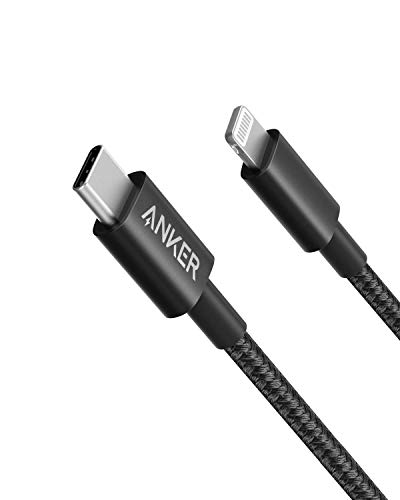
Anker New Nylon USB-C to Lightning Cable (6 ft, Black) — Best all-round 6 ft cable
Every guide needs a default — the pick handed to the reader who wants the answer without the essay — and in this one-brand field the black braided USB-C-to-Lightning cable earns that role by having no weakness to explain away. It fast-charges when the brick allows it, being the correct USB-C geometry. It is MFi-certified, so the phone’s trust is permanent rather than provisional. Its braid is the finish that survives the widest range of lives, from the gentlest bedside to the roughest car, and its black colour is the one that disappears into the most interiors, cables being objects that should be felt as slack and never seen as clutter.
Its six feet behave with the braid’s characteristic posture: the cable holds a soft memory of its coil, drapes rather than puddles, and stays where a sofa’s arm places it instead of slithering to the floor. In the car it is the pick of this guide, because the footwell is where cables go to be abraded, frozen, and stood on, and the black braid treats all three as weather. At the bedside it asks one small favour — a cable clip or a weighted rest if your nightstand is slick — because a posture-holding cable on a smooth surface will, over a night of small tugs, migrate an inch at a time toward the floor.
Choose a different pick only for a stated reason: the Flow for feel, the silver for a pale room, the pairs for quantity, the USB-A for an old port. Absent such a reason, this is the cable, and the rest of the guide is the story of its variations. That is not a failure of the roundup; it is what a mature product category looks like when one maker has iterated the same good idea long enough that the idea’s best form is simply known.
- Connectors: USB-C to Lightning — fast-charge capable with a PD brick
- Certification: MFi-certified, with the licensed connector iOS authenticates
- Finish: braided nylon, black — the armour option in the discreet colour
- Length: 6 ft of posture-holding cable for bed, sofa, and car
- Role in guide: the default recommendation when no special case applies
Strengths
- No compromises to explain: certified, fast-capable, and armoured at once.
- The braid survives cars and bags that destroy lesser sheaths.
- Black vanishes against the interiors where cables are most used.
Trade-offs
- Slightly stiff hand feel compared with the silicone Flow.
- Its coil memory can walk it off a slick nightstand overnight.
- A single cable, where the pairs below cover two rooms at once.
Best for: the one-cable buyer who wants the surest all-round answer. Not suited for: readers whose priority is softness in the hand above survival.

Anker USB-A to Lightning Cable (2-Pack, 6 ft, Black) — Best for legacy ports
Judge this two-pack by the map of ports that actually exists. Cars built across the last fifteen years offer USB-A. Office docks, keyboard hubs, aeroplane seats, games consoles, the power bank in your bag, the beloved old wall adapter in the kitchen — USB-A, every one. A Lightning iPhone in any of those places needs this cable’s geometry, and needs it long, because legacy ports were placed for data, not for humans: the car’s port is in the console’s depths, the office port is under the desk, and six feet is what turns those placements from insults into infrastructure. What the cable cannot do is fast-charge — USB-A is the pre-PD world — and the guide states that plainly rather than letting the pack’s other virtues blur it.
At legacy pace, though, six feet changes the experience completely. The back-seat passenger charges and uses the phone at once. The driver runs a cable to a phone mounted high on the dash without the lead pulling tight across the wheel. The office worker’s phone lives on the desk’s far corner, plugged into the dock, reachable and charging through the whole afternoon. These are the actual jobs of USB-A in 2026 — duration jobs, where the phone sits for hours and the rate is irrelevant — and for duration jobs, reach is the whole specification.
The two-pack format fits the legacy world’s geography, which is scattered by nature: one cable emigrates to the car permanently, the other to the bag or the office, and neither is ever fetched back. Double braiding suits that scattered life, since a cable that lives in a footwell ages faster than one that lives on a desk, and a spare that frays is a spare that fails at the exact moment it was kept for. Buy this pack as the connective tissue between an iPhone and the older world it still moves through, and the fast-charge picks will handle the new world at home.
- Connectors: USB-A to Lightning — the legacy geometry, honestly labelled
- Certification: MFi-certified, so iOS acceptance is permanent
- Pack: two 6 ft leads for two separate legacy stations
- Finish: double-braided nylon for footwell and travel survival
- Charging pace: standard rate — reach is the product, not speed
Strengths
- Two long spares cover the car and the office in one purchase.
- Six feet redeems the worst-placed USB-A ports in daily life.
- Braiding matches the rough service legacy stations impose.
Trade-offs
- No fast charging is possible through this connector pairing.
- As USB-A retreats, these are cables for the present, not the future.
- Six loose feet in a small car need a tie or a clip to stay civilised.
Best for: cars, offices, and travel through the USB-A world that still surrounds us. Not suited for: the home fast-charge station, which needs the USB-C picks.

Anker PowerLine III Flow USB-C to Lightning Cable (6 ft, Midnight Black) — Best feel in hand
The Flow is the cable for people who notice cables. Its silicone sheath has a finish Anker describes in almost culinary terms, and for once the poetry is earned: the cable pours through the hand, coils without fighting, and — the property owners evangelise — comes out of a bedside drawer or a coat pocket essentially untangled, day after day, because silicone slides over silicone instead of gripping itself into knots. Six feet of ordinary cable in a bedside drawer is a small daily puzzle. Six feet of Flow is a cable you pick up. That difference, repeated nightly for years, is a legitimate engineering achievement disguised as a texture.
Electrically it is the equal of the braided flagship: USB-C-to-Lightning, MFi-certified, fast-charge capable with a PD brick, offered here in a midnight black that suits the bedside and the desk where this cable’s life is best spent. Its flexibility is also a routing virtue in tight furniture — the Flow bends around a headboard’s edge and lies along a skirting board with a compliance the braid’s posture resists — and its surface grips upholstery just enough to stay on a sofa arm rather than migrating to the floor under its own smoothness.
Its boundaries are the boundaries of softness. Keep it out of the car’s footwell, where grit under a heel is sandpaper to silicone; keep it away from the bag that also carries keys and tools loose; wipe it occasionally, because pale dust shows on the dark finish and the material collects lint the braid ignores. In exchange for that small territorial discipline, the Flow is the cable this guide’s writers would each take home — the one whose daily handling is a pleasure rather than a negotiation, in the rooms where a cable is handled most.
- Connectors: USB-C to Lightning — fast-charge capable with a PD brick
- Certification: MFi-certified, identical trust to the braided picks
- Finish: silicone Flow — soft, supple, and remarkably tangle-resistant
- Length: 6 ft that coils, drapes, and routes around furniture kindly
- Colour: midnight black, suited to bedsides and desks
Strengths
- The untangling act is real and pays out every single day.
- Suppleness routes it through furniture gaps that defeat stiffer cables.
- Feels like a premium object rather than a consumable.
Trade-offs
- Silicone and grit are enemies; cars and tool bags are not its home.
- Collects lint and dust that the braid shrugs off.
- Softness is less armour at the connector than the flagship’s build.
Best for: bedsides and desks where the cable is handled constantly and gently. Not suited for: footwells, workshops, or bags shared with loose metal objects.

Anker 310 USB-C to Lightning Cable (2-Pack, 6 ft, Black) — Best two-room value
Reach, multiplied by two rooms, is this pack’s argument. The arithmetic of long cables is usually done one room at a time — the bedroom gets its six feet, the sofa makes do — because flagship cables are priced as individual purchases. The 310 pair breaks that arithmetic: two MFi-certified, USB-C-to-Lightning, six-foot leads in one box, at a combined cost that reframes the second room from an indulgence into an obviousness. A household that fast-charges in the bedroom and merely wishes it could on the sofa is a household one purchase away from symmetry, and this is that purchase.
The 310 is Anker’s value line, and in the six-foot context its compromises are well aimed. The construction is lighter than the braided flagship’s, which matters for a cable that travels and matters barely at all for the life these two are designed for: plugged into a brick, routed once behind furniture, and then left in place for years, delivering slack to a cushion or a pillow. A stationary cable’s enemies are dust and time, and against those the 310 is fully armed. Its flexibility even helps the installation, threading behind a headboard or along a skirting line more obediently than a posture-holding braid.
One planning note, carried from the listing itself: no charger is included, and each of these stations needs a USB-C Power Delivery brick to deliver the fast charge the cables are capable of. Households often own one such brick and a drawer of lesser ones; the honest completion of this pack is a capable brick for the second station, after which the system is whole. Bought with that completion in mind, the 310 pair is the most economical route in this guide to a house where six feet of certified, fast-capable cable is simply present wherever people sit — which is the state of affairs the entire category exists to create.
- Connectors: USB-C to Lightning on both leads — fast-charge capable
- Certification: MFi-certified across the pair
- Pack: two 6 ft cables, intended as two permanent stations
- Construction: lighter value-tier build, ideal for routed, stationary duty
- Requirement: a PD brick per station; none is included in the box
Strengths
- Two rooms gain long, certified, fast-capable cables in one buy.
- Stationary installations play entirely to this build’s strengths.
- Flexible leads route behind furniture more obediently than braid.
Trade-offs
- Not the choice for a cable that will travel daily in a bag.
- Two stations may reveal the need for a second PD brick.
- Thinner finish shows hard use sooner than the braided flagship.
Best for: households furnishing a bedroom and a living room in one stroke. Not suited for: a single hard-travelling cable, where the flagship braid earns its premium.

Anker New Nylon USB-C to Lightning Cable (6 ft, Silver) — Best for light rooms
It would be easy to treat the silver version of the braided cable as a footnote to its black sibling, and electrically that treatment is accurate: same MFi certification, same USB-C-to-Lightning fast-charge geometry, same woven armour, same six feet. But cables are visible objects that live draped across the most styled rooms in a house, and colour is a real specification in a way spec sheets never admit. A black cable across a white desk, a pale linen bed, or a light oak floor is a stripe of visual static in every photograph and every glance. The silver braid — pale, metallic-threaded, closer to jewellery than to wiring — is the version designed to be looked at without resentment.
There is a functional edge to the paleness beyond aesthetics. A light cable is findable: in a dim room, in the footwell at night, at the bottom of a bag, the silver sheath announces itself where the black one hides. Households that share cables between members also discover the colour’s social use — his and hers, bedroom and study, the good cable and the spare — assigned by shade rather than by argument. And in the specific rooms this finish suits, the bright Scandinavian interior of pale wood and white walls that defines so much current taste, the silver cable is not merely acceptable but genuinely congruent, the rare accessory that looks chosen.
Its cautions mirror its virtues. Pale finishes show grime that black conceals, so a silver cable in a car footwell will look elderly within a season even while performing perfectly; keep this one in the clean rooms it was styled for. And the braid’s posture and winter stiffness are unchanged by the dye, so the Flow remains the answer for readers whose complaint was feel rather than colour. Within its territory — the bright, tidy, photographed rooms of the house — the silver flagship is not the alternative to the default pick. It is the default pick, correctly dressed.
- Connectors: USB-C to Lightning — fast-charge capable with a PD brick
- Certification: MFi-certified, identical to the black flagship
- Finish: braided nylon in silver — the pale-room, findable-in-the-dark option
- Length: 6 ft of the flagship’s posture-holding braid
- Role in guide: the same cable as the default, dressed for light interiors
Strengths
- Disappears into pale rooms instead of striping across them.
- Visibility in dim light and dark bags is a genuine daily convenience.
- Colour-coding between household members ends cable disputes.
Trade-offs
- Shows dirt and scuffs that the black finish hides completely.
- Same braid stiffness; not the answer if feel was your complaint.
- Styled for clean rooms and wasted on a workshop bench.
Best for: white desks, bright bedrooms, and anyone who photographs their space. Not suited for: cars and garages, where its finish will age visibly fast.
Apple Lightning Cable (2 m) — Prose-only original
Apple’s own long Lightning cable is the quiet reference under this entire guide: two metres of the company’s signature white, MFi by definition since Apple is the licensor, and possessed of a softness none of the challengers quite replicates — the original’s rubber sheath drapes like string where the braids hold posture and the silicone pours. For the owner who values that specific hand feel and the absolute simplicity of the first-party object, it remains a perfectly rational purchase, and this guide, which exists to judge third-party gear fairly, has no interest in pretending otherwise.
Its reputation carries one famous asterisk, and fairness requires naming it in the benchmark’s own section: Apple’s cable sheaths have a long-documented tendency to split and fray near the Lightning connector after extended bending, the failure that sent a generation of owners to braided alternatives in the first place. The two-metre length mitigates it somewhat — a long cable bends at gentler angles than a short one stretched tight — but the material’s nature is unchanged. Buyers choosing the original are choosing softness and simplicity over armour, knowingly, and should route it kindly: no tight bends at the plug, no yanking by the lead, no car footwells.
As the measuring stick, its final service is price context. The original’s cost for a single cable is the figure against which the pairs and braids above reveal their arithmetic — two certified six-foot stations for comparable money, or one armoured flagship with length to spare. None of that makes the Apple cable a bad product. It makes it a benchmark in the truest sense: the standard of feel and correctness, against which five Anker variations compete on durability, quantity, colour, and cost per room.
- Length: 2 m — the longest cable in this guide by a small margin
- Certification: first-party; MFi by authorship rather than licence
- Finish: Apple’s soft white rubber sheath, the supplest drape here
- Coverage here: prose-only benchmark, unlinked by this guide’s design
- Known asterisk: sheath splitting near the connector is its documented weakness
Strengths
- The softest, simplest cable of the six, with first-party correctness.
- Two full metres out-reach every challenger by a hand’s breadth.
- No certification question can ever arise about Apple’s own cable.
Trade-offs
- The sheath’s ageing at the connector is the category’s famous flaw.
- One cable at a price where rivals offer pairs or armour.
- White shows a household’s worth of grime within the year.
Best for: first-party purists who prize the original’s softness and simplicity. Not suited for: rough service, tight bends, or buyers furnishing several rooms.
How do the six cables compare in daily life?
| Cable | Connectors | Finish | Fast charge | Natural home |
|---|---|---|---|---|
| Anker New Nylon, Black | USB-C to Lightning | Braided nylon | Yes, with PD brick | Anywhere; the default |
| Anker USB-A 2-Pack | USB-A to Lightning | Double-braided nylon | No, legacy rate | Car and office |
| Anker PowerLine III Flow | USB-C to Lightning | Silicone | Yes, with PD brick | Bedside and desk |
| Anker 310 2-Pack | USB-C to Lightning | Value finish | Yes, with PD bricks | Two rooms at once |
| Anker New Nylon, Silver | USB-C to Lightning | Braided nylon, pale | Yes, with PD brick | Light, styled rooms |
| Apple 2 m | USB-C to Lightning class | Soft rubber | Yes, with PD brick | The purist’s bedside |
Two columns do the deciding. The fast-charge column eliminates exactly one pick for buyers whose goal is speed, and the finish column then sorts the survivors by the life they will lead. Everything else — certification, length, brand — is held constant across the table by this guide’s design, which is the luxury of a one-brand field: the variables that remain are the ones that genuinely differ, and they are few enough to choose between in a single honest minute.
How should you route and care for a six-foot cable?
Install it once, properly, and a long cable becomes furniture rather than clutter. Route the bedroom lead behind the headboard with enough slack at the pillow end to let the phone travel across the bed, and anchor the middle with a clip or a weighted holder so the connector end cannot slide to the floor at three in the morning — a Lightning plug that lands connector-down on hardwood, nightly, is a plug being slowly damaged by its own home. On the sofa, run the cable behind the cushions and out at the arm nearest the socket, leaving the usable end coiled loosely where hands expect it. In the car, gather the surplus into a loose loop with a fabric tie, never a tight knot, and keep the loop out of the footwell’s grit and the seat rail’s path.
Care is mostly the avoidance of three habits. Do not wrap any cable tightly around a brick or a fist for storage; coil it in loose loops the size of a dinner plate, which is how the braid and the silicone both prefer to rest. Do not use the cable as a handle — every extraction should be by the connector housing, a rule whose violation accounts for most connector deaths in every finish. And do not let a six-foot cable’s surplus live in a doorway’s swing or a desk chair’s castor path, because length that reaches everywhere also reaches trouble. Follow those rules and the picks above will outlast the phones they were bought for, which, for a Lightning accessory in the USB-C era, is exactly the lifespan required of them.
What mistakes do long-cable buyers keep making?
The first is buying length without a route — six feet purchased for a desk whose socket is eighteen inches away, producing a nest that the buyer then blames on the cable. Length is for distance; audit the distance first. The second is assuming all six-foot cables charge alike, and discovering that the USB-A bargain cannot fast-charge no matter how premium its braid feels. Connectors decide speed; length decides comfort; the two decisions are independent and both must be made. The third is the uncertified temptation, more dangerous at this length than any other, because a long cable is a semi-permanent installation in a bedroom — the last place a counterfeit connector’s slow failure should be smouldering.
Fourth is colour blindness of the practical kind: the black cable bought for the white room and resented daily, or the silver bought for the car and grey within a month. Fifth is forgetting the generation line — ordering a beautiful Lightning cable for an iPhone 15 that cannot receive it, a mistake now so common that this guide states the boundary in its opening, its takeaways, and here a third time, because repetition is cheaper than returns. The port on your phone is the first specification. Everything else in this guide is refinement.
How does six feet play in hotels, dorms, and rented rooms?
Any room you did not wire yourself is an argument for length. Hotels place sockets by the logic of lamps and kettles, not of guests in bed with phones, and the traveller with a one-metre cable sleeps beside a phone charging on the floor across the room — reachable for the alarm only by getting up, which defeats the alarm’s purpose and the holiday’s. Six feet bridges the hotel’s indifference: from the desk socket to the pillow, from behind the television unit to the bedside, the cable restores the arrangement you have at home to a room that was never designed for you. It is the single cheapest upgrade to business travel that exists in the accessories world, which is why road veterans pack length before they pack almost anything else.
Student rooms and rented flats sharpen the same point with different furniture. The dormitory gives each resident one or two sockets, placed in the 1970s for a lamp and a radio, and asks a phone, a laptop, and a life to share them; a six-foot cable is how the phone escapes the socket’s neighbourhood and joins the bed and the desk where its owner actually is. Renters, forbidden from adding sockets and unwilling to trail extension leads across every room, find that one long certified cable per main room quietly re-draws the flat’s electrical map. In both cases the braid earns a preference for sheer survivability in shared, high-traffic spaces, while a private hotel traveller may reasonably choose the Flow for the pleasure of the untangled morning.
Hospitals and care settings deserve a mention of their own, because they are where long cables stop being conveniences. A phone is a patient’s line to family, and the socket is reliably behind the bed, at the wrong height, on the wrong side. Six feet is frequently the difference between a phone in the hand and a phone in exile on a windowsill. If you are packing a bag for someone else’s stay, put a braided six-foot cable in it before the toiletries; it will be thanked for more than anything else in the bag.
What should households with children and pets know about long cables?
Length creates slack, and slack creates loops, and loops are interesting to exactly the household members with the least judgement. The safety picture is reassuring in its foundations — a Lightning cable carries modest power, the connectors are small and sealed, and no pick here presents the hazards of mains cabling — but the household rules are still worth setting deliberately. Route cables behind furniture rather than across open floor where a crawling child or a racing dog turns slack into a trip line, and keep the phone end’s resting place off the floor, because a connector that is chewed, however unlikely the damage, is a connector to retire immediately rather than inspect hopefully.
Pets add a specific habit to plan around: some animals chew cables the way they chew everything, out of youth or boredom, and a braided sheath is meaningfully harder to damage quickly than a rubber one — one more argument for the nylon picks in pet households, and for routing the cable’s run out of reach where the animal’s territory and the charging station overlap. The Flow’s softness, so pleasant to human hands, offers a determined chewer the least resistance of any pick here, which is a fair trade to make knowingly in a pet-free bedroom and a poor one beside a puppy’s basket.
Children old enough to own the Lightning phones these cables serve are old enough for the extraction rule — pull the housing, never the lead — and six feet actually helps teach it, because a cable with slack never needs the yank that a short cable trains into small hands nightly. Set the stations up once, with the routing done and the slack managed, and a long cable in a family home becomes what it is in every other setting this guide has visited: invisible infrastructure, noticed only on the day it is missing.
What is the honest lifespan of a six-foot cable in each role?
Role decides lifespan more than brand does, and setting expectations by role prevents both premature disappointment and premature replacement. The routed, stationary cable — the 310 behind the headboard, the braid along the skirting — lives the longest life in this category, measured in many years, because its bends were made once, gently, by the person who installed it. The handled cable, picked up and coiled daily at a bedside or desk, lives in the middle: the Flow and the flagship braid both serve for years in that duty, with the connector housings, not the sheaths, setting the eventual limit. The travelled and trodden cable — the car’s resident, the bag’s companion — lives hardest, and even there a braided pick should be measured in years rather than months, provided the extraction rule is kept and the footwell’s grit is shaken out rather than ground in.
The retirement signals are the same in every role, and they were worth listing in our companion guide too: a connector that no longer seats with certainty, a charge that interrupts when the cable is touched, warmth where warmth never used to be, or visible sheath damage near either end. A six-foot cable announcing any of these has finished its service and should leave the house’s circulation entirely, because a long cable’s semi-permanent installation makes its failures easy to live with and slow to notice. Replace on the first signal, keep the receipt’s lesson rather than the cable, and the replacement — chosen from the same certified field — starts the clock again from a position of knowledge.
Final Recommendation
Buy the black braided cable unless your life specifies otherwise — it is the complete answer in one object, certified, armoured, fast-capable, and long enough to redraw the charging map of the room it lands in, which is all this category has ever really promised anyone. Specify otherwise with confidence where the guide gives you grounds: the Flow if your hands handle the cable all day and hate tangles, the silver if your rooms are pale and photographed, the 310 pair if two rooms are waiting, the USB-A twins if your world still plugs in the old way. Apple’s original remains the soft benchmark and a fair purchase for purists. Whichever you choose, you are really buying the same thing in five costumes: six feet of slack between your phone and your furniture, certified, and long enough to forget the wall exists.
Frequently Asked Questions
Does a longer cable charge more slowly than a short one?
Not in any way you will measure at six feet. A well-made cable of this length, like every pick here, delivers the full rate its connector pairing allows — fast charging included — because the conductors are sized for it. The slow long cables of folklore are the ultra-cheap, ultra-thin kind, which is one more reason this guide’s field is certified and branded rather than merely lengthy.
Why are all the linked picks from one brand?
Because that is what verification returned, and the guide says so openly. Anker’s MFi-certified six-foot range covers every material and pairing this category needs, and rather than pad the list with unverifiable names for the appearance of variety, we judged the real field on the differences that exist — braid versus silicone, single versus pair, USB-C versus USB-A — and brought Apple’s original in as the prose benchmark.
Will these cables work with my iPhone 15 or 16?
No. Those phones charge through USB-C, and a Lightning connector has nothing to plug into. These picks serve the iPhone 14 and every Lightning generation before it, a fleet that will be in service for years. If your household has both generations, the USB-C phones need their own USB-C-to-USB-C leads, and sharing bricks between the two cable families is the normal, sensible arrangement.
Is the silicone Flow cable as durable as the braided one?
Durable against different things. The Flow shrugs off tangling, coiling, and daily handling beautifully, and its connectors are built to the same certified standard. The braid wins against abrasion, crushing, grit, and boots. Match the finish to the room’s hazards — silicone for the handled, braid for the trodden — and each will outlast the phone it serves.
Can I use a 6 ft cable with a power bank?
You can, though it is rarely the best pairing. Six feet from a pocketed power bank is a trip hazard and a tangle, and a short lead serves the walking-and-charging pattern better. Where the long cable shines with a bank is stationary use — a festival tent, a garden, a site cabin — where the bank sits on a table and the phone needs to reach a chair. Judge by the geometry, as with everything in this guide.
What length should I buy for a desk?
Usually not this one. A desk with a brick on it wants a metre or less, neatly managed. Six feet earns its place where the socket and the seat are in different postcodes of the same room — beds, sofas, cars, and deep chairs. Buying the desk a shorter cable and the bed a six-foot one is the two-cable pattern this guide quietly recommends throughout.
Should I buy one excellent cable or several adequate ones?
For six-foot cables, the answer tilts toward several — with the word adequate kept honest. A long cable’s value is positional: it is worth everything in the room it furnishes and nothing in the room it is absent from, so coverage beats pedigree once a quality floor is met. That floor is certification plus a reputable maker, which every pick here clears; above it, two 310s in two rooms will improve a household’s life more than one flagship braid shuttling between them and being forgotten in the wrong room twice a week. The exception is the cable that travels, where one object takes all the punishment a household distributes across several, and there the flagship’s armour justifies concentrating the budget. Furnish rooms with numbers, furnish journeys with armour, and the question answers itself room by room.
My six-foot cable reaches, but the phone still charges slowly — what is wrong?
Work the chain in order, because length is almost never the culprit. First, the brick: a six-foot USB-C-ended Lightning lead behind a five-watt adapter is a long slow cable, and the fast rate needs a Power Delivery brick of twenty watts or more. Second, the pairing: a USB-A-to-Lightning cable cannot fast-charge at any length, so confirm which geometry you actually bought. Third, the port: pocket lint compacted into a Lightning port makes connections shallow and intermittent in a way that mimics a dying cable, and a careful clean with a wooden pick restores more chargers than any purchase. Only when all three are cleared should the cable itself be suspected — and by then, in a certified field like this one, suspicion usually lands on physical damage at the connector, visible to a close look.
Is a six-foot cable safe to leave plugged in all the time?
Yes, in the way any certified cable in a sound installation is safe: plugged into a reputable brick, routed away from heat and foot traffic, and inspected when you happen to handle it. The cable itself draws nothing while idle — the brick and the absent phone define the circuit — and the MFi-certified picks here are built for exactly the permanent-station life this guide keeps recommending. The sensible cautions are environmental rather than electrical: keep the run out of a doorway’s swing, off a radiator’s path, and away from the chair castors discussed earlier, and a permanently installed six-foot cable is among the most benign objects in the house. Unplug it during the house’s long absences if you unplug everything else; otherwise, let it wait where you left it, ready at the pillow.
Related Guides
These cables are half of a system, so pair them with the best 3rd party iphone chargers for the bricks that feed them, the best 18w car chargers for the vehicle end of the journey, and the best 10w wireless chargers for the nights when no cable should be involved at all.
Related guides
- Best Canon Point and Shoot Digital Cameras: PowerShot Picks From Pocket Compacts to Travel Zooms
- Best Balancing Stabilizers for Mirrorless Cameras: Payload, Balancing and Native Vertical Shooting
- Best 3rd Party MacBook Chargers: 96W-Class Alternatives, the 100W Cable Rule, and the Apple Benchmark
- Best Basic Phones Camera Buyers Can Trust: Flip Phones and Simple Handsets That Still Take a Photograph


