What's inside
- Where to buy
- Key Takeaways
- Quick Picks
- How did we choose these six chargers?
- Why does independent-channel charging matter so much?
- How do the six chargers compare side by side?
- Which charger fits which kind of household?
- What do charge rates and termination methods actually mean?
- How should you store and rotate cells between charges?
- What mistakes shorten rechargeable battery life?
- How should you build a charging routine that lasts?
- When is the charger the problem, and when is it the cells?
- What does a year of rechargeable life actually look like?
- Which cells should you buy to go with the charger?
- Can you travel with these chargers?
- How do heat, cold and time change the way cells charge?
- What about shared charging stations at work or school?
- Final Recommendation
- Frequently Asked Questions
- Related Guides
As an Amazon Associate I earn from qualifying purchases. This post may contain affiliate links at no extra cost to you.
gizmoverdict.com is reader-supported. When you buy through links on our site, we may earn an affiliate commission.
Where to buy
All six chargers in this guide are sold through Amazon’s US store as listed, and the three Panasonic models below are the versions bundled or badged for the eneloop line, so check the model code on the box against the one in each heading before you check out. Battery bundles come and go, so if a listing shows a different cell count than the one described here, trust the model number over the photograph.
Households that run on rechargeable cells eventually learn that the best aa and aaa battery chargers are not the fastest or the flashiest — they are the ones that treat every single cell as its own job. A charger with independent channels watches each battery separately, stops when that battery is full, and never forces a strong cell to keep cooking just because its neighbour in the next slot was emptier. That one design decision is the difference between a set of eneloops that lasts for years of cycles and a drawer of tired cells that fade within a season. This guide ranks six chargers around that principle, from Panasonic’s slow-and-careful benchmark to two sixteen-bay workhorses built for homes that burn through cells by the dozen.
One safety boundary applies to everything that follows, and it is not fine print. Every charger here is made for nickel-metal hydride (NiMH) and, where stated, nickel-cadmium (NiCd) rechargeable cells only. Ordinary alkaline AA and AAA batteries — the single-use kind sold in blister packs — must never be placed in these chargers. Alkalines are not built to accept charge; forcing current into them can make them leak, swell, vent hot gas or rupture, and no indicator light on any unit in this roundup turns that into a safe idea. The same warning covers carbon-zinc cells and any battery whose wrapper does not plainly say rechargeable. If a cell’s chemistry is a mystery, it stays out of the charger.
Key Takeaways
- Panasonic’s BQ-CC17 remains the reference point for gentle, per-cell charging: four independent channels, honest charge times, and no settings to get wrong.
- The BQ-CC65 is the pick when waiting hurts — a quicker eneloop charger with an LCD that reports each slot’s progress and a USB port for a phone on the side.
- Independent channels matter more than bay count: a charger that fills cells in fixed pairs will quietly shorten the life of mismatched batteries.
- The two sixteen-bay units here earn their place in flash-heavy, microphone-heavy or toy-heavy homes, not on the average kitchen counter.
- Nothing in this guide charges lithium AA cells, 18650s or ordinary alkalines — chemistry matching is the charger’s first job and yours.
Quick Picks
| Pick | Badge | Why it is here |
|---|---|---|
| Panasonic BQ-CC17 eneloop Advanced Charger | The Benchmark | Four truly independent channels and unhurried charging that keeps eneloop cells healthy for years. |
| Panasonic BQ-CC65 Super Advanced Charger | Fast With a Display | Quicker cycles, an LCD panel per slot, and a USB output for topping up a phone from the same outlet. |
| Panasonic K-KJ17M3A4BA Charger Pack with 4 AAA eneloop | Starter Kit | The BQ-CC17’s charging manners bundled with four AAA eneloop cells, for a first rechargeable setup. |
| EBL 8-Bay Individual Charger | Double the Slots | Eight individually controlled bays for NiMH and NiCd cells at a friendlier cost per slot than the big brands. |
| EBL 16-Bay Charger with LCD | Bulk Handler | Sixteen bays and a status screen for households cycling large fleets of AA and AAA cells. |
| BONAI 16-Bay Charger | Simple Fleet Charging | Independent control across sixteen bays with plain LED feedback and a standard US mains plug. |
How did we choose these six chargers?
We started from the way people actually use AA and AAA rechargeables in 2026: camera flashes and wireless microphones at events, game controllers and remotes at home, headlamps and bike lights, children’s toys that eat batteries at an alarming rate, and the humble wall clock that needs one AA every year or so. A charger that serves all of that has to do three things well — sense each cell’s state on its own, stop cleanly at full charge, and make its progress obvious enough that nobody pulls cells early or leaves them baking for a weekend.
Every model here was checked against its manufacturer’s stated specification: which chemistries it accepts, whether its channels are genuinely independent or wired in pairs, how termination is detected, and what its indicators actually report. Where a brand’s marketing ran ahead of its manual — a recurring habit in this category — we wrote from the manual. Generic-brand units were judged on the same criteria as the Panasonics, neither inflated nor dismissed: a sixteen-bay charger from a lesser-known name can be exactly right for a school theatre programme and wrong for a photographer babying a matched set of flash cells, and the sections below say which is which.
We also drew a hard line at chemistry. Chargers that claim to handle everything from NiMH to lithium in one slot exist, and some are excellent, but this guide answers a narrower question — the household AA/AAA charger — so anything without solid NiMH termination behaviour stayed out, and anything that blurs the alkaline warning got extra scrutiny rather than a pass.
Why does independent-channel charging matter so much?
Rechargeable cells that live together do not age together. Two AAs from the same pack, used in the same flash, will drift apart in capacity after dozens of cycles; one might take a full charge in three hours while its partner needs four. A pair-charging unit cannot see that difference. It pushes current through both cells in series and stops when the combined voltage looks right, which in practice means the stronger cell gets overcharged — heated, stressed, venting a little of its life away — while the weaker one may never quite fill. Repeat that pattern weekly and the pair converges on the weaker cell’s level, then keeps sinking.
An individual-channel charger gives every slot its own monitoring and its own termination decision, usually watching for the small voltage dip (negative delta V) that signals a full NiMH cell, backed by temperature sensing and a safety timer. The practical payoff is unglamorous and large: you can charge one cell or three, mix AA and AAA in neighbouring slots where the maker allows it, top up a half-used cell without punishing a full one, and pull a finished battery while the rest keep going. For anyone whose devices take odd numbers of cells — a three-AAA headlamp, a single-AA clock — independent channels are not a luxury feature. They are the feature.
There is a second, quieter benefit: diagnosis. When each slot reports its own status, a cell that consistently finishes suspiciously fast or triggers an error is telling you it is failing. Chargers with per-slot lights or screens turn that into information you can act on — retire the cell, mark it, keep it out of the flash kit — instead of discovering the failure mid-wedding.
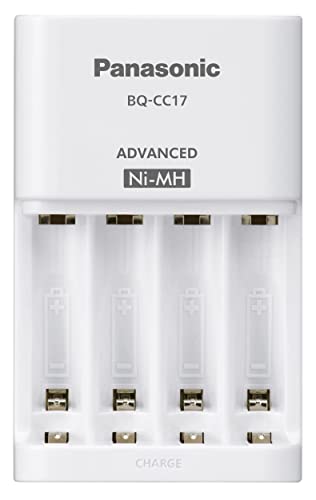
Panasonic BQ-CC17 eneloop Advanced Charger — The Benchmark
The BQ-CC17 is the charger Panasonic bundles with its eneloop cells, and after years on the market it remains the easiest recommendation in this category for a simple reason: it does the important things correctly and asks nothing of you. Four slots, each with its own channel and its own LED, accept AA or AAA NiMH cells in any combination. There are no modes, no buttons, no current settings. You insert cells, the lights come on, and each light goes out as its cell reaches full charge and the slot settles into doing nothing further — which is precisely the behaviour that keeps low-self-discharge cells like eneloop healthy across hundreds of cycles.
The trade for that simplicity is speed. The BQ-CC17 charges at a gentle rate, and a set of high-capacity AA cells can take the better part of a working day to fill. Panasonic’s own positioning treats that as a feature — lower current means less heat, and heat is what ages NiMH chemistry — and for overnight charging, which is how most households actually use these devices, the pace never matters. Where it does matter is the morning-of scramble before an event, and that scenario is exactly what the next pick exists for. Judged on its own terms — set it down, forget it, collect healthy cells — nothing else in this guide is as foolproof.
- Format: 4 bays, AA and AAA NiMH
- Channels: fully independent, one LED per slot
- Termination: per-cell detection with auto shut-off
- Input: direct mains plug, no separate adapter brick
- Extras: retractable prongs on some regional versions; check listing
Strengths
- Per-slot termination means a single AA for a clock charges as correctly as a matched set of four.
- No interface to misconfigure — visiting relatives and teenagers cannot set it wrong.
- Gentle charge current is kind to cell longevity, especially for premium low-self-discharge batteries.
Trade-offs
- Slow with high-capacity AAs; a depleted set is an overnight job, not a coffee break.
- Four bays only, which flash photographers and big families will outgrow quickly.
- LEDs report done-or-not and nothing more — no capacity or health information.
Best for: households moving to eneloop-style cells who want one correct, forgettable charger for remotes, controllers and clocks. Not suited for: anyone cycling more than four cells a day or needing a set charged before lunch.

Panasonic BQ-CC65 Super Advanced Charger — Fast With a Display
If the BQ-CC17 is Panasonic’s patient option, the BQ-CC65 is its impatient one — a four-position quick charger that keeps the eneloop line’s per-cell discipline while cutting charge times substantially, and adds an LCD panel that shows each slot’s state instead of reducing it to a single lamp. Watching individual cells progress changes how you use a charger: you stop pulling sets early out of uncertainty, you spot the one tired AAA in a rotation because its bar behaves differently from its siblings, and you learn your own fleet’s habits within a few weeks.
The BQ-CC65 also carries a USB output port, which sounds like a gimmick until a travel morning when the hotel room offers one reachable outlet and both your flash cells and your phone are low. It will not replace a proper fast phone charger, but as a bonus on a device that already owns the socket, it earns its keep. The cautions are the usual ones for quicker NiMH charging: faster means warmer, and warmth over hundreds of cycles is a slow tax on cell life, so owners who mostly charge overnight may still prefer the gentler unit above for their best cells and keep this one for working sets. As a single-charger household compromise, though, it is the strongest all-round Panasonic here.
- Format: 4 bays, AA and AAA NiMH (eneloop and eneloop pro)
- Display: LCD panel with per-slot status
- Channels: independent monitoring and termination
- Extras: USB charging port for a phone or small device
- Charge style: quick charging, faster than BQ-CC17
Strengths
- Noticeably shorter waits when a flash kit or controller set has to turn around the same day.
- The screen’s per-cell readout doubles as a rough health check for ageing batteries.
- USB output rescues single-outlet hotel rooms and crowded power strips.
Trade-offs
- Quicker charging runs cells warmer, which is a mild long-term cost versus the slow charger.
- Still only four bays — speed helps turnaround, not total fleet size.
- Costs more than the basic model while using the same basic slot layout.
Best for: photographers and gamers whose cells must be ready again within hours, and travellers who value the display and spare USB port. Not suited for: bulk fleets, or purists who charge premium cells as slowly as possible on principle.

Panasonic K-KJ17M3A4BA Charger Pack with 4 AAA eneloop — Starter Kit
Plenty of people do not need a charger recommendation so much as a starting point, and this pack is Panasonic’s: the same independent-channel charger sold under the BQ-CC17’s model family, bundled with four AAA eneloop cells ready to drop into a headlamp, a scale, a wireless presenter or the smaller remotes. Buying the bundle settles two compatibility questions at once — the cells are the exact chemistry and capacity class the charger was designed around, and eneloop’s low self-discharge means the set you charge in spring is still largely charged when autumn pulls the headlamp back out.
Read the listing carefully before ordering, because Panasonic sells several near-identical packs whose cell counts and sizes differ; this one’s value is the AAA bundle, and households whose devices lean AA should look at the AA-bundled sibling instead of buying AAA cells they will struggle to use. Beyond that caveat the advice is simple. This is the lowest-friction way to find out whether rechargeable life suits your household: one box, no decisions, and a charger that remains useful for years even if you later add a bigger unit, because a small trustworthy charger by the kitchen counter gets used in a way a sixteen-bay station in a cupboard does not.
- Format: 4-bay charger plus 4 AAA eneloop cells included
- Cells: eneloop AAA, low self-discharge, pre-charged
- Channels: independent, per-slot LED indication
- Chemistry: NiMH rechargeable only
- Use case: first rechargeable kit for small devices
Strengths
- Charger and cells arrive matched, removing the usual first-purchase guesswork.
- Included eneloops hold their charge on the shelf, suiting seasonal gadgets like headlamps.
- The charger itself is the well-regarded four-slot design, not a throwaway pack-in.
Trade-offs
- AAA-only bundle; AA-heavy households should pick the corresponding AA pack instead.
- Four cells is a starting set, not a rotation — heavy users will buy more within months.
- Same unhurried charge pace as the standalone BQ-CC17.
Best for: first-time rechargeable buyers kitting out AAA devices, and as a gift that actually gets used. Not suited for: anyone who already owns cells and needs bays, or AA-dominant device collections.

EBL 8-Bay Individual Charger — Double the Slots
EBL built its name selling rechargeable cells and chargers to people who found the big brands’ four-slot ceiling annoying, and this eight-bay unit is the straightforward answer: eight individually controlled slots for AA and AAA NiMH or NiCd cells, each monitored on its own so a half-empty cell and a flat one can share the unit without either being mistreated. For a family whose games controllers, fairy lights, toothbrushes and toys collectively chew through a dozen cells a week, doubling the bay count halves the queue — and the queue, more than raw charge speed, is what makes rechargeable systems feel like a chore.
EBL is a value brand and the review should be honest about what that means. The plastics and finish are workmanlike rather than premium, the indicator scheme is functional rather than informative, and long-term support depends on a smaller company than Panasonic. None of that prevents the charger from doing its stated job, and its per-slot independence puts it ahead of older pair-charging units from famous names. Treat it as a household appliance rather than a precision instrument: keep cells from the same purchase together where you can, retire any cell that runs hot or finishes oddly, and the EBL will move a lot of batteries for the money.
- Format: 8 bays, AA and AAA
- Chemistry: NiMH and NiCd rechargeable cells
- Channels: individual control per bay
- Indication: per-slot status lights
- Power: mains powered for the home counter or utility shelf
Strengths
- Eight independent bays clear a family-sized backlog in one overnight run.
- Accepts both NiMH and older NiCd cells that may still serve in garden lights.
- Cost per bay undercuts the premium brands by a wide margin.
Trade-offs
- Basic indicators tell you finished or not, with no progress or capacity detail.
- Build feel is utilitarian; this is a utility-room device, not a desk ornament.
- No analysing or refresh functions for reviving tired cells.
Best for: busy families and hobbyists whose weekly cell traffic outgrew a four-slot charger. Not suited for: photographers who want per-cell data, or anyone charging lithium cells of any shape.

EBL 16-Bay Charger with LCD Display — Bulk Handler
Sixteen bays changes the conversation from charging batteries to managing a fleet, and this EBL is built for the households and small venues that live there: the community theatre with twenty wireless-microphone transmitters, the photography studio cycling flash cells across weekend weddings, the holiday-let manager whose remotes and locks all run on AAs. Its LCD display reports slot status across the bank, which stops being a luxury at this scale — with sixteen cells in play, a screen that shows which are done is how you avoid the handful-left-charging-all-weekend mistake.
The headline fast-charging claim deserves the usual translation. Any multi-bay charger charges quickest with a few cells aboard; fill every slot and total current is shared, so a full sixteen-cell load takes proportionally longer than the marketing scenario. That is physics, not deception, and it matters only if your routine truly needs sixteen cells turned around in an hour — in which case the honest answer is two chargers, not a faster claim. Used as intended, loaded in the evening and emptied in the morning, this EBL is a sensible fleet appliance, and it reappears in our sixteen-bay guide where it belongs to that category outright.
- Format: 16 bays for AA and AAA NiMH cells
- Display: LCD status readout across slots
- Power: AC mains via plug cable
- Channels: per-bay charging control
- Role: high-volume household or small-venue fleet charging
Strengths
- One overnight session can refresh an entire microphone or flash-cell fleet.
- The display keeps sixteen simultaneous charges legible at a glance.
- Cost per bay is the lowest among the linked picks in this guide.
Trade-offs
- Full loads charge slower per cell than the headline rate suggests.
- Its footprint claims real counter space; small kitchens will resent it.
- Overkill, plainly, for a household with six rechargeable cells in total.
Best for: event, venue and studio users rotating dozens of NiMH cells weekly. Not suited for: minimalists, travellers, or anyone whose rechargeable habit fits in one hand.

BONAI 16-Bay AA AAA Charger — Simple Fleet Charging
BONAI’s sixteen-bay charger takes the opposite presentational route to the EBL above: no screen, just independent control across a long row of slots and an LED per bay to say where things stand. For charging stations that live in a cupboard, a classroom cupboard or a church hall’s tech drawer, that simplicity has real appeal — there is nothing to configure, nothing fragile to crack, and a volunteer who has never seen the unit can still load it correctly after one sentence of instruction.
Positioned honestly, BONAI is a generic-brand fleet charger and should be bought with generic-brand expectations: verify on arrival that every bay’s light behaves, keep the receipt, and let it prove itself on cheap household cells before trusting it with your best flash sets. Within those expectations it fills a genuine gap, because the famous names largely refuse to sell sixteen independent bays at consumer prices. If your problem is volume rather than data — school robotics clubs, escape rooms, rental gear — a simple, wide charger like this one, watched with ordinary care, solves it.
- Format: 16 bays, AA and AAA NiMH
- Control: independent charging per bay
- Indication: LED light for each slot
- Power: standard American AC plug
- Role: unattended fleet charging in shared spaces
Strengths
- Sixteen independently controlled bays without a premium-brand price.
- Dead-simple operation suits shared and volunteer-run charging stations.
- LED-per-bay feedback is enough to harvest finished cells without guesswork.
Trade-offs
- No display means no progress detail beyond each bay’s lamp.
- Generic-brand quality control varies; test all bays during the return window.
- Large body needs a permanent home rather than drawer storage.
Best for: clubs, venues and big households that need many bays and minimal fuss. Not suited for: cell-health tracking, travel, or buyers who want established-brand support.
How do the six chargers compare side by side?
| Charger | Bays | Channels | Feedback | Character |
|---|---|---|---|---|
| Panasonic BQ-CC17 | 4 | Independent | LED per slot | Slow, gentle, foolproof |
| Panasonic BQ-CC65 | 4 | Independent | LCD panel | Quick, informative, travel-friendly |
| Panasonic K-KJ17 pack | 4 | Independent | LED per slot | Starter bundle with AAA cells |
| EBL 8-Bay | 8 | Individual | Status lights | Family throughput on a budget |
| EBL 16-Bay LCD | 16 | Per-bay control | LCD display | Fleet charging with visibility |
| BONAI 16-Bay | 16 | Independent | LED per bay | Fleet charging, minimal interface |
Read the table by workload rather than by specification. Four bays serve a household that charges on rotation; eight serve one that charges in batches; sixteen serve a fleet with a schedule. Feedback scales the same way — a lamp is plenty for four cells and a strain for sixteen — which is why the two big units diverge on display versus simplicity, and why neither choice is wrong for the room it will live in.
Which charger fits which kind of household?
Walk through the homes these chargers actually land in and the right answer usually names itself. Consider the apartment with a games console, two controllers, a TV remote, a bathroom scale and a couple of headlamps: perhaps ten rechargeable cells in total, charged in twos and fours whenever something dies. That household will never feel the BQ-CC17’s four bays as a limit, and it will feel the benefit of its gentleness every year those same cells keep going. Buying sixteen bays for that drawer is not future-proofing; it is furniture.
Now consider the house with three children, where AA and AAA cells power a small civilisation of toys, torches, night-lights, walkie-talkies and a robot vacuum’s remote that nobody can find. Cells come back in handfuls, usually all on the same evening, usually because several devices died within hours of each other. Here the queue is the enemy, and the EBL eight-bay earns its shelf space — not because it charges any single cell better, but because the whole handful goes on at bedtime and comes off at breakfast, and the system survives contact with a busy family’s patience.
The third household is not a household at all: it is the amateur theatre, the wedding photographer, the school with a cupboard of wireless microphones, the escape room resetting props between groups. Cells there are consumables with a schedule, and the cost of a flat battery is not inconvenience but a failed event. Sixteen bays, a labelled charging shelf and a strict charged-versus-spent box system are professional equipment in that world, and the EBL or BONAI units pay for themselves against disposable alkalines within a single season of shows. Notice that none of these three answers is “the best charger” in the abstract — each is the best match between bay count, feedback and the rhythm of the place it serves, which is why this guide refuses to crown one winner for everybody.
A fourth, quieter case deserves a sentence: the elderly relative’s home, where the charger will be operated by someone who neither knows nor cares what a milliamp is. For that counter, foolproof beats capable every time — the charger with no settings, no modes and a light that simply goes out. Several buying decisions in this category are really decisions about who else will touch the device, and the honest guide says so.
What do charge rates and termination methods actually mean?
Charger specifications speak a dialect worth learning once, because it explains every price difference in this guide. Charge rate is expressed in milliamps or as a fraction of the cell’s capacity, written C. A 2,000 mAh AA charged at 0.5C receives about 1,000 mA and fills in roughly two hours plus losses; at 0.1C it receives 200 mA and takes most of a day. Slow is not automatically kind and fast is not automatically cruel — what damages NiMH cells is heat and overcharge, and a well-designed fast charger that watches each cell and stops decisively can be gentler in practice than a crude slow one that trickles on forever.
Termination is the moment the charger decides a cell is full, and it is where cheap chargers earn their bad reputation. Timer-based units guess: they push current for a fixed number of hours calibrated for one assumed capacity, then stop — undercharging big cells and overcooking small or partly-full ones. Smarter units watch for negative delta V, the tiny voltage dip a NiMH cell shows at full charge, and cut off there; better ones cross-check with temperature rise and a hard timer backstop. Every pick in this guide uses per-cell sensing rather than a blind clock, which is precisely why a half-charged cell can be topped up safely on them while the same act slowly ruins cells on a timer box.
Trickle behaviour after termination separates careful designs from lazy ones. The kindest chargers simply stop, or drop to a maintenance current so low it merely offsets self-discharge. The lazy kind keep pushing a meaningful current indefinitely, which is why the old advice never to leave batteries on the charger existed. Modern low-self-discharge cells complicate the picture helpfully: an eneloop left off the charger loses so little per month that maintenance charging barely matters, one more reason the simple Panasonic units age so gracefully in real homes.
Finally, capacity numbers deserve a calm eye. A cell labelled 2,500 mAh and one labelled 1,900 mAh are not automatically better and worse; the lower-capacity eneloop-style cell typically survives far more cycles and holds its charge on the shelf far longer. Chargers cannot change that trade — they can only avoid ruining whichever side of it you chose. Buy cells for your pattern of use, then let any pick here treat them properly.
How should you store and rotate cells between charges?
Storage is where rechargeable systems quietly succeed or fail, because cells spend ninety percent of their lives waiting. Keep them in a cool, dry place — a drawer away from radiators and sunny sills — and keep them in the small plastic cases they often ship with, or a divided box, rather than loose in a metal-tin jumble where terminals can bridge against coins and keys. A short circuit in a drawer will not usually cause drama with NiMH the way it can with lithium, but it will silently empty and sometimes damage the cell, and the failure surfaces later as a mystery.
Rotation discipline is the second half. Work in sets: cells bought together, marked together, used together in the same device, charged together. Series devices — flashes, toys, anything taking two or four cells in a row — are only as strong as their weakest member, and a set keeps its members ageing in step. When one cell in a set dies, the honest options are to retire the set to single-cell duty in clocks and remotes, or recycle the lot; promoting a stranger into the set restarts the mismatch problem that independent charging worked to solve.
Charge level for storage is a smaller question than the internet suggests. NiMH chemistry is tolerant: storing cells charged is fine for low-self-discharge types, and storing them part-charged harms nothing over household timescales. What matters more is the seasonal audit — once or twice a year, charge everything, note any cell a smart charger flags or that runs oddly warm, and recycle the suspects. Ten minutes of ruthlessness a year is the entire maintenance burden of a well-run AA and AAA drawer, and it is why the people who adopt these systems rarely go back to buying disposables by the gross.
What mistakes shorten rechargeable battery life?
The classic error is the one this guide opened with: putting ordinary alkaline cells on charge. Beyond the safety risk, it never works — alkalines are not rechargeable in any meaningful household sense, whatever a viral video claims. Close behind comes mixing old and new cells in series devices, then blaming the charger when the weak cell drags the set down; chargers fill cells, they cannot equalise a mismatched team inside your flash.
Heat is the slow mistake. Charging in a sunlit window, in a drawer with the door shut, or stacked under other electronics adds degrees that NiMH cells repay in lost capacity. So does the habit of leaving finished cells sitting on a dumb charger for days — the smart units here stop properly, but the discipline of unloading within a day costs nothing. Finally, respect the odd cell that behaves strangely: hot, leaking, rusted at the terminal or finishing in minutes. Retire it to battery recycling. A charger is only ever as safe as the worst cell you feed it.
How should you build a charging routine that lasts?
Start by labelling. A fine marker dot or a dated sticker on each cell, applied the day it arrives, turns your drawer from a mystery pile into a rotation you can manage: same-age cells work together, and the cell that starts failing identifies itself by date. Keep charged spares in a separate small box from discharged ones, and never let the two populations mix — half of all rechargeable frustration is simply not knowing which cells are full.
Charge where you can see the charger, on a hard surface with air around it, and make overnight the default session. Once a season, run a deliberate audit: any cell that a smart charger flags, that self-discharges within a fortnight, or that cannot run its usual device for its usual span goes to recycling, not back into rotation out of thrift. That small ruthlessness is what keeps a rechargeable system feeling better than disposables instead of slowly becoming worse.
When is the charger the problem, and when is it the cells?
Owners routinely replace the wrong half of the system. The symptoms divide cleanly once you know what to look for. If every set of cells seems to die young regardless of brand, if runtimes shrank across the whole drawer over a few months, or if cells come off the charger suspiciously hot, suspect the charger first — especially if it is an old timer-based unit or a pair-charger that has been force-feeding mismatched sets for years. A charger that overcharges does not announce itself; it simply taxes every cell that passes through it, and swapping in premium new batteries only feeds better victims to the same fault.
If, instead, one device disappoints while others run fine, or one marked set fades while its same-age siblings hold up, the cells are confessing. NiMH batteries do wear out: internal resistance climbs, capacity shrinks, self-discharge accelerates, until a cell that once ran a flash for an evening barely runs it for an hour. No charger in this guide — or anywhere — reverses that chemistry. The diagnostic habit worth building is the swap test: move the suspect set into a device that behaves well with other cells. Blame follows the component that carries the problem with it.
There is also a middle case nobody warns about: contact trouble. Oxidised terminals on cells or charger springs add resistance that mimics both faults at once, producing hot spots, early termination and erratic lights. A pencil eraser on the cell ends and the charger’s contacts, once a year, cures a surprising share of “my charger died” stories. Try the eraser before the shopping cart.
What does a year of rechargeable life actually look like?
Picture the system settled in, because the settled state is the product you are really buying. The charger lives on a shelf near where devices die — kitchen counter end, utility room, hall cupboard — plugged in permanently, empty most days. Cells live in two small boxes beside it, marked in effect if not in words: ready, and waiting. A controller dies on a Friday night; two cells swap from the ready box, the dead pair goes onto the charger Saturday morning while coffee brews, and by lunch they are in the waiting box’s front row, which everyone in the house understands without a manual.
The year’s dramas are tiny and that is the point. A headlamp before a winter trip gets fresh cells and the spares ride in a coat pocket. A toy at Christmas arrives with a note in the family chat that it takes AAs and the drawer has it covered, so nobody buys the emergency blister pack at petrol-station prices. Twice, a cell misbehaves — finishes in minutes, runs warm — and gets dropped in the recycling tube by the door, its set-mates demoted to remote duty. The charger itself is never discussed, which is the highest praise household infrastructure can earn.
Set against that, the disposable alternative is a year of small frictions: the drawer of half-dead alkalines nobody can assess, the midnight run for batteries, the leak discovered in a stored torch in October. None of it is ruinous, all of it is avoidable, and the avoidance costs one decent charger and a labelled box. That is the whole argument of this guide, and why the cheapest adequate charger used consistently beats the finest one left in its packaging.
Which cells should you buy to go with the charger?
A charger guide that ignores cells is half a guide, because the two halves of the system set each other’s ceiling. For most household duty, low-self-discharge NiMH cells of the eneloop type are the default worth defending: they arrive charged, they keep most of that charge across months in a drawer, and they tolerate the stop-start life of remotes and controllers gracefully. Their rated capacity is lower than the biggest numbers on the shelf, and in a remote that difference is meaningless — the cell will be swapped for its calendar age or a seasonal audit long before raw capacity becomes the limit.
High-capacity cells earn their place where runtime per charge is measured and mourned: camera flashes at events, powerful torches, RC transmitters, anything that can empty a cell in a day of honest work. There, the extra capacity is real and the costs — faster self-discharge, typically fewer total cycles — are acceptable because the cells are charged the night before and used the next day anyway. The mistake is buying high-capacity cells for the whole house out of a bigger-is-better reflex, then wondering why the spares in the drawer are always mysteriously flat.
Whatever line you choose, buy cells in sets of the count your devices actually take, from a seller you trust, and be suspicious of capacity claims that leap far beyond what the established makers offer at the same size — physics sets the ceiling for a AA cylinder, and listings that promise double the leaders’ numbers are describing a label, not a battery. Date each set on arrival. That tiny habit, plus any charger in this guide, is ninety percent of rechargeable success.
Can you travel with these chargers?
Yes, with two practical notes. First, input voltage: many Panasonic and EBL units sold for the US market are wound for North American mains, so check the rating printed on the body before packing one for a continent on 230 volts — a dual-voltage model travels freely, a single-voltage one needs a converter rather than a mere plug adapter, and confusing the two is a classic way to kill a charger on night one. Second, airline rules treat loose rechargeable cells kindly compared with lithium, but the tidy habit still applies: cells in their case, terminals protected, charger in the cabin bag if the cells are in it.
For travel specifically, the BQ-CC65’s USB port and compact four-bay shape make it the natural pick of this six, while the sixteen-bay units should stay home where their fleet lives. Travellers who run camera flashes abroad sometimes carry two small chargers instead of one large one, so a failure or a forgotten bag never zeroes the kit — a redundancy logic that applies to far more expensive equipment too.
How do heat, cold and time change the way cells charge?
NiMH chemistry has a comfort zone, roughly ordinary room temperature, and both ends of the thermometer bend its behaviour. In a cold garage in January, cells accept charge reluctantly and their voltage behaviour confuses marginal chargers into early termination — the set comes off reading full and dies young in the device. In a hot room in August, the voltage dip that signals full charge grows faint, and chargers that rely on it alone can overshoot, which is one reason the better designs in this guide cross-check temperature and time rather than trusting a single signal. The household translation is simple: charge indoors, in the rooms you live in, and both problems mostly vanish.
Time bends things too, in the form of self-discharge. Every NiMH cell loses charge sitting still; standard cells can shed a noticeable share within weeks, while low-self-discharge designs stretch that same loss across many months. This is why the spares box matters and why cell choice should follow the device’s rhythm: a torch used nightly never notices self-discharge, while the emergency radio touched twice a year lives or dies by it. Match the cell to the calendar, not just to the device.
Age is the third variable and the least sentimental. A cell’s hundredth charge is not its first, and capacity fades gradually rather than failing on a schedule, which is why the dated-set habit keeps paying off — you can see the fade coming in runtimes, plan replacements around it, and never have the whole drawer reach old age in the same month because you bought it all on the same day. Stagger purchases the way you stagger the sets, and the system renews itself in small, cheap steps forever.
What about shared charging stations at work or school?
Shared spaces add one variable the home never has: other people’s habits. A charging shelf in a staff room, a media department or a scout hall works only when the rules fit on an index card taped above it — charged cells live in the green box, spent cells go in the red box, nothing goes on the charger that is not in a labelled set, and anything hot, leaking or dented goes straight to the recycling tube. The sixteen-bay units in this guide suit these stations precisely because their per-bay independence forgives the reality that five different people loaded them.
Keep a small log, even a notebook page, of when sets were bought and when any cell was retired; fleets beyond twenty cells outgrow anyone’s memory, and the log turns arguments about which batteries are “the good ones” into a thirty-second lookup. It also reveals the true cost per year of the system, which is usually so low that the log-keeper becomes the office bore on the subject of rechargeable economics.
Label the charger itself, too, with its chemistry rule in plain language: NiMH and NiCd rechargeables only, never ordinary batteries. In a shared drawer there will always be one person who tries to charge an alkaline because it fits, and the sign is cheaper than the incident. Schools and clubs running fleets should also nominate one owner for the seasonal audit described earlier — shared equipment with no named owner drifts, and drift in a battery fleet ends with every device failing during the same important week.
Final Recommendation
Most households should buy the Panasonic BQ-CC17 and stop thinking about chargers for a decade: it is gentle, independent and impossible to misuse. Step up to the BQ-CC65 when your cells work for a living and turnaround time is real, or when the display’s quiet health reports appeal to you. The K-KJ17 pack is the right first box for AAA-heavy homes. Beyond four bays, let workload decide — the EBL eight-bay for families, either sixteen-bay unit for fleets, with the EBL’s screen earning its place wherever many hands share the charging shelf. Whichever you choose, keep alkalines out of it, keep cells in dated sets, and let each slot finish its own cell in its own time — that patience, more than any specification, is what a decade of healthy batteries is made of.
Frequently Asked Questions
Can these chargers recharge regular alkaline batteries?
No, and attempting it is the one genuinely dangerous misuse in this category. Alkaline cells are primary batteries, designed to be discharged once; pushing current back into them can cause leakage, swelling or rupture. Only cells marked rechargeable — NiMH or NiCd for these units — belong in the slots.
Is it bad to charge just one battery at a time?
Not on any charger in this guide. Independent channels exist precisely so that one, two or three cells can charge correctly without a partner. It is pair-wired chargers, absent from our picks, that force you to fill slots in twos.
Why do my rechargeable AAs run out faster than disposables in some devices?
NiMH cells deliver about 1.2 volts against an alkaline’s 1.5, and a few devices — some older cameras and high-drain toys — interpret that lower voltage as a nearly empty battery. In most modern gear the NiMH’s flatter discharge curve wins over a full run; where a specific device complains, it is a device quirk, not a charger fault.
How long should a good NiMH cell last?
Quality low-self-discharge cells are rated for hundreds to thousands of cycles depending on the line, but real lifespan depends on heat, drain depth and charging manners. With a per-cell charger like the ones here and sane storage, expecting several years of household service is reasonable.
Can I mix AA and AAA cells in the same charging session?
On the independent-channel units in this guide, yes, where each slot accepts either size — every bay manages its own cell. What you should not mix is chemistry or wildly different capacities within a series-powered device later; charging together is fine, working together is the stricter test.
Do I need to fully discharge NiMH batteries before recharging?
No. The memory effect associated with old NiCd practice barely applies to modern NiMH, and routinely running cells flat shortens their life. Top up when convenient; an occasional full cycle in normal device use is all the exercise they need.
Should I throw away cells that a charger refuses or flags?
Usually, yes — a modern smart charger flagging a cell is reporting high internal resistance, a short, or voltage behaviour outside what healthy NiMH chemistry produces, and coaxing such a cell back rarely restores real capacity. Clean its terminals once and retry in a different bay to rule out a contact problem; if the verdict repeats, send the cell to battery recycling rather than back into a device, where it will fail at the least convenient moment and may drag its set-mates down with it.
Related Guides
Charging more cells than a countertop unit can handle? Our companion roundup of sixteen-bay chargers for serious battery fleets goes deeper on that class. If your drawer also holds cylindrical lithium cells for torches, read the 18650 charger guide with its full safety section before buying anything, and for the vehicle side of the charging world see our guide to 12-volt battery chargers and maintainers.
Related guides
- Best 3rd Party MacBook Chargers: 96W-Class Alternatives, the 100W Cable Rule, and the Apple Benchmark
- Best Canon Point and Shoot Digital Cameras: PowerShot Picks From Pocket Compacts to Travel Zooms
- Best Balancing Stabilizers for Mirrorless Cameras: Payload, Balancing and Native Vertical Shooting
- Best Basic Phones Camera Buyers Can Trust: Flip Phones and Simple Handsets That Still Take a Photograph



[…] reading: our guide to the best 10 amp battery chargers, our roundup of the best 12v solar trickle chargers for boats without shore power and our selection […]