What's inside
- Key Takeaways
- Quick Picks
- How Did We Choose These Picks?
- What Should $500 Buy You in a Pair of Home Speakers?
- Which of These Six Speakers Fits Your Room and Your Budget?
- Bookshelf or Tower: Which Shape Should Carry This Budget?
- What About Amplification, Sources and the Rest of the Chain?
- Which Listener Should Buy Which Pick?
- How Does Voicing Differ Across These Six?
- How Do the Six Compare Side by Side?
- How Should You Set Up a Pair at This Level?
- What Mistakes Do Buyers Make at This Budget?
- How Should You Actually Shop This Budget, Step by Step?
- Final Recommendation
- Frequently Asked Questions
- Related Guides
As an Amazon Associate I earn from qualifying purchases. This post may contain affiliate links at no extra cost to you.
gizmoverdict.com is reader-supported. When you buy through links on our site, we may earn an affiliate commission.
Where to buy: Every pick below links to a listing verified in this site’s product pool. Read the labels before the badges: three of these speakers are sold as complete pairs, two towers are priced per single speaker, and one tower pair deliberately stretches past the budget in the keyword. The per-speaker pricing is flagged everywhere it appears, because it changes the arithmetic of this entire guide.
The best $500 speakers are not a product category so much as a negotiation. Five hundred dollars, treated honestly as the price of a pair of home speakers, sits at the most contested altitude in hi-fi: high enough that genuine engineering lives there, low enough that every manufacturer must choose what to sacrifice. Cabinet or drivers? Bass extension or midrange clarity? A tower’s physical presence or a bookshelf’s refinement? Nobody gets everything at this level, and the honest guides are the ones that tell you which compromise each speaker has made on your behalf.
One accounting rule governs everything that follows, and it is stated now so it cannot ambush you later. The $500 frame in this keyword is read as the cost of a working pair of speakers for a home stereo or home-theater front stage. Listings in this market are not uniform about what a purchase contains. Some are true pairs in one box. Others — most floorstanding towers among them — are priced per individual speaker, so the pair on your floor costs roughly double the number on the listing. Two of the six picks below are sold that way, and both are labelled as exceeding the frame as a pair. They are included because shoppers meet them constantly while searching this budget, and meeting them unlabelled is how budgets quietly double.
The bench that results spans the real shapes of this decision. Three verified pairs sit inside or near the frame: two ELAC bookshelf models from the same Debut 2.0 family at two sizes, and Q Acoustics’ current 3020c, the successor generation to a long-running compact favourite. Against them stand the towers: Klipsch’s RP-6000F and Polk’s Signature Elite ES60, each priced per speaker, each representing the dynamics-and-scale argument for spending past the frame, and SVS’s Prime Tower, sold as a pair but positioned as a stretch beyond it. Six speakers, three honest relationships to the budget, and one guide that refuses to blur the difference.
Key Takeaways
- The $500 frame in this guide means a complete pair of home speakers; any pick priced per single speaker is labelled as exceeding it.
- Three picks are true pairs: the ELAC Debut 2.0 B6.2, the ELAC Debut 2.0 B5.2 and the Q Acoustics 3020c.
- The Klipsch RP-6000F and Polk ES60 are each sold per speaker, so a stereo pair of either lands well beyond the frame.
- The SVS Prime Tower is sold as a pair but sits above the frame — it is the deliberate stretch pick, not a hidden one.
- Every pick here is passive: budget separately for an amplifier or AV receiver if you do not already own one.
- Bookshelf picks need stands or suitable furniture; tower picks need floor space and breathing room from walls.
Quick Picks
| Pick | Badge | Why it earns its place |
|---|---|---|
| ELAC Debut 2.0 B6.2 | The pair that fits the brief — sold as a pair | A 6.5-inch aramid-woofer bookshelf pair that spends the frame on balance and bass reach rather than flash. |
| Q Acoustics 3020c | The compact-room choice — sold as a pair | The current c-generation of Q Acoustics’ small bookshelf line, voiced for clarity in rooms where towers cannot go. |
| ELAC Debut 2.0 B5.2 | The smaller-room ELAC — sold as a pair | The B6.2’s 5.25-inch sibling: same family thinking, less low-end weight, easier placement near walls and desks. |
| Klipsch RP-6000F | The tower temptation — priced PER SPEAKER, pair exceeds the frame | A horn-loaded floorstander with Klipsch’s trademark liveliness; order two and the budget roughly doubles. |
| Polk Signature Elite ES60 | The big-tower stretch — priced PER SPEAKER, pair exceeds the frame | Polk’s flagship Signature Elite tower with three woofers and Power Port bass, sold one cabinet at a time. |
| SVS Prime Tower | The stretch pair — sold as a pair, above the frame | A true pair of towers from a subwoofer-famous brand, for buyers who decide the frame was a guideline. |
How Did We Choose These Picks?
The first filter was accounting, not sound. Every candidate listing was read for what a purchase actually contains — pair, single speaker, or something stranger — because a guide to a fixed budget that ignores pack quantity is fiction. Speakers sold per single unit were not excluded; at this level, towers are very commonly priced that way, and pretending otherwise would empty the category. Instead they were kept and labelled, so the reader’s arithmetic is never worse than the guide’s.
The second filter was verification. Each linked pick corresponds to a listing confirmed through this site’s product pool under its exact current model name. That discipline matters in this segment: ELAC’s Debut 2.0 line replaced an earlier Debut generation with similar names, and the Q Acoustics pick is the 3020c — the current c-series model — not the older 3020i that older reviews describe. Where a model’s name has changed across generations, this guide uses the name on the verified listing.
The third filter was coverage of the real decision. A $500 speaker shopper is choosing among shapes as much as brands: compact bookshelf, larger bookshelf, or tower; near a wall or out in the room; stereo music first or front-stage home theater first. The six picks were arranged to make those trade-offs visible rather than to crown one winner for a room the guide has never seen. Two ELACs at two sizes show what cone area buys. The Q Acoustics shows what a smaller, placement-friendly cabinet does instead. The three towers show three different prices of admission to floorstanding scale — two of them honestly doubled by per-speaker pricing, one of them a pair that simply costs more than the frame allows.
Finally, everything here is passive. That is not an oversight; it is the shape of this market. Serious powered speakers exist, but the $500 home-speaker conversation is overwhelmingly about passive pairs driven by an amplifier or receiver the buyer already owns or plans to buy. The guide treats amplification as part of the real budget throughout, and returns to it in the mistakes section, because a pair that consumes the entire frame leaves nothing for the electronics that make it sing.
What Should $500 Buy You in a Pair of Home Speakers?
Start with what the money is physically purchasing. In a bookshelf pair at this level, the frame buys a properly braced cabinet, a woofer in the five-to-six-and-a-half-inch class with a cone material the maker can brag about — woven aramid fibre in the ELACs’ case — a dome tweeter with a considered waveguide or surround, and a crossover built from real components rather than the cheapest possible network. None of that is glamorous. All of it is audible, mostly as an absence: no cabinet buzz at volume, no hard edge on voices, no sense that loud passages are an imposition.
In a tower, the same money buys cabinet volume, and cabinet volume buys bass extension and efficiency of effort. A floorstander does not need stands, presents its drivers at seated ear height by design, and moves air with less strain at film-soundtrack levels. What it asks in return is floor space, distance from walls, and — in the per-speaker listings that dominate this class — a budget roughly twice the sticker the search results first show you. The tower question at this frame is therefore never just sonic. It is whether the room, the layout and the true pair price all say yes at once.
Expect, at this level, speakers that reward decent amplification without demanding exotic electronics. Expect voicing differences that are real but not enormous: one maker’s lively and forward, another’s smooth and relaxed, a third’s neutral and studio-leaning. Expect finish quality that looks considered across a room and merely fine up close. And expect the law of the segment: the last increment of bass and scale is the expensive one, which is exactly why the stretch picks exist and why they are labelled rather than hidden.
Expect, too, a segment where the second-hand temptation is strong and deserves a cool head. Used examples of older generations circulate constantly at this altitude, sometimes wearing names a single letter away from the current models in this guide. A used speaker can be a bargain; it can also be a previous owner’s problem with a fresh photograph. The verified listings in this guide are the reference point: whatever else you consider, compare its exact model string, its sold-as basis and its condition against a pick whose identity has been pinned down, and let any saving justify itself against the certainty of buying the current model new.
Which of These Six Speakers Fits Your Room and Your Budget?

ELAC Debut 2.0 B6.2 — The pair that fits the brief
The B6.2 is the pick this keyword seems to have been written for: a complete pair, in one purchase, that spends the frame on the fundamentals. Its 6.5-inch aramid-fibre woofer is the largest cone among the bookshelf picks here, and that area shows up as composure — bass lines with shape rather than thump, male voices with chest behind them, and a general refusal to sound strained when a film score swells. The Debut 2.0 generation was ELAC’s ground-up revision of a line that had already earned its reputation, and the B6.2 carries the family’s signature quality: a voicing that flatters nothing and hides nothing, which makes it a speaker owners tend to keep through several electronics upgrades.
Placement is where the B6.2 asks for a little respect. It is a substantial bookshelf cabinet, happiest on proper stands with space behind it rather than shoved onto a crowded shelf against a wall. Given that room, its scale surprises people who equate bookshelf with small sound. Denied that room, it can thicken in the bass — the classic large-bookshelf compromise, and the reason its smaller sibling appears later in this guide. For a main stereo pair in a medium room, though, this is the bench’s most complete answer to the brief as written: pair-priced, frame-respecting, and engineered without an obvious corner cut.
- Format: passive bookshelf speaker, sold as a pair
- Drivers: 6.5-inch aramid-fibre woofer, 1-inch cloth dome tweeter
- Needs: amplifier or AV receiver; stands recommended
- Budget status: a true pair inside the frame
Strengths
- Bass weight and midrange body that belie the bookshelf format.
- Honest, even voicing that suits music and dialogue equally.
- Sold as a pair — the listing price is the pair price.
Trade-offs
- Needs stands and rear space to sound its best.
- Cabinet is plainly finished rather than furniture-pretty.
- Can sound thick when trapped against a wall on a shelf.
Best for: a main stereo or front pair in a medium room, bought once and kept. Not suited for: desktop duty or shelf-against-wall placement.

Q Acoustics 3020c — The compact-room choice
Name discipline first: this is the 3020c, Q Acoustics’ current c-series bookshelf model — not the 3020i that a decade of reviews describes. The c generation revised the cabinet and driver thinking of a line whose entire reputation rests on making small speakers sound civilised, and the 3020c continues that argument with a 4.75-inch bass driver in a cabinet sized for real rooms rather than showroom fantasies. It is the pick for the listener whose space is measured in compromises: a living room where speakers share furniture, a bedroom system, a smaller flat where towers would be furniture with delusions.
What the 3020c trades away is obvious — deep bass — and what it keeps is the reason it exists. Voices are its home ground: podcasts, dialogue-heavy television, acoustic recordings and anything else that lives in the midrange comes through with a clarity that larger, cheaper speakers often smear. It is also the most forgiving pick here about placement, content closer to walls and on real shelves than the bigger bookshelf models. Pair it later with a subwoofer if the room grows; as a pair inside the frame, it is the choice that respects both the budget and the architecture of smaller homes.
- Format: passive bookshelf speaker, sold as a pair
- Drivers: 4.75-inch bass driver, 0.9-inch tweeter
- Needs: amplifier or AV receiver
- Budget status: a true pair inside the frame
Strengths
- Midrange clarity that flatters voices and dialogue.
- Compact cabinet that fits shelves and smaller rooms honestly.
- More placement-tolerant than the larger bookshelf picks.
Trade-offs
- Limited deep bass — large-scale music wants a subwoofer’s help.
- Smaller scale at high volume in big rooms.
- Current c model — do not confuse listings with the older 3020i.
Best for: smaller rooms, shelf placement and voice-led listening. Not suited for: bass-led music in a large open-plan space without a subwoofer.

ELAC Debut 2.0 B5.2 — The smaller-room ELAC
The B5.2 is the B6.2’s thinking in a smaller box: the same Debut 2.0 family, the same aramid-fibre approach, wrapped around a 5.25-inch woofer instead of the 6.5. That inch and a quarter of cone is the whole story of the difference. The B5.2 gives up some low-end authority and some sheer scale, and in exchange it becomes easier to place, easier to drive in small rooms without boom, and the natural choice for surround or secondary-system duty in a house that already likes the ELAC sound. Families of speakers exist so that rooms of different sizes can share one voicing, and this pair is the smaller-room expression of the guide’s lead pick.
Judged alone rather than against its sibling, the B5.2 is a balanced, unfussy speaker that does the midrange honestly and never embarrasses itself at the frequency extremes. It suits the buyer who measured the shelf, the desk-adjacent setup, the spare room that became an office — spaces where the B6.2’s cabinet is simply too much furniture. It also makes a shrewd surround-channel partner in a Debut-based home theater, where its job is effects and ambience rather than foundations. What it should not be asked to do is anchor a large room’s stereo system on its own; that is the larger model’s brief, and pretending otherwise serves nobody.
- Format: passive bookshelf speaker, sold as a pair
- Drivers: 5.25-inch aramid-fibre woofer, 1-inch cloth dome tweeter
- Needs: amplifier or AV receiver
- Budget status: a true pair inside the frame
Strengths
- Same family voicing as the B6.2 in a smaller, easier cabinet.
- Well behaved near walls and in compact rooms.
- Natural surround or second-system partner in an ELAC setup.
Trade-offs
- Less bass reach and scale than its larger sibling.
- Not the anchor for a big room’s main system.
- Shares the family’s plain finish.
Best for: small rooms, desks-adjacent setups and ELAC-based surround duty. Not suited for: filling a large room as the only pair.

Klipsch Reference Premiere RP-6000F — The tower temptation, priced per speaker
The label before the love letter: the RP-6000F listing is priced for one speaker. A stereo pair costs roughly twice the frame this guide is built on, and any shopper who falls for this tower should do so with that arithmetic open on the table. What the money buys is Klipsch’s Reference Premiere argument in floorstanding form — a horn-loaded tweeter that gives the brand its famous liveliness and efficiency, copper-spun woofers that announce themselves visually before a note plays, and a cabinet that fills a room with sound at amplifier levels that would leave other speakers clearing their throats. Klipsch speakers ask little power to go loud, and they go loud with an ease that makes film nights feel like events.
The honest cautions are two. First, the budget: as a pair, this is not a $500 purchase in any reading, and the guide will not pretend the frame stretches to cover it. Second, the voicing: that horn-driven presence is a flavour some listeners adore and others find forward over long sessions, which makes the RP-6000F the pick most worth hearing before committing. It earns its place here because searches at this budget surface it constantly, because its per-speaker pricing is exactly the trap this guide exists to flag, and because — budget honestly doubled — it is a genuinely thrilling tower for rock, film and anything that benefits from scale delivered without strain.
- Format: passive floorstanding tower, sold PER SPEAKER
- Drivers: horn-loaded tweeter with 6.5-inch-class woofers
- Needs: amplifier or AV receiver; floor space and wall clearance
- Budget status: pair exceeds the frame — order two and the frame roughly doubles
Strengths
- Effortless dynamics and volume from modest amplification.
- Horn clarity that cuts through film mixes and busy rooms.
- No stands to buy; drivers sit at seated ear height by design.
Trade-offs
- Priced per speaker — the pair breaks the frame outright.
- Forward voicing divides listeners on long sessions.
- Tower footprint and rear clearance are non-negotiable.
Best for: buyers who accept the doubled budget for horn-driven scale and film impact. Not suited for: anyone whose $500 must actually cover the pair.

Polk Signature Elite ES60 — The big-tower stretch, priced per speaker
Polk’s ES60 carries the same accounting warning as the Klipsch, in larger type: the listing is for a single tower. It is the flagship of the Signature Elite line — three 6.5-inch woofers under a one-inch tweeter, with Polk’s Power Port bass design firing downward to load the room more evenly and sit closer to walls than a conventional rear port tolerates. As an object and as an instrument it is the most ambitious speaker in this guide, and as a pair it is also the furthest from the frame. Both facts belong in the same paragraph, always.
Why include it at all? Because the ES60 is what the top of this search looks like, and because its argument is coherent: if the speakers are a decade-long purchase and the room is large, a pair of full-range towers removes the subwoofer question for most music and much film, presents a front stage of genuine physical scale, and does it with a smoother, less divisive voicing than the horn-loaded alternative. The guide’s job is not to sell that argument — it is to price it honestly. Read as a pair, the ES60 is a stretch-goal speaker for a buyer whose frame was aspirational. Read as the listing’s single unit, it is the classic way a $500 search becomes a four-figure checkout, and the label exists so that choice is made awake.
- Format: passive floorstanding tower, sold PER SPEAKER (Single)
- Drivers: 1-inch tweeter with three 6.5-inch woofers, Power Port bass
- Needs: amplifier or AV receiver with real current for a full-range tower
- Budget status: pair exceeds the frame by the widest margin here
Strengths
- Full-range scale that covers most music without a subwoofer.
- Power Port design is kinder to near-wall placement than rear ports.
- Smooth flagship voicing suited to long mixed listening.
Trade-offs
- Single-speaker pricing — the pair is a different budget entirely.
- Largest footprint in the guide; needs a room that fits it.
- Deserves amplification with genuine current behind it.
Best for: large rooms and decade-long front stages, budget knowingly expanded. Not suited for: frame-strict shoppers or small rooms.
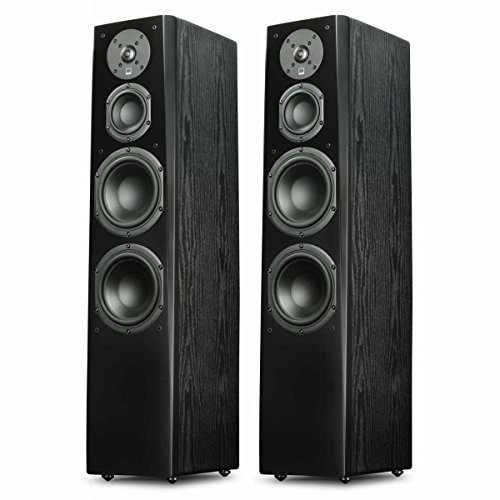
SVS Prime Tower — The stretch pair
The Prime Tower resolves the accounting tension differently: it is sold as a pair, honestly, and the pair simply costs more than the frame. SVS built its name on subwoofers and carried that low-frequency seriousness into its Prime speaker line; the Tower is the line’s floorstanding expression, a three-way design in the brand’s Premium Black Ash finish that aims for the neutral, full-range presentation of speakers from the class above. Of the three towers here, it is the one whose purchase contains no surprises — one listing, two towers, a total the buyer can read in a single glance, provided the glance registers that the total sits beyond $500.
Its inclusion is a judgement call the guide makes openly. Some shoppers set a frame as a ceiling; others set it as a centre of gravity and will move for the right pair. For the second kind, the Prime Tower is the stretch that makes sense: pair-priced transparency, tower scale without horn flavouring, and a voicing that pairs naturally with the subwoofers the brand is famous for if the system grows. For the first kind — ceiling shoppers — the honest answer remains the ELAC B6.2, and the Prime Tower’s role in this guide is to mark the border clearly: cross it knowingly, for these reasons, or not at all.
- Format: passive floorstanding towers, sold as a PAIR
- Design: three-way tower in Premium Black Ash
- Needs: amplifier or AV receiver; floor space and placement care
- Budget status: a true pair priced above the frame — the labelled stretch
Strengths
- Pair pricing with no per-speaker surprise at checkout.
- Full-range tower scale with a neutral, even presentation.
- Natural upgrade path within a subwoofer-famous brand’s ecosystem.
Trade-offs
- Above the frame as a pair — a deliberate overspend.
- Towers need floor space the bookshelf picks do not.
- Neutral voicing may feel restrained to thrill-seekers.
Best for: stretch buyers who want pair-priced towers and full-range sound. Not suited for: ceiling-strict budgets.
Bookshelf or Tower: Which Shape Should Carry This Budget?
The shape question deserves its own examination, because at this frame it is really three questions wearing one coat: what the room allows, what the listening habits demand, and what the true pair price turns out to be once the sold-as column has been read. Work through them in that order and the shape usually chooses itself.
Room first. A bookshelf speaker is a tenant: it lives on stands, on furniture, on a shelf, and it can be moved when the room’s life changes. A tower is a resident: it claims floor area permanently, it needs clearance behind and beside it, and in a rented or multi-purpose room that claim can be the whole argument. Measure honestly. If the only available positions are a crowded media console and a bookshelf that already holds books, the tower conversation is over before it starts, and the B6.2 or 3020c is not a consolation prize — it is the correct tool. Conversely, a dedicated room with a clear wall and a fixed listening seat is tower country, and the bookshelf picks will always leave a little scale unclaimed there.
Habits second. Music listening at moderate levels in a medium room is the bookshelf pair’s home fixture; the B6.2 plays it superbly. Film listening is where towers press their claim, because soundtracks ask for dynamic headroom — the quiet-to-explosive swing — that larger cabinets deliver with less effort, and because a tower front stage anchors a screen’s image with physical presence a small cabinet cannot counterfeit. Mixed households should weigh which listening is the week’s rule and which is its exception, then buy for the rule. The exception can be served later with a subwoofer; the rule cannot be served at all by the wrong shape.
Price third, and here the guide’s labelling does its work. The bookshelf pairs in this guide are frame-true: the listing is the pair, the pair is the budget. The Klipsch and the Polk are frame-doubling: each listing is one cabinet. The SVS is frame-exceeding but pair-honest. A shopper comparing a B6.2 pair against a single RP-6000F listing at a similar number is not comparing equals — they are comparing a finished purchase against half of one. Every year, living rooms end up with one tower and a story. The story is always the same, and it is always told sheepishly.
There is also a growth argument, and it cuts both ways. Bookshelf pairs grow gracefully: add a subwoofer and the system gains the bottom octave without replacing anything; move them to surround duty and a later tower purchase upgrades the fronts while the old pair keeps working. Towers grow by addition too — centres, surrounds, subwoofers — but they cannot be demoted as gracefully, because a tower doing surround duty in a small room is furniture in revolt. Households that expect to move, rearrange or upgrade in stages usually extract more total value from the bookshelf route. Households building one room, once, for a decade, are the tower’s natural constituency.
What About Amplification, Sources and the Rest of the Chain?
A passive speaker is a promise that electronics will arrive. At this frame the driving question is not exotic: any competent stereo amplifier or AV receiver of reasonable quality will run every pick in this guide, but the picks differ in how much they reward better driving. The Klipsch, with its horn-loaded efficiency, is the least demanding — it reaches film levels on modest power, which is one honest reason its fans stay fans. The ELACs and the Q Acoustics sit in the comfortable middle: ordinary receivers need not apply apologies. The big Polk, with three woofers to move, is the pick that most appreciates an amplifier with genuine current delivery rather than optimistic labelling, and the SVS rewards clean power in the same direction, if less emphatically.
Sources matter at this level more than cable folklore does. A pair at this frame will faithfully reproduce whatever it is fed, including the thin, compressed character of a television’s built-in streaming apps routed through a bargain converter. A decent streaming source, a properly set-up turntable, or a receiver with competent digital conversion all sit upstream of the speakers, and the speakers will report their quality without commentary. Budget conversations that ignore the source are buying a magnifying glass and complaining about the specimen.
Room treatment is the least purchasable and most effective upgrade in the whole chain. A rug between speakers and seat, curtains on a reflective side wall, bookshelves breaking up a bare expanse — these unglamorous interventions change the sound at the seat more than the difference between adjacent models in this guide. The frame buys speakers good enough that the room becomes the limiting factor; the wise buyer treats that as the good news it is, because rugs are cheaper than the next tier of speakers.
One more chain-link deserves mention because this budget invites the mistake: the centre channel question. Home-theater builders sometimes buy three different speakers for the front stage to spread a budget, reasoning that dialogue comes from the middle anyway. It does — which is precisely why the centre should match the front pair’s family and voicing, so voices do not change character as they cross the screen. The ELAC picks have natural family partners for that role. Buy the pair first, match the centre later, and let the front stage speak with one accent.
Which Listener Should Buy Which Pick?
Abstract comparisons end where households begin, so consider the six picks against the listeners who actually search this keyword. The first is the upgrader: a household with a competent receiver, a pair of ageing speakers from a long-dead home-theater-in-a-box kit, and a determination that this purchase ends the cycle. That listener should buy the B6.2 and stop reading comparison tables for several years. It is the frame’s most complete stereo pair, it will expose how much music the old kit was hiding, and its honesty means better sources bought later will keep paying off.
The second listener is the small-space dweller: a flat, a bedroom system, a desk that doubles as a listening post. For them the contest is between the 3020c and the B5.2, and it is decided by placement more than preference. Speakers that must live on a shelf or close to a wall belong to the Q Acoustics, whose compact cabinet and forgiving nature were designed for exactly that servitude. Speakers with stands and a little air around them can be the B5.2, whose family resemblance to the larger ELAC pays off if a bigger room arrives later. Either way, this listener’s worst move is the tower listing misread as a pair — the classic route to owning one ES60 and a grievance.
The third listener is the film-first household with a large room and a budget that turned out to be a starting bid. Their honest shortlist is the three towers, and their decision is about flavour and arithmetic. The Klipsch pair asks the most money relative to the frame’s doubling and gives the most excitement per watt in return; it is the choice for action cinema, sport and rock in rooms where volume is a feature. The Polk pair is the flagship route — smooth, full-range, subwoofer-optional — for listeners who keep speakers a decade and want the front stage finished. The SVS pair is the middle road: pair-priced, neutral, and the easiest of the three to buy without a spreadsheet, for the household that wants tower scale and a single honest total.
The fourth listener is the builder: starting a system that will grow — centre channel next season, surrounds after that, perhaps a subwoofer when the neighbours are ready. Builders should buy into a family, and this guide’s deepest family bench is ELAC’s, with the B6.2 as fronts now and the B5.2 as surrounds later sharing one voicing across the room. Building on the 3020c works too, in smaller rooms, with the same discipline: one maker, one accent, channels added in matched steps rather than opportunistic bargains that never quite blend.
Notice what none of these listeners should do: split the frame across two mediocre pairs, buy the per-speaker tower singly with a plan to “get the other one later” that life will postpone indefinitely, or let a search-result number outrank the sold-as column. The frame is enough money to finish a purchase properly. Every pick in this guide, correctly counted, either finishes it or honestly declares itself a bigger purchase wearing this keyword’s clothes.
How Does Voicing Differ Across These Six?
Voicing — the tonal personality a maker tunes into a speaker — is the least measurable and most lived-with difference at this level, and the six picks span its useful range. The Klipsch sits at the vivid end: presence and projection, a sense of performers leaning toward the listener, thrilling with live recordings and film, occasionally fatiguing with bright material played loud for hours. The Polk sits toward the composed end: smooth, weighty, reluctant to shout, the personality that disappears into long evenings. The SVS aims at neutrality as a creed — the recording’s balance rather than the speaker’s — which suits listeners who cross genres constantly and want no house flavour imposed on any of them.
The bookshelf picks voice the same spectrum in miniature. ELAC’s Debut 2.0 tuning is the segment’s reference for even-handedness: neither spotlighted treble nor warmed-up bass, a presentation that flatters good recordings and forgives few bad ones. The Q Acoustics leans a degree warmer and more intimate, prioritising the midrange where voices live, which is why it keeps winning small-room recommendations despite conceding the frequency extremes. Neither is “correct”; correctness in voicing is a match between a speaker’s personality, a room’s acoustics and a listener’s patience. Bright rooms with hard floors tend to tame vivid speakers and exaggerate composed ones’ restraint; soft, furnished rooms do the reverse. The guide cannot hear your room — but it can insist, as it has throughout, that the arithmetic be settled first, because no voicing, however beloved, redeems a purchase that arrived as one speaker instead of two.
How Do the Six Compare Side by Side?
| Pick | Format | Sold as | Budget status | Character |
|---|---|---|---|---|
| ELAC Debut 2.0 B6.2 | Bookshelf | Pair | Inside frame | Balanced, full-bodied |
| Q Acoustics 3020c | Bookshelf | Pair | Inside frame | Compact, voice-led clarity |
| ELAC Debut 2.0 B5.2 | Bookshelf | Pair | Inside frame | Smaller-room balance |
| Klipsch RP-6000F | Tower | Per speaker | Pair exceeds frame | Lively, horn-driven dynamics |
| Polk ES60 | Tower | Per speaker | Pair exceeds frame | Full-range flagship scale |
| SVS Prime Tower | Tower | Pair | Above frame | Neutral full-range stretch |
Read the table as a map of the decision rather than a ranking. The top three rows are the guide’s answer to the keyword as written. The bottom three are the guide’s answer to the searches shoppers actually run — towers that surface at this budget with pricing structures that must be decoded before they can be compared. Any cross-row comparison that ignores the “Sold as” column is comparing a pair against a single cabinet, which is the original sin of speaker shopping at this level.
How Should You Set Up a Pair at This Level?
Begin with placement before electronics. Bookshelf picks belong on stands or sturdy furniture that puts the tweeter near seated ear height, pulled far enough from the wall behind them that bass stays defined — the ELAC B6.2 in particular rewards that space, while the Q Acoustics 3020c forgives tighter quarters. Towers need their own version of the same care: level floors, a little distance from side walls, and symmetry around the listening seat, because a front stage is a geometry problem before it is a volume problem.
Then wire them properly. Use speaker cable of sensible gauge, keep left and right runs similar in length, and check polarity twice — one reversed cable quietly cancels bass and smears imaging in a way new owners often blame on the speakers. If an AV receiver is doing the driving, run its room calibration after placement, not before, and re-run it whenever the speakers move. Stereo listeners with a plain amplifier should spend the saved effort on toe-in: small angle adjustments change the treble balance at the seat more than most cable swaps ever will.
Height deserves its own sentence, because it is the setup variable owners most often leave to chance. A bookshelf speaker’s tweeter should sit close to the height of a seated listener’s ears; stands exist to achieve exactly that, and the improvised alternatives — a stack of books, a low cabinet, the floor itself in desperate cases — each tilt the speaker’s tonal balance away from what its designer intended. Towers solve the problem by construction, which is one of their genuine, unglamorous advantages. Whichever shape you bought, check the geometry before the first serious listen: symmetrical distances, matched heights, nothing soft and absorbent draped directly in front of a grille. Five minutes of geometry outperforms an afternoon of equaliser fiddling.
Finally, live with the pair before judging it. New speakers and new rooms both need settling — drivers loosen slightly, ears adjust, and the placement experiments of the first week matter more than the first hour’s impression. The frame buys speakers good enough that setup, not shopping, becomes the bottleneck; treat the first fortnight as tuning, and the purchase will repay it.
Break-in deserves a calm word, because folklore inflates it. Mechanical parts of a driver — the surround and spider — do loosen with early use, and a speaker can sound marginally more relaxed after some hours than it did in its first evening. The larger change, though, happens in the listener: your hearing recalibrates to the new balance, and recordings you know become the reference against which the room gets tuned. Either way, the practical advice is identical. Do not make return-or-keep decisions on day one unless something is plainly broken; make them after a week of varied listening at the volumes you actually use.
Subwoofer integration, for those who add one later, follows a simple discipline. Let the speakers run as full-range in the receiver’s settings only if they genuinely reach low — of these picks, the towers argue that case; the bookshelf models are better served by a crossover that hands the deepest bass to the subwoofer, freeing their smaller woofers for the midrange work they do best. Place the subwoofer, set the crossover, then adjust by ear with familiar music rather than test tones alone. The goal is a handover you cannot hear: bass that seems to come from the speakers, with weight the speakers alone could not supply.
What Mistakes Do Buyers Make at This Budget?
The defining mistake is the one this guide is built around: reading a per-speaker tower listing as a pair price. It converts a $500 plan into a doubled checkout and a miserable unboxing. The defence is mechanical — before any speaker enters a shortlist, find the words Each, Single or Pair on its listing and write the true pair cost beside its name. Two of this guide’s six picks require that doubling, and they are labelled every time they appear.
The second mistake is spending the whole frame on speakers and nothing on what drives them. Every pick here is passive. A household that owns no amplifier or receiver does not have a $500 speaker budget; it has a smaller speaker budget plus an electronics budget, and the honest split serves the sound better than starved flagship speakers ever will. The third mistake is placement by furniture rather than by ear — speakers shoved into corners, onto resonant shelves, at mismatched heights — followed by blaming the speakers for the room’s decisions. At this level the speakers are rarely the weakest link. The room and the arithmetic usually are.
A fourth mistake is quieter: buying across generations by accident. Speaker lines live for years under similar names, and the difference between a current model and its predecessor can hide in a single letter — the 3020c in this guide is not the 3020i of older reviews, and ELAC’s Debut 2.0 models are not the original Debuts. Sellers’ listings, marketplace posts and even some reviews blur those lines. The defence is the same listing discipline used for the sold-as check: confirm the exact model string on the verified listing before money moves, and let this guide’s names — copied from the pool — be the reference when a listing’s wording wanders.
How Should You Actually Shop This Budget, Step by Step?
Step one is the audit, and it takes ten minutes. Write down what the household already owns: a receiver or amplifier, or none; speaker cable, or none; stands, or furniture that can serve. The answers decide what the frame must cover beyond the speakers themselves. A household with a working receiver has a true speaker budget. A household starting from zero has a system budget wearing a speaker keyword, and the honest move is to divide it deliberately — speakers first and largest, electronics second, accessories last — rather than discover the division at checkout.
Step two is the room measurement nobody wants to do. Note the distance from the listening seat to the speaker wall, the width available for cabinets or towers, and how close to walls the speakers must live. Those three numbers quietly eliminate half of every shortlist. Towers need their footprint plus clearance; large bookshelf models need stands plus rear air; only the compact picks tolerate the shelf-against-wall reality of many homes. Measuring first converts the guide’s general advice into a personal verdict, and it prevents the most melancholy purchase in audio: the excellent speaker that does not fit the room it was bought for.
Step three is the listing check, performed with the sold-as discipline this guide has repeated deliberately. For every candidate, record four facts from its listing: the exact model name and generation, whether the price buys one speaker or a pair, whether the finish shown is the finish priced, and what the purchase does not include. That last item matters at this level — stands, cable and amplification are all separate, and a frame that forgets them is a frame that will be exceeded by postage-sized surprises.
Step four is the listening decision, made according to your circumstances. Where auditioning is possible, bring recordings you know intimately and listen for voices first — a speaker that gets a familiar singer right will rarely disgrace an orchestra. Where it is not possible, buy on the voicing descriptions and the return policy rather than on superlatives, and give the pair the full first week described in the setup section before deciding. The segment’s differences are real but modest; the difference between a well-set-up good pair and a badly placed excellent pair is neither.
Step five is to stop. A frame honoured, a pair correctly counted, a room measured and a setup week planned — that is a finished purchase, and the correct response to it is music, not another month of comparison tables. The upgraders who haunt this budget happiest are the ones who buy once, place carefully, and let the next purchase be a source or a subwoofer rather than a replacement. This guide’s six picks were chosen so that any of them, honestly counted and honestly placed, can be that kind of purchase.
Final Recommendation
Buy the ELAC Debut 2.0 B6.2 if the frame is real: it is the complete pair that honours the keyword’s promise without a footnote. Choose the Q Acoustics 3020c when the room is small and voices matter most, and the ELAC B5.2 when the smaller ELAC’s placement manners fit the space better. Treat the Klipsch RP-6000F and Polk ES60 as what they are — per-speaker towers whose pairs live in a different budget — and the SVS Prime Tower as the labelled stretch for pair-priced tower scale. Five hundred dollars, counted as a pair and spent on the B6.2, buys the rarest thing in this segment: a purchase with nothing left to explain.
Frequently Asked Questions
Does the $500 frame include an amplifier?
In this guide, no — the frame is read as the speakers themselves, as the keyword intends. Every pick is passive, so a buyer with no amplifier or receiver should split the total spend and let the speaker portion shrink accordingly.
Why are two picks priced per speaker?
Because their listings are. Floorstanding towers are commonly sold individually, and the Klipsch RP-6000F and Polk ES60 follow that convention. Both are labelled per-speaker in every table and heading in this guide so the pair cost is never ambiguous.
Are bookshelf speakers a compromise compared with towers?
They trade deep bass and physical scale for placement freedom and price efficiency. In small and medium rooms, a good bookshelf pair on stands — the B6.2 above all — is not a lesser purchase, merely a different allocation of the same money.
Is the Q Acoustics pick the 3020i?
No. The verified listing is the 3020c, the current c-series model that succeeds the 3020i generation. Older reviews of the 3020i describe a previous model; this guide’s pick is the 3020c throughout.
Can these speakers anchor a home theater?
Yes — any pair here can serve as front left and right channels, and the ELACs have natural family partners for centre and surround duty. Add channels over time rather than diluting the front pair’s budget today.
Should I buy one tower now and its partner later?
Almost never. Life postpones the second purchase, finishes change, and a lone tower is a mono speaker with ambitions. If the pair price is out of reach today, buy the complete bookshelf pair the frame covers and enjoy stereo now.
Do expensive cables change the result at this level?
Sound, serviceable cable of adequate gauge is all any pick here requires. Spend remaining budget on placement, stands or a better source before exotic wire; the audible returns follow that order.
What if my budget genuinely stretches — which tower?
If pair-priced simplicity matters, the SVS Prime Tower. If horn-driven excitement matters and the doubled budget is truly available, hear the Klipsch first. The ES60 suits the largest rooms and the longest ownership horizons.
Related Guides
Continue with our guide to bookshelf speakers for small rooms, compare floorstanding tower speakers for home theater, or read how to match an amplifier to passive speakers before you buy.


