What's inside
- Key Takeaways
- Quick Picks
- How Did We Choose These Picks?
- Passive Package or Active System — Which Architecture Fits Your Room?
- How Do the Six Systems Compare?
- How Should You Set Up a 5.1 System So It Sounds Like One?
- What Mistakes Do 5.1 Buyers Make Most Often?
- How Do You Choose a Receiver for a Passive Package?
- Why Does the Subwoofer Deserve Its Own Decision?
- What Does the Full Installation Actually Involve?
- How Much Does Each Route Cost Once Everything Is Counted?
- How Long Will These Systems Serve?
- Which Content Shows a 5.1 System at Its Best — and Its Worst?
- Why Does the Center Channel Carry the Whole System?
- Final Recommendation
- Frequently Asked Questions
- Related Guides
As an Amazon Associate I earn from qualifying purchases. This post may contain affiliate links at no extra cost to you.
gizmoverdict.com is reader-supported. When you buy through links on our site, we may earn an affiliate commission.
Where to buy: All six systems below are sold through Amazon, where availability and delivery options appear before checkout. Five of the six are passive speaker packages that require a receiver; the sixth is a self-powered system that does not — and this guide never lets that distinction blur, because it changes what you must buy, where the system can live, and how it can grow.
The best 5.1 speakers question sounds simple and hides the most consequential fork in home audio: where does the power come from? Five of this guide’s six picks are passive packages — speakers only, engineered to be driven by an AV receiver that supplies amplification, decoding, room correction, and source switching. They range from a palm-sized satellite set that disappears into a small room to a tower-fronted system that anchors a dedicated theater, and the best of them produce the most convincing surround sound in this guide by a clear margin. The sixth pick, the Logitech Z906, inverts the architecture: amplification and decoding are built in, no receiver exists, and the system is complete the day it arrives. Neither architecture is the correct one in the abstract. Passive systems win on sound quality, upgrade paths, and longevity of the speakers themselves; the active system wins on simplicity, total price visibility, and rooms where a receiver has no home. This guide ranks all six together because shoppers cross-shop them, but it grades each against its own architecture’s promises and labels the architecture in every pick, every table row, and every verdict.
A second distinction runs underneath the first: scale. A 5.1 layout is a geometry — three front channels, two surrounds, one subwoofer — that can be executed at satellite scale for a bedroom or at tower scale for a cinema room, and the two executions share almost nothing except channel count. We have therefore chosen the six to span the honest range: two compact satellite packages of different pedigrees, two mid-priced packages of different philosophies, one full-size tower system, and the powered benchmark. Read the room-fit notes as seriously as the sound notes; a magnificent system in the wrong room is a wrong system. There is a third distinction, quieter than both, that the pick texts keep returning to: temperament. Some buyers love the component ritual — the research, the wiring weekend, the calibration — and for them the passive route’s demands are features wearing work clothes. Others want the film to start. This guide refuses to rank temperaments; it simply insists that you buy for the one you have, because a system that suits its owner’s temperament gets used, and use is the only metric that survives the first year.
Key Takeaways
- Five of the six picks are passive packages and need a receiver; only the Logitech Z906 is a complete, self-powered system — the distinction is stated in every pick.
- The Klipsch Reference Theater Pack is the compact passive benchmark: efficient, dialogue-clear, and easy for modest receivers to drive.
- The Fluance Signature system is the scale pick — tower fronts and real cabinet volume for large rooms, at the price of floor space.
- Energy’s Take Classic remains the refinement pick among compact packages, with midrange composure beyond its size.
- Monoprice fields two honest value entries — the Premium 5.1 package and the HT-35 with its powered subwoofer — that protect the receiver budget instead of consuming it.
- Judge total system cost, not package cost: for every passive pick, the receiver is part of the purchase.
Quick Picks
| Pick | Badge | Why it is here |
|---|---|---|
| Klipsch Reference Theater Pack 5.1 | Best compact passive package | Horn-loaded efficiency and crisp dialogue from satellites small enough for any shelf — receiver required, and worth it. |
| Energy Take Classic 5.1 Speaker System | Best compact refinement | A long-admired passive package whose voices and midrange sound grown-up beyond its footprint — receiver required. |
| Fluance Elite 5.1 System (SX51BR) | Best mid-range scale | Tower fronts and a DB10 subwoofer bring full-size front-stage weight to the middle of the market — receiver required. |
| Monoprice Premium 5.1 Channel Home Theater System | Best value package | Matched passive speakers with a powered sub at a price that leaves the receiver fund healthy — receiver required. |
| Logitech Z906 5.1 Surround Sound Speaker System | Best active system — no receiver | The self-powered outlier: amplification and Dolby Digital/DTS decoding built in, complete in one box. |
| Fluance Signature HiFi 5.1 System (HF51BR) | Best large-room system | The full Signature tower package for rooms where compact satellites run out of air — receiver required. |
How Did We Choose These Picks?
We required each passive package to be a genuinely matched set — one voicing across fronts, center, and surrounds from a single maker — because surround coherence is the first casualty of mixing orphaned speakers, and because a package’s reason to exist is that someone engineered the five to disappear into one field. We required the subwoofer story to be clear in every pick: powered subs in most of these packages relieve the receiver and simplify setup, and where a system’s low end is its known ceiling, the pick text says so. We weighted dialogue performance heavily, because the center channel carries the majority of what households actually watch, and we weighted efficiency for the compact sets, since their natural partners are entry-level and mid-range receivers whose power is finite. We also listened for the quality that separates packages in long ownership rather than in demos: whether a system stays composed in the unglamorous middle of its volume range, on ordinary content, in the second hour of a film — because that is where households live, and where a system either becomes furniture in the best sense or becomes a reminder of money spent.
The Z906’s inclusion was debated and then defended on the evidence of real shopping: a large share of buyers comparing 5.1 speakers are indifferent to architecture and care about the room’s result, and excluding the only complete system would make the guide purer and less useful. It is graded here against the passive systems on sound and against its own class on completeness, and its verdict names both. Listings were verified before inclusion, model codes were checked against current listings — the Fluance Elite in this guide is the SX51BR, the current model, not the discontinued code some pages still cite — and specifications are used qualitatively wherever listings disagree with each other.
Passive Package or Active System — Which Architecture Fits Your Room?
Decide this before falling for any single product, because it determines the budget’s shape. A passive architecture is a partnership: speakers that will serve for decades, and electronics that carry the formats, the ports, and the calibration, replaceable when they age. It asks for shelf space, ventilation, speaker wire to five positions, and a setup evening with a calibration microphone. In return it offers the best sound in this guide, the freedom to upgrade any single element, and a path upward — better subwoofer, added height channels, a stronger receiver — that never discards what you own. An active architecture is a product: everything matched and finished at the factory, installed in an afternoon, operated by one console or remote, and retired as a unit when its electronics or formats reach their end. In return for that simplicity it offers a fixed ceiling — the sound it makes on day one is the best sound it will ever make.
Households sort themselves honestly along a few questions. Will a receiver have a ventilated home in this room? Is there an upgrade itch in the buyer, or a buy-once temperament? Is the room’s primary content films in surround, or a mixture where a simpler system will be used more because it asks less? There is no score at the end of these questions, only a fit — and the picks below are written so that either answer leads to a system its owner will defend. One more question belongs in the set, asked of the room rather than the buyer: where will the surrounds physically go? A passive build and an active system alike depend on two speakers living behind the listening position, and a room that cannot host them — a sofa hard against the rear wall with no shelf, stand, or mount possible — will deform either architecture into wide stereo. In that room, the honest purchase may be a smaller layout done properly, and this guide would rather lose the sale than bless a geometry that cannot form.

Klipsch Reference Theater Pack 5.1 — Best compact passive package
Klipsch built this pack around the company’s signature move: horn-loaded tweeters that give small satellites an efficiency and a dialogue presence that their size has no right to claim. Five identical-in-spirit satellites and a powered subwoofer, voiced as one family, make up a passive package — a receiver is required, full stop — that has become the default recommendation for compact rooms precisely because it asks so little of that receiver. Modest amplification drives it to satisfying levels; the horns keep voices intelligible at the low volumes of apartment evenings; and the satellites’ small footprint allows correct placement in rooms where correct placement is usually the first casualty.
The listening character is immediacy. Effects start and stop with a crispness that flatters action mixes, the front stage stays coherent as sounds cross the center, and the subwoofer — wireless-capable in this family — can sit where the room measures best rather than where a cable ends. In small-to-medium rooms the system sounds larger than its boxes, a trick of efficiency and voicing rather than of power. Owners upgrading from television speakers routinely describe the first evening as the moment their room became a cinema, and while that sentence is a cliché of the category, this package earns it more often than most.
The boundaries are physical. Compact satellites hand midbass work to the subwoofer, so crossover and sub placement matter: set them carelessly and male voices thicken, set them well and the handoff disappears. Large rooms expose the design’s scale, and at high volumes in big spaces the Fluance systems below simply move more air. The pack also inherits the passive bargain in full — its final quality is partly the receiver’s quality, and pairing it with the cheapest amplification on the shelf undersells it. Buy it as the heart of a modest, well-chosen component system and it performs like one.
- Architecture: Passive package — receiver required for all amplification and decoding
- Design: Horn-loaded tweeters; high efficiency from compact satellites
- Subwoofer: Powered, with placement flexibility in this family
- Room fit: Small to medium rooms
- Upgrade path: Speakers persist; receiver and sub can evolve independently
Strengths
- Dialogue clarity at low and moderate volumes is the class benchmark.
- Easy load — entry-level receivers drive it without strain.
- Small satellites allow genuinely correct placement in tight rooms.
Trade-offs
- Midbass leans on the subwoofer, so crossover setup needs care.
- Large rooms and high volumes exceed its design brief.
- Receiver quality is part of its sound — budget accordingly.
Best for: Compact rooms building a proper component system. Not suited for: Receiver-free shoppers or very large spaces.

Energy Take Classic 5.1 Speaker System — Best compact refinement
The Take Classic has outlived most of its contemporaries by being quietly excellent at the things compact systems usually fudge. It is a passive package — four satellites, a center, and a powered subwoofer rated by its maker in the 200-watt class — and a receiver is required. What distinguishes it is composure: voices sound like voices rather than like small speakers imitating them, the satellites and center share a voicing that keeps the front stage seamless, and the subwoofer integration avoids the detached boom that gives budget surround its bad name. In a room where films are watched at civilized volumes and dialogue matters more than demolition, this is the compact package that sounds most like a hi-fi system and least like a compromise.
Its longevity in the market cuts two ways, both worth stating. In its favor: a deep record of owner experience, known reliability, and a design that has been refined rather than reinvented. As a caution: it is a long-running model, so buy from a listing you trust and inspect on arrival, and expect no modern wireless features in the speakers themselves — those belong to the receiver you pair with it, which is the passive division of labor working as intended. Paired with a competent mid-range receiver, the Take Classic also makes an unusually good music-adjacent system for a surround package, its satellites holding together at nearfield distances if a desk-adjacent room is its home.
Where it yields to rivals: outright scale and efficiency. The Klipsch pack plays louder on less power and speaks more crisply at whisper volumes; the Fluance systems dwarf it in big rooms. The Take Classic’s claim is narrower and, for its buyers, decisive — within a compact footprint, it is the package that treats midrange, the frequency band where films actually live, with the most respect.
- Architecture: Passive package — receiver required
- Configuration: Four satellites, center channel, powered subwoofer
- Character: Composed midrange and natural dialogue for its size
- Room fit: Small to medium rooms, civilized volumes
- Note: Long-running model — buy from a trustworthy listing
Strengths
- Most natural voices in the compact class.
- Subwoofer handoff is unusually clean, without one-note boom.
- Proven design with a deep owner knowledge base.
Trade-offs
- Less efficient and less incisive than the Klipsch pack.
- No modern features in the speakers — the receiver supplies them.
- Scale ceiling arrives quickly in larger rooms.
Best for: Film-first compact rooms that prize natural sound. Not suited for: High-volume listening or feature hunters.

Fluance Elite 5.1 System (SX51BR) — Best mid-range scale
First, the name, because this guide checks model codes so you do not have to: the current Fluance Elite 5.1 is the SX51BR — a system built around 3-way floorstanding towers for the front channels, a matched center, surrounds, and the DB10 subwoofer. Older pages cite a discontinued code for this line; the SX51BR is the model with a current listing, and it is the one reviewed here. It is a passive package — receiver required — and its proposition is scale at a mid-market price: real tower cabinets for the front stage, with the bass extension and midbass body that satellite systems structurally cannot produce, so the subwoofer is freed to handle only the lowest octave and the crossover can sit where voices stay clean.
In the room, that architecture buys presence. Orchestral scores have a floor to stand on, stadium broadcasts open up, and action mixes gain the front-stage weight that makes a surround field feel anchored rather than floating. The surrounds and center are voiced to the towers, so the field stays coherent even though the front pair does the heavy lifting. For medium-to-large rooms — the rooms where compact packages start to sound like they are shouting from a shelf — the Elite is the point in this guide where the sound stops being impressive-for-its-size and starts being simply impressive.
The costs are space and commitment. Towers need floor room, distance from walls, and a household at peace with two substantial pieces of furniture flanking the screen. The DB10 subwoofer is the system’s most upgradeable component in a big room. And as a passive package, it deserves a receiver with real current and good correction; the mid-range total, receiver included, is the honest number to plan around. Buyers who clear those bars get the guide’s best balance of scale and spend.
- Architecture: Passive package — receiver required
- Model: SX51BR — the current Elite 5.1 code; call it by this name
- Front stage: 3-way floorstanding towers, matched center and surrounds
- Subwoofer: Fluance DB10 powered subwoofer
- Room fit: Medium to large rooms
Strengths
- Front-stage scale and midbass body beyond any satellite package here.
- Low crossover keeps the subwoofer invisible and voices natural.
- Mid-market pricing for genuinely full-size hardware.
Trade-offs
- Towers claim floor space and wall clearance.
- Deserves a mid-range receiver — total cost is the real price.
- Subwoofer is the first upgrade candidate in very large rooms.
Best for: Medium-to-large rooms wanting full-size sound at a mid-range total. Not suited for: Small rooms or discreet, furniture-light setups.

Monoprice Premium 5.1 Channel Home Theater System — Best value package
Monoprice’s Premium 5.1 is the package that respects the arithmetic of a component system: since the receiver is unavoidable and consequential, the speakers should cost what good speakers need to cost and not a premium for a badge. The set — five matched speakers rated by their maker in the 100-watt handling class, plus a powered subwoofer in the 200-watt class — is passive, receiver required, and unapologetically plain in finish. What it buys is coherence: one voicing across all five channels, so a pan that crosses the room does not change accent mid-journey, and a powered sub that lifts low-frequency duty off the receiver entirely.
Performance lands where the design aims. In small-to-medium rooms, dialogue is clear, effects are placed honestly, and the system plays at satisfying volumes without the strain that exposes cheap drivers. It is the package most often paired with an entry-level or secondhand receiver in this guide’s audience, and that pairing is its native habitat: competent electronics, honest speakers, total spend that leaves room in the budget for the content itself. Owners who later catch the upgrade itch will find the subwoofer the first component to outgrow, which is the correct order — the five speakers hold their value in the system longer than the bass does.
The ceiling here is set by its price class, stated without drama: fit and finish are functional, the satellites’ small drivers set a volume ceiling in large rooms, and the system offers no flourish to point at when guests visit. It is, in the best sense, infrastructure — the package you buy when the goal is a working, coherent surround system rather than a conversation piece, and when the money saved is visibly at work in the receiver beside it.
- Architecture: Passive package — receiver required
- Configuration: Five matched speakers plus powered subwoofer
- Power story: Sub is self-powered; receiver drives the five speakers
- Room fit: Small to medium rooms
- Budget role: Protects the receiver fund instead of consuming it
Strengths
- Coherent, matched sound at the lowest package cost here.
- Powered subwoofer simplifies the receiver’s job.
- Honest pairing for entry-level and secondhand receivers.
Trade-offs
- Functional finish; no design flourish.
- Small drivers cap volume and scale in big rooms.
- Subwoofer is the first component most owners outgrow.
Best for: Value-first component builds in modest rooms. Not suited for: Large rooms or buyers shopping for furniture-grade looks.
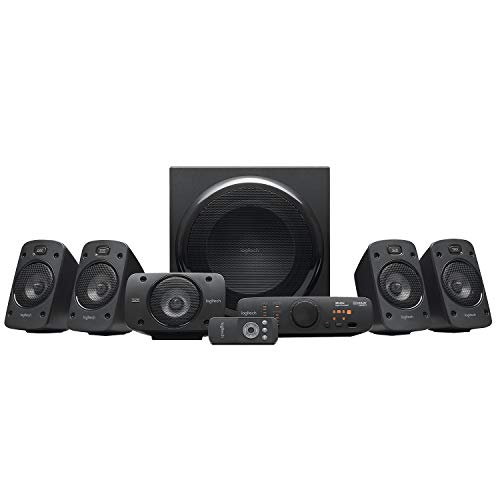
Logitech Z906 5.1 Surround Sound Speaker System — Best active system: no receiver
Every other pick in this guide is half a system until a receiver arrives. The Z906 is the whole of one. Its architecture is active: the amplifiers for all channels live in the subwoofer enclosure, Dolby Digital and DTS decoders live alongside them, and a control console with an infrared remote runs the whole from your seat. Logitech rates the system at 500 watts RMS in total and it carries THX certification. Connect a television over optical, a console, a PC over six-channel analog if you like — the input panel is the most accommodating in this guide — and you have genuine discrete 5.1 with no receiver shelf, no calibration microphone, and no second purchase standing between you and a film tonight. In a guide about 5.1 speakers, it is the deliberate exception, labeled as one in every mention: an active system among passive packages.
Judged on sound alone against the passive picks, it plays a respectable but not winning hand. Its subwoofer produces more sheer low-end enthusiasm than any package sub here, its satellites keep effects decisive and dialogue forward, and in small-to-medium rooms at sane volumes many listeners would not trade it for the Klipsch pack on sonics alone. Where the passive systems pull away is refinement and growth: subtler midrange, calibration that adapts to the room, and components that can be improved one at a time. The Z906’s sound on its best day is the sound it makes every day, forever — for its owners, that consistency is the feature.
Its other limits are generational. No HDMI input means the TV connection is optical, and the format ceiling is the Dolby Digital/DTS era — entirely sufficient for broadcast, streaming’s common surround forms, and games, and a hard stop beyond them. The system is sealed: a failed amplifier retires five good speakers with it. Buyers should choose it the way one chooses any finished appliance — because its completeness fits the room and the household — and not as a stepping stone, because it is not one. It is a destination, and for a great many rooms it is the right one.
- Architecture: Active system — amplification and decoding built in; no receiver needed or possible
- Decoding: Dolby Digital and DTS
- Inputs: Two optical, coaxial, six-channel analog, stereo analog
- Control: Console plus infrared remote
- Upgrade path: None — a finished, sealed system
Strengths
- Complete surround in one purchase — the only pick here that can say so.
- Subwoofer impact exceeds every package sub in this guide.
- Inputs for TV, console, and PC simultaneously.
Trade-offs
- No HDMI and no formats beyond the Dolby Digital/DTS era.
- Sealed set — nothing upgrades, nothing is replaced alone.
- Refinement trails the better passive packages at matched volumes.
Best for: Rooms and households that want real 5.1 without a receiver, full stop. Not suited for: Upgraders, format collectors, or very large rooms.

Fluance Signature HiFi 5.1 System (HF51BR) — Best large-room system
The Signature is Fluance’s flagship statement in this guide and the Elite’s bigger sibling in spirit: 3-way floorstanding towers up front, a matched center and surrounds, and the DB10 subwoofer, carrying the Signature series’ HF51BR code. It is a passive package — receiver required — and it exists for the rooms where this guide’s other picks run out of physics: open-plan spaces, high ceilings, seating distances that turn compact satellites into distant suggestions. Cabinet volume is its argument. The towers’ enclosures give the front stage a natural extension and ease that small speakers simulate with effort, and the whole system plays loudly without the hardening that signals drivers at their limits.
Against its own sibling, the Elite SX51BR, the Signature justifies itself on refinement and headroom rather than on a different idea: same architecture, executed with the series’ higher-tier components and voicing, for buyers whose rooms and listening habits will actually use the difference. That is a narrower claim than marketing usually makes, and it is the true one — in a medium room at moderate volume, the two Fluance systems are closer than their prices suggest, and the Elite is the rational buy. In a large room at cinema volume, the Signature’s composure is the difference between a system that fills the space and one that merely reaches it.
Ownership demands match the hardware: floor space, wall clearance, a receiver with genuine current delivery and competent room correction, and a subwoofer plan — many Signature owners eventually add a second or larger sub, not because the DB10 fails, but because rooms that need these towers usually need bass to match. Budget the system as the flagship it is, electronics included, and it returns the most complete large-room performance in this guide.
- Architecture: Passive package — receiver required, with real current delivery
- Model: HF51BR — Fluance Signature series 5.1
- Front stage: 3-way floorstanding towers, matched center and surrounds
- Subwoofer: DB10 powered; large rooms may justify a second sub later
- Room fit: Large and open-plan rooms
Strengths
- The most complete large-room performance in this guide.
- Composure at cinema volumes that compact systems cannot imitate.
- Front-stage scale that anchors the whole surround field.
Trade-offs
- Highest total cost here once a worthy receiver is counted.
- Towers dominate a room physically and visually.
- In medium rooms, its advantage over the Elite narrows sharply.
Best for: Large dedicated rooms and listeners who use real volume. Not suited for: Modest rooms, modest budgets, or discreet installs.
How Do the Six Systems Compare?
| System | Architecture | Receiver? | Scale | Best room |
|---|---|---|---|---|
| Klipsch Reference Theater Pack 5.1 | Passive satellites | Required | Compact | Small–medium |
| Energy Take Classic 5.1 | Passive satellites | Required | Compact | Small–medium |
| Fluance Elite 5.1 (SX51BR) | Passive towers | Required | Full-size | Medium–large |
| Monoprice Premium 5.1 | Passive satellites | Required | Compact | Small–medium |
| Logitech Z906 | Active system | Not used | Compact–medium | Small–medium |
| Fluance Signature 5.1 (HF51BR) | Passive towers | Required | Full-size | Large |
Two columns do the deciding. The architecture column tells you what else you must buy and how the system can grow; the scale column tells you whether the system and your room are the same size. Every disappointment in this category is a mismatch in one of those two columns — an active system asked to be upgraded, a satellite package asked to fill a hall, a tower system suffocated in a bedroom. Match both columns to your reality and any row in the table becomes a defensible purchase. One more reading of the table is worth making before you leave it: notice how many rows share the small-to-medium room. That is where most households live, and it is why the compact passive packages — Klipsch, Energy, Monoprice — plus the Z906 form the guide’s crowded, competitive heart. The tower systems are not better versions of those picks; they are answers to a different room, and the table’s discipline is refusing to rank a room above another room.
How Should You Set Up a 5.1 System So It Sounds Like One?
Placement is free performance, and the rules are stable across every pick here. Front left and right form a triangle with the main seat, at ear height, angled inward; the center sits at the screen, as near ear height as furniture permits, because dialogue anchored away from faces pulls you out of every scene. Surrounds belong slightly behind the listening line and a little above ear level — not on the front wall, not in the room’s rear corners firing forward. The subwoofer goes where the room says: put it at your seat temporarily, play bass-heavy material, walk the room’s edges, and place it where the bass sounded most even; then sit down and fine-tune its level against dialogue, aiming for the setting where muting it is more noticeable than hearing it.
Then calibrate, by microphone if your receiver offers it, by test tones and a tape measure if it does not. Distances should match reality, levels should equalize at the seat, and crossovers should respect the speakers: compact satellites hand off to the sub in the upper bass, towers can run lower, and every system in this guide benefits from the receiver managing the split rather than each speaker fending for itself. Finish with a film you know by heart and adjust the center channel for your actual listening volume. A 5.1 system is a geometry plus a balance; the products above supply the hardware for both, and an hour of setup is what separates the hardware from the experience. Treat that hour as part of the purchase price and pay it gladly: no component swap in this guide’s price range buys as much audible improvement as placement and calibration give away free, and the owners who understand that stop shopping sooner and start enjoying earlier than the owners still auditioning their next upgrade.
What Mistakes Do 5.1 Buyers Make Most Often?
Buying a passive package without budgeting the receiver is the classic, and this guide’s labeling is the vaccine. Second is scale mismatch — satellites in a hall, towers in a closet. Third is front-wall surrounds: speakers placed where the furniture is easy rather than where the geometry works, producing expensive stereo. Fourth is subwoofer by symmetry — centered under the TV because it looks right, booming because the room disagrees. Fifth is skipping calibration and blaming the speakers for level imbalances that ten minutes of tones would have cured. Sixth is judging the system on a dialogue drama and returning it for lacking surround fireworks the content never contained. Every one of these is a process error with a free fix, which is why this guide spends as many words on rooms and setup as on products.
How Do You Choose a Receiver for a Passive Package?
Since five picks in this guide are incomplete without one, the receiver deserves its own buying logic. Channels first: five amplified channels serve every system here today, but a seven-channel receiver buys the option of height speakers tomorrow, and the price step is usually smaller than replacing the unit later. Room correction second — in real rooms with real furniture, competent auto-calibration is worth more than any other single feature, because it is the difference between the geometry you placed and the geometry you hear. Third, HDMI: enough inputs for your sources, eARC for the television’s own apps, and video passthrough that does not bottleneck a current console. Fourth, subwoofer outputs and bass management, because every package here hands its low end to a powered sub and the handoff quality is set in the receiver’s menus.
Power ratings deserve a demystifying paragraph. Headline wattage is measured under conditions — often two channels driven, at a forgiving distortion figure — that no film night reproduces. In practice, the compact packages in this guide are efficient enough that any reputable receiver drives them to satisfying levels, and the tower systems ask more for current delivery and stability than for brochure watts. Buy the receiver whose correction, channels, and connectivity fit your next five years; the amplification inside any established brand’s mid-range will do its job, and the money saved by ignoring the wattage arms race is better spent on the subwoofer or the center channel’s placement. Finally, buy once with the upgrade path in mind: the receiver is the component that ages fastest in a passive system, and choosing the one you will replace last is the cheapest form of future-proofing there is.
Why Does the Subwoofer Deserve Its Own Decision?
Every package here includes a subwoofer, and in several it is the component that defines the system’s ceiling. Understand its three jobs: reproducing the dedicated low-frequency effects channel, relieving the main speakers of bass they cannot produce cleanly, and pressurizing the room enough that film sound becomes physical. Package subs are engineered to the package’s price and scale — the DB10 units in the Fluance systems are honest mid-size performers, the compact packages’ subs are proportioned to small rooms — and the upgrade culture around subwoofers exists because bass is where rooms differ most. A large, open space may ask a package sub to work beyond its design; the graceful answer, unique to the passive architecture, is that the sub is the easiest component to upgrade or duplicate later without touching anything else you own.
Placement and setup decide more than model choice within this class. The crawl test described earlier, a crossover set where the mains genuinely fade, and a level balanced against dialogue rather than against an effects demo will make a package sub sound like a considered component. Two errors ruin more bass than any product limitation: corner-loading a sub for maximum boom and calling it power, and running the level hot enough that the sub announces itself in scenes — a door slam in a drama should not arrive with a subwoofer’s signature attached. Get those right and the included sub will serve most owners for the life of the system; the upgrade itch, when it comes, will be about a bigger room rather than a failed component. A third error deserves dishonorable mention: stacking objects on the subwoofer because it is a convenient flat surface. It is also a vibrating one, and the plant, the remote, and the drink will all eventually testify — keep the sub’s top clear and its vents unblocked, and let it be a speaker rather than a side table.
What Does the Full Installation Actually Involve?
Budget an honest weekend for a passive build done well. Day one is placement and wire: fronts and center around the screen, surrounds at their geometry, five runs of speaker cable routed along baseboards, under rugs rated for foot traffic, or through walls where skill and local rules allow. Label both ends of every run as you lay it — the left surround identified in October is a gift to yourself in March when something needs moving. Day two is calibration and judgment: the receiver’s microphone routine, a tape-measure audit of its distances, crossover sanity checks against the pick notes above, and an evening of familiar content with a notebook for the two or three adjustments every room demands. The active Z906 compresses all of this into an afternoon, which is its own argument, honestly stated.
Small hardware decisions compound across a whole installation, and they compound in your favor when they are made deliberately rather than discovered one frustration at a time, weeks later, when the enthusiasm that would have powered the fix has long since been spent on other things entirely, as enthusiasm tends to be, in every household, without exception. Banana plugs or bare wire, either is fine if the connection is tight and stays tight; stands at ear height beat speakers balanced on book stacks; a center channel angled toward the seat beats one firing at your knees from a low shelf. None of these cost real money, and together they are worth more than the price step between adjacent picks in this guide — a truth worth remembering when the budget meeting turns to which component to upgrade: the room and the setup are components too, and they are the ones most owners underbuy.
How Much Does Each Route Cost Once Everything Is Counted?
Package prices are the most misleading numbers in this category, so plan in systems. A passive package’s true total adds a receiver, speaker wire and small hardware, and stands or mounts where the room needs them; for the compact sets, the receiver commonly matches or exceeds the speakers’ price, and for the Fluance tower systems the electronics deserve a mid-range allocation that pushes the total into a different bracket than the box suggested. None of this is hidden cost in the dishonest sense — it is the architecture’s nature, visible the moment you ask where the power comes from — but it must be the number in your plan, because a system bought at 90 percent and finished never is the most expensive outcome of all. The Z906’s total, by contrast, is its price plus stands at most, and that transparency is a genuine part of its value proposition, especially for a first system.
There is also a second-purchase pattern worth planning against. Owners of compact packages who move to larger homes often keep the speakers and upgrade only the subwoofer, then perhaps the receiver — the passive architecture absorbing life changes in installments. Owners of sealed systems start again from zero at each change, which is painless at the Z906’s level and would be painful at flagship prices; it is one reason active systems cluster at the affordable end of this guide and passive packages own the top. Let your expected tenure in your current room cast a vote: short stays favor completeness, long stays favor architecture.
How Long Will These Systems Serve?
Passive speakers are among the longest-lived products in consumer electronics. With no firmware, no apps, and no servers, a Klipsch, Energy, Fluance, or Monoprice package bought today will be limited mainly by its materials — surrounds and capacitors age on timescales of decades, not product cycles — and by its owner’s wandering eye. The receiver beside it will age faster, on format and port timescales, and the architecture’s grace is that the aging part is the replaceable part. The active Z906 concentrates its risk in its electronics, as all sealed systems do, balanced by a long production history and a large base of owner knowledge about its care and feeding. In practical terms: buy passive for a room you expect to keep, buy active for a chapter you expect to close, and in both cases keep the systems ventilated, surge-protected, and out of the dust — the three commandments of audio longevity, none of which appear on a spec sheet.
Which Content Shows a 5.1 System at Its Best — and Its Worst?
Choose your evaluation material like an engineer, because first impressions calcify. Modern action and science-fiction mixes are the showcase: discrete effects, aggressive surrounds, a low-frequency channel with real content. A reference scene with a vehicle pass that crosses the room will verify placement, levels, and pans in ninety seconds. Dialogue-driven drama is the audit: it exposes center-channel quality, subwoofer discipline, and whether the system can stay out of the story’s way. Sports broadcasts test the surrounds’ ambience and the center’s commentary intelligibility against crowd noise. Music in stereo mode tests the front pair’s honesty, which is where the Fluance towers quietly humiliate satellite systems and where the Z906’s theatrical tuning asks for a bass trim.
And know the traps. Older films with stereo or modest surround mixes will not become showcases through any system here; upmixing helps and honesty helps more. Streaming tiers vary in the audio they deliver, so the receiver’s display — not the app’s banner — is the authority on what is being decoded. A system judged only on its best scene will disappoint on Tuesday; a system judged only on a talky episode will be underrated for Saturday. Keep two reference scenes, one loud and one quiet, and return to them after every adjustment. That small discipline is the difference between owners who tune a system once and live happily, and owners who chase settings for a year.
There is a seventh mistake, subtler than the rest: calibrating once, at installation volume, and never revisiting the balance at the volume you actually use at night. Systems are level-balanced in a quiet, empty house at a confident volume, then lived with at half that level in a full room — and at low volumes, surrounds and subwoofers recede perceptually faster than fronts do. Many receivers offer features that compensate; all owners can compensate manually with a second saved setting or a small seasonal adjustment. The point is not the mechanism but the awareness: the balance you set is a balance at a volume, and the household’s real volume is the one that deserves the calibration.
Why Does the Center Channel Carry the Whole System?
Count the minutes in an ordinary evening of viewing and the center channel wins by a landslide: nearly all dialogue, much of the score’s anchor, and the on-screen effects that tie sound to picture all pass through it. This is why matched packages matter — the center is voiced to the fronts so a voice panning across the screen does not change bodies mid-sentence — and why its placement deserves the guide’s repeated nagging about ear height and angle. It is also why the picks divide as they do on this channel: the Klipsch pack’s horn-loaded center is its quiet star at low volume, the Energy’s center is the composure champion, and the Fluance towers’ matched center benefits from being designed against fronts with real midrange rather than against satellites that needed rescuing.
Practical center craft is short and decisive. Keep it unobstructed — a center inside a closed cabinet is a center in another room. Angle it at the listeners’ ears, with a wedge if the shelf is low or high. In the receiver’s levels, be willing to run it a touch proud of the measured balance if your household’s hearing or habits ask for it; calibration is a starting point for intelligibility, not a commandment against it. And if a future upgrade ever tempts you to improve one speaker in a package, improve this one last and most carefully — it is the channel your family will judge every night, in every scene, whether they know its name or not.
Final Recommendation
Start with architecture, end with scale. If a receiver has no home in your room, the Z906 is the complete answer and a good one. If you are building a component system, the Klipsch pack is the compact default, the Energy the compact connoisseur’s choice, and the Monoprice the value floor that keeps the receiver budget honest; step up to the Fluance Elite when the room grows, and to the Signature when it grows up. Whichever you choose, buy the system your room can hold and your habits will actually calibrate — because the best 5.1 speakers are not the ones with the finest drivers on paper, but the ones still correctly placed, correctly balanced, and switched on every night two years from now.
Frequently Asked Questions
Do all 5.1 speakers need a receiver?
Passive packages — five of the six picks here — always do: they contain no amplification. Active systems like the Logitech Z906 carry their amplifiers and decoders inside and need no receiver. Check the architecture before the price; it decides the total cost.
Which is better, satellite or tower 5.1 systems?
Neither in the abstract. Satellites fit small rooms, place easily, and lean on the subwoofer for midbass. Towers fill larger rooms with more natural front-stage scale and cost more space and money. Match the system to the room’s volume and your seating distance.
Can I mix speakers from different brands in a 5.1 system?
You can, and matched packages exist because mixing usually disappoints: the front three channels especially should share one voicing, or pans and dialogue will change character across the screen. Subwoofers are the honorable exception — any good sub can join any package.
How much receiver do the passive packages need?
Less than marketing implies. The compact sets here are efficient enough for entry-level receivers; the tower systems deserve mid-range current and good room correction. Spend on calibration quality and the channels you will actually use before spending on wattage headlines.
Is the Fluance Elite’s model code SX51BR or SX51HTB?
The current listing is the SX51BR, the model reviewed in this guide. The other code belongs to a discontinued listing that older pages still reference; if a listing uses it, treat that as a sign to verify exactly what is being sold.
What gauge of speaker wire do these systems need?
For the run lengths of ordinary rooms, standard copper speaker wire of modest gauge is entirely sufficient for every package here; spend on neat routing and solid terminations rather than on exotic cable. Very long surround runs benefit from a step up in gauge, and in-wall installations should use wire rated for that purpose.
Will a 5.1 system work for music as well as films?
Yes, with expectations set: these systems are film-first, and most owners listen to music in stereo mode through the front pair and sub, where the tower systems shine and the compact sets are pleasant. A dedicated stereo setup still wins for critical listening, but no pick here embarrasses itself.
Related Guides
Narrowing the decision? See our guides to the best 5.1 Atmos speakers and what the label really means, 5.1 home theater speakers without a receiver, and the best 5.1 computer speakers.



[…] the other side of the trade? See our guides to the best 5.1 speakers overall, the best 5.1 Atmos speakers and what the label really means, and the best 5.1 computer speakers. […]