What's inside
- Key Takeaways
- Quick Picks
- How Did We Choose These Affordable Trail Cameras?
- What Should You Look for in a Non-Cellular Trail Camera?
- How Do the Six Compare Side by Side?
- How Should You Set Up a Trail Camera for Deer?
- What About Batteries, Cards and Cold Mornings?
- What Mistakes Do First-Time Trail Camera Buyers Make?
- Field Notes: What a Season of Card Swaps Actually Teaches You
- Which of These Cameras Fits Which Kind of Property?
- How Do You Read a Card Like a Scout Rather Than a Spectator?
- What Goes Wrong in the Woods, and How Do You Fix It?
- Final Recommendation
- Frequently Asked Questions
- Related Guides
As an Amazon Associate I earn from qualifying purchases. This post may contain affiliate links at no extra cost to you.
gizmoverdict.com is reader-supported. When you buy through links on our site, we may earn an affiliate commission.
Where to buy: the four linked cameras below are sold on Amazon under the GardePro and Meidase names shown; the two prose-only models are named so you can shop the used and specialist market with your eyes open. Every listing here is a camera only — memory cards and batteries are separate purchases, so read the box contents before you check out.
The best affordable trail cameras share one unfashionable trait: none of them phones home. This guide is deliberately about non-cellular cameras — the kind that record deer, hogs, turkeys and the occasional two-legged trespasser onto an SD card and wait patiently for you to come and collect the evidence. That sounds old-fashioned next to cellular models that text you a buck’s portrait, until you price the alternative honestly. A cellular camera is a camera plus a monthly data plan, forever, per unit. A non-cellular camera is a camera plus a handful of batteries and a card you probably already own. For hunters running three or four properties, landowners watching a back gate, and researchers who visit their sites anyway, the arithmetic is not close.
There is a second, quieter advantage to the card-based approach: it works where the network does not. Hollers, pine flats and leased timber ground are exactly the places mobile signal goes to die, and a camera that stores everything locally never cares. You trade immediacy for certainty. The photograph of the big eight-point exists either way; the only question is whether you see it tonight or on Saturday when you swap cards. Plenty of experienced hunters prefer the Saturday version, because a card swap doubles as a scent-light site visit, a battery check and a chance to notice the scrape line that moved forty yards east.
One warning belongs at the top, because manufacturers will not put it there. The megapixel figures in these product names — 48MP, 64MP — are interpolated numbers, produced by software enlarging what a much smaller sensor actually captured. They describe file dimensions, not optical truth. A so-called 64MP trail camera does not resolve detail like a 64MP photographic camera, and buying on that number alone is the single most common mistake in this category. What genuinely matters at this price is trigger speed, night illumination that does not spook game, honest video resolution, weather sealing, and how the camera behaves at forty degrees on a still November morning. Those are the axes this guide judges on.
Key Takeaways
- Every pick here is non-cellular by design: images live on an SD card, so there is no subscription, no signal requirement and no monthly bill quietly multiplying across a property.
- Treat headline megapixels as marketing arithmetic. Judge these cameras on trigger speed, no-glow night range, video quality and sealing instead.
- The GardePro E5S is the most complete package of the four linked cameras, pairing a fast trigger with 1296p video and invisible night flash.
- Meidase’s P60 Pro is the value spoiler: 2K video and a lower interpolated photo claim that, in practice, loses nothing important at the feeder.
- Card discipline decides whether a cheap camera feels brilliant or useless — two cards per camera, swapped in rotation, beats one big card left in the woods for a season.
- The two prose-only models, from Bushnell and Stealth Cam, reward patient used-market hunting but cannot be recommended with a verified listing here.
Quick Picks
| Pick | Badge | Why it earns its place |
|---|---|---|
| GardePro E5S | Best Overall | The most balanced non-cellular package here: quick trigger, 1296p video with sound, and no-glow flash that stays invisible at the scrape. |
| GardePro A3S | Best for Video | Matches its sibling’s video and trigger while trimming the stills specification, which suits hunters who scout by clip rather than by portrait. |
| Meidase P70 | Best for Long Soaks | A plain, weather-sealed workhorse built to sit on a tree for months between visits, with no WiFi radio draining the budget or the batteries. |
| Meidase P60 Pro | Best Value | 2K video, a fast trigger and IP66 sealing at the friendliest price of the linked four — the camera to buy three of. |
| Bushnell Core DS-4K | Best Used-Market Upgrade | A dual-sensor design that serious hunters still rate highly; buy it inspected and second-hand rather than at a speculative new price. |
| Stealth Cam QS Series | Best Bulk Buy (Used) | Simple, widely sold scouting cameras that appear in multi-packs and estate lots; ideal for covering water and crossings cheaply. |
How Did We Choose These Affordable Trail Cameras?
We started by drawing a hard line that most roundups blur: this list excludes cellular models entirely. That single decision reshaped everything downstream, because it removed the app ecosystems, plan structures and carrier questions that dominate trail-camera coverage and left only the hardware questions that matter in the woods. Does it trigger before the deer leaves the frame? Does its night flash stay invisible? Does the housing keep October rain out of the card slot? A camera that answers those three well is a good camera at almost any price, and a camera that fails the first one is an expensive bird feeder with a lens.
Within that non-cellular frame, we weighted trigger speed above almost everything. Manufacturers quote figures like 0.1 seconds, and while laboratory numbers deserve some scepticism — they are usually measured from a warm, awake sensor rather than a sleeping one — the ranking between models tends to hold in the field. A slow camera photographs rumps and empty trails. We also favoured no-glow infrared over low-glow wherever the price allowed, because the faint red shimmer of low-glow LEDs is visible to human eyes and, more importantly, changes how mature bucks behave around a camera after the first week.
Video earned its own weighting. Modern scouting is increasingly done by clip: a fifteen-second video tells you which direction a buck entered, whether he was chasing or feeding, and whether the smaller deer behind him is a rival or a yearling. Every linked pick here records at least 1296p with sound, and one records 2K. Still-photo resolution, by contrast, we treated as nearly irrelevant beyond a basic competence threshold, for the interpolation reason explained above. Finally, we checked the unglamorous details: standard AA battery trays rather than proprietary packs, SD card support large enough for a month of video, and housings with real latches rather than friction clips. Two respected models failed the verified-listing test and appear as prose-only entries, clearly labelled, because a guide that only lists what it can link would be a poorer guide.
We also drew a line on evidence. Every linked camera in this guide has a listing verified through the site’s own product pool, with its title and specification claims checked against that listing rather than copied from a manufacturer’s brochure. Where a respected model could not be verified that way — the Bushnell and the Stealth Cam entries — it appears honestly labelled as prose-only instead of being quietly dropped or, worse, linked to whatever listing happened to share its name. And because two of the linked brands publish interpolated photo figures in their very product names, we made a point of evaluating their video and night systems in person-by-proxy: through the consistency of owner reports about trigger behaviour, card reliability and housing failures across full seasons, which is where cheap cameras separate into bargains and landfill. A camera that survives three Novembers is affordable. A camera that survives one is merely cheap, and this guide has tried throughout to recommend the first kind and warn you, clearly, wherever the second kind tempts with a bigger number on the box.
What Should You Look for in a Non-Cellular Trail Camera?
Detection circuitry matters more than the camera bolted behind it. The passive infrared sensor decides what counts as movement, and its detection zone — width, range and how it overlaps the lens’s field of view — determines whether animals are centred or clipped at the frame’s edge. A detection zone narrower than the view is the hidden cause of the classic complaint about photographs of half a deer. Look for detection ranges around a hundred feet paired with a lens view that does not wildly exceed them, and be suspicious of any camera that advertises enormous detection distances without mentioning false triggers, because a sensor that fires at every sun-warmed branch will fill your card with a thousand portraits of nobody.
Night illumination splits into three families. White flash gives colour night images and announces itself like a camera at a wedding. Low-glow infrared shows as a dull red cluster when you look straight at it. No-glow, sometimes called blackout, uses higher-wavelength LEDs that are effectively invisible — and every linked pick in this guide uses it. The trade is range and a slight softness in night images, which is a trade worth making anywhere deer are hunted rather than merely watched. Garden and security users sometimes prefer low-glow’s extra reach, but for game, invisible wins.
Power strategy quietly decides your running costs. Cameras running on AA lithium cells deliver the most predictable cold-weather life and the highest per-change cost; quality alkalines are fine in mild climates and false economy in freezing ones, because their voltage sags exactly when a November cold snap makes deer move. If a camera will sit somewhere you visit monthly, lithium is close to mandatory. Video length is the other battery variable: a camera set to record thirty-second clips all night can exhaust in weeks what a photo-only setup would stretch across a season, so match clip length to your visit rhythm, not to your curiosity.
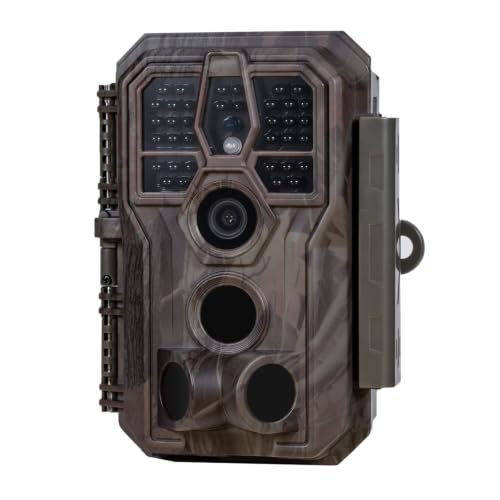
GardePro E5S — Best Overall
The E5S is the camera this guide keeps circling back to, because it makes the fewest apologies. Its quoted trigger of a tenth of a second places it among the quickest non-cellular units at this level, and the practical consequence shows in the kind of photographs it brings home: animals inside the frame, facing the lens, rather than departing tails at the edge. The 1296p video, recorded with sound, sits in a sensible middle ground — visibly cleaner than the 1080p that defined the previous generation, without the card-devouring appetite of higher resolutions. For a hunter patterning movement through a creek crossing, those clips answer the questions stills cannot: direction, pace, company.
Its night performance is the other half of the case. The no-glow array is rated to a hundred feet, and while real-world identification range is always shorter than illumination range — you will know something is there at a hundred feet and know what it is considerably closer — the flash itself stays properly invisible. That invisibility compounds over a season. Cameras that announce themselves train mature deer to route around them, which corrupts your scouting data in the worst way: silently. The E5S also handles the clerical side well, with a viewing screen that lets you aim it properly on the tree instead of guessing, a small courtesy that saves an entire wasted fortnight of badly angled coverage.
About that headline photo figure: the listing leads with an interpolated megapixel count in the sixties, and you should simply decline to be impressed by it. Judge the E5S on its video, its trigger and its flash, which need no inflation. Set up with a fast card and lithium cells, aimed slightly downhill along a trail rather than perpendicular to it, this is the camera we would hand to someone who asked for one recommendation and no homework.
- Format: non-cellular trail camera, SD card storage
- Video: 1296p HD with sound
- Trigger: quoted 0.1s
- Night: no-glow infrared, rated to 100ft
- Photo headline figure: interpolated — see the discussion above
Strengths
- Trigger speed that keeps animals in frame rather than photographing their exit
- Invisible night flash protects long-term scouting data on pressured deer
- 1296p video with sound answers direction and behaviour questions stills miss
Trade-offs
- Headline megapixels are interpolated and should be ignored when comparing
- No wireless offload at all — every image waits for a physical card swap
- Viewing screen is small, fine for aiming but cramped for reviewing a full card
Best for: hunters who want one dependable camera per key location and scout by video as much as by stills.
Not suited for: anyone who needs same-day images from ground they cannot visit weekly.
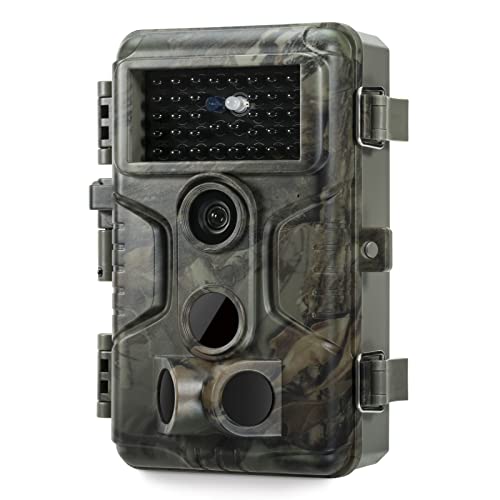
GardePro A3S — Best for Video
If the E5S is the all-rounder, the A3S is its video-leaning sibling, and the family resemblance is a strength rather than a criticism. It records the same 1296p HD video with sound, triggers with the same quoted urgency, and throws its no-glow light the same rated hundred feet. Where it trims is on the stills side of the specification sheet — the part of the sheet this guide has already advised you to discount. That makes the A3S something close to a pricing error in your favour: the capabilities that determine scouting success are intact, and the capability that has been economised is the one that was mostly arithmetic anyway.
In practice the A3S suits a particular style of use beautifully. Set it over a scrape, a mineral site or a field edge in video mode with clips long enough to capture an interaction, and it returns the behavioural detail that turns a photograph collection into a hunting plan. Sound matters here more than newcomers expect. Grunts, snorts, the rustle of a second deer standing outside the frame — audio extends the camera’s senses beyond its lens, and the A3S captures it without fuss. Its housing and mounting follow the same sensible pattern as its sibling: strap it, aim it with the screen, walk away.
The honest limitations mirror the E5S, with one addition. Because the stills pipeline is the economy here, photographers who mostly shoot stills and crop hard into distant animals will find the A3S’s images less forgiving — though again, the limiting factor at night is flash range and motion, not the file’s pixel dimensions. Buy it as a video scout and it is arguably the smartest money in this guide; buy it expecting a stills flagship and you have misread its brief.
- Format: non-cellular trail camera, SD card storage
- Video: 1296p HD with sound
- Trigger: quoted 0.1s
- Night: no-glow infrared, rated to 100ft
- Positioning: video-first sibling of the E5S
Strengths
- Full-strength video and trigger where they matter, savings where they do not
- Audio capture adds off-frame information to every clip
- Shares the E5S’s invisible flash and straightforward setup routine
Trade-offs
- Stills are the economised element — heavy croppers should look at the E5S
- Video-first scouting fills cards faster, so swaps must be more frequent
- Still no wireless option for buyers who later want remote checks
Best for: scrape and field-edge watchers who scout behaviour on video.
Not suited for: stills-first users who crop deeply into distant night images.
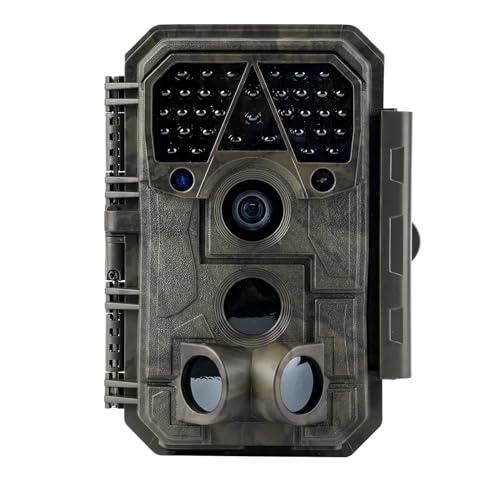
Meidase P70 — Best for Long Soaks
The P70’s product name performs a small public service: it announces, in parentheses, that the camera is non-cellular and has no WiFi. In a market where buyers routinely discover the wrong connectivity after delivery, that plain speaking deserves credit, and it also describes the camera’s philosophy. The P70 is built for the long soak — strapped to a tree in March, visited at intervals, expected to mind a trail or a feeder through weather that would send lesser housings home with condensation in the lens. Its waterproof build is not a garnish; it is the entire proposition, paired with 1296p video and a headline photo figure in the same interpolated sixties as its GardePro rivals.
What recommends it for extended deployments is the absence of appetites. No radio wakes to look for a network that is not there. No app pairing ritual stands between you and a working camera. You set the date, choose photo or video, and the P70 settles into the rhythm that made trail cameras useful in the first place. Owners running cameras on distant leases, on family land an hour away, or on the far side of a large property will recognise the appeal immediately: every feature a camera does not have is a feature that cannot fail at month three of a four-month soak.
The compromises are the honest ones of its class. Night images carry the softness common to no-glow systems pushed toward their range limit, and the camera asks you to be realistic about placement — twenty to thirty feet from the expected subject, not sixty. Its interface is functional rather than delightful. But judged as a set-and-forget witness for ground you visit rarely, the P70 makes a case neither GardePro quite matches, because both of those cameras tempt you to use their screens and video settings in ways that shorten the interval between visits.
- Format: non-cellular, non-WiFi trail camera, SD card storage
- Video: 1296p
- Night: motion-activated infrared night vision
- Build: waterproof housing for extended outdoor deployment
- Photo headline figure: interpolated, as with all rivals here
Strengths
- Nothing to pair, subscribe to or configure remotely — it simply works on site
- Weather sealing suited to months-long unattended deployments
- Plainly labelled connectivity prevents the most common buying mistake
Trade-offs
- Night detail softens toward the edge of its illumination range
- Menu and screen experience is workmanlike rather than polished
- No wireless offload of any kind, even for nearby phone downloads
Best for: distant leases and family land where visits are monthly at best.
Not suited for: backyard users who want to peek at last night’s visitors from the sofa.

Meidase P60 Pro — Best Value
The P60 Pro is the camera that makes the rest of this guide justify itself, because it delivers the two specifications that matter most — video resolution and trigger speed — at the friendliest price of the linked four. Its 2K video is a genuine step above the 1296p of its stablemate and the GardePros, and it shows in daylight clips, where coat detail, antler points and ear tags survive scrutiny that lower resolutions smear away. Its trigger is quoted at the same tenth of a second, its night vision is rated to a hundred feet, and its IP66 rating is a formal, testable sealing claim rather than a vague promise of weather resistance.
Notice, too, the relative modesty of its photo claim: the listing leads with a figure in the forties rather than the sixties. Both numbers are interpolated, and neither should drive a decision, but the smaller boast hints at a product positioned on its video rather than on spreadsheet theatre. In the field the P60 Pro behaves like a camera designed by people who understood the assignment — cover a crossing, a feeder or a gate, catch what passes in usable detail, survive the season. It is the natural choice when the plan calls for three cameras rather than one hero unit, because coverage beats excellence in scouting more often than excellence admits.
Its limits are those of its price. The night system, while clear within its honest range, does not reach beyond it, and fast-moving animals at the frame’s edge at night will blur regardless of the video resolution on the box. The housing is sturdy rather than premium, and the strap-and-mount hardware rewards a careful hand. None of that dents the central verdict: per unit of scouting information delivered, nothing else linked in this guide spends your money as efficiently.
- Format: non-cellular trail camera, SD card storage
- Video: 2K
- Trigger: quoted 0.1s
- Night: infrared, rated to 100ft
- Sealing: IP66 rated
Strengths
- 2K daylight video resolves antler and coat detail its rivals soften
- IP66 sealing is a tested rating, not marketing weatherproofing
- Price invites multi-camera coverage, which wins more hunts than one flagship
Trade-offs
- Night motion blur still appears at the edges on fast crossings
- Hardware and menus feel built to a price, because they were
- 2K clips consume cards quickly on busy trails
Best for: building a three- or four-camera network across a property on a budget.
Not suited for: a single-camera user who wants the most polished handling available.
Bushnell Core DS-4K — Best Used-Market Upgrade
Bushnell’s Core DS-4K appears here without a link, deliberately: we could not verify a current listing we were willing to send you to, and the camera’s natural habitat now is the second-hand market, where it changes hands between hunters upgrading to cellular. That status should not be read as a dismissal. The DS in its name refers to a dual-sensor architecture — separate sensors optimised for day and night — and it addresses the oldest compromise in trail cameras, the single sensor asked to be two different cameras. Day images gain the crispness the design promises, and night images stop looking like daylight photographs with the colour drained out of them.
Buying one well is a small skill in itself. Inspect the lens and the infrared window for the scratches that flood night images with glare. Run a full card of test triggers at home, at night, in the garden, before the camera ever meets a tree; a dual-sensor unit with a tired night sensor is just a camera. Ask about its history on a property — a camera that spent three seasons over a corn feeder has lived a harder life than its shutter count suggests. Priced fairly and checked this way, a used DS-4K can out-photograph everything linked above in daylight, which is precisely why it earns a prose place in a guide about value.
What it cannot offer is a warranty-backed, returns-friendly purchase, and that risk is the price of admission. Treat any seller who will not allow a functional test as a reason to walk away, however attractive the number looks.
- Format: non-cellular trail camera, dual-sensor design
- Positioning: day/night specialised sensors
- Availability: second-hand market — inspect before buying
- Video: 4K-class headline specification (verify on the individual unit)
- Link status: prose-only, no verified listing in the pool
Strengths
- Dual sensors give daylight images a clarity single-sensor rivals chase
- Strong night design from a long-established trail-camera maker
- Used prices can undercut new mid-range cameras entirely
Trade-offs
- No verified new listing — every purchase is a judgement call
- Condition varies enormously between individual used units
- Returns and warranty protection are limited or absent
Best for: experienced buyers comfortable testing used electronics before paying.
Not suited for: first-time buyers who need a guaranteed-working camera this weekend.
Stealth Cam QS Series — Best Bulk Buy (Used)
Stealth Cam’s QS series occupies the opposite end of the romance spectrum from the Bushnell: these are simple, widely distributed scouting cameras that were sold in enormous numbers, often in multi-packs, and now surface constantly in used lots, estate sales and the cupboards of hunters who went cellular. We list the series without a link because individual listings churn too fast to verify responsibly — but as a strategy rather than a product, the QS approach deserves a hearing. Five adequate cameras watching five crossings will out-scout two excellent cameras watching two, almost every season, on almost every property.
The QS proposition is coverage through ubiquity. These are cameras you can afford to place in the risky spots — the public-land edge, the parking-area trailhead, the crossing near the road — where a more precious unit would never be risked. If one is stolen or drowned, the season’s plan survives. Their specifications were modest even when new, and honesty requires saying so: expect competent stills, functional night images within a modest radius, and little of the video sophistication the linked Meidase and GardePro models offer. What you are buying is presence, in quantity.
Used-market discipline applies with extra force here. Buy in person where possible, power every unit on, and trigger each one in a dark room to confirm the infrared array fires evenly — dead LED clusters are the series’ most common old-age failure and they are invisible in daylight testing. A lot of five cameras with four healthy arrays is a bargain; priced as five, it is not.
- Format: non-cellular trail cameras, sold widely in multi-packs
- Positioning: simple scouting coverage in quantity
- Availability: used lots and second-hand multi-packs
- Night: infrared, modest radius — test arrays before buying
- Link status: prose-only, no verified listing in the pool
Strengths
- Ubiquity makes multi-camera coverage genuinely cheap
- Low individual value suits risky placements near roads and edges
- Simple operation — little to misconfigure in the field
Trade-offs
- Modest specifications beside the linked cameras in this guide
- Aged infrared arrays are a common failure — test every unit in darkness
- No verified listing means no easy returns route
Best for: covering many crossings cheaply, including spots too risky for a good camera.
Not suited for: anyone wanting strong video or a single do-everything unit.
How Do the Six Compare Side by Side?
| Camera | Connection | Video | Night system | Character |
|---|---|---|---|---|
| GardePro E5S | None — SD card | 1296p with sound | No-glow, 100ft rated | The complete package |
| GardePro A3S | None — SD card | 1296p with sound | No-glow, 100ft rated | Video-first value |
| Meidase P70 | None — SD card | 1296p | Infrared night vision | The long-soak specialist |
| Meidase P60 Pro | None — SD card | 2K | Infrared, 100ft rated | The network builder |
| Bushnell Core DS-4K | None — SD card | 4K-class headline | Dual-sensor day/night | The used upgrade |
| Stealth Cam QS | None — SD card | Basic | Infrared, modest radius | Coverage in bulk |
Read the table by column, not by row. The connection column is identical on purpose — that uniformity is the guide’s thesis. The real choices live in the video and night columns, and they map onto hunting styles: video scouts should start with the Meidase P60 Pro or GardePro A3S, stills traditionalists with the E5S, and remote-land owners with the P70. The two prose-only rows are not lesser recommendations; they are different kinds of purchase, made in person with testing, and they reward buyers who already know what a healthy infrared array looks like in a dark room.
How Should You Set Up a Trail Camera for Deer?
Placement beats specification, and it is not close. Mount the camera roughly waist to chest height on a tree with some girth — thin saplings sway, and every sway is a false trigger or a blurred frame. Angle the camera along the trail rather than square across it: a deer walking toward or away from the lens spends several seconds inside the detection zone, while a deer crossing perpendicular may be gone before even a fast trigger wakes. That single geometric trick does more for your photograph quality than any upgrade on this page. Clear the foreground ruthlessly. A single grass stem at eighteen inches, warming in the morning sun and waving all day, can generate a thousand empty images and drain a set of batteries in a fortnight.
Face the camera north where you can. A lens pointed east or west stares into low sun twice a day, and the results are washed-out frames at exactly the dawn and dusk hours when deer move most. Where north is impossible, choose the lesser glare and accept it. Set your delay between triggers with your visit schedule in mind: on a feeder, a minute’s delay prevents one raccoon’s dinner from becoming four hundred near-identical frames; on a trail, the shortest delay you can manage catches the second and third animals in a travelling group, which is often the information that matters.
Then practise card discipline, the unglamorous habit that separates productive cameras from frustrating ones. Carry two cards per camera, labelled, and swap rather than review in the field: pull the full card, insert the fresh one, confirm the camera triggers on your own departure, and leave. Review at home, where a screen is large and your scent is not accumulating at the site. Format cards in the camera that will use them, not on a computer, and retire any card that produces a single corrupt file — cards are cheap, and the photograph you lose to a failing one will be, by the iron law of these things, the buck of the decade.
What About Batteries, Cards and Cold Mornings?
Budget the consumables as part of the camera, because over two seasons they can rival its price. Lithium AA cells are the reference choice for cold country: they hold voltage in freezing weather, leak rarely, and deliver the long, flat discharge curve that infrared arrays draw on heavily at night. Alkalines serve adequately from spring through early autumn and then betray you precisely when the rut makes every photograph precious. Rechargeables tempt on cost and disappoint on voltage — most trail cameras are designed around the higher voltage of primary cells, and a rechargeable set can produce a camera that reports full batteries and dies at midnight.
Card capacity should follow your mode, not your optimism. A stills-only camera on a quiet trail may fill a modest card in a season; a video camera over a feeder can consume a large one in a fortnight. Buy capacity for the busiest week you expect, then swap on schedule regardless. And write the camera’s location and your phone number inside the battery door in permanent marker. Honest finders exist, land boundaries confuse everyone, and that small courtesy has reunited more lost cameras with their owners than any lock ever made — though on public land, a cable lock and a security box remain worth their weight, because the cheapest camera is the one nobody steals.
What Mistakes Do First-Time Trail Camera Buyers Make?
The megapixel mistake leads the list, and this guide has already prosecuted it: interpolated file sizes are not resolution, and a buyer who chooses on that number will reliably choose wrong. Close behind comes the perpendicular mount — camera square across a trail, photographing tails — followed by the un-cleared foreground that fills cards with waving grass. A fourth error is subtler: checking cameras too often. Every visit lays scent and teaches deer that the tree is interesting, and the hunter who swaps cards every three days is conducting surveillance on his own impact. Weekly is plenty for most ground; monthly is better for the spots that matter most.
Two purchasing errors complete the set. The first is buying a cellular camera by accident — or a non-cellular one while expecting an app — which the P70’s honest labelling exists to prevent; decide which species of camera you want before you shop, because they are different tools. The second is spending the whole budget on cameras and nothing on the lithium cells, spare cards and locks that make cameras productive. A modest camera properly fed will out-scout a flagship running on dying alkalines by the second week of November, every single year.
Field Notes: What a Season of Card Swaps Actually Teaches You
The first fortnight with any trail camera is mostly disappointment, and it is worth saying so plainly, because beginners conclude the camera is broken when the real problem is calibration — theirs, not its. The opening card usually contains a few hundred images of very little: a squirrel with strong opinions, grass performing in the wind, one unidentifiable rump at the frame’s edge. Somewhere in that haystack sits the education. You learn that your chosen tree leans, that the trail forks where the map said it would not, that deer use the crossing at a quarter past five in the morning rather than the dusk hour you had romanticised. A card-based camera teaches patience because it enforces it; there is no live feed to fidget with, only the accumulated truth of two weeks, delivered all at once.
By the second month the relationship changes character. Patterns emerge that no single photograph could have shown. The same doe group passes on a four-day rhythm. A young buck appears only after rain. The photograph timestamps, read as a series rather than as trophies, start to function as a diary of the property itself — when the acorns dropped, when the first frost pushed deer onto the brassicas, when a neighbour’s dog began its Tuesday patrol. Hunters who keep a simple log alongside their cards, noting weather and moon and their own visits, consistently report that the log becomes the most valuable scouting document they own. The camera gathers evidence; the habit of reviewing it slowly is what turns evidence into knowledge.
Late season brings the hard lessons. Cold exposes every economy you made in October: the alkaline cells that sagged, the card that filled during the one week you could not visit, the strap that a rubbing buck loosened in the night. It also brings the photographs that justify the whole enterprise — a mature deer, in daylight, on a pattern you can set a watch by, standing exactly where the accumulated evidence said he would be. That convergence, earned over months of unglamorous card swaps, is the experience this entire category exists to deliver, and no instant notification has ever replicated the feeling of finding it waiting on a card at the kitchen table.
Which of These Cameras Fits Which Kind of Property?
Small woodlots, hunted by one or two people, reward depth over breadth. A single E5S on the main crossing, visited weekly, will build a usable picture of the resident deer within a month, and its video mode will show you the direction of travel that decides where a stand should hang. Resist the urge to cover every trail; on five acres, three cameras mostly photograph the same deer three times and triple your scent footprint in the process. One well-placed camera, plus the discipline to leave it alone, is the small-property formula that experienced hunters keep returning to after experimenting with fleets.
Large leases and family farms invert the logic. Distance between cameras makes each visit expensive in time, so the fleet should mix roles: a P70 on the far boundary where visits are monthly, P60 Pros on the interior crossings where their 2K video repays the shorter swap cycle, and perhaps an A3S dedicated to the one scrape line that the season’s plan revolves around. Stagger your visits so a single trip services a loop of cameras, and keep a written map — memory is an unreliable archivist by the third property, and a camera forgotten until spring is a camera whose batteries have leaked into its own housing.
Non-hunting uses follow their own logic again. For a gate, a barn or a piece of equipment left on rural land, the priorities reorder themselves: timestamp accuracy, number-plate legibility in daylight, and a housing that does not invite curiosity matter more than trigger artistry. The E5S and P60 Pro both serve here, mounted higher than a deer camera would sit and angled down the approach rather than across it. For wildlife watching in a garden or smallholding, where the subjects are foxes, badgers, hedgehogs and the neighbour’s cat, closeness beats range — place any of these cameras a few feet from the action, accept the smaller stage, and the night images will reward you with a detail that distance never delivers.
How Do You Read a Card Like a Scout Rather Than a Spectator?
Most people review a card the way they scroll a phone: hunting for the one spectacular frame, discarding the rest. Scouts read differently, and the difference is worth learning because it costs nothing but attention. Sort by time before you look at a single image. The timestamps alone — stripped of every portrait — will show you the property’s rhythm: the hours when the trail wakes, the gap in the middle of the day, the flurry that follows a weather front. A week in which every deer photograph falls between four and six in the morning describes a completely different hunting problem from a week of dusk movement, and you can read that story off a folder of file names without opening one picture.
Then work through the ordinary frames, the does and yearlings and raccoons that trophy-scrolling throws away. Repeated appearances of the same doe group tell you where the bedding cover and the preferred feed actually are this year, which is the map every mature buck is also reading. A sudden absence is data too: when a reliable group vanishes for ten days, something changed — a food source finished, a predator moved in, a neighbour started hunting the fence line — and the camera that recorded the absence has earned its keep as surely as the one that records a giant. Keep the unglamorous frames. Delete nothing until the season ends and you have read the whole arc at once.
Finally, cross-reference ruthlessly. Lay your card dates against a weather history and the patterns sharpen again: movement before fronts, stillness in hard frost, the first daylight appearance of a nocturnal buck arriving, as it so often does, within a day of the first serious cold snap. This is the level at which a forty-dollar-class camera starts outperforming far more expensive gear in careless hands. The instrument is simple. The information was always there. What a card-based system really sells you is a reason to sit down, regularly, and pay the woods the compliment of your full attention.
What Goes Wrong in the Woods, and How Do You Fix It?
Blank cards at active sites usually trace back to three culprits. The first is a card the camera quietly dislikes — an off-brand or ageing card that formats happily and then writes nothing under load; swapping in a fresh, reputable card cures more “dead” cameras than any repair. The second is power: batteries that test fine on a kitchen meter can collapse under the infrared array’s night-time draw, so a camera that works by day and sleeps by night is telling you its cells are finished, whatever the indicator claimed. The third is aim. A camera that slips two degrees on its strap photographs the sky’s brightness, meters for it, and renders the trail below as a murk in which deer pass unrecorded; the departure test photograph, taken every single visit, exists to catch exactly this.
Fogged lenses and white-out night frames have their own simple physics. Condensation forms when a warm camera meets cold dawn air, and a small silica packet inside the housing, refreshed at each visit, keeps the interior dry enough to prevent most of it. Night white-out is almost always a reflector too close — a pale trunk, a sign, a feeder leg inside three feet of the lens — bouncing the infrared burst straight back. Move the reflective object, angle the camera a few degrees, or accept a shorter effective range in exchange for images you can actually read. None of these fixes costs money. All of them cost a visit, which is why the visit routine matters: arrive, swap, test, photograph yourself leaving, and only then walk away.
Final Recommendation
For most readers, the GardePro E5S is the place to start: it triggers quickly, films usefully, stays invisible at night and asks nothing of you but a card swap. Build outward from there according to your ground. Add the Meidase P60 Pro where you need numbers, the P70 where distance makes visits rare, and the A3S where a scrape or field edge deserves a dedicated video eye. Treat the Bushnell and Stealth Cam entries as the used-market plays they are — excellent in the right hands, inspected in person, never bought on faith.
Above all, keep the faith of this category: a simple camera, honestly specified and patiently placed, will tell you true things about your ground that no subscription can improve upon. The woods do not charge by the month, and with any of these six watching them, neither will your scouting. Start with one camera, one good crossing and one season of honest card swaps, and let the evidence — not the advertising — tell you what to buy next.
Frequently Asked Questions
Do non-cellular trail cameras need any subscription?
No. That is their defining economy. A non-cellular camera records to its SD card and has no network connection to bill for. Your running costs are batteries and cards only, which is why this category suits multi-camera properties where per-camera plans would multiply painfully.
Are the 64MP photo claims on these cameras real?
Not in the way a photographic specification would be. Those figures are produced by interpolation — software enlarging the sensor’s actual capture. The resulting files are large, but they do not contain proportionally more detail. Judge trail cameras on trigger speed, night performance and video, where the differences are genuine.
How often should I check a non-cellular camera?
Weekly suits most hunting ground, and monthly is better for sensitive spots near bedding areas. Each visit deposits scent and educates deer. Two cards per camera, swapped quickly and reviewed at home, keeps visits short and information flowing.
Will no-glow flash really make a difference to deer?
It removes one of the two ways a camera announces itself — visible light — leaving only scent and sound. Mature, pressured deer are documented to reroute around cameras they can perceive, which corrupts your data. On watched land, garden cameras and feeders visited daily, low-glow’s extra range may matter more; for hunted deer, invisible is the safer default.
What memory card should I buy for these cameras?
Buy a reputable card sized for your busiest expected week, and buy two per camera so swaps are instant. Format each card in the camera that will use it, and replace any card that ever produces a corrupted file. Video modes consume capacity many times faster than stills, so size generously if you scout by clip.
Can a trail camera double as security for a gate or cabin?
Yes, with expectations set correctly. It will record visitors, vehicles and wildlife with timestamps, day or night, without any network. What it cannot do is alert you in the moment — the evidence waits for your next visit. For deterrence plus documentation on unpowered, unwired land, few tools compete at this price.
How long will a set of batteries actually last?
It depends on mode more than on brand. A stills-only camera on a quiet trail, running lithium cells, can plausibly work for many months; the same camera recording long night videos over a busy feeder may need fresh cells within weeks. Cold shortens every estimate, video shortens it further, and a high trigger count from an un-cleared foreground can drain a set faster than either. Plan your visits around the hungriest setting you use, not the manufacturer’s best-case figure.
Is it legal to run trail cameras on public land?
Rules vary sharply by jurisdiction and land manager: some public areas welcome cameras, some restrict them during hunting seasons, and some prohibit unattended equipment altogether. Theft and tampering are also more common where access is open. Check the specific regulations for the ground you hunt, label your cameras with your details, secure them with a cable lock, and accept the small residual risk as part of the public-land bargain.
Related Guides
Keep exploring with our guides to the best affordable deer cameras, cellular trail cameras compared and trail camera placement strategies.
Related guides
- Best 43 1080p TVs: Why 43 Inches Went 4K — and Where True Full HD Survives
- Best 1080p IP Cameras: PoE Domes, Turrets, Bullets and a PTZ That Earn Their Cable
- Best Doorbell Cameras No Subscription: Local Storage Picks, and the Ring/Blink Truth
- Best AC Powered Wireless Security Cameras: Wi-Fi Data, Mains Power, Zero Sleep


