What's inside
- Key Takeaways
- Quick Picks
- How Did We Choose These Six?
- Driver or Enclosure — Which One Are You Actually Shopping For?
- What Do Dual 2-Ohm and Dual 4-Ohm Voice Coils Actually Change?
- Why Are the Best 12 Inch Speakers So Often Car Subwoofers?
- Sealed or Vented — What Does the Enclosure Choice Do to the Sound?
- How Do You Wire a Dual-Voice-Coil Subwoofer Without Regretting It?
- How Much Amplifier Does a 12-Inch Subwoofer Actually Need?
- Loaded Versus Loaded — How Do the Two Ready-Made Enclosures Differ?
- What Should You Measure and Check Before Ordering Anything?
- How Do These Six Subwoofers Stack Up Against Each Other?
- What Mistakes Do 12-Inch Subwoofer Buyers Keep Making?
- Final Recommendation
- Frequently Asked Questions
- Related Guides
As an Amazon Associate I earn from qualifying purchases. This post may contain affiliate links at no extra cost to you.
gizmoverdict.com is reader-supported. When you buy through links on our site, we may earn an affiliate commission.
Where to buy: Each product below links to a listing checked against this site’s verified pool, and each one is labelled — in the tables, in the headings and in the running text — as either a bare driver or a subwoofer already mounted in an enclosure. That label is the single most important fact on this page, so it is never left implied.
Type “best 12 inch speakers” into a search box and the results lean heavily in one direction: the car subwoofer. Twelve inches is the size where a subwoofer stops being a compromise and starts moving serious air, yet the driver itself still fits in trunks, hatchbacks and under-seat-adjacent boxes without surrendering the whole cargo area. Guitar-amp and PA worlds use 12-inch drivers too, but the volume of choice, the depth of the catalogues and the sheer number of buyers all sit with car audio — so this guide follows the demand and covers the six 12-inch options that matter most to the people actually shopping the phrase.
Here is the complication, and it shapes everything that follows. A “12-inch speaker” listing can be one of two fundamentally different products. It might be a bare driver: a cone, a motor and a basket with terminals on the back, useless until somebody designs or buys an enclosure, wires the voice coils and pairs it with an amplifier. Or it might be a loaded enclosure: that same class of driver already mounted in a tuned, carpeted box, ready to be wired to an amp and played the same afternoon. Both products appear side by side in search results, often from the same brand and the same model family, at similar prices, with near-identical photography. Confusing one for the other is the most common and most expensive mistake in this category, which is why every pick in this guide carries its form factor like a name tag.
The six picks split four and two. Four are bare drivers — from Skar Audio, Kicker and Rockford Fosgate — for builders who want to choose their own enclosure and wiring. Two are loaded vented enclosures, again from Skar and Kicker, for buyers who want the box engineering done for them. Layered over that split is the second axis of the category: voice-coil impedance. Dual 2-ohm and dual 4-ohm drivers wire up to different final loads at the amplifier, and choosing the wrong one can leave power on the table or push an amp outside the load it is happy driving. Neither axis is complicated once it is explained plainly, and both are explained below before a single verdict is handed down.
Key Takeaways
- Four of the six picks are bare drivers that need an enclosure you supply; two are loaded vented boxes that arrive ready to wire and play.
- Driver versus enclosure is the first decision in this category — before brand, before wattage, before price tier.
- Dual 2-ohm and dual 4-ohm voice coils exist so the final load at the amplifier can be matched to what that amplifier drives best.
- Skar’s listings quote maximum power while Rockford Fosgate quotes RMS on the P3D4-12, so headline watt numbers are not directly comparable across brands.
- A loaded enclosure trades flexibility for certainty: the box volume and port tuning are already matched to the driver inside.
- Every bare driver here is a dual-voice-coil design, which means the wiring diagram is part of the purchase, not an afterthought.
Quick Picks
| Pick | Badge | Why it earns its place |
|---|---|---|
| Skar Audio EVL-12 D2 | Bare driver — hardest-hitting single sub | The flagship of Skar’s 12-inch driver line, built for one-driver systems that still want maximum output. |
| Skar Audio SDR-12 D4 | Bare driver — value entry into the hobby | The gentler Skar driver for first builds, smaller amplifiers and pairs wired together. |
| Kicker CompR 48CWR124 | Bare driver — mainstream polish | Kicker’s long-running CompR formula with dual 4-ohm coils and speaker wire included in the box. |
| Rockford Fosgate P3D4-12 | Bare driver — honest RMS rating | The Punch P3 states a 600-watt RMS figure instead of a peak number, which makes system planning easier. |
| Skar Audio EVL-1X12D2 | Loaded enclosure — no box to build | An EVL-series driver factory-mounted in a vented enclosure, tuned by Skar rather than by guesswork. |
| Kicker 48VCWR122 | Loaded enclosure — 2-ohm plug-and-play | A CompR driver in Kicker’s own vented box, presenting a 2-ohm load that suits common monoblock amps. |
How Did We Choose These Six?
The first filter was honesty of form. Any 12-inch subwoofer product considered for this guide had to be classifiable without detective work: the listing itself had to make clear whether the buyer receives a driver alone or a driver installed in an enclosure. Products whose photography showed a box while the description quietly sold a bare driver — a real pattern in this category — were excluded, because a guide that repeats that ambiguity has failed at its only job.
The second filter was representation. The bare-driver side needed both ends of the market: the high-output specialist end, where Skar’s EVL series lives, and the established mainstream, where Kicker’s CompR and Rockford Fosgate’s Punch lines have sold for years. The loaded side needed the same two flavours, so a buyer comparing a Skar enclosure against a Kicker enclosure is comparing like with like. Impedance variety mattered as well — a guide with only dual 4-ohm drivers would duck the wiring question that dual 2-ohm drivers raise, so both coil configurations appear.
Finally, every pick had to be a current, verifiable listing with a stable identity: a named series, a stated coil configuration and a form factor the manufacturer itself describes. No white-label drivers, no listings assembled from spare parts, and no enclosure-plus-driver bundles invented by third-party sellers.
That last exclusion deserves a sentence of its own, because marketplace bundles — a driver paired with an unrelated box by a reseller — are where form-factor confusion is manufactured. A bundle assembled by a seller carries no engineering relationship between its parts, whatever the photograph implies. Every loaded enclosure in this guide is a manufacturer’s own product, with the driver’s and the box’s design signed by the same engineering team.
Driver or Enclosure — Which One Are You Actually Shopping For?
A bare driver is a component. What arrives is the subwoofer itself: cone, surround, spider, motor structure and a pair of voice-coil terminals. It produces no useful bass sitting on a shelf, because a subwoofer driver needs an enclosure to separate the sound waves coming off the back of the cone from those coming off the front — without that separation, the two cancel each other and the low frequencies largely vanish. Buying a driver therefore commits you to a second decision, the box, and that decision is not cosmetic. Enclosure volume and port tuning shape how deep the driver plays, how loud it gets on a given amount of power and how controlled it sounds doing it.
A loaded enclosure removes that second decision. The manufacturer has chosen the internal volume, the port dimensions and the mounting, matched them to the specific driver inside, and shipped the combination as one product. What arrives is a box you carry to the car, connect to an amplifier and use. The trade is flexibility: you cannot later decide the box should have been bigger, smaller, sealed instead of vented, or tuned differently, because the engineering is already fixed. For many buyers that trade is not a compromise at all — it is the entire appeal.
There is a middle consideration that rarely gets mentioned: resale and reuse. A bare driver can move from box to box across several cars and several system redesigns. A loaded enclosure is a single unit that fits the spaces it fits. Neither is better in the abstract; they serve different relationships with the hobby. Builders who enjoy the design process should buy drivers. Listeners who want bass this weekend should buy enclosures. The mistake is only ever buying one while believing you bought the other.
What Do Dual 2-Ohm and Dual 4-Ohm Voice Coils Actually Change?
Every bare driver in this guide has two voice coils wound on the same former, and each coil carries its own impedance rating — 2 ohms per coil on a D2 driver, 4 ohms per coil on a D4. Having two coils is not about power handling; it is about wiring options. The two coils can be connected in series, which adds their impedances together, or in parallel, which drops the combined load below either coil alone. A single D2 driver can therefore present a 4-ohm load wired one way or a 1-ohm load wired the other. A single D4 driver offers an 8-ohm load in series or a 2-ohm load in parallel. Add a second driver to the system and the menu of possible final loads grows again.
Why does the final load matter? Because an amplifier delivers its power into a load, and most car-audio monoblock amplifiers make their most useful power at low loads — commonly 2 ohms, with many designs stable at 1 ohm — while delivering notably less at 4 or 8 ohms. The driver’s coil configuration decides which loads are even reachable. A buyer planning a single subwoofer on a typical monoblock usually wants to land at 2 ohms or 1 ohm, which points toward a D2 driver wired in parallel or a D4 driver wired in parallel. A buyer planning two subwoofers on one amplifier does the arithmetic again with both drivers in the circuit, and may find the D4 the smarter starting point. There is no universally correct coil; there is only the coil that matches the system being built.
One warning belongs here because it is the wiring error that damages equipment: presenting an amplifier with a load below the minimum it is rated to drive invites overheating and shutdowns, and wiring coils with one coil’s polarity reversed makes the driver fight itself. Neither mistake is exotic — both happen in driveways every weekend. The fix costs nothing: decide the final load before buying the driver, then follow the manufacturer’s wiring diagram for exactly that configuration when the parts arrive.
Why Are the Best 12 Inch Speakers So Often Car Subwoofers?
Subwoofer diameter is a genuine engineering variable, not a marketing ladder where bigger automatically wins. A 12-inch cone has substantially more surface area than a 10-inch, and moving air is the whole job: more area means more air displaced per millimetre of cone travel, which translates into deeper extension and higher output without the driver working at its limits. Against a 15-inch driver, the 12 gives back some of that ultimate displacement but asks for a far smaller enclosure, fits in far more vehicles, and typically costs less to buy and to power. That three-way balance — real depth, real output, real-world fit — is why the 12-inch class became the default recommendation of car audio and why searches for it dwarf the neighbouring sizes.
The size also shapes the supporting budget. Enclosures for 12-inch drivers are the most commonly stocked, most commonly documented and easiest to source second-hand in the entire hobby, because the installed base is enormous. Amplifier pairings are equally well-trodden: whatever load and power class you land on, someone has built it with a 12 and written about it. Choosing the popular size is sometimes laziness; here it is logistics. Every part of a 12-inch system — box, wiring guidance, replacement parts, resale — moves through the deepest market in car bass.
Where does the 12-inch class run out of road? At the extremes. Very small vehicles with sealed-space constraints may genuinely serve their owners better with a compact 10-inch or an under-seat design, accepting less depth for a system that fits. Dedicated output builds chasing maximum volume will eventually want the displacement of larger drivers or multiple drivers. Between those poles sits the overwhelming majority of real systems, and they sit at twelve inches for sound reasons.
Sealed or Vented — What Does the Enclosure Choice Do to the Sound?
Since four of the six picks are bare drivers, the enclosure decision deserves its own honest treatment rather than a footnote. A sealed enclosure is exactly what it sounds like: an airtight box of a specified volume. The trapped air acts as a spring behind the cone, keeping excursion controlled and the response smooth. Sealed boxes are comparatively small, forgiving of minor volume errors, and widely described by listeners as tight and accurate — the bass note starts and stops with discipline. The cost is efficiency: a sealed driver needs more amplifier power to reach a given volume than the same driver in a vented box, and the deepest frequencies roll off earlier, if more gracefully.
A vented — or ported — enclosure adds a tuned opening that lets the air inside contribute to the output. Around the tuning frequency, the port does a large share of the work, which is why both loaded picks in this guide are vented designs: they deliver more output and stronger low-end emphasis from a given amplifier. The trade-offs are size, precision and behaviour below tuning. Vented boxes are bigger, their volume and port dimensions must be right rather than approximately right, and below the tuning frequency the driver’s control falls away quickly, which is why amplifier low-pass and subsonic settings matter more with vented builds.
How should a buyer choose? Start with space, because it eliminates options fastest: a compact hatchback may simply not hold the vented volume a driver wants, and a sealed box that fits beats a vented box that doesn’t. Continue with taste. Listeners who prize definition in fast, complex bass lines — jazz upright bass, intricate electronic production — often land sealed. Listeners who want the physical, room-filling weight that makes car audio fun at the traffic lights usually land vented. Then check the manufacturer’s own recommendation: drivers are designed with intended enclosure types in mind, and the published guidance reflects where the driver performs as engineered. Finally, remember the loaded picks have already made this choice — both are vented — so a sealed preference is, by itself, a reason to shop the bare drivers instead.
How Do You Wire a Dual-Voice-Coil Subwoofer Without Regretting It?
Wiring is where this category’s theory becomes physical, so here is the sequence in the order it should happen. Step one happens before purchase: decide the final load your amplifier should see, and buy the coil configuration that produces it. Step two happens when the driver arrives: confirm which terminals belong to which coil, because dual-coil drivers carry two pairs of terminals and guessing their pairing is the root of most wiring failures. Step three: choose series or parallel deliberately. Series wiring runs the signal through one coil and then the other, adding the impedances; parallel wiring splits the signal across both coils at once, lowering the combined load. The two schemes use the same terminals and the same wire — only the topology changes — which is exactly why it is easy to build the wrong one while believing you built the right one.
Step four: mind polarity with unusual care. In parallel wiring, both coils’ positive terminals meet the amplifier’s positive output and both negatives meet the negative. Reverse one coil and the two coils push against each other: the driver still moves, the system still makes noise, but output collapses and the driver works against itself. Step five: if a second driver joins the system, redraw the whole diagram rather than extending the old one — two dual-coil drivers create enough series-parallel combinations that improvisation reliably produces a load nobody intended. Step six: verify before power. A multimeter across the amplifier-end of the speaker cable should read close to the expected load; a reading far from the plan means the wiring is not the wiring in the diagram, and finding that out with a meter is cheaper than finding it out with smoke. Step seven: set the amplifier’s gain with the system playing real music at a realistic level, increasing slowly and backing off at the first hint of distortion, because the gain knob meters how hard the amplifier works, not how loud the result should be.
None of this requires professional certification — driveway installs are the culture of this hobby — but it does require treating the wiring diagram as part of the product. The drivers in this guide are dual-coil designs precisely so that one product can serve several system plans; that versatility is only available to buyers who wire intentionally.
How Much Amplifier Does a 12-Inch Subwoofer Actually Need?
The honest answer is a relationship, not a number. An amplifier should be chosen so that its RMS output at your system’s final load sits comfortably alongside the driver’s RMS handling — enough that the amplifier is not straining at the volumes you actually use, since a straining amplifier distorts, and distortion is what overheats voice coils. This is where the P3D4-12’s published 600-watt RMS figure earns its keep a second time: it gives the amplifier shopper a target written in the same language amplifiers are rated in. For drivers whose listings headline maximum power, the discipline is to look for the RMS figure in the manufacturer’s documentation before matching anything.
Two practical corollaries follow. First, headroom is safety: an amplifier with somewhat more clean power than the driver needs, run at sensible gain, is gentler on equipment than a small amplifier driven into clipping to reach the same volume. Second, the car’s electrical system is part of the amplifier budget. High-output builds like an EVL on a strong monoblock draw serious current, and alternator and wiring capacity become real considerations rather than forum paranoia. The SDR and CompR class of system exists comfortably below that threshold, which is another reason first builds start there.
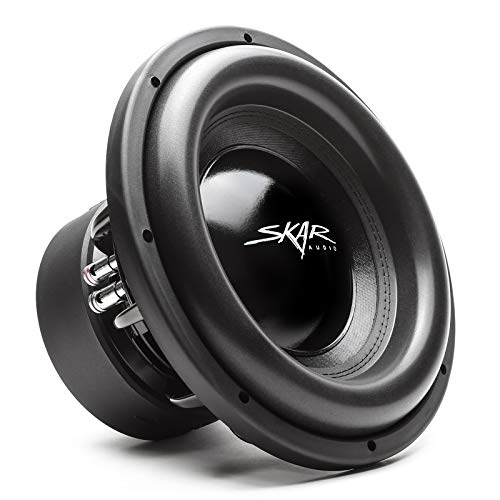
Skar Audio EVL-12 D2 — Bare driver for maximum single-sub output
The EVL-12 D2 is Skar Audio’s statement piece in the 12-inch class: a bare dual 2-ohm driver from the company’s EVL series, which sits at the top of its subwoofer range. Skar quotes a maximum power figure of 2,500 watts for this driver, and while maximum ratings should always be read as ceiling claims rather than planning numbers, the figure does communicate the design intent honestly — this driver is built around a large motor and a coil meant to be fed by a serious monoblock amplifier, not by a modest four-channel bridged as an afterthought. Buyers cross-shopping it against gentler drivers should understand that the EVL’s appetite is part of the product.
In a build, the D2 coil configuration is the EVL’s quiet advantage. Wired in parallel it presents a 1-ohm load, which is exactly where many high-output monoblocks deliver their rated strength; wired in series it offers 4 ohms for amplifiers that prefer a lighter load or for multi-driver arrangements. That flexibility means the driver can anchor a one-sub system today and still make sense if a second EVL joins later and the wiring gets re-planned. What the EVL does not do is forgive a weak enclosure. A driver of this intent placed in an undersized or flimsy box will sound strained and can be damaged by the mismatch, so budget for a properly built enclosure — or accept the loaded version further down this page as the shortcut.
One more consideration belongs to the EVL specifically: electrical appetite is a system property, not a driver property, and this driver exposes it. A high-output monoblock delivering its strength at 1 ohm draws current that factory charging systems in smaller cars may not sustain at full tilt for long. Owners of such builds talk about upgraded grounds and healthy batteries the way other hobbyists talk about tyres — as consumables of the pursuit. None of that makes the EVL a poor choice; it makes it a choice with a supporting cast, and buyers who price the whole cast before ordering are the ones who finish their builds.
- Form: bare driver — enclosure not included, must be supplied by the buyer
- Voice coils: dual 2-ohm (D2), series or parallel wiring
- Power figure quoted by the maker: 2,500 watts maximum
- Series position: EVL, Skar Audio’s top subwoofer line
Strengths
- Built for the single-driver system that still wants genuine output, rather than asking two lesser subs to share the work.
- The dual 2-ohm coils reach the 1-ohm load that unlocks full output from many performance monoblock amplifiers.
- Skar’s EVL line has a deep bench of matched enclosures and community build knowledge behind it, which shortens the research phase.
Trade-offs
- It is only a driver — the enclosure, and the cost and effort of getting it right, are entirely on you.
- Feeding it properly means a substantial amplifier; pairing it with a small amp wastes what the driver was built to do.
- The maximum-power headline needs an RMS-minded reading, so system planning takes more care than the listing’s big number suggests.
Best for: experienced builders assembling a high-output single-sub system around a strong monoblock amplifier.
Not suited for: anyone wanting bass this weekend without an enclosure project, or anyone running a low-power amplifier.
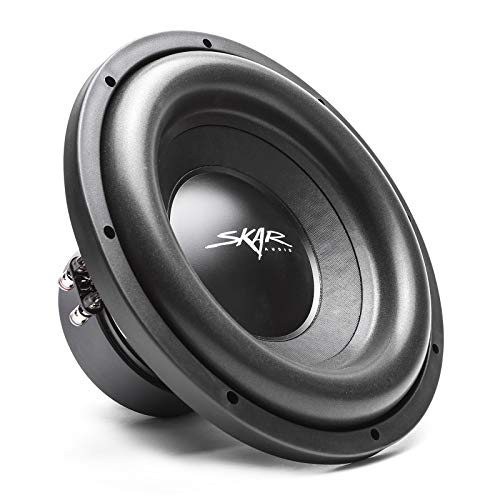
Skar Audio SDR-12 D4 — Bare driver for first builds and pairs
If the EVL is Skar’s flagship, the SDR-12 D4 is its invitation. This bare driver comes from the SDR series, the company’s accessible line, with dual 4-ohm voice coils and a maximum power figure of 1,200 watts quoted by the maker. Everything about that positioning is deliberate: the SDR is the driver Skar sells to people building a first system, upgrading from a factory subwoofer, or putting together a two-driver setup where each individual driver does not need to be a heavyweight. It is the same 12-inch cone area as its bigger sibling, asked to do a less extreme job.
The D4 coils suit the SDR’s likely systems well. A single SDR wired in parallel presents a 2-ohm load — the sweet spot for the affordable monoblocks most first builds use — while a pair of SDRs opens up load combinations that land comfortably on common amplifiers. Because the driver asks for less power than the EVL, the whole supporting cast gets cheaper and simpler: a more modest amplifier, less demanding electrical expectations, and an enclosure that does not need to survive flagship-level punishment. For a daily-driven car where the goal is full, satisfying bass rather than demonstration-level output, that proportionality is a virtue rather than a limitation.
The SDR also deserves credit as a teaching tool. Because its power demands are modest, mistakes in a first SDR build are survivable in a way that flagship-build mistakes are not: gains set a little optimistically, an enclosure a little off the recommended volume, wiring redone once after a multimeter reading exposes a topology error. Every experienced installer has that apprenticeship behind them, and the SDR’s forgiving economics are precisely what an apprenticeship wants. Graduating to a heavier driver later costs less when the first system was proportioned like this one.
- Form: bare driver — enclosure not included
- Voice coils: dual 4-ohm (D4), series or parallel wiring
- Power figure quoted by the maker: 1,200 watts maximum
- Series position: SDR, Skar Audio’s entry subwoofer line
Strengths
- The friendliest entry point in this guide — modest amplifier requirements keep the total system cost under control.
- Dual 4-ohm coils make a single driver land at 2 ohms in parallel, matching the amplifiers first builds typically use.
- Works naturally in pairs, so a system can start with one driver and grow without replacing the first purchase.
Trade-offs
- Output ceiling is well below the EVL’s; buyers chasing maximum volume will outgrow it.
- Still a bare driver, so the enclosure decision and its cost remain part of the project.
- The quoted figure is a maximum rating, and treating it as a continuous target would be a planning error.
Best for: first-time builders and daily-driver systems that want real bass weight without flagship amplifier demands.
Not suited for: competition-leaning builds or anyone whose goal is the loudest possible single-driver setup.

Kicker CompR 48CWR124 — Bare driver with mainstream polish
Kicker’s CompR line has been a default recommendation in car audio for so long that its design language is practically the category’s wallpaper, and the 48CWR124 is the current 12-inch bare driver in that family. It carries dual voice coils rated at 4 ohms each, and Kicker includes speaker wire in the box — a small, telling detail. Brands confident their buyers are seasoned builders do not pack wire; Kicker knows a large share of CompR buyers are installing their first or second subwoofer, and equips them accordingly.
The CompR’s appeal is balance rather than extremity. It is voiced and built for the broad middle of the market: ported or sealed enclosures of ordinary dimensions, amplifiers of ordinary output, music of every genre played at enthusiastic but sane levels. Kicker’s dealer and support network also means enclosure recommendations, wiring guidance and warranty handling are easier to come by than with younger brands. In a guide that also contains a maximum-output specialist, the CompR is the reminder that most 12-inch systems are not built for trophies — they are built to make a commute sound better for a decade, and this driver has a long record of doing exactly that.
- Form: bare driver — enclosure not included
- Voice coils: dual voice coil, 4-ohm configuration
- In the box: speaker wire included, per the listing
- Series position: CompR, Kicker’s long-running mainstream subwoofer line
Strengths
- A proven, widely supported design — enclosure guidance and community experience are easy to find.
- Included speaker wire and mainstream tuning make it approachable for less experienced installers.
- Balanced manners suit sealed or vented enclosures and mixed-genre listening at real-world levels.
Trade-offs
- It does not chase the output extremes the Skar EVL aims at; SPL-first buyers should look up the page.
- The dual 4-ohm coils cannot reach a 1-ohm load from a single driver, which limits pairing with some amplifiers.
- Mainstream ubiquity means it brings no exclusivity — this is the sensible shoe of subwoofers.
Best for: mainstream builds that prize support, predictability and long service over headline output.
Not suited for: builders planning a 1-ohm single-driver system or chasing maximum volume per driver.
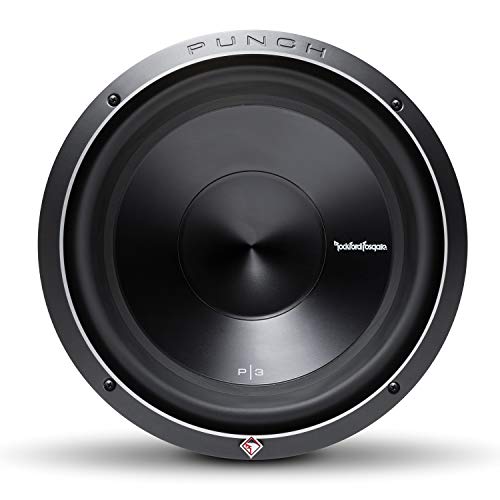
Rockford Fosgate P3D4-12 — Bare driver with an honest RMS rating
The Punch P3D4-12 earns its place in this guide partly for what its listing refuses to do. Where the Skar drivers headline maximum wattage, Rockford Fosgate rates this 12-inch bare driver at 600 watts RMS — a continuous figure, the kind of number an amplifier’s output can actually be matched against. That single act of labelling honesty makes system planning measurably easier: choose an amplifier whose RMS output at your final load sits in a sensible relationship to 600 watts, and the pairing logic is done. In a category addicted to inflated peak numbers, the P3’s restraint is a feature worth naming.
Beyond the rating, the P3 is the Punch line’s serious middleweight: dual 4-ohm voice coils, a build aimed at daily systems that play loudly and cleanly, and a brand heritage in car audio that stretches back decades. The D4 configuration wires a single driver to 2 ohms in parallel, which is where a great many monoblocks are happiest, and pairs of P3s have anchored countless two-driver builds. Rockford also publishes enclosure guidance with unusual thoroughness, which matters for a bare driver — the box remains the buyer’s responsibility, but the homework comes with worked answers rather than folklore.
- Form: bare driver — enclosure not included
- Voice coils: dual 4-ohm (D4), series or parallel wiring
- Power figure quoted by the maker: 600 watts RMS (continuous, not peak)
- Series position: Punch P3, Rockford Fosgate’s core performance line
Strengths
- The RMS rating lets you match an amplifier with real arithmetic instead of translating between brands’ peak claims.
- Thorough manufacturer enclosure documentation takes much of the guesswork out of the box build.
- Dual 4-ohm coils land a single driver at the widely useful 2-ohm load in parallel wiring.
Trade-offs
- Its continuous rating is honest but not huge; extreme-output builds will want the EVL class of driver.
- As a bare driver it still demands an enclosure purchase or build before it makes any sound.
- Rockford’s mainstream presence means pricing follows brand-premium logic rather than value-brand logic.
Best for: planners who think in RMS, want documented enclosure guidance, and value a decades-deep brand behind the driver.
Not suited for: buyers seduced by the biggest watt number on the page, or anyone avoiding an enclosure project.
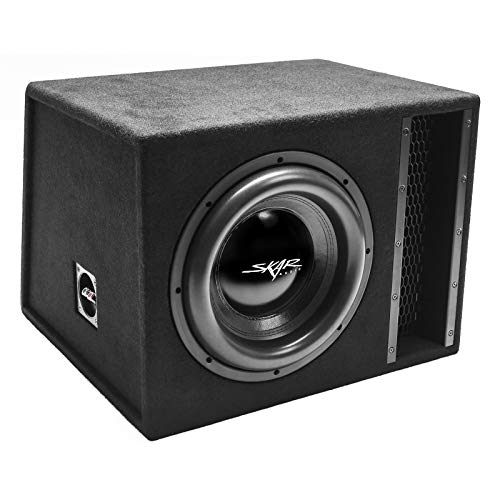
Skar Audio EVL-1X12D2 — Loaded vented enclosure, factory tuned
Everything changes with this pick, because the product changes category. The EVL-1X12D2 is not a driver — it is a complete, loaded subwoofer system: a 12-inch EVL-series driver already mounted in a vented enclosure that Skar designed for it, sold as one unit rated by the maker at 2,500 watts maximum. The internal volume, the port and the driver were chosen together, which removes the single largest variable in subwoofer building. A bare EVL-12 in the wrong box can disappoint; this combination cannot be mismatched in that way, because the matching was done at the factory.
What the buyer still supplies is the amplifier and the wiring, and the load the enclosure presents should be checked against that amplifier before purchase, as with any loaded system. In exchange for that one check, the buyer skips enclosure shopping, enclosure building and tuning anxiety entirely. The vented design leans toward output and low-end emphasis, which is the EVL character through and through. For the driver-curious but time-poor, this is the honest shortcut: flagship-series bass with the engineering decisions pre-made by the people who designed the driver.
- Form: loaded enclosure — driver factory-mounted in a vented box
- System power figure quoted by the maker: 2,500 watts maximum
- Driver family: EVL series, Skar Audio’s top subwoofer line
- Enclosure tuning: vented, matched to the driver by the manufacturer
Strengths
- The enclosure is engineered for the driver inside it, eliminating the most common cause of disappointing builds.
- Installation collapses to amplifier wiring — no box shopping, building or tuning calculations.
- Delivers the EVL series’ high-output character to buyers who would never build a custom enclosure.
Trade-offs
- The box dimensions are fixed; if it does not fit your cargo space, there is no smaller version of the same idea.
- Vented tuning is chosen for you — listeners who prefer a sealed enclosure’s tighter character cannot change it.
- Maximum-rated power still requires an amplifier chosen with RMS discipline, not headline matching.
Best for: buyers who want EVL-level output without designing or building an enclosure.
Not suited for: tight or irregular cargo spaces, or listeners who specifically want sealed-box behaviour.

Kicker 48VCWR122 — Loaded vented enclosure at a friendly 2-ohm load
Kicker’s answer to the loaded question pairs a 12-inch CompR driver with the company’s own vented enclosure, and presents the combination as a 2-ohm load — a detail that does real work. Two ohms is the load at which a wide range of affordable monoblock amplifiers produce their full rated output, so this enclosure slots into mainstream systems without impedance puzzles, adapter thinking or a second driver to make the arithmetic work. Open the box, and what remains is placement, wiring and gain setting.
The CompR character carries through from the bare driver: balanced, musical bass with enough output for real enthusiasm, in a package from a brand with deep support. The vented enclosure adds low-end weight and efficiency, making the most of moderate amplifier power — a sensible pairing for factory electrical systems and daily drivers. Where the Skar loaded enclosure chases the top of the output range, the Kicker chases the middle of the road and paves it well. For a buyer whose research budget is one evening rather than one month, that completeness is the product.
- Form: loaded enclosure — CompR driver factory-mounted in a vented box
- System load: 2 ohms, per the listing
- Driver family: CompR, Kicker’s mainstream subwoofer line
- Enclosure tuning: vented, designed by Kicker for the driver inside
Strengths
- The 2-ohm load matches the amplifiers most mainstream systems already use, with no wiring gymnastics.
- Factory-matched vented enclosure extracts strong low-end output from moderate amplifier power.
- Kicker’s support network and documentation make ownership straightforward for first-time system owners.
Trade-offs
- Output ceiling sits below the Skar EVL enclosure; it is tuned for balance, not maximum volume.
- Fixed enclosure dimensions and vented character leave no room for later re-tuning.
- Buyers who later want to reuse the driver in a custom box start by unbuilding a finished product.
Best for: mainstream system builders who want matched, musical bass with the simplest possible amplifier pairing.
Not suited for: maximum-output builds, or hobbyists who enjoy enclosure design as part of the project.
Loaded Versus Loaded — How Do the Two Ready-Made Enclosures Differ?
Because the two loaded picks compete for the same buyer, they deserve a direct comparison beyond the table. The Skar EVL-1X12D2 is the extrovert: an EVL-series driver in a vented box, aimed at buyers who measure success in output. Its character follows the EVL brief — maximum low-end presence from a single 12-inch package, assuming an amplifier with the strength to feed it. The Kicker 48VCWR122 is the diplomat: a CompR driver in a vented box presenting a 2-ohm load, aimed at buyers who measure success in how painlessly the system integrates with the amplifier they already own or can afford. Neither is the “better” enclosure in the abstract; they optimise for different definitions of a good Saturday.
Three questions separate them in practice. First, the amplifier you own or plan to buy: the Kicker’s stated 2-ohm load is a known quantity that flatters mainstream monoblocks, while the Skar asks you to verify its presented load against a stronger amplifier class. Second, your honest volume habits: listeners who regularly play at the top of the dial belong in the EVL’s corner, while listeners who want full, confident bass at ordinary levels will never reach the region where the Kicker runs out. Third, your relationship with the hobby: the loaded Kicker is a finishing point, a system complete at purchase, while the loaded Skar is often a gateway — its owners are statistically the people who, a year later, are reading about bare drivers and custom enclosures. Both outcomes are respectable. Buy for the listener you are, not the one the forums describe.
What Should You Measure and Check Before Ordering Anything?
Four checks, done with a tape measure and the listings open, prevent nearly every return in this category. First, measure the cargo space the system may occupy — width, depth and, critically, the height under any parcel shelf or seat-back angle — and compare it against the enclosure dimensions for loaded picks or the planned box for drivers. Second, confirm the amplifier’s minimum stable load and its RMS output at the load your wiring plan produces; write both numbers down, because memory edits them optimistically. Third, for bare drivers, confirm the enclosure you intend to buy or build matches the manufacturer’s recommended volume and type, and that its mounting depth clears the driver’s motor. Fourth, check the small print of the listing itself: whether the product is the driver alone or the loaded system, whether the coil configuration in the title matches the variant in the options, and whether anything in the box contents surprises you. Ten minutes of this arithmetic is the cheapest performance upgrade in car audio.
How Do These Six Subwoofers Stack Up Against Each Other?
| Pick | Form | Coils / load | Maker’s power figure | Character |
|---|---|---|---|---|
| Skar EVL-12 D2 | Bare driver | Dual 2-ohm | 2,500W max | Maximum-output specialist |
| Skar SDR-12 D4 | Bare driver | Dual 4-ohm | 1,200W max | First builds and pairs |
| Kicker CompR 48CWR124 | Bare driver | Dual 4-ohm | Not headlined in the listing title | Balanced mainstream |
| Rockford P3D4-12 | Bare driver | Dual 4-ohm | 600W RMS | Planning-friendly honesty |
| Skar EVL-1X12D2 | Loaded vented enclosure | Fixed by manufacturer | 2,500W max | Flagship output, no build |
| Kicker 48VCWR122 | Loaded vented enclosure | 2-ohm system load | Not headlined in the listing title | Plug-and-play balance |
Read the table by form first and wattage last. The wattage column mixes maximum and RMS figures because the manufacturers themselves mix them, and treating those numbers as one scale is precisely the error the P3D4-12’s listing quietly warns against. The form column, by contrast, never lies: it tells you whether an enclosure project stands between you and bass.
What Mistakes Do 12-Inch Subwoofer Buyers Keep Making?
The champion mistake is the one this guide opened with: ordering a bare driver while expecting a working subwoofer, or — the sadder direction — ordering a loaded enclosure for a custom build and discovering the driver was never the product. Read the form factor in the listing title, not the photograph, because photographs of drivers are often shot in enclosures for drama.
Second comes wattage illiteracy. Maximum power figures describe what a driver might survive in an instant; RMS describes what it handles continuously, and amplifiers are rated in RMS. Matching a 2,500-watt-max driver to an amplifier by hunting for the same number in the amp’s headline is how systems end up underpowered, overpowered or simply confused. Pick the final load, read the amplifier’s RMS output at that load, and compare it with the driver’s RMS figure where the maker publishes one.
Third, the enclosure afterthought. A bare driver dropped into whatever box was cheapest inherits that box’s tuning, and a great driver in a wrong-volume enclosure sounds worse than a modest driver in a correct one. Manufacturers publish recommended volumes for a reason. Fourth, wiring a dual-coil driver with only one coil connected, or with the coils opposed, both of which still produce some sound — just bad, weak, potentially damaging sound. And fifth, forgetting the gain control is not a volume knob: setting it by ear to “loud” invites clipping, which is amplifier distortion sent to the driver as heat.
Sixth, and quieter than the rest: ignoring mounting depth and magnet clearance on a bare-driver build. A 12-inch cone describes the front of the driver, not its depth, and high-output motors are deep. An enclosure built to the right volume but too shallow for the driver’s motor produces a build day that ends with the driver resting beside the box instead of in it. The specification exists on every manufacturer’s page; reading it before the enclosure is ordered takes one minute and saves one weekend.
Finally, there is the mistake of buying for the system you describe online rather than the one in your driveway. Output figures, coil choices and enclosure styles all bend toward exaggeration in forum retelling. The drivers and enclosures in this guide cover the honest middle and the honest top of the 12-inch market — choose by your amplifier, your cargo space and your ears, and the build will still be worth describing accurately.
Final Recommendation
Start with form, and the rest of the decision nearly makes itself. Builders should shortlist the drivers: the Skar EVL-12 D2 for maximum single-sub output on a strong amplifier, the Rockford P3D4-12 for the most plannable system on paper, the Kicker CompR 48CWR124 for supported mainstream balance, and the Skar SDR-12 D4 for first builds and growing pairs. Buyers who want the engineering finished should choose between the two loaded enclosures by temperament — the Skar EVL-1X12D2 for output, the Kicker 48VCWR122 for effortless 2-ohm pairing. Whichever direction you take, decide your amplifier’s final load before the driver arrives, because in this category the best 12-inch speaker is the one whose coils and box were chosen for the system it will actually live in — everything else is just a cone in a photograph.
Frequently Asked Questions
Is a 12-inch subwoofer driver the same product as a 12-inch subwoofer in a box?
No, and the distinction is the spine of this guide. A driver is the speaker component alone; it needs an enclosure and an amplifier before it produces bass. A loaded enclosure is that same class of driver factory-installed in a tuned box, needing only the amplifier. Listings for both appear under near-identical names, so check the form in the title before ordering.
Which is better for a single subwoofer, dual 2-ohm or dual 4-ohm?
Neither is better in isolation — the right choice depends on the load your amplifier wants. A dual 2-ohm driver wired in parallel presents 1 ohm; a dual 4-ohm driver wired in parallel presents 2 ohms. Most mainstream monoblocks are happiest at 2 ohms, while many performance amplifiers are built for 1 ohm. Choose the coil that lands your single driver on the load your amplifier is rated to drive well.
Can I run one of these drivers without an enclosure, mounted free-air?
Free-air and infinite-baffle installations exist, but they require a rigid, well-sealed baffle separating the driver’s front and back waves, plus a driver suited to the job. Dropping a bare driver into an unsealed trunk space or an open panel is not that installation — output collapses and the driver can over-excurse. For the drivers in this guide, plan on a proper enclosure.
Why do the wattage numbers differ so much between brands?
Because brands quote different kinds of numbers. Skar’s listings here state maximum power; Rockford Fosgate states RMS, a continuous rating, for the P3D4-12. A maximum figure will always dwarf an RMS figure for a comparable driver, so cross-brand comparisons must compare like with like — RMS against RMS wherever the data exists.
Does a vented enclosure always beat a sealed one?
No. Vented enclosures, including both loaded picks in this guide, generally deliver more output and deeper extension around their tuning point, which suits high-energy listening. Sealed enclosures are smaller and often described as tighter and more controlled. The choice is about character and space, not a league table.
What else do I need besides the subwoofer itself?
An amplifier matched in RMS output to your final load, wiring of adequate gauge, and — for every bare driver — an enclosure built or bought to the manufacturer’s recommended volume. Loaded enclosures remove the box from that list but nothing else.
How do I know which final load my finished system will present?
Work it out on paper from the coil configuration. One dual 2-ohm driver gives 1 ohm in parallel or 4 ohms in series; one dual 4-ohm driver gives 2 ohms in parallel or 8 ohms in series. Adding a second driver halves the load when the drivers are paralleled with each other, or doubles it in series arrangements. Manufacturer wiring diagrams cover the standard combinations — pick the diagram whose stated final load matches your amplifier, and verify the result with a multimeter before powering up.
Is one 12-inch subwoofer enough, or should I plan for two?
For most vehicles and most listeners, one well-chosen 12-inch driver in a correct enclosure, on adequate power, is genuinely enough — the class became dominant on single-driver systems. Two drivers add output and even out the load across the cabin, and they make sense for larger vehicles or listeners who know from experience that one leaves them wanting. The picks here support both paths: the SDR and CompR drivers are natural pair candidates, while the EVL is designed to satisfy as a single.
Related Guides
Building out the rest of the system? Continue with our guides to the best car amplifiers for subwoofer systems, the best 10-inch subwoofers for tighter spaces and the best car speakers for a full front-stage upgrade.


