Our Top Picks




What's inside
- Four Different Products Wearing One Label
- Worktops: Size, Depth, Edges, and How Each Material Ages
- Load Ratings, Read Honestly: Surface Figures, Clamp Points, and Frame Shapes
- Casters: The Small Wheels That Define the Entire Product
- Height and Posture: Elbows, Eye Lines, and the Wobble That Ends Standing Work
- Stability Physics: Footprints, High Loads, and the Loaded Side Shelf
- Power and Cables on a Desk That Refuses to Stay Put
- The Extras That Separate One Design From Another
- Where These Desks Earn Their Keep: Five Rooms, Five Different Briefs
- Assembly and Upkeep: Standard Stems, Grease, and a Spanner Schedule
- Check prices on Amazon
- A Buying Path in Prose: Floor First, Then Load, Then Height, Then Surface
As an Amazon Associate I earn from qualifying purchases. This post may contain affiliate links at no extra cost to you.
A note on how this guide is funded before the designs themselves: some links here are affiliate links, and when readers buy through them the publisher may earn a commission at no added cost to the reader; that commission does not change the order in which products are discussed below.
Four Different Products Wearing One Label
The phrase rolling cart desk describes at least four distinct pieces of furniture, and confusing them is the source of most disappointed purchases. The first is the laptop cart: a small surface, often barely wider than the computer it carries, mounted on a single column or a light frame, meant to hold one machine and perhaps a mouse. It is furniture for moving a laptop between a sofa, a bed, and a chair, not for supporting a monitor, a separate keyboard, and a day of documents. Its virtues are a tiny footprint and easy steering through doorways; its limits appear the moment a second device joins the first.
The second type is the mobile workstation cart, a sturdier design borrowed from workshops and clinics. It carries a broader top, sometimes a lower shelf or a holder for a computer case, and a frame built to be pushed across a building rather than nudged across a room. Hospital and warehouse versions of this idea have existed for decades, and the home models inherit their priorities: durability, a surface that tolerates being wiped down, and casters chosen for distance rather than silence. A workstation cart assumes the load travels with it, so its shelves, handles, and frame all serve the journey as much as the destination.
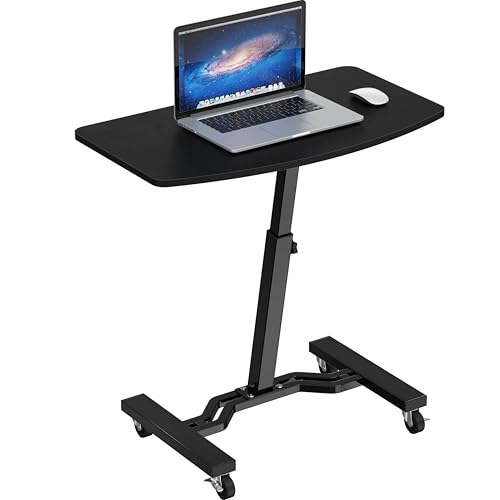
The third type is the pneumatic sit-stand rolling desk, which adds a gas-lift column — the same mechanism family as an office chair — to a worktop on casters. One lever releases the column, the surface rises or settles, and the desk alternates between a chair and a standing position while remaining free to roll. This is the most mechanically ambitious of the four types and the one where quality differences hide. A good lift moves smoothly under load and holds its height for months; a poor one drifts downward during a working day or requires a wrestling match to raise, and neither flaw appears in a photograph.
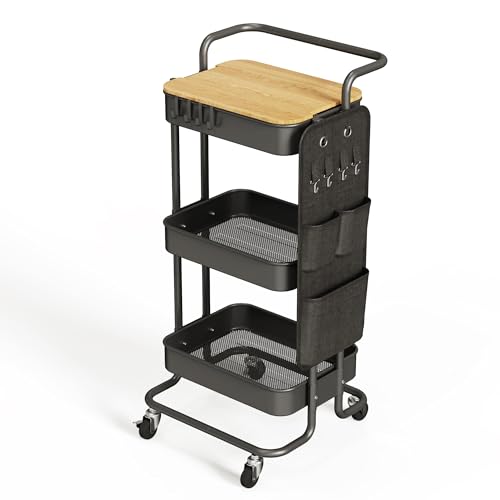
The fourth type is the utility cart-desk, a hybrid that is half trolley and half table: two or three open shelves, a top surface large enough for writing or a laptop, and a frame that expects to carry supplies as well as support work. Teachers, crafters, and market traders live on these. The top shelf works as a desk in short bursts while the lower shelves do the hauling, and judging it by workstation standards misses its purpose. Knowing which of the four types a listing actually describes — by frame, column, and shelf arrangement rather than by the seller’s chosen name — is the first and cheapest piece of research a buyer can do.
These categories blur at the edges, deliberately in some catalogues, because a laptop cart photographed with a monitor on it sells a fantasy its frame cannot sustain. The frame tells the truth. A single slender column with a small base describes a laptop cart whatever the listing calls it; four legs, cross-bracing, and a lower shelf describe a workstation or utility design. Buyers who classify by structure first and marketing second rarely end up surprised, and the sections that follow assume that classification has already happened.
Worktops: Size, Depth, Edges, and How Each Material Ages
Worktop dimensions decide what kind of work a rolling desk can host, and depth matters more than width for most people. A surface around 40 to 60 cm deep holds a laptop comfortably but leaves a separate keyboard competing with the machine for the same strip of space, while depths approaching 70 cm allow a monitor on a stand, a keyboard in front of it, and a notebook beside them. Widths run from roughly 55 cm on laptop carts to about 120 cm — the 48-inch class — on the largest rolling workstations, and every centimetre of width adds leverage the frame and casters must manage when the desk is pushed from one end.
Shoppers whose rooms suit a fixed desk of a known width can compare the rolling options against best 47 inch desks, since a cart that parks against the same wall competes for exactly the same floor plan. The comparison usually clarifies the trade: the fixed desk offers a deeper, steadier surface, while the cart offers the ability to reclaim the floor. Neither wins in the abstract. The room, and how often it changes purpose during a day, decides which compromise serves its owner.
Materials divide into three common families. Laminate over particleboard dominates the middle of the market: a printed or textured surface bonded to a board core, finished with edge banding around the perimeter. It resists stains, wipes clean, and keeps its appearance for years in dry rooms, but its weakness is the edge. Once banding lifts or a corner chips and moisture reaches the core, the board swells and the damage cannot be sanded back. Bamboo tops, built from laminated strips, tolerate edge knocks better and can be refinished lightly, though they cost more and vary in tone between batches. Powder-coated steel tops belong to workshop carts: nearly indestructible, noisy under a mug, cold to the forearm, and honest about their industrial intent.
Edge treatment shapes daily comfort in ways dimensions do not. A square, thinly banded edge presses into forearms during long typing sessions, while a waterfall or rounded front edge spreads that contact. Some workstation carts add a raised lip at the back or sides, which keeps pens and tools aboard during a push across the building but interrupts the surface for anyone who spreads papers wide. A recessed cup holder or a cable slot sounds trivial in a listing and becomes either a daily convenience or a daily irritation depending on where it sits relative to the owner’s dominant hand.
Ageing also differs under sunlight and cleaning. Laminates fade evenly and tolerate most household cleaners; bamboo darkens gradually and prefers gentler treatment; powder coat chips at impact points and shows the steel beneath, which can rust in a damp workshop if the chip is ignored. None of these behaviours makes a material wrong. They make it matched or mismatched to a setting — a sunlit conservatory, a garage, a clinic corridor — and a buyer who pictures the desk in its actual room, under its actual light, with its actual cleaning routine, will choose better than one comparing finishes on a screen.
Load Ratings, Read Honestly: Surface Figures, Clamp Points, and Frame Shapes
Every rolling desk publishes a load figure, and the figure means less than buyers assume. A surface load rating describes a distributed weight — books, equipment, and forearms spread across the top — applied to a stationary desk on a level floor. It does not describe a point load, it does not describe the desk in motion, and it rarely describes the lower shelves, which often carry separate and smaller ratings of their own. A desk rated for 50 kg with the load spread evenly may still object to 15 kg hung off one corner, because the physics of a concentrated load and a distributed one are entirely different conversations.
The monitor arm is the classic concentrator. An arm clamps to the back edge of the worktop, and the entire weight of the arm and screen travels through a clamp footprint a few centimetres wide, with leverage multiplying the force whenever the screen is extended forward or swung to one side. Particleboard cores are at their weakest exactly there: the clamp can crush the core locally, loosen over weeks, and eventually tear through the edge banding. A rolling desk intended to carry an arm needs either a steel-reinforced edge, a through-bolted mounting plate, or a top material with genuine compressive strength. The spec sheet shows whether the maker anticipated arms at all; a maker who did usually says so, because it is a selling point worth printing.
Frame shape decides how gracefully a desk carries what the rating promises. A single central column concentrates everything — load, wobble, and the consequences of a caster catching — through one joint, and the design compensates with a wide, heavy base. Four-leg frames spread load to the corners, tolerate uneven weight distribution far better, and fail more politely, creaking and flexing before anything gives way. Twin-column designs sit between the two, common on wider sit-stand carts where one column would allow the top to seesaw. When a listing gives a generous load figure for a single-column desk with a narrow base, the arithmetic of the design deserves a sceptical look, because the rating may describe the column’s strength while saying nothing about the base’s willingness to stay planted.
Motion changes the load case again. Pushing a loaded desk over a threshold applies a shock to whichever caster meets the strip first, and the frame experiences a brief multiple of the static weight. Shelves loaded to their stationary limit can shed items or stress their fixings during an ordinary trip down a hallway. Experienced owners of workstation carts develop a habit of loading to perhaps two-thirds of the published figure for anything that travels daily, reserving the full rating for desks that roll once a month between two positions in the same room. That habit is not timidity; it is the difference between a rating measured on a laboratory floor and a building with lift thresholds, cable ramps, and one famously uneven corridor.
Buyers comparing frame layouts across the wider desk market will find the same single-column versus four-leg argument running through best 50 inch computer desks, where the desks do not move but the load paths are identical. The rolling versions simply add consequences: a fixed desk that flexes is annoying, while a rolling desk that flexes is also a desk whose casters splay, whose steering degrades, and whose joints loosen faster with every trip. Load honesty on a cart is therefore partly about weight and partly about how often the whole structure is asked to prove it while moving.
Casters: The Small Wheels That Define the Entire Product
If one component deserves the buyer’s closest attention, it is the casters, because they determine whether the desk glides or grumbles, whether it crosses a doorway or stops at it, and whether the floor beneath survives the arrangement. The cheapest designs use twin-wheel casters borrowed from office chairs: two narrow wheels side by side on a small axle, adequate on hard floors and low-pile carpet, quick to clog with hair and thread, and prone to skating sideways when pushed at an angle. Better carts use single rubber or polyurethane wheels with real bearings, which roll quieter, shed debris more gracefully, and keep their direction under load.
Diameter is the specification that predicts behaviour over obstacles. A wheel of 50 mm meets a door threshold as a wall; a wheel of 75 mm climbs it with a bump; a wheel of 100 mm treats it as a rumour. The geometry is unforgiving — a wheel rolls over an obstruction comfortably only when the obstruction is a modest fraction of its radius — so any desk expected to travel between rooms should carry casters of at least 75 mm, and any desk crossing thresholds daily justifies 100 mm. Carpet pile works the same way in reverse: deep pile swallows small wheels and multiplies pushing effort, while larger diameters ride higher in the pile and narrower wheels sink less than wide soft ones, a trade-off worth weighing for a bedroom installation.
Locking styles vary more than listings admit. A toe brake on an individual caster locks that wheel’s rotation; better designs also lock the swivel, because a desk with locked wheels and free swivels still wanders in an arc when leaned on. Total-lock casters, common on medical carts, freeze both with one press and are worth seeking for any desk used standing, where the user’s weight shifts against the surface all day. Count the locks as well as the type: two locking casters on the diagonal usually suffice on a four-leg frame, while a single-column desk may need its whole base considered, since one free corner becomes the pivot for every wobble.
Mounting decides whether a caster is a replaceable part or a life sentence. Stem mounts push or screw into the frame’s legs — grip-ring stems and threaded stems in a handful of standard sizes dominate — while plate mounts bolt a flat flange to the frame’s underside and spread load across four screws. Plates suit heavier carts and make replacement a matter of matching a bolt pattern; stems suit lighter frames and make replacement a matter of matching a diameter and length. Either is serviceable when the size is standard. The designs to avoid are proprietary housings moulded into the frame, because a single cracked wheel then retires the whole desk, and wheels are wear parts by nature.
Floor marking is the caster question hardwood owners ask last and regret first. Hard plastic wheels can leave scuffs and, under a loaded desk dragged sideways, genuine scratches; soft polyurethane and rubber compounds are marketed as non-marking and generally earn the description, though a gritty wheel of any material acts as sandpaper. The discipline that protects floors is mundane: keep wheels clean, lift rather than drag when repositioning sideways, and treat felt or rubber caster cups as cheap insurance under a desk that parks in one place for weeks. A wheel that sits loaded in one spot can also flat-spot over months, producing a rhythmic thump on the first roll after a long stay — another argument for moving the desk a few centimetres now and then, if only to rotate its resting points.
Height and Posture: Elbows, Eye Lines, and the Wobble That Ends Standing Work
A fixed-height cart makes one posture decision on the buyer’s behalf, and the decision had better match the chair and the person. Seated work wants the surface near elbow height when the upper arms hang relaxed — for most adults a band roughly between 68 and 76 cm, varying with body size and chair height — because a surface far above the elbows shrugs the shoulders upward all day, and one far below rounds the back over the keyboard. A laptop cart used from a sofa lives by different numbers entirely, since sofa seats sit lower and softer than office chairs, and the cart must slide its base beneath the furniture while its surface hovers over the user’s lap. Measuring the gap under the sofa and the height of its seat is worth more than any ergonomic chart for that use.
Adjustable designs widen the safe zone. Crank and pneumatic models in this category commonly span from the low seventies in centimetres up to around 105 to 120 cm, covering seated work and standing work for a broad range of heights. Standing elbow height runs higher than most first-time standers expect, and a desk whose maximum falls short forces a stoop that the lower back reports by mid-afternoon. The monitor’s eye line is the second measurement: the top of the screen should sit near or slightly below eye level, which on a single surface means the keyboard and the screen compete for the same plane. A laptop on a standing cart almost always needs a riser and a separate keyboard, or the screen sits at typing height and the neck pays the difference.
Wobble is where tall rolling desks live or die. Every frame flexes more as it extends, every caster adds a small freedom of movement, and the combination multiplies at standing height until typing sets the monitor swaying. The physics is plain leverage: a force applied at the surface travels down a longer column, and the base has proportionally less authority over it. Single-column pneumatic carts show this first and worst, which is why the better ones use oversized columns, heavy bases, and dampers. A buyer who plans to stand for hours should weight stability at full extension above every other feature, because a desk that sways gets lowered, then parked, then quietly replaced by the table it was meant to supersede.
Owners report a pattern worth heeding: the wobble that feels acceptable in a showroom, unloaded and on a polished floor, grows at home under a monitor, a laptop, and a mug, on a floor with its own opinions. Judging a cart at its maximum height, with a hand resting and typing motions simulated at the front edge, reveals more than any specification. Where buying in person is impossible, the return terms become the showroom, and the first afternoon’s standing session should be treated as the real evaluation — at working height, with the real equipment aboard, for long enough that small annoyances have time to introduce themselves.
Posture also changes with the task in ways a single height cannot serve. Writing by hand wants a surface slightly higher than typing; drawing wants a tilt most carts do not offer; video calls want the camera near eye level, which may mean the laptop rides a riser while the keyboard stays low. A two-level cart — main surface plus a keyboard tray or a raised rear shelf — resolves several of these conflicts at once, which is why the extras section below treats trays and shelves as ergonomic equipment rather than decoration. Height range buys adaptability between sitting and standing; a second level buys adaptability between looking and typing, and many owners need the second more than the first.
Stability Physics: Footprints, High Loads, and the Loaded Side Shelf
A rolling desk tips when its centre of gravity travels beyond the footprint of its casters, and everything about stability follows from that sentence. The footprint is the rectangle — or, on a column base, the shape — connecting the contact points of the wheels. Weight placed inside that outline is stable; weight cantilevered beyond it, or raised so high that a small lean moves the combined centre outside it, begins the tip. This is why a modest cart carrying a low load of books is nearly impossible to upset, while the same cart with a large monitor raised on an arm at full standing height deserves respect every time it is pushed.
Height raises the centre of gravity and shortens the distance it must travel to escape the footprint. A push at surface height, a caster dropping into a floor vent, a child leaning on the front edge — each applies a tipping moment that a low, wide desk shrugs off and a tall, narrow one must genuinely resist. Manufacturers counter with the tools available: wider caster spacing front to back, heavier bases that drag the centre downward, and outrigger-style feet on some workstation carts that extend the footprint beyond the frame itself. Ballast is the unglamorous hero of the category. A low shelf loaded with a computer case or a battery brick is not merely storage; it is an anchor that lowers the whole system’s centre and steadies every trip.
The loaded side shelf is the scenario that catches owners out, because it shifts the centre sideways, toward the edge of the footprint with the least margin. A printer perched on a side extension, a stack of files on a swing-out shelf, a bag hung from a handle — each moves weight toward one boundary, and a turn during a push adds a lateral force in the same direction. The desk rarely falls dramatically; it lifts a caster, hesitates, and either settles or goes, and the hesitation is the warning. Keeping heavy items centred and low, and treating side shelves as territory for light, bulky things — paper, cables, a headset — respects the geometry without sacrificing the convenience.
Four-leg frames and column bases fail differently, which informs how each should be used. A four-leg cart telegraphs instability through flex and caster lift, giving its user time to react, and its footprint is usually the full size of the frame. A column base concentrates the footprint into the base’s own dimensions, which may be considerably smaller than the worktop above it, so the visual size of the desk overstates its stability in a way that surprises people. Comparing base dimensions rather than top dimensions is the corrective habit. Wider buying guides make the same point about fixed desks — readers browsing best 60 computer desks will see footprint discussed for monitor-heavy setups — but casters shrink every footprint by their swivel offset, so a rolling desk needs more margin than its fixed equivalent, not the same.
Dynamic behaviour completes the picture. A stationary desk can be perfectly stable and still be a poor traveller, because motion adds acceleration forces at every start, stop, and turn. The taller and heavier the load, the gentler the handling must be: push from low on the frame rather than at the surface, steer through thresholds squarely rather than at an angle, and lock the casters on arrival so the first lean against the desk does not become a roll across the room. These habits sound fussy in print and become automatic within a week of ownership, the way drivers of tall vehicles learn to take roundabouts with respect.
Power and Cables on a Desk That Refuses to Stay Put
Electricity is the problem every rolling desk must negotiate, because the wall socket does not roll with it. The simplest honest arrangement is a single supply lead: one power strip mounted to the desk itself, under the top or on the frame, feeding the monitor, the laptop charger, and the lamp, with one cable leaving the desk for the wall. Every device then moves as a unit, cable lengths stay constant, and the only variable is the slack in that single lead. Desks wired any other way — each device with its own cord to the wall — become a small harbour of tangled lines the first time they move, and someone eventually rolls a caster over a cable that mattered.
Slack must be planned, not discovered. The lead needs enough length to reach the socket from every parking position the desk actually uses, plus the extra that a route around furniture consumes, and it needs a home while the desk travels: a hook, a basket, or a coil point on the frame where the excess rides instead of trailing. A trailing cable finds caster wheels with unerring instinct, wraps around an axle, and either stops the desk or leaves the plug behind at speed. Cable spines and flexible conduits, borrowed from sit-stand desk practice, guide the lead from the moving surface down to the frame in a controlled curve, and a strain-relief point — a clamp or a grommet where the cable is anchored — ensures that any tug loads the frame rather than the connector at the back of a monitor.
Battery bricks offer the genuinely cordless session. A large power station or a high-capacity battery pack riding on the low shelf can run a laptop for hours and a monitor for a respectable stretch, turning the desk into an island that parks anywhere — a garden room, a balcony doorway, the quiet corner far from sockets. The trade-offs are weight, which the ballast discussion above reframes as partly a virtue, and the discipline of recharging. Owners who work this way describe a rhythm: the desk docks at its charging spot overnight and roams by day. For a rolling desk in a small home, that rhythm can be the difference between furniture that serves the room and furniture that must always live within one cable’s reach of the same wall.
Small decisions compound here. Chargers velcroed beneath the top stay with the desk instead of migrating to other rooms. A short cable from the strip to each device, sized to its position, removes the loops that catch on drawer handles and door frames. USB power delivered from the strip or a hub reduces the count of separate bricks. And a labelled switch on the strip gives the whole desk a single off point, which matters for safety in workshops and classrooms where the desk is one of many electrical citizens. None of this requires exotic parts; it requires deciding the power design once, deliberately, rather than re-deriving it every time the desk moves.
The adjustable-desk world solved most of these problems earlier, and its accessories transfer directly — a point worth exploring through best adjustable desks for readers comparing cable-management kits. The rolling desk simply adds one rule the fixed sit-stand desk never faces: everything attached must survive motion. A cable tray that holds its contents on a stationary desk may shed them on a cart crossing a threshold, so trays need lips or lids, and anything resting loose on a shelf should be assumed to be auditioning for a fall.
The Extras That Separate One Design From Another
Keyboard trays divide opinion because they solve a real geometry problem and create a real knee problem. A tray drops the keyboard below the main surface, letting the screen sit higher relative to the hands, which is exactly the separation posture asks for. But a tray consumes the space knees occupy, and on a compact cart the tray’s rails and brackets can reduce knee clearance to a negotiation, especially for taller users. Trays that slide fully away when unused mitigate the conflict; fixed trays demand that the buyer measure seated knee height against the tray’s underside before committing, a measurement almost nobody makes and many wish they had.
CPU holders and low shelves carry the computer itself, and their value depends on the machine. A small-form-factor PC strapped beneath the top or standing on a low shelf travels with the desk, keeping cable runs short and the ballast benefit described earlier. A full tower needs a shelf with genuine depth and a retaining lip or strap, because a tower that slides during a push changes the centre of gravity mid-journey. Printer shelves follow the same logic with an added vibration question: a printer working on a rolling cart shakes the surface its paper emerges onto, so printers belong low, on the shelf least connected to the writing surface, with casters locked during printing.
Push handles look like a styling flourish and function as a safety feature. A desk pushed by its worktop edge is steered from its highest, least stable point, and the hands doing the pushing are also positioned to catch the desk if it tips. A handle at waist height on the frame applies force where the structure is strong and the leverage is kind, and on workstation carts a handle at each end acknowledges that the desk will be pulled out of rooms as often as pushed into them. Modesty panels, by contrast, are mostly about appearance and cable concealment — except that a panel adds sail area and a little weight low on the frame, and on a cart used in a classroom it also keeps students’ feet and bags out of the cable zone, which is a practical virtue wearing a cosmetic name.
The remaining extras reward a sceptical inventory. Cup holders prevent spills only if sized for the owner’s actual vessel. Hooks for headphones and bags are useful exactly where they do not create the side-load problem discussed earlier. Drawer units under a rolling top add prized storage and a surprising amount of weight high in the structure, and their contents shift the balance as drawers open — a loaded top drawer pulled fully out is a cantilever that small carts feel immediately. The pattern across all extras is the same: each one spends some of the desk’s stability, space, or load budget, and the good designs are the ones where the purchase was worth the spend.
It helps to rank extras by the problem they solve rather than collecting them. A home clinician needs the wipe-clean surface and the handle; a teacher needs shelves and a panel; a bedroom worker needs the tray and the quiet casters. Listings that bundle every accessory into one model are selling the longest feature list, not the most coherent desk, and the incoherence shows up later as a cart that is heavy, cluttered, and oddly short of space for the one task it performs daily.
Where These Desks Earn Their Keep: Five Rooms, Five Different Briefs
The small apartment is the natural habitat. A rolling desk that serves as an office by day and rolls into a closet, behind a sofa, or against a bedroom wall by night lets one room hold two lives without the daily penance of packing a fixed desk into boxes. The constraints are storage geometry and door widths: the desk must fit its hiding place with its load aboard, because a cart that must be unloaded before it can be parked will simply stop being parked. Measuring the closet’s interior, the turn from the hallway, and the threshold between them is the unglamorous research that decides whether the concept works in a particular flat.
Bedside work suits a different member of the family: the laptop cart, swung over the bed for a convalescent worker, a student revising in a shared house, or anyone whose illness or injury makes a chair a poor office. The base must slide beneath the bed frame, the surface must reach across the mattress without its edge digging into it, and the whole arrangement must clear quickly when a nurse, a partner, or a spilled drink demands it. Stability expectations adjust accordingly — this is a one-laptop, one-person setup — and the best bedside carts are the ones that accept that brief gracefully instead of impersonating workstations.
Classrooms ask for fleet behaviour. A teacher’s rolling cart-desk migrates between rooms, carries the day’s materials on its shelves, presents from its top surface, and survives being borrowed, bumped, and cleaned by strangers. Durability outranks adjustability; locking casters matter because classroom floors slope in ways architects never intended; and a surface that tolerates whiteboard markers, glue, and disinfectant earns its place. Schools buying several should value identical models, because shared spare casters and interchangeable parts turn maintenance from a procurement exercise into a drawer of spares.
Workshops and garages use workstation carts as mobile benches with pretensions, and the brief is load, impact, and surfaces that forgive. A steel-topped cart holding tools, a task light, and the component currently being repaired brings the work to the vehicle or the bench rather than forcing trips back and forth. Caster diameter grows in importance where floors carry expansion joints, cables, and the occasional dropped fastener, and brakes must hold the cart still against the force of a wrench. The desk that thrives here looks overbuilt in a showroom and merely adequate in February, in a cold garage, under a gearbox.
Home clinic setups — a telehealth corner, a visiting practitioner’s base, a carer’s documentation station — combine several demands at once: a surface for a laptop and notes, shelves for supplies, a frame that cleans down properly, and casters quiet enough not to announce every repositioning to the patient. Privacy enters the specification too, since a rolling desk can turn its screen away from a doorway in one push, a manoeuvre no fixed desk offers. In each of these five settings the winning product differs, which is the real lesson: rolling cart desks are not one purchase but a family of answers, and the room writes the question.
Assembly and Upkeep: Standard Stems, Grease, and a Spanner Schedule
Assembly quality predicts ownership quality. Bolted frames reward a methodical build: casters seated fully before the frame is loaded, bolts tightened in a cross pattern so the frame pulls square, and the lift mechanism, where fitted, cycled empty several times before equipment trusts it. A desk that rocks on a flat floor immediately after assembly is usually a frame bolted out of square rather than a defective part, and loosening, settling, and re-tightening the joints in order cures most cases. Keeping the hex keys that arrive in the box, taped beneath the worktop, is a small habit that separates owners who maintain their furniture from owners who mean to.
Caster replacement is the maintenance task this category guarantees, and its ease was decided at purchase time by the mount standard. Threaded stems in common sizes — 8 mm and 11 mm diameters cover much of the market, with 7/16-inch stems on some imported frames — unscrew and swap in minutes once the desk is tipped or lifted. Grip-ring stems pull free with firm leverage. Plate casters need a bolt pattern match and a few minutes with a driver. The practical advice is to identify the stem size when the desk is new, record it with the manual, and consider ordering a spare caster in the same order as the desk, because the day a wheel cracks is the day that size is out of stock.
Bearings ask for little and repay it. A drop of light oil or a smear of grease on a swivel race that has begun to grumble restores the silent steering the desk had when new, while hair and fibre wound around axles — the silent tax of carpeted homes — need picking out before they compact into felt. A quarterly ritual covers most of it: pick the axles clean, check each brake still bites, spin each wheel and listen. Wheels that have flat-spotted from long parking often round out again after a few days of regular rolling; wheels that have cracked or chunked should be replaced in pairs on the same axle line so the desk sits level.
Bolted frames loosen in service, predictably, because rolling is vibration delivered in small doses for years. A tightening schedule — every few months, every bolt, a quarter-turn of attention each — prevents the wobble that owners otherwise attribute to age. Laminate tops can be patched at small chips with repair wax or a colour-matched filler before moisture finds the core, and lifted edge banding can be re-bonded with heat and pressure if caught while the core is still dry. Powder coat chips take a dab of touch-up paint to keep rust out of a workshop cart. None of this is skilled work; all of it is the difference between a cart that serves for a decade and one that is replaced at year three for a collection of small, curable complaints.
Rolling a Loaded Desk Through a Real Building, Door by Door
The journey deserves its own rehearsal, because a rolling desk’s working life is measured in journeys and most product photography shows it parked. Start at the doorway of the room where the desk sleeps. Standard interior doors leave a clear opening narrower than their nominal size once the door slab and its stops are accounted for, and a wide workstation cart may need to enter at a slight angle, which requires swing room on both sides of the frame. A desk that fits the doorway squarely but cannot make the turn from a narrow hallway into that doorway has failed its route just as completely as one that is simply too wide, and the failure only appears on the first attempt, with the desk loaded and the hallway blocked.
Thresholds and transitions come next, in order of hostility. A bare aluminium strip between rooms is a small event for a 100 mm wheel and a genuine obstacle for a 50 mm one, especially approached at an angle, when the leading caster tries to swivel away from the impact instead of climbing. Carpet-to-tile transitions hide a lip that catches the same way. Lift entrances add a gap as well as a step, and a small caster dropping into that gap stops a loaded desk with a jolt that travels straight up to the monitor. The technique that experienced cart users develop — approach squarely, at walking pace, with a hand low on the frame, and lift the leading end a fraction as the wheels meet the obstacle — is not a workaround for a bad desk. It is the normal operating method for any desk, and a model whose casters are large enough to make the technique feel easy is a model specified correctly for its building.
Rugs deserve a specific mention because they defeat desks quietly. A low-pile rug with a bound edge behaves like a soft threshold and most carts cross it without comment. A deep, unbound rug edge curls under a leading wheel, folds, and either stops the desk or rides up against the frame, and repeated crossings chew the edge into a permanent wave. In rooms where the desk must cross the same rug daily, a rug pad that stiffens the edge, or a route that crosses at the rug’s corner where it can be lifted and settled, preserves both the rug and the owner’s temper. These details never appear in a specification table, yet they decide whether the desk’s mobility is a daily pleasure or a daily negotiation that ends with the desk parked permanently — the fate the purchase was meant to avoid.
Noise belongs to the journey too. Hard wheels on tile or laminate announce a desk’s passage with a rumble that hard floors amplify, and a night-shift worker rolling a desk at dawn learns this in one morning. Softer tyre compounds and larger diameters quiet the travel considerably, and bearing quality separates a hum from a rattle. A buyer whose desk will travel at unsocial hours should treat quiet running as a specification on par with load rating, because a desk that cannot be moved without waking the household will not be moved, whatever its other virtues.
What the First Week of Ownership Reveals That No Listing Can
The first week with a rolling desk is an audit the owner performs without meaning to. The desk gets parked in its intended place and the discovery phase begins: the parking place is two centimetres too close to a door’s swing, the socket that was supposed to feed it is behind the bookcase, the route to the kitchen table crosses the one rug in the home with a curling edge. None of these findings indicts the desk. They describe the room with new precision, because a piece of furniture that moves exposes measurements that fixed furniture never asks about. Owners who treat the first week as a fitting — adjusting the parking place, the cable route, and the load arrangement — end it with a desk that feels designed for the home. Owners who treat it as a verdict often return a good desk for the wrong reasons.
Small frictions announce their remedies during that week. A monitor that sways when the desk is nudged asks for its stand to be swapped for a lower mount or for the load to be rebalanced toward the low shelf. A caster that collects hair from one particular carpet asks for a weekly pick-out added to the household routine. A brake that is awkward to reach with a foot asks to become the caster that gets parked against the wall, where its lock matters least. Each friction is information, and the pattern across owners is consistent: the desks that remain in service for years are not the ones that arrived perfect, but the ones whose owners made three or four small adjustments in the first fortnight and then stopped needing to think about the furniture at all.
The week’s most valuable revelation is behavioural. A rolling desk only earns its premium over a fixed desk if it actually rolls — if the room genuinely reconfigures around it, the desk migrating from window light in the morning to the quiet wall in the afternoon, from office to dining table when guests arrive. Some owners discover their routines never needed that freedom, and the honest outcome is a desk parked forever, which a fixed desk would have served better and steadier. Others discover the opposite: the desk moves six times a day, and its mobility becomes the feature the household organises around. No listing can predict which household a buyer lives in. The first week can, and it is worth listening to before the return window closes, whichever way the evidence points.
Check prices on Amazon
Live listings for the shortlist in this guide are pulled from Amazon below, so prices and availability are always current at the moment you look.


A Buying Path in Prose: Floor First, Then Load, Then Height, Then Surface
Begin with the floor, because the floor eliminates more models than any other factor and asks nothing of the buyer’s imagination. Hard floors with thresholds call for large, soft-tyred casters; deep carpet calls for large diameters and modest loads; delicate hardwood adds the non-marking requirement and the discipline of clean wheels. A desk that cannot travel its actual route is not a rolling desk at all, merely a desk with decorative wheels, so the route — every doorway, threshold, rug edge, and lift entrance between the desk’s parking place and its working places — should be walked and measured before a single product page is opened.
Load comes second, counted honestly. List everything the desk will carry in its heaviest realistic configuration: screen and arm, computer, books, printer, the battery brick if cordless running is planned, and the owner’s own forearms at the end of a long day. Compare that total not with the headline rating but with the rating discounted for motion, and check the frame shape against the load’s distribution. A concentrated monitor-arm load at the back edge eliminates thin particleboard tops regardless of their distributed rating; a heavy low load flatters almost any frame and can be allowed to rescue a lighter design.
Height is the third gate. Decide whether the desk must serve standing work, because that single answer divides the field into fixed and adjustable designs and sets the stability standard the frame must meet at full extension. Measure the chair it will pair with, the user’s seated and standing elbow heights, and any furniture the base must slide beneath — a sofa, a bed, a radiator’s shadow. A pneumatic range that covers both postures for the actual user beats a wider advertised range that starts too high for their chair, and the wobble check at maximum height, described earlier, is the audition no specification can replace.
Surface size comes last, deliberately, because it is the specification buyers instinctively start with and the one most easily compromised by the other three. With floor, load, and height settled, the remaining field usually contains a handful of designs, and choosing the largest surface among them that still fits the parking place and the doorways is a safe instinct. Depth before width, a front edge the forearms can live with, and a material matched to the room’s light and cleaning habits finish the decision. Followed in this order, the path narrows calmly: each gate removes models for a stated physical reason, and what survives is a short list of desks that can do the job in that home.
Choose the cart whose casters match your worst threshold, whose frame carries your heaviest day at two-thirds of its rating, and whose top parks where your room needs it to disappear — that desk will still be earning its floor space long after wider, taller, cheaper rivals have been rolled away for good.