Our Top Picks
 N Scale Metal Wheel Sets 6 Pairs 6.85mm/4.5 x 2.5 x 0.47 inches4.5 x 2.5 x 0.47 inches0.07 poundsCheck on Amazon
 24PCs Wheelsets N Scale 33" Metal DC Wheels33 inches4.5 x 2.55 x 0.47 inches0.07 poundsCheck on Amazon


What's inside
- Why wheels decide how an N scale railroad feels
- How we compared: fit, size, insulation, roll, and upkeep
- The eight wheel and bogie options, compared in detail
- Plastic versus metal, and how the packs stack up
- Fitting, checking, and troubleshooting your conversion
- Frequently asked questions
- Check prices on Amazon
- Conclusion
As an Amazon Associate I earn from qualifying purchases. This post may contain affiliate links at no extra cost to you.
Why wheels decide how an N scale railroad feels
N scale rewards patience. At 1:160, a freight car that looks perfect on the shelf can wobble, click, or derail through every turnout on the layout, and the cause is very often the smallest part on the model: its wheels. Wheel sets decide how a car tracks, how much drag a locomotive feels, how quietly a train runs at night, and whether electrical pickup and coupler height stay consistent from car to car. If you searched for plastic wheel sets, you are probably trying to replace worn factory wheels, quiet down a noisy roster, or bring a mixed collection of older cars up to a common standard. This guide answers that search honestly, and the honesty matters.
Here is the honest part up front. True plastic wheel sets are now the minority in the current N scale replacement market. Most replacement packs sold today use metal wheels on metal axles, because metal adds useful weight low in the car, rolls with less friction in most sideframes, and gives that familiar clickety-clack over rail joints that many modelers enjoy. Plastic wheels, and in particular POM plastic wheels, still have a real role: they are light, quiet, electrically insulating by nature, and gentle in older sideframes. So this guide puts the one true POM plastic option in this group at the center of the comparison, and then treats the metal sets around it as the alternatives you will actually cross-shop. Nothing in the metal sections pretends those wheels are plastic, because material is the whole decision here.
The eight products below cover the full practical range. There is a 24-piece pack of POM plastic 33-inch wheels, several Evemodel metal wheel sets in 12-piece and 24-piece counts, a smaller 6.85 millimeter metal option, a complete bogie with coupler and metal DC wheels, two pack sizes of 33-inch metal DC wheelsets, and a 12-piece metal set from Atlas. Between them you can re-wheel a single problem car, standardize an entire freight fleet, or replace a damaged truck assembly outright. Our research for this guide compared published specifications, product titles, pack counts, stated wheel sizes, and stated compatibility notes, and then organized the findings around the questions modelers actually ask before ordering: Will it fit my trucks? Is it insulated for DC operation? And how many axles does one pack really cover?
One quick piece of arithmetic will save you money throughout this guide. In N scale, one wheel set means one axle with a wheel at each end. A typical freight car rides on two trucks, also called bogies, with two axles in each truck, so one car needs four wheel sets. A 12-piece pack therefore covers three cars, and a 24-piece pack covers six cars, assuming every axle on those cars is being replaced. Keep that math in mind as you read the pack descriptions, because the difference between the 12 and 24 counts of otherwise similar products is simply fleet size, not quality.
How we compared: fit, size, insulation, roll, and upkeep
Start with prototype wheel diameter, because it decides both appearance and coupler height. Most modern freight cars ride on 33-inch prototype wheels, and most of the products in this guide are explicitly 33-inch wheels, including the POM plastic pack, the two HP05150 metal packs, and the bogie set with 33-inch metal DC wheels. A car that originally carried a different wheel size will sit slightly higher or lower after a swap, which moves coupler height with it. Check coupler height against a gauge after any wheel change, even a like-for-like one, and adjust with truck shims or coupler changes if the car no longer matches the rest of the fleet.
Next, confirm axle length and sideframe fit by comparing published specifications for your specific trucks. N scale axle lengths are not fully universal across brands and eras, and a wheel set that is a free-rolling delight in one sideframe can bind or drop out in another. The 6.85 millimeter figure in one product title below refers to wheel diameter as published, which is a reminder to read titles carefully: diameter, axle length, and wheel profile are three different measurements. Before ordering a fleet quantity, our research suggests ordering or borrowing a single pack, fitting it to one representative car from each truck type you own, and rolling that car through your tightest curves and turnouts.
Electrical insulation deserves its own paragraph because it confuses newcomers. On two-rail DC and DCC layouts, the two rails carry opposite polarity, so the two wheels on an axle must not create a conductive path between them. DC wheel sets solve this with insulation, typically by isolating one or both wheels from the metal axle. Every metal product in this guide is described as a DC wheel set, which signals that insulated arrangement. Plastic wheels insulate naturally, since the wheel itself does not conduct, which is one reason plastic sets remain attractive for older cars and for modelers who want the simplest possible electrical behavior. Whichever material you choose, a wheel set should never be used to bridge power between rails, and metal wheels should never be substituted into a three-rail or live-axle pickup scheme without checking the manufacturer guidance for that system.
Rolling quality is the fourth criterion, and it is a system, not a single part. A wheel set rolls well only when the axle ends match the sideframe bearings, the wheels are true and in gauge, and the truck itself is square. Metal axles in well-matched sideframes generally spin longer and add a little low weight that helps a light car track. POM plastic is a low-friction engineering plastic, so a POM wheel set can also roll very freely, while producing a softer sound over joints and turnouts. If quiet running matters for an apartment layout or a bedroom module, that softer sound is a genuine advantage, not a compromise. If you love the rhythmic sound of a long freight crossing a jointed main line, metal will suit you better. Neither answer is wrong; they serve different layouts.
Finally, think about maintenance and fleet consistency. Metal wheels tend to stay cleaner longer in the experience reported across the hobby, and they are easy to wipe down when track grime builds up. Plastic wheels can pick up and hold grime differently and deserve a more frequent visual check, especially on layouts that also run metal-wheeled cars. Mixing materials across a fleet is perfectly workable, but standardizing wheel diameter and profile across similar cars makes coupler height, tracking, and troubleshooting far easier. Many modelers standardize the bulk of the fleet on one 33-inch set and keep a second option for special cars, which is exactly the pattern the recommendations below follow.
The eight wheel and bogie options, compared in detail
Best plastic pick for the original search: 24pcs POM Plastic 33-Inch Wheels, HP28 (B08YYJSR3B)
This is the product that matches the search term most literally, so it leads the guide. The published title describes 24 pieces of POM plastic 33-inch wheels for model trains in 1:160 N scale, under the HP28 designation. POM, often known by the broader family name acetal, is an engineering plastic valued in small mechanisms for low friction and dimensional stability, and those two traits translate directly to model wheels: a stable profile that holds its shape, and a free-spinning feel in the truck. With 24 pieces in the pack, and four wheel sets needed per typical freight car, one pack covers about six cars, which makes it a sensible fleet pack rather than a single-car experiment.
Choose this set when quiet running is a priority, when you want insulation without thinking about which wheel is isolated, or when you are re-wheeling older cars whose sideframes you do not want to stress. Plastic wheels also change the sound signature of the whole train: joint clicks become muted, turnout frogs sound softer, and the overall noise floor of the layout drops. On a small layout run late in the evening, that difference is easy to appreciate. The trade-offs are equally clear. Plastic adds almost no weight, so a very light car stays light and may still need weight added to the car body itself to track reliably. And if the rest of your fleet is metal-wheeled, keep an eye on cleaning intervals, since mixed fleets reward a single, regular wheel-cleaning routine.
Fit notes are simple but important. The stated 33-inch size suits the large population of freight cars built around that prototype diameter. Before fitting all six cars, fit one car completely, check gauge and coupler height, and run it through every turnout on the layout in both directions, pushed by hand and pulled by a locomotive. If that car behaves, the rest of the pack should behave the same way in identical trucks. If your roster uses several different truck designs, repeat the single-car check for each design. That ten-minute discipline is the cheapest insurance in this entire guide.
Fleet metal standard in a 12-piece pack: Evemodel N Scale Metal Wheel Sets, HP11150, 12 count (B0FHWLRF97)
The first Evemodel entry is described as N scale metal wheel sets with DC wheels and a metal axle, offered for FLE trains under the HP11150 designation, in a 12-piece count described as six pairs. In practical terms this is the starter quantity of a fleet metal standard: enough for three typical freight cars, which is enough to convert one short cut of cars, compare them directly against your plastic-wheeled cars, and decide whether metal suits your layout before committing to larger packs. The explicit mention of FLE trains in the title makes this set especially relevant if your roster includes cars from that brand family, though the general buying checks in this guide, gauge, diameter, and axle fit, still apply car by car.
Metal wheels bring three consistent benefits that our comparison of published specifications and hobby practice kept returning to. First, weight: metal wheel sets add mass at the lowest possible point in the car, which helps tracking without raising the center of gravity. Second, roll: a metal axle turning in a matched sideframe typically spins freely and keeps spinning, reducing drag across a long train. Third, sound and feel: metal on metal rail produces the crisp joint click many modelers associate with real freight movement. Against those benefits, remember that metal DC sets rely on their insulation design, so keep wheels and axles clean and undamaged, and never file or force an axle in a way that could compromise the insulated joint.
This 12-count pack is the right buy for a trial conversion, for a small roster, or for keeping spares matched to cars already converted with the same HP11150 family. If you already know metal is your standard and your roster is large, the larger Evemodel pack below is the more efficient route, and the two packs are covered separately precisely so you can choose by quantity rather than by guesswork.
Fleet metal standard in a 24-piece pack: Evemodel N Scale Metal Wheel Sets, HP11150, 24 count (B0FHWKWPSL)
The second Evemodel entry carries the same published description, N scale metal wheel sets with DC wheels and a metal axle for FLE trains, HP11150, but in a 24-piece count described as twelve pairs. That single difference, quantity, changes who should buy it. Twenty-four wheel sets cover about six typical freight cars, which is a meaningful fleet block: a full unit train cut, a complete local freight, or every car of one type on a medium layout. Standardizing six cars at once also standardizes their coupler heights, rolling resistance, and sound, which makes train handling noticeably more predictable.
Buying in this quantity rewards a little preparation. Lay out the cars you intend to convert, group them by truck type, and convert one car from each group first. Check each converted car on a gauge, confirm coupler height, and run the group together before converting the rest. If one truck type in your roster does not agree with the axle fit, you will discover it after one car, not six. Keep the removed factory wheel sets in a labeled container rather than discarding them; they are useful spares, they suit cars you may sell later in original condition, and they let you reverse a conversion on a car that turns out to prefer its original wheels.
For modelers building a fleet standard from scratch, this pack and the POM plastic pack are the two natural anchors of the whole guide. One gives you six cars of quiet, insulating plastic; the other gives you six cars of weighty, free-rolling metal. Running one converted cut of each, back to back on the same track on the same evening, is the most informative comparison you can make, and it costs less than converting the entire roster on a hunch.
The smaller-diameter option: N Scale Metal Wheel Sets, 6.85mm, HP09150, 12 count (B0DLGQ4XLG)
Not every N scale car rides on the same wheel diameter, and this Evemodel-family set exists for the exceptions. Its published title specifies metal wheel sets with 6.85 millimeter, or 0.27 inch, DC wheels on a metal axle, for model train trucks, under the HP09150 designation, in a 12-piece count described as six pairs. That explicit millimeter figure is the reason to choose it: when a car’s published specifications or its original equipment point to a smaller wheel, matching that size preserves the car’s ride height and therefore its coupler height, instead of lifting the car on a larger wheel and creating a mismatch at every coupling.
Smaller wheels most often appear on certain passenger equipment, older designs, and specific truck types where the original model was engineered around a compact wheel. The safe workflow is measurement before ordering. Remove one original wheel set, compare it against the published 6.85 millimeter figure, and check how the car sits and couples with its usual running mates. If the original size matches, this 12-piece pack covers about three cars, which suits a short passenger cut or a small group of special freight cars. If the original size does not match, stay with the 33-inch options instead; close enough is not close enough when coupler height is measured in fractions of a millimeter at this scale.
Because this is a metal DC set like the other Evemodel entries, the same insulation and handling notes apply: keep the insulated joint intact, keep axle ends clean, and check gauge on every axle before fitting. Small wheels also make truck condition more visible, since a slightly worn sideframe that a larger wheel tolerates can let a smaller wheel sit low. Inspect the trucks while the car is apart, and replace a damaged truck rather than blaming the new wheels for an old problem.
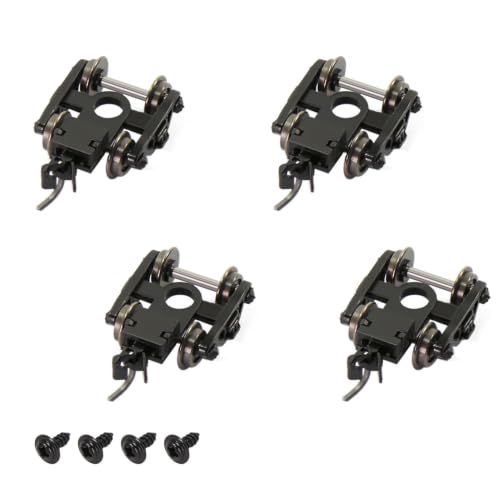
When the truck itself is the problem: 4pcs N Scale 1:160 Bogies with Coupler and 33-Inch Metal DC Wheels, HP03150 (B0C2BVGWKQ)
Every other product in this guide replaces wheels inside trucks you already own. This one replaces the truck. The published title describes four pieces of model train bogies in N scale 1:160, with coupler, 33-inch metal DC wheels, and a screw and washer included, under the HP03150 designation. That makes it the repair and rescue option: the right choice when a sideframe is cracked, a bolster is damaged, a coupler box is broken, or an older car needs a complete running-gear renewal rather than another set of wheels in a tired truck.
Four bogies equip two typical cars completely, since each car uses two trucks. The included screw and washer matter more than they might seem, because truck mounting hardware is exactly the sort of small part that disappears during a repair, and a truck mounted with the wrong screw can bind against the car floor or sit at the wrong height. Work on one car at a time, note how the original truck was mounted and how freely it pivoted, and match that freedom of movement with the new bogie: a truck should swivel and rock slightly, never bind, and never wobble loosely. After fitting, check coupler height first, since a new truck changes ride height more than a wheel-only swap, then check tracking through turnouts.
The coupler included with these bogies deserves a compatibility check against the rest of your fleet. Coupler style and mounting vary across brands and eras, and a car that couples reluctantly to everything else will annoy you on every operating session. Test-couple the repaired car to several regular running mates on straight track and on a curve. If the included coupler does not play well with your standard, the bogie can still be the right repair, with the coupler addressed as a separate, small job. Either way, this set solves a different problem from the wheel-only packs, and for a car with a genuinely damaged truck it is the only entry in this guide that solves the whole problem at once.
Bulk metal conversion, larger pack: 24PCs Wheelsets N Scale 33-Inch Metal DC Wheels, HP05150, 24 count (B0D9YBMRML)
The HP05150 family is the straightforward bulk route to a metal fleet. This larger entry is described as 24 pieces of wheelsets in N scale with 33-inch metal DC wheels and a metal axle, for model train trucks, under the HP05150 designation. Twenty-four sets cover about six typical freight cars. The stated 33-inch size aligns it with the most common freight-car standard in this guide, and the plain, specification-led title tells you exactly what decision it asks of you: if you want metal, in the common size, in fleet quantity, this is a candidate anchor pack for your standard.
Bulk conversions go best as an assembly line. Set up a clean mat, a gauge, a coupler height gauge, and containers for removed wheels, then work car by car in a fixed order: remove, inspect the truck, fit, gauge, couple-check, and note the car number on a simple list as you finish it. The list sounds fussy until the day a car misbehaves months later and you can immediately see whether it was converted, with what, and alongside which other cars. Six cars converted in one sitting will also roll as a matched cut, which is the fastest way to hear and feel what a full metal conversion does to train handling on your grades and curves.
If your roster is larger than six cars, treat this pack as the first block rather than the whole project. Convert the cars that run most often, live with them through several operating sessions, and confirm the standard before ordering the next block. Fleet standards chosen after real operating time rarely get reversed; standards chosen in a single enthusiastic evening sometimes do.
Bulk metal conversion, smaller pack: Wheelsets N Scale 33-Inch Metal DC Wheels, HP05150, 12 count (B0D9YC2ZHK)
The companion HP05150 entry carries the same published description, wheelsets in N scale with 33-inch metal DC wheels and a metal axle for model train trucks, in a 12-piece count. Twelve sets cover about three typical freight cars. Everything said about the larger pack’s role applies here at trial scale: this is the pack for converting one short cut, for topping up spares matched to an existing HP05150 fleet, or for a small roster that simply does not need six cars’ worth of wheels.
Having both pack sizes of the same family in one guide is deliberate, because pack size is the most common buying mistake in this category after axle fit. Modelers count wheels instead of axles, or count cars instead of axles per car, and end up one pack short in the middle of a conversion. Recount before ordering with the simple formula from the introduction: cars multiplied by four equals wheel sets needed. Three cars need twelve, six cars need twenty-four. If your plan sits between those numbers, the larger pack leaves you with matched spares, and matched spares in this hobby always get used eventually.
As with the other metal DC sets, verify insulation-friendly handling and gauge on each axle as you fit it, and run the first converted car through your most demanding trackwork before converting its mates. A single car that traverses every turnout, crossover, and tight curve on the layout without complaint is the green light for the rest of the pack.
The established-brand option: Atlas 22020 N Scale Metal Wheels, 12 count (B0006O7QYI)
The final entry is the established name in the group: Atlas 22020 N scale metal wheels, in a 12-piece count, from Atlas Model. Atlas is a long-standing name in N scale, and for many modelers that longevity is itself the buying reason: a known catalog number, a known brand behind it, and a product that slots into a roster already standardized on Atlas equipment. Twelve wheels’ worth of product, in the counting used throughout this guide, is the trial and top-up quantity rather than the bulk fleet quantity, so this set suits a few cars, a specific Atlas-heavy group, or a modeler who prefers to convert gradually under one brand.
Brand-standard rosters have a quiet advantage: consistency of spares, notes, and experience. If your layout room notebook already records Atlas part numbers for track and rolling stock, keeping wheels under the same catalog discipline makes future troubleshooting simpler. The general checks do not change, however. Confirm the size suits the cars you intend to convert by comparing published specifications, check gauge and coupler height on the first car, and confirm the wheels behave in your particular sideframes, since no brand name overrides the physical fit between an axle and a truck.
Placed in the full lineup, the Atlas set is best understood as the confidence pick in a small quantity, the Evemodel HP11150 packs as the FLE-noted fleet options, the HP05150 packs as the plain bulk standard, the 6.85 millimeter set as the size exception, the bogie set as the repair solution, and the POM pack as the true plastic answer. That spread is a strength of the current market: every common reason to re-wheel an N scale car has at least one product shaped for it.
Plastic versus metal, and how the packs stack up
Side by side, the material decision comes first and the brand decision comes second. POM plastic gives you quiet running, natural insulation, and minimal added weight, in a single 24-piece pack covering about six cars. Metal gives you low added weight where it helps most, long spin in matched sideframes, and the classic joint sound, in 12-piece and 24-piece packs across three families in this guide. Neither material wins universally, because layouts differ: a quiet apartment module and a basement empire with twenty-car freights are optimizing for different things, and both optimizations are legitimate.
Within the metal options, separate them by job rather than by name. The HP11150 packs carry the explicit FLE trains note, which matters if that describes your roster. The HP05150 packs are the plain 33-inch bulk standard in two sizes. The Atlas 22020 set is the small-quantity established-brand choice. The HP09150 set exists for the smaller 6.85 millimeter size. The HP03150 bogies exist for damaged trucks. Read that way, the lineup has no redundancy at all: each product answers a different question, and your job is simply to identify which question your cars are asking.
If you enjoy research beyond the workbench, the wider hobby shelf has its own deep dives; readers comparing notes on other gear sometimes browse guides as varied as best affordable drones with cameras for an entirely different kind of rolling stock, so to speak. Back on the rails, a practical mixed strategy suits many fleets: standardize the everyday freight fleet on one metal pack, keep the POM pack for the cars that run on a quiet home module or for older cars you want to treat gently, and keep one bogie set on hand for repairs. That three-part shelf covers conversion, quiet running, and rescue, with no wasted overlap.
Budget planning in this category should count cars, not packs. Work out how many cars you truly intend to convert this season, multiply by four wheel sets, and buy to that number with a small margin for spares. Converting the cars that actually run, rather than every car in storage, is the financially sensible order of operations, and stored cars can join the standard later using the same pack family. Readers who plan hobby purchases carefully often apply the same discipline elsewhere, whether they are reading best dji drone sd cards or planning a workbench upgrade, and the discipline transfers: define the fleet, count the axles, buy once.
Fitting, checking, and troubleshooting your conversion
Fitting wheel sets is gentle work. Support the car upside down in a cradle or on foam so details on the roof and underframe are not crushed. Spread a sideframe only as far as needed to release one axle end, lift the old set out, and keep the truck oriented so you remember which end faced which way. Seat the new axle by easing one end into its bearing, then the other, with the minimum flex the sideframe allows. Spin the axle with a fingertip before moving on: it should rotate freely with no visible wobble, and the truck should still swivel and rock as it did before.
Work through a fixed checklist for every car. One, confirm each new axle is in gauge. Two, confirm the truck pivots freely and the car sits level. Three, confirm coupler height at both ends. Four, roll the car by hand through the nearest turnout in both directions. Five, add the car to a short train and run the full layout. Skipping steps feels faster and is slower, because a fault discovered after six cars are converted must be hunted through six cars. The checklist takes minutes per car and converts a vague worry about a fleet project into a sequence of small certainties.
For the bogie set, add mounting checks to the same checklist. Use the included screw and washer as published, tighten only until the truck is secure while still pivoting freely, and confirm the car floor is not distorted by overtightening. A truck screwed down rigidly will lift wheels on uneven track and derail on curves it should handle easily. The correct feel is firm but free, and once you have felt it on the first car, you will recognize it on every car after. Readers setting up a dedicated workbench for jobs like this sometimes also research best 3d modeling laptops for layout design work, but the fitting itself needs nothing more than a cradle, a gauge, good light, and patience.
Troubleshooting after a conversion follows a short decision tree. If the car derails at one spot, check that spot with other cars before touching the converted one. If the car derails everywhere, check gauge, then truck freedom, then coupler height, then weight, in that order. If the car uncouples in trains, suspect coupler height or a coupler that does not center freely. If the whole train feels draggy, spin each converted axle by hand and find the one that stops early. Methodical order beats random part-swapping at this scale every time, because the parts are too small for guesswork to be efficient.
Frequently asked questions
Are plastic wheel sets worse than metal ones? No. They are different. POM plastic wheels are quiet, naturally insulating, and low-friction, and they suit modelers who value quiet running and gentle treatment of older trucks. Metal wheels add helpful low weight, spin freely in matched sideframes, and produce the classic rail-joint sound. The right choice depends on your layout, your roster, and your ears, which is why this guide centers the POM option instead of treating it as a footnote.
How many packs do I need for my fleet? Count axles, not wheels. Each car typically needs four wheel sets, so a 12-piece pack covers about three cars and a 24-piece pack covers about six cars. Count only the cars you will actually convert, add a small margin for spares, and buy the pack size that matches. If your count falls between sizes, the larger pack leaves matched spares, which are always useful.
Will metal DC wheel sets work on a DCC layout? The DC designation in these product titles refers to the insulated wheel arrangement used on two-rail systems, and two-rail DCC uses the same basic insulation requirement between the rails. As always, follow the guidance for your specific system and models, keep insulation intact, and never use a wheel set to bridge power between rails. When in doubt about a special pickup arrangement on a particular model, check that model’s documentation before fitting any replacement set.
What if my car uses a different wheel size? Measure the original equipment and compare it with published specifications before ordering. Most freight cars in this guide’s scope suit the 33-inch options, while the 6.85 millimeter HP09150 set exists for cars engineered around a smaller wheel. Fitting the wrong diameter changes ride height and coupler height, so size is a measurement, not an estimate. The same careful-spec habit serves readers well in other categories too, from wheels to best 2 1 bluetooth speakers on a workbench shelf.
Can I mix plastic and metal wheels in one fleet? Yes, and many modelers do. Keep wheel diameter consistent on similar cars so coupler heights stay matched, keep a single cleaning routine for the whole fleet, and note which cars carry which material in your roster list. Mixed fleets only become a problem when they are undocumented fleets, because troubleshooting then starts from memory instead of from records.
When should I replace a whole bogie instead of just wheels? Replace the bogie when the truck itself is damaged: cracked sideframes, a broken bolster or coupler mount, a truck that no longer pivots correctly, or mounting hardware that no longer holds. Wheels cannot repair a structurally tired truck. The HP03150 bogie set, with coupler and included screw and washer, is the guide’s answer for that situation, and it equips two cars completely.
Check prices on Amazon
Live listings for the shortlist in this guide are pulled from Amazon below, so prices and availability are always current at the moment you look.


Conclusion
Standardize deliberately, convert gradually, and check every car as you go. If quiet, insulating plastic is your priority, the POM HP28 pack is the center of this guide and covers about six cars. If weight, roll, and the classic joint sound matter more, anchor the fleet on the HP11150 or HP05150 metal packs in the size your car count demands, use the 6.85 millimeter set where the original size calls for it, keep the Atlas set in mind for small brand-standard conversions, and reach for the HP03150 bogies when the truck itself has failed. Any of those routes, followed with a gauge and a coupler check, will leave your railroad running more smoothly than it did before.
Disclosure: This article is affiliate content. If you buy through links associated with this guide, the site may earn a commission at no additional cost to you. The comparisons above are based on manufacturer-published product titles and specifications and on general practice within the N scale hobby. We did not handle, fit, or run the individual wheel sets listed here, and nothing in this guide should be read as a claim of personal use. Always confirm axle fit, wheel diameter, and gauge against the published specifications for your own models before ordering.


