What's inside
- Key Takeaways
- Quick Picks
- Why does VR punish weak hardware so much harder than flat gaming?
- How We Chose These Picks
- The six laptops, headset in mind
- Side by side: the six VR laptops compared
- What should you check about your headset before choosing?
- How do you set up a room and a laptop for VR that stays comfortable?
- What mistakes do people make when buying a laptop for VR?
- How does a VR laptop’s life change across the first year?
- What about spectators, streaming and taking turns?
- What should you do in the first week with a new VR laptop?
- How do you choose between the five RTX 5060 machines?
- Final Recommendation
- Frequently Asked Questions
- Related Guides
As an Amazon Associate I earn from qualifying purchases. This post may contain affiliate links at no extra cost to you.
gizmoverdict.com is reader-supported. When you buy through links on our site, we may earn an affiliate commission.
Where to buy: Every machine below links to its Amazon listing, which is where the graphics card, memory and drive fitted to the unit in your cart should be confirmed — gaming ranges reuse one name across several builds, and in VR the difference between two builds of the same laptop is the difference between presence and a headache.
Virtual reality is the least forgiving workload a laptop can be given. A flat game that dips its frame rate merely looks untidy; a headset that dips makes its wearer feel genuinely unwell, because the picture is strapped to the eyes and the inner ear votes on every inconsistency. The best laptops for virtual reality are therefore judged here on the hardware facts that protect a steady image: graphics tier first, then the ports a headset and its sensors need, then the cooling that keeps the first two honest across a long session. Everything else — screen, keyboard, chassis flair — is judged as the supporting cast it is.
Honesty rules for this guide, stated once and applied throughout. The phrase VR ready appears only where a listing title itself uses it — exactly one pick here does. No headset-specific performance figures are promised for any machine, because the listings do not state them and the real figure depends on the headset, the title being played and the settings chosen. Compatibility claims are likewise limited to what titles name. What this guide can do reliably is rank the hardware headroom the titles document, flag the connection questions each listing leaves open, and identify the floor of the class so nobody buys beneath it by accident.
The field itself is compact. Five of the six picks carry the GeForce RTX 5060 — a striking concentration that makes memory, display and processor the real separators among them — while one carries the RTX 5070 and the VR ready label, and one carries the RTX 4050 as the honestly labelled floor. Screen sizes cluster at 16 inches, refresh rates run from 120Hz to 240Hz, and memory splits evenly between 16GB and 32GB configurations. The reviews below read those differences the way a headset owner will feel them.
Key Takeaways
- Only one pick, the HP Omen 16 AI, carries the words VR Ready in its listing title, and it pairs them with the strongest graphics card here, the RTX 5070.
- Five picks carry the RTX 5060, so among them the separators are memory, display and processor rather than the graphics tier itself.
- Three picks carry 32GB of memory and three carry 16GB; the 32GB machines suit headsets used alongside streaming, recording or development tools.
- The Lenovo LOQ’s RTX 4050 is the floor of this class and is framed that way — a value route into tethered VR, not a peer of the 50-series machines.
- Ports decide headset practicality and the titles are uneven about them: the Alienware 16X Aurora names Ethernet and Wi-Fi 7, while several listings name no connection details at all.
- No headset-specific frame rates or compatibility promises appear in this guide, because no listing title states them; headroom is ranked, outcomes are not invented.
Quick Picks
| Pick | Badge | Why it earns its place |
|---|---|---|
| Alienware 16 Aurora (RTX 5060) | Best balanced VR laptop | RTX 5060 graphics with a 2560×1600 120Hz display and 1TB of storage — the composed all-round specification of the 5060 group. |
| HP Omen 16 AI VR Ready (RTX 5070) | Best headroom, VR ready as titled | The only listing that says VR Ready, backed by an RTX 5070, a Core Ultra 9 processor, 32GB of memory and a 240Hz panel. |
| ASUS ROG Strix G16 (Ryzen 9, RTX 5060) | Best processor muscle | A Ryzen 9 9955HX with 32GB of memory behind its RTX 5060, for headsets used beside capture, streaming or creation tools. |
| Alienware 16X Aurora (RTX 5060) | Best display and connections | A WQXGA OLED 240Hz screen with Wi-Fi 7 and Ethernet named in the title — the most connection-candid listing of the six. |
| MSI Cyborg 15 (RTX 5060) | Best memory value in class | RTX 5060 graphics with 32GB of memory and a 1TB drive in the smaller 15.6-inch chassis, bundled with a mouse pad. |
| Lenovo LOQ (RTX 4050) | Honest floor of the class | An RTX 4050 with a surprising 32GB of memory and a full port list in the title — the value route, labelled as the floor it is. |
Why does VR punish weak hardware so much harder than flat gaming?
Three multipliers stack up. The first is rendering load: a headset shows two viewpoints, one per eye, and expects them refreshed at the headset’s own high rate, so the graphics card performs roughly double duty against a deadline that does not negotiate. The second is latency sensitivity. On a monitor, a delayed frame is a visual blemish; in a headset, the world lagging behind a head turn is a physical sensation, and the discomfort it produces is the body’s honest report that the picture and the vestibular system disagree. The third multiplier is session shape. VR play happens in bursts of concentration with the machine plugged in and working at a sustained level, often in a room cleared of furniture — not climate-controlled for the laptop’s benefit.
Those multipliers explain the judging order used throughout this guide. Graphics tier leads because it sets the ceiling for how much scene the machine can draw twice, quickly, indefinitely. Memory follows because VR sessions increasingly share the machine with voice chat, recording software, streaming tools or a development environment, and the frame that arrives late because the system was busy swapping memory is indistinguishable, to the wearer, from a frame the graphics card failed to draw. Cooling closes the triangle: a laptop that holds its performance for ten minutes and then throttles has, for VR purposes, two different specifications, and only the slower one matters in the second hour. Ports, finally, are the practical gate — a headset ecosystem is a small parliament of cables and sensors, and the laptop has to host it.
What this guide refuses to do is convert that reasoning into promised numbers. A headset’s experience depends on the headset’s resolution and refresh demands, the software’s settings and the scene being drawn, none of which a laptop listing can state. The honest deliverable is a ranking of documented headroom plus a list of the checks each listing leaves open, and that is what the six reviews below provide.
How We Chose These Picks
Selection started with the graphics tier, since it is the one specification VR cannot route around. Every pick carries a discrete NVIDIA card from the RTX 4050 upward, and the guide is explicit about the spread: one 5070, four 5060s in the main field plus one more in the Cyborg’s company — five 5060 machines in total — and one 4050 holding the floor. Memory was weighed next, with 32GB configurations credited for the multitasking reality of modern VR use. Ports and wireless were credited only where a title names them, which rewarded the Alienware 16X and the Lenovo LOQ for candour and left question marks, honestly recorded, against the listings that stay silent. Displays were judged last and on their own terms: a VR laptop’s panel serves setup, spectators and flat gaming, and a 240Hz OLED is a genuine virtue there without being mistaken for a headset specification.
Two exclusions are worth stating. No machine was credited with the words VR ready unless its own title used them, and no cooling claim was credited beyond a title naming the system, because sustained performance is exactly the claim VR buyers most need and least can verify from a listing. Where a title is silent, the spec boxes below say so, and the silence itself is treated as a pre-purchase task rather than a defect to be hidden.
The six laptops, headset in mind
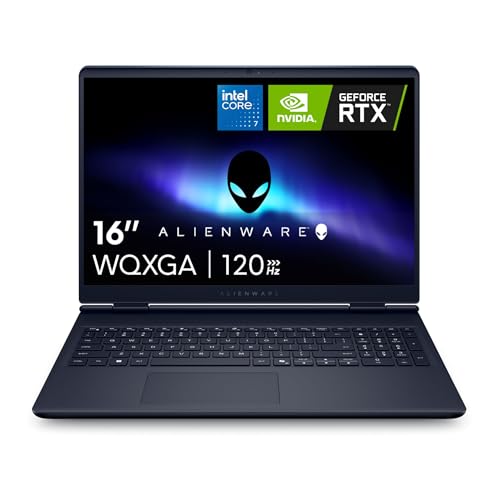
Alienware 16 Aurora (RTX 5060) — Best balanced VR laptop
The Alienware 16 Aurora is the composed centre of this guide’s large RTX 5060 group. Its specification pairs the card with an Intel Core 7 240H processor, 16GB of DDR5 memory and a 1TB solid-state drive, behind a 16-inch display at 2560×1600 resolution with a 120Hz refresh rate and a 16:10 aspect ratio. For VR purposes the balance is the point: the graphics tier matches four of its five rivals, the storage is the full terabyte that a library of large VR titles quietly demands, and the panel — sharp, tall, and quick enough for flat gaming between headset sessions — makes the machine pleasant company when the headset is off.
There is a domestic virtue to the Aurora’s balance that deserves a sentence. A VR laptop rarely lives alone in a household’s affections; it is also the machine that gets borrowed for the spreadsheet, the presentation, the game that is not in VR at all. A specification without an eccentric corner — no tiny drive to apologise for, no panel that embarrasses it at the kitchen table, no tier that dates it prematurely — is the specification that stays welcome in every room it enters. The Aurora is the pick in this guide most likely to be described, two years on, as simply the laptop, and in a shared household that ordinariness is a form of success.
Where the Aurora asks for homework is connection detail. Its title names no ports and no wireless standard beyond the basics implied by the platform, so the headset host questions — how the headset itself connects, what remains free for sensors, controllers’ receivers or a capture device — must be answered from Dell’s documentation for the exact model before purchase. That is a check, not a criticism; several rivals share the silence. The backlit keyboard and the blue finish are the listing’s lighter notes. Read the Aurora as the 5060 group’s all-rounder: nothing in its titled specification is the best in this guide, and nothing in it is a weakness a VR owner will meet weekly.
- Display: 16-inch 2560×1600, 120Hz, 16:10
- Graphics: NVIDIA RTX 5060
- Processor: Intel Core 7 240H
- Memory: 16GB DDR5 RAM
- Storage: 1TB SSD
- Input: backlit keyboard
- Operating system: Windows 11 Home
- Not stated in the listing title — verify with the maker’s documentation: ports, wireless standard, cooling system detail
Strengths
- RTX 5060 graphics matched with a full 1TB of storage for large VR libraries
- 2560×1600 16:10 panel is sharp and tall for setup screens and flat gaming
- Balanced specification with no single titled weakness in the group
Trade-offs
- 16GB of memory, where three rivals in this guide carry 32GB
- The title names no ports, so headset connection planning starts from documentation
- 120Hz panel is the slowest refresh rate among the six for flat gaming
Best for: the balanced 5060 machine, covering VR and everything else the week contains on one configuration. Not suited for: running VR alongside streaming and recording tools all evening, because 16GB of memory is this configuration’s ceiling.
All-rounders reward a direct comparison, so check price on Amazon for the Aurora against the Omen below and let the headroom difference speak.

HP Omen 16 AI VR Ready (RTX 5070) — Best headroom, VR ready as titled
This is the only listing in the guide whose title says VR Ready, and HP has backed the phrase with the strongest specification on the page. The graphics card is the GeForce RTX 5070, a tier above the 5060 group; the processor is an Intel Core Ultra 9 285H, the highest designation here; memory is 32GB and storage a 1TB solid-state drive. The display completes the pattern — a 16.1-inch WQXGA IPS panel at 240Hz — which serves spectators and flat gaming handsomely while the headset does its own work. Windows 11 Pro, rather than Home, is a small professional note in a gaming listing, and the RGB backlit keyboard and Shadow Black finish are the expected Omen furniture.
There is a longer game being played by this specification, and it is worth naming. VR software’s centre of gravity moves steadily toward heavier scenes, higher headset resolutions and richer social spaces, and the interval between a machine feeling generous and feeling adequate has historically been shorter in VR than in flat gaming. A buyer choosing the Omen is, in effect, purchasing distance from that moving line: the 5070’s tier, the Ultra 9’s surrounding muscle and the 32GB of memory are three separate cushions against three separate kinds of growth, and the machine that carries all three is the one whose owner reads future release announcements with interest rather than with a calculator.
The VR ready wording deserves a precise reading rather than either hype or dismissal. It is the maker’s own label in the maker’s own title, and this guide reports it as exactly that: a signal that HP positions this configuration for headset use, attached to a specification that independently justifies the positioning. It is not converted here into promised frame rates for any headset or title, because no listing can honestly carry that promise. What can be said on the documented facts is that a buyer choosing this machine is choosing the most graphics headroom, the joint-most memory and the strongest processor in the guide simultaneously — which is to say, the longest interval before VR software growth becomes a hardware conversation.
- Display: 16.1-inch WQXGA IPS, 240Hz
- Graphics: NVIDIA GeForce RTX 5070
- Processor: Intel Core Ultra 9 285H
- Memory: 32GB RAM
- Storage: 1TB SSD
- Maker’s label: VR Ready, as stated in the listing title
- Operating system: Windows 11 Pro
- Not stated in the listing title — verify with the maker’s documentation: ports, wireless standard, weight
Strengths
- RTX 5070 graphics are the highest tier in this guide
- Core Ultra 9 processor and 32GB of memory complete the strongest overall specification
- The VR Ready label is the maker’s own, stated in the title itself
Trade-offs
- The title names no ports, so the headset connection audit remains a documentation task
- Its 240Hz panel serves spectators and flat gaming, not the headset itself — spend is partly there
- As the flagship specification here, it presumably carries the flagship position in the range
Best for: a headset owner buying headroom deliberately, to keep demanding VR titles comfortable for years. Not suited for: a strict budget build, because this is the flagship specification of the six and the LOQ below exists precisely for that constraint.
Flagships justify themselves against the field, so look at the current price on Amazon for the Omen beside the 5060 group before deciding the premium is or is not earned.

ASUS ROG Strix G16 (Ryzen 9, RTX 5060) — Best processor muscle
The Strix G16’s argument is written in its processor line. A Ryzen 9 9955HX is the kind of chip usually discussed in desktop-replacement company, and ASUS pairs it with 32GB of DDR5 memory and a 1TB drive behind the RTX 5060. For pure headset rendering, the graphics card sets the ceiling and this machine shares that ceiling with the other 5060 picks. Where the Ryzen 9 earns its mention is everything that increasingly surrounds the headset: capture and streaming software, voice and social platforms, a browser of guides, and — for the growing number of owners who build as well as play — the development and modding tools that compile while the headset waits. Those are processor-and-memory workloads, and this is the pick that treats them as first-class.
One further audience should claim this machine explicitly: the developer-player. The same specification that surrounds a headset with capture and streaming tools also runs the engines and editors those tools feed — building a scene in the afternoon and standing inside it in the evening is a single-machine workflow now, and it asks exactly what the Strix assembles: processor depth, memory depth and a current graphics tier. The 5060 will not out-render the Omen’s 5070 in the heaviest scenes, and this guide does not pretend otherwise; but the developer’s bottleneck is as often the compile and the capture as the frame, and on those the Ryzen 9 configuration makes its case every working day.
The display is a 16-inch 1920 by 1200 panel at 165Hz, a step below the two WQXGA Alienwares in resolution and a perfectly sensible specification for a machine whose serious display is worn rather than watched. Windows 11 Pro and an RGB backlit keyboard complete the title. The silences are the familiar ones: no ports are named, so the headset connection plan comes from ASUS’s documentation, and no wireless standard is stated. Neither silence is unusual in this guide; both are recorded here because a VR setup is a parliament of peripherals and the Strix’s owner will be hosting it.
- Display: 16-inch 1920×1200, 165Hz
- Graphics: NVIDIA RTX 5060
- Processor: AMD Ryzen 9 9955HX
- Memory: 32GB DDR5 RAM
- Storage: 1TB SSD
- Input: RGB backlit keyboard
- Operating system: Windows 11 Pro
- Not stated in the listing title — verify with the maker’s documentation: ports, wireless standard, cooling detail
Strengths
- Ryzen 9 9955HX is the most muscular processor story in the guide for work around the headset
- 32GB of memory supports streaming, capture and creation tools beside VR
- Windows 11 Pro suits owners who also use the machine for development work
Trade-offs
- Graphics tier matches the other 5060 picks; the premium buys processor, not frames
- 1920×1200 panel is a resolution step below the WQXGA Alienware pair
- No ports or wireless standard are named in the title
Best for: streaming, recording or building alongside playing, where the machine around the VR has to keep up with the headset. Not suited for: pure headset use on a tight specification budget, because the Ryzen 9 premium buys capability that a play-only setup will rarely touch.
Processor-led value is a judgement call, so check the Strix’s price on Amazon against the Aurora and weigh what your evenings actually run beside the headset.

Alienware 16X Aurora (RTX 5060) — Best display and connections
The 16X Aurora is the listing that tells you the most, and in a category full of silences that candour is a feature. Its title names a WQXGA OLED display at 240Hz — the most ambitious panel in this guide, serving spectators, setup screens and flat gaming with the contrast only OLED offers — and then keeps going: Wi-Fi 7 and Bluetooth for wireless, Ethernet for a wired network, an RTX 5060 for the rendering, an Intel Ultra 7 Plus processor, 16GB of DDR5 memory and a 1TB drive. For a VR buyer, the Ethernet line deserves emphasis out of proportion to its length. A wired network is the unglamorous foundation under several headset-adjacent activities — downloading very large titles, streaming to the headset over the home network in setups that use it, keeping firmware and software updates off the congested wireless band — and this is one of only two titles in the guide that names it.
The same candour clarifies the compromises. Memory is 16GB, matching the smaller Aurora and sitting below the 32GB trio, so the multitasking ceiling described elsewhere applies here unchanged. The OLED panel, glorious as it is, serves the people watching rather than the person wearing, and anyone watching a contested budget should notice that part of this machine’s cost is a screen the headset makes secondary. Neither point dents the central fact: of the six listings here, this is the one whose connection story can be planned from the title itself, and in VR, where the setup is half the hobby, that planning value is real.
- Display: WQXGA OLED, 240Hz
- Graphics: NVIDIA GeForce RTX 5060
- Processor: Intel Ultra 7 Plus as titled
- Memory: 16GB DDR5 RAM
- Storage: 1TB SSD
- Connections named: Ethernet, Wi-Fi 7, Bluetooth
- Operating system: Windows 11 Home
- Not stated in the listing title — verify with the maker’s documentation: exact port list beyond Ethernet, weight, cooling detail
Strengths
- WQXGA OLED 240Hz panel is the finest spectator and flat-gaming display in the guide
- Ethernet and Wi-Fi 7 are both named in the title — the most complete connection story here
- RTX 5060 graphics with a 1TB drive match the main field’s core specification
Trade-offs
- 16GB of memory, where three rivals carry 32GB
- Part of the spend buys a premium panel the headset itself does not use
- The exact port list beyond Ethernet still needs the maker’s documentation
Best for: heavy streaming, downloading and spectating in one household, with the network story settled by the listing itself. Not suited for: heavy simultaneous streaming and recording beside VR, because 16GB of memory is this configuration’s ceiling.
Connection candour is worth pricing directly, so see the current Amazon price for the 16X beside its smaller Aurora sibling.

MSI Cyborg 15 (RTX 5060) — Best memory value in class
The Cyborg 15 makes a quietly radical choice for its position: it spends on memory. Its RTX 5060 is driven by an Intel Core 7 240H and paired with 32GB of DDR5 memory and a drive the title lists as 1024GB — the full terabyte, in other words — inside the smaller 15.6-inch chassis with a Full HD 144Hz panel. Among the five 5060 machines, that memory figure puts it in the 32GB trio alongside the Omen and the Strix, both of which occupy grander positions in their ranges. For the VR owner whose sessions share the machine with chat, recording or a stream, the Cyborg offers the multitasking headroom of the expensive picks in the guide’s most compact gaming body.
It is worth dwelling on why the memory-first allocation works so well in this particular chassis. VR sessions generate company — the headset’s own runtime, the platform’s social layer, the recording buffer, the browser where the next title is being read about — and that company is memory-shaped rather than graphics-shaped. A 5060 machine with 16GB spends part of its evening housekeeping; the Cyborg, with the same card and double the memory, spends that part playing. Owners upgrading from an older gaming laptop will recognise the sensation immediately, because it is the difference between a machine that feels busy and one that feels ready, and in VR readiness is the whole product.
One more consideration belongs to this pick: the room it frees you from. A compact 15.6-inch machine with this memory figure is the easiest in the guide to move between a desk setup and a cleared play space, to lend to a second player, or to carry to another household for the evening — and VR, for all its talk of immersion, is a hobby that travels between living rooms more than most. The Cyborg’s specification seems to understand that social fact: nothing about it demands a permanent installation, and everything about it survives being packed up on a Sunday night.
The panel is the corresponding compromise: Full HD at 144Hz is the most modest display specification here, and while the headset owner watches another screen entirely, spectators and flat gaming feel that modesty directly. The listing also bundles a mouse pad, a small inclusion recorded here because it is in the title, and the backlit keyboard is present. Ports and wireless go unnamed, so the headset connection audit belongs to MSI’s documentation as with most of this guide. Judge the Cyborg as the value-weighted 5060: the specification spends where VR sessions actually press — graphics tier and memory — and saves where the headset makes spending hardest to notice.
- Display: 15.6-inch FHD, 144Hz
- Graphics: NVIDIA RTX 5060
- Processor: Intel Core 7 240H
- Memory: 32GB DDR5 RAM
- Storage: 1024GB SSD as titled
- Included: mouse pad bundle as titled
- Operating system: Windows 11 Home
- Not stated in the listing title — verify with the maker’s documentation: ports, wireless standard, weight
Strengths
- 32GB of memory at this position in the range is the value story of the guide
- RTX 5060 graphics and a full terabyte of storage match the main field
- 15.6-inch chassis is the joint-smallest here, for rooms where the laptop must tuck away
Trade-offs
- Full HD 144Hz panel is the most modest display specification of the six
- Ports and wireless are unnamed in the title
- The Core 7 processor sits below the Strix’s Ryzen 9 and the Omen’s Ultra 9 for surrounding workloads
Best for: multitasking around VR on 32GB of memory, without buying the flagship tier. Not suited for: a setup where spectators watch the laptop screen as the main event, because the Full HD panel is this pick’s deliberate economy.
Value claims deserve a number, so confirm the price on Amazon for the Cyborg against the 16GB 5060 machines it out-remembers.

Lenovo LOQ (RTX 4050) — Honest floor of the class
This guide ends its reviews where every honest guide should: at the floor, clearly marked. The LOQ’s GeForce RTX 4050 is a full tier below the 5060 group, and no wording in this section will blur that. What the listing does around that card is more interesting than the card itself. Memory is 32GB of DDR5 — the generous figure, matching the guide’s best — storage is a 1TB drive, and the title names its connections outright: Wi-Fi 6, Ethernet, USB-C and HDMI, a port list more candid than several grander listings manage. The processor is an AMD Ryzen 5 7235HS and the panel a 15.6-inch FHD screen at 144Hz with a backlit keyboard beneath it.
It is also worth stating who this machine quietly suits beyond the first-time VR buyer. A household adding a second VR seat — for a partner, a teenager, a guest room — often discovers that the second library is lighter than the first: established favourites, social titles, the games that get demonstrated to visitors. The LOQ’s combination of an entry card with generous memory and a full terabyte fits that second-seat profile surprisingly well, and its candid port list simplifies the hand-me-down setup. Floors, in a growing household, have a way of becoming foundations.
The correct way to buy this machine is with a clear-eyed view of which VR it serves. Less demanding titles, older favourites and modest settings are its natural territory; the newest, heaviest releases at ambitious settings are where the 4050’s tier announces itself, in reduced detail or a picture the wearer feels rather than sees. Its 32GB of memory cannot change that — memory is not the constraint the card imposes — and this guide will not pretend the specification is balanced for VR when it is, in truth, a strong general laptop with an entry graphics card. Bought as the floor, for the right library, it is a rational purchase with an unusually honest port list. Bought as a peer of the machines above it, it is a disappointment scheduled in advance.
- Display: 15.6-inch FHD, 144Hz
- Graphics: NVIDIA GeForce RTX 4050
- Processor: AMD Ryzen 5 7235HS
- Memory: 32GB DDR5 RAM
- Storage: 1TB SSD
- Connections named: Wi-Fi 6, Ethernet, USB-C, HDMI
- Operating system: Windows 11 Home
- Not stated in the listing title — verify with the maker’s documentation: exact USB-C capabilities, weight, cooling detail
Strengths
- 32GB of memory and a 1TB drive are generous figures at the floor of the class
- Ethernet, USB-C and HDMI are all named in the title — a candid port list
- The value route into tethered VR for less demanding libraries
Trade-offs
- RTX 4050 graphics sit a full tier below the rest of the guide
- Demanding new titles at ambitious settings are beyond its comfortable territory
- The Ryzen 5 processor is the lightest in this guide for surrounding workloads
Best for: a first tethered-VR setup built around less demanding titles, bought with the floor clearly understood. Not suited for: the newest heavyweight releases at high settings, because the RTX 4050’s tier is the hard limit of this configuration.
Floors are priced to be stepped on, so review the configuration and price on Amazon and measure the gap to the Cyborg before deciding which side of it your library lives on.
Side by side: the six VR laptops compared
| Model | Graphics | Memory / storage | Display | VR note |
|---|---|---|---|---|
| Alienware 16 Aurora | RTX 5060 | 16GB / 1TB | 16-inch 2560×1600 120Hz | Balanced all-rounder |
| HP Omen 16 AI | RTX 5070 | 32GB / 1TB | 16.1-inch WQXGA 240Hz | VR Ready as titled; most headroom |
| ASUS ROG Strix G16 | RTX 5060 | 32GB / 1TB | 16-inch 1920×1200 165Hz | Ryzen 9 for surrounding workloads |
| Alienware 16X Aurora | RTX 5060 | 16GB / 1TB | WQXGA OLED 240Hz | Ethernet and Wi-Fi 7 named |
| MSI Cyborg 15 | RTX 5060 | 32GB / 1TB | 15.6-inch FHD 144Hz | Memory value in compact body |
| Lenovo LOQ | RTX 4050 | 32GB / 1TB | 15.6-inch FHD 144Hz | Floor of the class; candid ports |
The table makes the field’s shape visible at a glance: storage is uniform at a terabyte, graphics cluster at the 5060 with one step up and one step down, and the genuine choices are memory, display ambition and how much of the connection story the title is willing to tell. Choose the tier first, the memory second, and the rest by the room the headset lives in.
What should you check about your headset before choosing?
Start with the headset’s own documentation rather than the laptop’s marketing. Establish how the headset connects — a cable to the laptop, a wireless link over the home network, or both across different uses — and what it asks of the host: the connection type it expects, the network standard it prefers, the software platform it runs. Then read the shortlist against those answers. A setup that leans on the home network makes the 16X Aurora’s named Ethernet and Wi-Fi 7 more than trivia. A setup with sensors, receivers and a capture device competing for connections makes the titles that stay silent on ports into homework, to be finished on the maker’s documentation pages before any order.
Then check the library, honestly. The titles you already own and the ones you actually intend to buy set the graphics requirement more truthfully than any tier table: a library of established favourites sits comfortably lower in this guide than a library pre-ordered from the newest releases. Owners still deciding whether a headset needs a PC at all will find the standalone side of the question in our look at the best affordable vr headsets and the best 6dof standalone vr headsets, which cover the machines that leave the laptop out of the equation entirely.
How do you set up a room and a laptop for VR that stays comfortable?
Comfort in VR is a system property, and the laptop is only one component of it. The room comes first: a cleared play space with boundaries the headset’s software can map, lighting even enough for tracking cameras where the headset uses them, and a cable route — where a cable exists — that does not cross the play area at ankle height. The laptop’s place in that room is a stand or desk at the edge of the space, vents unobstructed, close enough for its connections and far enough that an enthusiastic sword swing meets air rather than aluminium.
The machine’s own setup is a short, deliberate list. Power settings belong in plugged-in mode, with sleep and screen dimming told to leave the session alone. The graphics drivers and the headset’s software should be updated on a calm afternoon, never in the ten minutes before guests arrive. Large titles should be downloaded over the wired connection where one exists — the 16X and the LOQ both name Ethernet — rather than discovered, at 9 p.m., to be an overnight wireless project. And the first session with any new setup should be a short one in a familiar title, because comfort problems announce themselves early and are diagnosed honestly at minute ten rather than endured to minute ninety.
What mistakes do people make when buying a laptop for VR?
The classic error is buying the panel instead of the pipeline: choosing the machine with the most beautiful laptop screen while underfunding the graphics tier and memory the headset actually consumes. The screen serves spectators; the wearer never sees it. The second error is treating the words VR ready as a transferable promise. In this guide the phrase appears exactly where a maker printed it, attached to one specification; elsewhere it is a marketing fog that settles over any machine with a discrete card, and it should be priced accordingly — which is to say, at nothing.
Third is ignoring the connection audit until delivery day, when the parliament of headset cables and receivers meets a laptop whose port list was never read. Fourth is underestimating memory because a demo ran well in a shop: the demo was the headset alone, while the real evening adds chat, capture, a browser and a stream, and the frame that arrives late for housekeeping reasons feels identical to the frame the graphics card missed. The last mistake is buying the floor with flagship expectations. The LOQ is a rational machine for the library it suits; asked to run the newest heavyweight titles at ambitious settings, it becomes two purchases. The wider gaming context for these tiers, including how the same machines behave on a flat screen, is covered in our roundup of the best 1080p gaming laptops.
How does a VR laptop’s life change across the first year?
The first month is all setup and discovery: the play space mapped, the software installed, the library small enough that storage feels theoretical. The machine’s job in that month is mostly the headset’s job, and almost any pick in this guide feels magnificent. The third month is when the library crosses the size where downloads become scheduling, the first large title arrives that was bought on ambition rather than research, and the difference between a terabyte drive treated casually and one treated as a budget becomes visible. All six picks carry that terabyte; the discipline is the owner’s, in deleting the abandoned and archiving the finished rather than letting the drive become the library’s attic.
By the sixth month the surrounding software has usually arrived — the recording habit, the streaming experiment, the friend group whose sessions run through voice platforms — and this is the point where the guide’s memory split stops being a table row. The 32GB machines absorb the new company without comment. The 16GB machines begin asking their owners to choose what runs beside the headset, which is a fine bargain knowingly made and an irritating one discovered. The twelfth month brings the software’s own growth: updates that assume newer hardware, a flagship release that becomes the household’s test of the machine, and the first honest answer to whether the tier bought was the tier the library needed. None of this is predictable in detail, and all of it is predictable in shape — which is why this guide ranks headroom rather than minimums, and why the Omen’s specification is described as buying time rather than buying frames.
What about spectators, streaming and taking turns?
VR looks solitary and behaves socially. The person in the headset is having the experience; everyone else in the room is watching the laptop’s screen, which makes that screen a shared instrument rather than a private one. This is the context in which the guide’s display differences acquire their real weight. The 16X Aurora’s OLED 240Hz panel and the Omen’s 240Hz screen are spectator instruments — the mirror view of the headset’s world, rendered for the couch — and a household that takes turns, coaches beginners or hosts VR evenings will use them constantly. The Cyborg’s modest Full HD panel, by contrast, is a private instrument, entirely adequate for setup and solo play, and its economy is rationally placed for the owner whose VR is a solo pursuit.
Streaming extends the same logic out of the room. Broadcasting a VR session asks the machine to render the headset’s world, encode a video feed and hold the stream’s software open simultaneously — the three-workload pattern this guide keeps returning to — and it is the use case that most cleanly separates the 32GB trio from the 16GB machines and the Strix’s Ryzen 9 from the field. None of the listings here promises anything about streaming, and this guide promises nothing on their behalf; the ranking simply notes where the documented headroom sits, and leaves the platforms and their settings to the streamer’s own testing. The household that knows streaming is coming should buy as though it has already arrived.
What should you do in the first week with a new VR laptop?
The first week sets the habits the machine will live with, and it should be spent deliberately rather than in a blur of downloads. Begin with the unglamorous foundations: the operating system and graphics drivers updated, the headset’s software installed and its firmware settled, the play space mapped in the light you will actually play in. Then run the calibration session nobody wants to run — a familiar title, played at the settings you intend to keep, for long enough that the machine reaches its working temperature and stays there. That session is the honest audition. A laptop that holds its composure through it has told you the truth about its cooling and its tier; a laptop that falters has told you early, while settings can still be adjusted and expectations set, rather than during the first session with guests.
Midweek belongs to the library’s organisation. VR titles are large, and the terabyte every pick here carries fills with the quiet inevitability of a hallway cupboard. Decide now which titles live on the machine and which live in the re-download queue, because that decision made calmly in week one is the same decision made resentfully, mid-evening, in month four. Set the download habit to match the connection: wired where the machine offers Ethernet, scheduled where it does not. End the week with the social test — a spectator on the couch, a second player taking a turn, the voice platform open — because that is the configuration the machine will actually serve for most of its life, and the one in which the difference between the 16GB and 32GB picks stops being theoretical. A laptop that passes its first week in that company has been bought correctly, whatever its tier.
How do you choose between the five RTX 5060 machines?
With the graphics tier tied, the choice among the 5060 group is made in the columns where they actually differ, and it helps to interrogate them in the order your evenings will. Memory first: if your sessions run beside capture, streaming or creation tools, the Strix and the Cyborg carry 32GB and the question narrows to those two — the Strix if the work around the headset is processor-heavy, the Cyborg if it is company-heavy and the budget is doing its own talking. If your sessions are the headset alone, the 16GB pair enters honestly, and the choice between the two Alienwares is a choice about the room: the 16X for the spectator screen and the wired network it names in its title, the smaller Aurora for balance and the sharpest non-OLED panel of the group.
Display second, and only in its proper role — as the spectator and setup instrument, never as a proxy for what the headset will show. Connections third, where the 16X’s candour is the exception and everyone else’s silence is a documentation task of equal size. What this ordering refuses is the reflex that picks by brand familiarity or by the single largest number on the box. Five machines sharing a graphics card are five different answers to the question of what surrounds the card, and VR — a hobby conducted as much around the headset as inside it — is precisely the context where the surroundings decide satisfaction. Read the five reviews with your own evenings in mind and the tied tier resolves itself.
Final Recommendation
Buy the tier your library demands
and the memory your evenings actually use. The HP Omen 16 AI is the headroom choice — the only listing that says VR Ready, holding the strongest graphics card, processor and memory combination here — and it is the machine least likely to start a hardware conversation in the next few years. Inside the 5060 group, the choice is about emphasis: the Strix for processor muscle around the headset, the Cyborg for 32GB of memory at a value position, the 16X Aurora for its display and its candid connections, the smaller Aurora for balance. The LOQ is the floor, honestly labelled, for libraries that live comfortably there. Settle the headset’s connection demands before the order, give the machine air and a wired network where you can, and the technology will do the thing VR asks of all its hardware — vanish, so that only the place you are standing in seems real.
Frequently Asked Questions
What does VR Ready actually mean on the HP Omen?
It means HP prints the phrase in this model’s listing title and positions the configuration for headset use. This guide reports the label as the maker’s own and notes that the specification beneath it — RTX 5070 graphics, a Core Ultra 9 processor, 32GB of memory — independently supports the positioning. It is not a promise of specific frame rates in specific headsets, and no listing could honestly make that promise.
Is the RTX 5060 enough for VR, or is the 5070 necessary?
Enough depends on the library, which is why this guide ranks headroom rather than declaring a threshold. The five 5060 machines form the guide’s main field and suit the broad middle of current VR catalogues; the Omen’s 5070 buys margin for the most demanding titles and for software growth. The LOQ’s 4050 marks the floor, suited to less demanding libraries and modest settings.
Why does memory matter if the graphics card does the rendering?
Because the headset rarely has the machine to itself. Voice chat, recording, streaming tools, a browser and the operating system all draw from the same memory, and when memory runs short the system shuffles data in ways that delay frames — which the wearer feels exactly as keenly as a rendering failure. That is why the 32GB configurations are credited throughout this guide and the 16GB ones carry the caveat in their reviews.
Can these laptops also serve as ordinary gaming machines?
Yes — every pick is a gaming laptop whose panel, keyboard and graphics card work conventionally when the headset is off, and several are excellent at it: the 16X Aurora’s OLED 240Hz display and the Omen’s 240Hz panel are spectator-class screens. The flat-gaming side of the family is surveyed in our guide to the best gaming laptops with long battery life for owners who also play away from a socket.
How long will a laptop bought today stay comfortable for VR?
Nobody can date it honestly, because the answer lives in your library’s appetite rather than in the machine. The shape of the answer is more useful: the Omen’s tier-and-memory combination buys the longest interval, the 5060 group sits a step behind it with the 32GB members ahead of the 16GB ones for multitasking longevity, and the LOQ should be bought expecting the shortest horizon of the six. What ages a VR laptop is rarely failure — it is a release you care about arriving with demands your tier meets only at settings you do not enjoy, and headroom is the only insurance sold against that day.
Should I buy a standalone headset instead of a laptop?
That depends on the catalogue you want. Standalone headsets remove the computer entirely and suit the libraries built for them; a laptop opens the tethered catalogues, the development tools and the heavier simulations. Many households end with both across time. The laptop-free route is examined in our coverage of affordable vr headsets, and this guide’s machines remain the answer when the PC catalogue is the point.
Related Guides
The same graphics tiers power the simulator world, so golfers building a bay will find the headroom argument continued in our guide to the best laptops for golf simulators. Owners weighing whether the headset needs a computer at all should read the best affordable vr headsets alongside this page.


