Our Top Picks
 Fits 1994-2001 Chevy S10 Truck Replacement Speakers 4x6Rhythm Series16 x 9 x 8 inches8.7 poundsCheck on Amazon
 Harmony Audio Fits 1990-1994 Chevy S-10 Blazer SpeakersRhythm Series16 x 9 x 8 inches7.95 poundsCheck on Amazon
 ORION Cobalt CB65C 6.5" 2-Way Component Speaker System18.9 x 8.1 x 3.9 inches4.4 poundsCheck on Amazon


What's inside
- The S-10 speaker layout, and why it upgrades so well
- How we compared: fitment, size, system design, and effort
- Eight speaker options for the S-10, in detail
- Kits versus universal builds: choosing your route
- Installation planning for dash, doors, crossovers, and tweeters
- Frequently asked questions
- Long-term fleet care: notes from the layout room
- Check prices on Amazon
- Conclusion
As an Amazon Associate I earn from qualifying purchases. This post may contain affiliate links at no extra cost to you.
The S-10 speaker layout, and why it upgrades so well
The Chevrolet S-10 earned its following the honest way: a compact, durable pickup that owners keep for decades, work hard, and gradually improve. Audio is usually the improvement that changes daily driving most, because the factory system in these trucks was built to a price in the 1990s, and its paper-cone speakers have now had twenty to thirty years of heat, cold, and door slams. If your S-10 sounds thin, buzzy, or distorted at modest volume, the speakers are the first place to look, and the good news is that the truck’s speaker layout is simple, well documented, and unusually friendly to upgrades.
That layout is the organizing fact of this guide. S-10 pickups in the years covered here use 4×6 speakers in the dash and 6.5-inch speakers in the doors. The dash pair fires up at the windshield, which shapes the soundstage, while the door pair carries the body of the music. A component speaker system improves on the usual coaxial arrangement by separating the tweeter from the woofer and adding a crossover to divide the signal between them, so high frequencies can be placed and aimed more deliberately and each driver handles the range it was built for. In a small regular-cab truck, where your ears are close to every speaker, that separation is easy to hear.
The eight products below fall into two families, and understanding the families matters more than memorizing model names. The first family is vehicle-specific: Harmony Audio packages described as fitting specific S-10 year ranges, with adapter kits or plug-and-play wiring included, covering a full 4×6 plus 6.5-inch package, a front dash 4×6 pair, and an earlier-years Blazer-inclusive package. The second family is universal 6.5-inch component systems and a universal 4×6 speaker from Pyle, RECOIL, Orion, and Kenwood, which fit by size rather than by vehicle kit and may need adapters, wiring work, and tweeter mounting decisions. Kit versus universal is the real decision in this guide, and both routes are legitimate.
Year range is the second decision, and it is not a detail. The Harmony packages divide the S-10 story at 1994: one group addresses 1994-2001 trucks, another addresses 1990-1994 S-10 and S-10 Blazer models. Those ranges overlap at 1994 in the published descriptions, which is exactly why owners of 1994 trucks should confirm fitment against the published specifications for their exact cab and trim before ordering. Throughout this guide, our research compared published fitment statements, speaker sizes, and included-accessory descriptions, and flagged every place where a buyer should verify rather than assume. No speaker in this guide should be ordered on year alone without that check.
How we compared: fitment, size, system design, and effort
Start by mapping the truck you actually own. Confirm the model year, whether it is a pickup or an S-10 Blazer, the cab style, and which factory locations are populated. The dash location takes a 4×6 speaker and the door location takes a 6.5-inch speaker in the applications covered here, but trim levels and prior owners complicate real trucks: a previous owner may have cut a door, added a tweeter pod, or replaced a dash speaker with something nonstandard. Pull a door panel or a dash grille and look before you buy. Ten minutes with a flashlight prevents the most common failure in truck audio, which is a correct speaker ordered for an incorrectly assumed truck.
Next, decide what a component system means for your build. In a true component set, the woofer and tweeter are separate drivers joined by a crossover network. The universal sets in this guide from Pyle, RECOIL, and Orion follow that pattern, with the Orion Cobalt CB65C explicitly described as including 1-inch silk dome tweeters and external passive crossovers. Separate tweeters can be mounted higher than the door woofer, lifting the soundstage toward ear level, and crossovers keep low frequencies away from the small tweeter and high frequencies away from the woofer. The vehicle-specific Harmony packages take a different route to a similar goal: they replace the factory speakers in their factory locations with upgraded drivers and vehicle-matched installation hardware, prioritizing a straightforward fit over custom tweeter placement.
Power handling figures need careful, honest reading. One product in this guide, the Pyle system, is published as a 6.5-inch 400 watt component system, and the Orion CB65C is published as a 280 watt pair, while the Kenwood 4×6 is published as a 60-watt system. Those published numbers are not directly comparable across brands, because manufacturers measure and present power figures differently, and a headline watt number says little about how a speaker will sound on a factory head unit or a modest amplifier. Our research treats those figures as part of each product’s published identity, not as a ranking. What matters in practice is matching the speaker to your source: a factory or modest aftermarket head unit favors an efficient speaker that sounds full at low power, while an external amplifier rewards a component set built to use that power.
Installation effort is the fourth criterion, and for many S-10 owners it is the deciding one. The Harmony packages are described with phrases like adapter kit included, plug-and-play install, and plug-and-play wiring included, which signals a job measured in basic hand tools and an afternoon, reusing factory wiring connections where the kit provides them. Universal component sets ask more: crossover mounting, tweeter placement and mounting, and possibly adapter rings or wiring adapters for the door location. Neither route is better in the abstract. If your goal is a reliable daily driver that sounds dramatically better by Monday, the kit route respects your time. If your goal is a tailored system you will keep refining, the universal route gives you placement freedom the kits do not attempt.
Finally, plan the system as a system. Dash speakers and door speakers are heard together, and replacing only one pair leaves the older pair as the weak link that limits volume and clarity. That is why the full Harmony package covering both sizes exists, and why this guide repeatedly pairs a 6.5-inch component choice with a 4×6 dash choice for universal builds. Also plan for the small parts: panel clips break on trucks of this age, door vapor barriers tear, and a little sound deadening on a door skin does more for midbass than most owners expect. Readers planning a fuller interior refresh alongside audio sometimes start with fitment research such as best 6 1 2 component speakers to understand the component category before narrowing to the S-10 itself.
Eight speaker options for the S-10, in detail
The one-box S-10 solution: Harmony Audio replacement package, 4×6 and 6.5-inch, for 1994-2001 Chevy S10 Truck (B0161I6CJ2)
This package leads the guide because it answers the most common S-10 question in a single box. Its published description presents it as a replacement speaker package fitting 1994-2001 Chevy S10 trucks, combining 4×6 and 6.5-inch speakers as a door sound upgrade package, with an adapter kit included and a plug-and-play install. In plain terms, it addresses both factory locations, dash and doors, for the later generation of the truck, and it includes the adaptation hardware that universal speakers leave you to source separately. For an owner who wants the whole factory system refreshed in one job, that completeness is the product.
The working appeal is sequencing. One package means one delivery, one afternoon, and no moment where the doors are finished but the dash still waits on a second order. It also means the two locations are voiced as a package rather than as strangers, which matters in a small cab where dash and door output blend a few feet from your ears. Fitment discipline still applies: the stated range is 1994-2001 pickups, so Blazer owners and owners of earlier trucks should look to the other Harmony entries below rather than assuming this package stretches to cover them. Confirm your year and body style against the published fitment before ordering, especially if your truck is a 1994, since that year appears in both Harmony ranges in this guide.
Choose this package if your truck falls squarely in the stated range, your factory speakers are tired in both locations, and you value a matched, hardware-included job over custom tweeter placement. It is the recommendation our comparison kept returning to for the typical later-model S-10 daily driver, precisely because it removes decisions rather than adding them: sizes are chosen, adapters are included, and the install is described as plug-and-play.
Dash-only refresh for later trucks: Harmony Audio HA-C46 front dash premium speakers, for Chevy S-10 1994-2001 (B07BM92K55)
The second Harmony entry narrows the job to the location owners hear most directly. It is described as a front dash premium speaker option, model HA-C46, fitting Chevy S-10 trucks from 1994-2001, as a direct 4×6 drop-in replacement for pickup trucks with a plug-and-play upgrade install. The dash pair in an S-10 fires upward into the windshield and reflects toward the listeners, so its condition has an outsized effect on perceived clarity, vocal intelligibility, and how spacious the system feels. A worn dash pair can make a whole system sound dull even when the door speakers still work.
This is the right purchase in three common situations. First, your door speakers were already replaced by you or a previous owner, and the dash is the remaining weak link. Second, you want a staged build, improving the most audible location now and budgeting the doors later. Third, a single dash speaker has failed and you want a matched pair rather than a lone generic replacement. Because it is described as a direct drop-in with plug-and-play installation, it is also the lowest-effort entry in the entire guide: the smallest job with a clearly audible result.
Keep expectations aligned with physics. A 4×6 dash speaker cannot produce deep bass, and no dash-only upgrade will give a truck the low-end body that healthy 6.5-inch door speakers provide. What it can do is restore clarity, detail, and balance to the top of the system, and make talk radio, vocals, and acoustic music sound present again. If your doors are also tired, treat this pair as stage one of the full package approach above, not as a substitute for it, and you will be pleased with both stages.
The early-years and Blazer package: Harmony Audio speakers with harness, for 1990-1994 Chevy S-10 Blazer (B0161IRO08)
The third Harmony entry serves the earlier trucks that the later packages exclude. Its published description presents it as a factory upgrade package fitting 1990-1994 Chevy S-10 Blazer applications, with R46 and R65 speaker designations indicating the 4×6 and 6.5-inch pairing, and a harness included for plug-and-play wiring. Two things distinguish it: the year range reaches back to 1990, and the Blazer is named explicitly. Owners of early S-10 Blazers are used to being an afterthought in fitment charts, so a package that names their vehicle and includes its wiring harness deserves its place near the top of this guide.
The included harness is the detail to appreciate. On a truck from the early 1990s, factory wiring and connectors have aged alongside the speakers, and a plug-and-play harness avoids cutting factory wires, which preserves the truck and makes the job reversible. Reversibility matters on vehicles that are becoming collectible in their own right: a clean, uncut installation respects the truck’s future value as well as its present sound. As with every fitment in this guide, confirm the exact year and model against the published description before ordering, and give 1994 trucks the extra check, since that year sits at the boundary of the Harmony ranges.
Choose this package if your vehicle is an early S-10 or S-10 Blazer in the stated range and you want both speaker sizes addressed with wiring included. If your truck is a later pickup, the first Harmony package is your counterpart. Together the two packages divide the S-10 production run covered here into an early group and a late group, and the buyer’s only real task is placing their truck in the correct group honestly, by build year and body style, rather than by hope.
The high-headline-power universal set: Pyle 2-way custom component speaker system, 6.5-inch (B0007LCLPE)
With the Pyle entry, the guide crosses from vehicle kits to universal component systems. Its published title describes a 2-way custom component speaker system in 6.5-inch size, published at 400 watt, with an electroplated plastic basket, a butyl rubber surround, and a 40 ounce magnet structure. Each of those published details tells a buyer something concrete. A butyl rubber surround is a durable surround material well suited to a door environment that cycles through heat and cold. A substantial magnet structure speaks to the motor design behind the woofer. And the word custom in the title is accurate in spirit: a universal set is a starting point for a build you configure, not a kit configured for you.
That configuration work is the honest trade-off. A universal 6.5-inch component set must be matched to the S-10 door location with whatever adapter or mounting solution your truck requires, its crossovers need a secure mounting home, and its tweeters need a placement decision: flush in a panel, on a bracket, or in another location you prepare. None of that is difficult for an owner comfortable removing door panels and planning wire runs, and the reward is control over the soundstage that a factory-location kit cannot offer. Readers comparing universal component sizes for other vehicles often consult best 5 25 component speakers for context, but for the S-10 door the 6.5-inch size in this set is the relevant fit by size.
Choose the Pyle system if you are building beyond a factory refresh, if you may add amplification later, and if the published construction details match the durable door build you have in mind. Pair it with a 4×6 dash solution from this guide, either a Harmony dash pair if your year matches or the Kenwood 4×6 below, because a door-only component upgrade leaves the reflective dash pair as the oldest voice in the cab. Bought with that pairing in mind, this set is a coherent foundation rather than half a system.
The straightforward universal component set: RECOIL REM65 Echo Series 6.5-inch component speaker system (B08DNJDR6K)
The RECOIL entry is the most plainly described product in the guide: the REM65 Echo Series, a 6.5-inch car audio component speaker system. That plainness is informative. It positions the product as a series-named component set in the standard door size, without vehicle-specific claims, which means the S-10 buyer should approach it exactly as a universal component purchase: confirm door mounting depth and adapter needs for your truck, plan crossover and tweeter placement, and pair it with a dash solution. For buyers who prefer a named series from a car-audio-focused brand and a clean, uncomplicated product identity, that straightforward positioning is the appeal.
In a build plan, the REM65 occupies the middle of the universal group. The Pyle set leads with published construction and power figures, the Orion sets lead with tweeter and crossover specifics, and the RECOIL set offers the component architecture itself in the correct size. Component architecture is not a small thing: separating the tweeter from the woofer and dividing their work with a crossover is the single structural change most responsible for the clarity difference owners hear when they move away from tired factory speakers. Any well-installed component set delivers that structural benefit, and installation quality will influence the result as much as the badge on the box.
Choose this set if you want a universal 6.5-inch component system from a named series, you are comfortable handling adapters and tweeter mounting yourself, and you prefer to make your own placement decisions. As with every universal entry here, budget the small parts alongside the speakers: adapter rings if your doors need them, wiring adapters or wire, crossover mounting tape or screws, and replacement panel clips for a truck whose panels have been removed many times before. The speakers are the headline purchase, but the small parts decide whether the job finishes on the same day it starts.
The detailed-spec component set: ORION Cobalt CB65C 6.5-inch 2-way component system (B00TFAT5RK)
The Orion Cobalt CB65C is the most specifically described universal set in this guide. Its published description identifies it as a 6.5-inch 2-way component speaker system, a 280 watt pair, with 1-inch silk dome tweeters and external passive crossovers. Those two component details are exactly the details a component buyer should shop for. Tweeter material and size shape the character of high frequencies, and a silk dome is a widely chosen material for a smooth presentation. External passive crossovers tell you the signal division happens in a dedicated network you mount separately, which is the classic component layout and gives you a defined place in the wiring path to plan around.
For the S-10, that layout translates into a clear installation plan. Woofers go to the 6.5-inch door locations with the adapters your truck requires. Crossovers mount securely inside the door on a protected surface or inside the cab at the end of the door wiring path, kept away from window mechanism travel and moisture. Tweeters mount higher, aimed toward the listening position as your mounting choice allows, transforming the soundstage from footwell-weighted to ear-level. That transformation, more than any single specification, is why component systems exist, and the CB65C’s published description gives you every element of it in one system.
Choose the CB65C if published component specifics guide your buying and you want the tweeter and crossover arrangement stated plainly before you order. It suits a deliberate build, possibly with amplification, where placement will be planned rather than improvised. Pair it with a dash refresh so the windshield-reflected sound keeps pace with the newly lifted door soundstage, and take the time to set tweeter aim symmetrically on both sides; in a narrow cab, a small aim asymmetry is easy to hear and just as easy to fix during installation.
The Orion kit alternative: ORION Cobalt CT-CK655 6.5-inch 4 ohm 2-way car speaker kit with tweeters (B08MV7M6Z1)
The second Orion entry, the Cobalt CT-CK655, is described as a 6.5-inch 4 ohm 2-way car speaker set of two, in a kit that includes tweeters. The published 4 ohm figure is worth pausing on, because impedance matching is a real compatibility check that buyers skip too often. Most factory and mainstream aftermarket head units are built around 4 ohm speaker loads, so a set published at 4 ohm aligns with the common expectation for a straightforward replacement build. As always, confirm your source unit’s requirements against published specifications if your truck carries an unusual factory amplified system or a previous owner’s custom work.
Having two Orion 6.5-inch options in one guide is useful rather than redundant, because they let an Orion-minded buyer choose by description: the CB65C states its tweeter size, tweeter material, crossover type, and pair power figure, while the CT-CK655 states its impedance and its kit-with-tweeters format. Neither description should be stretched beyond what it says. Our research kept each product to its published claims deliberately, because the fastest way to a disappointing install is ordering a product for a feature its description never promised. Read both, decide which published facts matter to your build, and let that decide between them.
In the truck, this set follows the universal component workflow: door woofers with the required adapters, tweeters placed deliberately, wiring planned before panels come off. It suits an owner who wants a tweeter-inclusive kit in the correct door size with a clearly published impedance, and who will pair it with a 4×6 dash upgrade for a complete cab refresh. If you are also weighing smaller dash and door sizes for a second vehicle, a category overview such as best 3 5 inch car speakers can help you keep sizes straight across projects, but for the S-10 itself the sizes in this guide, 4×6 and 6.5-inch, are the ones to hold in mind.
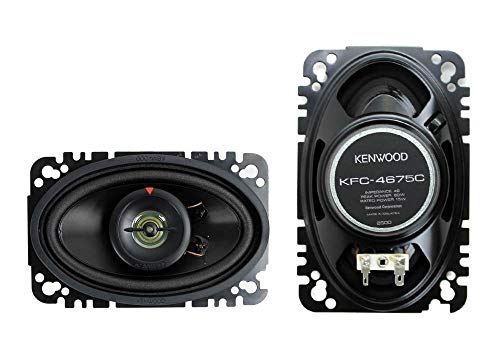
The universal dash answer: Kenwood KFC-4675C 4-inch by 6-inch two-way speaker system (B00020C5QA)
The final entry completes the universal route by covering the location the universal component sets do not: the dash. The Kenwood KFC-4675C is described as a 60-watt 4-inch by 6-inch two-way speaker system, from a long-established car audio brand. Its role in an S-10 build is precise. If you choose a universal 6.5-inch component set for the doors, you still need a 4×6 answer for the dash, and this is the guide’s universal answer, sized for that location and free of any vehicle-kit assumptions. If your doors are already done and only the dash remains, it is also the universal alternative to the Harmony dash pair for owners who prefer to choose by brand and size.
A two-way design in the dash location means a woofer and a tweeter working together in one unit, which suits a location where separate tweeter mounting is impractical. Firing into the windshield, a healthy two-way 4×6 restores the top-end detail and vocal clarity that a tired factory dash speaker loses first. The published 60-watt figure should be read the way this guide reads all power figures: as part of the product’s published identity, suitable for the factory and modest aftermarket head units that power most of these trucks, rather than as a number to rank against differently measured figures from other brands.
Choose the Kenwood if your build is universal by design, if you are pairing it with one of the 6.5-inch component sets above, or if you simply want an established-brand 4×6 for the dash with no kit attached. Together with a component set, it completes the two-location system the S-10 layout asks for. Bought alone for a dash-only refresh, it competes directly with the Harmony HA-C46 for later trucks, and the choice between them is the guide in miniature: vehicle-specific plug-and-play convenience on one side, universal brand-and-size selection on the other.
Kits versus universal builds: choosing your route
Laid side by side, the lineup divides cleanly. For 1994-2001 pickups, the full Harmony package refreshes both locations with adapters included, and the HA-C46 refreshes the dash alone as a direct drop-in. For 1990-1994 S-10 and Blazer applications, the Harmony harness package covers both sizes with wiring included. For builders who want component architecture and placement control, the Pyle, RECOIL, and two Orion sets provide 6.5-inch component options with different published emphases, and the Kenwood provides the universal 4×6 dash partner those sets require. Every S-10 owner in the covered years has a coherent route, and the routes do not overlap confusingly once year and body style are placed correctly.
Soundstage thinking ties the routes together. In factory form, the S-10 system places a reflective dash pair high and door pairs low, and the blend is familiar to anyone who has driven one. Vehicle kits preserve that layout with better drivers. Component builds let you raise the tweeter portion of the door system toward the dash’s height, narrowing the gap between the two locations and creating a more unified stage. Neither philosophy is a trick; they are different allocations of effort. Kits spend effort before the purchase, in fitment engineering. Component builds spend effort during installation, in placement. Choose where you would rather spend yours.
Source-unit planning deserves a final mention in this comparison. A factory head unit in good health can drive the kit options and the Kenwood dash speaker happily, and will drive efficient component sets at the volumes a small cab needs. An aftermarket head unit adds power and tuning flexibility. A separate amplifier adds headroom that component sets can use. Decide your source before finalizing speakers, because the same speaker is a different purchase behind different power. Owners researching a broader system sometimes compare adjacent sizes through best 5×7 car speakers for a second vehicle, but the discipline is identical: size, impedance, power source, and installation plan, in that order.
Installation planning for dash, doors, crossovers, and tweeters
Preparation decides how an S-10 speaker job feels. Gather panel tools, the correct screwdrivers, replacement panel clips, electrical tape or heat-shrink for any universal wiring work, and a container for screws, because these trucks use several screw types across the dash and doors. Disconnect the battery before working around dash wiring as a general precaution, and photograph each panel and connector before removal. On a twenty-year-old interior, photographs are the manual you wish the previous owner had left you, and they make reassembly a matching exercise instead of a memory test.
For kit installations, follow the logic the kit provides. The Harmony packages are described as plug-and-play with adapters or harnesses included, so work location by location: remove the factory speaker, connect with the provided hardware, confirm polarity and operation before fully seating the panel, and only then close the location up. Checking operation before reassembly is the single most valuable habit in vehicle audio. A speaker confirmed working with the panel off is a finished job; a speaker discovered silent after reassembly is the same job done twice.
For universal component installations, plan the wiring path before removing anything. Decide where each crossover will live, how tweeter wires will reach their mounts without pinching in door jambs or window mechanisms, and which adapters the door locations need. Mount crossovers where they will stay dry and secure, route wires alongside factory looms where practical, and leave enough slack for the door to open fully and the window to travel completely. Test the full system with panels still off, set tweeter aim, and only then reassemble. The extra planning hour is what separates a component system that delights from one that rattles, pinches, and gets removed in frustration.
Finishing touches repay their small cost. Replace every broken panel clip you find, since a door panel held by half its clips will buzz on coarse roads and be blamed on the speakers. Refit or replace a torn vapor barrier, because it protects the door speaker from moisture. Consider a modest amount of door sound treatment while the panel is off, concentrating on the outer skin behind the woofer. None of these steps appear on a speaker box, and all of them appear in how the finished truck sounds at highway speed. Break-in expectations should stay calm: new speakers may open up slightly with use, but a system that sounds wrong on day one has an installation or setting issue, not a break-in schedule, so investigate rather than waiting hopefully.
Frequently asked questions
Which speakers does my S-10 actually need? In the applications covered by this guide, the dash location uses 4×6 speakers and the doors use 6.5-inch speakers. Confirm both locations on your own truck before ordering, because trim, cab style, and previous-owner modifications vary. Then choose by year and body style: the Harmony packages divide at 1994 and name the Blazer explicitly in the early package, while universal sets fit by size with adapters and installation work as needed.
What is the advantage of component speakers over the factory setup? A component system separates the tweeter from the woofer and divides the signal with a crossover, so each driver handles the frequencies it was built for and the tweeters can be placed higher for a better soundstage. In the S-10’s small cab, that placement benefit is close to the listener and easy to appreciate. Vehicle-specific kits pursue improvement differently, by upgrading the drivers in the factory locations with matched installation hardware, which preserves the factory layout while refreshing its sound.
Can I install these with a factory head unit? The kit options and the 4×6 dash speakers in this guide are aimed squarely at factory-style upgrades and are described with plug-and-play installation, which suits factory wiring and power. Universal component sets will also play from a factory or aftermarket head unit, while an external amplifier gives them more headroom. Match the plan to your source, read published power figures as brand-specific rather than directly comparable, and confirm impedance against your source unit’s published requirements, noting that one Orion kit in this guide is published at 4 ohm.
My truck is a 1994. Which Harmony range applies? Both Harmony ranges in this guide include 1994 in their published descriptions, the 1994-2001 packages and the 1990-1994 package. That overlap means 1994 owners should verify fitment for their exact model and body style against the published specifications before ordering, rather than choosing by year alone. The same advice applies at any boundary: fitment statements are the authority, and a short verification step is cheaper than a return.
Should I replace the dash and door speakers together? Together is the coherent choice, because the two locations are heard as one system and an old pair will limit a new pair. The full Harmony packages exist for exactly that reason, and universal builders should pair a 6.5-inch component set with a 4×6 dash speaker such as the Kenwood in this guide. Staged replacement also works, dash first for clarity or doors first for body, as long as stage two is genuinely planned rather than indefinitely postponed.
Do universal component sets fit the S-10 doors without extra parts? Plan on extra parts. Universal sets fit by size, not by vehicle, so adapter rings, wiring adapters or wiring work, crossover mounting, and tweeter mounting are part of the job, along with fresh panel clips for an older truck. That is the honest difference between the universal route and the Harmony kits, whose descriptions include adapters or harnesses. Neither route is hidden about it in this guide, and choosing with eyes open is what makes either route satisfying.
Long-term fleet care: notes from the layout room
Regular-cab and extended-cab trucks ask slightly different things of the same speakers. The regular cab is a small, reflective space where dash output arrives quickly and door output has little room to dissipate, so modest volume goes a long way and tweeter aim matters immediately. The extended cab adds volume behind the seats and often carries more road gear, tools, and cargo noise. In both cabs, secure installation and rattle control matter as much as speaker choice, because a small truck interior forgives nothing: every buzz sits within arm’s reach of the driver.
Check prices on Amazon
Live listings for the shortlist in this guide are pulled from Amazon below, so prices and availability are always current at the moment you look.

Conclusion
Place your truck by year and body style first, then choose your route honestly. Later pickup owners who want the whole job in one box should start with the full Harmony package, or its dash-only HA-C46 companion for a staged refresh. Early S-10 and Blazer owners should start with the Harmony harness package written for their years. Builders who want component architecture and tweeter placement control should choose among the Pyle, RECOIL, and Orion 6.5-inch sets by their published details, and complete the system with the Kenwood 4×6 in the dash. Any of those routes, installed carefully and verified before the panels go back on, will make an S-10 sound like the truck its owners always believed it could be.
Affiliate disclosure: This guide contains affiliate links, and purchases made through them may earn this site a commission, which helps support future guides without changing the price you pay. Our comparisons rely on manufacturer-published fitment statements, sizes, and product descriptions, together with established car audio practice for vehicles of this era. We have not installed, listened to, or otherwise used the speakers listed here in our own truck, and no statement in this guide claims otherwise. Confirm year, body style, and fitment against the published specifications for your exact vehicle before ordering.

