Our Top Picks


What's inside
- What light transmission means, and why identical numbers diverge at dusk
- Coatings: how thin films decide how much light survives
- Prism systems: Porro, roof, and the mirror surfaces inside
- Glass: ED, HT, and what happens at the blue end of the spectrum
- Exit pupil and brightness math: the formulas and their limits
- Aperture classes: 42, 50, and 56 millimetres in practice
- Why transmission figures are rare, and how to read the ones that exist
- Supporting specifications that decide dawn and dusk usability
- A pre-purchase checklist tied to lines on the spec sheet
- Worked comparisons: putting the arithmetic together
- Check prices on Amazon
- Care, dew, and viewing habits that protect delivered light
As an Amazon Associate I earn from qualifying purchases. This post may contain affiliate links at no extra cost to you.
Two binoculars can share the same printed numbers, 8×42 for example, and still deliver visibly different images in the last twenty minutes of daylight. One shows a deer as a brown shape with a readable edge against dark grass. The other shows a darker shape that merges with the background, forcing the eye to guess where the animal ends and the field begins. The difference rarely comes from magnification or objective diameter alone, because those figures are identical. It comes from how much of the light gathered by the front lenses actually reaches the eye, and from how evenly that light survives across the visible spectrum. That proportion is called light transmission, and it is the central subject of this guide.
This guide is built from published specifications, manufacturer documentation, and optical standards rather than from invented bench claims. Where a maker publishes a transmission figure, the method behind the figure matters as much as the figure itself. Where a maker publishes no figure at all, other lines on the spec sheet still reveal a great deal: coating language, prism type, mirror coating, glass type, exit pupil, eye relief, and sealing. Reading those lines together gives a buyer a defensible way to compare models for dawn and dusk use without relying on slogans.
If some links in this guide lead to a purchase, the site may earn a commission from the retailer at no added cost to you, and that support helps keep these specification-led guides free to read.
What light transmission means, and why identical numbers diverge at dusk
Light transmission is expressed as a percentage. It states what share of the light entering the objective lens exits the eyepiece and reaches the eye. A figure of 90 percent means that, under the stated measurement conditions, nine tenths of the incident light in the measured band survives the full optical path. The remaining tenth is lost to reflection at glass surfaces, absorption inside glass and prism material, scattering, and reflection losses at mirrored surfaces inside the prism system.
No binocular transmits 100 percent. Every boundary between air and glass reflects a portion of light, every millimetre of glass absorbs a small portion, and every mirror surface returns less than the full beam. The design task is to keep each individual loss small, because losses multiply rather than add in a simple way. A path that keeps 95 percent at each of ten stages does not keep 95 percent overall; it keeps roughly 60 percent, since 0.95 raised to the tenth power is about 0.60. That multiplication is the single most useful idea in this entire subject.
A typical binocular contains far more optical surfaces than the two lenses a buyer sees. Count the objective group, the prism entry and exit faces, the internal prism reflections, the eyepiece group with its several elements, and the total of air-to-glass surfaces commonly reaches ten to sixteen, before mirror surfaces are counted at all. Small differences per surface therefore compound into large differences at the eye. A model that loses half a percent per coated surface and a model that loses four percent per poorly treated surface are not close relatives at dusk, even if their boxes carry the same magnification and aperture.
Human vision makes the gap feel larger still. In bright midday light the eye has light to spare, the pupil contracts to roughly 2 to 3 millimetres, and a modest transmission shortfall is hard to notice. At dusk the pupil opens, the scene luminance falls by orders of magnitude, and the visual system works near its contrast threshold. Near a threshold, a 10 or 15 percent difference in delivered light can decide whether low-contrast detail crosses into visibility or stays below it. Transmission matters most precisely when light is scarcest.
Transmission also interacts with contrast. Light reflected at internal surfaces does not always leave the system cleanly. Some of it scatters forward as stray light, lifting the black level of the image and washing out shadow detail. A binocular can therefore lose twice from weak coatings: less useful light reaches the eye, and more unwanted light arrives as veiling glare. At dawn, when a bright sky often sits above a dark treeline, that veiling glare is a practical problem, not a laboratory curiosity.
Colour is part of the story from the start. Transmission is not one number across all wavelengths. Glass, coatings, and mirror layers each treat blue, green, and red light differently. A binocular might transmit 92 percent near 550 nanometres, in the green where daylight vision peaks, and only 80 percent near 450 nanometres in the blue. The image then looks slightly warm or yellow, and blue-grey shadow detail suffers. Section four returns to spectral curves in depth, but the principle belongs here: any single percentage hides a curve.
Finally, transmission must be separated from brightness terms used loosely in marketing. Relative brightness, in the traditional formula, is simply the square of the exit pupil diameter. Twilight factor combines aperture and magnification in another formula. Neither formula contains a transmission term at all. Both describe geometry only. A maker can quote an impressive twilight factor for a binocular with mediocre coatings, and the arithmetic will still be correct while the dusk image remains dim. Geometry sets the ceiling; transmission decides how close the instrument gets to that ceiling.
best affordable low light cameras
Coatings: how thin films decide how much light survives
Uncoated glass reflects about 4 percent of light at each air-to-glass surface, with the exact figure depending on the refractive index of the glass. Higher-index glass reflects more. Four percent sounds trivial until the multiplication from the previous section is applied. Across twelve surfaces, keeping 96 percent each time leaves about 61 percent overall, before prism absorption and mirror losses are subtracted. Early binoculars lived with figures in that region, and their dusk performance reflected it.
A single anti-reflection layer changes the physics. The classic material is magnesium fluoride, applied with a thickness near one quarter of the wavelength it is tuned for. Light reflects from both the top of the layer and the glass beneath it, and the two reflected waves are arranged to interfere destructively, cancelling much of each other. The energy that is not reflected must go somewhere, and it passes into the glass instead. A good single layer can cut reflection at its design wavelength to roughly 1 to 1.5 percent per surface.
The vocabulary on spec sheets maps onto this history. Coated means at least some surfaces carry at least one layer, often only the outer faces. Fully coated means every air-to-glass surface carries at least one layer. Multi-coated means at least some surfaces carry several layers. Fully multi-coated means every air-to-glass surface carries several layers, and that is the phrase a low-light buyer should look for, written in full, on the spec sheet or in the maker documentation.
Multi-layer stacks improve on a single layer in two ways. First, they push residual reflection lower, toward about 0.5 percent per surface or below at the design band. Across twelve surfaces, keeping 99.5 percent each time leaves about 94 percent before other losses, a dramatic gain over the uncoated case. Second, a stack can hold that low reflection across a broader band of wavelengths, instead of performing best only near one colour. Broadband behaviour matters for neutral colour at dusk, when the remaining daylight is itself shifting blue.
The quarter-wave idea also explains why coatings show coloured reflections. A layer tuned perfectly for green may reflect a little more red and blue, so the lens surface shows a faint magenta or purple sheen when viewed at an angle. Green, amber, and blue reflections from different makers reflect different tuning choices and layer recipes. The colour of the sheen alone does not prove quality. A deep, even, subdued reflection usually suggests a well-controlled broadband stack, while a bright white reflection suggests an untreated surface, but visual inspection is a clue, not a measurement.
Coating durability is a separate published topic worth checking. Outer surfaces face cleaning, dust, salt spray, and glove contact. Hard coating layers and hydrophobic top layers, which cause water to bead and roll off, appear in maker literature under various trade names. For dawn use, where dew forms quickly on cold glass, a documented hydrophobic outer coating has practical value: droplets scatter light badly, and a surface that sheds them keeps the image usable longer into a damp morning.
Buyers should also note what coating language does not say. Fully multi-coated describes anti-reflection treatment on lens and prism faces. It says nothing about phase correction on roof prisms, and nothing about the mirror coating used inside a Schmidt-Pechan prism. Those are distinct treatments with distinct effects, covered next. A spec sheet that lists all three separately is giving the buyer more checkable information than one that relies on a single glowing adjective.
Prism systems: Porro, roof, and the mirror surfaces inside
A binocular needs prisms to fold the optical path into a short body and to present an image that is the right way up and the right way round. The prism system sits in the middle of the light path, so its losses apply to every ray. Two families dominate. Porro prisms, named for Ignazio Porro, offset the objectives wider than the eyepieces and use two prisms whose reflections rely on total internal reflection. Roof prisms keep the objectives in line with the eyepieces, giving the straight, slim body most current models use.
Total internal reflection is the Porro design’s quiet advantage. When light inside glass strikes a surface at a steep enough angle, beyond the critical angle, it reflects completely, with no mirror coating required and, in principle, no reflection loss at that bounce. A well-made Porro binocular therefore avoids one whole category of loss. Porro models also tend to deliver a stronger sense of depth, because the wider objective spacing widens the stereo baseline. Their costs are bulk, weight distribution, and a shape that is harder to seal against water.
Roof prisms come in two main geometries. The Schmidt-Pechan design is compact and is used in the great majority of roof binoculars. The Abbe-König design is longer and heavier, appears in a smaller set of premium low-light models, and is often chosen precisely because of its transmission behaviour. The difference lies in how many reflections need a mirror coating and how long the glass path is.
In a Schmidt-Pechan prism, one reflection strikes a surface at an angle where total internal reflection does not occur, so that surface must be mirrored. The quality of that mirror layer sets a direct ceiling on total transmission. Published reflectance figures for mirror materials differ clearly. A conventional aluminium mirror reflects roughly 87 to 90 percent in the visible band. A silver mirror does better, around 94 to 96 percent. A dielectric mirror, built from many alternating thin layers, can exceed 99 percent across the visible band, according to manufacturer documentation for premium models.
Those percentages deserve a pause. Replacing an aluminium mirror at 88 percent with a dielectric stack above 99 percent recovers more than a tenth of all light in the system at a single surface. No other single component swap in a binocular offers a gain of that size. When a spec sheet states a dielectric prism coating by name, it is stating something concrete and checkable. When it says only high-reflectivity coating without naming a type or figure, the buyer has less to work with.
The Abbe-König system avoids the mirrored surface altogether: its geometry keeps reflections within the total internal reflection regime. That is why several makers reserve it for their largest low-light models, where every percent is defended. The trade is length and mass. An Abbe-König binocular is noticeably longer than a Schmidt-Pechan model of the same aperture, and the extra glass adds weight that the neck and hands notice during long glassing sessions at dawn.
Roof prisms introduce a second effect that Porro prisms do not: phase shift. The roof edge splits the light into two components that reflect differently, shifting their phase relative to each other. When the components recombine, interference reduces contrast and fine resolution. Phase-correction coatings, often listed as P-coatings or phase coatings, are applied to the roof surface to realign those components. The effect is mainly on contrast and detail rather than on raw transmission percentage, but at dusk contrast is the currency that matters, so a low-light roof binocular without documented phase correction is missing a relevant line.
Prism glass itself matters too. The common prism material is BaK-4, a barium crown glass with a higher refractive index than the BK-7 borosilicate used in cheaper models. A higher index widens the cone of light that total internal reflection can handle and helps the exit pupil stay round and fully illuminated at the edge. In a finished binocular the buyer cannot easily see the prism glass grade, which is exactly why its presence or absence on the published spec sheet is worth recording during comparison.
Putting the prism section into a decision rule: for roof models, look for phase correction stated explicitly, a named mirror coating with dielectric preferred, and BaK-4 or better prism glass. For Porro models, check sealing carefully, because the transmission advantage is real but the weather protection is often weaker. Neither family wins automatically; the published details decide.
best cameras to take pictures at night
Glass: ED, HT, and what happens at the blue end of the spectrum
Standard optical glass absorbs a small share of light over the path length inside a binocular, and the absorption is not equal across colours. Conventional glass tends to absorb more in the blue and violet, so long glass paths, especially through large prisms, can tilt the image warm. High-transmission glass, labelled HT by some makers, is formulated to reduce that internal absorption, with the largest gains at the short-wavelength end. Manufacturer spectral charts for HT glass typically show the clearest improvement below about 480 nanometres.
That blue-end behaviour matters more at twilight than at noon, for a physiological reason. As light falls, human vision shifts from cone-dominated photopic vision toward rod-dominated scotopic vision, and peak sensitivity moves from about 555 nanometres toward about 507 nanometres, a change known as the Purkinje shift. The visual system at dusk leans harder on blue-green light. A binocular that starves exactly that band is handicapped at exactly the wrong hour, even if its headline transmission, measured near the green-yellow, looks strong.
ED glass addresses a different problem. Extra-low dispersion elements reduce chromatic aberration, the failure to bring all colours to the same focus, which shows as colour fringing on high-contrast edges such as a bird against a bright sky. ED elements do not by themselves guarantee high transmission, and HT glass does not by itself correct colour fringing. Premium low-light models often use both, because dusk viewing needs clean edges and a well-fed blue-green band at the same time. Treating ED and HT as interchangeable labels is a common reading error on spec sheets.
Fluorite and fluorite-like materials sit at the top of the dispersion discussion. Genuine fluorite crystal has exceptionally low dispersion, and several makers instead use fluorite-type ED glass with similar aims. For a transmission-focused buyer, the relevant point is narrower: these materials earn their place by protecting resolution and contrast, which lets the eye use the transmitted light well. A bright image with smeared edges delivers less usable information than a slightly dimmer image with crisp edges, particularly when the target is feather detail or antler points in low contrast.
Spectral transmission curves are the most honest format in which transmission can be published, and a few makers do publish them. A curve plots transmission against wavelength, usually from 400 to 700 nanometres. Reading one takes seconds once the habit forms. Look at the height of the curve near 500 to 520 nanometres for twilight relevance. Look at whether the curve sags at the blue end, which predicts a warm cast, or at the red end, which predicts a cool or green cast. Look at the area under the whole curve, not only its highest point.
A single percentage, by contrast, may describe the peak of the curve, the value at one wavelength, an average weighted for daylight vision, or an average across a stated band. All four can be truthful and still differ by several points for the same instrument. Section seven covers claim scepticism in full, but the glass lesson stands alone: ask what the number averages, over what band, and whether a curve exists. A maker willing to publish a curve is accepting a level of scrutiny that a single rounded number avoids.
Glass choice also sets weight. Denser high-index and ED elements, larger prisms, and longer Abbe-König paths all add grams. There is no free transmission. The buyer is always trading carried mass against delivered light, and the right trade depends on whether the binocular travels in a vehicle, on a chest harness for a short walk, or over ridges for a full day. Sections six and eight quantify that trade by aperture class.
Exit pupil and brightness math: the formulas and their limits
The exit pupil is the disc of light that leaves the eyepiece and enters the eye. Its diameter follows from one division: objective diameter in millimetres divided by magnification. Divide the objective diameter in millimetres by the magnification and the result is the exit pupil: 42 over 8 lands at 5.25 millimetres, 42 over 10 at 4.2, 56 over 8 at a full 7, and 50 over 10 at 5. This figure appears on most spec sheets, and it is worth recomputing by hand during comparison, because a mismatch between the printed exit pupil and the division signals careless documentation.
The exit pupil matters because the eye can only accept light through its own pupil. Light in the exit pupil disc that falls outside the iris is wasted. Light that fits inside is usable, subject to transmission losses along the path. Matching the two pupils is therefore the core sizing decision for low-light work. An exit pupil far smaller than the eye pupil delivers a dimmer image than the aperture could support. An exit pupil far larger wastes glass and weight, though it does make eye placement more forgiving, since the eye can move within the larger disc without the image blacking out.
The dark-adapted pupil shrinks with age, and published ophthalmology ranges are consistent enough to plan around. Young adults in full darkness often reach 7 millimetres or a little more. By around age 30 the typical maximum is nearer 6 to 6.5 millimetres. By age 50, figures around 5 to 5.5 millimetres are common. By the mid-60s, many eyes reach only about 4 to 4.5 millimetres in darkness. Individual variation is wide, medication and health affect the result, and full dark adaptation takes 20 to 30 minutes, which a dawn observer rarely has. Planning should use the conservative end of the range for the buyer’s own age.
Those ranges produce concrete guidance. A buyer in their twenties can use the full 7 millimetre exit pupil of an 8×56 on a truly dark site. A buyer in their fifties gains little brightness from an exit pupil beyond about 5.5 millimetres, so an 8×42 at 5.25 millimetres or a 10×50 at 5 millimetres already fills the eye, and the extra mass of a 56 millimetre model buys steadiness and eye-placement comfort rather than raw brightness. A buyer in their sixties may find a good 10×42, at 4.2 millimetres, effectively as bright as larger glass, while being far easier to carry and hold.
Twilight factor is the other traditional formula, calculated as the square root of magnification multiplied by objective diameter. For an 8×42 the result is the square root of 336, about 18.3. For a 10×42 it is the square root of 420, about 20.5. For an 8×56 it is the square root of 448, about 21.2. Higher magnification raises the factor, which is why the formula was historically read as favouring higher power for detail recognition at dusk.
The limits of twilight factor deserve equal emphasis. The formula contains no transmission term, no coating term, and no account of the observer’s pupil. It also rewards magnification without charging for the smaller exit pupil or the amplified hand shake that comes with it. Two binoculars with the same twilight factor can differ by 15 percentage points of real transmission. Treat twilight factor as a rough detail-recognition index for comparing similar designs, never as a brightness measurement, and never as a substitute for the exit pupil division.
Relative brightness, the square of the exit pupil, has the same geometric limit. An 8×56 scores 49, an 8×42 scores about 27.6, and a 10×42 scores about 17.6. Those ratios describe how much light the geometry could deliver to a large enough eye pupil. Multiply by the transmission fraction to approach reality: a 10×42 transmitting 92 percent can out-deliver an 8×42 transmitting 80 percent to an eye whose pupil is 4.5 millimetres, because the older or smaller pupil cannot collect the larger disc anyway. Formula first, transmission second, observer third: all three steps are required.
Aperture classes: 42, 50, and 56 millimetres in practice
The 42 millimetre class is the general-purpose standard for good reasons. An 8×42 offers a 5.25 millimetre exit pupil, a wide field, and a weight that most makers hold in the 600 to 750 gram region. A 10×42 trades field width and exit pupil for reach, suiting open country and water. For buyers whose low-light use means the first and last half hour around sunrise and sunset, rather than full darkness, a high-transmission 42 millimetre model is frequently the rational ceiling, because the eye pupil in civil twilight has not opened to its full night size.
The 50 millimetre class splits into two distinct tools. A 10×50 keeps a 5 millimetre exit pupil while adding reach, which suits scanning shorelines, watching raptors settle, and marine use where distance is constant. A 12×50 pushes magnification to the practical hand-held limit for most people, narrows the field, and gives a 4.17 millimetre exit pupil, so it is a detail tool rather than a brightness tool. Weights in this class commonly run from about 800 grams to just over a kilogram, and the harness or strap choice starts to matter.
The 56 millimetre class exists for the darkest work. An 8×56 delivers the full 7 millimetre exit pupil for young eyes and the widest margin for eye placement, and makers who build 8×56 models usually build them around transmission, often with Abbe-König prisms and their best coatings. A 10×56 gives 5.6 millimetres with more reach. The cost is unmistakable: weights commonly reach 1,100 to 1,250 grams, the barrels are long, and close focus is often poor, sometimes beyond 3 metres, because the design is optimised for distance in dim light.
When does an 8×56 beat a 10×42 at last light? When the observer’s pupil can accept more than 4.2 millimetres, when the target is close enough that extra magnification adds little, when the light is deep twilight rather than late afternoon, and when the binocular can be rested on a fence, vehicle, or monopod so that its mass becomes stability instead of fatigue. A woodland hunter watching a clearing at 60 metres in the final minutes fits that profile. So does a warden counting roosting birds against a darkening sky.
When does the 10×42 win instead? When identification depends on detail at range, when the observer’s pupil is limited by age to near 4 millimetres, when the walk in is long, and when the same binocular must serve all day rather than only at the edges of it. A brighter image of an unidentified shape is less useful than a slightly dimmer image that resolves the feature the observer came to check. Brightness is a means; recognition is the end.
Smaller classes deserve a brief, honest note. A 32 millimetre binocular, even with excellent coatings, gives an 8×32 exit pupil of 4 millimetres and gathers roughly 58 percent as much light by area as a 42 millimetre objective. Fine coatings can narrow the gap but cannot repeal area arithmetic. Compact models are travel tools and daylight tools. A buyer whose stated purpose is dawn and dusk performance should not let portability arguments quietly move the shortlist down a class.
Hand shake belongs in this section because aperture decisions often raise magnification. Every doubling of magnification doubles the apparent movement from the same tremor. At 8 power most adults can hold a usable image for minutes at a time. At 10 power fatigue arrives sooner. At 12 power a support is advisable for sustained viewing. Image-stabilised models exist and change this calculation, but they add electronics, battery dependence, and cost, and their transmission figures follow the same coating and prism rules as every other model in this guide.
Why transmission figures are rare, and how to read the ones that exist
Most makers do not publish a transmission percentage for most models. That silence has several causes, and not all of them are evasive. Measuring transmission properly requires a spectrophotometer or an equivalent calibrated bench, a defined wavelength band, a defined weighting, and a decision about whether to report the peak, the daylight-weighted average, or the value at a single wavelength. Without an industry-wide reporting convention, two honest laboratories can produce different headline numbers for the same binocular, which makes legal and marketing teams cautious.
There is also a commercial cause. A published figure invites direct comparison, and a maker whose mid-priced model transmits 86 percent has little incentive to print that beside a rival’s 91 percent. Coating language such as fully multi-coated is safer for the seller because it is qualitative. The buyer’s response is not suspicion for its own sake; it is to weight documented specifics, named mirror coatings, named glass, published curves, over adjectives, and to treat an actually published figure, with its method stated, as a sign of confidence.
A small group of makers, mainly European premium manufacturers, do publish figures or curves for flagship models, with headline values in the region of 90 to 95 percent for their best roof-prism instruments under stated conditions. Some publish separate daylight and twilight transmission values, recognising the Purkinje shift discussed earlier. That two-number practice is more informative than a single number, because a model can lead on daylight weighting and trail on twilight weighting if its blue-green transmission sags.
Sceptical reading follows a short set of questions. First, is the figure a peak or an average? A peak of 95 percent at 550 nanometres can coexist with an average near 88 percent across 450 to 650 nanometres. Second, what band does it cover? A figure limited to 500 to 600 nanometres excludes the difficult blue region where weak designs lose most. Third, is the weighting photopic, scotopic, or unweighted? Fourth, does the figure describe one barrel or the complete binocular as used? Fifth, is there a curve behind the number that can be inspected?
Round numbers deserve mild caution. A claim of exactly 99 percent transmission for a complete binocular should be read as describing a coating or a mirror surface, not the whole instrument, because glass absorption and the sheer count of surfaces make whole-system figures that high implausible for current production binoculars. By contrast, a claim of 91 percent with a published curve and a stated band is a claim that can be checked, compared, and believed provisionally. Precision about method is worth more than an extra point of headline value.
Independent measurement exists but is scattered. Some European hunting and birding publications have historically measured transmission with laboratory equipment and published results by model, and those archives, where available, are more useful than retailer copy. Buyers should note the year of any such measurement, because coating recipes change during a model’s production life without a change of model name. A figure from a decade ago may describe an earlier coating generation of a binocular still on sale.
The practical stance for a shortlist is therefore comparative rather than absolute. Rank models by the completeness of their optical documentation: published curve at the top, published figure with method next, named dielectric mirror and phase coating next, then specific coating and glass language, then generic language alone. That ranking is reproducible from public documents, which is the standard this guide applies throughout. It will sometimes place a less famous model above a famous one, and that is a feature of the method, not a defect.
Supporting specifications that decide dawn and dusk usability
Eye relief and glasses
Eye relief is the distance from the rear lens surface at which the full field remains visible, and spec sheets state it in millimetres. Glasses wearers generally need at least 15 millimetres, and many need 17 to 19 millimetres, because the glasses hold the eye farther back. Insufficient eye relief crops the field into a tunnel, which at dusk also wastes the outer, dimmer part of the image that peripheral vision uses for detection. Twist-up eyecups with firm intermediate stops help both groups: glasses wearers leave them down, others raise them to a repeatable position.
Sealing, fogproofing, and cold mornings
Dawn is the dampest hour. A binocular moved from a warm vehicle into cold morning air can fog internally if its interior holds moist air, and internal fog ends the session. Nitrogen or argon purging replaces moist internal air with dry inert gas, and O-ring sealing keeps it there. Argon molecules are larger and leak more slowly in principle, and several makers state argon for that reason, but a well-sealed nitrogen instrument outperforms a poorly sealed argon one. The checkable lines are the purging gas named, the waterproof claim, and the immersion depth and duration behind it, where stated.
Waterproof ratings for binoculars are less standardised than watch ratings. Some makers cite a depth such as 1 metre, 3 metres, or 5 metres for a stated time. Others cite a Japanese Industrial Standard water resistance class. A model described only as weather-resistant or fog-resistant without a depth, a class, or the word waterproof should be treated as splash-tolerant rather than sealed. For coastal and wetland dawn use, that distinction decides service life, because salt moisture inside a prism is effectively permanent.
Field of view and its trade with magnification
Field of view is stated either as width at a standard distance, commonly metres at 1,000 metres, or as an angular figure in degrees. At dusk, a wider field helps in two ways: moving targets are found faster against a dark background, and the eye gets more contextual light for orientation. As a rough class guide, an 8×42 often offers around 7.5 to 8.5 degrees, while a 10×42 more often offers around 6 to 6.5 degrees. The apparent field, magnification multiplied by the real field, governs how spacious the view feels, and eyepiece designs that chase a very wide apparent field can soften edge sharpness, which matters when the target sits off-centre in poor light.
Close focus, focus wheel, and handling with gloves
Close focus is the nearest distance at which the binocular focuses, often around 1.5 to 2.5 metres in 42 millimetre models and longer in 56 millimetre models. It rarely decides a dawn purchase, but it decides dual use for insects, flowers, and feeder birds. More relevant at first light is the focus mechanism itself: a large, centrally placed wheel with moderate resistance, a documented diopter adjustment that locks or holds its setting, and a bridge design that leaves room for gloved fingers. Cold hands at dawn lose fine control, and a small, stiff wheel becomes a real cost. Rubber armouring with a documented texture, rather than smooth cosmetic cladding, serves the same cold-morning purpose and protects alignment when the binocular knocks against a gate or hide rail.
Dimensions, weight, and tripod fitting
Published length, width, and weight allow a buyer to compare carrying burden honestly, provided the weight states whether caps and strap are included, which many sheets omit. A standard tripod thread, usually hidden under a cap on the front of the hinge, is worth confirming for 50 and 56 millimetre models and for any 12 power model, because supported viewing at dusk recovers more detail than any coating upgrade. Harness compatibility is not a spec-sheet line, but lug placement and barrel diameter decide whether a chest harness holds the binocular flat and quiet, which determines whether it is carried at all on a long approach in the dark.
A pre-purchase checklist tied to lines on the spec sheet
Work through the following checks in order, using only published documents, and record the answer for each model on the shortlist in the same terms. First, recompute the exit pupil from aperture and magnification, and compare it with the buyer’s age-based pupil range from section five. A model whose exit pupil falls well short of that range needs exceptional transmission to stay on a low-light list, and a model far beyond it must justify its weight on other grounds.
Second, copy the coating sentence exactly as published. The words fully multi-coated, applied to all air-to-glass surfaces, are the threshold for serious dawn use. Anything weaker, coated, multi-coated without the word fully, or language that refuses to say which surfaces are treated, moves the model down the list regardless of other strengths. Note also whether an outer hydrophobic or scratch-resistant layer is documented, since dew behaviour at dawn is a functional property, not a cosmetic one.
Third, for a roof-prism model, confirm three separate lines: phase-correction coating stated, mirror coating type named, and prism glass grade named. Dielectric mirror treatment and BaK-4 glass are the preferred answers. For a Porro model, confirm the sealing lines with extra care, and accept the bulk only if the viewing site and carrying distance make it reasonable.
Fourth, separate the glass claims. An ED element answers the fringing question. HT or high-transmission glass answers the absorption question, especially in the blue. A model may have either, both, or neither, and the spec sheet should make clear which. If a maker publishes a spectral curve, record the transmission near 500 nanometres and the behaviour at 450 nanometres, not only the peak value quoted in marketing summaries.
Fifth, if a headline transmission figure exists, write down its band, its weighting, and whether it is a peak or an average, beside the figure itself. A figure without those companions goes into the notes as unverified marketing, not as data. If no figure exists, do not invent one from coating language; rank the model by documentation completeness instead, following the order set out in section seven.
Sixth, check eye relief against eyewear. Glasses wearers should require at least 15 millimetres on paper and prefer 17 or more, with eyecups that stay where they are set. Seventh, check the sealing lines: named purging gas, the word waterproof rather than weather-resistant, and a stated depth or recognised class where available. Eighth, check field of view in degrees and convert any width-at-distance figure to the same unit as the rest of the shortlist before comparing, because mixed units hide real differences.
Ninth, record weight, length, close focus, and tripod fitting, and match them to the actual pattern of use: distance carried, likelihood of supported viewing, and whether the same binocular must handle close subjects. Tenth, confirm warranty terms on the optical and mechanical system from the maker documentation, including how long sealing and purging remain covered, since a low-light binocular that loses its gas fill loses the dawn reliability that justified its price class.
Matching the checklist to common buying situations
A woodland observer working short distances in deep shade should weight exit pupil and field of view first, accept 8 power, and treat dielectric mirror treatment as the highest-value upgrade. A coastal or estuary observer should weight sealing, eye relief with glasses against wind-driven spray, and 10 power reach, accepting a 5 millimetre exit pupil in a 10×50 as the balanced answer. An older observer should weight transmission completeness and moderate weight above aperture class, since a limited pupil cannot spend the light that a 56 millimetre objective gathers. A vehicle-based observer, by contrast, can let weight fall to the bottom of the list and take the largest exit pupil and longest prisms on offer.
Across all four situations the same discipline holds: every preference in the paragraph above maps to a line that either exists on a published spec sheet or does not. Where the line does not exist, the honest entry in the comparison table is the word unpublished, and enough unpublished entries in the rows that matter should end a model’s candidacy. That rule protects the buyer from the most common failure in this category, which is paying for low-light performance that was described warmly and documented nowhere.
Light transmission rewards the buyer who reads slowly. The physics is not mysterious: each surface takes its share, mirrors take theirs, glass absorbs unevenly across the spectrum, and the eye at dusk needs blue-green light delivered to a pupil whose size age has already decided. A binocular that documents low loss at every one of those steps, in numbers and named treatments that a stranger could verify from public documents, is the binocular that will still be showing detail when the path home has gone the colour of wet slate.
Worked comparisons: putting the arithmetic together
Formulas become useful when they are run on complete configurations rather than on isolated numbers. Consider three roof-prism models described only by published-style data. Model A is an 8×42 with fully multi-coated optics, a silver mirror treatment, phase correction, and a documented transmission average of 88 percent across the visible band. Model B is a 10×42 with the same coating language, a dielectric mirror treatment, phase correction, ED glass, and a documented average of 92 percent. Model C is an 8×56 with Abbe-König prisms, HT glass, fully multi-coated optics, and a documented average of 93 percent, at roughly 1,200 grams.
For an observer aged 28 with a dark-adapted pupil near 7 millimetres, the ranking follows aperture. Model C fills the pupil completely and transmits the largest share, so it delivers the brightest image and the most forgiving eye placement. Model A delivers a 5.25 millimetre disc, leaving part of the pupil unused, and Model B delivers only 4.2 millimetres, so its higher transmission percentage cannot close the area gap. Area grows with the square of diameter: the 5.25 millimetre disc has about 56 percent more area than the 4.2 millimetre disc, a margin no plausible coating difference in this class can overturn.
For an observer aged 62 with a pupil near 4.3 millimetres, the ranking inverts in an instructive way. Model B now fills the pupil almost exactly and applies the best combination of transmission and magnification, so it resolves the finest dusk detail of the three. Model A slightly overfills the pupil, wasting a modest share of its disc, and its lower transmission leaves it behind Model B despite the larger objective class on the box. Model C overfills the pupil by a wide margin; the surplus light falls on the iris, while the observer still carries 1,200 grams and a long body. For this buyer the largest binocular is the worst purchase of the three, and the spec sheets contain every fact needed to see that in advance.
A third observer, aged 45, works from a boat at dawn, where the platform moves and distances run long. Here Model B in a 10×50 variant, giving a full 5 millimetre exit pupil with reach, becomes the balanced answer, provided the sealing lines are strong and the weight stays near or below a kilogram. The worked lesson generalises: there is no best configuration in the abstract, only a best match among exit pupil, transmission documentation, magnification, and carried mass for a stated eye, site, and hour. Any guide or seller offering a single winner without asking those four questions is skipping the arithmetic that decides the outcome.
Check prices on Amazon
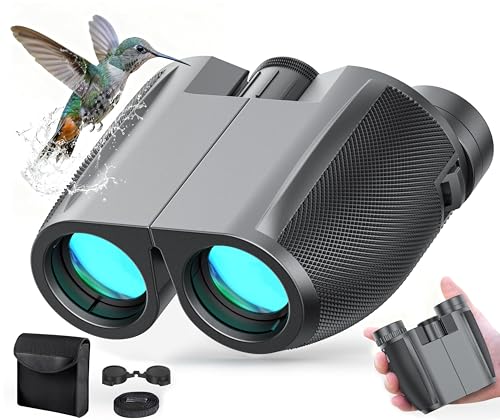
Live listings for the shortlist in this guide are pulled from Amazon below, so prices and availability are always current at the moment you look.



Care, dew, and viewing habits that protect delivered light
Transmission figures describe a clean instrument. Field habits decide how much of that figure survives a real morning. The largest avoidable loss is a film on the outer surfaces: dew, dried salt, skin oil from a stray fingerprint, and dust ground across a coating by dry wiping. Each contaminant scatters light, and scatter at dawn, with a bright sky in or near the field, converts directly into veiling glare. A blower first, then a clean microfibre cloth with lens fluid where the maker permits it, preserves both the image and the coating. Dry rubbing of gritty glass is the one cleaning habit maker documents consistently warn against.
Dew management starts before the glass fogs. Keeping the binocular near ambient temperature, rather than in a heated vehicle until the moment of use, reduces condensation on cold outer surfaces. Leaving caps off in moving air, shielding the objectives from the clear night sky where radiative cooling is strongest, and using the documented hydrophobic behaviour of modern outer coatings all delay droplet formation. If dew does form, patience and moving air restore the surface; wiping a saturated lens every few minutes mostly redistributes the water and risks the coating over a season.
The observer is part of the optical system as well. Full dark adaptation takes 20 to 30 minutes, and a single glance at a bright phone screen or vehicle light can set it back noticeably, because the rod pigment that supports low-light vision bleaches quickly and regenerates slowly. Dim red light preserves adaptation better than white light, which is why astronomy practice standardised on it. Arriving before dawn, setting focus and diopter by the last usable light, and then leaving screens in a pocket gives the eye the sensitivity that the binocular was bought to feed.
Stability is the final habit. Bracing elbows on knees, a fence, or a vehicle, shortening the neck strap so the binocular can be tensioned against it, or fitting a tripod adapter for the largest models, all raise the resolution the eye actually receives. At dusk the target is usually near the contrast threshold, and image motion pushes detail across that threshold in both directions many times a second. A steady 8 power view routinely reveals more than a wandering 10 power view, whatever the twilight factors on the two boxes claim.
Taken together, the habits in this section cost nothing and defend everything the earlier sections measured. The buyer who has chosen documented coatings, a named mirror treatment, suitable glass, and a matched exit pupil still has to arrive early, keep the outer surfaces clean and dry, protect dark adaptation, and hold the instrument still. Do those things, and the percentage on the spec sheet becomes the percentage at the eye, on the coldest and darkest morning of the year, when a heron lifts from black water and holds, for three seconds, perfectly still against the first grey light.


