Our Top Picks



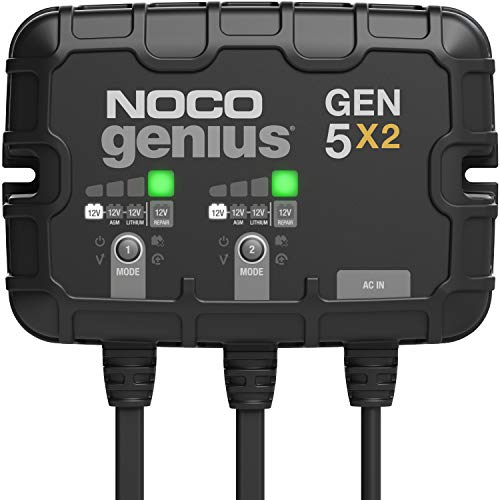


What's inside
- How a GENIUS charger differs from a traditional charger
- The line-up by output current, from 1 amp to the workshop models
- Sizing current to battery capacity, charge time and the C-rate idea
- Chemistry modes: flooded, AGM, gel and lithium iron phosphate
- Six volts, twenty-four volts, and the vehicles that still need them
- Repair mode, desulfation and the limits of bringing a battery back
- Force mode and the battery that has fallen below one volt
- Temperature compensation and why voltage should follow the weather
- Multiple batteries, marine and RV installations, and living with the charger full-time
- Safety systems, fault behaviour and lithium thermal risk
- Maintainer versus trickle charger, and getting a battery through winter
- Check prices on Amazon
- Choosing by scenario, common questions and final guidance
As an Amazon Associate I earn from qualifying purchases. This post may contain affiliate links at no extra cost to you.
A note on how this guide was put together: it rests entirely on published specifications, owner manuals and battery engineering references released by the charger maker and by battery manufacturers, cross-checked against one another for voltage, current and mode definitions. Nothing here rests on having borrowed, bought or bench-run a unit for this page, and where a figure could not be confirmed in those documents it has been left out rather than filled in from retailer product pages. If you follow a retailer link from this site, the retailer may pay this site a commission that helps fund the writing, and that arrangement does not change which models are described or how their limits are stated.
A dead battery rarely announces itself at a convenient moment. It shows up on the first cold morning after a car has sat for three weeks, on the spring day a boat comes out of storage, or when a mower that started all summer suddenly only clicks. The charger you reach for in that moment matters less for its headline amperage than for whether it understands what kind of battery is in front of it, how deeply that battery has discharged, and when to stop pushing current into it. The NOCO GENIUS range was built around that judgement call. Instead of a single transformer box with a needle and a timer, the line is a family of microprocessor-controlled chargers and maintainers spanning 1 amp for long-term storage duty up to 50 amps for workshop benches, with shared logic for chemistry, temperature and fault detection running through nearly every model.
That shared logic is the real subject of this guide. Model names differ mainly by output current, voltage coverage and mounting style, while the underlying questions stay constant. Does the charger recognise a lithium iron phosphate pack as something distinct from a flooded lead-acid battery? Will it attempt recovery on a sulfated plate, and where does recovery stop being realistic? Can it start a charge on a battery that has fallen below the voltage most chargers treat as absent? And once the battery is full, will it watch quietly for months without cooking the electrolyte away? Answering those questions in order tells you far more than a ranked list ever could.
Readers comparing this brand hub with broader category guides will also want best 12 volt battery chargers for the wider 12-volt field, because the GENIUS line makes the most sense when its trade-offs are set against simpler and cheaper rivals.
How a GENIUS charger differs from a traditional charger
An older linear charger is essentially a transformer, a rectifier and very little else. Connect it, and it delivers a roughly fixed voltage while current tapers as the battery fills. Leave it connected too long and it keeps pushing, raising electrolyte temperature, gassing flooded cells and slowly warping plates. Remembering to disconnect it was part of the product. A smart charger replaces that blunt behaviour with staged charging governed by a controller that samples voltage and current many times per second and changes its output in response.
The stages have names worth knowing because they explain most of what the mode lights on a GENIUS unit are reporting. Bulk charging delivers the bulk of the energy at the charger’s rated current while voltage climbs. Absorption holds voltage steady, commonly around 14.4 volts for a conventional 12-volt lead-acid battery at room temperature, while current falls as the plates convert lead sulfate back into active material. Float or maintenance then drops to a lower holding voltage that offsets self-discharge without sustained gassing. Some profiles add an equalisation or optimisation step, and lithium profiles skip float in the lead-acid sense altogether, a distinction covered later in this guide.
Two safety behaviours separate this family from bargain boxes most clearly. Spark-proof connection logic means the clamps do not deliver output until the charger has detected a plausible battery connection, so brushing a clamp against a terminal or a frame rail during hookup does not throw the spark that a live clamp would. Reverse polarity protection means that if positive and negative are swapped, the unit refuses to charge and flags the error instead of passing current backwards through a battery and its vehicle electronics. Neither feature makes careless hookup wise, and the manuals still insist on eye protection and ventilation, but both remove the two most common beginner errors from the list of things that can damage a vehicle.
The controller also watches for conditions that should stop a charge entirely. A battery that will not accept current in a plausible pattern, a cell that has shorted internally, or a voltage that behaves as though the wrong battery type has been selected will push the charger into a diagnostic or standby state rather than into ever-higher output. That refusal is a feature, not a fault. A charger that always tries harder will eventually find the one battery that should have been retired, and it will find it by overheating it.
Form factor follows the electronics. Because switch-mode power conversion is compact and efficient, even the 10-amp model is a sealed brick a fraction of the size of an old steel-cased unit of similar output, and the smallest maintainer is closer in size to a phone power supply than to workshop equipment. Sealed housings matter for garages and engine compartments where dust, splashes and vibration are normal, although the exact ingress rating varies by model and should never be assumed from the look of the case.
Finally, a GENIUS unit is designed to stay connected. That single design goal changes everything about its maintenance behaviour, its thermal design and its intended owner. It is aimed at the motorcycle under a cover until April, the convertible that only leaves on dry weekends, the standby generator battery and the boat on a trailer, as much as at the daily driver that needs rescuing tonight.
The line-up by output current, from 1 amp to the workshop models
Choosing within the range starts with amperage, and the range is unusually wide. The table below summarises the core models discussed in this guide using the headline figures published for each one. Treat it as a map rather than a verdict, because the sections that follow explain why the smallest adequate charger is often the better long-term buy, and why the largest one can be the wrong tool for a small powersports battery.
| Model | Output | Voltages | Typical role |
| GENIUS1 | 1A | 6V and 12V | Maintainer for stored cars, motorcycles and mowers |
| GENIUS2 | 2A | 6V and 12V | Maintainer and slow charger for small to mid-size batteries |
| GENIUS2D | 2A | 12V | Direct-mount maintainer fitted at the battery |
| GENIUS5 | 5A | 6V and 12V | General garage charger for car and deep-cycle batteries |
| GENIUS10 | 10A | 6V and 12V | Faster charging for larger automotive, marine and RV batteries |
| GENIUSPRO25 | 25A | 6V, 12V and 24V | Bench and workshop charging, larger banks |
| GENIUSPRO50 | 50A | 6V, 12V and 24V | Professional throughput and power-supply duty |
The GENIUS1 is a maintainer first and a charger second. At 1 amp it will eventually refill a healthy car battery that has run down, but eventually is the operative word, and its real purpose is holding a battery at full charge through weeks or months of inactivity. Motorcycles, lawn tractors, classic cars and standby equipment suit it precisely because their batteries are modest in capacity and their enemy is self-discharge plus parasitic drain, not a single deep discharge. Its compact body and simple clamp or eyelet connections reflect that stay-connected role.
Doubling output, the GENIUS2 covers the same storage ground with more patience-testing headroom. Two amps will recover a partially discharged motorcycle or small car battery overnight rather than over a weekend, and it remains gentle enough for the small batteries fitted to powersports machines. For many households with one stored vehicle and one small machine, this is the point where a maintainer stops feeling like a compromise.
The GENIUS2D takes the 2-amp idea and changes the installation instead of the electronics. The D denotes direct mounting: the unit is designed to be fitted at or near the battery itself, with short leads, so that maintaining the battery becomes a matter of plugging in an extension lead rather than opening a bonnet, finding terminals buried under covers and routing clamp leads across paintwork. That matters on vehicles where the battery lives under a seat, behind a panel or in a crowded engine bay, and on equipment kept outdoors where a loose brick charger would wander or get knocked. The trade-off is commitment. A direct-mount unit belongs to one vehicle, so households rotating one charger among four batteries should buy a portable model instead.
The GENIUS5 is the general-purpose centre of the consumer range. Five amps charges a typical car battery from half charge in a matter of hours rather than days, handles mid-size deep-cycle batteries sensibly, and still behaves as a maintainer once full. If a household owns cars, a mower and perhaps a small boat, and wants one charger that neither crawls nor overwhelms a small battery when its automatic limits are respected, this output class is where the balance usually lands.
At 10 amps, the GENIUS10 is aimed at larger batteries and shorter windows. Diesel trucks with paired batteries, big marine starting batteries, RV house batteries and frequently used deep-cycle banks all reward the extra current, provided the battery itself is large enough to accept it. The maker publishes an IP68 rating for this model in its documentation, reflecting a sealed unit intended for harsher mounting environments than a shelf in a dry garage, but owners should still follow the manual on orientation, cable routing and immersion limits rather than treating any rating as permission to abandon a charger underwater or in bilge water.
The PRO models change the conversation from household to throughput. The GENIUSPRO25 and GENIUSPRO50 add 24-volt capability across the board, higher sustained output for large banks, and in the professional documentation, power-supply and advanced diagnostic functions suited to workshops that need to hold vehicle voltage steady during service work. Their size, fans, cost and output are all disproportionate for keeping a motorcycle alive through winter. Buying one for that job is not buying quality, it is buying unused capacity and giving up the simplicity that makes a small maintainer easy to leave connected.
One naming trap deserves a clear warning. Products carrying Boost in their name belong to a different family of lithium jump starters, designed to deliver a short burst of cranking current, not to recharge or maintain a battery over hours. A jump pack and a charger solve opposite problems, and neither substitutes for the other, however similar the branding on the box may look.
Sizing current to battery capacity, charge time and the C-rate idea
Battery people express charging current as a fraction of capacity, written as a C-rate. A 100 amp-hour battery charged at 10 amps is being charged at C/10, or 0.1C. At 5 amps the same battery sits at C/20. The convention is useful because it travels across battery sizes: a 10-amp charger is gentle on a 100Ah deep-cycle battery and violent overkill as a first suggestion for a 9Ah motorcycle battery, even though the charger itself has not changed.
For flooded and AGM lead-acid batteries, a common planning band for routine charging is roughly C/10 to C/5, with the manufacturer’s own rating for the specific battery always taking precedence. Smaller and older batteries, and batteries in poor condition, belong at the low end. Lithium iron phosphate batteries typically accept higher rates, often up to C/2 or beyond for cells rated for it, but the battery management system inside the pack is the authority, not the charger’s front panel.
Charge time follows from simple arithmetic, then gets corrected by reality. Divide the amp-hours you need to replace by the charger’s amps to get an ideal number of hours, then add roughly a fifth to a quarter for conversion losses and for the absorption phase, during which current deliberately tapers. Replacing 40Ah in a car battery therefore takes about eight ideal hours at 5 amps and nearer ten hours in practice, while the same job at 10 amps lands around five hours once tapering is included. At 1 amp it stretches beyond a day and a half, which is exactly why the smallest model is sold as a maintainer rather than as a rescue device.
Two qualifications keep those estimates honest. First, a battery is rarely empty, and guessing its state of charge from a single rested voltage reading is approximate at best, especially if it has just been loaded. Second, the last portion of a lead-acid charge is intentionally slow. A charger showing a battery as mostly charged after the bulk phase is not nearly finished in chemical terms, and disconnecting during early absorption week after week leaves sulfate behind that later hardens. Let the charger finish and move into maintenance on its own schedule.
Undersizing and oversizing fail differently. An undersized charger on a big bank may never quite overcome parasitic loads plus self-discharge, so the battery hovers below full, sulfates slowly and dies young while appearing to be on a charger the whole time. That pattern shows up in RV storage more than anywhere else. An oversized charger on a small battery risks excessive current early in the charge if the battery’s internal resistance is low, generating heat and stressing plates, which is why matching the charger to the smallest battery you will regularly connect matters as much as matching it to the largest.
A practical household rule emerges from all of this. Size for the battery you charge most often, check that the result still makes sense for the biggest battery you own, and accept a slow overnight charge on the rare occasion the biggest one comes home empty. Households whose biggest and smallest batteries differ wildly, a house bank and a jet ski, for example, are the households that genuinely benefit from owning two different sizes.
Chemistry modes: flooded, AGM, gel and lithium iron phosphate
Lead-acid is a family, not a single recipe, and the GENIUS mode button exists because each member of that family wants a slightly different voltage ceiling and finishing behaviour. A flooded battery has liquid electrolyte that can be topped up, tolerates a fuller absorption voltage around 14.4 volts at room temperature, and can even accept a controlled equalising charge in some service regimes. An AGM battery traps its electrolyte in glass matting, recombines gases internally and is less forgiving of sustained overvoltage, because gas vented through its valves is electrolyte it can never get back. Gel batteries are stricter still, generally wanting lower charge voltages, and owners should confirm gel suitability and settings in the manual for the specific model rather than assuming an AGM setting is close enough.
Selecting the wrong lead-acid mode rarely destroys a battery in an afternoon. The damage is slower and quieter: chronic slight overcharge drying an AGM battery over a season, or chronic undercharge leaving a flooded battery sulfated. That is why the mode indicator deserves a glance every time the charger is connected, especially on units shared between vehicles with different battery types. Modes can persist between sessions, and the battery that arrives today may not be the chemistry the charger was set for last month.
Lithium is a different matter entirely, and it gets its own mode for structural reasons. A 12-volt lithium iron phosphate battery is four cells in series with a nominal voltage of 12.8 volts and a full-charge voltage around 14.6 volts, higher than the 14.4-volt figure associated with lead-acid absorption. Its battery management system monitors individual cell groups and can disconnect the pack if conditions leave its safe window. A lead-acid profile applied to lithium can undercharge it, confuse its management system with float behaviour it was not designed around, or in the worst combination keep presenting voltage after the pack has tried to protect itself.
The lithium profile in the GENIUS documentation is written for lithium iron phosphate, commonly shortened to LiFePO4. That qualifier matters. Other lithium chemistries with different cell counts and voltage curves, including the lithium cobalt and nickel-based packs common in electronics and some motorsport batteries, do not automatically share that profile. If a battery maker specifies its own charging requirements, those requirements win, and if a pack has a proprietary charging connector or a mandated dedicated charger, that instruction wins over any general guide including this one.
Temperature interacts with lithium more sharply than with lead-acid. Charging a lithium iron phosphate battery below freezing can plate metallic lithium inside the cells, permanently reducing capacity and creating an internal hazard, which is why many packs block charging at low temperature through their management system and why a charger with temperature awareness is a meaningful partner rather than a marketing pairing. Owners storing lithium-equipped machines through winter should read both manuals, the charger’s and the battery’s, before assuming that a connected maintainer is the right winter plan.
Deep-cycle batteries cut across these chemistry labels. A deep-cycle battery is defined by its job and its plate construction, thick plates built for repeated substantial discharge, rather than by one chemistry. Flooded, AGM and lithium deep-cycle batteries all exist, and each still wants its own chemistry mode. Starting batteries, by contrast, use thin plates optimised for brief high current and suffer when repeatedly deep-discharged, whatever charger is attached afterwards. No charging profile converts a starting battery into a deep-cycle battery, a point worth remembering when an RV house load has flattened a battery that was never meant for that work.
Guides focused narrowly on sealed lead-acid care, such as best agm chargers, go deeper on AGM voltage limits, and that depth is worth consulting before leaving an expensive AGM bank on any charger unattended for a season.
Six volts, twenty-four volts, and the vehicles that still need them
Six-volt support sounds like nostalgia until you inventory what still runs on it. Classic cars and tractors built before the industry standardised on 12 volts, vintage motorcycles, some golf carts wired as series strings of 6-volt units, and older floor-care and industrial equipment all depend on 6-volt batteries that a 12-volt-only charger cannot serve safely. Applying a 12-volt profile to a 6-volt battery is not a faster charge, it is a destructive overvoltage, so automatic or selectable 6-volt detection is a genuine requirement for anyone keeping older machinery alive.
Within the consumer GENIUS models discussed here, 6-volt charging is a standard part of the specification for the 1, 2, 5 and 10-amp units, which makes any of them a plausible single charger for a mixed garage containing one vintage vehicle. The direct-mount 2D, by contrast, is a 12-volt unit in the published specification, a reminder that mounting convenience and voltage breadth do not always arrive in the same box.
Twenty-four-volt systems sit at the other end of the same logic. Trucks, larger marine installations, mobility and industrial equipment, floor scrubbers, lifts and series-wired solar or RV banks all run at 24 volts, usually as two 12-volt batteries in series. Charging such a string as a single 24-volt battery requires a charger that actually offers a 24-volt profile, which in this family means stepping up to the PRO models. The alternative, disconnecting the string and charging each 12-volt battery separately, works but is slow, invites wiring mistakes on reassembly, and can leave the pair unbalanced if one battery receives a fuller charge than its partner.
Series strings deserve respect in their own right. Two batteries in series share current but not necessarily voltage, and an ageing battery with higher internal resistance can hog voltage while its partner starves. A 24-volt charge evens the string only if the batteries were reasonably matched to begin with. Owners of critical 24-volt equipment should periodically check each battery individually, and anyone replacing one battery in a series pair should understand that pairing a fresh battery with a tired one usually shortens the life of the fresh one.
Parallel banks raise the mirror-image issue. Batteries wired in parallel share voltage and divide current, so the charger’s amps split across the bank, and total capacity, not single-battery capacity, is the number to use in the charge-time arithmetic from the previous section. A 10-amp charger on a 300Ah parallel house bank is a maintainer, whatever the box calls it.
For readers weighing a mixed-voltage purchase, best 6v and 12v battery chargers covers that narrower decision directly, while the takeaway here is simpler: list every battery voltage you actually own before shopping, because voltage coverage is a hard gate that no amount of amperage can compensate for.
Repair mode, desulfation and the limits of bringing a battery back
Sulfation is the most common slow death of a lead-acid battery. During discharge, lead sulfate forms on the plates as a normal part of the chemistry. Recharging promptly converts it back. Leave a battery sitting partly discharged, though, and those soft crystals gradually reorganise into larger, harder crystals that resist conversion, coat the plate surface, raise internal resistance and shrink the battery’s usable capacity. The battery still shows a plausible voltage on a meter, yet collapses under load, which is why sulfation confuses so many owners.
Repair mode, as described in the GENIUS documentation, is an extended recovery programme that applies controlled pulses and a carefully managed elevated voltage over a long session, with the aim of breaking down that hardened sulfate and restoring some plate surface. It is intended for batteries that have lost capacity through neglect, and the documentation frames it as an optimisation and recovery attempt, not as a resurrection guarantee. Running it on a battery disconnected from the vehicle is the cautious approach recommended in the manuals, because an extended elevated-voltage session is not something vehicle electronics need to sit through.
What repair mode cannot do is equally important, and honest guides should say it plainly. It cannot mend a plate that has physically shed its active material into the bottom of the case. It cannot repair a shorted cell, a cracked plate, a warped separator or a battery that has frozen and bulged. It cannot restore electrolyte that has vented away from a sealed battery. When a battery fails a load check after a full normal charge, or when one cell behaves dramatically differently from the rest, replacement is the answer and further recovery cycles are delay dressed as thrift.
Expectations should also be scaled by age. Recovering useful extra months from a three-year-old battery that sat discharged over one winter is a realistic outcome. Expecting a seven-year-old battery at the end of its design life to behave like new after a repair cycle is not, and planning a vehicle’s reliability around that hope invites the failure to simply reschedule itself to a worse location. Treat any recovered battery as probationary: charge it, let it rest, check it under load, and keep watching it over the following weeks.
Prevention beats every recovery programme in this section. A battery kept fully charged sulfates very slowly, which loops the argument back to maintainers. The cheapest desulfation strategy ever devised is a small charger connected during storage, long before crystals have had a season to harden. Repair mode is the salvage tool you reach for when that habit lapsed, and its existence in the feature list should not be read as permission to let it lapse routinely.
One safety footnote belongs here. A battery undergoing recovery deserves ventilation and distance from ignition sources, as any charging lead-acid battery does, because charging releases hydrogen in small amounts from flooded cells. Work in the open or in a ventilated space, keep sparks and flames away, and if a battery becomes hot to the touch, swells or smells strongly during any programme, stop, disconnect when safe and treat the battery as hazardous waste bound for a recycler.
Force mode and the battery that has fallen below one volt
Every smart charger faces a detection problem at the bottom of the voltage range. A 12-volt battery resting at 10.5 volts is deeply discharged but unmistakably present. A battery at 3 volts might be a ruined 12-volt battery, or it might be a healthy smaller battery, or a wiring fault, and a cautious charger refuses to guess. Most of the GENIUS range will not begin a normal charge until it detects at least a minimal voltage, around 1 volt in the published specification, because below that threshold the identity and condition of what is connected are genuinely uncertain.
Force mode is the deliberate override of that caution. Engaged by holding the mode control for several seconds as described in the manual, it instructs the charger to begin output for a limited period even when the battery presents almost no voltage, on the theory that a deeply discharged but salvageable battery needs a small amount of energy before its voltage rises into the range where normal detection and normal charging can take over. Owners use it after a light left on for a fortnight, a parasitic drain during long storage, or a door ajar in an airport car park for two weeks.
The same override that makes force mode useful makes it the feature in this guide that deserves the most restraint. Defeating a safety detection means the human is now responsible for the judgement the charger declined to make. Before using it, confirm with a multimeter that the battery really is a deeply discharged unit of the voltage the charger is set for, confirm polarity twice, and confirm there is no sign of case damage, leakage, swelling or a rotten-egg smell suggesting an internal fault. A battery that fell to near zero because a cell shorted internally is not a candidate, and pushing current into it can generate heat quickly.
Supervision is part of the procedure. Stay nearby during the initial period, check that voltage begins to climb in a plausible way, and be ready to disconnect if the case warms noticeably or voltage behaves erratically. If the battery accepts the initial charge and rises into the normal detection range, the charger can continue with its standard profile, after which the battery still needs the probationary treatment described for recovered batteries: a full charge, a rest, then a load check before it is trusted with a journey, a launch ramp or a generator start.
It is also worth asking why the battery reached that depth at all. Force mode answers the immediate problem, but a parasitic drain, a failing alternator diode, a boot light switch or a tracker drawing more than it should will recreate the problem within weeks. Measuring parasitic draw with the vehicle fully asleep, and comparing it with the maker’s specification, turns a one-off rescue into an actual repair. Chargers maintain batteries; they do not fix vehicles that eat them.
Temperature compensation and why voltage should follow the weather
A battery’s correct charging voltage is not a fixed number, because the chemistry underneath it speeds up and slows down with temperature. In cold conditions a lead-acid battery needs a somewhat higher voltage to complete the same conversion reactions in reasonable time, while in heat it needs a lower voltage, because heat already accelerates the reactions and excess voltage in a hot battery drives gassing, water loss and grid corrosion. The commonly used compensation figure in battery engineering is on the order of a few millivolts per cell per degree Celsius away from a reference near 25 degrees, which sounds trivial until it is multiplied across six cells and a forty-degree seasonal swing.
The GENIUS range addresses this with an integrated thermal sensor and temperature compensation logic described by the maker as adjusting charge behaviour for ambient conditions, including a cold-weather mode in the broader feature set for charging in low temperatures. The practical effect an owner notices is not a number on a display but an absence of problems: a battery in an unheated garage in January gets a charge profile that acknowledges the cold instead of undercharging it all winter, and a battery in a hot engine compartment in August is not pushed with a voltage chosen for a mild spring day.
Cold deserves extra attention because it attacks from both sides. A cold battery delivers less cranking power at exactly the moment cold, thick engine oil demands more of it, and a discharged battery’s electrolyte approaches the freezing point of water as its specific gravity falls, so a flat battery in deep winter can freeze, expand and crack its case in a way a charged battery, whose electrolyte freezes far lower, will not. Keeping a stored battery fully charged in winter is therefore not just about starting reliability, it is about physically protecting the battery from the weather.
Heat is the quieter killer. Sustained high temperature roughly halves lead-acid life for every substantial step above the reference range, a rule of thumb battery makers repeat because fleet data keeps confirming it. A charger cannot change the climate of an Arizona garage, but compensation that avoids adding electrical heat and overcharge stress on top of ambient heat removes one controllable insult. Parking and storage choices do the rest.
Lithium owners should read this section alongside the chemistry section rather than instead of it. Temperature compensation in a lead-acid sense and low-temperature charge inhibition in a lithium sense are different mechanisms answering different risks, and the battery’s own management system remains the final authority for a lithium pack. When documents disagree, the stricter instruction is the one to follow.
Multiple batteries, marine and RV installations, and living with the charger full-time
Boats and recreational vehicles complicate charging by multiplying batteries and dividing their jobs. A typical boat may carry a starting battery and a separate house battery or bank, while an RV adds solar input, a converter and shore-power habits to the same problem. A single-output GENIUS charger maintains one battery or one bank wired as a unit. Owners who need genuinely independent charging of separate batteries, each at its own state of charge and possibly its own chemistry, should look at dedicated multi-bank equipment, and best 3 bank chargers addresses that three-bank configuration directly for larger boats.
Wiring two batteries as one bank for a single charger is legitimate when the batteries are the same type, age and capacity and are wired correctly, but it inherits all the matching cautions raised in the series and parallel discussion earlier. A failing battery inside a bank will drag its partner down and can cause the charger to behave as though the whole bank is troubled, because electrically, it is. Periodic individual checks are the only way to see inside that arrangement.
Marine environments add corrosion, vibration and moisture to every electrical decision. Terminals should be clean, protected and mechanically sound, connections should use proper marine-grade hardware, and charger placement should respect ventilation and the manual’s environmental limits even on a model with a strong ingress rating. An IP68 figure in the documentation for the GENIUS10 describes resistance tested under defined conditions; bilge mounting, constant immersion and high-pressure washdowns are separate conversations that belong in the manual, not in assumptions. Salt air finds every shortcut in wiring within a season.
Fixed installation is where the direct-mount 2D earns its keep beyond cars. Equipment that returns to the same bay every night, mobility vehicles, standby pumps and stored machinery all benefit from a charger that lives at the battery, with leads dressed once, correctly, rather than clamps re-fitted by whoever parked it. The discipline shifts from remembering to connect a charger to simply remembering to plug in one lead, and that reduction in friction is, in practice, the difference between batteries that are maintained and batteries that were going to be maintained.
RV owners should also map every other charging source before blaming or crediting any single one. The alternator charges on the road, solar charges in daylight, the converter charges on shore power, and a dedicated smart charger may be maintaining during storage. Overlapping sources are usually compatible when each regulates its own output, but understanding which source is active explains voltage readings that otherwise look mysterious, such as a battery apparently floating at an absorption voltage at noon on a sunny day.
Safety systems, fault behaviour and lithium thermal risk
The protection list in the GENIUS documentation reads like a catalogue of everything that has ever gone wrong in a garage: spark-proof connection, reverse polarity detection, short-circuit protection, open-circuit detection, overcharge prevention and thermal monitoring that can reduce or stop output when conditions leave the safe envelope. Each protection answers a specific, observed failure rather than a hypothetical one, and together they explain why a modern smart charger costs more than a transformer in a steel box while using far less material.
Fault indication matters as much as fault protection. An error light that distinguishes a reversed connection from a battery that will not accept charge turns a dead end into a diagnosis. Owners should learn the indicator patterns for their specific model from its manual and resist the universal temptation to disconnect, reconnect and hope. A charger repeatedly refusing a battery is delivering information, and the information is usually that the battery, the connection or the selected mode is wrong.
Connection quality sits underneath all of it. Corroded, loose or undersized connections create resistance, resistance creates heat and voltage drop, and voltage drop confuses a charger that judges the battery partly by the voltage it can see. Cleaning terminals to bright metal, tightening hardware to a firm mechanical fit and using the eyelet lead supplied for long-term connections rather than clamps that can be knocked loose will fix a surprising share of charging complaints that owners initially blame on electronics.
Lithium thermal runaway deserves plain language. A damaged, defective or abused lithium battery can enter a self-sustaining exothermic reaction that venting, smoke and fire can follow, and while lithium iron phosphate is materially more stable than higher-energy lithium chemistries, more stable is not the same as immune. Never charge a lithium battery that is swollen, punctured, crushed or has been submerged, never bypass its management system, and treat any battery that becomes unexpectedly hot during charging as an emergency to be disconnected only when doing so is safe, moved away from combustibles if it can be handled safely, and dealt with under local fire guidance.
Lead-acid batteries carry their own older hazards: hydrogen gas during charging, sulfuric acid in flooded cells, and enough short-circuit current at the terminals to weld a spanner and cause severe burns. Remove metal jewellery, protect eyes, ventilate, keep ignition sources away and never lean directly over a battery while making or breaking connections. These instructions appear in every manual because the injuries they prevent keep happening to people who had connected batteries a hundred times before.
Maintainer versus trickle charger, and getting a battery through winter
The words maintainer and trickle charger are often used as synonyms, and the difference between them is the difference between a battery that survives storage and one that is slowly damaged by its own life support. A traditional trickle charger delivers a small, constant current indefinitely, regardless of the battery’s state. If that current exceeds the battery’s self-discharge, and over months it usually does, the surplus goes into gassing, water loss and plate corrosion. The battery is found in spring at a plausible voltage and with quietly reduced life.
A maintainer, which is the role the GENIUS range is designed around, charges to full, then stops or drops to a closely regulated holding state, monitors the battery, and tops it up only when voltage falls by enough to justify it. The battery spends storage at or near full charge, which minimises sulfation, without spending it under continuous unwanted current. That monitoring loop, mundane as it sounds, is the entire technical argument for replacing an old trickle box with a smart unit for any battery stored longer than a few weeks.
A sound winter routine is mostly preparation done before the cold arrives. Charge the battery fully before storage rather than after a problem appears. Clean and protect the terminals. Decide whether the battery stays in the vehicle with the maintainer connected through an eyelet lead, or comes out to a ventilated shelf, a decision that depends on vehicle electronics, storage temperature and access. Vehicles with heavy parasitic draw may still flatten a battery if the maintainer cannot be connected, in which case disconnecting the negative terminal, after checking what the vehicle maker says about electronics and security systems, slows the drain to self-discharge alone.
During storage, an occasional check is enough for a monitored maintainer: confirm the indicator shows a maintained state, confirm leads are undisturbed, and confirm nothing has been knocked, chewed or flooded. Rodent damage to leads in stored vehicles and boats is common enough to deserve that sentence. In spring, let the charger declare the battery full, then check it under real load, the starter motor itself is the honest examiner, before concluding that winter storage succeeded.
Batteries removed from service entirely, spares on a shelf, follow the same rule with a calendar attached. Even disconnected, lead-acid self-discharges month by month, faster in warmth, so a stored spare should be topped up every few months or left on a small maintainer of its own. A spare that is flat when the main battery fails is not a spare, it is a second problem stored next to the first.
Check prices on Amazon
Live listings for the shortlist in this guide are pulled from Amazon below, so prices and availability are always current at the moment you look.


Choosing by scenario, common questions and final guidance
Matching the model to the job in front of you
For a motorcycle, mower or classic car stored for months, the GENIUS1 or GENIUS2 covers the need with the least complexity, and the choice between them is mostly about battery size and how flat it is likely to be when connected. For a battery that is awkward to reach, the GENIUS2D converts that recurring annoyance into a one-time installation. For a general family garage with ordinary cars and the occasional deep-cycle battery, the GENIUS5 is the balanced default. For diesel trucks, larger boats, RV house banks and owners impatient with overnight recoveries on big batteries, the GENIUS10 earns its output. For workshops, fleets and genuine 24-volt work, the PRO models are the appropriate tier, bought for throughput rather than for reassurance.
Can a small maintainer recover a flat car battery?
Given enough time and a battery that is fundamentally healthy, yes, a 1 or 2-amp unit will refill a car battery, but the time involved runs to days for a deeply discharged large battery, and a battery that has sat flat may need the recovery discussion from the repair section rather than simple patience. If the vehicle is needed tomorrow, borrow or buy amperage appropriate to the deadline instead of blaming a maintainer for doing its own job slowly.
Can one charger look after a car and a boat?
Sequentially, easily, provided both batteries match the charger’s voltage and the chemistry modes are set correctly at each swap. Simultaneously, only if the batteries are legitimately wired as one compatible bank. Owners who find themselves swapping constantly usually end up buying a second small maintainer, and that is often the rational outcome rather than an extravagance, because the stored vehicle that shares a charger is the one that spends half the winter unconnected.
What does it mean when the charger will not start?
Work through the unglamorous causes first: connection quality, polarity, selected mode, and a battery voltage below the detection threshold. A multimeter reading settles most arguments. If the battery is below the threshold and passes the damage checks described earlier, force mode exists for exactly that situation. If the battery is warm, damaged, leaking or repeatedly rejected after a correct connection, accept the charger’s verdict and replace it.
Is a higher-amp charger always kinder because it finishes sooner?
No. Within the battery maker’s recommended band, a full and properly finished charge is what matters, and the absorption phase takes roughly the time it takes regardless of how fast the bulk phase went. Excess current early in a charge adds heat and stress without buying back the slow tail of the process. The fastest charger a battery should meet is the fastest one its maker allows, not the fastest one on the shelf.
Should a charger stay connected all winter?
A maintainer designed for that duty, connected correctly to a healthy battery in a sensible location, is intended to stay connected, and that is the use case this entire product family is built around. The conditions attached are the ones repeated throughout this guide: correct mode, sound connections, ventilation, periodic checks and a battery that deserved maintaining in the first place. A failing battery on a maintainer is not being preserved, it is being postponed.
Leads, eyelets and the small accessories that decide daily convenience
The lead set in the box shapes how a charger is actually used far more than owners expect. Alligator clamps are the right tool for a charger that moves between vehicles, because they grip posts and side terminals quickly and release just as quickly when the job moves to another battery. Their weakness is permanence: a clamp knocked by a closing bonnet, a curious animal or a carelessly routed cable can loosen over a long storage period, silently ending the maintenance the owner believes is continuing. For any battery that will stay connected for weeks, the fused eyelet lead that bolts directly to the terminals is the more trustworthy connection, and fitting it once converts every later connection into a single weather-sealed plug near the battery.
Extension leads and panel-mount sockets extend that idea to vehicles whose batteries hide in awkward places. A socket fitted in a grille, a wheel arch or a boat console lets the owner connect without opening panels in the rain. Keep lead runs as short as the layout honestly allows, route them away from belts, fans, exhaust heat and sharp edges, protect any run that passes through metal with a grommet, and never extend the output side with improvised wire of unknown gauge. Voltage drop across a long, thin lead makes the charger read the battery through a fog, and a fogged reading produces exactly the undercharge that careful owners bought a smart charger to avoid.
Stepping back, the GENIUS range rewards buyers who start from their batteries rather than from the product page. Count the batteries, note their voltages and chemistries, be honest about how deeply they discharge and how long they sit, and the correct model usually selects itself from the line-up with surprisingly little drama. Amperage is a sizing decision, chemistry modes are a correctness decision, and features such as repair mode, force mode and temperature compensation are judgement tools whose value lies in being understood before the day they are needed. A charger bought on that basis becomes invisible in the best possible way, a small box on a garage wall whose only regular announcement is a battery that starts, season after season, as though storage had never happened at all. Choose the smallest model that honestly covers your largest regular job, keep it connected through every quiet month, and the spring morning when everything simply starts will feel less like luck than like the entirely predictable result of a battery that was never allowed to decline.
FAQ
Can a small maintainer recover a flat car battery?
Can one charger look after a car and a boat?
What does it mean when the charger will not start?
Is a higher-amp charger always kinder because it finishes sooner?
Should a charger stay connected all winter?
Related guides
- Best Fast Charge Qi Wireless Chargers: Qi2 at 15W and Qi2.2 at 25W
- Best 3rd Party MacBook Chargers: 96W-Class Alternatives, the 100W Cable Rule, and the Apple Benchmark
- Best Chargers for Google Pixel 6 Pro: Six Bricks Judged on Output, Ports and Negotiation Language
- Best 12 Volt Battery Chargers: Smart Picks From 1 Amp to 15 Amp