Our Top Picks




What's inside
- What an ignition wire set does on an Accent
- Accent generations, engines and which cars use wire sets at all
- Wire construction: suppression cores and resistance per foot
- Insulation: diameter, silicone, EPDM and temperature ratings
- Boots, terminals and the small details of fitment
- Symptoms of failing wires
- Measuring resistance with a multimeter
- Routing, loom clips and crossfire induction
- Replacement interval and changing plugs at the same time
- Brand classes sold for this car
- The coil pack, the plugs and the leads as one system
- A diagnostic order that saves money
- Cold, damp and heat: how weather exposes ageing leads
- Common fitting mistakes and how to avoid them
- Inspecting a new set before it goes on the car
- How long a good set should serve, and when to retire it early
- Buying checklist by model year and layout
- Check prices on Amazon
- Frequently asked questions
As an Amazon Associate I earn from qualifying purchases. This post may contain affiliate links at no extra cost to you.
Keeping an older Accent firing cleanly should not depend on which parts seller shouts loudest, so this guide is funded by affiliate commissions while its advice follows factory service information, wire construction standards and the resistance figures printed by manufacturers instead of any seller’s ranking. Where the correct answer is a plain original-equipment style set rather than a colourful performance lead, this guide says so plainly. Every fitment statement below is tied to an engine family and ignition layout, because on this car those details decide whether a wire set belongs on the vehicle at all.
What an ignition wire set does on an Accent
An ignition wire set is the collection of high-tension leads that carries each spark event from the ignition coil, or from a distributor on the earliest cars covered here, to the spark plugs. The voltage involved is measured in tens of thousands of volts, delivered in brief pulses, and the wire’s job is to move that pulse to the correct plug at the correct moment with as little loss and as little interference as possible. A lead that leaks voltage to a nearby metal surface, or whose internal conductor has broken down, delivers a weak spark or none at all, and the cylinder it serves misfires.
Suppression is the second job, and it explains why ignition leads are not ordinary wire. An unsuppressed spark radiates radio-frequency interference that can disturb the engine control unit, sensors, radio reception and other vehicle electronics. Ignition leads therefore build resistance and suppression into the conductor itself, containing that interference at its source. This is why fitting solid-core wire intended for older or racing applications is a mistake on a road-going Accent: the spark may look strong while the electronics around it suffer noise the factory design deliberately avoided.
Each lead in a set is a different length, shaped to reach one specific cylinder by a planned route, with a boot formed for the plug end and a terminal formed for the coil or distributor end. A correct set is therefore not a bundle of interchangeable cables. It is a mapped kit for one engine, and its part number encodes cylinder count, lead lengths, boot angles and terminal styles. Buying by engine and year, rather than by appearance, is the foundational rule for everything that follows.
The working environment is severe. Leads live above a hot engine, exposed to heat cycles, oil mist, vibration and moisture, and they flex slightly with engine movement throughout their service life. Their insulation must resist heat and electrical tracking, their boots must keep sealing a plug well that collects grime, and their terminals must keep contact pressure after thousands of heat cycles. A wire set is a consumable component with a finite life, not a lifetime fitting, and treating it that way prevents much diagnostic confusion later.
Accent generations, engines and which cars use wire sets at all
Fitment clarity matters more on this model than on most, because the Accent name covers several generations with different ignition layouts, and later cars do not use a traditional wire set. The earliest Accents, from the model’s first generation in the mid-1990s, used 1.5 litre engines of the Alpha family, in single and twin cam forms depending on market, with ignition arrangements from the distributor era and early coil arrangements. Cars of this period that use separate high-tension leads need a set matched to their exact layout, and assumptions carried over from later cars will mislead.
The second generation, sold around the turn of the 2000s, continued with 1.5 and 1.6 litre Alpha engines in many markets, commonly using coil packs with a set of separate leads running to the plugs. This is the heartland of the Accent wire set: a coil pack mounted on or near the engine, four leads of graduated length, and plug boots that must match the cam cover and plug tube geometry of the specific engine. Within this generation, single-cam and twin-cam variants can take different boot shapes and lead lengths, so the engine code and cam arrangement belong in every parts conversation.
Later generations moved the technology onward. The third generation introduced Gamma family engines in 1.4 and 1.6 litre forms in many markets, and ignition design shifted progressively toward coil-on-plug arrangements, where an individual coil sits directly on each spark plug and no long high-tension lead exists. A coil-on-plug Accent does not use a wire set, full stop. Owners of those cars who search for leads are usually pursuing a misfire whose causes lie in a coil, a plug, a connector or an injector, and fitting a wire set is impossible because there is nothing to fit it to.
The practical dividing line is therefore visual and mechanical, not just a model year printed on a registration document, because market variations mean the same year can hide different equipment. Open the bonnet and look: if individual coils sit on the cam cover with low-voltage connectors and no thick leads leaving them, the car is coil-on-plug. If a coil pack with thick, round high-tension leads running to the plugs is present, a wire set exists for that car and this guide applies. Confirming that layout takes one minute and prevents the most common wasted purchase in this entire topic.
Engine size badges alone are not enough either. A 1.6 litre badge appears across generations with different engines beneath it, and lead sets are not interchangeable between Alpha and Gamma applications even where a lead physically reaches a plug. Boot depth, terminal style and lead length all differ. The reliable identifiers are generation, engine family, cam arrangement and the ignition layout seen on the car, in that order, checked against the set manufacturer’s application list.
Wire construction: suppression cores and resistance per foot
The conductor at the centre of an ignition lead decides its electrical behaviour, and two construction families dominate the sets sold for this car. Carbon-core leads use a fibreglass or similar strand impregnated with conductive carbon as the conductor. They suppress interference well and were the original-equipment approach on many cars of the Accent’s wire-set era. Their weakness is durability of the conductor itself: repeated flexing, heat and careless removal by pulling the lead rather than the boot can fracture the carbon path internally, raising resistance until the spark suffers, sometimes with no external sign of damage.
Spiral-wound suppression leads, often called mag or performance core in manufacturer literature, wind a fine metal alloy wire helically around a magnetic core. The winding creates suppression through inductance while presenting much lower resistance than a carbon core. Typical published figures for spiral-wound leads fall in a low range of roughly 40 to 350 ohms per foot depending on construction, while carbon-core leads commonly measure in the thousands of ohms per foot, often cited around 3,000 to 12,000 ohms per foot when new. Exact targets belong to each manufacturer’s specification, and the service manual for the engine remains the authority for pass and fail judgements.
Lower resistance is not automatically better in isolation, because suppression must remain adequate for the vehicle’s electronics and because the coil and plug form a system with the lead. What lower resistance does offer, in a well-made spiral-wound set, is a conductor that does not depend on a fragile carbon path and that tends to hold its measured resistance more stably over its service life. That stability, rather than any dramatic spark claim, is the defensible reason many owners choose spiral-wound replacements for an ageing Accent.
Resistance should be understood per unit length. A long lead to a far cylinder legitimately measures more total resistance than a short lead, even in a healthy set, because there is more conductor. Comparing leads within a set therefore means dividing each lead’s measured resistance by its length, or comparing each lead against the specification for that lead, rather than expecting all four to read identically. A single lead whose resistance per foot stands far above its companions is the suspect, whatever the absolute numbers say.
Core construction also affects handling. Carbon-core leads dislike sharp bends and should never be yanked, kinked or crushed by a closing bonnet or a misplaced tool. Spiral-wound leads tolerate handling somewhat better but share the same boots, insulation and terminals, so gentle handling remains the rule for the whole set. Removal technique, gripping the boot and twisting slightly to break its seal before pulling, protects both families and is covered again in the replacement section.
Insulation: diameter, silicone, EPDM and temperature ratings
Insulation keeps tens of thousands of volts inside the lead until the pulse reaches the plug, and it does so while pressed against a hot engine. Most replacement leads for this car are described as 7 mm or 8 mm, figures that refer to the overall diameter of the insulated lead. The extra millimetre in an 8 mm design is mostly insulation and jacket material rather than a larger conductor, which can mean better resistance to chafing and electrical leakage, provided the thicker lead still fits the factory loom clips and separator positions. A lead too thick for its clips gets forced, pinched or rerouted, and each of those outcomes can undo the benefit of the thicker jacket.
Silicone is the premium jacket and insulation material in this market, valued for flexibility across a wide temperature span and for resistance to the under-bonnet heat that hardens lesser materials. Manufacturer literature for silicone lead sets commonly cites continuous temperature capability in the region of 220 to 260 degrees Celsius for the jacket system, well above ordinary operating exposure but relevant near exhaust-side routing. Silicone also stays flexible in cold weather, which matters during winter removal and refitting, when a stiff lead is most likely to be damaged by force.
EPDM rubber is the other common insulation material, used widely in original-equipment and standard replacement sets. EPDM offers good electrical properties and weather resistance at lower cost, with a lower practical heat ceiling than silicone, often cited in the region of 150 to 180 degrees Celsius depending on formulation. On a standard Accent driven normally, a quality EPDM set meets the thermal demand comfortably. The difference appears over years of heat cycling, where silicone jackets generally stay supple longer, and in routing that passes unusually close to hot components.
Many leads use layered construction: an inner insulation layer chosen for dielectric strength, a reinforcing braid or layer for mechanical strength, and an outer jacket chosen for heat, oil and abrasion resistance. When reading product descriptions, that layered detail is more informative than diameter alone. Cuts and abrasion that reach through the jacket but not the inner insulation may still run safely for a time, yet any damage exposing deeper layers should be treated as end of life for that lead, because moisture and grime will track along the damage under high voltage.
Colour, it should be said plainly, is not a specification, and neither is the thickness of the lettering on the jacket or the brightness of the packaging it arrived in. Bright jackets help an owner see routing and spot chafing, and they please some eyes, but colour predicts nothing about core type, resistance or heat capability. Judge a set by its stated core construction, resistance figure, insulation material and application list, and let colour be the last and least consideration.
Boots, terminals and the small details of fitment
Boots do three jobs at once: they insulate the connection, seal the plug well or coil tower against moisture and grime, and provide the grip by which the lead is removed and fitted. Plug boots on Accent applications vary in length and angle, with straight and angled forms matched to how each plug sits in its tube or recess. A boot of the wrong angle may still push onto a plug, but it will sit under strain, press the lead against a hot or sharp surface, and resist proper seating. That strained fit is a future misfire being installed on purpose, however unintentionally.
A correct fit has a feel that experienced fitters describe consistently: the terminal engages the top of the plug with a definite click or firm resistance, and the boot seats down to its intended depth without being forced. Coil-end terminals likewise should engage the coil pack towers positively, with the boot covering the tower as designed. Any connection that feels vague, loose or only partly home should be removed and inspected rather than trusted, because high-voltage connections that are nearly right behave badly precisely under the load conditions when a strong spark matters most.
Terminals themselves are usually formed metal clips crimped to the conductor, in styles matched to plug tops and coil towers. Corrosion, spreading from repeated removal, or a bent clip reduces contact pressure and adds resistance at exactly the point where the pulse must pass. Inspecting terminals during any removal, and comparing their grip with the other leads in the set, catches many faults that a resistance reading alone might average away.
Dielectric grease has a specific, limited role. A thin smear inside the boot, as many set manufacturers direct, helps the boot seal against moisture and prevents it bonding to the plug insulator or coil tower over time, making future removal gentler. It belongs on the insulating surfaces inside the boot, not packed onto the metal terminal as a supposed conductor, because dielectric grease is by definition an insulator. Used correctly it preserves the connection; used as a cure for a loose terminal it hides the fault it should reveal.
Plug well condition completes the picture. Oil or coolant standing in a plug tube, often from a tired cam cover gasket, will defeat a new boot quickly and can be the original cause of the misfire blamed on the old leads. Replacing a wire set into a wet, dirty plug well is wasted work. Clean and dry the wells, note any oil source for repair, and only then fit the new boots.
Symptoms of failing wires
The classic symptom is a misfire under load: the engine pulls cleanly at light throttle, then stumbles, hesitates or jerks as load rises, because higher cylinder pressure demands a stronger spark and a marginal lead fails exactly then. Idle may stay almost normal, which misleads owners into discounting ignition causes. A misfire that worsens in damp weather, on cold mornings or after rain points still more firmly toward insulation or boot leakage, since moisture gives escaping voltage an easier path.
Diagnostic trouble codes give the same story in electronic form. A random or multiple-cylinder misfire code, commonly P0300, or cylinder-specific codes in the P0301 to P0304 range on a four-cylinder Accent, tells the investigator that misfiring is real and may identify the cylinder involved. Codes do not by themselves prove a lead is at fault, because plugs, coils, injectors and compression share the suspect list, but a cylinder-specific code paired with a lead whose measured resistance is out of family turns suspicion into a plan.
Night-time inspection is an old technique that remains useful where it can be done safely. In darkness, with the engine running and hands, clothing and tools kept well clear of moving and hot parts, leaking leads may reveal faint blue arcing or corona discharge where voltage escapes, sometimes accompanied by a faint ticking. Any sign of arcing confirms leakage at that point. Absence of visible arcing proves nothing, because internal conductor failure leaks no light at all.
Other symptoms fill out the pattern: hard starting in damp conditions, a rough idle that smooths as the engine dries and warms, radio interference that rises with engine speed, visible cracking or white tracking marks on a boot or lead, and a lead that feels stiff, brittle or oil-swollen compared with its companions. Each symptom alone has several possible causes. Several together, on an old set of leads, justify the measurements in the next section before any money is spent.
Measuring resistance with a multimeter
Resistance measurement turns guesswork into evidence, and it requires only a basic digital multimeter set to its ohms range, with the engine off and the lead removed at both ends. Measure each lead individually, probe firmly on each terminal, and record the reading alongside that lead’s approximate length. Leads should be handled gently during removal for measurement, gripping boots rather than cables, because the act of measuring should not create the damage it is looking for.
Interpretation depends on core type. A carbon-core lead is expected to read in the thousands of ohms per foot, within the range its manufacturer or the factory service information states, and a reading of open circuit, or one far above its companions per foot, condemns it. A spiral-wound lead should read in its much lower published range per foot, and again the pattern matters more than a single absolute figure: consistency across the set, with allowance for length, is health, while one outlier is a fault.
Flex the lead gently while watching the meter, where this can be done without kinking it. A conductor fractured internally may read acceptably at rest and jump or open as it moves, reproducing in the hand the intermittent misfire the engine shows on the road. Any lead whose reading changes dramatically with gentle movement has failed, whatever its static number said. Replace the set rather than the single lead in most cases, because the remaining leads share the age, heat history and handling that produced the failure, and their turn is usually near.
Measurement has limits worth respecting. A lead can measure correctly and still leak voltage through damaged insulation under load, because a multimeter checks the conductor with a tiny voltage, not the insulation with tens of thousands. Resistance testing therefore clears or condemns conductors, while visual inspection, symptom patterns and, where needed, substitution with a known good set judge the insulation. Sound diagnosis uses both rather than asking one check to do everything.
Routing, loom clips and crossfire induction
How leads are routed matters almost as much as which leads are bought. Factory routing uses loom clips, separators and standoffs to hold each lead in a planned path, clear of hot exhaust components, sharp brackets and moving parts, and with controlled relationships between neighbouring leads. Refitting a new set through the original clips, in the original order, is not tidiness for its own sake. It preserves clearances the factory chose and prevents the chafing and heat damage that loose, improvised routing invites within months.
Crossfire induction is the routing fault with its own name. When two leads run parallel in close contact for a long distance, the pulse travelling down one can induce a smaller voltage in its neighbour. If that neighbour’s cylinder is at a vulnerable point in its cycle, the induced pulse can fire its plug at the wrong time or disturb its spark, producing a misfire that survives new plugs, new leads and much head scratching, because the fault is geometry rather than any component. Separators that keep leads spaced, and crossing leads at an angle rather than running them bundled together, are the established defences, and service literature for engines of this era calls the point out explicitly.
Firing order awareness helps the owner route intelligently. Leads serving cylinders that fire consecutively deserve particular separation where their paths run together, because those are the pairs where induced interference has the most opportunity to matter. The factory loom arrangement already embodies that logic, which is another reason to copy it exactly rather than inventing a neater-looking bundle. Neat, in ignition routing, means separated and secured, not tightly cable-tied into a single rope.
Heat clearance deserves a final check with the engine fully assembled. Confirm no lead rests against the exhaust manifold or its heat shield edges, none is trapped under a cover fitted after the leads, and none is stretched taut between its ends, because a taut lead transmits vibration to its terminals and pulls against its boots. A lead should rest in its clips with gentle slack, following the path of the one it replaced, which is why replacing leads one at a time, using the old lead as the routing template for the new, is the method recommended again below.
Replacement interval and changing plugs at the same time
No single mileage figure governs every Accent, because lead life depends on core type, heat exposure and handling, but manufacturer guidance and service practice for cars of this era commonly place wire set replacement in the broad region of 60,000 to 100,000 miles, or sooner when symptoms, measurements or visible condition demand it. Carbon-core sets tend toward the shorter end of honest expectations because their conductors age with flexing and heat. Any set that has already served through one full plug interval and shows stiffness, cracking or doubtful measurements should not be asked to serve through another.
Changing spark plugs at the same time as leads is sound practice for three reasons. First, the labour overlaps almost completely: the boots are already off, the wells are already exposed, and plug condition can be inspected rather than assumed. Second, worn plugs with widened gaps demand higher voltage from the whole ignition system, stressing new leads from their first day; fitting fresh leads to tired plugs shortens the benefit of both jobs. Third, reading the old plugs, their colour, deposits and gap growth, provides diagnostic information about each cylinder that is free to anyone willing to look before discarding them.
The replacement method itself protects the new parts. Work on a cool engine. Replace one lead at a time, transferring the routing directly from old to new, so firing order and lead lengths can never be confused. Grip boots, twist gently to break the seal, and never pull a lead by its cable. Seat each new terminal until its engagement is felt, route it through its clips, and only then move to the next cylinder. After all four, re-check every connection at both ends, confirm routing and clearances, and start the engine listening for the smoothness the job was meant to restore.
Keep the best of the old leads, if one is clearly sound, as a temporary spare only if storage space allows and its resistance was measured and recorded. In practice most owners will discard the old set, and that is acceptable. What should always be kept is the record: date, mileage, set brand class, core type and any resistance readings taken. That note turns the next diagnosis, years later, from archaeology into arithmetic.
Brand classes sold for this car
Replacement sets for the Accent fall into three broad classes, and thinking in classes is more useful than memorising badge names. Original-equipment equivalent sets aim to reproduce the factory specification: carbon or suppression core of the original type, correct resistance range, factory-style boots and terminals, and lead lengths matched to the application list. For a standard car in standard use, this class is the default recommendation, because it preserves the electrical environment the engine management system was calibrated around.
Performance spiral-core sets form the second class. Their low-resistance spiral-wound conductors, silicone insulation systems and 8 mm constructions are aimed at durability and stable resistance over a long service life, and on an older Accent those are genuine virtues, particularly where the car will be kept for years and leads may be removed several times for plug service. Their spark-related marketing claims should be read sceptically, since a healthy standard set already delivers the spark the engine needs, but the construction quality behind the claims can still justify the class on longevity grounds alone.
Budget carbon sets form the third class, and they require the most careful reading. Some are perfectly serviceable standard replacements from reputable makers. Others cut cost in boot material, terminal quality and conductor consistency, producing sets whose resistance varies widely from lead to lead when new. A budget set is a rational choice for an older car with a short remaining life planned, provided its application list is exact and its measured resistances, checked on arrival, sit consistently within the expected carbon-core range. A budget set whose numbers scatter widely when new has told the buyer what its future holds, and returning it is cheaper than diagnosing it later.
Across all three classes, the application list is the document that matters. A set listed for the correct generation, engine family and cam arrangement, from any class, will serve better than a premium set listed for a neighbouring application and fitted by optimism. Sellers’ vehicle selectors are a starting point; the manufacturer’s own catalogue entry for the part number is the confirmation.
The coil pack, the plugs and the leads as one system
It helps to picture the ignition path as a chain with no spare links. The coil pack builds the high voltage, the lead delivers it, the plug gap is where it must jump, and the cylinder conditions decide how hard that jump is. Weakness anywhere raises the demand everywhere else. A plug whose gap has grown wide through wear asks for more voltage; a lead with rising resistance delivers less of what the coil built; a coil tower with corroded contact wastes energy before the lead even begins its work. Diagnosis that isolates one component while ignoring its neighbours often replaces the wrong link first.
Coil pack condition can be inspected in simple ways before leads are condemned. Look at the towers where the leads attach: white or green corrosion, cracks in the coil body, tracking marks that look like faint pencil lines, and terminals that have lost their spring all matter. A coil serving two cylinders in a wasted-spark arrangement, as used on many engines of this era, fires a pair of plugs together, so one coil fault can present as misfires on two cylinders at once. That paired pattern is a diagnostic clue pointing away from a single lead and toward the shared coil.
Plug condition tells the other half of the story. A plug removed from a misfiring cylinder and compared with its companions can show heavy deposits, oil fouling, a worn rounded electrode or a gap well beyond specification, each pointing toward a different underlying story. Factory service information gives the exact plug type and gap for each engine, and those figures should be followed rather than generic advice, because gap directly sets the voltage the leads must carry. Fitting a premium lead set to plugs gapped far beyond specification is building a strong bridge to a broken destination.
Interaction also runs the other way. A lead that leaks voltage to the cam cover forces the coil to work against a partial short, heating it and shortening its life, while the affected cylinder receives a weakened spark that leaves deposits on its plug. Months later the car may present with a failed coil and a fouled plug, and the original lead fault, still present, will begin damaging the replacements. This is why experienced diagnosticians treat repeated ignition failures on the same cylinder as a system story with a first chapter they have not found yet.
A diagnostic order that saves money
Start with the free observations. Note when the misfire happens: under load, at idle, when damp, when hot, or in some repeatable combination. Read any stored codes and record them before clearing anything. Look over the engine bay in good light for cracked boots, chafed leads, oil in the plug area, loose connections and routing that has escaped its clips. A surprising share of wire-set faults announce themselves to eyes that take two unhurried minutes to look.
Continue with the measurements already described. Remove and measure each lead, compare resistance per foot within the set, flex gently while watching for unstable readings, and inspect both terminals and both boots as each lead comes off. Inspect the plugs if their age is unknown or if a cylinder-specific code names a suspect. Check coil towers for corrosion and tracking while the leads are off, because that view is never clearer than at this moment.
Substitution is the third step, used when measurements are ambiguous. Swapping two similar-length leads, or moving a suspect component between cylinders where the design safely allows it, and watching whether the misfire code follows the part, separates component faults from cylinder faults with a certainty no single reading matches. Keep notes as parts move; memory is an unreliable lab notebook, and a swapped part forgotten is a new fault invented.
Only then spend money, and spend it on the pattern the evidence describes. One fractured lead on an otherwise young set may justify a single matched replacement. Uniformly aged leads justify a set. Leads plus worn plugs justify the combined job described earlier. A coil fault justifies a coil, with leads judged on their own measurements. Following that order feels slower than ordering parts on the first symptom, and it is almost always cheaper by the second month.
Cold, damp and heat: how weather exposes ageing leads
Moisture is the great revealer of insulation weakness. A lead whose jacket and boots are sound sheds damp air without drama, while a lead with hairline cracks or a perished boot offers condensed moisture a conductive film along its surface. Voltage that stayed inside the lead on a dry afternoon tracks along that film on a wet morning, and the engine starts roughly, misfires until warmth dries the engine bay, and then behaves as if nothing happened. Owners often describe this pattern for months before connecting it to the leads, because the car repairs itself by lunchtime every day.
Cold adds a mechanical dimension. Insulation and boot materials stiffen as temperature falls, seals contract slightly, and a boot that sealed adequately in summer may admit damp in winter. Cold starting also demands a strong spark in a dense, fuel-rich mixture at the very moment battery voltage sags during cranking, so the ignition system faces its hardest task with its weakest supply. Marginal leads fail that combined examination first, which is why ignition faults so often announce themselves at the start of winter.
Heat works slowly in the opposite season. Repeated exposure to high under-bonnet temperatures hardens EPDM and eventually even silicone systems, cooks oil mist onto surfaces, and bakes boots onto plug insulators until removal requires the force that damages conductors. Engines that idle in traffic in hot climates age their leads faster than the same engines in cool, open-road use, at identical mileage. Replacement judgement should therefore weigh the car’s working life, not just its odometer, and owners in severe climates should inspect boots and flexibility more often than any generic interval suggests.
Seasonal inspection is simple enough to become a habit. Before winter, look for cracked or stiff boots, confirm every boot is fully seated, check that leads sit in their clips clear of hot components, and note any lead that feels brittle beside its companions. Ten minutes of looking in autumn prevents the specific misery of a damp-morning misfire in January, and it costs nothing but attention.
Common fitting mistakes and how to avoid them
Removing all four leads at once is the mistake that creates the most follow-on trouble, because it discards the routing and order information the old set carried. Two leads of similar length swapped between cylinders can leave the engine running roughly or not at all, and the resulting confusion gets blamed on the new parts. One lead at a time, old path copied to new, makes the error structurally impossible, and photographing the original routing before starting gives a reference no memory can corrupt.
Pulling leads by the cable ranks second. The conductor, especially a carbon core, can fracture inside an unmarked jacket, planting a fault that will surface weeks later as an intermittent misfire. Boots exist partly as handles; grip them, twist to break the seal, and pull there. Where a boot has bonded with age, patience and the correct twisting motion free it with far less risk than force applied to the cable.
Half-seated connections are the quiet third mistake. A terminal that feels close enough may not have engaged the plug top or coil tower fully, leaving a small air gap that arcs internally, erodes the terminal and delivers a weakened spark under load. Every connection should be confirmed by its definite engagement feel and, where visible, by the boot sitting at the same depth as its neighbours. A final pass along all eight connections, after the full set is fitted, catches the one that was interrupted by a dropped tool or a ringing phone.
The fourth mistake is creative routing: bundling leads tightly for appearance, letting a lead rest on a hot shield, or stretching a lead to a plug it was not shaped for because two leads were transposed. Each has been covered in principle earlier, and each appears here again because fitters keep rediscovering them. Copy the factory path, keep separations, keep clearances, and let the finished job look slightly untidy in exactly the way the original did.
Inspecting a new set before it goes on the car
A new wire set should be inspected on the bench before any old lead comes off the engine, because that is the moment when returning it is still simple. Lay the set out and compare it with the application information: count the leads, compare their graduated lengths with the lengths expected for the engine, and look at each plug boot’s angle and depth beside its companions. A set with a boot shape that clearly differs from the pattern the engine requires has announced a fitment problem while it can still be exchanged, rather than halfway through a job with the car dismantled.
Measure the new set and write the numbers down. Resistance per foot for each lead, calculated from its measured total and its length, should sit inside the manufacturer’s published range for that core type and should look consistent across the four leads. Carbon-core sets will read far higher than spiral-wound sets, and that difference alone is not a fault. Scatter is the warning sign: one new lead reading far from its siblings per foot suggests inconsistent construction, and a lead reading open circuit is simply defective. Both discoveries belong in a returns conversation, not on the engine.
Inspect the small parts with the same care. Terminals should be clean, evenly formed and firmly crimped, with no stray strands or cracked insulation at the crimp. Boots should be supple, free of moulding tears, and consistent in wall thickness where they will seal. Jackets should show no cuts from packaging or transit. None of this requires expertise beyond attention, and five minutes of it separates a set that will serve for years from a set that will generate a diagnostic puzzle next winter.
Keep the packaging and part number until the job is finished and the engine has run cleanly under load, and file the resistance readings with the vehicle records alongside the date and mileage. That small folder of information is what turns the next ignition question, years from now, into a comparison against known-good numbers rather than a fresh investigation from nothing. Good records are the cheapest diagnostic tool an owner can build, and they are built at exactly this moment or not at all.
How long a good set should serve, and when to retire it early
A well-made set fitted correctly to a healthy engine should serve quietly for years, and its retirement should normally be decided by evidence rather than by a calendar alone. The evidence list is short: measured resistance drifting well beyond the figures recorded when the set was new, stiffness or cracking in boots and jackets, tracking marks, corrosion at terminals that cleaning cannot restore, or a return of load-dependent misfire symptoms that measurement ties to a lead. Any one of those, confirmed, is enough. A set showing none of them, at whatever age, has earned continued service.
Some events justify early retirement regardless of readings. A lead that has rested against an exhaust component and heat-damaged its jacket, a boot torn during removal, a terminal stretched by repeated fitting, or insulation soaked by a long-standing oil leak all carry damage that resistance measurement may not reveal, because the conductor can remain intact while the insulation system that makes it safe has failed. Judging leads by conductor readings alone repeats the error described in the measurement section, and the eye must have its vote.
Retirement of the whole set, rather than its weakest member, remains the default for age-related decline because the four leads have shared every heat cycle, every damp morning and every removal together. Their remaining lives are correlated even when their readings differ slightly today. The exception is a young set with one lead damaged by a single identifiable accident, where a matched replacement restores a genuinely uniform set. Honest judgement about which situation applies, accident or ageing, is the difference between economy and false economy.
Disposal is the final, unglamorous step. Old leads have no core value and no second life on another engine, because their lengths, boots and wear are specific to the car they served. Discard them once the new set has proven itself over a few days of varied driving, and not before, so that a known comparison remains available if the new installation raises questions. After that proof period, keeping the old set only invites a future fitter to mistake tired parts for spares.
Buying checklist by model year and layout
Begin with the bonnet-open check described earlier. Confirm the car actually has a coil pack or distributor with separate high-tension leads, and stop if it is coil-on-plug, because no wire set applies. Note the engine family, Alpha or Gamma era as fitted, its size, and whether it is single or twin cam, and carry those facts, not just the model year, into the parts search.
Match the set’s application list to generation and engine exactly, then verify the physical details the listing states: number of leads, boot angle and depth for the plug tubes fitted, coil-end terminal style, and whether the set expects 7 mm loom clips or supplies its own separators for an 8 mm construction. Where a listing covers a suspiciously wide span of years and engines with one part number, treat that breadth as a warning and seek the manufacturer’s own catalogue confirmation.
Decide core class deliberately. Choose original-equipment equivalent carbon or suppression construction for a faithful standard replacement, spiral-wound silicone construction for longevity and repeated plug service, or a carefully verified budget carbon set for a car with limited remaining service planned. Note the published resistance per foot for the set and keep it with the vehicle records for comparison at the next diagnosis.
Plan the whole job at purchase time. Order plugs of the exact type and gap specification for the engine alongside the leads, consider dielectric grease for the boots, inspect the cam cover gasket for the oil leaks that fill plug wells, and keep loom clips or separators on the list if the originals are brittle. Buying the job as a kit of related needs prevents the common outcome of new leads fitted around old plugs, wet wells and broken clips.
Check prices on Amazon
Live listings for the shortlist in this guide are pulled from Amazon below, so prices and availability are always current at the moment you look.


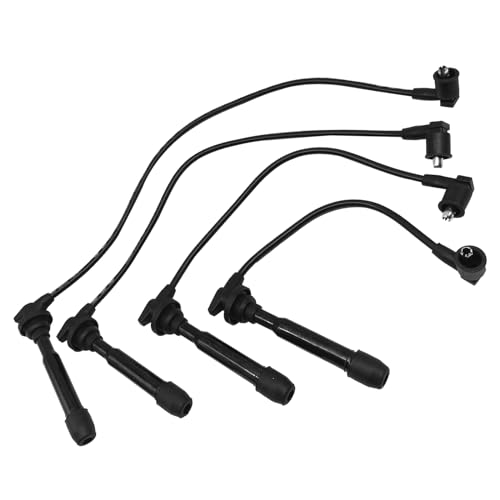
HYUNDAI Ignition Coil Extension Wire for Accent, Elantra, Forte, Soul

Frequently asked questions
Will a performance wire set add power to my Accent?
A healthy engine gains no meaningful power from a lower-resistance lead set, because the standard system already delivers a spark sufficient for complete combustion. What a good spiral-wound set can restore is the performance lost to aged, high-resistance or leaking leads, which can feel like a gain because the misfire and hesitation disappear. Judge the purchase as maintenance and durability, and any claim beyond that should be treated as marketing rather than engineering.
Can I replace just the one faulty lead?
A single lead can be replaced where an exact match is available, and it is a reasonable emergency repair. As a lasting repair it usually disappoints, because the remaining leads share the failed lead’s age and heat history, and mixed sets complicate later resistance comparisons. Where one lead has failed from age rather than from a single external injury, the set is the honest unit of replacement.
How do I know whether my car is coil-on-plug?
Look at the top of the engine. Coil-on-plug cars carry an individual coil over each plug position, secured by a small bolt and connected by a low-voltage electrical plug, with no thick round ignition leads anywhere in view. Cars using a wire set show a coil pack or distributor with thick leads, roughly 7 or 8 mm across, running in a managed row to each plug position. The distinction takes one look and decides the entire question.
Should resistance readings match exactly across all four leads?
No. Longer leads read higher total resistance because they contain more conductor, so readings should be compared per unit of length or against the specification for each lead. The healthy pattern is proportionate consistency. One lead reading far above its length-adjusted companions, reading open circuit, or changing value when flexed gently is the lead that has failed.
Does lead diameter change how the engine runs?
Diameter by itself changes nothing electrically, because the conductor inside a 7 mm and an 8 mm lead may be identical while the insulation around it differs. What the larger construction can offer is better protection against chafing, heat and leakage over a long service life, provided the thicker leads sit properly in the factory clips and separators. If an 8 mm set must be forced into clips shaped for 7 mm leads, pinched, or rerouted away from its intended path to make it fit, the supposed advantage has been spent on the installation. Judge diameter as a durability and fitment question, never as a performance promise, and choose the size the car’s loom was designed to hold unless the set supplies its own correctly sized separators.
Why did my misfire continue after fitting new leads?
Leads are one suspect among several. Worn or incorrectly gapped plugs, a failing coil pack, oil in the plug wells, an injector fault or low compression on the affected cylinder can each produce the same code and the same stumble. Routing errors, including leads bundled tightly together or connected in the wrong order after a full removal, can also create a new misfire on top of the old one. Work back through connections, routing, plug condition and coil checks in that order before condemning the new set.
Fit the set that matches the engine in front of you, route it the way the factory did, and an Accent that stumbled under load will pull cleanly again in the unglamorous way that well-kept ignition systems always have.


