Our Top Picks


What's inside
- What Makes KRK a Distinct Studio-Monitor Line
- Rokit Generations: G3 Switches, G4 DSP and G5 Voicing Modes
- Woofer Sizes From 5 to 10 Inches and Low-Frequency Extension
- Bi-Amplified Class-D Power and Headroom at Desk Distances
- Front Port, Foam Plug and Near-Wall Placement
- DSP Room Correction, Boundary Switches and What DSP Cannot Fix
- The Rokit 10-3 Three-Way Midfield as the Line Ceiling
- Connectivity, Balanced Lines and Gain Staging From an Interface
- Pairing a KRK S-Series Subwoofer and Setting the Crossover
- Isolation, Decoupling and Desk Reflections
- Choosing a Size by Room Dimensions and Listening Distance
- Check prices on Amazon
- Common Buzz, Hiss and Failure Points and What to Check
As an Amazon Associate I earn from qualifying purchases. This post may contain affiliate links at no extra cost to you.
What Makes KRK a Distinct Studio-Monitor Line
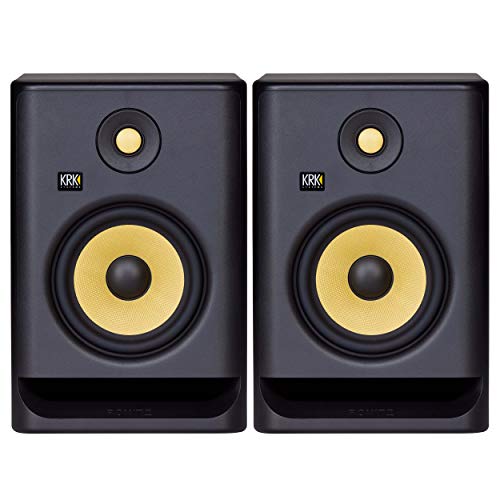
KRK occupies a recognisable corner of the nearfield market because the design language has stayed consistent across decades: a yellow woven woofer cone, a rounded front baffle, and a front-firing slot port that lets the cabinet sit closer to a wall than a rear-ported rival would tolerate. The woofer material is an aramid fibre composite, marketed as Kevlar, chosen for stiffness at low mass so the cone moves as a piston through its working band rather than breaking up early. That stiffness matters most on kick drums, bass guitar transients and synth fundamentals, where a flexing cone smears attack into a soft bloom.
The tweeter story splits by generation. Earlier Rokit models used a soft-dome tweeter with a slightly forward presentation that many beat makers liked for hearing vocal sibilance and hi-hat detail at low volume. Later generations moved to more controlled waveguide geometry and DSP-managed crossover behaviour, flattening some of that forwardness while keeping the low-mid weight that gives the line its reputation. Neither character is neutral in an absolute sense, and the spec sheet frequency figures should be read as a starting point rather than a promise about any particular room.
Readers should know how this guide is funded: some links in this guide may earn the publisher a commission when readers buy through them at no added cost to the reader, and that arrangement does not change the order in which products are discussed or the judgements offered about them.
Every current Rokit and Classic model is an active, bi-amplified design except where a system is explicitly described otherwise, which means the amplifiers, crossover and protection live inside the cabinet. That integration removes amplifier matching from the buying decision but adds heat, idle noise and service considerations that passive systems handle differently. For readers comparing powered and unpowered approaches, the guide at best 2 0 passive speakers explains the external-amplifier route in detail.
The G5 voicing selector changes filter targets in the digital domain, so the same cabinet can present a flatter mix curve or a mid-focused check without any hardware swap. A 5-inch woofer in a compact Rokit cabinet typically works with a port tuned to support output into the low fifties of hertz before the roll-off steepens sharply. Cone excursion doubles for each octave lower at equal level, which is why a small woofer sounds strained on sub-heavy material long before its amplifier runs out of headline wattage. The yellow colour of the aramid cone is a by-product of the fibre itself, and KRK turned that manufacturing trait into the most recognisable visual identity in budget nearfields. Boundary gain from a single nearby wall can add several decibels of low-frequency energy, and a corner placement adds the influence of a second and third boundary on top of that. Those details explain why placement and gain decisions usually change the perceived quality of this line more than swapping between adjacent woofer sizes in the same untreated room.
A podcast editor in a 15 square metre project studio cares less about extension than about consistency, and a 8-inch KRK at 1.2 metres earns trust when every episode sounds alike, with plosives, room tone and sibilance judged against the same stable reference day after day.
Remixing older recordings in a 15 square metre project studio tests a 8-inch monitor differently, because the source material carries tape hiss and limited bandwidth, and at 1.6 metres the system should present those limits plainly without adding harshness of its own near 300 hertz.
Translation to car playback is the test most home producers care about, and a 10-inch three-way KRK in a loft room under sloped eaves that is placed symmetrically will usually predict car balance well at 1.4 metres, while an asymmetrically placed pair sends its owner back to the desk after every drive.
Rokit Generations: G3 Switches, G4 DSP and G5 Voicing Modes
The third-generation Rokit, usually shortened to G3, belongs to the analogue era of the line. High-frequency and low-frequency level switches on the rear panel offered coarse steps, typically a few decibels up or down, and the user judged the result entirely by ear. There was no display, no app and no memory for presets, which made setup simple and repeatable only if the switch positions were noted. Many G3 cabinets remain in bedrooms and project rooms because the amplifier and driver package was durable and the control set never depended on firmware.
Generation four changed the control philosophy completely. A rear LCD shows a visual equaliser, a DSP engine provides room-tuning presets and boundary compensation, and a companion phone application helps place the speakers and suggest settings by analysing the room layout the user enters. The G4 also introduced a more rigid cabinet, a redesigned port and matching Kevlar tweeters in some sizes, moving the line toward a flatter reference intent. Owners report that the DSP presets are most useful for taming desk and wall reinforcement rather than for creating a preferred tonal flavour.
Generation five keeps the DSP foundation and reorganises it around three voicing modes that change the overall response target. Mix mode aims for the flattest available curve for editing and balancing decisions. Create mode lifts musical energy for writing and tracking sessions where inspiration matters more than forensic accuracy. Focus mode emphasises the midrange band where vocals, guitars and dialogue intelligibility live, making it useful for checking how a mix translates to smaller playback systems. Switching modes does not change the driver, port or amplifier; it changes the digital filter set applied before conversion.
The Classic line is the deliberate non-DSP branch. Classic models revive the earlier Rokit voicing with analogue controls, a simpler signal path and no screen, aimed at buyers who distrust app pairing or who already own measurement tools and outboard correction. The Classic 5, 7 and 8 sizes mirror the familiar woofer steps, and the flat-versus-vintage style voicing switch on some Classic variants acknowledges openly that many buyers want the older, weightier presentation for production work and a flatter option for mixing.
A listening triangle with sides near 1.1 metres places the Rokit 5 in its intended nearfield role, where direct sound dominates reflected sound at the ears. The LCD equaliser display on G4 models shows the curve being applied, which helps a user return to a known preset after experimenting with a different room layout. App-based placement guidance cannot hear the room by itself; it reasons from dimensions and positions the user enters, so honest measurements produce more useful suggestions. Classic models keep a continuously variable approach to some controls where the DSP models offer stepped presets, and some engineers prefer the finer analogue adjustment for high-frequency trim. A three-way layout lets the midrange driver operate in a sealed or separately enclosed space, protecting vocal clarity from the pressure swings the large woofer creates inside a shared cabinet. That pattern repeats across the range, since the hardware provides a capable baseline while the room decides how much of that capability reaches the listener in a usable form.
When a rectangular living-room studio doubles as a bedroom, the monitors share space with a wardrobe and a bed, and a 10-inch three-way pair heard from 1.4 metres benefits from that soft furnishing, which quietly absorbs reflections that a bare studio would need panels to control.
Dance music checked in a rectangular living-room studio at 0.9 metres will find the boundary of a 10-inch three-way cabinet quickly on sustained sub lines, and the producer who recognises that boundary early reaches for arrangement changes rather than equaliser boosts the room cannot support.
Streaming loudness targets have changed mixing habits, but they have not changed acoustics: a 5-inch monitor in a basement room with concrete walls still needs a stable level reference at 1.6 metres, because loudness decisions made at drifting playback levels produce masters whose balance shifts with every platform normalisation.
Woofer Sizes From 5 to 10 Inches and Low-Frequency Extension
Cabinet volume and woofer diameter together set the practical low-frequency limit far more than any equaliser can. A 5-inch Rokit works comfortably down to the region around fifty hertz in a small room, which covers the fundamental of a standard-tuned bass guitar top strings and most kick drum weight, but the lowest octave of electronic music will be suggested rather than reproduced. The 7-inch model gains cabinet volume and cone area, extending usable output a little lower with less cone excursion for the same level, which reduces distortion on sustained bass notes.
The 8-inch model is the largest two-way in the regular range and suits rooms where the listener sits farther back or works at higher monitoring levels. Its advantage is not only extension but headroom: a bigger cone moves more air per millimetre of travel, so intermodulation between bass and midrange content falls. The trade is size on the desk, stronger desk reflection from a larger baffle, and more energy into room modes that a small bedroom cannot absorb. Bigger is only better when the room and the listening distance can support it.
Port tuning interacts with woofer size in a way headline frequency figures hide. A port extends output near its tuning frequency and then rolls off steeply below it, and boosting equalisation below that point wastes amplifier power and excursion without producing useful sound. The front slot port on KRK cabinets also produces some midrange leakage and port noise at extreme levels, audible as chuffing on sine-like sub content. Keeping playback level moderate protects both accuracy and the port behaviour the design intends.
Rotating the midrange and tweeter plate on the 10-3 keeps the acoustic centres aligned when the cabinet is laid horizontally beneath a large video display. Balanced TRS and XLR carry the same electrical signal format in this context; the choice between them is about connector durability and what the interface already provides. Input sensitivity markings on the rear panel are relative rather than absolute, so matching a pair by identical dial position matters more than the printed number beside the control. A monitor controller with a dedicated subwoofer mute makes comparison checks faster, because the listener can hear the mains alone without reaching behind the subwoofer cabinet. Crossover frequencies near eighty hertz keep localisation cues in the main monitors while still relieving a 5-inch woofer of the octave where its excursion demand rises fastest. For a buyer, the practical lesson is to budget attention as carefully as money, spending setup effort on symmetry, height and level before judging whether a different model is required.
Film dialogue work in a loft room under sloped eaves exposes midrange behaviour first, so a 5-inch monitor at 1.6 metres should be judged on speech clarity through quiet scenes, where a lift or dip near 2.4 kilohertz changes how believable a whispered line feels against background music.
Audiobook production in a loft room under sloped eaves runs for hours at modest level, so a 5-inch monitor at 1.0 metre must avoid listener fatigue, since a fatiguing presentation tempts editors to dull recordings that were actually balanced correctly at the start of the shift.
Second-hand G3 cabinets remain common in a 9 square metre bedroom context because the analogue design ages gracefully, and a buyer checking one at 0.9 metres should listen for matched output between the pair, quiet controls and ports free of damage rather than pursuing cosmetic perfection.
Bi-Amplified Class-D Power and Headroom at Desk Distances
Bi-amplification gives the woofer and tweeter separate amplifier channels with an active crossover before the power stages, so a loud bass transient cannot starve the tweeter channel or modulate its supply. Published power figures rise with woofer size, with smaller models splitting modest wattage unevenly toward the woofer and flagship sizes offering substantially more total output. Those numbers describe short-term capability into the fitted drivers, not a universal loudness score that can be compared directly with a passive speaker and a separate amplifier.
At a typical desk distance between 0.8 and 1.5 metres, even the 5-inch model can produce levels well beyond safe long-session listening, which reframes the power question. Headroom matters less for sheer volume and more for clean peaks: a snare hit or a film-effects transient should pass without the limiter engaging, because limiter activity changes tonal balance moment to moment. Choosing one size up mainly buys that peak cleanliness at a given distance, plus lower distortion at the same average level.
Maximum sound-pressure figures quoted per pair at one metre should be read alongside distortion limits and the frequency at which they were measured. A monitor that reaches a headline level only with rising distortion will feel harsh long before it feels loud. Buyers comparing amplifier output across brands may also find the category view at best 100 watt studio monitors useful, and readers who need genuinely high levels for larger rooms should compare the powered options in best 10 inch powered speakers alongside the three-way KRK flagship discussed later in this guide.
Foam isolation pads compress over years of cabinet weight, gradually changing the tilt angle they originally provided, so tweeter aim should be rechecked when pads are replaced. Metal stands filled with dry sand or shot gain mass that resists rocking and lowers the resonance of the stand structure itself, an old studio practice that still works in home rooms. Desk reflections create a comb pattern whose first notch often falls in the low-midrange, the region that decides whether a voice recording sounds chesty or thin. Room modes are determined by dimensions alone, so two rooms with identical monitors and different lengths will disagree about which bass notes sound exaggerated. A ceiling cloud above the listening position targets the reflection that many home setups ignore, even though the ceiling is often the closest untreated surface after the desk. Experienced owners change one variable at a time and live with the result across familiar recordings, because instant comparisons exaggerate differences that long listening reveals as minor.
A beat maker in a basement room with concrete walls will push a 7-inch cabinet harder than most, pursuing kick weight at 0.9 metres, and the honest limit arrives when the port begins to complain or the limiter trims peaks, signalling that a subwoofer, not more level, is the next step.
A home cinema corner built in a basement room with concrete walls asks a 7-inch KRK pair to handle dialogue and effects from 1.2 metres, a role where centre clarity matters more than stereo width and where the front port helps because the cabinets sit close to the screen wall.
Newer DSP models in a 12 square metre spare room reward owners who save their settings and label them by layout, since a desk that moves between recording and video work may need two stored curves, and a 8-inch pair at 1.0 metre can serve both if the presets are treated as part of the furniture plan.
Front Port, Foam Plug and Near-Wall Placement
A front-firing port changes placement politics. Rear-ported monitors need clearance behind the cabinet so the port can breathe and so reflected energy does not reinforce bass unpredictably; a front port exhausts into the room in the same direction as the woofer, allowing the back panel to sit within centimetres of a wall. That freedom is why KRK cabinets appear on so many desks pushed against bedroom walls. The port does not remove boundary reinforcement, however, because the woofer itself still radiates low frequencies in all directions at wavelengths far larger than the cabinet.
Some owners use foam bungs or the supplied plugs to partially close the port when a cabinet must sit in a corner. Plugging lowers port output, raises the effective roll-off point and can tighten an obviously boomy balance, at the cost of maximum low-level output. It is a physical change to the tuning, not a subtle tweak, so it should be applied to both cabinets identically and judged on familiar programme material over several days rather than on a single bass-heavy track.
Distance to the side walls matters as much as distance to the front wall. Asymmetric placement, with one monitor near a side wall and the other in open space, skews stereo imaging because the closer boundary reinforces one channel. Centring the desk along the wall, keeping both cabinets equidistant from side boundaries, and matching their heights so both tweeters aim at the same ear position will improve imaging more reliably than any rear-panel switch.
Thermal protection circuits reduce output or shut a channel down before heat damages the amplifier, and repeated thermal events shorten component life even when no fault is ever diagnosed. Port noise becomes more likely when equalisation boosts content below tuning, because the woofer unloads there and air velocity through the slot rises without producing useful output. The front slot port also acts as a convenient visual check: dust accumulation patterns around the slot reveal how hard a small cabinet has been working in a dusty room. Stereo imaging depends on matched cabinets, so a pair should be bought as a pair and any replacement should be checked against the surviving monitor on mono programme material. Mono compatibility checks on a single KRK reveal crossover and placement problems quickly, because comb filtering that stereo masks becomes obvious when both channels sum. None of those behaviours makes the monitors unsuitable for serious work; they define the conditions under which the published design intent and the lived listening experience finally agree with each other.
Tracking guitars in a 9 square metre bedroom means the player sits beside the engineer, off the central axis, and a 8-inch pair at 1.0 metre with even dispersion keeps the recorded tone recognisable to both listeners instead of flattering only the person in the middle chair.
Sampling work in a 9 square metre bedroom involves short fragments played repeatedly, and a 8-inch monitor heard from 1.4 metres helps the producer judge whether a loop clicks, breathes or carries unwanted rumble before it is committed to a library of sounds.
Acoustic panels are often bought before monitors are understood, yet in a 15 square metre project studio the smarter order is placement first, level second and treatment third, because a 10-inch three-way system at 1.2 metres may already be balanced once symmetry and tweeter height are corrected.
DSP Room Correction, Boundary Switches and What DSP Cannot Fix
DSP correction in the G4 and G5 works on the signal, which means it can shape steady-state frequency balance at the listening position within the range the drivers can deliver. It is effective against broad low-frequency lift from wall proximity and against a persistent tonal tilt. It cannot create output below the port tuning, cannot widen a narrow cabinet’s dispersion, and cannot remove reflections that arrive a few milliseconds after the direct sound, because those reflections are time-domain events that equalisation of the direct signal does not cancel.
Desk bounce is the clearest example. Sound from the woofer strikes the desk surface and reflects upward, combining with the direct sound to carve a notch whose frequency depends on the geometry. Moving the monitor, angling it, raising it on stands behind the desk or placing absorptive material on the reflection point changes the geometry itself. A DSP notch filter aimed at the measured dip would need to boost energy into a cancellation, which wastes headroom and works at only one exact ear position.
First reflections from side walls and ceiling behave similarly. Thin foam panels at the mirror points, a rug between desk and floor in a hard room, and curtains over a window behind the listener all reduce reflection level before it reaches the ears. Physical treatment and DSP are therefore partners rather than substitutes: treatment handles time and direction, DSP handles broad tonal balance, and careful placement handles the boundary gains that neither should be asked to fight alone.
Analogue boundary switches on G3 and Classic models do less, but what they do is predictable. A low-frequency shelf cut of a couple of decibels compensates for wall loading in a broad, musical way, and a high-frequency trim compensates for a very live or very dead room. Because the steps are coarse and fixed, they encourage a set-and-forget approach that many small-room owners honestly prefer to a menu of presets they revisit after every session.
Dialogue editors often favour the Focus-style midrange emphasis for checking intelligibility, then return to the flattest mode before making final level decisions. Low-volume listening changes perceived balance because human hearing loses low and high sensitivity at quiet levels, a reason experienced engineers check mixes at several playback levels. The Classic voicing appeals to producers who learned on earlier Rokit generations and have years of translation experience tied to that familiar low-mid weight. A subwoofer placed against the front wall between the monitors usually integrates more predictably than one tucked into a corner, where boundary gain inflates its output unevenly. Time alignment between subwoofer and mains is affected by physical distance, so moving a subwoofer forward or backward by tens of centimetres can change the crossover blend measurably. Judged over weeks rather than minutes, small placement corrections compound into a steadier stereo image, fewer surprises on other playback systems and mixes that need less revision.
Mastering singles in a 12 square metre spare room is unforgiving work for a 10-inch three-way nearfield, because at 1.2 metres small tonal decisions become the product, and any desk reflection colouring the region near 120 hertz will be written permanently into every release the room produces.
Choral recordings edited in a 12 square metre spare room reveal imaging faults mercilessly, because a 10-inch three-way pair at 1.6 metres must hold a wide ensemble steady without letting the nearest wall pull the whole choir toward one loudspeaker on quiet entries.
A 5-inch pair used for teaching in a rectangular living-room studio must survive many hands and many opinions, and at 1.4 metres its forgiving character keeps student mixes intelligible even when the material ranges from spoken word exercises to dense electronic productions in a single afternoon.
The Rokit 10-3 Three-Way Midfield as the Line Ceiling
The Rokit 10-3 stands apart from the two-way range by adding a dedicated midrange driver and a 10-inch woofer in a much larger cabinet that can be oriented with the midrange and tweeter plate rotated for vertical or horizontal placement. Separating the midrange from the woofer removes the hardest compromise in a two-way design, where one cone must reproduce deep bass and the vocal band simultaneously. The result is cleaner dialogue, more stable imaging on dense arrangements and substantially greater output capability.
That capability comes with placement demands the smaller models forgive. The 10-3 is a midfield monitor intended for distances beyond a typical desk, ideally on stands in a room that can support its low-frequency output. Placed on a desk at arm’s length, its drivers may not integrate into a single coherent wavefront at the ears, and its bass output will excite every mode a small room possesses. It is the ceiling of the line in performance and in the seriousness of room it expects.
Studios that outgrow two-way nearfields sometimes keep the smaller pair for close checks and add the three-way as the main system, a division of labour that mirrors larger facilities. Readers weighing very large cabinets against alternatives can also review best 15 inch passive speakers for the passive high-output approach, while remembering that amplifier matching and crossover design then become separate decisions.
RCA inputs on a monitor that also offers balanced inputs share the same amplifier path after the input stage, so sound quality differences come from noise pickup rather than from a different amplifier. USB audio interfaces with balanced main outputs are the natural partner for this line, and their monitor level knob becomes the single daily volume control for the whole desk. Gain reduction from a built-in limiter is inaudible on brief peaks when the system is sized correctly, but constant limiter activity on music programme indicates the room needs a larger system or lower level. Waveguide shape around the tweeter controls how evenly high frequencies spread across the room, influencing how much side-wall reflection energy the tweeter produces. A wider waveguide dispersion helps collaborators sitting beside the engineer hear a similar balance, at the cost of sending more energy toward untreated side walls. The same reasoning applies when a pair is moved to a new address, because the settings that suited the previous room describe that room, not a permanent property of the cabinets themselves.
A student room of modest size, specifically a 15 square metre project studio, suits a 5-inch cabinet precisely because restraint fits the space, and from 1.4 metres the direct sound arrives before the walls have much chance to argue with it on ordinary programme material.
A jazz trio mix in a 15 square metre project studio depends on ride cymbal and double bass coexisting, so a 5-inch cabinet at 0.9 metres should be assessed on whether bass pitch stays readable under high-frequency detail rather than on either element heard in isolation.
Podcast networks standardising on one monitor for many small rooms often choose a 7-inch model, because editors moving between a loft room under sloped eaves and another studio hear a familiar balance at 1.6 metres and spend their attention on content rather than recalibrating their ears.
Connectivity, Balanced Lines and Gain Staging From an Interface
Rear panels across the modern range offer a combination XLR and quarter-inch TRS balanced input plus, on many models, an unbalanced RCA input. Balanced connection from an audio interface rejects interference picked up along the cable run because the receiving circuit responds to the difference between two conductors rather than to either one alone. In a desk environment full of USB cables, monitor power supplies and LED lighting, that rejection is the single most effective defence against whine that changes pitch when the mouse moves.
Gain staging should be set so the interface output control has a useful working range. A practical method is to raise the monitor input sensitivity only as far as needed for a comfortable maximum level with the interface near the top of its normal range, then work downward from there. Running the monitors wide open and the interface output near its bottom makes every small adjustment coarse and maximises the audibility of the interface noise floor and the monitor idle hiss.
Unbalanced RCA runs should stay short and away from power bricks. They remain useful for connecting a DJ controller, a phone adapter or a secondary source for reference checks, but they should not be the main path in a setup that also offers balanced outputs. Using one input type at a time, and removing unused cables that can form loops between devices, keeps troubleshooting simple when a hum appears.
Cabinet edge rounding on the front baffle reduces diffraction effects that would otherwise create small response ripples as sound leaves the woofer and wraps around sharp corners. Rear-panel controls should be photographed after a successful setup, because a knocked switch discovered weeks later is otherwise almost impossible to identify as the cause of a changed balance. Measurement microphones at the listening position reveal room behaviour honestly, but a single measurement point should never drive narrow equaliser cuts that only apply to one exact head position. Averaging measurements across a small area around the listening position produces correction curves that remain useful when the listener shifts in the chair during a long session. Low-frequency decay time matters as much as level: a note that rings for half a second in a small room will blur bass lines even if its measured level looks correct. Where money is limited, that ordering of priorities protects the purchase, directing the next spend toward stands, isolation or treatment only when listening has shown which weakness matters most.
Voiceover recording in a rectangular living-room studio benefits when a 7-inch monitor stays quiet between takes, since from 1.6 metres any idle noise competes with the silence an editor is trying to judge in a recorded room tone during headphone-free playback checks.
Video editors in a rectangular living-room studio cut dialogue against music beds all day, and a 7-inch monitor at 1.0 metre that keeps speech forward without exaggerating sibilance reduces the number of revisions a client requests after hearing a draft on laptop speakers.
When budget is fixed, a 8-inch KRK plus stands and isolation in a basement room with concrete walls is a more complete purchase than a larger cabinet alone, since the accessories determine whether the listener at 0.9 metres hears the monitor that was designed or the desk that happens to hold it.
Pairing a KRK S-Series Subwoofer and Setting the Crossover
The KRK S-series subwoofers, including models built around 8, 10 and 12-inch drivers, exist to take the lowest octave away from the main monitors rather than to add indiscriminate rumble. Diverting deep bass relieves the nearfield woofers of long excursions, which cleans up their midrange, and it lets the subwoofer sit where the room responds most evenly instead of where stereo imaging demands the monitors stand. A single subwoofer can serve both channels because deep bass carries little directional information in small rooms.
Crossover setup decides whether the partnership is seamless. The subwoofer low-pass and the monitor high-pass, whether provided by the subwoofer outputs, the interface software or a monitor controller, should meet at a frequency the mains can reach comfortably, often in the region where the smaller monitors begin rolling off. Phase or polarity alignment at that crossover point matters more than the exact frequency chosen: a polarity error carves a hole exactly where kick and bass should combine.
Level matching by ear using familiar tracks, then verifying with a measurement microphone if one is available, beats trusting a dial position. The correct subwoofer level is the one where the system sounds like a single larger monitor; if a listener can point to the subwoofer during normal programme, it is probably too loud or crossed too high. Film and game work may justify a deliberately stronger low channel, but music mixing decisions made on an inflated bottom end will translate thinly elsewhere.
Bass traps in vertical corners attack decay rather than level, and they complement DSP precisely because equalisation alone cannot shorten how long a mode rings. The 7-inch size often represents the practical ceiling for desks that also hold a large display, a control surface and nearfield pair without crowding the work surface. Ultrawide displays push monitors wider apart or farther back, changing the stereo triangle, so screen upgrades should trigger a fresh placement check rather than being treated as a purely visual change. Angling monitors inward so their axes cross slightly behind the head widens the stable listening area, while axes crossing in front of the head narrows it to a single rigid position. Speaker cables matter little for active monitors, but the balanced signal cables and mains leads should still be dressed separately to reduce the chance of interference and accidental disconnection. Engineers who document their settings in a notebook kept beside the desk recover a working setup in minutes after a move, a clean or a borrowed-cabinet experiment has disturbed it.
An electronic producer working in a loft room under sloped eaves should audition a 8-inch pair with a sine sweep before trusting it, because from 0.9 metres the sweep exposes which low notes the room exaggerates and which it swallows, regardless of genre or taste.
An attic studio, described here as a loft room under sloped eaves, has sloped surfaces that scatter reflections unevenly, and a 8-inch pair at 1.2 metres may image better there than in a bare rectangular room because the ceiling refuses to return one strong, simple echo.
Long-term ownership in a 9 square metre bedroom also means dust, sunlight and the occasional knocked cabinet, and a 10-inch three-way pair at 1.0 metre that is checked twice a year for switch positions, cable condition and pad compression will sound the same in year three as it did in month one.
Isolation, Decoupling and Desk Reflections
A monitor sitting directly on a desk couples cabinet vibration into the desktop, which then radiates as a resonant surface and blurs low-mid clarity. Foam isolation pads, recycled-rubber pucks and purpose-built isolation stands all break that mechanical path to different degrees, and angled pads also help aim the tweeter toward ear height. The improvement is usually heard first as tighter kick drum decay and clearer bass guitar pitch rather than as more or less bass overall.
Speaker stands placed behind the desk solve several problems at once: they decouple the cabinet, remove the desk reflection from directly beneath the woofer, and allow the monitors to form a wider, more accurate triangle. Their cost is floor space and the need to manage cable runs safely. In rented rooms where stands are impractical, isolation pads plus a thick desk mat under the work area is a reasonable compromise that still addresses the strongest reflection path.
Tweeter height deserves the same attention as isolation. When the tweeter sits well below or above the ears, the vertical off-axis response of the crossover region changes what the listener hears, often as a hollow or overly bright character that no equaliser setting quite resolves. Raising the cabinets so the acoustic axis points at the ears, or tilting them accurately when raising is impossible, is a free correction that should precede any DSP preset change.
A dedicated mains strip for the audio chain, separate from chargers and desk lamps with dimmers, removes several common sources of buzz before any diagnostic work begins. Dimmer switches and cheap LED supplies inject noise into building wiring that balanced lines reject well but unbalanced RCA runs collect readily along even short distances. Owners who hear pitch-varying whine that follows graphics activity on the computer are hearing a ground and shielding problem in the source path, not a characteristic of the monitor itself. Checking a suspect monitor with a phone and a simple adapter cable, entirely disconnected from the computer, isolates the cabinet from the rest of the chain in under a minute. Long sessions at high level in a small room fatigue hearing quickly, and decisions made with fatigued ears tend to overcorrect brightness, which is why level discipline is also an accuracy tool. Ultimately the line rewards methodical owners, since its controls, ports and voicings all respond predictably when each change is made deliberately and auditioned on material the listener knows deeply.
Classical editing in a basement room with concrete walls places a premium on decay, and a 10-inch three-way monitor at 1.0 metre reveals whether hall reverberation in a recording ends naturally or is being lengthened by the listening room adding its own tail to every quiet passage.
Finally, a spare-room setup in a basement room with concrete walls shared with storage boxes gains accidental absorption from its clutter, and a 10-inch three-way monitor at 1.4 metres often sounds calmer there than specifications alone would predict, provided the boxes are arranged symmetrically on both sides.
Choosing a Size by Room Dimensions and Listening Distance
Small rooms under roughly ten square metres, with listening distances near one metre, suit the 5-inch model and reward the money saved being spent on isolation, stands or basic treatment. The 7-inch model is the natural middle choice for rooms where the desk can sit a little farther from the wall and the listener works around 1.2 metres back, offering a fuller low end without the room pressure of the largest cabinet. The 8-inch model earns its place when distance approaches 1.5 metres or when electronic genres demand sustained low-frequency level.
Room shape modifies those rules. A square room stacks its axial modes at identical frequencies, exaggerating boom at specific notes, while a rectangular room spreads them. A long room lets the listener sit farther from boundaries and often flatters a larger monitor. Ceiling height matters too, because a low ceiling strengthens the floor-ceiling mode and the reflection from above the listening position.
Volume habits are the final filter. Editors working quietly on dialogue, podcasts and acoustic music rarely need the output of the larger sizes, and a smaller cabinet at modest level will sound clearer in an untreated room than a large one exciting every boundary. Producers of dance music who monitor loudly for short checks can justify the opposite choice, provided they also budget for the treatment that keeps that energy intelligible.
Consider a 9 square metre bedroom where the desk faces a window: daylight tempts the listener to push a 5-inch pair wide apart, yet from 0.9 metres the image holds together only when the cabinets toe in enough that a centred vocal stays put while a panned guitar moves smoothly across the stage without jumping at the edges.
Game audio work in a 9 square metre bedroom mixes dialogue, effects and music in one session, so a 5-inch system heard from 1.2 metres must stay coherent when a footsteps layer sits far below a score, without the low end masking small details.
Renting a room for a weekend of mixing teaches more about this line than a showroom visit, because a 7-inch pair must be carried, placed, calibrated and trusted quickly, and from 1.0 metre in an unfamiliar space the controls that prove easiest to set accurately are the ones an owner will actually use correctly at home.
Check prices on Amazon
Live listings for the shortlist in this guide are pulled from Amazon below, so prices and availability are always current at the moment you look.



Common Buzz, Hiss and Failure Points and What to Check
Ground-loop hum usually announces itself as a steady low tone that appears when two mains-powered devices connect through both audio cables and building wiring. The diagnostic path is methodical: disconnect inputs one at a time, power all audio gear from a single outlet strip where possible, switch to balanced cables, and never defeat a safety earth pin as a shortcut. A hum that changes when USB devices are unplugged points to a computer ground path rather than to a faulty monitor.
Idle hiss at very close range is a class behaviour of many active monitors, set by the sensitivity of the input stage and the efficiency of the tweeter. It should be inaudible at the normal listening position in a quiet room once gain staging is sensible. Hiss that is loud at one metre, hiss in only one cabinet, or hiss accompanied by crackling suggests a fault, a damaged cable or an input gain set far beyond what the source requires.
Intermittent crackle, channel dropouts and distortion at modest levels often trace to simpler causes than driver failure: an oxidised connector, a combo jack worn by frequent swapping, a cable crushed by a desk leg, or a limiter being driven by excessive low-frequency content below the port tuning. Swapping left and right cables at the interface end quickly separates a monitor fault from a source fault, because the symptom either follows the cabinet or follows the channel.
Heat and ventilation close the checklist. Class-D stages run cooler than older designs, but the rear panel still needs air, and a cabinet pushed into soft furnishings or sealed cabinetry will age its electronics faster. A monitor that shuts down after long loud sessions and recovers when cool is describing thermal protection, and the remedy is space and level discipline rather than a replacement purchase made in frustration.
In a 12 square metre spare room, late-night sessions at low level reveal a 7-inch cabinet honestly, because at 1.0 metre the room contributes little masking and any port emphasis around 120 hertz stands out on acoustic bass lines that would be forgiven at full afternoon volume.
A songwriter in a 12 square metre spare room often works with a guitar in hand and one ear off-axis, making a 7-inch pair at 1.4 metres with forgiving vertical dispersion more useful than a technically flatter cabinet that only sounds right in one rigid posture.
Headphone cross-checks complement monitors in a rectangular living-room studio, yet they cannot replace the shared reference a 8-inch pair provides at 1.2 metres when two people must agree on a vocal level, and agreement between collaborators is ultimately what a studio monitor is purchased to create.
A further placement detail separates careful setups from casual ones: the distance from each monitor to the wall behind it should match within a centimetre or two, because unequal boundary distances give each channel a different low-frequency lift and the stereo image then leans toward the reinforced side on bass-heavy passages, even when the balance control and the input gains are set identically on both cabinets.
Session routine matters as well, since a listener who always begins work at the same moderate playback level builds a stable internal reference for vocal level and low-end weight, whereas a listener who starts loudly on Monday and quietly on Tuesday will keep revising decisions that were actually consistent, blaming the monitors for a moving reference that lives entirely in daily habit.
Cable dressing behind a desk of KRK cabinets deserves a final mention, because balanced leads that hang in tidy loops away from wall adapters and computer power bricks stay quiet for years, while leads draped across hot supplies and fan exhausts slowly collect the buzzes and intermittent crackles that owners later misattribute to ageing drivers or failing amplifier modules.
Finally, consider the upgrade path honestly: a well-placed 5-inch pair with a correctly integrated subwoofer often outperforms a poorly placed 8-inch pair in the same room, and the money difference spent on stands, isolation and a few absorptive panels keeps paying off when the monitors themselves are eventually replaced by the next generation of the line.
Room size also decides how forgiving the sweet spot feels during collaborative work, because a producer and an artist sharing a small desk will sit off-axis in turn, and a cabinet whose tweeter dispersion stays even a little to each side keeps vocal balance recognisable for both listeners instead of reserving every accurate judgement for the single chair placed exactly on the centre line.
When a pair is first installed, a week of ordinary listening before any correction is applied teaches the ears what the room itself contributes, separating cabinet character from boundary effects far more reliably than immediate equalisation, which tends to bake first impressions into settings that later need to be undone once familiar recordings have revealed the real balance.
One last practical check before money changes hands: play a familiar voice recording, a solo piano piece and a bass-led track in that order, note where each feels wrong, and only then touch a control, because that sequence separates midrange honesty, transient behaviour and low-frequency room gain into three judgements that a single favourite song always blurs together.
Keep a small notebook entry for every change made after the first week, dated and brief, because memory rewrites setup history quickly and the written record is what lets a good balance be recovered after holidays, moves or borrowed equipment.
For KRK buyers the deciding question is never which cabinet looks most impressive on a desk, but which size lets a particular room speak honestly at the distance you actually sit, and the pair that answers that question in your room is the right monitor.
Related guides
- Best 25–35 Inch Monitors With Lowest Display Lag: An Honest Ranking Without Invented Numbers
- Best 1440p 165Hz Monitors: One Native 165Hz Pick, Three 180Hz Upgrades, an Overclock Headline and a 160Hz Ultrawide
- Best 24 Inch Monitors
- Best Monitors for Gaming and Programming: One Screen for the Workday and the Win


