Our Top Picks


What's inside
As an Amazon Associate I earn from qualifying purchases. This post may contain affiliate links at no extra cost to you.
Reader support keeps this publication independent: a few outbound links in this article are affiliate links, and a purchase through one may return a small commission that helps fund future coverage. Recommendations here rest on published movement specifications, calibre documentation and long-running owner communities, and no commission arrangement promotes one reference above another.
1988 and the third way
In 1988 Seiko presented a watch that refused the era’s tidy categories. It was not a mechanical watch, because no mainspring stored its energy and no balance wheel divided its time. It was not an ordinary quartz watch either, because no disposable battery waited inside to die on a schedule. Shown first under the name Auto Quartz and renamed Kinetic shortly after, the design borrowed the self-winding rotor of an automatic and pointed it at a tiny generator instead of a barrel. Motion went in; electricity came out; a quartz oscillator kept the time.
The timing of the idea deserves attention. Quartz had spent two decades humiliating mechanical watchmaking on accuracy and price, yet it carried a quiet embarrassment: the battery, a consumable heart that stopped the watch without warning and demanded a case opening to replace. Mechanical watches, meanwhile, never needed feeding beyond the wrist itself. Kinetic was engineered as the reconciliation of those two virtues — the one-second discipline of quartz with the self-sufficiency of a watch that lives on its wearer’s movement.
The numbers behind the promise were striking for the period. A quartz oscillator vibrates 32,768 times per second and divides that frequency down to one pulse per second, holding accuracy that manufacturer literature typically expresses in seconds per month rather than per day. A conventional automatic of the same era was doing well to hold a handful of seconds daily. Kinetic offered the quartz figure — commonly quoted around plus or minus fifteen seconds a month for many calibres — without the battery-change appointments that quartz ownership usually implied.
There was also an environmental and practical argument that Seiko made explicitly in early material: fewer disposable cells entering the waste stream, and no periodic breaking of case seals for battery swaps. Every opening of a watch case is an opportunity for dust, moisture and a damaged gasket to enter the story. A watch that could run for years on stored motion promised longer intervals of undisturbed sealing, a benefit owners of water-resistant sport models appreciated more than the brochure language suggested.
The concept did not conquer the industry, and the reasons are instructive. Rival houses pursued solar charging, which needs no moving parts and feeds on light that is available even to a watch sitting on a dresser. Kinetic demanded the one resource a desk-bound owner might not supply: actual bodily motion, delivered regularly. The technology therefore settled into a devoted niche rather than the mainstream, kept alive by owners who liked the mechanical theatre of a rotor with the conscience of a quartz movement.
That niche status shapes everything about buying one today, especially in the Coutura line examined later in this guide. Production was always smaller than Seiko’s mainstream quartz output, reference knowledge lives largely in calibre databases and owner forums, and the ownership experience includes rituals — shaking a sleeping watch awake, watching a reserve hand climb — that no solar or battery watch replicates. Kinetic is best understood not as a compromise between two watch families but as a third family with its own temperament.
Readers arriving from the smartwatch side of the hobby sometimes ask why anyone accepts a watch that must be worn to live. The Kinetic answer is that the dependency is the point: the watch becomes a small ledger of its wearer’s activity, gaining charge on busy days and sleeping through idle ones. Those comparing against fully electronic alternatives will find the broader field mapped at best mens smartwatches; this guide stays with the rotor, the generator and the peculiar satisfactions of feeding a watch by moving through the world.
Anatomy of the system
Open the caseback of a Kinetic — in description, at least, since most are sealed against owner curiosity — and the layout begins with a familiar silhouette. A semicircular oscillating weight, the rotor, pivots at the movement’s centre and swings with every change in the wrist’s angle. In an automatic watch that rotor winds a spring through a reversing mechanism. Here it drives a pinion into a step-up gear train, multiplying its slow swings into very high rotational speeds at the far end of the train.
The multiplication involved is dramatic. Published movement documentation describes gearing ratios on the order of one hundred to one between rotor and generator rotor, so a lazy swing of the wrist spins the miniature generator thousands of times per minute. That generator is the heart of the system: a small rotor turning inside a coil, producing alternating current in bursts as the wearer moves. It is the same electromagnetic principle as a dynamo, executed at a scale where the moving parts are measured in fractions of millimetres.
Electricity from the coil passes to a rectifier and into storage. Early storage meant a capacitor-style cell, a subject the next section treats in full; modern Kinetic movements use a rechargeable lithium-ion cell engineered for shallow, frequent cycling. Between storage and timekeeping sits the integrated circuit, the movement’s quiet administrator. The IC meters charge into the cell, draws it back out to power the quartz oscillator and stepping motor, and watches the reserve so it can warn the wearer before the well runs dry.
One component earns a paragraph of its own: the stepping motor’s appetite when driving chronograph or large-hand layouts. Sport cases carry broad, lume-filled hands whose mass the motor must index every second, and that torque requirement is part of why chronograph Kinetic calibres specify their reserves more cautiously than slim three-hand movements. The generator does not care which calibre it feeds, but the calibre’s hands decide how quickly the banked charge is spent — a reminder that in this system, dial design is an electrical decision.
The timekeeping side is conventional quartz architecture, and deliberately so. The oscillator’s high-frequency signal is divided electronically to one pulse per second, and a stepping motor advances the gear train and hands in discrete ticks. That ticking second hand, so ordinary on a battery quartz watch, carries extra information on a Kinetic: its gait is the movement’s public health bulletin. A smooth one-second advance means the cell is content; the famous two-second stutter, examined in the calibre section, means the watch is asking to be fed.
Energy accounting explains why the generator must work so hard. A quartz circuit sips power, but the stepping motor’s pulses, and especially the torque needed to drive large sport-watch hands and chronograph complications, draw meaningful current across a day. The system is balanced so that ordinary active wear roughly matches consumption, with surplus banking into the reserve. Seiko’s own guidance from the Kinetic era suggested that a few hundred rotor oscillations — the yield of a brisk walk or a deliberate shaking session — could bank a day or more of running, depending on calibre.
What the anatomy lacks is as telling as what it contains. There is no mainspring to fatigue, no escapement to regulate, no balance staff to shock out of true. The wear items are the rechargeable cell, the rotor’s bearings and the ordinary seals and gaskets of the case. Maintenance therefore follows an electrical logic rather than a horological one, a distinction that returns in the service section. The movement is less a tiny machine for dividing time than a tiny power station with a clock attached.
Handling one makes the abstraction physical. The rotor is audible in a quiet room, a soft whir when the wrist flicks, and the watch has a faint mechanical looseness of feel that pure quartz cases never show. Owner reports describe this character as the line’s charm and its giveaway: a Kinetic announces its hybrid nature to the ear before the eye. It is machinery you can hear thinking about electricity.
The capacitor lesson
The first Kinetic generation stored its harvest in a capacitor, and the choice made early sense. Capacitors charge quickly, tolerate enormous numbers of cycles and matched the generator’s bursty output gracefully. What they could not do, in the sizes a watch case allows, was hold much. Early Auto Quartz and Kinetic references carried reserves measured in days — commonly around three to seven days when fully charged — which meant a watch left off the wrist for a long weekend plus a quiet week could be found stopped and discharged.
Time added a second problem. Capacitors age, and the units fitted in early-1990s production aged faster than owners expected, losing capacity until some watches would run only while being worn and die within hours of removal. The failure mode was confusing because the watch appeared healthy on the wrist, where the generator fed it directly. Owner communities of the period are full of the diagnostic puzzle: a Kinetic that keeps perfect time all day and is found stopped every morning is not haunted; its storage cell has simply forgotten how to store.
Seiko’s remedy was a change of chemistry. Later Kinetic movements adopted rechargeable lithium-ion cells with far greater energy density, stretching reserves from days into months and behaving more predictably across years of service. The retrofit story matters to collectors: service documentation and parts suppliers describe replacement rechargeable units for many early calibres, so a tired capacitor-era watch can often be revived with the newer cell type fitted during service. The movement’s identity stays original while its memory for electricity is quietly modernised.
For buyers of older Kinetic references today, the capacitor lesson becomes a checklist. Ask how long the watch runs off the wrist after a full charge, and treat evasive answers as data. A healthy modern cell should hold its specified reserve within reason; a watch that fades overnight is announcing a service bill in the near future. Factor that service into the purchase decision rather than discovering it during the first week of ownership, when the romance of the rotor collides with the arithmetic of a stopped watch.
There is a subtlety in charging behaviour that the chemistry change introduced. Lithium-ion cells prefer partial cycling and dislike being held at absolute empty, while the old capacitors tolerated deep discharge with less complaint. A Kinetic with a modern cell that has sat discharged in a drawer for years may have suffered quiet damage that a simple shaking session will not reverse. The kindest storage for any Kinetic, of any era, is a watch kept partly charged and occasionally worn — a point the ownership section develops into a full routine.
None of this history should frighten a buyer away from the early references, some of which carry the most interesting case designs of the line’s life. It should instead set the terms of engagement: vintage Kinetic ownership includes stewardship of an ageing electrical component, much as vintage mechanical ownership includes stewardship of an ageing mainspring. The watches reward owners who understand which century’s problems they have adopted. A stopped early Kinetic is rarely a dead watch; it is usually a watch asking for its one known remedy.
The industry’s broader memory of this episode explains why modern Kinetic specifications emphasise reserve so prominently. Every current calibre advertises its months of autonomy like a headline, a direct answer to the era when days were all the chemistry allowed. When the calibre map below lists reserves climbing toward six months, that figure is not mere abundance. It is the sound of a lesson learned in public, over a decade of owners finding their watches stopped on Monday mornings.
Calibre map
Seiko’s calibre numbering rewards a slow reading, because the Kinetic family tree is written in it. The 5M series formed the workhorse generation of the modern era: the 5M62 and its relatives are three-hand movements with date, found across everyday Kinetic models, while the 5M82, 5M84 and 5M85 branches add combinations of day, date and 24-hour or dual-time indication. These are the calibres a buyer is most likely to meet inside a Coutura or a period Kinetic diver, and parts and service knowledge for them is correspondingly deep.
Reserve is where the family differences become concrete. Early 5M-generation figures began around the familiar few-days territory of the capacitor years, then climbed as the lithium-ion cells arrived: many later 5M references specify reserves approaching six months from a full charge. The 5J series, a later and slimmer branch, trades some of that stamina for thinner case profiles, with published reserves commonly around three to four months depending on reference. Exact figures belong to the specific calibre sheet, and any seller’s listing should be checked against one.
The two-second warning is the family’s most elegant piece of communication. When the cell’s charge falls toward empty, Kinetic movements advance the second hand in two-second jumps instead of one-second steps. The watch keeps correct time while doing so; the stutter is purely a message, impossible to ignore and requiring no battery gauge, window or digital display. Owner manuals state the meaning plainly: the watch is running low and should be worn or shaken soon, before the reserve reaches the point where the hands stop altogether.
A word on nomenclature traps in listings: sellers often describe any Kinetic with a reserve indicator as Direct Drive, borrowing the flagship’s glamour for the button-check system of the 5M family. The distinction is mechanical, not verbal. Direct Drive generates charge from the crown; the button check only reports charge the rotor has already made. A listing that cannot show the retrograde hand should be priced as what it is, however handsome the watch, and the calibre sheet settles any argument the photographs start.
Charging behaviour also varies by calibre in ways worth knowing before purchase. Some references include a power-reserve indication, either through the button-activated check — press a pusher and the second hand swings forward by an amount corresponding to stored days — or through a dedicated subdial or hand on higher references. The button check is a small ceremony owners describe with genuine affection: five seconds of hand travel for a day or so of reserve, thirty seconds for the fullest months. It turns an invisible electrical quantity into theatre.
Kinetic chronograph calibres complicate the map pleasantly. The 7L22 and related chronograph movements pair the generator system with mechanical-feeling chronograph architecture, including a sweep motion on the chronograph seconds that battery quartz chronographs rarely match. Coutura’s chronograph references draw from this branch of the family, which is one reason the line feels different in the hand from ordinary quartz timers. The chronograph’s energy appetite is higher, and its reserve expectations should be set accordingly.
Documentation discipline is the buyer’s best tool here. Seiko publishes calibre instruction booklets that specify reserve, charging swing counts, accuracy and the meaning of the two-second gait for each movement, and independent movement databases mirror those sheets for discontinued references. Matching the calibre number engraved or printed for a specific watch against its sheet takes minutes and prevents the most common Kinetic disappointment: expecting six months from a calibre that only ever promised a season.
It also pays to remember that calibre and case age independently. A later production example of an older calibre may carry the improved rechargeable cell from the factory, while an early example carries its original storage with decades of cycles behind it. The calibre map tells a buyer what a movement should do when healthy. Judging whether a particular watch still does it is the work of the reserve-behaviour checks in the final section, and of the simple question every Kinetic seller should be able to answer: how long does it run, off the wrist, from full?
Direct Drive: the 7D family
At the top of the Kinetic tree sits the 7D family, known by its feature name: Direct Drive. The idea answers the oldest Kinetic complaint — that the only way to feed the watch was to wave it around — by giving the crown a second job. Turning the crown in Direct Drive models drives the generator directly, converting the wearer’s fingers into a charging source. The watch can be filled deliberately, at a desk, in a minute, without the undignified maraca performance that standard Kinetic revival requires.
The family’s signature is its retrograde power-reserve hand. As the crown turns, that hand climbs in real time, sweeping across a scale marked in days, weeks and months, so the wearer watches the reserve accumulate with each rotation. Few watch complications anywhere offer so literal a picture of energy entering a movement. When winding stops, the hand settles at the honest total. The display converts charging from an act of faith into a reading, and owners consistently cite it as the feature that justifies the family’s premium position.
Published figures for flagship 7D calibres, including the 7D46 and 7D48 branches, place full-charge reserve at approximately six months, with calendar complications that in some references extend to perpetual-calendar functionality programmed for many decades. Accuracy remains in the quartz register of seconds per month. The combination — half a year of autonomy, a calendar that minds itself, and a crown that refuels the whole system — makes Direct Drive the most self-sufficient analogue watch Seiko has produced under the Kinetic name.
The engineering beneath the theatre is more demanding than the standard system. The crown’s input must be geared into the generator without exposing the train to damage from enthusiastic winding, and the reserve indication must integrate the cell’s state continuously rather than estimate it from recent motion. Movement documentation describes the hand as showing both generated power during winding and stored reserve at rest, a dual role that required the IC and the indicator mechanism to share information constantly. Complexity of this kind is exactly what the price ladder’s top rung is for.
Direct Drive also changes the failure psychology of Kinetic ownership. A standard Kinetic found stopped demands a shaking session and patience before its health can be judged; a Direct Drive found stopped can be wound to a known reserve and observed against a definite expectation. Diagnosis becomes methodical. Collectors who maintain several Kinetic watches often keep a Direct Drive as the reference standard of the group, the one whose behaviour is never in doubt, against which the plainer calibres are compared.
Coutura’s relationship to the 7D family is one of aspiration and occasional residence: the line’s flagship Kinetic references have carried Direct Drive, while the broader Coutura range draws on the 5M and chronograph branches. A buyer specifically hunting a Coutura Direct Drive should verify the calibre from the caseback and the manual rather than from listing language, since the Kinetic badge alone spans the whole family tree. The retrograde hand on the dial is the quickest visual confirmation that the top of the tree is what is actually being offered.
There is a philosophical completeness to Direct Drive that explains its following. The original 1988 idea removed the battery but kept the wearer passive, harvesting whatever motion life happened to provide. Direct Drive hands the wearer the tap. The watch can be fed by living or fed by decision, and the little retrograde hand reports the state of the account either way. It is the fullest expression of the third way Seiko opened in 1988, and the natural summit from which to survey the Coutura line that follows.
Coutura as a line
Coutura is Seiko’s sport-luxury register: the collection where the brand’s technologies are dressed in integrated bracelets, sculpted cases and dial furniture with a distinctly architectural flavour. Within that wardrobe, Kinetic references occupy a particular shelf, pairing the motion-charged movements with the line’s boldest casework. A Coutura Kinetic is not a dress watch that happens to charge from movement, nor a tool watch in a suit; it is a statement case built around a power station, and it wears like one.
Case dimensions set the tone. Coutura Kinetic references cluster in the 42 to 45 millimetre band, with substantial lug-to-lug presence and the integrated bracelet flowing directly from the case flanks in the manner the line is known for. On the wrist the effect is broad and low rather than tall, though smaller wrists should expect the bracelet’s first links to stand proud before they curve. Published case specifications for individual references should be checked where fit is a concern, because the family spans several case generations.
Water resistance across the Kinetic Coutura references is commonly rated at 100 metres, a figure that suits swimming and daily weather without pretending to dive-watch credentials. Crowns and chronograph pushers on these references are typically not of the screw-down saturation-diving pattern, and the manuals counsel against operating pushers underwater. For a watch whose charging depends on being worn through ordinary active life, 100 metres is the honest rating: rain, pools and clumsy dishwashing are covered; the deep end is somebody else’s department.
Ownership demographics quietly shape the used market for Coutura. The line sold strongly to buyers who wore one watch daily for years — exactly the usage Kinetic thrives on — so surviving examples often show honest surface wear paired with healthy electrical systems, the reverse of the collector-market pattern. A scuffed Coutura Kinetic with a strong reserve is not a compromised example of the breed; it is the breed’s natural adult form, and pricing that punishes the scuffs while ignoring the reserve has the value equation upside down.
Cross-shoppers arriving from round-faced connected watches sometimes need the size translation stated plainly: a 44 millimetre Coutura wears its diameter honestly, with none of the lug-less compactness that makes a round smartwatch feel smaller than its specification. Readers still deciding between an analogue case of this scale and a connected one can compare the wearing experience against the field surveyed at best affordable round android smartwatches.
Materials show the line’s upward aim. Sapphire crystal appears on selected references, a meaningful upgrade over the proprietary hardened mineral glass fitted elsewhere in the range, and buyers should verify crystal type per reference rather than assuming it from the collection name. Dial work tends toward layered construction: applied indices, textured subdials on chronographs, and the reserve or retrograde displays integrated as design features rather than apologetic instruments. The Coutura dial treats the Kinetic system’s information as jewellery, which is precisely the line’s job.
The range divides broadly into chronograph references and three-hand references. The chronographs, drawing on the 7L-branch movements and their relatives, offer the sweep-motion timing hand and a busier, more technical dial. The three-hand models keep the dial calmer and let the case and bracelet carry the design, with date windows and, on Direct Drive flagships, the retrograde reserve display as the complications. Neither branch is the value choice in any simple sense; they are different answers to whether the wearer wants information or architecture in front of them all day.
Finishing and bracelet construction deserve the scrutiny a buyer would give any sport-luxury piece. The integrated bracelet’s links are typically solid, with a push-button deployment clasp, and the transition from brushed case flanks to polished bevels is where the line’s money is visibly spent. Because the bracelet is integrated, strap changes are limited compared with a standard lug design — an ownership fact worth accepting before purchase rather than resenting after it. Coutura asks its wearer to commit to the bracelet, and rewards the commitment with one of the more distinctive silhouettes in its class.
Set against Seiko’s wider catalogue, Coutura Kinetic occupies the crossing point of two minority tastes: buyers who want the brand’s engineering theatre and buyers who want its most dressed-up sport case. That double minority explains both the line’s devoted following and its patchy availability across years and markets. It also explains why good references surface irregularly on the secondary market, a hunting reality the final section addresses with specific checks.
Living with charge
Daily Kinetic life is governed by a simple energy budget. An active wearer — walking commutes, gesturing through meetings, cooking, typing with wrist movement, climbing stairs — deposits more charge across a day than the movement spends, and the reserve quietly tops itself toward full. A sedentary wearer deposits less. Neither experience is a defect; both are the design working as specified. The watch is a mirror held up to a lifestyle, and the first month of ownership is mostly the wearer learning what their own reflection looks like in hours of reserve.
Desk jobs are the stress test the forums talk about endlessly. A wrist parked on a desk from nine to five generates modest rotor activity, and owners in such roles describe two stable outcomes: those who walk at lunch and stay active in the evening hold charge comfortably, while those who drive both ways and sit all evening watch the reserve erode across weeks. The remedies are mundane — wear the watch on the dominant wrist, take the stairs, shake the watch deliberately while the kettle boils — and they work because the generator needs surprisingly little honest motion to break even.
Rotation is the collector’s version of the same problem, sharpened. A Kinetic kept in a box of six watches, worn one day a week, may never climb above the two-second warning, because a single day’s deposit cannot refill what six days of running withdrew from a partly charged start. Owners who rotate Kinetic pieces successfully tend to run a ritual: each watch gets a charging session — several hundred swings, or crown time on a Direct Drive — when it enters rotation, and the reserve check becomes part of the selection ceremony on the watch box’s open lid.
The weekend-watch paradox follows directly. A Kinetic bought for weekends begins Saturday at whatever charge Friday’s desk week left, spends two glorious active days gaining, then sits five days draining. If the cell started healthy and full, a modern calibre’s months of reserve makes the pattern trivial. If the watch is an older reference with a tired cell and a reserve of days, the pattern guarantees the two-second stutter by Thursday. The paradox is never about the weekends; it is about the arithmetic of the other five days.
Revival technique is worth stating properly, because manuals do. A stopped Kinetic is woken by swinging the watch gently in an arc, a few hundred times for a day or two of charge, with the rotor’s whir confirming the generator is turning. Violent shaking is unnecessary and unkind to the movement. Once the second hand moves, the watch should be worn for the day rather than admired and returned to the box, since body motion across hours banks charge far more efficiently than any wrist workout performed in a doorway.
Seasonal rhythms appear in long ownership too. Winter layers cushion the wrist and shorten the active day; summer short sleeves and holidays fill the account. Owners who log their reserve checks across a year describe a recognisable tide. None of this requires management so much as awareness: the Kinetic wearer develops a low-level sense of the watch’s state of charge the way a driver senses a fuel gauge, and the two-second warning, when it comes, arrives as a reminder rather than a surprise.
It is worth saying plainly that some temperaments will find all of this delightful and others will find it homework. The Kinetic contract trades the battery watch’s total indifference for a relationship with mild obligations. Readers who suspect they are the second temperament lose nothing by knowing it early; the comparison section below lays out the rival systems honestly. Readers of the first temperament, meanwhile, tend to describe the rituals in the vocabulary of care rather than chore — feeding, checking, winding — the language people use for things they keep alive on purpose.
Off-wrist charging
Every Kinetic owner eventually asks the drawer question: how does the watch charge when nobody is wearing it? The first answer is the dedicated accessory Seiko produced for the system, an induction-based Kinetic charger into which the watch is placed so that an electromagnetic field can drive the generator circuit without motion. These chargers were never common retail items, and today they circulate as sought-after accessories among committed Kinetic collectors, precisely because they solve the rotation problem at a stroke: a watch can be filled on the bench like a phone.
The second answer is a warning about the obvious substitute. A conventional automatic watch winder — the rotating box beloved of mechanical collectors — barely helps a Kinetic, and the physics explains why. A winder turns a watch slowly in a plane, which keeps a mainspring topped through gentle rotor drift. A Kinetic generator, however, needs rotor speed multiplied through its gear train to produce useful current, and the stately rotation of a winder delivers motion too slow and too smooth to generate meaningfully. Owners who park a Kinetic on a standard winder for a month reliably report a watch that is, at best, no worse.
Reports do circulate of high-speed or modified winders doing better, and of owners experimenting with everything from ceiling-fan mounting to metronome arms. The responsible summary is that the generator wants vigorous, irregular swinging of the kind a wrist provides naturally and machines provide awkwardly. A winder designed to imitate gentle gravity-fed winding is answering a mechanical question that the Kinetic never asked. The induction charger remains the only off-wrist method with the manufacturer’s own engineering behind it.
Direct Drive owners, predictably, hold the practical trump card. The crown turns charging into a two-minute manual task requiring no accessory at all, which is why multi-Kinetic households so often route their discipline through a flagship. For standard calibres, the honest off-wrist toolkit is the human arm: a deliberate swinging session of several hundred arcs banks days, and a week of sessions banks the season. The ritual is oddly meditative once accepted, and more than one owner describes it as the moment the collection gets inspected, wound, compared and enjoyed as a group.
Storage strategy completes the picture. A Kinetic stored for months should be stored charged, not empty, for the sake of the lithium-ion cell’s health, and ideally woken for a charging session every couple of months. A watch heading into a safe-deposit box for a year is, frankly, a watch that will be found stopped, and the owner should plan the revival — and possibly a cell health check — as part of the retrieval. Long storage is the one scenario where Kinetic’s living-off-motion design and modern battery chemistry argue with each other, and the cell loses.
Travel produces the cheerful inverse problem. A single Kinetic worn daily on an active trip charges itself so reliably that owners forget the subject entirely, which is the system’s best advertisement. It is the watches left at home that need the plan: charge before departure, or accept the revival ritual on return. Frequent travellers with collections often designate one Kinetic as the travel watch precisely because it is the only one whose fuel supply improves the longer the trip runs.
The off-wrist question, chased to its end, reveals the design’s centre of gravity. Kinetic was never meant to live in a box; every element of the system assumes a wrist as its natural habitat and treats absence as an exception to be managed. Owners who accept that premise find the management light. Owners who need a watch that thrives unattended should read the next sections carefully, because the rivals — solar above all — were designed from the first sketch for exactly that life.
Service and cell replacement
A Kinetic’s service story divides into the ordinary and the electrical. The ordinary side mirrors any quality quartz watch: gaskets age and should be renewed to protect the water resistance, the case and bracelet want seals and pins inspected, and the movement benefits from cleaning and lubrication of its gear train on a long cycle. Manufacturer guidance for quartz movements generally speaks in terms of years rather than annual appointments, and Kinetic ownership honours that relaxed rhythm as long as the watch is running to specification.
The electrical side centres on the rechargeable cell. Even lithium-ion units have a finite cycle life, and a Kinetic cell that once held months may, after many years, hold weeks and then days. The diagnostic signature is distinctive and has been described already: charge behaviour that looks normal on the wrist paired with a reserve that collapses off it. When that signature appears, the remedy is a cell replacement, a defined service operation in which the cell is exchanged, the charging system verified, and the reserve confirmed against the calibre’s specification before the case is resealed.
Realistic intervals resist false precision, but the shape of an honest answer is this: a modern Kinetic cell in regular use should serve for many years — owner experience commonly discusses spans around a decade, varying with charge habits and storage — while capacitor-era originals still running today are living on borrowed time and usually present the classic symptoms. What a buyer should distrust is any promise of a specific year count. Chemistry, history and the previous owner’s drawer habits all vote, and none of them publishes minutes.
The sealed caseback shapes the service route. Most Kinetic references are not designed for owner opening, and the cell is not a user-swappable coin cell of the kind found in a kitchen-drawer quartz watch. Attempting a home replacement risks the gasket, the generator’s fine gearing and the water resistance in a single careless minute. The authorised service route — Seiko’s service network or an independent watchmaker with Kinetic experience and parts access — exists precisely because the operation is simple for the equipped and treacherous for the improvising.
A competent service visit for a tired Kinetic typically includes more than the cell: pressure testing after resealing, inspection of the rotor’s bearing and the step-up train for wear, and confirmation that the generator produces charge at the expected rate when the rotor is driven. Owners sending a watch in should describe the symptoms in reserve language — how long it ran from full, when the two-second gait began — because that history points the technician directly at the storage system rather than the timekeeping circuit, which is almost never the problem.
Cost talk is deliberately absent from this guide, in line with its no-static-prices rule and with the reality that service pricing varies by market, reference and the parts a given watch needs. What can be said structurally is that a cell service is a modest, defined operation compared with a full mechanical overhaul, and that it restores the watch’s defining specification — its reserve — to factory terms. Budgeting for one such service across a long ownership is the Kinetic equivalent of the mechanical owner’s overhaul fund: not a surprise, just the rent on the technology.
The encouraging closing note is longevity of support. Kinetic was produced in large enough numbers, across enough years, that cells, documentation and technician familiarity remain obtainable for the mainstream calibres discussed here. A Coutura Kinetic bought today is not an orphan technology experiment; it is a mature system with a known failure mode, a known remedy and a known route to the remedy. Few discontinued technologies of any kind can offer a cleaner bill of maintainability than that.
Kinetic against its rivals
Solar is the rival Kinetic owners meet first, because the pitch sounds identical: a quartz watch that never needs a battery change. The mechanisms could hardly differ more. A solar cell behind the dial feeds on light — any light, including a windowsill’s — and asks nothing of the wearer’s body. Citizen’s Eco-Drive made this architecture famous, with reserves commonly spanning months and a watch that can live happily in a drawer near a lamp. Solar wins the unattended-life contest outright, and Kinetic partisans do themselves no favours by pretending otherwise.
What Kinetic returns for its demands is mechanical presence. A solar watch is silent and still inside; a Kinetic has a rotor that swings, whirs faintly and ties the watch’s survival to the wearer’s own activity in a way many owners find companionable rather than burdensome. The choice between them is therefore not technical but temperamental: light-fed independence versus motion-fed relationship. Collections frequently contain both, assigned to different moods, which suggests the rivalry is friendlier than the brochures of either camp admit.
The conventional automatic is the second rival, and the comparison runs through accuracy and ritual alike. A good automatic offers a sweeping second hand, indefinite life while worn, and a mature service culture — at the cost of accuracy measured in seconds per day and an overhaul rhythm of several years. Kinetic answers with quartz accuracy in seconds per month and an electrical service profile, at the cost of a ticking second hand and a cell that will one day want replacing. The automatic’s owner maintains a machine; the Kinetic’s owner maintains a power supply that happens to tell excellent time.
Plain battery quartz, the third rival, wins on simplicity and loses on ceremony. It runs for years unattended, asks for a modest cell change, and offers the same monthly accuracy class. Its weaknesses are the sudden death when the cell fades — mitigated on better movements by an end-of-life indicator — and the repeated case openings across decades of ownership. For a wearer who wants a watch to be an appliance, battery quartz remains unbeaten, and no honest Kinetic guide should talk such a reader out of it. Appliances are a legitimate desire.
Smartwatches enter the comparison as a different species that happens to share the wrist. Their nightly charging makes Kinetic’s months of reserve look like sorcery, while their sensors make a Kinetic’s three hands look like a sundial. The overlap in buyers is smaller than the overlap in wrist space, but readers weighing a connected device against an analogue one for daily wear will find the terrain charted at best all around smartwatches. The Kinetic proposition is aimed at the reader who has already decided that the wrist’s job is time, presence and craft, with the fuel question answered by movement.
Maintenance rhythm summarises the four-way contest neatly. Solar asks for light and almost nothing else for a decade or more. Battery quartz asks for a cell every few years. Automatic asks for an overhaul every several years and daily wear or a winder. Kinetic asks for regular wear, occasional reserve awareness, and a cell service on a long horizon. None of these is the correct rhythm in the abstract; each matches a personality. The owner who forgets watches for months should buy solar. The owner who wears one watch daily and likes machinery should shortlist Kinetic without fear.
Accuracy, for the record, does not separate the quartz-based rivals at all: Kinetic, solar and battery quartz all live in the seconds-per-month class, with individual calibre sheets setting the exact figure. What separates them is where their energy comes from and what that source demands of a life. Energy source sounds like a specification. In practice, across years of mornings, it is the whole ownership experience — which is why this guide has spent more words on rotors, drawers and rituals than on dial colours.
Check prices on Amazon
Live listings for the shortlist in this guide are pulled from Amazon below, so prices and availability are always current at the moment you look.

SEIKO SRPK71 Automatic Watch for Men – 5 Sports SKX Series – Black/Red


Coutura SSC700 Perpetual Solar Alarm Chronograph 10 ATM 44.0mm Men's Watch


Fossil Women's Jacqueline Quartz Stainless Steel Watch, Silver/Gold Moonphase Watches for Women
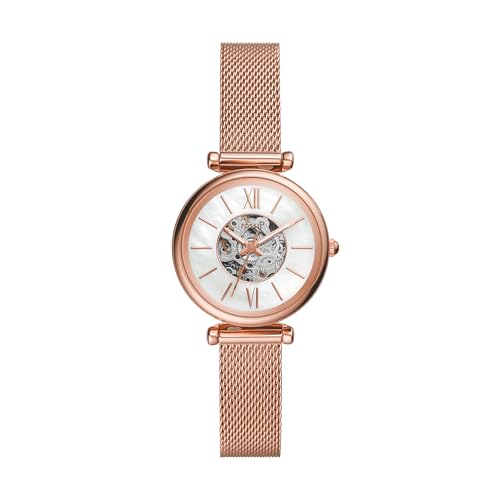
Fossil Women's Carlie Mini Automatic Stainless Steel Mesh Three-Hand Watch for Women, Rose Gold
Choosing a Coutura Kinetic
The flagship choice is the Direct Drive Coutura: the reference tier carrying the 7D-family movement, the retrograde reserve hand and the crown that refuels the watch on demand. It suits the buyer who wants the complete Kinetic idea with none of its revival rituals outsourced to arm-waving, and who expects to keep the watch in a rotation where deliberate topping-up matters. Verification is straightforward: the retrograde display on the dial, the calibre confirmed from the caseback, and a winding demonstration in which the reserve hand climbs as the crown turns — a behaviour no lesser calibre can imitate for a listing photograph.
The mid-range choice is the Coutura Kinetic chronograph, drawing on the chronograph branch of the family for its sweep-motion timing and technical dial. It suits the buyer whose eye wants information density and whose wrist can carry the line’s larger cases with intent. Checks here focus on chronograph function — start, stop, reset to zero with the hands aligning cleanly — and on reserve behaviour with the chronograph’s higher energy appetite in mind. A chronograph that resets off-centre or a reserve that will not climb past the warning zone are both reasons to negotiate or walk, stated in that order of preference.
The calm choice is the plain three-hand Coutura Kinetic on a 5M-branch calibre: date, reserve check by button where fitted, months of autonomy in healthy examples, and the line’s case-and-bracelet architecture left to speak without dial competition. It suits the buyer who intends daily wear — the usage pattern Kinetic rewards most — and who wants the technology as a quiet property of the watch rather than its conversation piece. Among the three tiers, this is the one whose ownership experience most closely matches the original 1988 promise.
Certain checks apply to every Coutura Kinetic regardless of tier, and they deserve listing as a liturgy. First, the reserve test: charge the watch fully by wearing, swinging or crown as the calibre allows, note the reserve indication, then rest it and observe across days whether the hold matches the calibre sheet’s promise in spirit. Second, the gait test: a healthy charged watch ticks in single seconds, and any two-second advance on a supposedly full charge is the watch contradicting its seller. Third, the paperwork test: calibre number, manual and service history should agree with each other and with the watch in hand.
Reference numbers reward the same discipline. Coutura references encode case, dial and market variations in their codes, and the difference between two near-identical listings is often a sapphire crystal, a Direct Drive calibre or a bracelet variation hiding inside one digit. Movement databases and archived Seiko catalogue pages resolve these codes reliably. Ten minutes with a reference decoder prevents the classic disappointment of paying a flagship price for a mid-tier specification that merely photographed like one.
Condition priorities differ from those for mechanical watches in one important way: the electrical system outranks cosmetics. A Coutura Kinetic with honest bracelet wear and a verified six-month reserve is a better purchase than a mint example whose cell collapses by Friday, because the first watch needs nothing and the second needs a service before its character can even be judged. Buy the reserve, then the calibre, then the case — in that order — and the Kinetic market’s usual traps lose most of their teeth.
Adventure-minded readers who split their wrist time between analogue pieces and rugged connected gear may also want the survey at best adventure fit smartwatches before settling a budget. For the reader who stays: a Coutura Kinetic, bought with its reserve verified and its calibre understood, offers something no rival system quite duplicates — a watch that eats motion, banks it as months of silence-proof time, and reports the state of its appetite through a stutter, a swinging hand or a crown that fills it like a fountain pen. Choose the tier that matches your rituals, and the watch will keep the time your life provides.


