Our Top Picks



What's inside
- Why a dedicated stopwatch still beats a phone or a smartwatch for officiating
- Timing resolution: what 1/100 and 1/1000 actually tell you
- Lap and split memory: capacity, and recall while the watch is still running
- Countdown timers, repeat timers, and programmable intervals
- Stroke-rate modes for rowing and swimming
- Water resistance: reading the ratings before you stand on a pool deck
- Display size, digit height, and reading the watch at arm’s length
- Button layout and protection against accidental presses
- Battery type, battery life, and what happens at the worst moment
- Dual timers, pacers, and metronome functions
- What sanctioning bodies and experienced officials expect you to carry
- Choosing by sport: track, swimming, motorsport, and gym intervals
- Start signals, reaction error, and honest hand timing
- Reading a specification sheet without being misled
- Care, storage, and keeping a watch trustworthy for seasons
- Check prices on Amazon
- Youth sport, schools, and buying for a whole programme
As an Amazon Associate I earn from qualifying purchases. This post may contain affiliate links at no extra cost to you.
A dedicated stopwatch looks like a simple object until you have to use one while watching a finish line, a touchpad, or a lane rope instead of the device in your hand. The job is not really measuring time in the abstract. The job is starting and stopping a clock at the exact moment something else happens, reading the result at arm’s length in bright sun or under pool-deck glare, and trusting that the number you write down was not changed by a stray tap, a notification, or a button you pressed twice. That is why coaches, referees, starters, and race officials still carry single-purpose timers even though every phone and smartwatch contains a stopwatch function.
This guide compares dedicated stopwatches on the specifications that manufacturers actually publish: timing resolution, stated accuracy, lap and split memory capacity, countdown and interval programming, stroke-rate measurement, water resistance ratings, display and digit dimensions, button layout, and battery type and life. Everything here is drawn from manufacturer documentation and published specifications, and the sections that follow explain what those numbers mean in practice so you can match a model to a sport instead of buying the longest feature list. Where a specification is commonly misunderstood, the guide says so directly, because a misunderstood specification is worse than a missing one.
Why a dedicated stopwatch still beats a phone or a smartwatch for officiating
The strongest argument for a dedicated unit is button feel. A mechanical-feeling top button with a defined travel and a clear click can be operated by touch alone, with your eyes on the athletes. Manufacturers describe button placement and actuation in their manuals because officials start and stop the watch without looking at it, sometimes hundreds of times in a meet or a training session. A touchscreen, by contrast, requires visual confirmation: capacitive glass does not register reliably through wet fingers, gloves, or a rain-spattered screen, and there is no tactile difference between the lap control and the stop control. When the margin you are recording is measured in hundredths of a second, a control you have to look at is a control that costs you accuracy.
Glanceability is the second argument. A dedicated stopwatch shows one thing, in large segmented digits, with no competing information. A phone stopwatch shares its screen with notifications, incoming calls, low-battery warnings, and an operating system that may dim or lock the display mid-race unless you change settings before the session. A smartwatch is better on the wrist but smaller still, and its stopwatch may be one complication among several, with a swipe or a crown press between you and the lap button. Officials also have to consider perception and rules: a phone in an official’s hand on a pool deck or at a finish line can look like a distraction or a communication device, while a stopwatch reads unambiguously as timing equipment to athletes, parents, and other officials.
There is also a failure-mode argument that rarely appears in marketing. A dedicated stopwatch does one job, so its failure modes are narrow and predictable: the battery fades, a button wears, the case seal ages. A phone can fail at timing because of a software update, a storage warning, a thermal shutdown in direct sun, or an app that was closed by memory management. None of that means phones are useless for timing. For informal training, a phone app with exportable splits is genuinely convenient, and many coaches keep one as a backup. The point is narrower: when a result will be recorded, disputed, or used to seed a later round, the device should be the one whose only job is the clock. Readers weighing a wrist device for training rather than officiating may also want to compare training features in best activity smartwatches before deciding which tool belongs on the deck.
Timing resolution: what 1/100 and 1/1000 actually tell you
Resolution is the smallest increment the display can show, not a promise about how accurate the watch is. Most dedicated stopwatches display to 1/100 of a second, written as 0.01 second. A smaller group displays to 1/1000 of a second, or 0.001 second, and those models are usually aimed at motorsport, laboratory timing, and industrial work rather than school sport. The distinction matters because human reaction time dwarfs both increments. Published human-factors references put a trained timer’s reaction variability at roughly a tenth of a second or more depending on anticipation and the stimulus, so the difference between a hundredth and a thousandth on the display is not a difference in how precisely a hand-timed result reflects the athlete’s performance.
Accuracy is a separate specification, and manufacturers who publish it express it as a drift rate, for example a number of seconds gained or lost per month, or as a percentage tied to the quartz movement at a stated temperature range. A watch can display thousandths while its oscillator drifts enough over an hour to make the last digits meaningless for absolute accuracy, though for short intervals the drift is usually negligible. Read the manual’s accuracy line, not the digit count, when you care about absolute time. For relative timing, which is what most coaching is, consistency matters more than absolute accuracy: if the same watch times every rep in a session, the comparisons inside that session are sound even if the watch runs fractionally fast.
There is a practical reason to prefer 1/100 for most field sports beyond honesty about reaction time. Displays that show thousandths cycle their final digit so fast that the running readout becomes visual noise, and some officials find the blur distracting when they are trying to follow the running time during a long event. Several manufacturers address this by letting the thousandth digits appear only on a stopped or recalled result, or by offering a mode that truncates the running display. Check the manual for how the model handles its smallest increment while running, because the specification sheet alone will not tell you. For swimming and track, where official hand times are conventionally recorded and rounded according to the governing body’s rules, a hundredth display matches the recording convention and avoids implying a precision the procedure cannot support.
How rounding and recording rules interact with resolution
Governing bodies specify how hand times are recorded, and those rules assume a hundredth-resolution watch operated by a person. In swimming, hand times from watches serve as backups to automatic equipment and are combined and adjusted under published procedures when the primary system fails. In track, hand times are converted and rounded under rules that acknowledge reaction error. Buying a thousandth-resolution watch does not change the recording rule that applies to your result, and it does not make a hand time equivalent to a fully automatic time from a photo-finish or touchpad system. Keep the categories separate in your own records: note whether a time was automatic, semi-automatic, or hand-timed, because that provenance matters more for fairness than an extra decimal place.
Lap and split memory: capacity, and recall while the watch is still running
Lap time and split time answer different questions. A lap time is the duration of the segment just completed. A split time is the cumulative elapsed time at the moment the button was pressed. A coach timing 400-metre repetitions wants lap times for each repetition and splits at intermediate marks. A swim official wants the cumulative split at the finish and may want intermediate splits at each turn for a distance event. Manufacturers list memory in number of stored laps or splits, with common capacities ranging from a handful of memories on basic models to 100, 200, 300, or more on multi-row display models, and some models organise memories into dated runs or files so that one session does not overwrite another.
Capacity alone is a weak guide. Ask three better questions of the documentation. First, can you recall stored laps while the watch continues running? Better multi-line models allow recall during timing, so a coach can check the third repetition while the fifth is in progress. Basic models require the watch to be stopped before recall, which makes their memory a post-session archive rather than a working tool. Second, does recall show both lap and split for each memory, plus fastest, slowest, and average lap summaries? Summary statistics save manual arithmetic on the deck. Third, what happens when memory fills mid-session: does the watch warn, stop storing, or overwrite the oldest entries? Manuals differ, and overwriting without warning can quietly delete the early part of a long distance race.
Multi-row displays change how memory is used. A two-row or three-row display can show the running total, the current lap, and the last lap simultaneously, which reduces button presses and the chance of pressing the wrong control while an athlete approaches. The trade-off is physical size and smaller digits for each row. When comparing models, look for published digit height alongside row count, because a three-row watch with very small secondary digits may be harder to read at arm’s length than a two-row watch with generous numerals. Also check whether the memory is retained when the battery is changed. Some models hold data in non-volatile memory; others clear everything at a battery swap, which is an unpleasant discovery after a championship session.
Multiple timers and multi-athlete timing
Some stopwatches provide more than one independent timer channel, letting one official follow two athletes or two lanes with separate start and lap sequences. Others offer a finish-time memory that records a rapid series of finishing places as competitors cross in quick succession, storing each cumulative time in order so places can be matched to times afterwards. That finish-memory pattern suits cross-country and road events where the official’s job is to capture the sequence first and assign identities second. If you time group finishes, prioritise a model whose documentation describes exactly this workflow, and practise the button sequence before the event, because finish clusters arrive faster than any menu navigation.
Countdown timers, repeat timers, and programmable intervals
The countdown function looks simple and varies a great deal. A basic countdown runs from a preset duration to zero and sounds an alarm. A repeat countdown restarts automatically, which suits rotation drills and station work. A programmable interval timer stores a sequence of different durations, for example a work period, a rest period, and a number of rounds, and signals each transition. Manufacturer manuals distinguish these carefully, and the specification to look for is the maximum number of segments and rounds the timer can store, along with whether the settings survive a power-off or are lost when you leave the mode.
Signal design matters as much as programmability. In a quiet hall, a beep is enough. On a windy track or beside a pool with a public-address system running, officials often need a louder alarm, a flashing display, or a vibrating alert, and not every model offers all three. Some timers let you set a pre-alarm that sounds a few seconds before the end so a starter or a group can prepare. Others count up after reaching zero, showing how far past the target an athlete finished, which is useful for pacing tests. Check the published alarm duration too: a one-second chirp is easy to miss, while models aimed at officiating often sustain the signal or repeat it until a button is pressed.
Starts are the mirror image of finishes, and some watches serve starters directly. Countdown-to-start modes with audible signals at set marks help a starter run a consistent sequence, and certain models aimed at sailing and rowing build in the specific countdown sequences those sports use, with signals at each minute and at the start. If your sport has a prescribed start sequence, a watch that encodes it removes one source of human inconsistency. If your sport does not, a plain, quickly set countdown is faster to use than a deep programmable system you must navigate under pressure. Match the timer’s complexity to the sequence you actually run every week, not to the most elaborate session you can imagine.
Stroke-rate modes for rowing and swimming
Stroke-rate measurement is the feature that most clearly separates sport-specific stopwatches from general ones. The standard method, described in manufacturer manuals for rowing and swimming models, is the three-stroke measurement: you start the watch at one stroke catch or hand entry, count three complete stroke cycles, and stop the watch at the same point in the fourth cycle. The watch divides the elapsed time and displays the rate in strokes per minute. Measuring across three cycles instead of one smooths out the timing error of a single button press, which is why the convention exists and why models built for these sports automate the division.
Some models extend the idea. Rate memory stores a series of stroke-rate readings so a coach can review how rate changed across a piece or a race, and some watches pair rate with a lap or distance count to show rate per length or per segment. A few offer a base-3 mode naming that reflects the three-stroke convention directly. When comparing, look for the published rate range, typically expressed in strokes per minute with a stated minimum interval between strokes, because a model designed for rowing rates may behave differently at the higher rates seen in sprint swimming. Also note whether the rate function shares memory with the lap function or has its own store, since that determines whether taking a rate reading mid-session disturbs your split record.
Using rate well is a coaching skill the watch cannot supply. Rate without boat speed or split time is only half a picture: a crew can raise its rate while going no faster if the extra strokes are rushed and short. Coaches therefore read rate alongside the split for the same segment, which is an argument for a watch that can show or store both in one session. In swimming, rate per length combined with stroke count per length gives a fuller view of whether a swimmer is holding technique as fatigue builds. Choose a model whose workflow lets you capture rate and split in the order your sport presents them, because a technically capable watch with the wrong button order will be abandoned by the second week of the season.
Water resistance: reading the ratings before you stand on a pool deck
Water resistance is the most misread specification in this category. Ratings follow conventions in which a number in metres or atmospheres describes a static pressure test on a new sample, not a guarantee about dynamic use. Manufacturer manuals and rating guidance commonly describe splash resistance as suitable for rain and hand washing, a 50-metre rating as suitable for showering and shallow swimming in many product lines, and a 100-metre rating as the safer choice for regular swimming and deck work. The exact wording varies by brand, so read the manual for the specific model rather than generalising from the number printed on the case.
Two cautions from manufacturer documentation deserve emphasis. First, buttons should generally not be operated underwater unless the manual explicitly permits it, because pressing a button can momentarily compromise the seal that the static test assumes. A swim official timing from the deck presses buttons in air, often with wet hands, which is a different and less demanding exposure than pressing them submerged. Second, seals age. Gaskets harden, and resistance declines after battery changes if the case is not resealed correctly. Models with user-replaceable batteries often note that water resistance cannot be guaranteed after the case is opened. If your watch lives on a pool deck daily, treat the rating as a property that needs maintenance, and consider a model whose battery service is factory-performed if submerged use is routine.
Pool decks add chemicals to the equation. Chlorinated water, sunscreen, and cleaning agents can degrade straps and gaskets faster than fresh water does. Rinsing the watch in clean water after sessions, a care step manuals commonly recommend, extends seal and strap life. For outdoor officials, rain is the more common exposure, and even a modestly rated watch handles rain well provided the case back and crown seals are intact. The realistic buying rule is this: choose at least a rating the manufacturer describes as suitable for swimming if the watch will be poolside every week, choose splash resistance only for dry-land sports, and never let a high printed number persuade you to press buttons underwater against the manual’s instruction. Anyone comparing deck-side viewing with screen-based timing for other sports may find the display discussion in best hd tvs for sports a useful contrast in how size and glare change readability.
Display size, digit height, and reading the watch at arm’s length
Manufacturers who serve officials publish digit height because it predicts readability better than case size does. A large case can still carry small digits if the display devotes space to multiple rows, calendars, and mode labels. As a working approach, compare the height of the main running-time digits across models, and prefer the largest main digits your hand comfortably holds if you read the watch while moving. Segmented liquid-crystal digits remain the standard because they stay legible in direct sunlight, where emissive phone screens wash out or throttle brightness to manage heat.
Contrast and viewing angle matter outdoors. A display that reads crisply straight on may fade at the shallow angle of a watch held at waist height. Some models offer adjustable contrast in their settings, a detail mentioned in manuals and worth checking if you officiate in mixed light. Backlights help at evening meets and indoor venues, but an electroluminescent or LED backlight draws heavily on a small cell, so manuals often limit its duration to a few seconds per press. If you time evening sessions regularly, confirm that the backlight illuminates all rows of the display evenly, not only the main row, and check whether button presses for laps also trigger the light, which can drain the battery across a long meet.
Display layout is an information-design choice. Single-row watches show one number very large. Two-row watches typically show cumulative time with lap time, or running time with the last split. Three-row watches add the current lap or a timer channel. More rows reduce button presses but shrink each number, so the right choice depends on whether your task is reading one finish time precisely or monitoring several values during a session. Officials who record finishes should weight the main row. Coaches running repetitions should weight the combination of running total and last lap, because those two numbers drive the feedback they give between efforts.
Button layout and protection against accidental presses
Most dedicated stopwatches place start and stop on one top button, lap and split on another, with mode and recall controls on the front or sides. The consistency of that layout across brands is a quiet benefit: an official can pick up a colleague’s watch and operate it. Where models differ is in button size, spacing, and resistance. Larger, well-separated top buttons suit cold hands and gloves. Recessed or stiffer lap buttons reduce accidental splits when the watch swings on its lanyard against clothing or a clipboard. Manuals sometimes specify a lock or hold function that freezes the controls, which protects a finished time from being cleared while it is carried to the recorder’s table.
Accidental-press protection takes several forms. A key-lock mode disables the buttons until a deliberate combination or long press releases them. A protective case or bumper reduces side-button contact in a kit bag. Some watches require a longer press to reset than to lap, separating a destructive action from a routine one by effort. That separation is worth seeking: the most damaging error in hand timing is not a stray lap, which can be ignored in recall, but a stray reset, which destroys the session. When you evaluate a model, read the manual’s reset procedure. If reset is a single press of an exposed button, treat that as a genuine officiating risk, however good the timing specifications are.
Lanyards and grip deserve a mention because drops end more timing sessions than electronics do. Most models include a neck lanyard, and some cases have textured sides or a shape that sits against the fingers so the thumb lands on the start button without searching. A breakaway lanyard is the safer choice around moving equipment and in school settings. If you time from a fixed position such as a finish-line table, a larger desktop-style timer with big buttons and a stable base may serve better than a handheld watch at all, and several manufacturers publish table timers with the same memory and interval functions in a bigger housing.
Battery type, battery life, and what happens at the worst moment
Dedicated stopwatches commonly use a coin cell, with the widely used CR2032 appearing across many models, while others use smaller cells or, in a growing minority, a rechargeable battery charged by USB. Published battery life for coin-cell models is often stated in years under defined daily-use assumptions, because a simple liquid-crystal watch draws very little power when it is not sounding alarms or running a backlight. Rechargeable models state life in hours of active use or days of typical use, a shorter but more honest figure for their feature set, which may include Bluetooth transfer of results to an app.
The cell type affects ownership more than the life figure does. A user-replaceable coin cell can be swapped in minutes with a small screwdriver, though opening the case can compromise the water-resistance seal as noted earlier. A sealed rechargeable watch avoids that trade-off but must be remembered and charged, and a flat rechargeable battery on meet morning is a harder problem than a fading coin cell that warned you with a dim display for weeks. Many models provide a low-battery indicator; check the manual for its presence, because a watch that simply stops is a liability in competition. The prudent official’s habit is procedural rather than technical: carry a spare watch, replace cells on a schedule before major events, and record which battery each watch holds so a replacement is bought before it is needed.
Data transfer is the one modern feature that changes the battery conversation. Models with Bluetooth or USB export can move splits into a spreadsheet or a results system, removing transcription errors, which are a larger source of wrong results than oscillator drift. If your programme already manages athlete data on watches and phones, a stopwatch that exports may fit that workflow, and the comparison in best fitness and music smartwatches shows how training devices handle the same transfer problem from the wrist side. Weigh export against simplicity honestly. A schools official who writes times on paper gains nothing from connectivity and loses battery life to it, while a professional timing team may regard export as the main reason to choose one model over another.
Dual timers, pacers, and metronome functions
Beyond lap timing, many models bundle a pacer: a beeping cadence at a selectable rate, expressed in beats per minute, that athletes follow for tempo work, step rate, or stroke tempo. A metronome function is essentially the same tool presented for rhythm rather than pace. Pacers are simple, but check the published rate range and step size, because a pacer that adjusts in large steps cannot fine-tune tempo, and one with a low maximum rate will not reach sprint cadences. Volume and the option to use a flashing signal instead of sound decide whether the pacer works in your venue.
Dual-timer models run two countdowns, either independently or in sequence, which suits work-and-rest structures without full interval programming. Some watches combine a countdown with a stopwatch so a coach can cap a session while timing repetitions inside it. Clock functions also appear: time of day, date, and an alarm. Those are conveniences, not timing features, but an official who wears one device all day may value them. The risk in feature-rich models is mode confusion. Every added mode is another state the watch can be in when you press start, and manuals for multi-function models run long for a reason. If a watch offers modes you will never use, confirm that the stopwatch is the default or is reachable in one press from the clock display, because a race will not wait while you cycle through a pacer, a world clock, and an alarm screen.
What sanctioning bodies and experienced officials expect you to carry
Formal requirements vary by sport and level, and the governing body’s current rulebook is the only authoritative source for a given competition. In broad terms, sanctioned swimming and athletics rely on automatic or semi-automatic systems as primary timing at higher levels, with hand watches as backup operated by a prescribed number of timers per lane or place, precisely because individual hand times carry reaction error. Published procedures describe how multiple watch times are combined when they disagree and how a watch time is used when primary equipment fails. An official’s obligation is therefore less about owning a particular model and more about operating a reliable hundredth-resolution watch, knowing the backup procedure, and being positioned so the start signal and the finish are both clearly visible.
Experienced officials share habits that no specification sheet lists. They carry at least two watches so a failure or a disputed reading never leaves a lane untimed. They check the watch before the session: battery indicator, button action, memory cleared or archived deliberately rather than accidentally. They agree signals and positions with the other timers before the first event, including who watches the start and who calls the finish order. They write times immediately, in the format the results team expects, and they note the watch used when a backup time is submitted. None of this requires an expensive instrument. It requires a dependable one, understood thoroughly, which is why many officials keep the same model for years and resist switching mid-season.
For training environments without formal sanction, expectations are social rather than regulatory, but they still matter. Athletes accept hand times more readily when the same person, position, and procedure produce them each week. A coach who times from a consistent mark, starts the watch on the same signal, and records laps the same way builds a dataset athletes trust, even knowing it carries hand-timing error. Consistency of procedure contributes more to useful training data than any purchasable increment of display resolution, and it costs nothing.
Choosing by sport: track, swimming, motorsport, and gym intervals
Track and field timing rewards memory depth and finish-sequence capture. A distance race generates dozens of splits, and a coach following several athletes needs either multiple timer channels or a finish memory that records places in order. Prioritise recall while running, a clear fastest and slowest lap summary, and buttons that can be operated without looking down as runners approach. Water resistance can be modest for dry venues, but outdoor seasons bring rain, so splash protection at minimum is sensible. Digit size matters at the finish line, where the watch is read at arm’s length while the next finisher is already arriving.
Swimming rewards water resistance, stroke-rate measurement, and memory organised by swimmer or by event. Deck officials need a rating the manufacturer describes as suitable for a wet environment, buttons that work with wet hands, and a display that survives glare off the water. Coaches need rate measurement using the three-stroke convention and enough lap memory for long aerobic sets with many repetitions. Because a swim session produces repetitive, similar numbers, a watch that groups memories into separate runs or sessions prevents yesterday’s set from mixing with today’s, and export, where offered, earns its keep in this sport more than most.
Motorsport and other vehicle timing reward resolution and interval precision at longer durations. Here a 1/1000 display has a more defensible role, because the events are machine-paced, the timer often triggers from a repeatable visual reference, and differences between runs can be genuinely small. Long total capacity matters too: check the maximum elapsed time before the watch rolls over, since models differ from under ten hours to a full day or more, and an endurance event will expose a short limit. Lap counts in motorsport sessions can be high, so deep memory and a clear method for separating sessions matter, as does a display that stays readable in a bright paddock.
Gym and interval training reward the timer more than the stopwatch. Programmable intervals with clear signals, a repeat countdown, a pacer for tempo work, and a large display that can be read from across a training space are the deciding features. A tabletop or wall-visible timer may beat a handheld watch for group sessions, while a personal coach moving between stations will prefer a handheld or wrist-carried unit with a vibrating alert for noisy rooms. If your programme also tracks athletes between sessions on consumer wearables, the budget comparison in best android smartwatches fitness trackers under 100 covers the low-cost end of that separate category.
Rowing sits between swimming and track in its needs. Rate measurement is central, splits over a course or an ergometer session are the other half of the picture, and weather exposure is guaranteed, so water resistance and a secure grip rank highly. Officials at regattas additionally use countdown sequences for starts, which argues for a model that supports the start procedure of the event rather than a generic countdown. Field sports such as football, hockey, and lacrosse ask something different again: referees need a countdown that tracks playing time and stoppages, often with a period structure, plus a simple way to show elapsed and remaining time at a glance. A referee’s watch mode, offered on some models, structures exactly that, and it is worth more to a match official than lap memory they will never open.
A short specification checklist before you buy
Work through the published specifications in this order. Confirm the resolution and any stated accuracy figure, and be sure you are not mistaking one for the other. Confirm lap and split memory capacity, whether recall works while timing continues, and whether fastest, slowest, and average summaries are provided. Confirm the countdown type you need, whether a plain, repeat, or fully programmable interval timer, and how transitions are signalled. Confirm the water-resistance description in the manual in words, not only the number on the case. Confirm main digit height and row count together. Confirm the battery type, the stated life, whether a low-battery warning exists, and whether changing the battery affects the water seal. Finally, read the reset and lock procedures, because protecting a recorded result is a feature, even when it is listed in the manual rather than on the box.
Common buying mistakes this category invites
The first mistake is buying resolution you cannot use and neglecting memory you needed daily. The second is assuming a water-resistance number permits underwater button use when the manual says otherwise. The third is choosing a feature-dense model whose stopwatch sits several modes away from the clock screen. The fourth is ignoring digit height and discovering at the first evening meet that the secondary row cannot be read. The fifth is forgetting the unglamorous accessories: a breakaway lanyard, a spare battery of the correct cell type, and a case that keeps side buttons from being pressed in a kit bag. Each mistake is visible in the documentation before purchase, which is why this guide keeps returning to manuals and published specifications rather than to impressions.
There is a final, quieter consideration: continuity. A stopwatch is a long-lived tool, and models stay in production for years. Choosing an established model means replacement units match the one your fellow officials already know, batteries and lanyards are easy to find, and the button layout your hands have learned stays valid when a unit is replaced. Novelty has little value in an instrument whose entire purpose is to be operated without thought. Buy the watch whose documentation answers every question on the checklist, learn its recall and reset procedures before the first event, and let it disappear into the background of the work.
Start signals, reaction error, and honest hand timing
Hand timing contains an unavoidable human element, and understanding it makes you a better timer than any purchase will. The timer reacts to a start signal, which may be a gun, a whistle, a flash, or a starter’s call, and reacts again at the finish. Reaction to the start usually makes the recorded time slightly short, because the watch starts after the athlete does, while reaction at the finish can add or subtract depending on anticipation. Experienced timers reduce error by watching the smoke or flash of the gun rather than waiting for the sound, which arrives measurably later over distance, and by anticipating the finish from the athlete’s approach rather than reacting to the line itself. Rulebooks that adjust hand times are acknowledging this physiology, not criticising the timer.
Position is part of the instrument. A finish-line timer should stand in line with the finish, elevated if possible, so that the moment of crossing is a clean visual event rather than a judgement through a crowd of bodies at different distances. A swim timer stands at the end of the lane, looking down the lane line, so the touch is seen against the wall. Splitting timers on a track position themselves at the mark they are timing, not at the finish, because parallax from an angle distorts the apparent moment of crossing. None of these practices appears in a product manual, yet each affects recorded times more than the difference between two reputable watches, which is why officiating courses teach position before they discuss equipment at all.
It also helps to separate the roles people confuse at busy events. The timer records times. The finish judge records order. When one person attempts both in a close finish, both records suffer, because the eyes cannot simultaneously read a running watch and resolve a blanket finish. Published meet procedures assign the roles separately and reconcile them afterwards, with times attached to places by the recorders. If you organise school or club events, copying that separation is the cheapest accuracy improvement available, and it explains why finish-memory watches that capture a sequence of times are so useful: they let the timer keep pressing in rhythm while a separate judge, or a later review, supplies the identities in order.
Reading a specification sheet without being misled
Specification sheets compress information, and a few entries deserve translation. Total time capacity tells you when the elapsed display rolls back to zero; a watch limited to just under ten hours behaves differently at an endurance event from one that runs for a hundred hours or twenty-four days, figures that appear in manuals for long-duration models. Lap capacity quoted as a number of memories may be shared across all stored sessions, so a watch advertising several hundred memories might hold far fewer per session once earlier runs are kept. The manual’s memory section, not the box summary, states whether the total is per run or overall, and whether old runs can be deleted individually.
Alarm specifications are similarly compressed. A stated alarm is not necessarily an audible one at a useful volume, and sheets rarely publish loudness. What they do publish is the number of alarms, their duration pattern, and whether a snooze or repeat applies. For interval work, the relevant figure is the number of programmable timers and segments, and whether the timer counts down in seconds only or also in hours for long sessions. Clock accuracy, when stated, is usually given at normal temperature, with a note that extremes shift it; a watch left in a hot car or a cold kit bag may drift more than its headline figure suggests, another reason backup watches at an event should be compared against a common reference before the session starts.
Case dimensions and weight are published and worth a glance for a reason beyond comfort. A heavier, larger watch is easier to grip with gloves and less likely to be knocked from a wet hand, while a compact watch suits a referee who carries it in a pocket through a match. Strap and lanyard attachment points are a known failure area on older units, so a case design with a reinforced lanyard loop is a practical merit. Water-resistance statements, digit height, and battery type have already been covered, but they belong on the same reading pass: the sheet is short, and every line on it corresponds to a decision the manufacturer made about who the watch is for.
Care, storage, and keeping a watch trustworthy for seasons
A stopwatch asks for little care, which is exactly why the little it asks for gets skipped. Rinse pool-deck watches in fresh water and dry them before storage, keep them out of prolonged direct sun in a hot vehicle where displays and batteries suffer, and store them with the display in clock mode rather than with a timer left running. Check button action at the start of a season: a button that feels gritty or inconsistent after a winter in a drawer will not improve during a meet. If the case was opened for a battery change, treat subsequent water exposure cautiously until the seal has been checked, as the manuals warn.
Record keeping extends to the equipment itself. Note the purchase date, battery changes, and any drops or repairs for each watch your programme owns, and number the watches so a disputed time can be traced to a specific unit whose behaviour can then be checked. Comparing all programme watches against a reference clock over an hour at the start of a season takes little time and occasionally reveals a unit drifting or a button double-registering, either of which is far better discovered in a quiet room than at a championship finish. Retire watches that double-register or lose memory; a timer that occasionally invents a lap is worse than no backup at all, because its errors enter the record disguised as data.
Finally, practise with the exact unit you will use. Recall the memory, clear it deliberately, set the countdown, and trigger the lock, all before the event, until the sequences are automatic. Familiarity is a genuine performance specification, it just happens to belong to the operator rather than the device. Two officials with identical watches will produce different quality of timing if one has rehearsed the recall sequence and the other is reading the button labels in fading light. The manufacturers publish manuals for a reason, and the most useful page in most of them is the one diagramming the button functions; an hour with that diagram in the off-season is worth more than a model upgrade.
Check prices on Amazon
Live listings for the shortlist in this guide are pulled from Amazon below, so prices and availability are always current at the moment you look.


Youth sport, schools, and buying for a whole programme
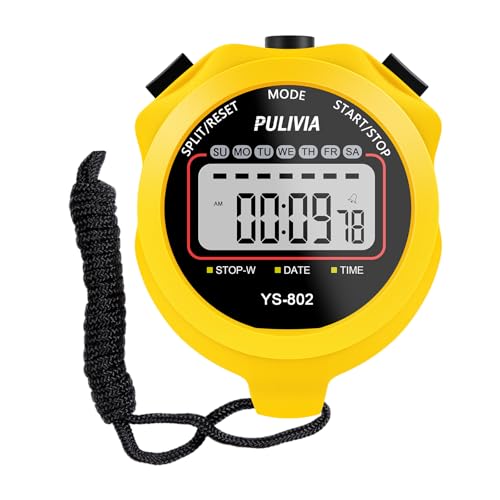
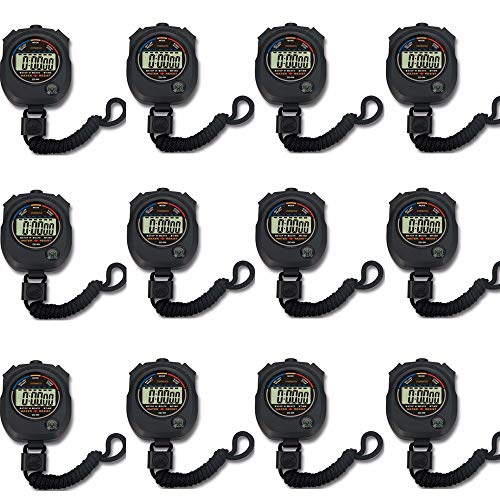
Programmes that buy watches by the dozen weigh specifications differently from an individual official. Unit consistency matters first: a class set of identical watches lets one briefing cover every timer, and lets a faulty unit be swapped without retraining anyone. Simplicity matters second, because volunteer timers rotate and a watch with three modes will be operated correctly by a parent who was handed it five minutes before the first race, while a twelve-mode instrument will not. For school sets, published durability information, replaceable batteries of a common cell type, and bright case colours that make the watches easy to count back in at the end of the day are practical merits that outrank deep memory or export functions nobody at that level will use.
Budget planning for a programme should include the accessories and spares as line items rather than afterthoughts: spare lanyards, spare cells, a labelled storage case, and at least two spare watches above the number of lanes or positions staffed. Loss and breakage rates in youth sport are a certainty, not a risk. A programme that buys exactly enough premium watches and then loses one is worse equipped than a programme that bought a larger number of simpler, consistent units and can absorb the loss. The specification discipline is the same at both scales; only the weighting changes, and writing the weighting down before ordering prevents the common outcome of a mixed drawer of incompatible models accumulated over years of one-off purchases.
There is also a teaching dimension. A clear, single-purpose watch is a good instrument for teaching young athletes and new officials what timing is: a start, a sequence of splits, a finish, and a record. Handling a real watch, reading its memory, and converting its splits into pace per lap or per length builds a feel for the numbers that govern training. That educational value is an argument for keeping dedicated watches in school programmes even where phones are permitted, and it costs very little to preserve.
When a printer or connected timer is worth considering
A small number of timing setups go beyond the handheld watch entirely. Printer-equipped stopwatches produce a paper record of splits at the moment they are taken, which suits events that require an immediate physical record or that lack any computer at the venue. Connected timers send results to a nearby display or a results application, which suits clubs publishing live splits. Both categories appear in manufacturer catalogues alongside handheld models, and both trade portability for infrastructure: paper, power, pairing, and setup time. For most coaches and officials the handheld watch remains the right unit, but knowing the adjacent categories exist prevents a common confusion, in which a buyer expects a basic watch to produce documentation it was never designed to produce. If your event’s rules require a printed or transmitted record, that requirement, stated in the event documentation, should drive the purchase from the start rather than being discovered after a handheld watch has already been bought and issued to the timing team.
Keep that distinction in mind when a listing advertises a watch with a long list of modes in large type and its core timing figures in small type. The order of emphasis on a product page is a marketing choice, not a measurement. The manual reverses that order: timing capacity, memory behaviour, and button functions come first, because they are what the device is. Reading the manual before purchase, which most manufacturers publish in full, is the single most reliable step in this entire category, and it takes less time than returning a watch whose recall mode or reset behaviour turned out to be wrong for your event.
Some links in this article lead to a retailer, and this site may earn a commission from qualifying purchases at no extra cost to you; that relationship does not change how models are compared here, which is based on manufacturer documentation and published specifications.
Before the season opens, lay your watches side by side, start them together on one signal, let them run through a full training session, and compare what each one recorded at the end.
Carry two watches, agree your signals before the first start, and the clock will be the one part of the day nobody argues about.


