Our Top Picks
 Easesyn Portable Veterinary Monitor Multi-Parameter for Cats &with ETCO2 function9.25 x 5.55 x 8.74 inchesCheck on Amazon
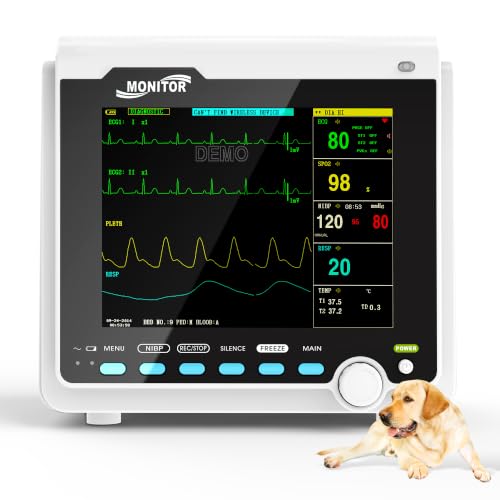 Easesyn Portable Veterinary Monitor Multi-parameters for Cats &6 parameters9.25 x 8.74 x 5.55 inchesCheck on Amazon


What's inside
- Easesyn portable veterinary monitor with ETCO2, seven parameters
- Easesyn portable veterinary monitor, six parameters
- HM10 veterinary vital signs monitor, 12.1-inch
- HM10 veterinary vital signs monitor with ETCO2, 12.1-inch
- PM6800V 15-inch veterinary multi-parameter monitor
- Portable veterinary multiparameter monitor, 4.3 inch
- SunTech Vet40 veterinary multiparameter monitor
- DAWEIanimed veterinary patient monitor, 12.1-inch
- How veterinary ECG differs from human monitoring
- What each parameter means in anesthesia and recovery
- Getting NIBP right starts with cuff size
- Surgery, ward care, and guided monitoring at home
- Large desktop screens versus small portable monitors
- Alarms, trends, and recorded data
- Cleaning probes and sensors between patients
- The limits of lower-cost monitors and when hospital-grade depth is needed
- Choosing among these eight monitors
- Check prices on Amazon
- Disclosure for this guide
As an Amazon Associate I earn from qualifying purchases. This post may contain affiliate links at no extra cost to you.
A veterinary ECG monitor does far more than trace a heartbeat. In a clinic it sits at the center of anesthesia, recovery, and emergency care, bringing heart rhythm, oxygen saturation, blood pressure, breathing, and temperature onto one screen so a veterinarian or technician can spot a change early and act before a small change becomes a crisis. At home, under a veterinarian’s direction, a simpler version of the same idea can help an owner follow a recovering dog or cat between visits, provided everyone understands what the numbers can show and what they cannot. This guide compares eight multi-parameter veterinary monitors that all include ECG, explains how they differ in parameter count, screen size, and intended setting, and walks through the practical details that matter most: cuff sizing, electrode placement, capnography, alarms, cleaning, and the limits of lower-cost equipment.
The eight models fall into three broad groups. Two portable Easesyn units for cats and dogs offer either seven parameters with ETCO2 or six parameters without it, and both are described for home, clinic, and hospital use. Two HM10 monitors share a 12.1-inch display, an animal-specific ECG, a 20 to 500 beats per minute heart rate range, and a six-second startup, with one adding ETCO2 to the set. A 15-inch PM6800V is the largest screen in the group. A compact 4.3-inch portable unit covers dogs, cats, and horses. A SunTech Vet40 combines blood pressure with AccuVet SpO2, temperature, ECG, and capnography. A DAWEIanimed monitor rounds out the list with a 12.1-inch display and a core set of six measurements. None of these machines replaces clinical judgment, and the right choice depends less on a single headline feature than on the species you treat, the procedures you run, and how the monitor will be used day after day.
Easesyn portable veterinary monitor with ETCO2, seven parameters
The first Easesyn model is a portable multi-parameter monitor for cats and dogs that measures seven parameters: ECG, NIBP, SpO2, RESP, TEMP, PR, and ETCO2. It is described for home, vet clinics, and hospital use, which makes it one of the more versatile options in this group on paper. The combination matters because it brings capnography into a portable format aimed at the two species most clinics see every day. For a small practice that anesthetizes cats and dogs in one room and then moves patients to recovery in another, a portable seven-parameter unit can follow the patient rather than forcing the team to swap between a surgical monitor and a simpler recovery spot-check device.
In practical terms, the ECG trace supports rhythm monitoring during anesthesia and in unstable patients, NIBP provides scheduled or on-demand blood pressure readings, SpO2 and PR track oxygenation and peripheral pulse together, RESP follows breathing rate, TEMP helps detect the gradual cooling that is common in small anesthetized patients, and ETCO2 adds ventilation monitoring for intubated cases. That is a complete anesthesia set for cats and dogs in a single unit. The trade-off with any portable design is screen real estate. Multiple waveforms and numeric boxes share limited space, so the team should confirm that the layout stays readable at the distance they actually work from, especially when ETCO2 and ECG are displayed together.
Easesyn portable veterinary monitor, six parameters
The second Easesyn model is also a portable multi-parameter monitor for cats and dogs, this time with six parameters: ECG, NIBP, SpO2, RESP, TEMP, and PR. It is described for animals in home, vet clinic, and hospital settings. The difference from its sibling is the absence of ETCO2, and that single difference should drive the choice between them. If your patients are rarely intubated, or if capnography is already covered by another monitor in the surgical area, the six-parameter version covers the core vital signs that most examinations, sedations, hospital ward checks, and recovery rounds require.
Think of this unit as the everyday workhorse configuration. During a dental procedure under anesthesia, ECG, SpO2, NIBP, temperature, and respiration still form the backbone of monitoring, and a trained technician watching trends in those values can detect most problems promptly, especially when direct observation of chest movement, mucous membrane color, and pulse quality continues alongside the screen. In a ward, the same unit can rotate between post-operative patients for scheduled checks. In an examination room, it can support blood pressure measurement in a calm cat or an ECG trace in a dog presented for collapse, without occupying the main surgical monitor.
Portability also changes how a clinic handles isolation and quarantine areas. Moving one large monitor between a surgical suite and an isolation ward creates cleaning delays and cross-contamination concerns. A portable unit that can be dedicated to a ward for a shift, then cleaned thoroughly before moving on, fits that workflow better. The six-parameter Easesyn should be judged on those everyday strengths rather than treated as a lesser version of the seven-parameter model. It only becomes the wrong choice when ventilation monitoring is part of the job it will actually be given.
HM10 veterinary vital signs monitor, 12.1-inch
The HM10 in its standard configuration is a veterinary vital signs monitor with ECG, SpO2, HR, NIBP, RESP, and TEMP on a 12.1-inch monitor. Three published details set it apart. First, it uses an animal-specific ECG, which matters because algorithms and lead handling designed for people do not always cope well with animal anatomy, fur, and movement. Second, its heart rate range runs from 20 to 500 bpm, a span wide enough for a large dog under anesthesia at the low end and a tiny, stressed, or very young patient at the high end. Third, it starts up in six seconds, so it is ready quickly when a patient arrives unstable or when the team needs to move from one case to the next without waiting for equipment.
A 12.1-inch screen changes the working experience in ways that are easy to underestimate. In surgery, the anesthetist may be positioned at the patient’s head, the surgeon across the table, and a technician circulating. A larger display lets more than one person follow the ECG trace, SpO2 waveform, and respiration at a glance, which supports closed-loop communication: one person calls a change, another confirms it on the same screen. Trend information is also easier to appreciate on a bigger display, and trends are usually more clinically useful than any single reading. A blood pressure value means more when you can see the last several values falling in sequence.
HM10 veterinary vital signs monitor with ETCO2, 12.1-inch
The second HM10 configuration adds ETCO2 to the same foundation: ETCO2, ECG, SpO2, NIBP, HR, RESP, and TEMP, again with a 12.1-inch display, a 20 to 500 bpm heart rate range, and a six-second startup. For practices that intubate cats and dogs routinely, this is the more complete surgical version. Capnography brings the breathing circuit into the monitored picture. A sudden loss of the ETCO2 waveform can indicate disconnection, extubation, or obstruction. A gradual rise can point to hypoventilation or rebreathing. A gradual fall can accompany reduced cardiac output or a sampling problem. None of those interpretations should be made from the number alone, but the waveform gives the team an early prompt to look, listen, and check the patient and circuit directly.
Choosing between the two HM10 versions is therefore a workflow decision, not a status decision. A practice that already owns a standalone capnograph in good working order might place the standard HM10 in a second procedure area or recovery. A practice equipping a single surgical suite from scratch will usually get more long-term value from the ETCO2 version, because ventilation monitoring is hardest to retrofit later and easiest to standardize when it is built into the main monitor from the start. Either way, staff training should cover both the mainstream or sidestream sampling setup your configuration uses and the mundane failures that cause most bad readings, such as moisture in a sampling line, a loose connection, or a sensor that needs replacement.
The shared 12.1-inch platform also simplifies training. When two monitors in different rooms present parameters in a familiar layout, technicians moving between areas make fewer setup errors and recognize alarms faster. Consistency has a safety value that rarely appears on a specification sheet. If a clinic plans to equip two stations over time, staying within one monitor family, where the budget and clinical needs allow, can reduce the learning curve and make accessories, cuffs, and sensors easier to organize, provided the accessories are genuinely compatible and labeled clearly for each unit.
PM6800V 15-inch veterinary multi-parameter monitor
The PM6800V offers ECG, RESP, SpO2, NIBP, Temp, and PR on a 15-inch display, the largest screen among the eight monitors here. That size suits a fixed station: a main surgical suite, an intensive care cage bank, or a dental area where the monitor stays in place and several staff members need to read it from different positions. In an intensive care setting, patients may be monitored for long stretches, and a large display helps the team keep waveforms and numeric values visible without crowding around the unit or repeatedly leaning in to check a small screen during rounds.
The parameter set covers the core vital signs without ETCO2. For an intensive care unit focused on post-operative recovery, sepsis cases, trauma stabilization, and ongoing ECG rhythm observation, that set addresses most continuous monitoring needs, while ventilated patients or heavily intubated caseloads would still require capnography from this unit’s set to be supplemented by other equipment. The large screen can also make alarm states clearer during busy periods, although alarm usefulness still depends on setting sensible limits for each patient rather than relying on defaults. A big display showing poorly set alarms simply makes alarm fatigue larger and brighter.
Portable veterinary multiparameter monitor, 4.3 inch
At the opposite end of the size range, this portable multiparameter monitor has a 4.3-inch screen and measures SpO2, ECG, NIBP, Temp, Resp, and PR for dogs, cats, and horses. The inclusion of horses in its described species range is significant. Equine work often happens in stalls, yards, and field settings where a cart-based monitor cannot follow, and where the clinician needs a compact unit that can travel in a vehicle, be carried to the patient, and deliver a focused set of readings on the spot. The same portability serves small-animal house calls, shelter work, and mobile clinics.
A small screen forces a different monitoring style. Instead of watching every waveform continuously from across a room, the clinician works close to the patient, checks values directly, and relies on audible signals and alarm tones when attention must stay on the animal. That is appropriate for examinations, sedation checks, transport, and field assessments. It is less appropriate as the sole monitor for a long, complex anesthetic in a busy suite, where distance viewing and multiple simultaneous traces matter. Matching the tool to the setting is the point: the 4.3-inch format earns its place by going where the larger HM10, PM6800V, and DAWEIanimed units cannot easily go.
For equine use, sensor and cuff practicality matter as much as the screen. Confirm which sensors are supplied or supported for large animals, how ECG clips attach to equine skin, and where SpO2 sensors are intended to be placed on a horse, because sites that work on a dog’s tongue or ear may not translate directly. Ask the same questions for very small dogs and cats at the other extreme. A monitor described for three species still depends on the right accessory in the right size for each patient, and accessory availability should be confirmed before purchase rather than discovered on the first field call.
SunTech Vet40 veterinary multiparameter monitor
The SunTech Vet40 is a veterinary multiparameter monitor with blood pressure, AccuVet SpO2, temperature, ECG, and capnography. SunTech is a name closely associated with blood pressure measurement, so a monitor from this maker will naturally draw attention from practices whose daily frustration is unreliable non-invasive blood pressure in awake or lightly sedated animals. Blood pressure is one of the hardest parameters to obtain well in veterinary patients: the animal moves, the cuff slips, the limb position changes, and anxiety alone can shift readings. A monitor designed around that measurement deserves consideration for examination-room and ward use as well as procedure areas.
The combination with AccuVet SpO2, temperature, ECG, and capnography makes the Vet40 a broad-coverage unit rather than a single-purpose blood pressure device. Capnography extends it into anesthesia monitoring, ECG supports rhythm assessment, and temperature tracking helps with both anesthetized patients who lose heat and critical patients whose temperature trend forms part of the overall picture. For a practice that wants one recognizable platform to move between blood pressure clinics, procedure monitoring, and recovery checks, that breadth is the appeal.
Buyers should still apply the same discipline here as with every model in this guide. Blood pressure accuracy in practice depends heavily on cuff selection and patient positioning, whatever the badge on the monitor says. Measure the limb circumference, choose the cuff the sizing guide indicates, position the cuff at heart level where possible, keep the patient as calm and still as the situation allows, and take repeated readings rather than reacting to a single value. A monitor can average, store, and display readings intelligently, but it cannot compensate for a cuff wrapped over a joint or a patient struggling throughout the measurement cycle.
DAWEIanimed veterinary patient monitor, 12.1-inch
The DAWEIanimed veterinary patient monitor provides ECG, SpO2, HR, NIBP, RESP, and Temp on a 12.1-inch display. It sits in the same large-screen, core-parameter category as the standard HM10, which makes direct comparison between those two a useful exercise for buyers equipping a procedure room. Both present the six measurements most surgical and recovery workflows rely on, in a format designed to be read at working distance. Differences in menu layout, alarm handling, accessory sets, and local support can matter as much as the headline parameter list, so clinics should request full documentation for the exact configuration on offer and confirm which cuffs, sensors, and ECG leads are included.
Without ETCO2 in its listed set, the DAWEIanimed fits best where capnography is either unnecessary for the caseload or already provided separately. Dental suites performing large numbers of anesthetics, spay and neuter programs, and general surgical lists all rely on the core six parameters hour after hour, and a clear 12.1-inch display supports that work well. In recovery, the same screen helps staff supervise several recovering patients in sequence, checking heart rate, oxygen saturation, and temperature trends as each animal emerges from anesthesia and is warmed, reassessed, and prepared for discharge or ward admission.
How veterinary ECG differs from human monitoring
It is tempting to assume a heart monitor is a heart monitor, but veterinary patients break human assumptions in several ways. The first is heart rate range. A resting adult human sits in a narrow band, while veterinary patients range from a large dog under anesthesia with a rate in the forties to a frightened kitten, a small toy breed, a young puppy, or an exotic patient with rates that would signal an emergency in a person. That is why the HM10 range of 20 to 500 bpm matters. A monitor that cannot track high rates accurately will alarm constantly, drop beats, or display a misleading average in exactly the small patients who need close attention.
The second difference is the electrode interface. Human monitoring commonly uses adhesive patches on shaved or prepared skin. Veterinary patients have fur, loose skin, and a strong objection to staying still. Veterinary ECG therefore commonly uses clip electrodes attached to the skin, ear, or other suitable sites, and SpO2 sensors are often clip designs placed on the tongue, ear, lip, toe, or another thin, well-perfused area depending on the patient and the procedure. Clips are reusable and tolerate fur better than patches, but they need good contact, sometimes with a small amount of coupling gel or alcohol as directed, and they can pinch or slip if positioned carelessly. Signal quality in veterinary monitoring is largely a placement skill.
The third difference is motion and environment. Animals pant, shiver, swallow, dream during recovery, and shift position. Panting can distort a respiration trace derived from ECG impedance. Shivering can bury an ECG in muscle artifact. A cold patient can have weak peripheral pulses that make SpO2 and PR unreliable even when the heart itself is performing adequately. Experienced technicians learn to read the patient and the monitor together: if the screen shows chaos but the animal in front of them is pink, breathing steadily, and has a strong palpable pulse, the first suspect is the sensor, not the heart. Conversely, a tidy trace should never override a patient who looks wrong. The monitor informs observation; it does not replace it.
What each parameter means in anesthesia and recovery
ECG shows the heart’s electrical sequence and is the primary tool here for rhythm. It answers questions about rate, regularity, and conduction, and it is essential when an arrhythmia is suspected, when certain drugs are used, or when an anesthetized patient’s rhythm needs continuous watching. It does not directly measure how strongly the heart is pumping. A normal-looking ECG can coexist with poor output, which is why blood pressure and pulse quality remain part of the assessment.
SpO2 estimates the percentage of hemoglobin carrying oxygen, using light passed through tissue by the pulse oximetry sensor. It is a cornerstone of anesthesia safety because it can reveal hypoxemia, but it lags behind real-time events and depends on a decent pulse signal. Cold extremities, pigmented tissue, bright ambient light on the sensor, and movement can all degrade it. PR, the pulse rate from that sensor, confirms that the oximeter is seeing real pulses and lets the team compare peripheral pulse rate with ECG heart rate.
NIBP is non-invasive blood pressure, measured with an inflatable cuff, usually reported as systolic, diastolic, and mean values. Mean arterial pressure is especially important during anesthesia because it relates to organ perfusion. Blood pressure trends guide decisions about anesthetic depth, fluids, and additional support, always under the veterinarian’s direction. RESP tracks breathing rate and, depending on the method, the breathing pattern. TEMP records body temperature, which drifts downward in anesthetized small animals and needs active warming and monitoring rather than a single check at recovery. ETCO2, present on the seven-parameter Easesyn, the HM10 with ETCO2, and as capnography on the SunTech Vet40, measures exhaled carbon dioxide and displays a waveform that reflects ventilation and airway integrity moment by moment.
Used together, these parameters tell a story no single number can. A falling SpO2 with a rising ETCO2 suggests a ventilation problem. A falling blood pressure with a rising heart rate raises different concerns than the same pressure fall with a dropping heart rate. A temperature that keeps sliding despite warming changes the recovery plan. Good monitoring is pattern recognition over time, recorded clearly enough that the next person taking over the case can see what happened before they arrived. That is also why monitors that store trends and events have value beyond the live screen, provided the team actually reviews and files those records with the patient’s notes.
Getting NIBP right starts with cuff size
If one practical skill improves veterinary monitoring more than any other, it is choosing the correct blood pressure cuff. The cuff should be selected by the circumference of the limb or tail where it will sit, following the sizing guidance for the monitor and cuff set in use. A cuff that is too narrow tends to produce falsely high readings and may need excessive pressure to occlude the artery. A cuff that is too wide tends to produce falsely low readings. Either error can push a team toward treating a number the patient never actually had, or toward ignoring a real change because earlier readings were equally unreliable.
Technique matters alongside size. Place the cuff on a consistent site for repeated measurements so trends are comparable, note the site in the record, keep the cuff roughly at the level of the heart, and avoid wrapping it over a joint or over thick fur that prevents even compression. In awake cats and small dogs, patience pays: allow the animal to settle, minimize restraint, and take a series of readings, discarding an obvious first outlier influenced by the initial handling, then recording the consistent values. In anesthetized patients, set a sensible automatic measurement interval for the case, closer together during induction, instability, or hemorrhage risk, and further apart for a stable maintenance phase, so the limb is not inflated unnecessarily often.
Surgery, ward care, and guided monitoring at home
In surgery, monitoring is continuous and active. A designated person watches the patient and the monitor, records values at regular intervals on the anesthetic record, and communicates changes to the surgeon. The monitors with larger screens, the 12.1-inch HM10 and DAWEIanimed models and the 15-inch PM6800V, fit this setting best, with the ETCO2-equipped options adding ventilation surveillance for intubated patients. Alarm limits are set for the individual animal, leads and sensors are checked whenever the patient is repositioned, and the record created during the case becomes part of the legal and clinical history of that procedure.
In ward and recovery care, monitoring becomes intermittent but repeated. A portable unit such as either Easesyn model or the 4.3-inch monitor can move cage to cage for scheduled observations, catching the recovering patient whose temperature keeps falling, the post-operative patient whose heart rate trend is climbing as pain breaks through, or the hospitalized patient whose blood pressure needs rechecking after medication. The key discipline is consistency: same cuff site, same sensor approach, values recorded with times, and clear thresholds agreed in advance for when a nurse escalates a finding to the veterinarian.
At home, the scope narrows further and the supervision requirement grows. Home monitoring only makes sense when a veterinarian has examined the animal, defined a specific question, such as tracking resting heart rate during recovery or checking blood pressure in a calm home environment where it may be more representative than in a clinic, and taught the owner exactly how to obtain and record the reading. Owners who already use a camera to check on a recovering pet between readings may find the guidance in best cameras to watch your pets useful alongside a written monitoring plan, because visual context helps explain a restless reading or a sensor displaced by movement. Any reading that worries an owner, any symptom such as collapse, labored breathing, pale gums, or unresponsiveness, and any sudden change from the animal’s established pattern should prompt immediate veterinary contact rather than repeated home measurement. Home equipment supports a care plan; it never substitutes for urgent assessment.
Large desktop screens versus small portable monitors
The format decision deserves its own summary because it shapes daily satisfaction with any of these machines. Large displays, 12.1 inches and 15 inches in this group, excel when several parameters must be watched continuously, when more than one clinician needs the information, when trends are displayed alongside live values, and when the monitor has a permanent home with mains power and organized cables. They are the natural choice for surgical suites, dental stations, and intensive care areas. Their costs are space, weight, and immobility: they do not slip into a vehicle for a farm visit, and moving them between rooms disrupts the station they belong to.
Small portable monitors excel in the opposite conditions. The 4.3-inch unit and the portable Easesyn models can travel to the patient, run in kennels, stalls, examination rooms, and homes, and be stored in a cupboard or vehicle kit when not in use. They suit spot checks, short procedures, transport, field work, and clinics that need monitoring in several changing locations more than they need a permanent surgical display. Their compromise is readability at distance and the amount of waveform information that can be shown comfortably at once. A practice with both surgical and ambulatory work should be honest about that split and, where possible, equip each setting appropriately instead of expecting one screen size to be ideal everywhere.
Alarms, trends, and recorded data
Alarms protect patients only when they are set thoughtfully and answered consistently. Every monitor in this category will offer default limits, but defaults are starting points, not clinical decisions. Set heart rate, SpO2, blood pressure, respiration, temperature, and, where fitted, ETCO2 limits around the individual patient’s expected range at induction or admission, then adjust as the case evolves. Limits set too wide will miss real deterioration. Limits set too narrow will sound constantly for trivial variation, training staff to silence first and think later, which is how genuine emergencies get missed in a noisy ward.
Good alarm practice is mostly culture. One person owns the monitor for each case. Every alarm gets a patient check before a monitor check, in that order: look at the animal, assess breathing, color, pulse, and consciousness, then examine sensors and connections. Document significant events and the action taken. Review recurring false alarms for patterns, such as a particular sensor site that always fails in recovery, and fix the underlying cause through better placement, a different sensor, or accessory replacement. A monitor’s alarm log, where available, can help that review by showing when events clustered and which parameter triggered most often.
Recorded trends serve a second purpose beyond the immediate case. They support handovers between shifts, help veterinarians judge whether a treatment is working over hours rather than minutes, and provide an objective record if a case is later reviewed. Clinics should decide in advance how monitor data enters the patient record: printed, exported, photographed, or transcribed at set intervals by the nurse in charge. The method matters less than consistency. A beautiful trend stored only inside a monitor that gets cleared before the next case helps no one, so build the transfer step into the discharge or handover routine and check that it happens.
Readers who follow heart-rate tracking in their own lives will recognize this emphasis on trends over single readings, and those curious about personal devices rather than clinical equipment can explore best android smartwatches fitness trackers under 100 for budget-oriented wearables, compare broader training features in best fitness and music smartwatches, or look at overnight tracking in best smartwatches with sleep tracking, keeping in mind that consumer wearables for people are not veterinary devices and cannot be used to monitor an animal patient.
Cleaning probes and sensors between patients
Monitors move between patients all day, and their sensors touch tongues, ears, skin, and sometimes wounds or bodily fluids. Cleaning is therefore both an infection-control duty and an equipment-care duty. After each patient, wipe down the monitor housing, ECG clips, SpO2 sensor, temperature probe, and cuff according to the manufacturer’s instructions for that model, using only cleaning agents the manufacturer permits on those materials. Some disinfectants cloud sensor windows, stiffen cables, or degrade cuff fabric, so a product that is suitable for a kennel floor may be entirely wrong for an optical sensor. When instructions are unclear, obtain them before the unit enters service, not after damage appears.
Pay particular attention to the SpO2 sensor, whose light source and detector must stay clean and aligned to read accurately, and to ECG clips, whose contact surfaces can accumulate gel, hair, and debris that degrade the trace. Capnography sampling components need their own routine: moisture traps, sampling lines, and adapters should be checked, emptied, or replaced as directed, because a partially blocked line produces misleading ETCO2 values that can mimic a patient problem. Temperature probes used rectally need a cover or cleaning protocol that the whole team follows without exception, and probes should be stored so cables are not kinked, crushed in drawers, or chewed by a recovering patient left briefly unattended.
The limits of lower-cost monitors and when hospital-grade depth is needed
Lower-cost multi-parameter monitors have made basic vital-signs monitoring accessible to smaller clinics, shelters, mobile services, and supervised home care, and that accessibility has real value. A practice that previously relied on intermittent manual checks can gain continuous ECG, SpO2, and scheduled blood pressure from a unit in this group. But buyers should understand the boundaries. Consumer-style or entry-level devices may have fewer validated accessories for very small or very large patients, less sophisticated artifact rejection when an animal moves, narrower service and calibration support, and software that handles unusual rhythms less reliably than the monitoring platforms used in referral hospitals.
Certain cases belong with deeper hospital equipment and specialist teams regardless of what a general monitor displays. Patients needing invasive arterial blood pressure, advanced ventilator monitoring, multiple simultaneous infusions titrated to minute-by-minute pressures, blood gas analysis, or continuous monitoring through complex cardiac disease and major thoracic surgery require a facility equipped and staffed for that level of care. A general monitor can still contribute its core parameters in such a hospital, but it is one component in a larger system, not the system itself. Recognizing that boundary early, and referring before a patient outgrows local resources, is a clinical strength rather than an admission of failure.
Choosing among these eight monitors
Start with the caseload. A cat-and-dog practice performing routine anesthesia with intubation should give the strongest consideration to the seven-parameter Easesyn with ETCO2, the HM10 with ETCO2, or the SunTech Vet40 with capnography, because ventilation monitoring will be used daily rather than occasionally. A practice whose procedures rarely involve intubation, or which already owns working capnography, can focus on the six-parameter options and judge them on screen, accessories, and workflow fit. A mixed practice with equine field work should examine the 4.3-inch portable unit closely for the ambulatory kit while still equipping the main surgery area separately.
Next, match the screen to the room. Choose 15 inches for a fixed intensive care or main surgical station where distance reading matters, 12.1 inches for a procedure room that needs the same readability in a slightly smaller footprint, and a portable format for ward rounds, examination rooms, transport, and field calls. Then audit the accessories with unusual care: cuff size range for your smallest cat and largest dog, ECG lead condition and replacement availability, SpO2 sensor types for tongue and ear placement, temperature probe type, and, for ETCO2 models, the ongoing supply of sampling consumables. A monitor is a system of accessories, and a missing size on a busy morning can sideline an otherwise capable unit.
Check prices on Amazon
Live listings for the shortlist in this guide are pulled from Amazon below, so prices and availability are always current at the moment you look.

Disclosure for this guide
This guide contains affiliate links, which means the site may earn a commission if a reader buys through a link here, at no requirement to use those links when shopping. The product descriptions in this article are based on information published by the manufacturers and sellers for each model, and this site has not personally used or trialed any of the eight monitors featured, so readers should confirm the exact configuration, included accessories, and current documentation with the seller before ordering. A veterinary patient monitor is an aid to observation and record-keeping, not a substitute for diagnosis or treatment decisions by a qualified veterinarian, and any animal showing signs of distress needs prompt professional assessment regardless of what a home or clinic reading appears to show.
Related guides
- Best 24 Inch Monitors
- Best 25–35 Inch Monitors With Lowest Display Lag: An Honest Ranking Without Invented Numbers
- Best 1440p 165Hz Monitors: One Native 165Hz Pick, Three 180Hz Upgrades, an Overclock Headline and a 160Hz Ultrawide
- Best Computer Monitors Graphic Designers Can Trust for Print and Screen Work


