Our Top Picks


What's inside
- Why short valves and deep rims collide
- Family one: simple extenders that leave the core where it is
- Family two: removable-core extenders that move the valve to the top
- The alternative that skips extenders entirely: long tubeless valves
- The length formula: rim depth plus working room, nothing more
- Brass against alloy: what the extender is made of and why it matters
- Sealing the joint: thread tape, snug threads, and diagnosing a leak
- Sealant and the clogged core: the tubeless tax and how to pay less of it
- Getting pumps to cooperate: floor pumps, CO2 heads, and hand pumps
- Fitting one properly, step by step
- Deep rims from the major wheel makers, and their house solutions
- What to carry: the extender-aware spares kit
- A note on disc covers, tri-spokes, and other special cases
- Check prices on Amazon
- Buying checklist, and the quiet satisfaction of a valve that simply works
As an Amazon Associate I earn from qualifying purchases. This post may contain affiliate links at no extra cost to you.
A Presta valve that ends below the rim surface is not a minor inconvenience. It is a wheel that cannot be inflated. Road wheels have grown deeper season by season, with rim sections of 40, 50, 60, and even 88 millimetres sold as everyday equipment, while the inner tubes and tubeless valves on the market still commonly arrive with stems of 32 or 40 millimetres. Put a short stem inside a deep rim and the threaded tip, the lock nut, and the valve core all hide below the rim bed opening, out of reach of any pump head. A valve extender closes that gap. It is a small threaded tube, usually no longer than a finger, that screws onto the valve you already have and carries the working end of the valve up to where a pump can grip it. Simple as that sounds, the category splits into two families that behave very differently, and picking the wrong family for your valves is the reason extenders have a mixed reputation among riders who otherwise agree on little.
Affiliate disclosure: links on this page may pay the site a commission if a reader buys after following one, and that arrangement does not shape the advice that follows. This guide is assembled from rim and valve makers’ published dimensions, extender manufacturers’ fitting documents, and tubeless system literature released by the brands named. The site has not handled or fitted the products discussed, and no claim here depends on personal use. Every length, thread, and compatibility statement can be traced to a document the relevant manufacturer publishes, and readers fitting parts to their own wheels should confirm measurements against those documents and against the rim in front of them.
Start with the measurement that decides everything. Rim depth is quoted by wheel makers as the full section height, and the valve hole sits at the inner circumference, so a valve must cross nearly the whole depth of the rim and still present enough stem above the outer surface for a pump head to seal on. A pump head needs real purchase: roughly 15 to 20 millimetres of exposed valve beyond the rim gives the chuck room to grip and the lock ring room to turn. Any less and the head perches on the very tip, leaks under pressure, and pops off at the worst moment. The extender’s job is to deliver that exposed length, no more and no less, because an extender far longer than needed adds a wobbling lever that bends valves and rattles inside deep rims.
The guide works through the two extender families first, then the alternative many riders now prefer, simply fitting a longer tubeless valve, then the practical crafts of the category: choosing length with a formula rather than a guess, sealing threads so air stays in, clearing sealant from clogged cores, matching extender materials to the job, and getting every kind of pump – floor pump, CO2 inflator, and the hand pump in a jersey pocket – to cooperate with the result.
Why short valves and deep rims collide
The Presta valve was designed in an era of shallow box-section rims, and its standard stem lengths still reflect that world. Tubes are sold with 32, 40, 48, and 60 millimetre stems as common options, and plenty of riders buy the shortest because it was cheapest or because it suited a previous wheelset. A 32 millimetre stem inside a 40 millimetre rim never emerges at all. A 40 millimetre stem inside a 50 millimetre rim is worse in a way, because it feels close: the tip may just peek out, tempting the rider to force a pump head onto a few threads and a prayer. That forced fit damages the soft brass tip, bends the slender valve pin, and still leaks, because a pump chuck seals on the smooth stem below the threads, not on the threaded tip itself.
Deep rims add a second problem beyond reach. The valve hole through a carbon aero rim is a long tunnel, and a valve that barely reaches the surface leaves no room to open it. A Presta valve opens by unthreading the small lock nut at its tip and pressing the pin; fingers need space to do both. With an extender fitted, that opening action moves to the top of the extender in one family of designs, or stays buried at the original valve in the other, and the difference between those two arrangements is the single most important idea in this guide.
There is also a balance and noise angle that riders notice later. A valve assembly is a small mass sitting at one point on a spinning rim. A long, heavy extender fitted carelessly can click against the rim tunnel as the wheel turns, a sound that drives owners to hunt for phantom spoke faults. Foam sleeves, a wrap of tape, or simply an extender of the correct length rather than an excessive one keeps the assembly quiet. None of this is difficult; it merely rewards the rider who measures once and buys once.
Family one: simple extenders that leave the core where it is
The simpler family, sold for decades and typified by the extenders long offered by Topeak, is a hollow tube that threads onto the outside of the existing valve stem. The valve core stays exactly where it always was, at the top of the original stem, now hidden down inside the rim tunnel. The extender is just a passage: air travels through it, and so does a slender tool. Because the lock nut of the buried valve still has to be opened before inflation and closed afterwards, these extenders are used with the nut left permanently open, or opened in advance with a tiny extension tool or a spoke wrench trick passed down the tube, depending on the design. Many riders simply leave the core nut undone for the life of the tube, accepting the small theoretical untidiness because the tube’s airtightness rests mainly on the core seal itself.
The strengths of this family are price, simplicity, and universality. The tube threads onto any Presta stem with standard external threads, including the fixed-core valves moulded into many inexpensive tubes, where the core cannot be removed at all. For a rider running tubes with fixed cores, this family is not merely an option; it is the only extender option, short of changing the tube. The extenders are light, they pack flat in a saddle bag, and a spare costs little enough that carrying two is normal practice among riders on deep wheels.
The weaknesses follow from the buried core. If the valve leaks, you cannot reach the core to tighten or replace it without removing the extender and fishing down the rim tunnel. Sealant, for riders who run sealant inside tubes, can migrate and glue the buried nut. Pressure readings can feel vague, because the pump gauge reads through a long narrow passage. And the open-nut arrangement offends some riders’ sense of mechanical order, fairly enough. None of these faults prevents the design from working – it has carried generations of time trialists – but they explain why the second family exists.
Family two: removable-core extenders that move the valve to the top
The second family assumes a valve with a removable core, the kind that unthreads from the stem with a small tool and shows two flat sides for that purpose. Fitting goes like this: the core comes out of the original valve, the extender threads into the stem in the core’s place, and the core then threads into the top of the extender. The working valve – lock nut, pin, and seal – now sits at the outer end of the extender, fully accessible above the rim, exactly as if the wheel had been built with a long valve from the factory. Zipp, ENVE, and SILCA are the names most associated with this pattern, and their extenders are dimensioned and finished to suit the deep carbon rims those companies sell.
Every advantage of this arrangement is a mirror of the first family’s compromises. The core can be tightened, removed, cleaned, or replaced at the roadside. Sealant can be injected through the valve in the normal way, which matters enormously for tubeless setups. The pump head seals on a real valve at a normal height, the gauge reads honestly, and the lock nut opens and closes with fingers alone. The extender and stem become one rigid assembly, so the valve does not flex at a hidden joint when the pump head is pushed on.
The requirements are stricter. Your tubes or tubeless valves must have removable cores, which is a feature to check before ordering, not after: look for the pair of wrench flats just below the lock nut, or check the tube maker’s specification. The threads at both ends of the extender must match and seal, which is why this family rewards buying from the rim or valve maker whose dimensions are published, rather than mixing anonymous parts. And the extender length must be chosen so the relocated core sits at the right height, a point the length section below treats in detail. Riders who tour far from shops sometimes carry a spare core and its tiny tool taped inside the extender bag, a habit worth copying whatever family you choose.
The alternative that skips extenders entirely: long tubeless valves
Tubeless riders have a third path that often beats both extender families: replace the valve itself with a longer one. Tubeless valves are separate parts, threaded through the rim and sealed with a rubber grommet and a lock nut, so swapping a 44 millimetre valve for a 60, 80, or 100 millimetre version is a tyre-off job of a few minutes. Stan’s and Muc-Off are the widely distributed names here, publishing valves across that whole span of lengths, with the longer sizes aimed squarely at aero rims. A one-piece long valve has no intermediate joint to leak, presents its core at the top where it belongs, and removes the extender question from the wheel permanently.
The trade-offs are practical rather than technical. The swap requires unseating the tyre, dealing with sealant, and reseating everything, which is a workshop task rather than a roadside one. Riders who run tubes gain nothing from this section, since a tube’s valve is part of the tube; their equivalent move is simply buying tubes with longer stems next time, which is why experienced deep-rim riders keep a note of stem length with their tyre size and buy tubes in the 60 or 80 millimetre versions as a matter of routine. For a tubeless wheel that chronically troubles its owner with extender leaks, though, the long valve is usually the end of the story, and this guide’s honest advice is to consider it before buying a second, fancier extender.
Whichever route you take, keep the removed parts. A short valve or a fixed-core tube still serves a shallow training wheel, and a labelled spares box prevents the classic error of fitting the short assembly to the deep rim on a dark evening before a race.
The length formula: rim depth plus working room, nothing more
Choosing extender length is arithmetic, not intuition. Take the rim depth in millimetres, subtract the length of valve already usefully inside the rim if you are extending an existing stem, then add the working room a pump head needs above the surface: 15 millimetres at the very least, 20 millimetres for comfort. For a complete replacement calculation, most riders use the simpler form published by several wheel makers: the total valve length, stem plus extender, should equal rim depth plus about 20 millimetres. A 50 millimetre rim therefore wants roughly 70 millimetres of total valve. With a 40 millimetre tube stem, a 30 to 35 millimetre extender lands in the right zone. With a 32 millimetre stem in a 60 millimetre rim, the same maths calls for an extender near 50 millimetres, or a longer tube.
Two refinements keep the formula honest. First, rim depth figures describe the outer section; the valve also crosses the rim bed and any rim tape, which quietly consumes a few millimetres, so rounding up within the 15 to 20 millimetre allowance is wiser than shaving it. Second, removable-core extenders replace part of the stem’s threaded section, so their stated length is not always pure addition; the maker’s fitting chart, which maps extender size to rim depth directly, outranks your own subtraction whenever the two disagree. Zipp and ENVE both publish such charts for their wheels, and using them takes less time than measuring twice.
Resist the temptation to buy the longest extender on the shelf as insurance. Excess length flexes when a pump head is pushed on, and flex at the joint is what works seals loose and bends the slender pin inside the core. It also places the lock nut high above the rim where a careless hand can knock it sideways. The correct extender looks almost plain once fitted: a modest post of valve standing above a deep rim, enough for fingers and a chuck, nothing spare. If your calculated size falls between two catalogue sizes, choose the longer only when your pump head is a deep screw-on type that swallows more stem; lever-lock heads that grip the outside of the stem are happier with the shorter of the two.
Brass against alloy: what the extender is made of and why it matters
Most extenders are turned from one of two materials. Brass, the traditional valve material, is soft enough to form a forgiving seal against the stem it threads onto, resistant to corrosion from the damp air inside a tyre, and heavy enough to feel substantial between the fingers. Its softness is also its weakness: cross-thread a brass extender once, or overtighten it with pliers, and the threads deform. Alloy extenders, usually anodised aluminium, weigh noticeably less, resist careless handling better at the threads, and come in colours that some riders match to their hubs, but the harder material is less forgiving of a poor fit and can seize against a dissimilar metal stem if it is left assembled, wet, and forgotten for a season.
Weight differences here are grams, and no rider wins or loses a climb on extender mass. The practical differences are sealing behaviour and durability under repeated removal. A rider who swaps extenders between wheelsets every week should favour the tougher threads of alloy and a habit of cleaning both thread sets. A rider who fits an extender once and leaves it for the life of a tubeless valve should favour brass and its kinder seal, then forget the question. Either way, a drop of the same care you give any small threaded part – clean threads, hand-tight plus a gentle nip with the proper tool, never pliers on the knurled body – prevents nearly every failure this section could describe.
Sealing the joint: thread tape, snug threads, and diagnosing a leak
An extender adds a threaded joint to a system that previously had none, and threaded joints under 80 to 120 psi of road tyre pressure either seal completely or announce themselves. The standard remedy, recommended in the fitting notes of several makers, is a single neat wrap of thin PTFE thread tape on the stem threads before the extender goes on, or a tiny smear of thread sealant where the maker suggests it. One wrap, laid flat and wound so the extender tightens onto it rather than unwinding it, is enough; a bulky wad of tape can crack a thin extender wall or shred into the air passage. Removable-core extenders also rely on the small rubber seal of the core itself at the top joint, so a core that is merely finger-loose can imitate an extender leak perfectly.
Diagnosis follows a calm order. Inflate the tyre, then brush soapy water or plain water over each joint in turn: the extender-to-stem joint down at the rim, the core at the top, and the valve base where it meets the rim bed. Bubbles name the culprit without guesswork. Bubbles at the top mean the core needs a quarter turn with its tool. Bubbles at the extender joint mean the extender comes off, the threads get cleaned and re-taped, and the assembly goes back together snugly. Bubbles at the base mean the problem was never the extender at all, but the tubeless valve’s rubber grommet or the rim tape, and no extender work will fix it. A slow leak that shows no bubbles anywhere usually lives at the core seal, and a fresh core costs so little that replacing it beats further detective work.
One leak pattern deserves its own warning because it misleads so many riders. If a tyre holds pressure on the stand but loses it on the road, suspect the extender joint flexing under the vibration and load of riding, particularly with an over-long extender. The cure is the correct length and a properly taped joint, not more tape on a bad geometry. Treat the symptom as information about fit, and the fix becomes permanent rather than repeated.
Sealant and the clogged core: the tubeless tax and how to pay less of it
Tubeless sealant does its work by finding holes and drying in them, and a valve core is, from the sealant’s point of view, a very small hole it passes through often. Latex-based sealants skin over inside cores, gather around the pin, and slowly strangle airflow until inflation becomes a wrestling match and pressure readings turn fictional. Extenders complicate the picture in the first family, where the core hides at the bottom of a tube and cannot be reached for cleaning, and simplify it in the second family, where the relocated core can be pulled in seconds. This single maintenance fact is the strongest argument for removable-core extenders, or long one-piece valves, on any wheel that runs sealant.
Prevention is mostly storage and habit. Sealant migrates to the lowest point of a resting wheel, so a bike stored with its valves at the bottom parks the cores in a sealant bath. Rotate the wheels so the valves rest near the top when the bike hangs or stands for weeks, and the cores stay clear far longer. When topping up sealant through the valve, remove the core fully rather than forcing sealant past a half-open pin, rinse the core in water while it is out, and refit it only after the sealant is in. A core tool lives happily on a keyring or taped under a bottle cage; riders who carry one treat a clogged core as a two-minute pause, and riders who do not treat it as a ruined ride.
When a core does clog solid, replacement beats excavation. Picking dried latex out of the fine spring and seal with a pin can nick the sealing surfaces, and a core that looks clean afterwards may weep pressure forever. Cores are sold in small multi-packs precisely because the makers expect them to be treated as consumables. Keep the pack with your sealant and plugs, and the whole problem shrinks to a routine. Riders organising the rest of a tubeless repair kit sometimes ask what else earns its space on long rides; sound and visibility gear is a personal call, and our look at best bicycle speakers covers one option riders weigh for group rides and quiet roads.
Getting pumps to cooperate: floor pumps, CO2 heads, and hand pumps
Not every pump head treats an extended valve equally. Lever-lock floor pump chucks, the workshop standard, grip the smooth portion of the stem and need that 15 to 20 millimetres of exposure the length section demanded; given it, they seal on an extender exactly as on a long valve. Screw-on heads, common on portable pumps and some floor pumps, thread onto the valve’s own threads, and here the first extender family shows a quirk: the threads at the top of a simple extender may be shallower or absent, because the design expects a push-on head. If your pump screws on, the removable-core family, which presents a genuine valve at the top with full threads, is the safer match.
CO2 inflators divide the same way. A push-on CO2 head works with either family. A threaded CO2 head wants real valve threads at the top. There is a second CO2 caution that applies to every extended valve: the gas arrives cold and fast, and a partly sealed chuck that would merely hiss with a floor pump can blast off under CO2 and take the ride’s only cartridge with it. Seat the head fully, hold it square with one hand, and open the cartridge with the other. Riders who recharge lights, watches, and other kit from the same garage shelf will recognise the general principle that small connectors reward patience; the charging guidance in our roundup of best 12 volt battery chargers makes a similar point for a different corner of the workshop.
Hand pumps ask the most of an extended valve because the rider is both the power and the stand. A pump that connects by a short flexible hose is far kinder than a rigid direct-fit pump, since every stroke of a rigid pump levers the valve sideways, and an extender lengthens that lever. If your pump is the rigid kind, brace the valve with the fingers of one hand at the rim while the other pumps, and stop to reseat the head the moment it starts to hiss. On a night ride, the same discipline that keeps a valve safe keeps a rider visible and rested; our guides to best smartwatches with sleep tracking and best android smartwatches fitness trackers under 100 sit in a different category entirely, but riders who log training seriously tend to care about recovery data and valve stems with the same completist streak.
Fitting one properly, step by step
For a removable-core extender, the sequence is short and worth doing slowly the first time. Let the tyre down fully. With the core tool, unthread the core from the valve and keep it somewhere clean and visible, not loose in a pocket. Wrap the stem threads once with thread tape if you are using it, keeping the tape off the air opening at the stem’s tip. Thread the extender onto the stem by hand until it seats, then give it a gentle final nip with the tool or fingers alone, as the maker directs. Thread the core into the top of the extender and snug it the same way. Open the lock nut, attach the pump, and inflate while watching each joint for the first rise of pressure; a joint that will leak usually announces itself early and quietly. Close the nut when the pump comes off, and spin the wheel once to listen for clicks against the rim tunnel.
For a simple pass-through extender, the order differs at one point: open the valve’s lock nut fully before the extender goes on, since you will not reach it again, and confirm air passes by pressing the extender’s inner pin or by a quick test inflation before the wheel goes back on the bike. Some of these extenders include a slender rod or a knurled top that engages the buried nut; if yours does, learn its action at the workbench rather than at the roadside. In both families, the last step is the same and the most skipped: write down what you fitted. Extender length, core type, and the date, noted in a phone or on tape inside the saddle bag, turn the next puncture from an investigation into a repetition.
Deep rims from the major wheel makers, and their house solutions
The big wheel brands treat valve length as part of the wheel system rather than an afterthought, and their documentation is the first place to check before buying any extender. Zipp publishes valve and extender guidance matched to its rim depths, which run from road-disc sections in the mid-40 millimetre range up to the very deep time trial profiles, and supplies extenders dimensioned for them. ENVE pairs its SES rims with its own extenders and prints the pairing by rim model. SILCA, which sells no rims, built its extender range around the same depths and adds small details like knurling that fingers can work with gloves on. Roval, Bontrager, DT Swiss, and Hunt all address valve length in their wheel manuals, usually as a minimum total valve length per rim depth, which the formula in this guide mirrors.
The practical lesson is that house extenders remove thread and length guesswork for that maker’s rims, while quality third-party extenders serve perfectly well when their dimensions are published and matched with the formula. What fails riders is the unlabelled extender in a parts-bin blister pack, bought by eye against an unmeasured rim. Carbon rims add one more consideration: the valve hole edges on some deep carbon sections are sharp enough to chafe a valve or extender that moves, which is another argument for the rigid, correctly sized assembly over a long, flexing one, and for the foam sleeve or tape wrap that some wheel makers include to keep the valve centred and silent in the tunnel.
What to carry: the extender-aware spares kit
A puncture kit built for shallow rims can strand a deep-rim rider in a specific, embarrassing way: the spare tube fits the tyre, but its short valve vanishes into the rim. Audit your kit against your deepest wheel. The spare tube should carry a stem long enough for that rim, or an extender should ride in the bag beside it, already test-fitted at home. Add a valve core tool and one spare core if your valves use removable cores, a short length of thread tape wound around an old spoke or a card, and the pump adapter your inflator needs. The whole addition weighs less than a gel and removes the only class of puncture that a tube alone cannot fix.
At home, keep the discipline in one place: a small box with spare cores, the extenders not currently in use, tape, and the note of what is fitted to each wheelset. Riders with several wheelsets – a deep set for racing, a mid-depth set for training, a shallow set for winter – benefit most, because the extender that belongs to the 60 millimetre rims will otherwise migrate, as small parts do, to whichever drawer is nearest.
A note on disc covers, tri-spokes, and other special cases
Not every deep wheel presents its valve through a simple round hole. Disc wheels and some tri-spoke designs hide the valve inside a cutout or a small access window in the wheel’s structure, and there the problem reverses: the valve may be long enough, yet the space around it is too tight for a standard pump head. Riders of such wheels use short, angled adapters or compact pump heads made for the purpose, and an extender chosen for a disc should be the shortest that lets a low-profile head seat properly, because the window leaves no room for the generous exposed length recommended elsewhere in this guide. If you own one of these wheels, consult its maker’s documentation before ordering anything, since the access dimensions are published and unforgiving. Track wheels with very deep sections follow the ordinary rules but reward the rigid removable-core assembly, because track pressures run high and a flexing joint at those pressures wastes effort with every stroke. Gravel and mountain wheels sit at the opposite extreme, with shallow rims where extenders rarely appear at all, though a rider who shares tubes across a road and gravel fleet should still check that the spare in the bag suits the deeper of the two rims. The habit underneath all of these cases is the same one this guide has repeated from its first page: the wheel in front of you, measured and read about in its maker’s documents, decides the part – never the other way round.
Check prices on Amazon
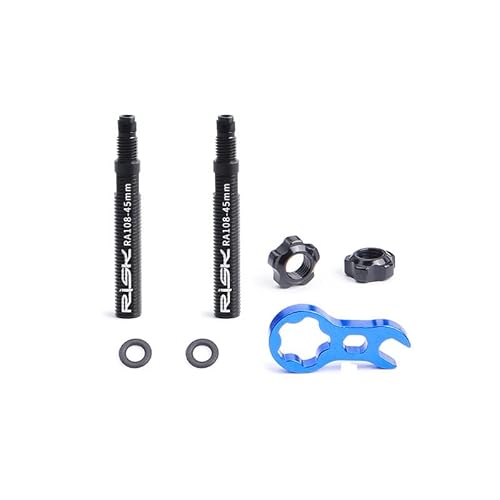
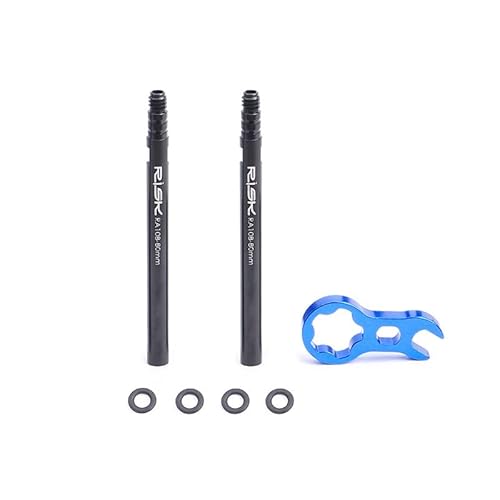
Live listings for the shortlist in this guide are pulled from Amazon below, so prices and availability are always current at the moment you look.


Buying checklist, and the quiet satisfaction of a valve that simply works
Before ordering, settle five things. Know your rim depth from the wheel maker’s page, not from memory. Know whether your valves have removable cores, from the wrench flats or the specification. Decide the family on that answer: removable-core extenders for removable cores and for any tubeless wheel, simple extenders for fixed cores and for the spares bag. Compute the length with the formula, rim depth plus 15 to 20 millimetres of working room, and check it against the maker’s chart if one exists. Finally, buy from a maker who publishes dimensions and fitting notes, and buy the spare at the same time, while the specification is in front of you.
There is no glamour in a valve extender, and that is rather the point: the best one disappears, leaving a deep, fast wheel that inflates in seconds on a wet morning, holds its pressure through the week, and asks for nothing but a clean core now and then – so measure your rim, pick the family that fits your valves, and let this smallest of parts be the one thing on the bike you never have to think about twice.