Our Top Picks
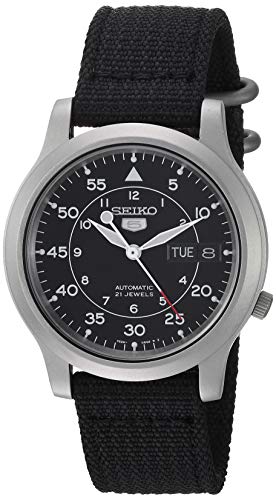 Seiko Men's SNK809 "Seiko 5" Automatic Watch with37 mm5.91 x 5.91 x 5.91 inches0.1 poundsCheck on Amazon


What's inside
- Why canvas straps keep earning their place on men’s watches
- Canvas itself: cotton weave, waxed finishes, and ballistic nylon
- Lug width: the 18, 20, and 22 mm decision
- Buckle straps, NATO-style one-piece straps, and what each does best
- Water, sweat, and the honest limits of a cloth strap
- Case sizes and wrist fit for men
- Field watches and the military style that shaped the category
- Strap thickness, spring bars, and the hardware details
- Canvas against leather and silicone: sweat, smell, and lifespan
- Colors, patterns, and pairing a strap to a wardrobe
- Watch families that wear canvas well, described by type
- Care routine: washing, drying, and storing canvas straps
- Fit problems and their fixes
- A brief history: from issued kit to everyday staple
- Weave, lining, and construction grades
- Canvas straps on smartwatches and hybrids
- Changing straps without marking the case
- Dress codes, seasons, and wearing canvas well
- Durability in real use: abrasion, ultraviolet light, and hardware wear
- A buyer checklist for canvas-strap watches and spare straps
- Special cases: large wrists, small wrists, and left-handed wear
- Putting it together: three sensible starting points
- Check prices on Amazon
- Canvas straps and skin comfort over long days
As an Amazon Associate I earn from qualifying purchases. This post may contain affiliate links at no extra cost to you.
Why canvas straps keep earning their place on men’s watches
A canvas strap changes a watch more completely than almost any other single part. It softens the look of a steel case, drops weight from the wrist, and brings a field-ready character that leather rarely matches and metal bracelets never attempt. For men choosing a watch for daily wear, travel, outdoor work, or a relaxed office, the combination of a legible dial and a woven strap has endured because it solves practical problems: canvas handles heat well, it tolerates knocks without showing every mark, and it can be swapped in minutes when a different color or a fresh strap is wanted.
The category covers more ground than the single word canvas suggests. True woven cotton canvas, waxed canvas with a water-shedding finish, and ballistic nylon woven in a tight basket pattern all sit under the same broad shelf label, yet they feel different on the wrist, age differently, and demand different care. Lug width, strap thickness, hardware style, and case size decide whether a given pairing looks deliberate or accidental. This guide works through each of those variables, then compares canvas with leather and silicone for sweat, odor, and longevity, so the final choice rests on construction detail rather than on a photograph alone.
Product families are described in general terms drawn from published maker specifications: case diameters, lug widths, water resistance ratings, and strap materials as the brands themselves state them. Strap condition, weave quality, and stitching vary between production runs, and a strap is a wear item by nature, so the guidance here focuses on the measurable points that stay true across examples: dimensions, materials, hardware, and care method.
Canvas itself: cotton weave, waxed finishes, and ballistic nylon
Traditional watch strap canvas is a plain-weave cotton fabric, tightly woven so the surface feels firm rather than floppy, often backed with a thin layer of leather or synthetic material to give the strap body. Cotton canvas breathes, which is the first reason it suits warm weather and active days. It also absorbs moisture, which is the first reason it needs honest care: a cotton strap that stays damp against the wrist will hold odor and lose its crispness far sooner than its weave wears out. Makers who take the material seriously use a dense weave, folded and stitched edges, and a backing that resists stretching at the buckle holes.
Waxed canvas starts as the same cotton cloth and receives a wax treatment, historically paraffin or beeswax blends, worked into the fibers. The wax sheds light rain, resists stains, and gives the surface a slight sheen that deepens in tone where the strap bends, a crease pattern owners often value as the strap ages. Waxed canvas dries faster than untreated cotton and picks up less grime, though the wax layer slowly wears and can be renewed with a fresh application warmed into the cloth. For a field watch that sees weather, waxed canvas is usually the most forgiving version of the material.
Ballistic nylon is a different cloth wearing a similar look. Developed for protective military applications, it uses a dense two-by-two basket weave of nylon filament that resists abrasion and tearing far beyond cotton. On a strap it feels smoother, dries quickly, and shrugs off water, but it lacks the matte, fibrous character of real canvas and can feel slightly synthetic against the skin in heat. Some makers layer the two ideas, a canvas top surface over a nylon core, trading a little authenticity for strength. Knowing which cloth is actually on the wrist explains most of the difference in how two outwardly similar straps behave after a year of wear.
Lug width: the 18, 20, and 22 mm decision
Lug width is the distance between the horns of the case where the strap attaches, and it is the first measurement to confirm before any strap purchase. Men’s field and casual watches cluster around three sizes. An 18 mm lug suits slimmer vintage-style cases and smaller wrists, giving a tapered, dressier line. A 20 mm lug is the most common fitting on modern field watches in the 36 to 40 mm case range, and it carries the widest choice of canvas straps in every color and weave. A 22 mm lug belongs to larger cases, divers, and tool watches, where a narrower strap would look pinched and leave the case visually top-heavy.
Measure the lug width directly rather than trusting memory or a listing summary. A digital caliper across the inside faces of the lugs gives the true figure in seconds; a ruler works with care, reading the gap rather than the strap that came off, because old straps shrink and compress. Strap makers cut to the stated width with small tolerances, and a strap half a millimeter wide can be persuaded in, while one a full millimeter over will buckle at the edges and wear its sides raw against the lugs. A strap slightly under width slides on its spring bars and clicks as the watch moves, a small fault that quickly becomes an irritating one.
Taper adds a second dimension to the same decision. Many canvas straps narrow by 2 mm from lug to buckle, 20 mm at the case and 18 mm at the clasp, which reads as refined and keeps the buckle end light. Straight-cut straps hold their width along the full length and suit the utilitarian character of military-style watches. Neither is better in the abstract; the case shape decides. A slab-sided tool watch wears a straight strap naturally, while a curved, polished case looks more coherent with taper echoing its lines.
Buckle straps, NATO-style one-piece straps, and what each does best
The classic two-piece canvas strap fastens with a pin buckle, one length carrying the buckle and the other a row of punched holes. It sits flat, adds almost no height under the case, and presents the cleanest profile with a shirt cuff. Hole spacing and count decide the fit quality: holes spaced about 6 to 7 mm apart across a generous range let most wrists land near the middle hole, which is where a strap looks and wears best. A strap worn on its last hole strains the hole edge; worn on the first, the tail flaps and catches on sleeves and straps of bags.
The NATO-style strap takes a different route, a single long piece of woven material that passes under the case between the spring bars and doubles back through a set of metal keepers, fastening with its own buckle. The design began as a military specification, and its virtues remain practical. If one spring bar fails, the watch stays on the wrist, held by the other bar and the one-piece construction. The extra length folds back into the keepers, giving the style its layered look, and the strap can be washed without removing anything from the case beyond sliding the whole piece free.
The trade-offs are height and bulk. A one-piece strap adds its thickness under the case, lifting the watch by roughly a millimeter or more, and the folded tail adds material at the side of the wrist. On a thin dress-leaning case that lift can spoil the line; on a field watch it reads as part of the equipment character. Two-piece straps keep a low profile and suit smaller wrists, while one-piece straps reward larger cases and owners who value the security story. Many men keep both styles for the same watch and swap by season or by trip, which is precisely the flexibility the format was built to offer.
Water, sweat, and the honest limits of a cloth strap
A watch case rated for swimming can still ride on a strap that hates water, and canvas sits in the middle of the strap water scale. Waxed canvas and ballistic nylon tolerate rain, splashes, and the odd dunk with little complaint beyond a slower drying time than silicone. Untreated cotton canvas soaks through, stays damp for hours in humid air, and repeated soaking shortens its life by working at the backing glue and the stitching. The case rating protects the movement; it says nothing about how the strap will smell after a week of sea air and sunscreen.
Sweat is the more common enemy. Salt and skin oils work into a cotton weave, and a strap worn daily through a summer without washing will develop a sour note that no surface wipe removes. The remedy is simple and cheap: wash the strap off the watch in lukewarm water with a small amount of mild soap, work the cloth gently with a soft brush along the weave, rinse until the water runs clear, and dry it flat away from direct heat. Radiators and hair dryers speed drying at the cost of stiffening cotton and cracking any leather backing, so patience and moving air are the better tools.
Drying time deserves planning. A thick canvas strap can take most of a day to dry fully in a still room, which is why owners who wear one watch daily often keep a second strap in rotation. Swapping straps every few days lets each one dry and rest, and the rotation spreads wear across two straps instead of concentrating it in the buckle holes and fold points of one. The one-piece style has an edge here, since it slides off in seconds without tools, making the wash-and-rotate habit easy enough to actually keep.
Case sizes and wrist fit for men
Canvas straps pair most naturally with cases between 36 and 42 mm, the span where most men’s field, pilot, and casual watches live. A 36 to 38 mm case on canvas reads as classic and wears easily on wrists under about 17 cm around, with the strap suppleness keeping the whole package light. The 39 to 41 mm band is the modern center of gravity: enough dial presence for quick reading, enough case to balance a 20 or 22 mm strap, and proportions that move between outdoor and office settings without apology. Cases above 43 mm can wear canvas well when the strap is thick and the lugs are 22 mm or wider, but the combination leans fully into tool-watch territory.
Lug-to-lug length matters as much as diameter and is quoted less often. It measures the full span the watch occupies along the wrist, and when that span approaches the width of the wrist itself, the case overhangs and the strap angles down sharply at both ends. Canvas helps here because it bends more readily than a stiff leather strap or a bracelet with solid end links, wrapping the wrist sooner and softening the visual overhang. Still, a published lug-to-lug figure under about 48 to 50 mm suits the widest range of men’s wrists, and makers who state it plainly make fitting far easier.
Strap length is the quiet third measurement. Standard men’s lengths assume a wrist in the broad middle range; men with wrists above roughly 19 to 20 cm should look for long versions or one-piece straps, whose extra length is built into the style. A buckle strap worn near its final hole not only strains the hole but also places the keepers in the wrong spot, so the tail either escapes or doubles back awkwardly. Checking the stated hole range against wrist size before purchase prevents the most common disappointment in strap buying.
Field watches and the military style that shaped the category
The modern canvas-strap watch descends from issued military field watches: matte cases, high-contrast dials with full Arabic numerals, luminous markers for night reading, and a woven strap chosen because it was cheap, light, replaceable, and tolerant of mud and rain. Current field watches from long-running Japanese, American, and Swiss lines keep that formula with better movements and sapphire or hardened mineral crystals in place of wartime acrylic. On canvas, the style coheres: every part of the watch looks selected for use rather than display, which is exactly the appeal for men who want one watch for most days.
Dial design decides how military the result feels. A black dial with bold white numerals and a 24-hour inner track is the full field statement, and it pairs naturally with olive, khaki, or black canvas. A cream or white dial with the same layout softens the effect toward vintage casual, working with tan or navy straps for warmer weather. Minimal dials without numerals move the same case toward a cleaner, almost dress-casual look, where a darker canvas strap in charcoal or deep brown keeps the pairing grounded rather than costume-like.
Case finish completes the picture. Brushed steel and bead-blasted finishes hide the small marks that outdoor wear brings and match the matte texture of woven cloth. Polished cases fight the strap visually, reflecting light while the canvas absorbs it, and they show scratches that a field strap shrugs off. Black-coated cases sit between the two, pairing strongly with black or dark grey canvas for a uniform look, with the caveat that coating wear at the lug edges will show bright metal over years of strap changes if bars are handled roughly.
Strap thickness, spring bars, and the hardware details
Canvas strap thickness usually runs from about 1.2 mm for a one-piece woven strap to 3 or 4 mm for a padded two-piece design with backing. Thickness changes both look and fit. A thin one-piece strap slides easily under most cases and suits watches with tight clearance between spring bar and case wall. A thick padded strap needs that clearance and can refuse to pass under bars set close to the case, a fit failure that surprises buyers who checked width alone. Where a maker states the bar-to-case gap or the strap states its thickness, compare the two numbers before ordering.
Spring bars are the load-bearing part of the whole arrangement and the cheapest to upgrade. Standard bars use a small spring-loaded tip at each end; shoulderless and heavy-duty variants give a firmer seat for one-piece straps that get pulled through their length daily. Fat bars, used on some tool watches, need a strap with room at the fold to accept them. Quick-release bars, now common on two-piece canvas straps, carry a small lever that lets the strap come off without a tool, trading a measure of old-school security for real convenience in rotation and washing routines.
Hardware finish and keeper design finish the inspection. Buckles and keepers in brushed steel match most field cases; black hardware suits coated cases, and bronze hardware belongs with bronze cases, where mixed metals look like an oversight. One-piece straps should have heat-sealed or well-stitched holes and keepers that stay in place rather than sliding to one end by midday. Stitching on two-piece straps should run straight, with no loose ends at the lug fold, because that fold is where flexing concentrates and where a weak stitch line fails first.
Canvas against leather and silicone: sweat, smell, and lifespan
| Quality | Canvas | Leather | Silicone |
| Sweat handling | Absorbs, needs washing, dries slowly | Absorbs, stains, cracks with repeated soaking | Absorbs nothing, rinses clean at once |
| Odor over time | Builds if unwashed, clears with soap and air | Builds deep in the hide, hard to clear fully | Lowest odor retention of the three |
| Water tolerance | Good when waxed, fair when untreated | Poor unless specially treated | Excellent, made for swimming |
| Look with a field case | Native pairing, matte and utilitarian | Warmer, more formal, suits dress-casual | Sporty, best with divers and digital cases |
| Typical service life | One to several seasons of daily wear | Similar, longer if kept dry | Longest, until tearing at the holes |
The table compresses the comparison, but the deciding factor is usually climate and routine. A man in a hot, humid place who wears one watch through work, exercise, and weekends will fight odor with cotton canvas unless the wash rotation becomes habit, and silicone wins that contest outright. The same man in a temperate climate, wearing the watch for ordinary days, gets the comfort and look of canvas with only occasional washing. Leather remains the choice when the watch must sit well with a jacket, accepting that summer sweat will shorten its best-looking years.
Cost of ownership tilts back toward canvas. A quality canvas strap generally costs less than a comparable leather strap and far less than a bracelet, and replacing it when the weave tires refreshes the whole watch for a modest outlay. That replaceability is part of the original military logic: the strap is the sacrificial part, renewed so the watch itself continues. Budgeting for a strap change every year or two of hard daily wear is not a flaw in the format; it is the format working as designed.
Colors, patterns, and pairing a strap to a wardrobe
Color choice follows the dial more than the wardrobe. Black canvas under a black dial gives a single dark block that suits black-coated and steel cases alike and hides grime the longest. Olive and khaki carry the field heritage openly and pair with earth-tone clothing without effort. Navy canvas is the quiet all-rounder, dark enough for an office, softer than black, and kind to both white and black dials. Tan and sand straps lighten a watch for summer and show dirt sooner, which some owners accept as part of the worn-in character and others read as a reason to wash more often.
Striped one-piece straps add pattern through woven bands of color along the length, a look with roots in regimental colors. Stripes raise the casual pitch of a watch considerably and can clash with patterned shirts, so they work best as the second or third strap in a rotation rather than the only one. Solid colors remain the safe foundation. A useful starter rotation covers three moods: a dark solid for general wear, an olive or khaki for outdoor days, and a striped or lighter strap for weekends, all in the correct lug width for one case.
Stitching color is the detail that separates a considered pairing from a random one. Contrast stitching in off-white or tan thread gives canvas a crafted, casual feel and echoes vintage field gear. Matching thread keeps the strap visually quiet and lets the case and dial hold attention. Neither choice affects durability when the thread is a proper bonded synthetic, but loose or purely decorative stitching on very cheap straps can unravel at the fold, one more reason the stitching line belongs on the inspection list before price enters the discussion.
best smartwatches with sleep tracking
Watch families that wear canvas well, described by type
Classic field watches from Japanese makers, built around automatic or quartz movements in 36 to 40 mm steel cases with 20 mm lugs, are the center of the category. Their dials favor full numerals, their water resistance suits daily life, and their lug spacing accepts the widest range of canvas straps made. For a first canvas-strap watch, this is the lowest-risk shape: proportions proven over decades, straps everywhere, and a look that survives changes in fashion because it was never following fashion in the first place.
American heritage field designs, some assembled domestically with quartz movements and slip-through one-piece straps as the factory fitting, lean harder into the military story. They often run slightly smaller in case size, wear light, and treat the strap as part of the product rather than an accessory. Their canvas is typically a sturdy woven nylon-canvas blend chosen for washing ease. Owners who plan to wear one watch through travel, yard work, and wet weather often land here, accepting a more utilitarian dial in exchange for a strap system built around removal and rinsing.
Swiss and German field and pilot watches raise the finishing level: better case brushing, sapphire crystals, movements with longer service stories, and canvas straps with leather backing and finer stitching. The pairing works because the strap keeps the watch honest; a refined case on canvas reads as deliberate understatement rather than economy. These watches usually carry 20 or 22 mm lugs and enough bar clearance for padded straps, opening the two-piece waxed canvas options that give the most tailored result in the whole category.
Dress-leaning casual watches can wear canvas too, with conditions. A slim case, a clean dial with applied markers, and a dark, fine-weave canvas strap with matching stitching produce a relaxed warm-weather alternative to leather. The weave must be fine and the edges finished cleanly; a coarse, frayed field strap under a polished dress case looks like a mistake rather than a style choice. When the conditions are met, the combination serves men who want one watch to loosen up for summer without buying a second case.
Care routine: washing, drying, and storing canvas straps
- Remove the strap, or slide the one-piece free, before washing so the case and crystal stay out of the water.
- Use lukewarm water and a drop of mild soap; work along the weave with a soft brush, paying attention to the buckle holes and the fold at the lugs.
- Rinse until no soap film remains, since dried soap stiffens cotton and attracts fresh dirt.
- Press the strap in a dry towel, then lay it flat in moving air; keep it away from radiators, strong sun, and hair dryers.
- Store spare straps flat or loosely rolled in a dry drawer, never sealed in a damp bag after a trip.
- Renew waxed canvas when water stops beading, warming fresh wax into the cloth and letting it cure before wear.
Rotation is the care habit that multiplies every other one. Two or three straps cycled through the week each get full drying time, and the weave at the stress points rests between wears. The buckle holes elongate more slowly, the fold at the lug keeps its shape longer, and odor never gains the foothold that daily unwashed wear guarantees. Rotation also spreads the small cost of straps across a longer calendar, since three straps rotated usually outlast three straps worn one after another to exhaustion.
Travel care is mostly about damp discipline. A strap worn swimming or caught in rain should dry before it goes into a packed bag, because a sealed, warm, damp strap is the fastest route to a musty smell that later washing struggles to clear. One-piece straps earn their keep again here: slide the strap off, rinse it in a sink, hang it over a hotel towel rail overnight, and the watch itself can stay on a spare strap or rest in a case. Men who travel with one watch and two straps rarely face a damp wrist twice in a trip.
Fit problems and their fixes
A strap that twists on the wrist usually traces back to width or bar condition rather than to the watch. A strap cut narrow for its lugs slides sideways and lets the case wander; a worn spring bar with weak tips lets one end of the strap shift under load. Replacing bars is cheap and quick, and measuring the true lug gap before blaming the strap saves a cycle of returns. A strap that sits correctly stays centered through the day with no conscious adjustment, which is the quiet test of a good fit.
Pressure points at the buckle or keepers point to thickness and hole position. If the buckle lands under the wrist bone rather than flat beneath the wrist, the strap length split between the two pieces is wrong for that wrist, and a different length split, shorter buckle piece or longer tail piece, fixes what tighter fastening only worsens. One-piece straps move the buckle to the side by design in some routings, which is why men who type all day often prefer them: nothing hard sits between wrist and desk.
Fraying at the edges tells its own story. Quality canvas straps seal or stitch their edges so the weave cannot unravel; early fraying on a new strap signals loose weave or skipped edge finishing, and it will not improve with wear. Minor fuzz on a well-worn strap is different, a surface nap that can be trimmed carefully, never burned, since synthetic blends melt rather than singe cleanly. Knowing which kind of fraying you are looking at separates a strap at the end of honest service from one that was never made properly.
A brief history: from issued kit to everyday staple
The woven watch strap began as logistics, not style. Mid-twentieth-century military specifications called for straps that could be produced in volume, replaced in the field, and kept serviceable without special tools or leather supplies. Cotton webbing met those demands, and the one-piece slip-through pattern meant a torn strap could be swapped in moments with nothing more than a knife tip or a dedicated bar tool. Soldiers kept wearing the pattern after service because it worked, and civilian makers adopted both the construction and the muted color palette that still defines the category today.
Civilian canvas straps gained their second wind when field watches themselves became everyday wear rather than specialist kit. As case designs from the service era were reissued for the public, the straps that belonged with them came along, refined with better stitching, metal keepers in place of cloth loops, and a wider color range. The modern market now spans faithful reproductions of issued patterns at one end and tailored two-piece straps in waxed canvas with leather backing at the other, all tracing back to the same practical origin.
That history explains a design habit worth knowing: canvas straps favor function words in their descriptions, weave density, sealed holes, bar tack stitching at stress points, because the pattern was judged on service life. When a modern listing dwells on those details, it is speaking the original language of the format. When a listing offers only color names and lifestyle language, the strap may still be fine, but the maker is selling an appearance rather than a construction, and the inspection points in this guide become the buyer homework.
Weave, lining, and construction grades
Not all canvas straps are built to the same grade, and the differences hide in three places: weave density, lining, and edge work. A dense weave feels almost smooth, resists stretching at the holes, and keeps its surface even after months of friction against cuffs and desk edges. A loose weave feels soft on day one and relaxes into a shapeless band by the end of a season, with holes that oval out and edges that curl. Hold a strap to the light: a tight weave blocks most light through the cloth, while a loose one shows a visible grid of bright points.
Lining decides comfort against the skin. Unlined cotton canvas is the lightest and dries fastest, but the weave texture can irritate sensitive skin during the first wears until it softens. A thin leather lining feels smooth immediately and adds structure, at the cost of slower drying and a shorter life if the strap is washed often. Synthetic linings split the difference, smooth and quick to dry, though some feel clammy in high heat. Men who plan to wash the strap weekly should favor unlined or synthetic-lined builds; men who wear the strap in an office and wash it rarely can enjoy leather lining without penalty.
Edge work is the third grade marker. Folded and stitched edges, where the cloth wraps around the strap core and the stitch line locks it, outlast glued and painted edges, which can split where the strap bends through the buckle. On one-piece straps, look at the holes: heat-sealed holes on synthetic weaves and stitched or eyeleted holes on cotton hold their shape, while simple punched holes in untreated cloth fray into ovals. These are small observations that take seconds in hand or can be judged from a clear product photograph, and they predict service life better than brand language does.
Canvas straps on smartwatches and hybrids
Canvas has crossed into the smartwatch world through quick-release straps and lug adapters, and the pairing has its own logic. A smartwatch case in aluminum or steel loses its gadget character on a woven strap, which matters to men who wear the same device from a morning run to an evening out. The lug question changes shape here: many smartwatches use proprietary fittings or state strap width at the case rather than a classic lug gap, so the maker adapter or the stated strap width for that exact case generation is the figure to trust, not a measurement taken from a different model year.
Comfort during exercise is the strong argument for canvas on a smartwatch worn around the clock. A woven strap breathes during sleep in a way a solid silicone band does not, and the buckle allows fine adjustment as the wrist swells and shrinks across a day of training and rest. The counterweight is water and sweat management: a canvas strap worn through daily workouts needs the wash rotation described earlier, while silicone can be rinsed in the shower without a thought. Men who track sleep with the same watch they train in often settle on canvas for the night and shoulder the laundry, or keep silicone for training days and canvas for the rest.
Sensor contact is the technical footnote. Optical heart rate sensors read best when the case sits snug and stable, and a buckle strap with closely spaced holes holds that position well once the right hole is found. A one-piece strap adds its layer under the case, which can tilt a thick smartwatch slightly and change sensor pressure; most wearers adjust one hole tighter and solve it, but anyone whose readings turned erratic after a strap change should check strap thickness and fit before blaming the device.
Changing straps without marking the case
Swapping a canvas strap is a five-minute skill worth learning properly, because scratched lugs are the tax on hurried changes. Work over a soft surface so a dropped bar stays findable and the crystal never meets a hard edge. A spring bar tool with a forked end compresses the bar tip from its shoulder while the strap is eased out of the lug; tape over the lug tops is the old watchmaker trick for protecting polished surfaces during the learning phase. Canvas straps forgive clumsy handling better than leather, since the cloth hides minor creases, but the case deserves the same care regardless of strap material.
Quick-release bars remove most of that risk and most of the excuse for never washing a strap. The small lever sits in a notch on the strap underside; a fingernail slides it, the bar compresses, and the strap lifts away. When refitting any strap, listen and feel for the click of both bar tips seating into their lug holes, then tug the strap firmly in both directions. A bar that missed its hole often holds for hours and lets go under a knock, and the tug check is the only inspection that reliably catches it before the watch finds the floor.
One-piece straps need no bar removal at all for routine washing, which is their quiet superpower. Note the routing before sliding the old strap out, over the first bar, under the case, over the second bar, so the new strap follows the same path and the buckle lands on the correct side. Reversing the routing puts the tail and keepers in awkward positions and can place the case off-center on the strap, small annoyances that owners sometimes live with for months without realizing a thirty-second rethread would fix them.
Dress codes, seasons, and wearing canvas well
Canvas sits at the casual end of the strap spectrum, and wearing it well means respecting that position without treating it as a ban. With an open-collar shirt, knitwear, chinos, or denim, a clean solid-color canvas strap looks entirely at home and often better than a tired leather strap kept past its prime. With a suit, the margin narrows: a dark, fine-weave, two-piece strap on a slim case can pass in many modern offices, while a striped one-piece strap under a formal cuff reads as a deliberate statement that not every workplace rewards. Knowing which room you are dressing for is the whole skill.
Season shifts the choice inside the canvas family. Summer favors lighter colors, unlined straps that dry after a wash, and one-piece styles that can be rinsed the same evening they were worn through a hot day. Winter brings thicker weaves and waxed canvas into their own, since the wax sheds slush and rain, and a padded two-piece strap sits comfortably over the longer wear hours of the season. Men in climates with a real rainy season often keep one waxed strap reserved for those months, sparing the untreated cotton straps the soaking that shortens their lives.
Formal occasions aside, the most common style error is mismatch of condition rather than category. A frayed, faded strap on an otherwise tidy watch drags the whole presentation down, while a fresh canvas strap makes an old field watch look intentional and cared for. Because canvas straps are the least costly part of the watch to renew, condition is a choice in a way that case scratches are not. Retiring a tired strap on time is the simplest presentation upgrade available to any owner in this category.
Durability in real use: abrasion, ultraviolet light, and hardware wear
Abrasion is the daily wear mechanism for canvas. Cuff edges, desk surfaces, seatbelt webbing, and bag straps all rub the same zones: the outer face near the buckle, the fold at each lug, and the edges along the tail. Dense weaves and waxed finishes slow that wear visibly, and rotating straps spreads it. When the weave at the fold begins to show the lining or core through the surface threads, the strap is near the end of safe service, because the fold carries the load of the spring bar and a failure there drops the watch without warning.
Sunlight works more slowly but just as surely. Ultraviolet exposure fades dyes, olive drifting toward grey and navy toward a dusty blue, and it weakens cotton fibers over long periods of outdoor wear. Fading alone is cosmetic and many owners value it as patina, the record of summers worn. Strength loss is the serious side, and it argues for retiring straps that have lived outdoors for several seasons even when they still look presentable in indoor light. Ballistic nylon resists ultraviolet damage better than cotton, one of its quiet advantages for men who work outside.
Hardware wears too. Buckle tongues thin where they ride the holes, keeper loops stretch, and the plating or coating on inexpensive buckles can flake at the edges. Stainless hardware avoids most of that and can even be moved to a replacement strap of the same width when the cloth wears out, a small economy that rewards buying straps with standard, removable buckles rather than stitched-in fittings. Checking hardware during each wash takes seconds and turns surprises into planned replacements.
A buyer checklist for canvas-strap watches and spare straps
- Confirm lug width by measurement: 18, 20, or 22 mm covers nearly every men’s field and casual case.
- Match strap thickness to the gap between spring bar and case wall, especially on padded two-piece straps.
- Choose the cloth for the climate: waxed canvas or ballistic nylon for wet use, untreated cotton for dry comfort.
- Check the hole range against wrist size so the buckle lands near the middle holes.
- Inspect stitching at the lug fold and the sealing of the holes before judging color or pattern.
- Prefer stainless buckles and keepers in a finish that matches the case.
- Plan a second strap from the start if the watch will be worn daily, so washing never leaves a bare wrist.
Price tiers in this category map loosely onto construction, and the checklist explains where money actually goes. The least costly straps use loose weaves, glued edges, and plated hardware; they serve as color experiments and spare straps rather than daily foundations. Mid-range straps buy dense cloth, stitched edges, and stainless hardware, which is where most owners should live. The highest tier adds waxed cloth from heritage mills, leather lining, and hand-finished stitching, rewards that are real but incremental. Spending in that order, construction first and story last, keeps the budget aligned with service life.
Buying the watch and strap together as a factory pairing has one advantage worth noting: the maker has already matched lug width, bar clearance, and hardware finish, and the strap proportions suit the case. Buying separately opens the full color and material range and usually lowers the cost of spares. Either route succeeds when the measurements are checked, and either can disappoint when they are assumed, because a two-millimeter error in width or a millimeter too much thickness defeats an otherwise perfect pairing.
Special cases: large wrists, small wrists, and left-handed wear
Men with larger wrists face a narrower shelf than catalog photographs suggest. Many standard straps run out of holes near a 20 cm wrist, and the fix is to shop by stated strap length and hole range rather than by lug width alone. Long versions of two-piece straps, and one-piece straps whose extra length is inherent to the pattern, serve this group best. Case choice helps too: a 22 mm lug and a lug-to-lug span near the upper end of the normal range keep proportions balanced, so the strap does not look like string holding a coin. When a maker publishes a wrist-size range for a strap, that range deserves more trust than any photograph of the strap on a model.
Smaller wrists have the mirror problem. A standard strap worn on its tightest holes leaves a long tail that wraps awkwardly, and a thick case on a long lug-to-lug span overhangs no matter how supple the canvas is. Short-length straps exist for this reason, and one-piece straps can be trimmed by a careful owner or a watch shop, with the cut end sealed to stop fraying. A 36 to 38 mm case with an 18 or 20 mm strap keeps the whole watch inside the wrist outline, and canvas flexibility lets the strap follow the wrist curve closely from the first wear, without the break-in period a stiff new leather strap demands.
Left-handed wearers and men who wear a watch on the right wrist should think about crown position and buckle orientation rather than strap style. A crown that digs into the back of the hand on one wrist may sit clear on the other, and cases with the crown at the four o’clock position or on the left side exist for exactly this reason. Buckle straps can be fitted reversed, buckle piece at six o’clock instead of twelve, when that places the tail and keepers more comfortably. Canvas tolerates these experiments gracefully because swapping and reversing a woven strap takes minutes and leaves no mark on the cloth or the case.
Putting it together: three sensible starting points
For a first purchase, the most forgiving combination is a 39 or 40 mm field case, a 20 mm lug width, and two straps: a solid olive or black one-piece for wet and active days, and a waxed two-piece with a buckle for ordinary wear. That pairing covers nearly every setting a casual watch meets, teaches the owner both fastening systems, and keeps a dry strap always ready. From there, taste can wander toward stripes, tan summer straps, or finer lined canvas with experience of what the wrist actually prefers, rather than by guesswork at the start.
For a watch that must lean toward the office, keep the same case logic and shift the strap choices darker and finer: charcoal or navy fine-weave canvas, matching stitching, brushed stainless hardware, and a slim profile that slides under a cuff. For a watch that lives outdoors, reverse the emphasis: ballistic nylon or waxed cloth, a one-piece routing for security, and a spare strap in the kit bag. The case can be identical in all three lives; the strap wardrobe is what steers the watch between them, which is the deepest reason this category rewards attention.
Check prices on Amazon
Live listings for the shortlist in this guide are pulled from Amazon below, so prices and availability are always current at the moment you look.

Canvas straps and skin comfort over long days
Comfort over a fourteen-hour day is a different test from comfort in a shop, and canvas earns its reputation in the longer trial. A woven strap distributes pressure across its full width rather than concentrating it at the edges, and the cloth yields slightly as the wrist swells in heat, so the same hole setting stays tolerable from morning to evening. Men who find silicone clammy by midday and leather stiff until it breaks in often settle on canvas as the material their wrist forgets. The exception is the first days with a coarse weave, which can feel scratchy until the surface fibers lay down; a lined strap or a gentler weave avoids that settling period entirely.
Skin reactions are uncommon with cotton canvas and usually trace back to detergent residue after washing or to metal hardware rather than to the cloth itself. Rinsing a washed strap until the water is fully clear, and choosing stainless or titanium hardware where nickel sensitivity is known, resolves most cases without giving up the format. A strap worn during heavy exercise should come off for a rinse the same day, because dried salt left in the weave is mildly abrasive against skin on the next wear. These are small habits, but they are the difference between a strap that stays in daily rotation for a year and one that gets abandoned in a drawer by the end of its first summer.
Weight completes the comfort picture. A canvas strap adds only a few grams, so the total watch stays close to the weight of the case alone, noticeably lighter than the same case on a steel bracelet. For men who type, drive, or work with their hands all day, that lightness reduces the urge to take the watch off and leave it on a desk, which is where watches get knocked to the floor or left behind. A watch that stays worn is a watch that gets used, and in that simple sense the humble woven strap may be the most practical part of the whole instrument.
One final habit protects both strap and watch: loosen the buckle by one hole during long flights or drives, when the wrist tends to swell in still air, then return to the usual hole on arrival. That tiny adjustment prevents the deep weave marks and end-of-day irritation that make some men conclude, wrongly, that canvas simply does not suit their wrist at all.
Disclosure: everything in this guide was assembled from brand-published dimensions, material descriptions, and care instructions reviewed on paper; the author never picked up, wore, or fastened any of the watches or straps discussed, so sizing checks against your own wrist and lugs remain the final word.
Months from now, the right canvas strap will show its map of creases and faded folds, and the watch above it will still be the one reached for without a second thought.


