Our Top Picks



What's inside
- How the effect works: pumps, jets and the audio signal
- Light through water: the LED half of the performance
- The sound: small drivers doing a secondary job
- Water: filling, chemistry and the slow problem of cloudiness
- Power: USB desktops, batteries and runtimes
- Connections: Bluetooth versions, aux inputs and pairing two towers
- Splash resistance and where the speaker can live
- Failure modes: clogs, leaks, dead lights and cloudy walls
- Desk use versus party use: two different products in one category
- Outdoor use, and why most of these belong indoors
- What to compare on a specification sheet
- A maintenance rhythm that keeps the display clear
- Reading demonstration videos and listings critically
- Controls, indicators and the small print of daily operation
- How the display behaves across musical genres
- Safety, children, pets and the electrical common sense of water displays
- Check prices on Amazon
- Choosing between the shapes: a closing framework
As an Amazon Associate I earn from qualifying purchases. This post may contain affiliate links at no extra cost to you.
Before the first jet rises, a word about how this page supports itself: some links here are affiliate links, and if you buy through one of them the publisher may earn a commission from the retailer at no extra cost to you, which funds the time spent reading manuals and specification sheets for products most reviewers dismiss in a paragraph. That arrangement does not influence which designs this guide praises or warns against, and every technical statement below is grounded in manufacturer documentation, published specifications and the established behaviour of small pumps, acrylic chambers and light-emitting diodes, rather than in any claim of personal product trials.
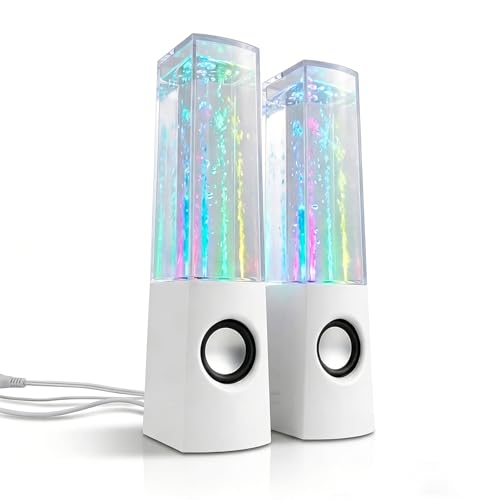
A dancing water speaker is a deliberate hybrid: part loudspeaker, part fountain, part lamp. Inside a transparent chamber, jets of water leap in time with the music while coloured light shines up through the moving columns, and the whole performance happens in a desktop object small enough to sit beside a monitor. Products in this class are bought for the spectacle first and the sound second, and an honest guide should say so at the outset, because judging them as though they were conventional speakers produces the wrong winner every time. The right questions are different. How convincingly do the jets follow the music? How tall and how varied is the display? How much maintenance does the water demand across a year? What fails first, and can it be cleaned, refilled or repaired when it does? This guide works through the mechanism, the optics, the acoustics, the plumbing, the electronics and the failure modes in that order, so a buyer can separate a well-made novelty from a short-lived one.
The category divides loosely into three shapes. Single desktop units pair one chamber with one or two small drivers in a base. Dual-tower sets place a chamber on each of two stereo speakers, so the display frames the listening position symmetrically. A smaller number of larger party models scale the idea up with taller chambers, bigger reservoirs and brighter lighting intended to read across a room rather than across a desk. The physics and the maintenance are the same in all three, but the specifications that matter shift: tower height and chamber volume dominate the party end, while footprint, cable routing and quiet pump behaviour dominate the desk end. Readers whose priority is actually the sound, with no water involved, will be better served by the conventional designs surveyed in best 2 1 bluetooth speakers, where a separate subwoofer does the low-frequency work that no dancing speaker attempts.
How the effect works: pumps, jets and the audio signal
Every dancing water speaker contains the same core assembly: a sealed or semi-sealed transparent chamber partly filled with water, a set of small nozzles along the chamber floor, and a pump or pressure mechanism that forces water up through those nozzles in pulses. When a pulse arrives, a jet rises, breaks into droplets at its peak, and falls back into the reservoir surface below. Fire the pulses in rapid, varied succession and the chamber fills with leaping columns that appear to dance. The water itself is ordinary; the choreography comes entirely from how the driving pulses are timed and how strongly each one is delivered.
Two drive methods account for nearly every product sold. In the direct-drive method, a signal derived from the audio output itself — tapped from the amplifier stage or from a dedicated sensing circuit — modulates the pump. Loud low-frequency transients, such as a kick drum or a bass note attack, produce strong pulses and tall jets; quiet passages let the water settle. In the microphone method, a small microphone in the base listens to the speaker’s own output or to the room and a control circuit converts what it hears into pump commands. Microphone designs can react even when the source is another speaker nearby, which makes for amusing demonstrations, but they also react to raised voices, door slams and applause on a television soundtrack, so their dancing is less faithful to the music. Line-level sensing is the more disciplined approach, and product documentation that states the sensing method plainly is a good sign; documentation that never mentions it usually means a microphone is doing the work.
The emphasis on bass is physics, not taste. Low-frequency content carries the rhythmic envelope of most popular music, and a pump is a mechanical device with inertia: it can follow the slow swell of a bass line far more readily than the thousands of oscillations per second in a vocal or a cymbal. Control circuits therefore filter the signal heavily, extract the low-frequency envelope, and map its level to pump power. This is why dancing speakers perform best with beat-driven music and can look almost idle during a string quartet or a spoken podcast, where the envelope is flat. It also explains why the display lags the sound by a small, visible interval on some models: the water column takes time to rise after the pulse, and cheap control circuits add their own delay on top.
Jet behaviour depends on nozzle design and chamber geometry as much as on the electronics. Nozzles are typically simple moulded apertures, sometimes arranged in a ring, sometimes in a row, occasionally with a central nozzle fed more strongly than its neighbours so the centre jet leads the display. Chamber height sets the ceiling for jet height, and responsible designs tune maximum pump pressure so the strongest transient throws water close to, but not into, the chamber roof; a model whose jets slam the roof on loud passages will mist the upper chamber walls, accelerate clouding, and stress its seals. Cross-section matters too: a narrow chamber produces a dense curtain of overlapping jets, while a wider one separates the columns so individual pulses can be read by the eye. Neither is objectively better, but the difference is visible in any demonstration video and worth choosing deliberately rather than discovering on delivery.
Light through water: the LED half of the performance
The lighting system is what turns moving water into a show. Light-emitting diodes mounted in the base shine upward through the chamber floor, and the water columns act as imperfect light guides: light entering the base of a jet is scattered and partly carried upward by the stream and its droplets, so each column glows in the colour of the diode beneath it. Where several diodes in different colours sit under different nozzles, the display becomes a set of coloured fountains; where a single colour-changing diode serves the whole chamber, the whole display breathes through a colour cycle together. Multicolour-per-jet designs look richer and cost more to build, and their documentation usually advertises the diode count, which is one of the few headline numbers in this category that correlates honestly with the visual result.
Colour behaviour is controlled in three common ways. Some units cycle colours automatically at a fixed pace unrelated to the music. Some shift colour with the same envelope that drives the pump, so loud passages flare one colour and quiet ones settle into another. Better designs offer both, plus a static colour choice and, importantly, a lights-off mode. That last option matters more than it sounds: a speaker used on a desk all day will sometimes be wanted as a speaker only, and a unit that cannot extinguish its display or stop its water becomes irritating in proportion to how long it is owned. Check the manual for a dedicated light control or a long-press function before assuming one exists, because on the simplest models the lighting is wired to the power state and cannot be separated from it.
Brightness and diffusion decide how the display reads in a lit room. In darkness, even modest diodes look dramatic through water. In daylight or under office lighting, the same display can wash out to faintly tinted water unless the diodes are bright and the chamber plastic is optically clear. Frosted chamber sections diffuse light evenly but blur the jets; fully clear acrylic keeps the jets crisp and concentrates the glow inside the columns. There is no specification-sheet number that captures this balance reliably, which is why demonstration footage recorded in a normally lit room is worth more than footage shot in a darkened studio, and why buyers planning a bright placement should weight brightness claims and diode counts more heavily than buyers furnishing a dim media room.
The sound: small drivers doing a secondary job
Sound quality in this category must be assessed with the priorities straight. The drivers fitted to dancing water speakers are typically small full-range units, commonly between about 40 and 60 millimetres in diameter, mounted in the base beneath or beside the chamber. A driver of that size, in a small enclosure, cannot move enough air to reproduce deep bass with authority; the laws governing cone area and excursion do not bend for novelty products. What such a driver can do well is the midrange — voices, melody instruments, the body of most music — and the better examples in the class are tuned to make that band clear and pleasant at desk distances rather than to pretend at bass they cannot produce. Some designs add a passive radiator, a non-powered diaphragm that resonates in sympathy with the main driver and extends the perceived low end modestly while adding a satisfying sense of weight to kick drums, which has the welcome side effect of strengthening exactly the signal the pump listens to.
Wattage claims in this category deserve particular scepticism. Listings frequently quote peak or summed figures that describe a theoretical maximum the amplifier chip could deliver into a stated load for an instant, not the sustained output the power supply and small drivers can actually use. A USB-powered model is bounded by what its supply provides: a standard USB connection delivers limited watts in total, and that budget must run the amplifier, the pump and the lighting simultaneously, so any claim of large audio wattage from a USB-only unit fails arithmetic before it fails listening. Battery models face a similar budget across a discharge cycle. The meaningful comparisons are driver size, enclosure design, and whether independent measurements or detailed documentation exist at all. A maker who publishes driver diameter, frequency response with its tolerance stated, and the amplifier’s rated output into a named impedance is behaving more honestly than one who publishes a single large watt number with no conditions attached.
Listening distance rescues the category. At a desk, the speakers may be less than a metre from the ears, where small drivers need little power to reach comfortable levels and where their limited bass is partly compensated by proximity. Across a room, the same units sound thin and strained when pushed, and pushing them also pushes the pump control into constant maximum, flattening the water display into a uniform boil that is less attractive than its dynamic range at moderate volume. This coupling between volume, sound quality and display quality is unique to the category: the sweet spot is a moderate level where the music is clear, the drivers are untroubled, and the jets still have headroom to leap on the chorus. Party buyers should therefore scale up to the larger models rather than overdrive desktop ones, a point the placement section returns to.
Water: filling, chemistry and the slow problem of cloudiness
Water is a consumable in these products, and how a design handles it determines whether the display looks as good in month twelve as in week one. Two architectures exist. Sealed chambers are filled at the factory and closed permanently; the buyer never adds or changes water, and the maker can include treatment agents in the fill to slow biological growth and mineral filming. Refillable chambers have a capped port through which the owner can top up, drain and replace the water, which permits maintenance but also permits mistakes. Neither architecture is automatically superior. A sealed unit is effortless until its water clouds, at which point nothing can be done. A refillable unit can be restored to clarity indefinitely, at the cost of a small chore performed correctly a few times a year.
The choice of water matters in a refillable design. Tap water carries dissolved minerals, chiefly calcium and magnesium salts in hard-water regions, and as tiny amounts of water evaporate or are lost as mist, those minerals concentrate and deposit on the chamber walls as a pale film, the same limescale that furs a kettle. Distilled or deionised water contains almost no dissolved minerals and largely prevents that filming, which is why most manuals for refillable models specify it. Distilled water is inexpensive and sold for irons and humidifiers in most supermarkets. What should never be added are dyes, oils or glitter suspensions not sanctioned by the maker: oils coat the nozzles and change jet behaviour, dyes stain acrylic permanently, and suspended particles clog the small pump passages described later.
Biological growth is the second slow problem. Any water exposed to light and warmth can support algae, which tint the water green and film the walls, and a chamber lit from below for hours sits squarely in that risk zone. Factory-sealed fills usually include a biocide or use a fill process that limits contamination. In refillable units, prevention is procedural: fill with distilled water, keep the cap sealed, store the unit away from strong sunlight when idle, and replace the water entirely if any green tint or musty odour appears rather than topping up over contaminated water. A chamber drained for storage should be left with its cap open in a ventilated place until the interior is dry, because a sealed, damp chamber in a dark cupboard is an ideal mould incubator; the manual’s storage instructions, where they exist, deserve to be followed literally on this point.
Water level affects performance in ways owners misdiagnose as faults. Too little water and the pump can draw air on strong pulses, producing sputtering jets and a rattling note from the base; too much and the falling water has too little airspace to break into droplets, so the display looks like agitated sloshing rather than distinct jets, and pressure on the seals rises. Refillable designs mark a fill line for a reason. Sealed designs hold their level permanently, though a very old unit can lose a small amount through microscopic seal permeability, one reason elderly sealed speakers sometimes dance less vigorously than their electronics would suggest.
Power: USB desktops, batteries and runtimes
Most desktop dancing speakers draw power over USB, which suits their natural habitat beside a computer and keeps them simple: one cable supplies the amplifier, pump and lights. The compromises follow from the power budget. Volume is modest, pump pressure is modest, and the unit depends on the host device or a USB supply being present and awake; a computer that sleeps its ports will silence a speaker mid-evening unless its settings are adjusted. Some models accept a separate mains adapter through a barrel or USB-C input, which usually unlocks a little more volume and jet height, and documentation that lists different performance figures for the two supply methods is, again, a sign of an honest maker.
Battery models trade that tether for placement freedom and add runtime as a specification to read critically. Runtime claims in this category are usually measured at moderate volume, but the pump and lighting draw a share of the battery that conventional speaker runtime tests never face, and that share grows with the music’s bass content and the display’s brightness. A runtime figure quoted without a stated volume or display condition should be treated as a best case. Practically, a battery dancing speaker at a party, playing beat-heavy music with the display at full brightness, should be expected to give noticeably less than its headline hours, and buyers planning an evening event should either choose the largest battery in the class or keep a mains supply within cable reach of the intended spot. Charging while playing is supported on most designs and solves the problem where the placement allows a cable.
For buyers comparing across power types, the ranges of conventional portable models in best high end portable bluetooth speakers illustrate what runtime and output look like when the entire power budget serves sound alone, which is a useful calibration even if the final choice remains a dancing model chosen for its display.
Connections: Bluetooth versions, aux inputs and pairing two towers
Wireless connection in this class is typically Bluetooth, and the version number matters less than buyers are led to believe, though it is not meaningless. Recent versions improve connection stability, power efficiency and multipoint handling — the ability to stay connected to a phone and a laptop and switch between them — while older versions in the 4.x family still carry music perfectly well at desk range but may drop more readily through walls and lack multipoint entirely. What matters more in daily use is codec support and latency behaviour. Standard music codecs are universal here; low-latency modes are rare, and a dancing speaker used for video will usually show a perceptible delay between lips and sound unless the player compensates. These are products for music first, and documentation that acknowledges video delay honestly is preferable to silence on the subject.
A wired auxiliary input, usually a 3.5 millimetre socket, remains valuable out of proportion to its age. It connects sources without Bluetooth, it eliminates latency for video, it provides the cleanest possible signal for the pump’s sensing circuit, and it rescues the evening when a phone refuses to pair. Some units also accept audio over their USB connection or play from removable media, though in this category such extras are uncommon. When a dual-tower set is wired, the aux input usually lands on one designated primary tower, which then feeds its partner; which tower is primary, and whether that assignment can be swapped, affects where the set can sit relative to the source, and the manual’s connection diagram is the place to confirm it.
Stereo pairing in dual-tower sets works in one of two ways. Wired sets join the towers with a link cable carrying the second channel, a simple and reliable arrangement whose only cost is a cable run between them. Wireless sets designate one tower as the Bluetooth receiver and forward the other channel to the second tower over a separate wireless link, sometimes described as true wireless stereo. The wireless version demands that both towers be powered, charged and within range of each other as well as sensibly placed, and its channel assignment can occasionally swap or drop to mono after a power interruption, which the manual’s re-pairing procedure exists to correct. For a permanent desk installation, wired linking is set-and-forget; for a party layout rearranged each time, wireless towers earn their complexity. Either way, the mirrored water displays are the point of the format: two chambers answering the same bass envelope in synchrony frame a room’s music in a way no single unit can, and synchrony itself is a quality marker, since a lagging tower betrays a weak inter-unit link immediately.
Splash resistance and where the speaker can live
A dancing water speaker contains water but is not necessarily resistant to water from outside, and confusing those two facts is a common and expensive mistake. The chamber is sealed against its own contents; the base, which holds the amplifier, pump motor, controls and battery, may have no ingress protection at all. Published ratings use the IP code defined in the IEC 60529 standard: a rating such as IPX4 indicates protection against splashing from any direction under test conditions, while the absence of any rating means the maker claims nothing and the base should be treated as ordinary electronics. A unit destined for a kitchen counter near a sink, or a bathroom shelf, should carry at least a splash rating for its base, and even then its controls and charging port deserve distance from direct spray.
Placement interacts with the display as well as with safety. The chamber needs a level surface: a tilt biases the jets, starves nozzles on the high side, and loads one seal continuously. It needs a stable surface, because a dancing speaker vibrates in sympathy with its pump pulses, and lightweight units can walk slowly across a smooth shelf toward its edge over an evening; a non-slip mat underneath is a trivially cheap insurance that also damps the buzz some bases transmit into hollow furniture. It needs clearance above, not because the water escapes, but because the visual effect reads best against a plain background at or slightly below eye level, and because heat from the lighting and electronics should dissipate freely. Finally, it needs distance from irreplaceable papers and keyboards, not because leaks are likely, but because the failure section below explains why the consequence of the unlikely event should be planned for anyway.
Failure modes: clogs, leaks, dead lights and cloudy walls
The pump is the mechanical heart and the most common point of failure. Small pumps in this class move water through passages only millimetres across, and those passages clog: mineral scale flakes, algae filaments, dust introduced during a refill, or a fragment of degraded seal material can each obstruct a nozzle or the pump intake. Symptoms arrive gradually — one jet shorter than its neighbours, a general loss of height, a pump note that rises in pitch as it strains — and in a refillable design the remedy is procedural: drain, flush the chamber with clean distilled water, run the unit briefly to clear the lines, and refill. Sealed designs offer no such access, which is the strongest argument for refillable construction in a product expected to last years. A pump that has run dry repeatedly, because the unit was operated tilted or with a low level, wears its bearings quickly and becomes noisy before it fails outright; a new rattle from the base is information, not character.
Leaks occur at seals, and seals age. The chamber’s joints — between the transparent wall and the base, around the fill cap, at the nozzle plate — rely on elastomer gaskets or adhesive bonds that harden, shrink or craze over years of temperature cycling and exposure to the chamber’s own treatment chemicals. A leak in this category is usually a seep rather than a flood: a damp ring at the base, a slow level drop, moisture where the unit stands. Any seep should be treated as the end of the unit’s placement over anything damageable, and probably as the end of the unit, because seal repair on a moulded chamber is rarely economical and a resealed joint beside mains-powered electronics is not a repair to improvise. This is the practical reason for the earlier advice about placement: electronics and water share the enclosure by design, and respect for the small probability of their meeting is part of owning the category sensibly.
Lighting failures are gentler. Individual diodes can fail, leaving one jet dark or one colour missing from a cycle, and driver circuits for the lighting can fail wholesale, leaving a speaker that plays and dances but no longer glows — a state many owners discover they find oddly acceptable, which says something true about where the product’s charm actually lives. Cloudiness is the slowest failure of all: a combination of mineral film, microscopic scratching from cleaning, and plastic ageing under light exposure gradually turns a crystal chamber into a frosted one. It cannot be polished back from the inside of a sealed unit, and in a refillable unit it can only be slowed by distilled water and soft cloths. Buyers choosing between two otherwise equal models should prefer the one whose chamber material is specified — acrylic grades differ in scratch resistance and clarity retention — over one whose chamber is described only as transparent plastic.
Desk use versus party use: two different products in one category
On a desk, the dancing speaker is a companion object. It sits within arm’s reach and within the near field of its listener, it plays at low to moderate volume for hours, and its display operates as ambient motion in peripheral vision. The qualities that matter are quiet pump behaviour, because a buzzing base at close range in a quiet room is the single most common reason these products are relegated to cupboards; a lights-off and water-off mode, for calls and concentration; a small footprint that does not evict the keyboard or monitor stand; and controls on the front or top that can be found without lifting the unit. Desk buyers should also consider how the display behaves with their actual music and speech content: spoken-word listening leaves the water nearly still, which some owners find restful and others find pointless, and no specification resolves that preference in advance.
At a party, the priorities invert. The display must read across metres, not centimetres, so chamber height, jet height and diode brightness lead the decision, and the sound must fill a room, which pushes toward the largest models or toward using the dancing speakers as visual satellites alongside a conventional speaker doing the audio work — a legitimate and increasingly common arrangement in which the microphone-driven designs, reacting to the room’s music rather than to their own small drivers, finally come into their own. Battery freedom matters for centre-of-room placement, multiple units synchronise a theme across a space, and the novelty itself is the entertainment, judged by guests in seconds rather than by an owner across months. Party buyers should plan the unglamorous logistics too: a level, stable surface away from drink traffic, because a knocked tower is the category’s most dramatic failure, and a charging plan for anything battery powered.
Between those poles sits the gift purchase, which deserves its own honesty. A dancing water speaker is a genuinely good gift for the right recipient — a teenager furnishing a first desk, a colleague whose workspace invites a talking point, anyone who enjoys objects that perform — precisely because it is not a sensible purchase, and gifts are allowed to be joyful rather than optimal. The giver’s responsibility is quality control on the recipient’s behalf: choose a maker whose documentation is real, prefer a refillable chamber so the gift can be maintained rather than discarded when it clouds, and check the return route in case the recipient’s taste runs the other way. The conventional alternatives at a similar size, surveyed in best 200 dollar bluetooth speakers, make the contrast plain: the same money buys markedly better sound with no display at all, and choosing the dancing model should be a deliberate preference for the show, not an accident of a listing that implied both.
Outdoor use, and why most of these belong indoors
It is tempting to carry a dancing speaker onto a patio for an evening, and battery models invite exactly that. The honest assessment is that the category is indoor equipment that tolerates a sheltered evening outside rather than outdoor equipment in any durable sense. The bases rarely carry meaningful ingress ratings, the chambers are not built to survive a fall onto paving, the displays wash out until dusk, and wind disturbs both the sound and, on open designs, the water surface itself. A calm, covered terrace after sunset is a fair venue; a poolside afternoon is not, both because splashes threaten the base and because a unit knocked into a pool takes its battery and electronics with it. Buyers whose real requirement is music outdoors in all weathers should start from the weather-sealed designs in best outdoor rock bluetooth speakers, which trade any visual performance for enclosures built to live outside permanently, and treat a dancing speaker as the indoor centrepiece it was designed to be.
What to compare on a specification sheet
Given the marketing fog around this category, a disciplined comparison list helps. Chamber volume, where stated, predicts the scale of the display better than overall product height, much of which can be base. Chamber height alone sets the maximum jet travel, so compare it directly between models rather than comparing total unit height. Nozzle count predicts display density; a single central jet produces a metronome, while five to nine nozzles produce a chorus line. Diode count and whether colours are assigned per jet or shared predict lighting richness. Driver diameter and the presence of a passive radiator predict sound quality more reliably than any watt figure. The sensing method — line-level or microphone — predicts how faithfully the water follows the music rather than the room. Power source and, for battery models, the conditions attached to the runtime figure predict where the unit can live. Refillable versus sealed construction predicts whether the unit can be maintained in year three. A maker who publishes most of that list is selling a product; a maker who publishes only a watt number and a photograph is selling a surprise.
- Chamber height and volume, nozzle count, and whether maximum jet height is stated or shown in a lit-room demonstration.
- Sensing method for the pump, and whether a sensitivity control exists for quiet listening.
- Diode count, per-jet colour or shared colour, and the availability of a lights-off mode.
- Driver diameter, passive radiator presence, and amplifier output stated into a named impedance.
- Bluetooth version, multipoint support, and the presence of a wired auxiliary input.
- Power type, runtime conditions for battery models, and whether it can play while charging.
- Sealed or refillable chamber, specified fill water, and the maker’s stated cleaning procedure.
- Any ingress rating for the base, stated as an IP code rather than a vague splash-proof claim.
A maintenance rhythm that keeps the display clear
Ownership goes well when a few small habits are established at the start. Wipe the chamber’s exterior with a soft, dry or barely damp cloth; household glass cleaners are unnecessary and some solvents craze acrylic, so the manual’s cleaning guidance governs. Keep the unit out of sustained direct sunlight, which warms the water, encourages algae and ages the plastic. For a refillable model, inspect the water monthly: clarity, colour and any particles are all visible through the wall, and a water change at the first hint of tint is far easier than rescuing a filmed chamber later. Top up only with the specified water, to the marked line, with the unit switched off and its charging cable removed, and dry the cap area before resealing so grit does not enter the threads. Every few months, run the unit on a plain surface and look underneath afterwards; a dry underside confirms the seals, and any dampness is early warning worth acting on while the unit can still be moved somewhere harmless. Before long storage, drain a refillable unit completely, leave the cap off until the interior is dry, and store it upright in its box away from radiators; a sealed unit simply wants a cool, dark shelf and a charge state for its battery in line with the maker’s storage advice, commonly neither completely full nor completely empty.
Reading demonstration videos and listings critically
Because the product is a performance, it is sold through performance footage, and that footage deserves the same scepticism as a specification sheet. Dark rooms flatter brightness. Close framing flatters scale; look for a familiar object in frame — a keyboard, a mug, a hand — to judge chamber height honestly. Edited footage can cut between songs and hide the idle behaviour during quiet passages, so unedited clips that include a verse-to-chorus transition reveal the pump’s dynamic range and lag far better. Audio in a demonstration is frequently replaced or sweetened, so it proves the water moves, not how the unit sounds. Listings that show the unit beside a computer in ordinary room light, state the sensing method, and publish a manual that can be downloaded before purchase are operating at a level of candour that correlates, in this category as in most others, with the product surviving its second year.
Controls, indicators and the small print of daily operation
The control layout of a dancing speaker decides how pleasant it is at the moments nobody photographs: pausing the music when the phone rings, dimming the display late at night, reconnecting a Bluetooth source that has wandered off. Physical buttons with distinct shapes can be operated by feel, which matters when the unit sits behind a monitor or on a shelf above eye level, while a single multi-function button that encodes everything in presses and long presses demands that the owner memorise a small language. Manuals reveal the truth here, and the control table is one of the first pages worth reading in any downloadable manual. A separate control for the water and light display, independent of volume and power, is the layout to hope for, because it lets the unit serve as a plain speaker during a call and resume its performance afterwards without a reconnection ritual.
Indicator lights deserve a sentence of their own. A small status diode that distinguishes charging, pairing and playing states by colour or blink pattern prevents the stabbing guesswork that otherwise greets a silent unit: is the battery empty, the source disconnected, or the volume simply down? Better designs put pairing into an obvious state after a long press and announce it with a tone, and they remember the last connected source so a desk unit reconnects to the same computer each morning without intervention. Auto-power behaviour cuts both ways. A unit that sleeps after a period without signal saves its battery and rests its pump, but a unit that sleeps too eagerly will cut the water display during a quiet film score or a long spoken introduction, so a stated sleep delay, or the ability to disable sleep while mains powered, is a detail worth confirming in documentation rather than discovering during the first film night.
Volume synchronisation between the source and the speaker is another quiet determinant of satisfaction. Where the speaker supports absolute volume control over Bluetooth, the phone’s volume buttons and the speaker’s output move together, and the pump’s sensing circuit tracks the level the listener actually hears. Where it does not, two volume controls fight: the source can be loud while the speaker is quiet, and the display, if it senses at the amplifier stage, may dance vigorously to music the room barely hears, or sit still during music played loudly from a low source setting. This behaviour is rarely advertised, but it explains a family of puzzled owner reports about displays that seem disconnected from the music, and it is one more reason the wired auxiliary input, with its single, predictable level path, remains the reference connection for judging any individual unit’s true responsiveness.
How the display behaves across musical genres
Because the pump follows the low-frequency envelope, genre is destiny for these speakers, and a buyer whose listening is broad should know how the display’s character changes across a library. Electronic dance music, hip-hop and modern pop production, with their steady kick patterns and shaped bass lines, produce the textbook display: regular, confident jets with clear variation between verse and chorus. Rock recording varies more; a live recording with an uncompressed drum kit gives lively, irregular motion, while a heavily compressed studio track can hold the pump near a constant level and flatten the choreography into enthusiasm without detail. Jazz with an acoustic double bass produces gentler, slower swells that many owners find the most elegant behaviour of all, the water rising and settling at the pace of a walking bass line rather than leaping.
Classical and acoustic music test the design’s sensitivity floor. A string quartet’s envelope is smooth and its low content modest, so only a unit with a sensitive, well-tuned sensing circuit and a low minimum pump threshold will move at all, and even then the motion is a breathing rather than a dance. Film soundtracks sit between the extremes: dialogue leaves the water still, which is arguably correct behaviour, while action sequences and orchestral climaxes wake it fully. Spoken word, news and podcasts produce near-stillness punctuated by the occasional emphatic syllable if the sensitivity is set high, and owners who listen to speech for much of the day should choose a model whose display can be switched off independently, returning to the control point made earlier, rather than one whose stillness they will read as brokenness. None of this is a defect to be engineered away; it is the honest consequence of a display driven by musical energy, and matching expectations to a household’s actual listening is the difference between a product that delights for years and one that is returned within the week for performing exactly as physics requires.
Sensitivity and response controls, where fitted, mediate between these extremes. A sensitivity dial or app setting raises the pump’s response to quiet material at the cost of also raising its response to electrical noise and room sound on microphone designs. A response or smoothing setting trades immediacy for grace: fast response follows each drum hit individually but can look frantic, while slower smoothing merges hits into waves that suit orchestral music. Digital models increasingly place these adjustments in a companion application, which adds setup complexity but allows per-genre presets. Print the manual’s page describing these controls and keep it with the unit; the difference between a display that seems random and one that seems musical is very often a single setting changed once, correctly, by an owner who knew it existed.
One further ownership detail separates careful makers from careless ones: spare parts and documentation longevity. Fill caps, gaskets and link cables are the small components most likely to be lost or to perish, and a maker who lists them as orderable parts, or who at least specifies their dimensions in the manual, extends the product’s life by years. The same applies to firmware or companion application support on digital models, where an abandoned application can strand the lighting controls on a phone the owner no longer has. Before buying, a quick search of the maker’s support pages for the model’s manual, a parts list and any software downloads is a five-minute investigation that predicts the ownership experience more reliably than any unboxing video, because it reveals whether the company expects its product to be maintained or replaced.
Safety, children, pets and the electrical common sense of water displays
A dancing water speaker is a low-voltage device, and that fact should frame its safety discussion calmly. Units powered over USB or from an internal battery operate at voltages that present no shock concern from the device itself, and the mains exists only inside a separate certified power adapter, which should be the adapter supplied or one from a reputable maker with the correct rating, never a damaged or improvised substitute. The sensible rules are the ordinary ones for small electronics near water: keep the adapter and its cable away from sinks and baths, do not charge a battery model with wet hands or in a steamy room, and retire any unit whose cable insulation is cut or whose base has taken a serious knock that might have opened a seam. A unit that has leaked onto its own electronics should be unplugged, allowed to dry completely, and treated as suspect even if it revives, because corrosion begun inside a base continues quietly after the surface looks dry.
Households with small children need a placement rule rather than a prohibition. The display fascinates children exactly as it is designed to fascinate adults, and a tower within toddler reach will be grabbed, shaken or pulled by its cable. Place the unit beyond reach or behind the natural barrier of a desk’s rear edge, route its cable so a tug pulls it along the surface rather than off it, and prefer a wide, low, stable model over a tall narrow tower in a family room. The water inside is a small volume and typically treated with agents not intended for drinking, another reason the chamber belongs out of mouthing range and any unit with a damaged chamber belongs out of use. For older children, the same product becomes a genuinely instructive object: the visible link between a bass line and a physical response demonstrates signal, energy and rhythm more vividly than most toys, and a refillable model maintained together teaches the small disciplines of distilled water, fill lines and inspection.
Pets present a narrower set of considerations. Cats are drawn to moving water and to warm electronics, and a cat that decides the chamber is a drinking fountain in waiting will pat it, sit on the base and occasionally knock a lightweight unit sideways; weight and a non-slip mat are the answers, along with placement that does not invite the experiment. The sound itself is ordinary speaker sound and holds no special risk beyond sensible volume, though the pump’s faint mechanical note sits in a frequency band some dogs notice, and an animal that finds the unit’s idle sounds interesting will usually lose interest within days. Aquarium households should note one genuine caution: a dancing speaker’s vibration and light show placed directly against a fish tank is an unnecessary stressor for its inhabitants, and a sensible distance between the two water displays keeps both performing for their intended audiences.
Check prices on Amazon
Live listings for the shortlist in this guide are pulled from Amazon below, so prices and availability are always current at the moment you look.

Choosing between the shapes: a closing framework
The decision resolves into three questions asked in order. First, where will it live? A desk argues for a compact single unit or a wired dual-tower set with quiet pump behaviour and full control over its lights; a party room argues for chamber scale and battery freedom; a gift argues for refillable construction and a forgiving return route. Second, what will it play? Beat-driven music rewards any model in the class; mixed listening with speech and quiet passages rewards line-level sensing with a sensitivity control, so the display stays alive at low volume without reacting to the conversation in the room. Third, who will maintain it? A sealed chamber suits an owner who wants no chores and accepts a finite visual lifespan; a refillable chamber suits an owner who will happily perform a ten-minute water change a few times a year in exchange for a display that can stay clear indefinitely. A model that answers all three questions for a particular household is the right one even if another model is taller, brighter or louder on paper, because in this category the best specification is the one matched to a real room, a real playlist and a real owner.
There is a final, slightly unfashionable point in the category’s favour that specifications cannot capture. Most consumer electronics ask for attention through notifications and screens; a dancing water speaker offers attention a place to rest, converting music that would otherwise be background into something a room watches together, and that modest, shared pleasure explains why a product class built on small drivers and small pumps has persisted through several generations of far more capable conventional speakers — so choose the one whose jets you can imagine still enjoying on an ordinary Tuesday evening, long after the novelty of the first song has worn off, because that quiet durability of delight is the true measure of a dancing water speaker.

