Our Top Picks
 Lighter Creative Footprints Terrain Bases for WH40K Tournament11.5" x 8"1 x 1 x 1 inchesCheck on Amazon


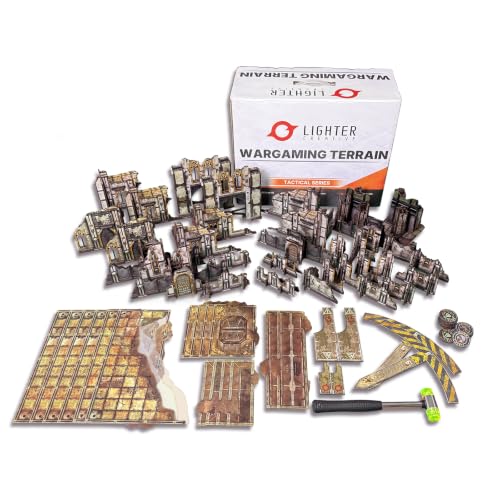
What's inside
- Start With Function, Not With a Theme
- Ruins: The Backbone of Almost Every Table
- Gothic Structures, Industrial Pieces, and the Space Between
- Scatter Terrain and Barricades: Small Pieces, Outsized Effects
- Scale, Proportions, and True Line of Sight
- How Current-Edition Rules Change What a Set Must Provide
- Board Coverage by Game Size
- Materials Compared: Plastic, MDF, Resin, Foam, and Printed Card
- Pre-Painted Sets Versus Build-and-Paint Kits
- Modularity and Footprint Standardisation
- Official Games Workshop Terrain Versus Third-Party Sets
- Storage, Transport, and Looking After a Collection
- Painting and Weathering Basics for Beginners
- Check prices on Amazon
- Putting a Collection Together
As an Amazon Associate I earn from qualifying purchases. This post may contain affiliate links at no extra cost to you.
Terrain decides how a game of Warhammer 40,000 actually plays. Two armies with identical lists can produce a cautious shooting duel on one table and a frantic contest for sheltered firing lanes on another, purely because the ruins sit in different places, the walls stand at different heights, and the gaps between footprints leave different routes open. A good terrain set therefore does more than decorate a mat. It supplies the physical vocabulary of the battle: corners to hide behind, upper floors to shoot from, low barriers that slow a charge without stopping it, and open ground that feels genuinely dangerous to cross. This guide compares terrain sets by category, material, footprint, and rules function, drawing on manufacturer documentation, current-edition rulebooks, and published product specifications rather than on impressions alone.
Readers support this site through purchases made via links to the retailer, and that funding helps pay for research time without changing which sets our research covers or how their specifications are described.
That distinction matters because terrain is easy to buy badly. A single spectacular centrepiece can dominate photographs while leaving the rest of a board empty. A box of low walls can look generous in a product image and then cover only a corner of a Strike Force table once the pieces are spread at sensible distances. Conversely, a plain set of L-shaped ruins with consistent footprints can transform every game played on it, even if no individual piece would win a painting competition. The sections that follow work outward from function to finish: first what each category does during a game, then how scale and line of sight behave in practice, then how much coverage different game sizes expect, and finally how materials, modularity, storage, and painting affect ownership over years rather than over one weekend.
Start With Function, Not With a Theme
Every terrain collection, whatever its visual theme, needs to answer four questions. Can infantry hide completely at the start of the game? Can vehicles and monsters move through the board without being funnelled into a single corridor? Are there positions worth advancing toward in the middle of the table, rather than only in the deployment zones? And can both players reach objectives without standing in the open for an entire turn? A set that answers yes to all four will serve almost any mission. A set that answers no to one of them will keep producing the same lopsided game, no matter how beautifully it is painted.
Spec sheets help here in a way photographs do not. Manufacturers list footprint dimensions, wall heights, and the number of separate pieces in a box, and those figures predict play value more reliably than a staged table shot. A ruin described as large may measure only a few inches along its longest wall, which makes it scatter rather than a true building. Two sets with the same piece count can differ enormously in total footprint area. Our research therefore treats dimensions as primary data: add up the footprints, note the tallest and lowest pieces, and check whether upper floors, if present, are large enough to hold a unit rather than a single model.
Theme still matters, just later in the decision. Gothic ruins suit Imperial worlds and read instantly as Warhammer 40,000. Industrial pieces suit manufactorum districts, ash wastes with a production past, and any army whose bases suggest factories or hive infrastructure. Xenos and frontier themes change silhouettes more than rules, yet silhouette is not trivial: tall, narrow pieces block sight along thin lines, while broad, low pieces shape movement across wide areas. Choosing a theme after settling the functional mix keeps a collection coherent without letting coherence become an excuse for missing categories.
Ruins: The Backbone of Almost Every Table
Ruins dominate modern 40K tables for sound reasons. A ruin offers a footprint that defines an area, walls that interrupt sight, and corners that let a unit occupy ground while remaining partly concealed. Broken wall sections create firing apertures without turning the piece into a solid block. When a ruin includes an upper floor, it also adds vertical play, giving infantry a reason to climb and giving opponents a reason to consider plunging fire, grenades, and charges that must measure vertical distance. Most matched-play layouts published in recent seasons lean heavily on ruins for exactly this combination of area definition and partial concealment.
Not all ruins behave alike. Corner ruins, usually L-shaped or U-shaped, are the most flexible pieces in any collection. An L gives two protected faces and two open faces, so rotating it during setup changes which approach it shelters. A U gives stronger enclosure and often becomes a home for a backfield objective or a support unit, though its interior can become a trap if the only exit faces the enemy. Full building shells with four walls look impressive but play awkwardly unless they have generous openings, removable roofs, or a footprint large enough that models are not constantly being lifted over walls to be placed inside.
Wall height deserves close attention. In the 28 to 32 millimetre scale used by the game, a ground-floor wall that rises roughly to the height of two infantry models will hide most foot troops completely when they stand behind it, while still letting taller walkers and monsters show above the parapet. That contrast is desirable. It creates a hierarchy of concealment in which different unit types experience the same ruin differently. Ruins with a mix of intact tall sections and collapsed low sections give that hierarchy within a single footprint, whereas ruins built from identical wall panels tend to produce flat, predictable sight lines.
Window and door apertures change a ruin from a sight blocker into a shooting position. Small, high windows favour models that can be placed precisely; large ground-floor openings favour units that need to see out as a group. Documentation for many plastic ruin kits shows alternative assembly options for apertures, and builders should think about those choices before glue dries. A wall with no openings at all is a pure blocker, valuable in a deployment zone. A wall pierced along its whole length is closer to a fence. Most collections want more of the former in the backfield and more of the latter near mid-table objectives, where two-way fights develop.
Ruins also carry a footprint question that pure wall sets avoid. Because area terrain is defined by its base or by the boundary agreed between players, a ruin without a base needs a convention: does the area extend to the outer edges of its walls, to a rectangle connecting its corners, or only to the walls themselves? Sets supplied with integral bases remove that ambiguity, which speeds setup and prevents mid-game disputes. Sets without bases look more natural on a textured mat and stack more compactly, but they ask players to agree boundaries before the first roll. Neither approach is wrong; mixing both in one collection without a house convention is where friction starts.
Gothic Structures, Industrial Pieces, and the Space Between
Gothic structures are the visual signature of the setting: arched windows, buttressed corners, shattered stained glass suggested by tracery, and rooflines that break into spires and stubs. As game pieces, intact gothic buildings differ from ruins mainly in completeness. A standing structure with a roof restricts placement inside and often functions as an impassable block with a footprint, while a roofless gothic ruin invites occupation. Buyers should read product descriptions carefully on this point, because the same silhouette can be sold as a ruin kit with open floors or as a solid scenic block, and the two play nothing alike.
Height is the gothic category’s great asset. Tall facades block sight for even large models, anchor the look of a city fight table, and give upper levels that overlook low scatter. Height is also its liability. Very tall pieces near the centre can split a board into sealed halves, and multi-storey kits with small floor plates may hold only a handful of models, turning an imposing building into a perch for a single character. Spec sheets that list floor dimensions, not just overall height, reveal which outcome a kit delivers. A floor that cannot fit a standard infantry unit’s footprint will see little use beyond lone models.
Industrial terrain works differently. Pipes, gantries, storage tanks, furnace stacks, and platform complexes create terrain that is porous rather than solid. A gantry lets models cross above ground level while remaining exposed. A pipeline blocks movement for vehicles, offers cover to infantry crouched behind it, and barely interrupts sight for anything taller. Tanks and silos are true blockers with small footprints, useful for breaking up a long diagonal without consuming much table. This porosity makes industrial sets excellent second purchases: they complicate a ruins-based table without replacing its structure.
Industrial pieces also introduce elevated walkways, and walkways introduce measurement questions. How wide is the platform? Can a unit stand on it, or only move across it? Do ladders and stairs count as part of the footprint? Manufacturer documentation for platform kits usually states platform dimensions and connector positions, and those details decide whether a network of gantries becomes a real second layer of the battlefield or a decorative obstacle that models keep falling off. Narrow walkways suit skirmish imagery; for squad-based play, platforms that hold several 32 millimetre bases side by side are far more practical.
Mixing gothic and industrial pieces in one set, as many starter collections do, gives a table narrative range: a shrine district beside a fuel depot, a manufactorum abutting a ruined chapel. The risk is dilution. A mixed box may contain too little of either theme to anchor a full board, leaving the owner with attractive variety and no coherent density. Players who already own ruins usually gain more from a focused industrial expansion than from another mixed assortment, while first-time buyers benefit from the mixed box precisely because it samples categories they have not yet learned to prefer.
Scatter Terrain and Barricades: Small Pieces, Outsized Effects
Scatter is the collective name for small, independent pieces: crates, barrels, wreckage, rubble piles, tank traps, statues, and low debris fields. Individually, none of it stops an army. Collectively, scatter fills the dead ground between major footprints, offers infantry places to pause mid-advance, and breaks up the long sight lines that survive even a well-placed set of ruins. Tables that feel empty despite having enough buildings usually lack scatter, not structures.
Good scatter shares three traits. It is low, so it modifies cover and movement without pretending to hide vehicles. It is stable, so a sleeve or a dice tray does not scatter the scatter. And it is quick to place, because a category that takes ten fiddly minutes to arrange will quietly stop being used. Sets moulded as clusters on small bases score well on all three counts. Loose individual barrels and crates look natural and can be arranged into walls, stacks, and depot scenes, but they migrate during play and multiply setup time; many owners end up gluing clusters together, effectively converting loose scatter into based scatter themselves.
Barricades occupy the border between scatter and structure. A barricade is a linear piece, longer than it is tall, designed to shelter a unit deployed behind it in a line. In game terms, barricades reward static gun lines and punish them in equal measure, because a unit arranged along a wall is a unit arranged conveniently for blast weapons and for charges that make contact along the whole frontage. Purpose-built barricade sets with consistent heights and lengths integrate cleanly with ruins; improvised barricades from crates and debris read as scatter and should be agreed as such before deployment, so nobody discovers mid-game that a pile of boxes has become a fortification.
Scatter is also where collections quietly acquire theme. A set of gothic ruins says city; the scatter says what the city did. Ammunition crates and fuel drums make it a logistics hub. Statues, braziers, and broken aquilae make it a shrine quarter. Alien growths, wrecked vehicles, and craters make it a battlefield rather than a district. Because scatter is comparatively cheap in material terms and quick to paint, it is the easiest category to own in two themes at once, letting one set of structures serve several narrative settings simply by swapping the small pieces around them.
One caution applies to scatter more than to any other category: count it honestly. Product photography arranges scatter densely, and a box that photographs as a depot may contain a dozen small pieces that cover very little ground when spread at playable intervals. Adding up base sizes from the specification gives a truer picture. As a working pattern drawn from published layouts, most tables want scatter distributed so that no large open lane runs the full length of the board without at least one interruption, and so that each objective has some small piece near enough to matter without sitting directly on the marker.
Scale, Proportions, and True Line of Sight
Warhammer 40,000 models are nominally 28 to 32 millimetre scale, often described as heroic scale because heads, hands, and weapons are enlarged relative to strict proportion. Terrain built to exact architectural scale can therefore look subtly wrong beside the models: doorways through which a marine could not pass, windows at ankle height, stairs with risers taller than a model’s knee. Better sets embrace the heroic convention. Doors are oversized, windows sit high and large, and floor-to-floor heights accommodate bulky armour. When comparing sets from different makers, place the stated wall height against a known model height from the documentation rather than trusting the scale label, because labels vary while millimetres do not.
True line of sight is the principle that what a model can physically see, it can target, subject to the terrain rules layered on top. In practice, players check sight by crouching to the model’s eye level or by using a laser line tool, and terrain determines the outcome through its actual geometry. This is why apertures, broken edges, and decorative holes matter so much. A ruin wall sculpted with cracks and missing bricks creates dozens of narrow sight lines that technically exist and practically invite argument. Sets with clean wall edges and deliberate window openings produce faster, cleaner games, because the intended sight lines are the visible ones.
Wings, banners, and raised weapons complicate true line of sight for models, and tall decorative terrain elements do the same for scenery. A statue’s upraised sword or a crane’s jib can block or permit a line that the main body of the piece would not. Most groups handle this by treating terrain as its footprint and principal volumes, ignoring thin decorative projections, but that convention works best when sets avoid extreme projections in the first place. When a specification lists overall dimensions, check whether the largest figure comes from a spire or antenna rather than from the usable structure; a piece can be tall on paper and low in play.
Base sizes interact with terrain scale in a less obvious way. Modern infantry commonly stand on 32 or 40 millimetre bases, and larger creatures occupy footprints wider than many ruin doorways and floor openings. A ruin interior that cannot admit a 40 millimetre base through any opening is, for those models, a solid block with extra steps. Interior dimensions and doorway widths appear in better product documentation and in assembly guides; where they are absent, overall footprint minus wall thickness gives a workable estimate. Collections intended for games involving Terminators, battlesuits, or hulking infantry should favour ruins with at least one wide breach per piece, not only narrow doors.
Vertical scale deserves separate thought. Upper floors at roughly three inches above the table and again at six inches have become a common convention in plastic kits, partly because those heights interact cleanly with movement values and partly because they stack well across manufacturers. Sets built to different floor heights can still share a table, but mixed heights inside a single ruin footprint create awkward intermediate levels that models cannot cleanly occupy. Consistency within each piece matters more than consistency across the whole collection.
How Current-Edition Rules Change What a Set Must Provide
Recent editions have shifted terrain from a collection of individual obstacles toward a system of defined areas with named traits. The core rulebook’s terrain framework assigns properties such as obscuring behaviour to area terrain: models inside an area may see out and be seen according to the rules for that category, while lines drawn across the area to models beyond it are blocked under the conditions the rules specify. The practical consequence for buyers is significant. A terrain set is no longer just a group of walls; it is a group of defined areas whose boundaries, not merely whose masonry, shape the game.
Obscuring ruins reward footprints that are easy to identify at a glance. Rectangular and L-shaped bases with clean edges let both players agree instantly where the area begins and ends. Irregular scenic bases with rubble spilling beyond the walls create a penumbra of uncertainty exactly where certainty matters most, at the boundary a model must cross to claim the area’s protection. This is a strong argument for sets with integral, geometric footprints for the main ruins of a collection, reserving freeform scenic bases for scatter and centrepieces whose area status matters less.
Area terrain also changes the value of interior detail. Under older, purely model-by-model sight conventions, a ruin’s interior walls were mostly decoration. Under area rules, the footprint itself carries much of the effect, so interior detail becomes a matter of placement practicality: can models stand inside without wobbling on sculpted rubble? Flat interior floors with texture shallow enough to keep bases level are a functional feature, not a lack of ambition. Kits whose documentation shows smooth interior floor plates with debris concentrated at the edges are designed with this in mind, and they play noticeably faster than ruins that treat every square inch as a sculptural opportunity.
Rules for moving through terrain have likewise raised the premium on openings. Where earlier editions abstracted passage, current movement rules make breach points, doorways, and ground-floor gaps into real tactical geography: a unit that must detour around a sealed ruin loses measurable inches, and a vehicle that cannot pass a gap at all must choose another route entirely. Sets that provide ruins in mirrored pairs with generous ground-floor openings support the symmetrical and near-symmetrical layouts that matched play favours. Sealed buildings still have a role as pure blockers, but a collection composed mainly of sealed buildings will produce boards that feel like mazes for the wrong reasons.
Finally, current missions score objectives that sit on the table, often in no-man’s land, and terrain near those points is contested all game. A set must therefore provide pieces sized for objective zones: footprints large enough to shelter a unit holding a point, small enough that the unit is not automatically beyond reach, and shaped so that models can occupy the area while remaining within range of the marker. Published tournament layouts, which many clubs adapt, illustrate this balance repeatedly, and buyers can learn a great deal by comparing a prospective set’s footprint list against one of those layouts before spending anything.
Players building boards at home often adapt these ideas alongside other hobby equipment; anyone printing custom markers or movement tools will find the comparisons in best 3d printers sub 500 useful when weighing whether to print small accessories instead of buying them, since printed scatter and objective markers pair naturally with purchased ruins.
Board Coverage by Game Size
The current edition organises games by points size, and each size carries a recommended board dimension. Combat Patrol games use the smallest boards and pre-set forces. Incursion games, at around a thousand points, expand the table. Strike Force games, at around two thousand points, use the full recommended board, commonly played at roughly sixty by forty-four inches in recent editions. Onslaught games go larger still. Terrain needs scale with area, but not linearly: doubling board area more than doubles the number of distinct positions, because the centre expands in both directions at once.
Combat Patrol
Combat Patrol forces are small, fixed, and designed to teach the game, so their boards need clarity more than complexity. A handful of ruins, a couple of low pieces, and modest scatter suffice. The danger at this size is overcrowding: too many footprints compress a small force into corridors and remove the manoeuvre the format exists to teach. Two substantial ruins, two smaller pieces, and a scattering of crates and barricades will fill a Combat Patrol board generously. Owners starting here should buy with expansion in mind, choosing a set whose style and footprint sizes will still make sense when the same pieces are spread across a board four times the area.
Incursion
Incursion is where collections are most often caught short. The board grows, armies gain transports and heavier units, and layouts that felt dense at Combat Patrol scale suddenly show long, open diagonals. A workable Incursion table generally wants four to six major footprints, at least two of them in or near the central band, plus scatter and at least one piece that meaningfully blocks sight for vehicles. Sets marketed as complete table bundles usually target this size or Strike Force; checking the stated total footprint area against the board size is the fastest way to tell which. As a rough orientation drawn from published layouts, major terrain footprints often cover somewhere around a fifth to a quarter of the board’s area in aggregate, with the rest of the effect coming from placement and scatter.
Strike Force
Strike Force is the reference size for most terrain discussion, most published layouts, and most product claims about covering a full table. A credible full-table set at this size typically provides eight or more substantial footprints, a vertical element or two, and enough scatter to dress the spaces between. Symmetry matters more here because both deployment zones must offer comparable shelter; a set with an odd number of near-identical ruins forces one side to improvise. This is why modular ruin systems sold in multiples have become popular for matched play: identical footprints make balanced layouts a matter of measurement rather than negotiation.
Density guidance varies by community, and that variation is healthy. Event layouts tend toward denser, more standardised boards that suppress first-turn shooting and reward movement. Club tables often run lighter, with more open ground and more narrative pieces. Neither is the correct amount of terrain in the abstract. What a set must provide is range: enough pieces to build the dense version, with the option to leave some in the box. A collection that can only just fill a board at maximum stretch gives its owner no choices, and terrain choice during setup is one of the game’s quiet pleasures.
Game size also changes which categories earn their place. At Combat Patrol, a tall centrepiece is a luxury. At Strike Force, some verticality is close to a necessity, because flat boards let long-range weapons dominate the expanded sight lines. Barricades, marginal on small boards, become useful at larger sizes where backfield units sit still for several turns. When a manufacturer’s bundle lists contents, mapping those contents against the largest game size the owner realistically plays is more informative than the bundle’s headline piece count.
Materials Compared: Plastic, MDF, Resin, Foam, and Printed Card
Material determines weight, durability, detail, assembly effort, and how a set ages. No material wins every category, which is why serious collections often mix two: one for the structural ruins that take knocks every game, another for characterful pieces used more gently.
Injection-Moulded Plastic
Hard plastic kits, the kind produced on steel moulds and supplied on sprues, offer the sharpest detail, the best resistance to tabletop wear, and the most forgiving painting surface. They assemble with plastic cement, can be converted and kit-bashed with other plastic ranges, and survive being dropped onto a gaming mat with little more than a snapped antenna in most cases. Their weaknesses are cost of tooling reflected in the box, assembly time, and the sprue waste they generate. For ruins and structures that will be handled weekly for years, plastic’s durability usually justifies its position at the top of most collections, and its compatibility with the models themselves, in material and in finish, helps a table look unified.
MDF and Laser-Cut Board
Medium-density fibreboard terrain arrives as flat sheets to be punched out and glued, and it has reshaped the market for footprint-standardised play. MDF ruins are dimensionally consistent, stack flat for storage, and can be produced with etched surface detail that reads well once painted or even when left in a sealed, pre-coloured finish. Their flat planes and right angles suit the area-terrain era: footprints are exact, walls are vertical, and sight lines are unambiguous. The trade-offs are edge durability, since MDF corners dent and can swell if they absorb moisture, and a certain flatness of silhouette compared with sculpted plastic. Painters mitigate the flatness with texture pastes, debris, and posters or decals; players who value clean geometry consider it a virtue outright.
Resin
Resin captures fine, undercut detail that plastic tooling historically avoided, and small producers use it for elaborate centrepieces, alien landscapes, and wreckage with real sculptural depth. Resin is also heavier, more brittle at thin sections, and more demanding to prepare, typically needing washing to release mould agents and care with dust when sanding. As the material for one dramatic piece, it excels. As the material for an entire working set that must be transported, stacked, and handled by opponents, it asks for commitment. Buyers should check whether a resin set is supplied as solid castings or hollow shells, because weight and fragility differ sharply between the two.
Foam and Pre-Printed Card
Expanded foam and printed card or board sets prioritise weight, speed, and coverage. Foam ruins are light enough to carry a full table in one bag and forgiving when knocked, though their surfaces dent, their edges crumble over time, and some paints and sprays attack the material unless it is sealed first. Pre-printed card terrain goes further toward convenience: fold, slot, or clip together, play immediately, store flat. Colour printing removes the painting barrier entirely, at the cost of a flatter visual finish and less tolerance for rough handling. For clubs equipping several tables, schools, and players who travel to games by public transport, these materials solve real problems that plastic cannot. Home printers have blurred this category too; the output quality discussed in best 3d printers less than 1000 explains why some players now print hybrid sets that combine printed structures with purchased plastic detail pieces.
Durability testing in the everyday sense, drops, knocks, and years of stacking, tends to rank plastic first, MDF second when kept dry, card and foam as consumables with long but finite lives, and thin resin last. That ranking reverses for sculptural detail and reverses again for transport weight. The sensible question is never which material is best, but which failure mode the owner minds least: chipped paint, dented corners, crumbled edges, or a cracked gargoyle.
Pre-Painted Sets Versus Build-and-Paint Kits
Pre-painted terrain removes the longest delay between buying terrain and using it. A table can go from bare mat to city fight in an afternoon, which matters for new players whose painting time is already committed to their army, and for clubs that need several tables ready at once. The finish on reputable pre-painted sets is usually a competent tabletop standard: base colours, drybrushed edges, and weathering washes that read well at arm’s length. Owners can still improve such pieces later with additional washes, pigments, or detail work, and because the base finish already exists, any later session is enhancement rather than obligation.
The limitations are consistency and repair. A pre-painted set bought this year may not match the same line bought later if the producer changes paint recipes or weathering intensity, and battle damage to a finished piece shows the raw material beneath in a way that demands a colour match to fix invisibly. Pre-painted pieces also constrain conversion: cutting a new doorway into a finished wall means repainting the whole affected area. Players who enjoy modifying terrain, or who expect a collection to grow in stages over several years, often find unpainted kits the safer long-term choice even though the first games wait longer.
Build-and-paint kits invert every term of that bargain. They demand assembly time, tools, and painting sessions before the first game, and they reward that investment with a collection finished exactly to the owner’s scheme, repairable from the same paint pots, and expandable whenever an identical kit is bought later. They also teach useful judgement. Assembling ruins reveals which wall sections combine cleanly, which floors warp, and which connectors loosen, knowledge that informs every later purchase. Spec sheets show part counts and sprue photographs for many kits, and those figures are a fair proxy for build time: a ruin with scores of small decorative parts will not assemble in an evening, however simple each individual part may be.
A hybrid route suits many collections. Buy the structural core, the matched ruins that define layouts, as kits to build and paint in a controlled scheme. Add pre-painted or pre-coloured scatter, barricades, and industrial dressing that can join the table immediately and be repainted gradually if the mismatch ever bothers anyone. This sequencing keeps a board playable throughout the building process, which is not a trivial benefit: projects that block play tend to stall, while projects that improve an already functioning table tend to finish.
Modularity and Footprint Standardisation
Modular terrain promises variety from repeated components: wall sections, corners, floors, and connectors that rearrange into different buildings each game. The promise is real but conditional. Modularity earns its keep when the connections are strong enough to survive transport and mid-game knocks, when the module dimensions divide evenly into sensible footprints, and when the owner actually rearranges the pieces. Many modular sets settle, after a few experiments, into a few favourite configurations that are then glued permanently, at which point the owner has paid in complexity for flexibility they no longer use. There is no shame in that outcome, but buyers should recognise it and consider fixed ruins when their habits are already known.
Where modularity genuinely shines is layout standardisation. Event play more and more uses published layouts with specified footprint sizes and positions, and a modular system built on a small set of standard footprints, for example rectangles in two or three sizes with walls placed along defined edges, lets a club reproduce those layouts faithfully. Footprint standardisation also simplifies storage, because identical bases stack, and simplifies fairness, because mirrored deployment zones can be built from identical pieces. Product documentation that states footprint dimensions prominently, rather than burying them, is usually a sign the maker designed for this style of play.
Connectors deserve scrutiny in any modular system. Magnets give fast, satisfying joins and allow walls to be swapped without wear, but polarity mistakes during assembly are tedious to correct, and strong magnets can snap pieces together hard enough to chip paint. Clips and pegs are mechanically positive and cheap, yet they loosen with repeated use and can be fiddly with painted, gloved, or hurried hands. Slot-together MDF relies on friction and gravity, which works until a table is nudged. None of these systems fails the category; each simply shifts effort between assembly day and game day, and our research suggests buyers should choose based on how often they truly intend to reconfigure.
Stackability is modularity’s quieter sibling. Ruins whose upper floors can nest inside their ground floors, walls that lie flat against each other, and industrial pieces whose pipes align in a case all reduce the storage volume of a set dramatically. Manufacturers rarely headline nesting behaviour, but assembly guides and product photographs often reveal it. A set that stores in half the volume of an equivalent non-nesting set is, for apartment dwellers and club organisers alike, a materially better set even if the two are identical on the table. Players who fabricate their own storage inserts or replacement connectors may also appreciate the machine comparisons in best 3d printers delta, since fast vertical printing suits tall, thin terrain accessories and custom clips.
Official Games Workshop Terrain Versus Third-Party Sets
Games Workshop’s own terrain carries the setting’s visual language in its purest form. The gothic detailing matches the model range, the plastic quality is consistently high, and boxed sets tied to game formats, such as boards and terrain packaged for specific mission packs or skirmish boxes, are designed against the current rules by the people who wrote them. When a new edition or season redefines layouts, official sets tend to reflect the change first. For players who attend events where published layouts assume particular footprints, that alignment has practical value beyond aesthetics.
The counterpoints are familiar. Official kits concentrate on the Imperium’s architecture, so xenos, Chaos-corrupted, and frontier tables require conversion or outside help. Box contents follow the needs of the box, not the needs of a full matched-play table, so assembling a complete Strike Force layout from official kits alone usually means buying multiples. And because the kits are detailed display-quality plastic, they ask for display-quality time: clipping, cleaning mould lines, assembling sub-assemblies, and painting architectural detail that simpler sets omit entirely.
Third-party producers compete on exactly those gaps. MDF specialists offer footprint-exact ruins in mirrored multiples, explicitly dimensioned for current layouts. Resin and boutique plastic makers offer alien flora, ork scrap structures, hive interiors, and ruined versions of architecture the official range treats only in passing. Pre-painted and pre-coloured producers offer instant tables. The quality spread is wider than in the official range, which makes documentation more important, not less: dimension lists, material specifications, and clear photographs of the actual product rather than renders are the markers of a third-party maker worth trusting.
Mixing official and third-party pieces on one table works best when scale and footprint discipline hold the mixture together. A third-party ruin with the same footprint and similar wall heights as an official one will play seamlessly beside it, whatever its surface detail. A piece with eccentric dimensions disrupts layouts no matter who made it. Paint scheme is the other great unifier: a shared palette of wall colour, trim, and weathering can make plastic, MDF, and resin pieces from five makers read as one district, while five unpainted or differently finished pieces from a single maker can look like a warehouse sale. Buy the mixture, then paint the unity in.
Storage, Transport, and Looking After a Collection
Terrain is bulky in a way armies are not. A two-thousand-point force fits in a case; the table it fights over may fill a car boot. Storage planning should therefore begin before the collection does. Measure the shelf, cupboard, or case the terrain will live in, and favour sets whose footprints tile into that space. Flat-packed MDF and nesting plastic excel here. Tall gothic pieces with spires and statues are the worst storers in the hobby, and a single fragile finial can dictate the box size for an entire shelf.
Transport adds impact and abrasion to the problem. Foam-lined cases protect painted plastic well but waste volume on air. Plastic storage boxes with pieces separated by bubble wrap or foam offcuts are cheaper and denser, at some risk to protruding detail. Magnetic storage, fashionable for models, helps terrain less, because most pieces are too large and light to benefit and many contain no metal-friendly base. What does help, consistently, is transporting ruins upside down or nested so that weight rests on their strongest edges, and keeping scatter in a single shallow tray where it can be seen at a glance during setup and, just as importantly, during packing away, when missing pieces are actually noticed.
Long-term care is mostly a matter of finishes. A coat of matt varnish protects paint from the handling terrain inevitably receives, and a second coat on edges and corners, the high-wear zones, repays the minutes it takes. MDF benefits from sealed edges to resist moisture. Foam needs sealing before painting and gentle storage away from heavy objects that will emboss it permanently. Resin needs the respect due to any brittle casting: no drops, no stacking under weight, no leaning on thin projections. None of this is elaborate, but collections that receive it still look deliberate after a hundred games, while neglected collections acquire a uniform shabbiness that no single game caused.
Clubs face an amplified version of the same decisions, plus labelling. A club set that cannot be packed by a tired volunteer at closing time into labelled boxes will slowly lose pieces, and incomplete ruins play worse than plain ones. For shared collections, standardised footprints, robust materials, and a painted scheme forgiving of touch-ups are worth more than sculptural excellence. Home collections can indulge the fragile centrepiece, because one owner handles it the same careful way every time. Hobbyists who make their own labelled dividers, tokens, and replacement parts will find the step-up discussion in best 3d printers intermediate relevant to producing durable accessories that match a collection’s footprints.
Painting and Weathering Basics for Beginners
Terrain painting rewards a different mindset from model painting. The goal is a convincing surface at table distance, achieved quickly across a large area, and the techniques that deliver it are correspondingly bold: prime thoroughly, establish the main colour with a large brush or sponge, pick out a contrasting trim sparingly, shade recesses with a wash, and restore the edges with drybrushing. A ruin painted in those five passes will look finished in play even if close inspection reveals every shortcut, because games are viewed from standing height and nobody’s eye lingers on a wall the way it lingers on a character model.
Colour choice shapes how armies look on the table. Neutral stone, warm sandstone, and muted industrial greys flatter almost every army scheme, which is why they dominate published tables. Strongly coloured terrain, rust-red industrial zones or pale marble shrine districts, creates memorable boards but can clash with particular forces and can make some model colours hard to read at a glance. Beginners do well to paint the structural core neutrally and reserve strong colour for scatter, doors, posters, and industrial dressing, where it can be changed or swapped without repainting the city.
Weathering is where terrain gains its story, and a little goes further than most beginners expect. Dark washes pooled at the bases of walls suggest damp and grime rising from the ground. Pale drybrushing on broken edges suggests fresh fracture in old masonry. Soot staining above windows and around industrial vents, applied as soft dark sponging, implies fires and exhaust without any sculpted damage at all. Rubble deserves restraint: a few piles at the feet of ruined walls, painted in the wall colour lightened with grey, sell destruction more convincingly than debris spread evenly everywhere, which reads as texture rather than event.
Consistency across a growing collection comes from a written recipe, however brief. Note the primer, the base colour, the wash, and the drybrush colour used on the first set, and later pieces can join the district years afterwards without visible seams. Photographing a finished piece beside the paints used achieves the same record with less writing. The recipe matters more than the brand, because terrain consumes paint in quantities that tempt substitution, and a near match applied with the same weathering passes will blend in, while an exact match applied differently will not.
Check prices on Amazon
Live listings for the shortlist in this guide are pulled from Amazon below, so prices and availability are always current at the moment you look.


Putting a Collection Together
A sensible buying order emerges from everything above. Begin with matched ruins in standardised footprints, enough for the largest game size played regularly, because those pieces define every layout. Add scatter and barricades next, since they multiply the value of the ruins immediately and paint quickly. Then add one contrasting category, industrial pieces for a gothic core or structures for an industrial one, to open up board variety. Leave the spectacular centrepiece until last, when its dimensions can be chosen to complement a working collection rather than to compensate for an empty one.
Judge every candidate set by the same short audit: total footprint area, tallest and lowest wall heights, number of genuine openings, whether floors can hold real units, how the pieces store, and what the documentation actually specifies. Sets that survive that audit rarely disappoint, whatever they cost in time or money, because their behaviour on the table was predictable from the start. Sets bought on photography alone disappoint in predictable ways too, usually by being smaller, flatter, or fewer than the pictures implied.
Budgeting for terrain benefits from the same discipline as measuring it. Because no static figure suits every maker or material, think in proportions rather than totals: the structural ruins will normally claim the largest share of any collection’s spending, scatter and barricades a modest share for a disproportionate return, and finishing materials, primer, washes, texture pastes, and varnish a small but real share that beginners often forget until the first unpainted wall stares back at them. Setting aside part of the plan for storage boxes from the beginning also prevents the familiar situation in which a finished collection lives in a pile because its owner spent everything on the pieces themselves and nothing on the containers that keep them safe between games.
Second-hand terrain deserves a mention in any buying plan, because ruins and structures change hands frequently when players leave the hobby or change scales. Inspect used pieces for the failure modes of their material: warped floors and softened detail on plastic that has been stripped, swollen or fuzzy edges on fibreboard that has absorbed moisture, chips at thin points on resin, and crushed corners on foam. Missing floors, connectors, and clips reduce a modular set’s value far more than worn paint does, since replacement parts may no longer be available, while a sound structure under an ugly scheme can be primed and repainted in an afternoon. Photographs of the underside and the joins reveal more about a used set’s condition than any number of heroic table shots.
It also helps to play a borrowed or club layout before committing to a personal style. A few games on dense, footprint-standardised boards and a few on lighter, narrative tables will teach a player more about their own preferences than any amount of product research, because preference in terrain is partly about temperament: some players love the chess-like clarity of mirrored ruins, others love a lopsided battlefield with a story. Neither temperament is wrong, and collections built honestly around one of them satisfy their owners far longer than collections built to imitate photographs of someone else’s games.
Above all, remember that terrain is the one part of the hobby every game uses and no army list can replace, so the collection that gets built, painted, and played with beats the grander collection that stays in its boxes.


