What's inside
- Where to buy
- Key Takeaways
- Quick Picks: Best 88-Key Weighted Digital Pianos That Work With Android Phones
- How did we judge pianos by both their keys and their Android apps?
- The picks in detail: best 88 weighted key digital piano that works with android phones
- Comparison table: six pianos, three questions each
- What does weighted and graded actually feel like?
- What do the Android apps actually add to practice?
- Bluetooth, USB or both — which connection should you want?
- How long should a weighted piano last a learner?
- What should your first month of practice look like?
- Headphones, speakers and neighbours: how will you actually listen?
- How does an Android phone change the first year of learning?
- How do teachers view the phone-and-piano partnership?
- How do you connect a digital piano to an Android phone, step by step?
- What mistakes do piano buyers make with apps and actions?
- Final Recommendation
- Frequently Asked Questions
- Related Guides
As an Amazon Associate I earn from qualifying purchases. This post may contain affiliate links at no extra cost to you.
gizmoverdict.com is reader-supported. When you buy through links on our site, we may earn an affiliate commission.
Where to buy
All six instruments in this guide to the best 88 weighted key digital piano that works with android phones are established models from Yamaha, Casio, Roland, Donner and Alesis, sold through major music retailers and the linked listings checked for this page. Buy from a seller who states the exact model, because piano actions differ between siblings that share a family name.
A stand, bench and pedal are part of the real purchase for most of these instruments; some listings bundle a sustain pedal, few bundle furniture. The reviews note what each piano expects you to add, so the price you imagine is the price you will actually pay to sit down and play.
Measure your space before ordering any of these instruments: eighty-eight keys need roughly a metre and a half of wall, plus depth for the bench and the player’s knees. The Privia forgives the tightest corners; the Rolands ask for a little more room and repay it. A piano that fits the room gets played in the room — the oldest truth in this guide, and the easiest to verify with a tape measure.
- Roland FP-30X — linked pick — use the Amazon button on this page
- Casio Privia PX-S1100 — linked pick — use the Amazon button on this page
- Yamaha P-45 (P45B) — linked pick — use the Amazon button on this page
- Roland FP-10 — linked pick — use the Amazon button on this page
- Casio CDP-S160 — linked pick — use the Amazon button on this page
- Donner DEP-20 — linked pick — use the Amazon button on this page
A digital piano succeeds or fails under the fingers. Eighty-eight keys are the easy part — every pick here has them — but weighted, graded action is what makes practice on a digital instrument transfer to a real piano: heavier in the bass, lighter in the treble, with enough resistance that your hands learn honest technique. This guide therefore judges actions first, sound second, and only then turns to the phrase that makes the keyword unusual — works with Android phones.
The Android partnership matters because the modern practice room runs on apps. Yamaha’s Smart Pianist, Casio’s Music Space and Roland’s piano apps turn a phone into the instrument’s control panel, lesson book and recording studio: adjusting voices without menu-diving, practising with guided exercises, recording a performance and hearing it back honestly. Each review describes its piano’s app relationship in qualitative terms — what the pairing is for — without inventing feature lists, because app versions evolve and the listing page is the authority on today’s specifics.
Connection routes vary: some of these pianos carry Bluetooth for audio or MIDI, others expect a USB cable and an inexpensive adapter to reach your phone. Neither route is a flaw; they suit different rooms and different budgets. What matters is that the partnership works, and each pick here has a genuine one.
A word about who this guide is not for: players seeking a stage keyboard, a synthesizer or a MIDI controller for production should shop in those categories, where the priorities invert. This page is about pianos — instruments whose first duty is to the acoustic tradition — that happen to speak fluent Android.
Key Takeaways
- Roland FP-30X is the complete package, pairing the PHA-4 weighted action with Roland’s app ecosystem and strong built-in sound.
- Casio Privia PX-S1100 is the slimline marvel, a genuinely portable weighted piano with Bluetooth and the Casio Music Space app.
- Yamaha P-45 is the trusted teacher’s choice, simple, honest and partnered with Yamaha’s Smart Pianist over USB.
- Roland FP-10 brings the PHA-4 action to the friendliest Roland price, for buyers who want the feel above all.
- Casio CDP-S160 is the student workhorse, with duet mode and USB-MIDI for app-based lessons.
- Donner DEP-20 is the budget doorway, a full weighted keyboard with pedal included for beginners testing their commitment.
- Hands decide, phones assist: every pick here honours that order — weighted keys first, Android partnership second, everything else after.
Quick Picks: Best 88-Key Weighted Digital Pianos That Work With Android Phones
| Pick | Badge | Why it earns its place |
|---|---|---|
| Roland FP-30X | Best Overall | The PHA-4 action and SuperNATURAL sound make it the piano teachers recommend when budget allows. |
| Casio Privia PX-S1100 | Best Portable | A weighted piano slim enough for small flats, with Bluetooth and Casio Music Space on Android. |
| Yamaha P-45 (P45B) | Most Trusted Teacher’s Pick | Yamaha’s Graded Hammer Standard action and a famously honest approach — the lesson-room standard. |
| Roland FP-10 | Best Action per Coin | The same PHA-4 family feel as its senior sibling, trimmed to the essentials at a friendlier tier. |
| Casio CDP-S160 | Best for Lessons and Duets | Scaled hammer action, duet mode for teacher-and-student playing and USB-MIDI for Android lessons. |
| Donner DEP-20 | Best Budget Doorway | A full weighted 88 with sustain pedal and power supply in the box — the lowest-risk start in piano. |
How did we judge pianos by both their keys and their Android apps?
The action test came first and eliminated the most candidates. Semi-weighted and synth-action boards can be fine keyboards, but they do not teach piano hands; every pick here uses a hammer-action system with graded weighting across the full 88 keys. Where a maker’s action has a known character — Roland’s PHA-4, Yamaha’s Graded Hammer Standard, Casio’s scaled hammer actions — the reviews describe that character in playing terms rather than brochure terms.
Android partnership was the second gate, judged qualitatively: does the maker offer a real Android app or a standard USB-MIDI route that Android lesson apps recognise? Yamaha’s Smart Pianist, Casio’s Music Space and Roland’s companion apps anchor the branded experiences, while standard USB-MIDI keeps the Donner and Alesis honest with the wider world of Android music software.
Sound, speakers and practicalities formed the third layer: a piano whose speakers cannot fill a living room will live through headphones, which is fine if stated; a piano without a proper sustain pedal path is not fine at all. Stands and benches were treated as the buyer’s homework and noted per model.
One more selection principle deserves daylight: every maker in this guide publishes the weight and dimensions of its action’s intent, maintains a service network, and has sold pianos long enough for teachers to have opinions about them. The internet offers cheaper 88-key weighted boards from names with none of that history, and some are surprisingly decent — but a piano is a decade-long purchase taught on by professionals, and a guide that will be read by parents buying for children owes them the makers whose instruments those teachers can vouch for. The Donner earns its place as the honourable exception: a younger brand whose starter instruments have built a genuine track record in exactly the beginner role it fills here.
The picks in detail: best 88 weighted key digital piano that works with android phones

Roland FP-30X — Best Overall
The FP-30X is the piano in this guide most likely to be the last piano a learner needs to buy. Roland’s PHA-4 Standard keyboard gives each key an individual, escapement-flavoured feel that rewards developing technique instead of tolerating it, and the SuperNATURAL piano engine responds to touch with the kind of tonal gradation that makes quiet playing expressive rather than merely quiet. Played side by side with cheaper actions, the difference is not subtle — it is the difference between practising typing and practising piano.
The Android partnership runs through Roland’s app ecosystem and Bluetooth connectivity, turning your phone into a larger, friendlier control surface for the piano’s voices and settings, plus a route into lesson and recording workflows. The built-in speakers are strong enough for a living room, the cabinet is portable without being flimsy, and a proper stand is available in Roland’s range. It asks the most money in this guide and returns the most piano; that is the beginning and end of its review.
A practice detail separates the FP-30X from its rivals in daily life: its sound holds together at low volume. Many digitals turn thin and apologetic when played quietly through their own speakers; the Roland keeps body in the tone, which matters because most home practice happens at household volume, not concert volume. Late-evening sessions through speakers — not just headphones — stay musical, and that quietly doubles the hours this piano gets played.
One audience should choose the FP-30X without further deliberation: the adult learner with a teacher. Teachers consistently ask for actions that will not need un-teaching later, and this is the action in the guide they name most. Its price buys out an entire category of future problems, and its app partnership keeps solo practice between lessons structured. That combination is why it, and not a cheaper instrument, is the safe expensive choice.
Bench verdict: the FP-30X is the piano this guide would buy with its own money for a serious student — the action alone justifies it, and everything else agrees.
- Keys: 88 weighted, PHA-4 Standard hammer action
- Sound: Roland SuperNATURAL piano engine
- Connectivity: Bluetooth and USB for app and MIDI use
- Speakers: built-in stereo system for room-filling practice
- Pedal: sustain pedal support, stand available separately
Strengths
- Action feel leads this entire guide
- Expressive sound rewards dynamic playing
- Bluetooth partnership with Roland apps and Android
Trade-offs
- Highest commitment in this line-up
- Stand and bench are separate purchases
- Weight makes it portable in principle more than in habit
Best for: Serious learners and returning pianists who want one instrument for years.
Not suited for: Buyers testing whether piano is for them at all — start with the Donner.

Casio Privia PX-S1100 — Best Portable
The PX-S1100 performs a small miracle of packaging: a full 88-key weighted action in a body slim and light enough to lean against a wall, slide under a bed or carry to a friend’s house without planning the expedition. Casio’s scaled hammer action feels convincing under the fingers — lighter in character than Roland’s, but genuinely graded and responsive — and the German grand piano tone at its heart sounds warm through both its speakers and headphones.
Bluetooth is built in, and Casio’s Music Space app on Android becomes the piano’s second front panel: choosing tones, adjusting the instrument and exploring its learning features from the phone screen rather than through button combinations. For apartment players, students in shared houses and anyone whose piano must share a room with the rest of life, the Privia’s combination of real action and real portability is unmatched in this guide.
The Privia’s party trick is social: it can be carried to where the music is. A weighted piano that visits a friend’s flat, a school hall or a garden room changes what its owner attempts — accompaniments, duets, impromptu teaching. Instruments shape musicians partly by where they can go, and the PX-S1100 goes places the rest of this guide visits only in a car with the seats down.
The Privia also wins the small-room sound argument: its speakers are voiced for near distances, so practice at conversation volume sounds full rather than apologetic — the exact condition of apartment playing. Add the wireless app control and the PX-S1100 becomes the piano most aligned with how urban musicians actually live: close quarters, shared walls, irregular hours, real standards.
Bench verdict: the Privia is the piano for real rooms and real lives — weighted, wireless and welcome anywhere, including the small flat where music was supposed to be impossible.
- Keys: 88 weighted, scaled hammer action
- Sound: Casio grand piano tones
- Connectivity: Bluetooth built in, Casio Music Space app
- Build: exceptionally slim and light cabinet
- Speakers: built-in stereo speakers
Strengths
- Portability no rival here approaches
- Bluetooth app control feels modern and simple
- Warm grand tone suits small rooms
Trade-offs
- Speakers are sized for rooms, not halls
- Action is lighter in feel than Roland’s PHA-4
- Stand and pedal arrangements vary by bundle
Best for: Apartment players and students who need a real piano that can move.
Not suited for: Players wanting the heaviest, most acoustic-like touch.

Yamaha P-45 (P45B) — Most Trusted Teacher’s Pick
The P-45 has spent years as the piano that teachers name when a parent asks what to buy, and its virtues are unfashionable ones: a Graded Hammer Standard action that teaches correct weight transfer, a core piano sound sampled from Yamaha’s acoustic grands, ten voices rather than a hundred distractions, and controls a child can master in an afternoon. It is an instrument that gets out of the way of the lesson.
Its Android partnership runs over USB to Yamaha’s Smart Pianist app, which gives the P-45 a graphical control panel and practice features its spare front panel never attempts. A cable and, depending on your phone, a small USB adapter are the price of that partnership — wired, dependable and latency-free. A sustain foot switch is included in the box, speakers are adequate for practice rooms, and a matching stand is sold separately. For households buying for lessons, this remains the calmest recommendation in the guide.
Longevity is the P-45’s closing argument. Yamaha’s parts and service network, the model’s long production life and its presence in thousands of lesson rooms mean a P-45 bought today will be repairable, sellable and recognisable for years. First pianos are often stepping stones; the P-45 is the stepping stone that holds its value while the student decides how far the path goes.
A small setup note completes the P-45’s picture: its USB partnership means the phone or tablet becomes its screen, so place a tablet on the music rest and the humble P-45 suddenly presents like an instrument with a built-in display. Owners who discover this arrangement rarely go back. It is the guide’s best example of the keyword’s whole thesis — the phone is not an accessory to the piano; it is half the interface.
Bench verdict: the P-45 is the recommendation that has survived a decade of lesson rooms — unfashionable, unpretentious and still correct.
- Keys: 88 weighted, Graded Hammer Standard action
- Sound: Yamaha acoustic grand sampling, 10 voices
- Connectivity: USB to host — Smart Pianist app on Android
- Included: sustain foot switch and music rest
- Speakers: built-in stereo speakers for practice
Strengths
- Action teaches honest technique from day one
- Smart Pianist app adds a friendly control panel
- Simplicity suits children and focused practice
Trade-offs
- Wired app connection — no Bluetooth onboard
- Voice library is deliberately small
- Stand is a separate purchase
Best for: Lesson households and beginners who want the teacher-approved route.
Not suited for: Players wanting built-in Bluetooth or hundreds of voices.

Roland FP-10 — Best Action per Coin
The FP-10 is Roland’s argument that action should not be the thing budget buyers surrender. It carries the PHA-4 action family — the same basic key mechanism philosophy as the FP-30X — paired with Roland’s SuperNATURAL piano sound, in a cabinet that strips away the extras: fewer voices, simpler speakers, no Bluetooth. What remains is the part your hands actually judge, and judged by hands, this is the best value in the guide.
Android partnership arrives via USB-MIDI, which opens the door to the wide world of Android lesson and recording apps even without Roland’s wireless conveniences. For a learner whose practice will be app-guided — and modern practice increasingly is — that wired route is entirely workable and arguably more reliable than wireless. Add a stand, use the included pedal path, and the FP-10 becomes the connoisseur’s budget answer: spend on the keys, economise on the garnish.
The FP-10 rewards a specific kind of buyer: the adult returner. Someone who played to a decent standard as a teenager, stopped for twenty years and wants their hands back will find this action honest enough to rebuild on, without paying for features aimed at beginners they no longer are. Paired with an Android lesson app for structure, it is a rehabilitation instrument — modest in the brochure, serious at the keys.
The FP-10’s speakers are its most forgivable compromise because its audience practises through headphones at a rate far above average — students, flat-dwellers, night owls. Judged in headphones, where its SuperNATURAL tone arrives undiluted, the FP-10 closes much of the gap to its senior sibling. Judge it in a hall and the gap reappears; judge it in a bedroom at midnight and it nearly vanishes.
Bench verdict: the FP-10 is the connoisseur’s shortcut — flagship fingers at a student price, with the savings spent exactly where a pianist would spend them.
- Keys: 88 weighted, PHA-4 hammer action
- Sound: Roland SuperNATURAL piano tones
- Connectivity: USB-MIDI for Android apps and recording
- Speakers: built-in stereo speakers
- Build: compact cabinet for its class
Strengths
- PHA-4 feel at the friendliest Roland level
- SuperNATURAL tone outclasses its tier
- USB-MIDI works with the broad Android app world
Trade-offs
- No Bluetooth — cables are the way
- Fewer voices and features than the FP-30X
- Speakers are modest in larger rooms
Best for: Learners who prioritise key feel over features, full stop.
Not suited for: Buyers wanting wireless app control out of the box.

Casio CDP-S160 — Best for Lessons and Duets
The CDP-S160 is built for the way piano is actually taught. Its duet mode splits the keyboard into two identical middle ranges so a student can mirror a teacher sitting beside them — a feature that sounds like a bullet point and feels, in a real lesson, like the whole point. Casio’s scaled hammer action gives developing fingers a properly weighted, graded surface to learn on, in a slim cabinet that suits homes where the piano shares space with everything else.
USB-MIDI connects the piano to Android devices, where Casio’s app world and the broader lesson-app ecosystem take over: guided practice, recording, and settings control from the phone. Built-in tones and effects cover the variety a student needs without burying the piano under a synth workstation’s ambitions. Speakers are honest practice-room equipment. For a child starting lessons or an adult returning with an app’s help, the CDP-S160 is the guide’s most lesson-shaped instrument.
Parents should note the CDP-S160’s headphone practicality: a child practising scales at seven in the morning is a household negotiation, and a piano that sounds full through headphones at that hour is practising diplomacy as well as music. The duet mode then turns the same instrument into the lesson’s centrepiece when the teacher arrives. Few products at this level serve both the solitary and the social hour so deliberately.
The CDP-S160’s effects and extra tones, easy to dismiss as garnish, serve one real purpose: they keep younger students exploring the instrument between pieces. A child who spends five minutes making the piano sound like a music box is still at the piano, still touching keys, still inside the habit. Teachers understand that loitering is practice in disguise, and this Casio is priced and featured to encourage exactly that.
Bench verdict: the CDP-S160 is the lesson-shaped piano — duet mode, honest action and app partnership, arranged around how teaching actually happens.
- Keys: 88 weighted, scaled hammer action
- Teaching: duet mode for side-by-side lessons
- Connectivity: USB-MIDI for Android apps
- Tones: built-in voices and effects for variety
- Build: slim, portable cabinet
Strengths
- Duet mode is genuinely useful in lessons
- Weighted action at a student-friendly tier
- App lessons via standard USB-MIDI
Trade-offs
- Speakers will not fill large rooms
- Action feel sits below the Roland pair
- Stand and accessories vary by bundle
Best for: Students in lessons, especially children learning with a teacher or parent.
Not suited for: Advanced players chasing the most expressive action.
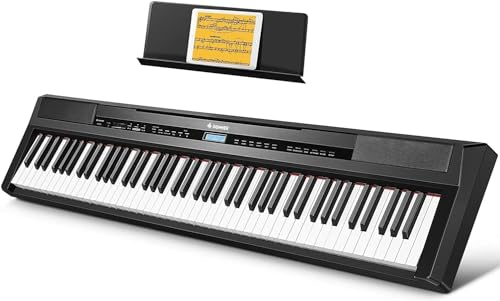
Donner DEP-20 — Best Budget Doorway
The DEP-20 exists for the most common piano question of all: what if I buy one and stop playing? Donnner’s answer is a complete, honest starter instrument — 88 full-size weighted keys, a sustain pedal and power supply included rather than upsold — at the gentlest commitment in this guide. The action will not fool a conservatory student, but it is genuinely weighted and graded enough to build correct early technique, which is the only job a first piano truly has.
Its Android relationship is the standard one: USB-MIDI connectivity that Android lesson apps recognise, letting your phone supply the teacher, the metronome’s smarter cousins and the recording studio. Built-in voices and speakers cover home practice, and the portable cabinet moves between rooms as motivation dictates. If the commitment takes root, the upgrade path leads to the Rolands and Yamahas above; if it does not, the DEP-20 has cost you the least possible tuition for finding out — and it resells easily to the next beginner asking the same question.
The DEP-20 also makes an unusually good second piano: the practice instrument at a grandparent’s house, the holiday-let piano, the spare for a church hall. Its price forgives environments you would never expose a Roland to, and its honest weighted action means practice on it still counts. Not every piano in a life has to be the main piano — some just have to be there.
Set the DEP-20 up properly and it punches above its paperwork: on a real stand, at the right height, through decent headphones, beginners cannot hear or feel the gap to the famous names as clearly as the price suggests. That is the correct way to own it — spend the saving on the stand, the bench and the first month of app-guided lessons, and the doorway becomes a room you are happy to practise in.
Bench verdict: the DEP-20 is the lowest-risk yes in piano — a complete, weighted, app-friendly start that respects both the beginner’s hope and the beginner’s budget.
- Keys: 88 full-size weighted keys
- Included: sustain pedal and power supply
- Connectivity: USB-MIDI for Android lesson apps
- Voices: built-in selection for practice variety
- Build: portable cabinet for home use
Strengths
- Complete starter kit in one box
- Lowest-risk entry to weighted piano in this guide
- USB-MIDI opens the Android lesson-app world
Trade-offs
- Action and sound sit below the big three brands
- Speakers are practice-room modest
- Long-term resale value is softer than Yamaha or Roland
Best for: Beginners testing a real commitment without a real gamble.
Not suited for: Intermediate players who will outgrow it within a year.
Comparison table: six pianos, three questions each
Three questions sort this table for most buyers. How serious is the action — Roland’s pair lead, Yamaha and Casio follow closely, Donner serves beginners honourably. How does the phone join in — Bluetooth on the Privia, branded apps over USB on the Yamaha, standard USB-MIDI elsewhere. And what else must you buy — stands, benches and occasionally pedals hide in that third answer, so read the watch-out column as part of the price.
| Pick | Badge | Standout trait | Watch out for |
|---|---|---|---|
| Roland FP-30X | Best Overall | Teacher-grade action and sound | Budget for the stand as well |
| Casio Privia PX-S1100 | Best Portable | A real weighted piano that fits small lives | Check what the bundle includes |
| Yamaha P-45 (P45B) | Most Trusted Teacher’s Pick | Lesson-room honesty with app support by cable | You will need a USB adapter for most phones |
| Roland FP-10 | Best Action per Coin | The connoisseur’s budget action | Wired connection only |
| Casio CDP-S160 | Best for Lessons and Duets | Shaped around how lessons actually happen | Confirm bundle contents before buying |
| Donner DEP-20 | Best Budget Doorway | The honest, low-risk first piano | Keen players may upgrade sooner than planned |
Notice that the cheapest and most expensive pianos here agree on the fundamentals: 88 keys, weighted action, a sustain pedal path and an Android route. They disagree on refinement — key feel at the extremes of touch, tonal gradation, speaker authority. Refinement is what years of playing are made of, which is why serious learners should buy the best action they can honestly afford.
The app question, by contrast, matters less than marketing suggests. Every piano here can partner with an Android phone for lessons and recording; the differences are cable versus Bluetooth and branded versus general apps. Choose the piano for your hands first and let the phone arrangement be the tiebreaker it deserves to be.
And a final physical note: whatever you choose, let your hands have the last word if a shop visit is possible. Play the same quiet passage on two finalists, slowly, and listen to which instrument makes the quiet notes easier to mean. That sensation — control at low volume — predicts years of expressive playing more reliably than any feature list, including the honest ones in this guide.
What does weighted and graded actually feel like?
Play the lowest note on an acoustic grand and the key resists like a small lever moving real machinery; play the highest and it feels comparatively light. That gradient — heavy bass, light treble — is what graded action imitates, and it matters because your hands calibrate force to it. Practise for months on an unweighted board and your technique learns a world that does not exist at a real piano; the first encounter with an acoustic instrument then feels like playing someone else’s hands.
The makers imitate the gradient differently. Roland’s PHA-4 uses individual hammer mechanisms with a touch many players describe as the closest to acoustic in this class. Yamaha’s GHS is firmer and famously consistent, a lesson-room standard for decades. Casio’s scaled hammer actions are lighter in character, which some smaller hands genuinely prefer. None of these is a wrong answer; they are accents in the same language.
If you can, play before you buy — ten minutes of scales and one quiet piece will tell your hands more than any review. If you cannot, buy by trajectory: beginners grow into actions, so choose the action your teacher would choose for your second year, not your second week.
What do the Android apps actually add to practice?
Three things, in descending order of importance. First, control: voices, split points, metronome settings and tuning live behind button combinations on the piano itself, and an app turns them into labelled sliders your eyes can parse. Second, structure: lesson features, guided exercises and practice tracking give solitary learners the shape that a weekly teacher provides. Third, ears: recording yourself through the app and listening back is the single fastest improver available to any pianist, because we never play as well — or as badly — as we think we do.
The branded apps differ in flavour. Yamaha’s Smart Pianist is built around controlling Yamaha instruments and analysing music. Casio’s Music Space leans into learning and playing along. Roland’s apps emphasise practice partnership and remote control of the piano’s functions. The general ecosystem of Android lesson apps, reached over USB-MIDI by any piano here, is broader than any single brand’s — which is why a wired piano is not a disconnected piano.
Set expectations qualitatively, as this guide does: app features change with updates, and the durable truth is the partnership itself — that your phone and piano are designed to work as one practice system. Check the app’s current listing for today’s specifics before you buy, the same way you would check any software.
Bluetooth, USB or both — which connection should you want?
Bluetooth is the tidy option: no cables across the music rest, the phone propped where you can see it, settings changed from the bench. Its costs are pairing rituals and, for playing data, a whisper of latency that most practice never notices but fast recording work can. The Privia in this guide carries the wireless flag.
USB is the dependable option: a cable, an adapter matched to your phone’s port, and a connection that simply works every time, with the tight timing that recording prefers. Yamaha’s P-45 partnership and the USB-MIDI pianos live here. The cable is a small aesthetic price for a connection you never think about again.
Choose by room and routine. A piano that lives in one place with a dedicated tablet or phone is happy wired. A piano that moves — the Privia’s whole personality — earns its Bluetooth. Either way, buy the adapter or cable with the piano, not after it, so the partnership starts on the first evening.
How long should a weighted piano last a learner?
Plan in stages. A beginner’s first two years ask for correct weighting, a reliable pedal and a sound that does not punish listening — every piano here clears that bar. Years three to five ask for more: finer dynamic control, better low-volume tone, actions that reward speed and repetition. The Roland pair and the Yamaha are built for that second stage; the Donner is honest that it serves the first.
This staging is why the guide keeps returning to action quality over features. Voices can be added later through your phone — a USB-MIDI piano can play through app sounds far beyond its built-in library — but the action you practise on is the action you own. Buy keys for the pianist you are becoming; rent features from the phone you already have.
Resale softens the staging risk. Branded pianos from Yamaha, Roland and Casio hold value in the second-hand market precisely because teachers recommend them to the next beginner. A well-kept FP-10 or P-45 funds much of its own upgrade, which makes starting serious cheaper than it first appears.
What should your first month of practice look like?
Shorter and more often than enthusiasm suggests. Twenty focused minutes daily builds more technique than a heroic Sunday hour, and it builds the habit that carries every pianist through the plateau months. Use the phone partnership deliberately: record one piece weekly, however rough, because the archive of your own progress is the best motivation ever invented.
Structure each session in thirds — warm-up and scales, current piece work, and something played purely for pleasure — and let the app handle the metronome and the recording while you handle the music. End before frustration, not after it; the piano should be left as a place you want to return to tomorrow.
Expect the hands to lag behind the ears for a while. You will hear what the music should be long before your fingers can produce it, on any piano in this guide. That gap is not failure; it is the definition of learning an instrument, and every pianist you admire lived inside it for years.
Headphones, speakers and neighbours: how will you actually listen?
Most digital piano hours are headphone hours, whether buyers admit it at purchase or not. Through good headphones, the field in this guide levels remarkably: the Donner and Casio sound closer to the Rolands than their speaker systems suggest, because the samples and engines are shared while the amplifiers are not. Budget for headphones with the piano — comfortable, wired, unhurried to fall apart — and you have upgraded every instrument in this guide simultaneously.
Speakers matter for the social hours: playing for family, teaching a child beside you, filling a room at a gathering. There the FP-30X’s authority and the Privia’s near-field warmth earn their keep. Decide your honest ratio of solitary to social playing and let it steer the choice; a hall-filling speaker system bought for a headphone life is money spent on an audience that never arrives.
Neighbours complete the triangle. Weighted actions make sound even with the volume at zero — key thump travels through floors more than owners expect. A rug under the stand and a piano placed away from shared walls are the unglamorous accessories that keep the peace, and they cost less than any feature discussed in this guide.
How does an Android phone change the first year of learning?
It supplies the three things solitary learners lack: a schedule, a witness and a library. The schedule arrives as practice reminders and structured lessons that remove the daily negotiation about what to work on. The witness is the recording function — the merciless, invaluable mirror. The library is the world’s sheet music, tutorials and play-along material, one search away from the music rest.
What the phone cannot supply is taste or patience, and the healthiest setup treats it as staff rather than guru: it holds the metronome, keeps the archive and opens the right page, while the musical decisions stay with the human and, ideally, a teacher whose ears no app replaces. The pianos in this guide were chosen to partner with the phone in exactly that spirit — instrument first, software second, musician always.
How do teachers view the phone-and-piano partnership?
Most teachers have made their peace with the phone at the piano, because they can see what it replaced: the metronome that lived in a drawer, the notebook of assignments nobody reread, the recording that never happened. An app that tracks practice, holds the lesson’s recordings and keeps the metronome honest is not a distraction from the tradition — it is the tradition’s paperwork, finally working. The teachers who resist are usually resisting a specific misuse: the phone as entertainment during practice, notifications blooming across the music rest.
The professional setup answers that misuse directly. Practice mode on the phone — notifications silenced, the lesson app full-screen, the device parked on the music rest and nowhere else — turns the phone into part of the furniture, like the metronome it replaced. Several owners dedicate an older phone or tablet to the piano permanently for exactly this reason, and it is the single best use of a retired Android device we know.
Ask your teacher which app they prefer before choosing between the branded ecosystems in this guide; a teacher already fluent in one platform will teach through it more effectively, and that fluency is worth more than any feature comparison. The piano is the long decision, but the teacher is the living one — let the living one break ties.
How do you connect a digital piano to an Android phone, step by step?
Connect your Android phone in five calm steps
First, identify your piano’s route from its review above: Bluetooth, USB to a branded app, or USB-MIDI to general apps. Second, install the maker’s app — Smart Pianist for the Yamaha, Music Space for the Casios, Roland’s companion for the FP-30X — or your chosen lesson app for a USB-MIDI piano, before the piano arrives if you can.
For Bluetooth, pair from inside the app rather than the phone’s general settings when the maker directs it, with the piano in pairing mode and the phone nearby. For USB, connect piano to adapter to phone, open the app and grant the USB permission prompt — that prompt is the step most often mistaken for a fault. Then play a note and watch the app respond; that small confirmation is the whole setup, done.
Finish by setting the phone where your eyes already go: on the music rest, in reach but out of the keys’ way. A practice partnership that requires furniture rearrangement will quietly stop being used, whatever its features.
Arrange the room so practice actually happens
The best piano setup is the one that removes excuses. Place the instrument where you pass daily, keep the bench at the right height — forearms roughly level with the keys — and leave the piano uncovered and ready. A piano that must be assembled, uncovered or plugged in from storage will be practised a fraction as often, whatever its action cost.
Lighting deserves a sentence of its own: sheet music and phone screens both punish glare, so position a lamp to fall on the music without reflecting off the screen. Headphones hung on a hook beside the piano extend your practice hours into the household’s sleeping ones — the quiet superpower of every digital instrument in this guide.
Record your practice with the phone you already own
Place the phone where the app can hear or receive the piano cleanly — for MIDI-connected pianos the recording is data, not room sound, so quality is perfect by default; for audio recording, a phone on the music rest beats a phone across the room. Record the same short piece every Sunday and change nothing else about the ritual.
Listen back with a pencil, not a verdict: mark one thing that improved and one thing to work on, then stop. Pianists who review everything fix nothing; pianists who fix one thing a week fix fifty things a year, which is how the pianists you admire were actually made.
What mistakes do piano buyers make with apps and actions?
Buying semi-weighted to save money
The saving is real and so is the cost: semi-weighted actions teach finger habits that a teacher will spend months unteaching, and the learner concludes they lack talent when they actually lack resistance. Every piano in this guide is fully weighted for a reason. If the budget is tight, the Donner’s honest weighting beats a fancier semi-weighted board at the same money.
Forgetting the stand, bench and pedal in the budget
A piano played on a dining table at the wrong height is an ergonomic injury with good sound. Price the furniture with the instrument: a proper stand at keyboard height, a bench that puts forearms level, and a piano-style sustain pedal rather than a flimsy switch where the model allows. The reviews above flag what each box includes.
Judging sound through phone speakers in videos
Listening to piano demos recorded through room microphones and replayed on a phone tells you about everything except the piano. Judge by action reputation, maker pedigree and, where possible, your own hands and headphones in a shop. The instruments here come from makers whose piano tones are known quantities — that is not an accident of selection.
Expecting the app to do the practising
Apps structure, record and encourage; they do not attend for you. The learners who progress are the ones who play most days, app or no app. Buy the piano your hands believe in, use the phone as the practice partner it is, and let consistency — the least purchasable feature — do the heavy lifting.
Placing the piano where it looks best instead of where it plays best
A piano against a picturesque wall, far from where life happens, will be admired and unplayed. Place it on your daily path — the room you cross, the corner you inhabit — even at some cost to the décor. Instruments are furniture that must be used to justify themselves, and the ugliest placement that gets played daily beats the beautiful one that gets played at Christmas. Every teacher has watched both arrangements; ask yours which students progress.
Final Recommendation
Choose the Roland FP-30X if this piano is meant to serve for years of serious progress, the Casio PX-S1100 if it must also fit a small and movable life, and the Yamaha P-45 if a teacher’s voice is guiding the purchase. The FP-10 rewards buyers who spend on action alone, the CDP-S160 serves lessons and duets, and the Donner opens the door at the lowest risk.
Every instrument here keeps the keyword’s double promise: eighty-eight weighted keys that teach honest hands, and a working partnership with the Android phone already in your pocket.
Buy the best action your budget honestly allows, set it up where you will pass it daily, and let the phone handle everything except the playing — that part, happily, remains yours.
Whichever of the six earns your bench, give it the two gifts no manufacturer can include: a permanent place in your home and a few minutes of your day, most days. The weighted keys and the patient phone will handle everything else.
Frequently Asked Questions
Do these pianos work with any Android phone?
Broadly, yes: the branded apps run on mainstream Android phones, and USB-MIDI is a standard Android recognises. Two practical checks remain — your phone’s port type decides which USB adapter you need, and very old phones may run current app versions poorly. The app’s store listing states its requirements and is the authority worth checking before purchase.
Can I learn piano properly on a digital instrument?
Yes — that is precisely what weighted, graded actions are for. Technique learned on the actions in this guide transfers to acoustic pianos because the resistance and layout mirror them. What digital cannot replicate is the acoustic instrument’s full resonance, which matters to advanced players and not at all to the first years of learning.
Is Bluetooth essential for using apps?
No. Bluetooth is convenience; USB is capability. The Yamaha’s Smart Pianist partnership runs over USB, and USB-MIDI pianos like the FP-10, CDP-S160 and DEP-20 work with the wide world of Android lesson apps through a cable and adapter. Choose wireless only if your piano will move rooms often.
What else do I need to buy with the piano?
For most picks: a stand at proper playing height and a bench, unless a bundle states otherwise. The P-45 includes a sustain foot switch and the DEP-20 includes pedal and power supply; check each review’s specification box. Headphones are the other near-essential — they unlock practice at any hour.
Which piano is best for a child starting lessons?
The Casio CDP-S160 for its duet mode and lesson shape, or the Yamaha P-45 for its teacher-approved simplicity — ask the child’s teacher, who will have a preference and will appreciate being asked. Both give small hands a properly weighted action to grow up on.
Do I need a special stand, or will a table do?
A table will do for the first week and harm your posture by the fourth. Proper height — keys at roughly the level where your forearms rest parallel to the floor — is not pedantry; it is how wrists survive years of practice. Budget for a dedicated stand with any piano here whose bundle lacks one, and treat the bench as part of the same purchase.
Can these pianos connect to Android tablets as well as phones?
Yes — the same apps and USB or Bluetooth routes work on Android tablets, and the larger screen suits sheet music and lesson apps particularly well. Many owners dedicate an older tablet to the piano permanently, which keeps the practice setup instant and the phone free for everything else.
Can I use these pianos with free Android apps only?
Yes. Every piano here speaks standard USB-MIDI or its maker’s free companion app, and the free tiers of the major lesson apps are generous enough to structure a beginner’s first months. Paid tiers add curriculum depth later, when you know the habit has taken — the correct order is piano, habit, subscription, in that sequence.
How loud is a weighted piano with the volume off?
Louder than buyers expect and quieter than neighbours fear: the keys thump, especially in the bass, and the sound travels through floors more than through air. A rug under the stand and felt-friendly playing hours solve it in almost every building. It remains vastly quieter than any acoustic piano, which is why digital instruments own the apartment market outright.
Related Guides
Keep exploring with these companion guides for piano buyers: best digital pianos for adult beginners android apps for learning piano weighted keyboards for small apartments


