What's inside
- Key Takeaways
- Quick Picks
- How Did We Choose These Picks?
- What Does a Stated Wattage Actually Promise?
- When Should You Deliberately Not Buy the Bundle?
- What Do Efficiency Tiers Buy in a Small Case?
- How Do the Six Compare on the Only Question That Defines Them?
- How Does the Included Supply Change the Case’s Own Value?
- How Do You Size a Bundled Supply to the Build?
- How Should the First Boot of a Bundled Build Go?
- What Mistakes Do Case-and-Supply Buyers Keep Making?
- Final Recommendation
- Frequently Asked Questions
- Related Guides
As an Amazon Associate I earn from qualifying purchases. This post may contain affiliate links at no extra cost to you.
gizmoverdict.com is reader-supported. When you buy through links on our site, we may earn an affiliate commission.
Where to buy: Every product below links to a listing from this site’s verified pool, and power supply claims are made only where a listing title makes them first. That discipline matters more in this category than in any other in this roundup: three of the six titles state a wattage, and three do not, and the three that do not are described accordingly. No prices and no star ratings appear in this guide, and no efficiency tier, wattage or cable claim has been borrowed from a sibling product’s listing.
The best pc cases with power supply answer a specific frustration: the build that stalls at the last step because the case arrived and the power supply did not, or because the supply in the spares drawer turned out to be the wrong format, the wrong capacity or a decade past trusting. A case and supply bought as one product remove that failure mode entirely, and they do it with the compatibility question pre-answered — the maker chose a unit that fits the case’s mounts, reaches its connectors and suits the machines the case is sized for. For first builds, office fleets, family PCs and spare-room machines, that pre-answered question is often worth more than the theoretical freedom of choosing every component separately.
Honesty requires the counterweight, and this guide will state it early: a bundled supply is a commitment. Enthusiast builders choose power supplies the way they choose processors — by rail design, fan curve, modularity and warranty — and a case that arrives with its unit fitted narrows that choice to the maker’s. The six listings below therefore split into honest sub-groups. Two Rosewill towers and the Raidmax bundle keep their power details out of their titles entirely, and are treated as cases whose supply situation must be verified before assuming anything. Three listings state their units outright — a pre-installed 650W Gold ATX 3.1 Rosewill, a 650W Evounic, and an 850W Gold SAMA in a walnut-wood gaming case — and those three carry the guide’s centre of gravity.
Key Takeaways
- Stated wattages in this pool are 650W twice and 850W once: the Rosewill pre-installed 80+ Gold 650W ATX 3.1 unit, the Evounic’s 650W supply, and the SAMA S32’s 850W Gold unit.
- Three titles — the Rosewill FBM-X6, the second Rosewill mini tower and the Raidmax i802 bundle — state no power supply details at all, so their supply status is marked not stated and must be verified with the maker before purchase.
- Efficiency language appears only where a title prints it: Gold on the Rosewill 650W and the SAMA 850W; the Evounic’s 650W carries no efficiency claim in its title.
- Every pick here is a Micro-ATX or mid-tower class case; the included-supply concept serves mainstream builds, and high-draw flagship hardware still belongs with a separately chosen unit.
- A standalone power supply is never a pick in this guide — the category is cases supplied with one, not components sold beside one.
Quick Picks
| Pick | Badge | Why it earns its place |
|---|---|---|
| Rosewill FBM-X6 Micro ATX Mid Tower Case | Verify-first Rosewill | A Micro ATX mid tower from a case range long associated with value builds; its title states no supply, so confirm the bundle before assuming one. |
| Rosewill Micro ATX Mini Tower with Pre-Installed 650W Gold PSU | The complete answer | A mini tower with an 80+ Gold 650W ATX 3.1 power supply pre-installed — the most fully specified case-and-supply product in the pool. |
| Rosewill Micro ATX Mini Tower Desktop Computer Case | Desktop brief, details pending | A Micro ATX mini tower for desktop duty whose title leaves the power question to Rosewill’s documentation. |
| Evounic Micro ATX Case with 650W Power Supply | 650W, plainly stated | A black Micro ATX case whose title puts the 650W supply in the product name — no ambiguity about what arrives. |
| SAMA S32 Walnut Wood M-ATX Gaming Case with 850W Gold PSU | The powerful one | Genuine walnut wood, USB-C and an 850W Gold supply: the gaming-grade entry in a category of sensible ones. |
| Raidmax i802 Vibe Series ATX Mid Tower Gaming Case Bundle | Bundle, contents to confirm | An ATX gaming mid tower sold as a bundle with a tempered glass side panel; the bundle’s full contents sit beyond its title. |
How Did We Choose These Picks?
The first filter removed every standalone power supply, however excellent, because a supply without a case is not this category. The second filter sorted the surviving cases by what their titles could prove. A case could be recommended as a case-with-supply only where its own title names the supply — its wattage, its installation state, or both. Cases whose titles stayed silent were not expelled; they were reclassified in plain sight, because a reader comparing Rosewill towers deserves to see the whole verified pool with the evidence labelled, rather than a curated three pretending to be a market.
The result is a guide with an unusual shape — three documented bundles, three open questions — and that shape is the honest one. Where a title states a supply, the analysis below spends real time on what the stated figures mean: what 650W covers, what the Gold tier and the ATX 3.1 label imply, and where 850W changes the class of machine the case can host. Where a title states nothing, the analysis says what the case is on the evidence available and hands the reader the exact questions to put to the maker.
What Does a Stated Wattage Actually Promise?
A wattage figure is a ceiling, not a character reference, and reading it well is the core skill of this category. The two 650W listings here — Rosewill’s pre-installed Gold unit and Evounic’s supply — sit at the capacity that covers the broad middle of home computing: a mainstream processor, a mid-range graphics card, several drives, and headroom for the transient spikes modern cards produce. The SAMA’s 850W moves the ceiling into a different conversation, where hungrier cards and processors can be considered without the supply becoming the build’s limiting factor. Neither figure says anything by itself about noise, cable quality or longevity, which is why the efficiency and standard labels in the titles matter as supporting evidence.
The Rosewill’s title carries the pool’s richest supply description: 80+ Gold efficiency and ATX 3.1. The Gold tier indicates an efficiency class that wastes less power as heat inside the case — a small, continuous saving in warmth and fan work. ATX 3.1 names the current revision of the ATX power standard, the generation designed with modern graphics cards’ power behaviour in mind. Neither label guarantees a great unit, but together they describe a supply specified to current expectations rather than a leftover from an older parts bin, and in a bundled product that currency is the strongest reassurance a title can offer.
Pre-installed deserves its own sentence, because it changes the first evening of the build. A fitted supply arrives mounted, its cables routed by the factory, its format beyond argument. The builder’s work reduces to connections. Against that convenience stands the obvious trade: replacing or upgrading the unit later means undoing the bundle’s premise, and the case’s supply bay — in these Micro-ATX towers, sized for the class of unit fitted — sets the terms of any future swap. Buyers who expect to grow into flagship hardware within the case’s lifetime should weigh that future against the first evening’s ease.
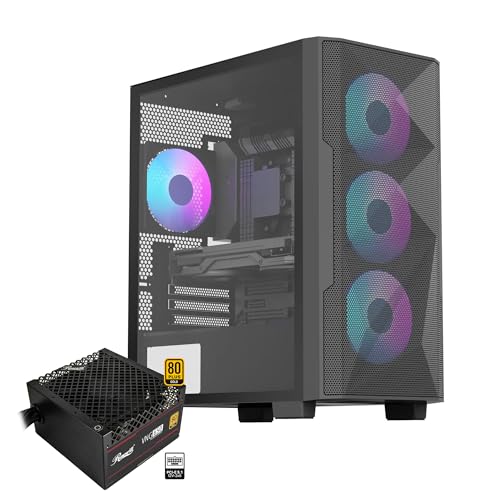
Rosewill FBM-X6 Micro ATX Mid Tower Case — Verify-first Rosewill
The FBM-X6 opens the guide with its most important lesson, so let it be stated without decoration: this listing’s title describes a Rosewill Micro ATX mid tower case and mentions no power supply in any form. It appears in a guide about cases with power supplies because the verified pool for this keyword includes it — Rosewill’s FBM line is a familiar name in value case-and-supply shopping — but a title’s silence cannot be converted into a bundle by association, and this guide will not do it. The FBM-X6 is presented as what its listing proves: a Micro ATX mid tower from an established budget case range, whose supply status is the buyer’s first question to Rosewill.
That question is worth asking rather than assuming in either direction, because both errors are expensive in their own way. Assuming a supply is included and finding an empty bay stalls a build; assuming none and ordering a separate unit that duplicates an included one wastes money and clutters a drawer. The verification takes minutes — the maker’s page for the exact model, or the listing’s full specification section — and it converts this pick from a gamble into a known quantity, at which point the FBM-X6 can be compared fairly against the documented bundles below.
Judged as a case alone, the FBM proposition is the line’s traditional one: a mid tower in the Micro-ATX class, sized for mainstream boards and mainstream hardware, from a range that has housed an enormous number of first builds and office machines. Mid tower proportions in a Micro-ATX case leave working room that mini towers deny — cable space, drive room, tolerance for a full-height card — and for a builder whose priority is an easy assembly at a value position, that room is the product. The supply question simply has to be answered before the value can be calculated.
There is a broader habit this pick teaches, applicable far beyond one Rosewill tower. Bundled products live and die by their exact model codes: a letter or digit’s difference in a case range can separate the version with a supply from the version without. Readers who train themselves to verify the precise SKU against the maker’s page — here, for the FBM-X6 specifically — will never be surprised by this category again, whichever of the six they ultimately buy.
- Format: Micro ATX mid tower case, stated in the listing title
- Maker and line: Rosewill FBM-X6, stated in the listing title
- Included power supply: Not stated in the listing title — verify with Rosewill documentation
- Supply wattage and efficiency, if included: Not stated in the listing title — verify with Rosewill documentation
- Fan and drive provision: Not stated in the listing title — verify with Rosewill documentation
Strengths
- A roomy Micro-ATX mid tower from a long-running value case range.
- Mainstream proportions suit first builds and office machines equally.
- The verification it demands is quick and settles the product completely.
Trade-offs
- The listing cannot be counted as a case-with-supply until Rosewill confirms the bundle.
- No internal specification of any kind appears in the title.
- Buyers in a hurry may prefer the sibling below, whose supply is stated outright.
Best for: a builder seeking a value Micro-ATX mid tower and willing to confirm its supply status with the maker first. Not suited for: a builder requiring an included power supply guaranteed by the listing itself.

Rosewill Micro ATX Mini Tower PC Case with Pre-Installed 80+ Gold 650W ATX 3.1 Power Supply — The complete answer
This is the listing the whole category wishes it could be. Rosewill’s title states the case class — Micro ATX mini tower — and then itemises the supply with a completeness no other pick matches: pre-installed, 80+ Gold efficiency, 650W capacity, ATX 3.1 standard. Each of those four facts answers a question the other listings leave open. Pre-installed answers when the work happens. Gold answers how efficiently. The wattage answers how much machine the case can host. ATX 3.1 answers how current the unit’s design assumptions are. A buyer can plan an entire build around this title alone, and that is a genuinely rare experience in bundled hardware.
The capacity deserves its practical translation. A 650W Gold unit in a Micro-ATX mini tower describes a machine with a mainstream processor and a mid-range graphics card — the configuration the overwhelming majority of home and office PCs actually are — with headroom managed by an efficient unit that sheds less heat into a small case. In a mini tower, that efficiency is not an abstract virtue: every wasted watt becomes warmth the case’s modest airflow must remove, so a Gold unit and a compact enclosure are natural partners in a way the specification sheet only hints at.
Pre-installation changes the build’s risk profile as much as its schedule. The supply arrives mounted with its cabling routed for this exact case, which removes the two beginner errors the bundle concept exists to prevent — the wrong format ordered, and the cable that cannot reach. What remains is a normal, pleasant assembly. The corresponding honesty is that the unit is the maker’s choice, fixed at purchase: a builder who later wants a flagship card beyond the 650W ceiling will be replacing the heart of the bundle, and should choose this pick only if the stated ceiling matches the machine’s realistic future.
For offices and families, one more quality compounds the appeal: repeatability. A case with a known, current-standard supply can be bought again next year for the next desk with confidence that the same machine results. That fleet logic rarely appears in enthusiast guides, but it is how a large share of the world’s PCs are actually purchased, and this Rosewill is the pool’s clearest expression of it.
- Format: Micro ATX mini tower, stated in the listing title
- Power supply: pre-installed, stated in the listing title
- Capacity: 650W, stated in the listing title
- Efficiency: 80+ Gold, stated in the listing title
- Standard: ATX 3.1, stated in the listing title
Strengths
- The only fully itemised supply in the guide — installation, wattage, efficiency and standard all stated.
- Gold efficiency suits a compact case’s limited airflow particularly well.
- ATX 3.1 currency means the unit was specified for modern hardware’s behaviour.
Trade-offs
- The 650W ceiling is fixed at purchase; flagship ambitions will outgrow it.
- A mini tower’s interior asks tidy cable work despite the factory’s head start.
- The maker’s unit replaces the buyer’s choice — the bundle bargain in its purest form.
Best for: a builder seeking a complete Micro-ATX case and current-standard 650W Gold supply in one verified purchase. Not suited for: a builder requiring power headroom beyond 650W for future flagship hardware.

Rosewill Micro ATX Mini Tower Desktop Computer Case — Desktop brief, details pending
The third Rosewill in the pool is the second open question, and its title is even plainer than the FBM-X6’s: a Micro ATX mini tower desktop computer case. Desktop is the operative word — this is a case briefed for the desk machine, the office PC, the family computer in the study — and the title offers no power supply information whatsoever. As with its sibling, the correct treatment is neither to invent a bundle nor to dismiss the case, but to label the gap and let the case be judged on its stated brief while the supply question travels to Rosewill’s documentation where it belongs.
It is worth pausing on why two near-identical Rosewill titles can carry different answers in the real world. Case ranges are families of variants: the same shell may be sold bare, with a basic supply, or with a premium one, under model codes close enough to blur at a glance. Marketplace titles compress those distinctions brutally. The reader’s defence is the habit this guide keeps recommending — match the exact listing to the maker’s page for that exact variant — and the existence of the fully itemised Rosewill above proves the maker does publish the information when a bundle is real.
As a desktop mini tower, the case’s stated shape has its own merits independent of the supply outcome. Mini tower proportions suit the under-desk and on-desk positions of working machines, Micro-ATX boards keep the parts mainstream, and a plain desktop brief usually means front connectivity and drive provision aimed at use rather than display. If the documentation reveals an included supply, this pick becomes a direct rival to its itemised sibling, separated by whatever unit is fitted. If it reveals a bare case, it competes with the FBM-X6 as a value shell awaiting a separately chosen supply — a legitimate product, honestly reclassified.
Either way, this pick performs a service in the guide beyond its own merits: it demonstrates that the category’s shopping skill is not finding bundles but verifying them. A reader who internalises that will read the remaining picks — Evounic’s plain statement, SAMA’s abundance, Raidmax’s bundle language — with exactly the right eyes.
- Format: Micro ATX mini tower desktop case, stated in the listing title
- Maker: Rosewill, stated in the listing title
- Included power supply: Not stated in the listing title — verify with Rosewill documentation
- Supply wattage and efficiency, if included: Not stated in the listing title — verify with Rosewill documentation
- Front connectivity and drive provision: Not stated in the listing title — verify with Rosewill documentation
Strengths
- A mainstream desktop brief in the most serviceable case class there is.
- Micro-ATX platform keeps every other component choice ordinary and affordable.
- May yet prove to be a bundle — the documentation decides, quickly.
Trade-offs
- On the listing’s evidence alone, this is a case, not a case-with-supply.
- Nothing internal is specified in the title at all.
- Its itemised sibling makes the omission impossible to ignore.
Best for: a builder seeking a mainstream Micro-ATX desktop tower who will verify its supply status before ordering. Not suited for: a builder requiring the included supply to be a documented certainty at listing level.

Evounic Micro ATX Case with 650W Power Supply, Black — 650W, plainly stated
Evounic’s title does the essential thing in six words: Micro ATX case with 650W power supply. No efficiency tier is claimed, no standard is named, no installation language is used — but the category’s defining fact, a supply of a stated capacity included with the case, is right there in the product name where a buyer cannot miss it. In a guide that has spent three sections negotiating with silence, that plainness has real value. A reader can shortlist this case in one reading, confident about the bundle’s existence and its headline capacity, with the remaining questions — efficiency, cabling, fan provision — correctly sized as refinements rather than foundations.
The 650W figure places the Evounic in the same practical territory as the itemised Rosewill: the mainstream machine, processor and mid-range card, assembled without a separate supply decision. The difference between the two picks is the depth of the paperwork. Rosewill’s title certifies Gold efficiency and the ATX 3.1 standard; Evounic’s certifies capacity and colour. A buyer comparing them is really deciding how much the unstated details are worth — and the honest way to decide is to fetch Evounic’s full specification, where the efficiency question in particular deserves an answer before the cases are ranked on anything subtler.
Black, the one aesthetic fact in the title, is worth its small paragraph because Micro-ATX cases live visible lives on and under desks, and a black mini tower is the closest thing computing has to a default. It matches every monitor, offends no room, and hides the dust of ordinary weeks better than lighter finishes. None of that will appear in a benchmark, and all of it will be true every day the machine is owned.
The Evounic’s broader role in this guide is as the middle path. Above it, the Rosewill offers certification; below it, the silent titles offer homework. For a builder who wants the bundle confirmed and the capacity mainstream, and who is content to verify the finer points in one documentation visit, this is arguably the most proportionate purchase in the six — provided that visit confirms a supply of respectable efficiency, which the guide flags rather than assumes.
- Format: Micro ATX case, stated in the listing title
- Power supply: included, 650W, stated in the listing title
- Colour: black, stated in the listing title
- Efficiency rating: Not stated in the listing title — verify with Evounic documentation
- Fan provision and cabling style: Not stated in the listing title — verify with Evounic documentation
Strengths
- The bundle and its capacity are stated in the product name itself.
- 650W matches the mainstream build this case class exists to house.
- A black Micro-ATX tower is the most room-agnostic machine in the guide.
Trade-offs
- Efficiency is unclaimed in the title, and it is the first question for the documentation.
- No installation or standard details are given, unlike the Rosewill flagship.
- A lesser-known brand’s support depth should be weighed by cautious buyers.
Best for: a builder seeking a plainly stated 650W bundle in a black Micro-ATX case. Not suited for: a builder requiring a certified efficiency tier visible in the listing before shortlisting.

SAMA S32 Genuine Walnut Wood M-ATX Gaming PC Case with 850W Gold PSU, USB-C — The powerful one
The SAMA S32 is the pick that breaks the category’s sensible spell, in the best way. Its title assembles an unlikely trio: genuine walnut wood on an M-ATX gaming case, a USB-C connection, and an 850W Gold power supply. Read separately, each element belongs to a different guide — furniture-grade materials, modern connectivity, enthusiast power. Read together, they describe a machine for the room where the PC is both the fastest object and the warmest-looking one, a gaming build that furnishes. For a buyer seeking a case-and-supply purchase with genuine headroom and a finish no plastic can imitate, this is the pool’s only candidate, and it is not close.
The 850W Gold supply changes the build’s ceiling decisively. Where the 650W pair serve the mainstream, 850W at Gold efficiency invites the tier above: hungrier graphics cards, processors that draw like them, and the transient behaviour of both, absorbed by a unit with room to spare. In a bundled product that headroom is the difference between a case that hosts one machine and a case that hosts the machine after next — the SAMA’s buyer can upgrade the card in two years without reopening the power question, which is precisely the future-proofing the smaller bundles cannot promise.
Walnut deserves scrutiny rather than swooning. Genuine wood on a case is a veneer-or-panel material choice with real consequences: it warms the object’s appearance beyond any finish, it varies from unit to unit because grain does, and it asks the owner to treat the case slightly more like furniture and slightly less like equipment. In a living-room or study gaming setup, that trade is usually gladly made. In a teenager’s battlestation or a dusty workshop, plastic’s indifference is the wiser material. The title’s inclusion of USB-C, meanwhile, is a small modern grace the other five titles do not mention — front connectivity from the current decade.
What the title leaves open is the supporting cast: fan provision, radiator room, card length and the supply’s cabling style all await SAMA’s documentation, and a gaming build at this power level should be planned against those figures carefully. But the centre of the product — the wood, the wattage, the efficiency tier — is stated in full, and it describes the most ambitious case-and-supply combination in this guide by a wide margin.
- Format: M-ATX gaming case, stated in the listing title
- Material: genuine walnut wood, stated in the listing title
- Power supply: 850W Gold PSU included, stated in the listing title
- Connectivity: USB-C, stated in the listing title
- Fan provision, radiator support and card length: Not stated in the listing title — verify with SAMA documentation
Strengths
- The highest stated capacity in the guide, at Gold efficiency — real upgrade headroom.
- Genuine walnut gives the machine a furniture presence no finish can fake.
- USB-C front connectivity is stated where rival titles omit it entirely.
Trade-offs
- Wood asks furniture care and varies in grain from unit to unit.
- Cooling and clearance figures need the documentation before a big build is planned.
- The bundle’s ambition is wasted on a modest office machine.
Best for: a builder seeking an 850W Gold bundle in a walnut-finished gaming case with headroom to upgrade. Not suited for: a builder requiring a plain, low-cost office enclosure with no premium materials.

Raidmax i802 Vibe Series ATX Mid Tower Gaming Case Bundle — Bundle, contents to confirm
The Raidmax i802 closes the guide with the category’s most slippery word: bundle. Its title describes an ATX mid tower gaming case in the Vibe series, sold as a bundle, with a tempered glass side panel — and then truncates at the word Includes, leaving the bundle’s actual contents beyond the evidence. A bundle might contain a power supply; it might contain fans, or accessories, or some combination. This guide’s rule is unforgiving on exactly this point: a case is a case-with-supply when its title says so, and the i802’s title, as listed, does not. It is included as the pool’s largest, glass-sided gaming option with its central question clearly flagged.
What the title does establish is still worth having. The i802 is the only full ATX mid tower among the six — the rest are Micro-ATX class — which makes it the natural home for a standard ATX board and the roomiest interior in the guide, with a tempered glass side panel aimed squarely at the gaming display build. Raidmax’s Vibe series language and the bundle framing suggest a product assembled to be bought as a starting kit, and if the maker’s page confirms a supply among the contents, this pick’s story changes completely: it would become the big-case counterpart to the Rosewill flagship, separated by whatever unit is fitted.
Until that confirmation, the disciplined reader treats the i802 as a gaming mid tower with an unopened question, and there is no shame in that classification — it is the same one half this guide carries. The verification here has a specific shape: find the bundle’s itemised contents on Raidmax’s page or the listing’s full description, identify any supply by wattage and efficiency, and only then compare. A bundle whose contents cannot be itemised by its own maker should be priced as the case alone, whatever the headline promises.
There is a final, almost philosophical point the i802 makes better than any other pick. Bundle is a marketing word; pre-installed 650W Gold ATX 3.1 is a specification. The distance between those two kinds of language is the distance this entire guide has been measuring, and a reader who finishes here able to feel that distance in any listing — who reaches instinctively for the itemised contents — has gained more from the category than any single case could give them.
- Format: ATX mid tower gaming case, stated in the listing title
- Sold as: bundle, stated in the listing title
- Side panel: tempered glass, stated in the listing title
- Bundle contents, including any power supply: Not stated in the listing title — verify with Raidmax documentation
- Fan provision and dimensions: Not stated in the listing title — verify with Raidmax documentation
Strengths
- The only full ATX mid tower in the guide, with the roomiest brief.
- Tempered glass suits the gaming display build the series targets.
- If the bundle’s contents confirm a supply, its value story strengthens considerably.
Trade-offs
- As listed, the bundle’s contents — and any supply — are unproven.
- The truncated title leaves even the included items unnamed.
- Glass and ATX size make it the least desk-friendly pick here.
Best for: a builder seeking a full ATX gaming mid tower and willing to itemise the bundle with the maker before buying. Not suited for: a builder requiring a documented included supply at listing level, with no verification step.
When Should You Deliberately Not Buy the Bundle?
The bundle concept has a proper territory, and naming its borders makes the recommendations inside them stronger. A builder assembling a high-end machine around a flagship graphics card should choose the supply separately, by rail design and warranty, and treat the case as a separate decision — none of these six, not even the 850W SAMA, was specified by its buyer, and at that tier the supply is a component, not a convenience. A builder with a specific acoustic target should do the same, since a bundled unit’s fan behaviour is whatever the maker chose, undocumented in every title here. And a builder who already owns a good, current supply gains nothing from paying for a second one inside a case.
There is also the matter of failure logistics. When a separately bought supply fails, one component travels for warranty service. When a bundled unit fails, the household faces the same reality — the supply still comes out alone — but the paperwork runs through a case purchase, and the clarity of that path varies by maker. None of this condemns bundles; it locates them. First builds, family machines, office fleets, gifts that must simply work on the day: inside that territory, the pre-answered question is worth real money. Outside it, the bundle is a constraint wearing a discount’s clothing.
What Do Efficiency Tiers Buy in a Small Case?
Efficiency language is easy to nod at and worth slowing down for, because in a compact case its effects are physical. A supply converts mains power to the voltages components use, and the fraction it loses becomes heat inside the enclosure. A Gold-tier unit, the tier stated for the Rosewill 650W and the SAMA 850W, loses less of that fraction than an unrated or lower-tier unit at the same load — which in a Micro-ATX tower means less warmth for the case fans to clear, less fan work to clear it, and a small, continuous saving on the electricity bill across years of daily use. None of these effects is dramatic alone; together they are why efficiency is the second figure, after wattage, that a title earns trust by printing.
The Evounic’s silence on this point is therefore the right size of problem: not a disqualification, but the first line of its documentation visit. A 650W unit of decent efficiency is a perfectly good heart for a mainstream machine, while a 650W unit of poor efficiency in a small case spends its life warming its neighbours. The tier is knowable in minutes from the maker’s materials, and a reader who has followed this guide this far will not skip the one lookup that separates those two machines wearing the same headline number.
How Do the Six Compare on the Only Question That Defines Them?
| Case | Class | Supply in title | Capacity / efficiency from title |
|---|---|---|---|
| Rosewill FBM-X6 | Micro ATX mid tower | Not stated | Not stated |
| Rosewill Mini Tower, Pre-Installed | Micro ATX mini tower | Yes — pre-installed | 650W, 80+ Gold, ATX 3.1 |
| Rosewill Mini Tower Desktop | Micro ATX mini tower | Not stated | Not stated |
| Evounic Micro ATX | Micro ATX | Yes — included | 650W, efficiency not stated |
| SAMA S32 | M-ATX gaming | Yes — included | 850W, Gold |
| Raidmax i802 Vibe | ATX mid tower gaming | Bundle — contents not stated | Not stated |
Three yeses, two silences and one bundle: that is the whole market for this keyword as the verified pool presents it, and the table’s honesty is its usefulness. A reader in a hurry can buy from the yes rows today. A reader drawn to a silent row knows the single errand standing between them and a fair comparison. And nobody, having seen the table, can mistake the word bundle for a wattage ever again.
How Does the Included Supply Change the Case’s Own Value?
A case with a supply should be priced as a system, and thinking of it that way clarifies several comparisons in this guide. The silent Rosewill towers can only be valued as shells until their supply status resolves, at which point one of them might leap in value past a documented rival — or settle as a bare case to be priced against other shells. The Evounic’s value is knowable today within one efficiency lookup. The pre-installed Rosewill and the SAMA carry the most knowable value of all, because their titles price the whole foundation: enclosure, capacity, efficiency and, in the SAMA’s case, materials and connectivity that would each be separate line items in a parts list.
This systems view also disciplines the upgrade conversation. A builder who values the SAMA as case-plus-850W-Gold-plus-walnut understands what a future card upgrade saves: the entire power line of the budget, already spent well. A builder who values a 650W bundle honestly sees the opposite — a future flagship card carries a hidden second price, the supply swap — and can decide with open eyes whether that deferred cost is acceptable. Neither answer is wrong; both are invisible until the bundle is priced as the system it is.
How Do You Size a Bundled Supply to the Build?
Start from the graphics card, because it dominates the arithmetic and produces the sharpest transients. Add the processor’s realistic draw, a allowance for drives, fans and USB devices, and then hold the total against the bundle’s ceiling with genuine margin — a supply loafing at half load runs cooler and quieter than one living at its limit. The 650W listings here cover the mainstream card tiers comfortably; the SAMA’s 850W exists for the tiers above. If the intended card’s maker recommends a supply larger than the bundle states, believe the card maker and leave the bundle for a smaller build.
Then check the connectors, a step titles never cover. The card’s power sockets, the board’s CPU power header and any unusual drives must all be served by the included unit’s cable set, and that set is documented by the case maker, not by the listing. Modular or fixed cabling also shapes a small case’s tidiness — in a Micro-ATX tower, unused fixed cables need somewhere to live. Both questions take minutes on the maker’s page and prevent the category’s second-most-common disappointment, right behind the supply that was never included at all.
How Should the First Boot of a Bundled Build Go?
A bundled machine deserves the same disciplined first hour as any hand-built one, with two checks specific to its nature. Before the board goes in, confirm the fitted supply’s fan faces the case’s intended vent — factories are reliable, not infallible — and run a hand along its cable set to learn what connectors the build actually has, comparing them against the board and card waiting on the table. Discovering a missing connector type at this stage is an inconvenience; discovering it with the board mounted is a disassembly.
Then build in the ordinary, careful order, and let the first power-on be a listening exercise. A bundled supply’s fan character is unknown until that moment, and the quiet of a good unit in a small case is one of this category’s genuine pleasures. Check that every fan spins, that the front panel’s switches and lights behave, and that the machine idles at the temperature and volume the room expected. Only then close the case. The bundle bought convenience, not exemption — and the builders who grant it one careful hour are repaid with years of not thinking about power at all, which was the point of the purchase.
What Mistakes Do Case-and-Supply Buyers Keep Making?
The first is the assumption this guide was built to dismantle: reading a brand’s bundle reputation into a specific listing whose title does not state a supply. The second is the mirror error — dismissing a silent listing entirely, when five minutes of documentation might reveal exactly the bundle wanted, as may be true of the Rosewill pair or the Raidmax here. The third is wattage-only thinking: treating 650W as a complete description of a unit whose efficiency, standard and cabling decide how the machine actually behaves.
Two more follow from the bundle’s nature. Buyers forget that the included supply defines the upgrade ceiling, and discover it at the graphics card upgrade two years later — the SAMA’s 850W exists precisely for readers who see that day coming. And buyers of pre-installed units sometimes never check the voltage switch, fan orientation or cable seating that a factory fitting usually gets right and occasionally does not; a bundled build still deserves the same first-boot inspection as a hand-assembled one.
A final mistake is quieter than the rest: forgetting that the household’s second machine inherits the first one’s lessons. Families and small offices rarely buy one PC; they buy a pattern, repeated across years and desks. A bundle that proves itself — the Rosewill’s documented unit running cool and quiet in the first machine — becomes the template for the second and third, with spares, familiarity and confidence compounding. Judged that way, the verification work this guide demands is not a tax on one purchase but the founding diligence of a small fleet, and it pays its dividend every time the pattern repeats.
Final Recommendation
Buy the Rosewill with the pre-installed 650W Gold ATX 3.1 supply if the build is mainstream, because it is the most completely documented product in this category and the one a first builder can order with the fewest open questions. Choose the Evounic when its plainer statement and black finish suit, after one documentation visit confirms its efficiency. Choose the SAMA S32 when the build is a gaming machine with a future — its 850W Gold unit and walnut finish make it the only pick here that is simultaneously the powerful option and the beautiful one. Treat the FBM-X6, the second Rosewill and the Raidmax i802 as cases awaiting a single answer, and ask it before money moves. In this category, the supply is either in the title or it is in question — and a reader who shops by that rule will never open a case box to find the build’s most important component missing.
It is worth ending on the value of the three documented bundles as a group, because together they map the category’s whole sensible range. Six hundred and fifty watts, certified twice over, for the mainstream machine that most households are actually building; the same capacity with plainer paperwork for the buyer who verifies once and moves on; and eight hundred and fifty watts in walnut for the machine that games now and upgrades later. Between those three points, nearly every honest use for a case with a power supply is covered — and the three silent listings remain on the table, awaiting the one question that will either promote them into this company or release the reader to choose among it.
Frequently Asked Questions
Is a bundled power supply good enough for gaming?
It depends entirely on which bundle, which is why this guide insists on stated figures. The SAMA S32’s 850W Gold unit is specified for serious gaming hardware with headroom to spare. The 650W listings suit mainstream gaming builds of the kind most households actually run. What no reader should do is generalise from the category: a bundle is exactly as good as its documented wattage and efficiency, and undocumented bundles should be treated as unknown until verified.
Can the included supply be replaced later?
Generally yes — these are standard-format cases, and a fitted unit can be unbolted and exchanged when needs outgrow it. The practical caveats are format and room: the replacement must match the case’s supply mount and the interior’s cable space, both documented by the maker. Readers who already know a flagship upgrade is coming should weigh starting with the 850W SAMA against planning a mid-life supply swap in a 650W case.
What does ATX 3.1 mean on the Rosewill’s supply?
It names the current revision of the ATX power supply standard, the generation specified with modern graphics cards’ power behaviour — including their sharp transient demands — in mind. On a bundled product it functions as a currency guarantee: the unit was designed to present expectations rather than inherited from an older parts bin. It appears in exactly one title in this pool, and that scarcity is part of why the Rosewill flagship leads the guide’s recommendations.
Why do three listings here not mention a power supply?
Because their titles, as published, do not — and titles are the evidence this guide is built on. The products may be sold in bundle variants elsewhere in their ranges, or the listings may simply be compressed. Either way, the remedy is identical and quick: check the maker’s page for the exact model. What the guide will not do is promote a case into the bundle category on reputation, because that promotion is precisely how buyers end up with an empty PSU bay.
Does a pre-installed supply make the build easier for a beginner?
Yes, in the specific ways beginners actually struggle. The supply’s format is guaranteed to fit because the factory fitted it; its cables start from the right neighbourhood of the case; and one whole compatibility research project — formats, lengths, connector counts — is removed from a first build’s long list. The beginner still faces board mounting, front-panel pins and cable tidiness, but the component most likely to be ordered wrong has been taken off the table. That is the honest core of the bundle idea, and the pre-installed Rosewill is its clearest example here.
What should be checked in the first week of owning a bundled case?
Three small things, all cheap to fix early. Listen to the supply’s fan under a real load and at idle, because a unit with a bearing complaint announces it young and warranty conversations go better in week one than in month nine. Feel the case’s exhaust after a long session; a bundled machine that runs hot at mainstream loads is telling you a fan faces the wrong way or a vent is blocked by its own packaging foam, both classic first-week discoveries. And keep the bundle’s documentation — the supply’s model identity above all — filed with the case’s paperwork, because the day the unit needs service, its name will be the first thing asked and the hardest thing to reconstruct from memory.
Is 650W enough for a family PC with a graphics card?
For the mainstream configuration — a mid-range card, a standard processor, a few drives — yes, with headroom, and an efficient Gold unit like the Rosewill’s manages that headroom with less waste heat in a small case. The figure stops being enough at the flagship card tier, where makers’ own recommendations climb past it. Match the card’s stated requirement to the bundle’s stated capacity and the answer is arithmetic, not opinion.
Related Guides
Power is one side of a build’s foundation; the other sides have their own guides. Readers who decide to choose components separately after all can start with quiet cases for home office builds for the enclosure half of the decision, those furnishing a gaming room should look at gaming cases with tempered glass panels, and builders planning the whole machine from scratch will find Micro ATX cases for compact builds a useful map of the size class most of this guide inhabits.
And whichever route the build takes from here, keep the makers’ pages for the exact models bookmarked until the machine has run for a month; the questions that arise in week two are always answered faster from the source than from memory, and in this category the source is the only voice that was ever entitled to speak for the supply, the wattage, and everything the title was too short to say.
That discipline — titles first, documentation second, assumptions never — is the whole method of this guide in one sentence, and it travels well beyond power supplies to every category where a headline promises more than it itemises, which in modern hardware retailing is very nearly all of them, on every shelf, in every season.
Related guides
- Best 3rd Party MacBook Chargers: 96W-Class Alternatives, the 100W Cable Rule, and the Apple Benchmark
- Best Graphics Cards with HDMI Out for TV Only: Six Picks for a PC Whose Only Screen Is a Television
- Best TLC SSDs: Six Drives With TLC NAND Confirmed in Their Own Listings
- Best Powerline Range Extenders: Wi-Fi Kits That Travel Through Your Wiring