Our Top Picks


What's inside
- Two watches, one idea: what a his and her set really is
- The two pairing models: twins and companions
- Case size pairs and how the numbers behave on real wrists
- Matching dials, straps, and materials across the pair
- Quartz movements in paired watches and the battery question
- Water resistance that matches on both wrists
- Engraving, presentation, and the gifting layer
- The tiers of the category, described by character
- Buying checks specific to pairs
- Sizing, fitting, and the first week with a pair
- Care routines for two watches that live together
- When a set is the wrong answer
- A brief history of matching watches
- Size pairings at a glance
- Occasions and what each one asks of the set
- Materials in depth: what ages together gracefully
- Reading a product listing like a sceptic
- Value, longevity, and passing a pair on
- Choosing a pairing by the life it will actually live
- Complications and dial layouts across a pair
- How sets are sold, and why the channel matters
- The surprise problem: buying a pair for two when one is a secret
- Closing thoughts on buying two watches as one decision
- Questions couples ask before committing to a pair
- Check prices on Amazon
- Dial colours and finishes that pair most reliably
As an Amazon Associate I earn from qualifying purchases. This post may contain affiliate links at no extra cost to you.
How the lights stay on here, stated plainly once: As an Amazon Associate, the publisher behind this guide may earn from qualifying purchases, and that arrangement plays no part in how matching sets are judged below.
Two watches, one idea: what a his and her set really is
A his and her watch set is a pair of timepieces sold or selected together so that two people wear visibly related watches. The pairing can mark a wedding, an anniversary, a shared graduation, or simply a taste two people hold in common, and the watches themselves range from light fashion pieces to serious mid range and premium references with real movements and sapphire crystals. What defines the category is not a mechanism or a price band but a relationship: each watch should look incomplete in a subtle way without the other, sharing enough design DNA that a stranger glancing at both wrists recognises the connection, while each piece still suits the wrist and the wardrobe of its own wearer.
That balance is harder to strike than it first appears. Scale a large watch down carelessly and the smaller version can look pinched, its dial crowded and its lugs stubby. Pair two unrelated models that merely share a colour and the set reads as coincidence rather than intention. The strongest sets in this category are designed as pairs from the first sketch, with dial layouts, hand shapes, case profiles, and strap materials drawn once and then proportioned twice. This guide works through the two pairing models used across the industry, the case size pairs that recur again and again, and the practical details, from battery changes to engraving, that decide whether a set delights for a decade or quietly separates into a drawer.
Nothing about a set requires the wearers to be a couple in the romantic sense, despite the traditional name. Parents and adult children buy them, siblings mark shared milestones with them, and close friends occasionally adopt a matched pair as a private emblem. Retailers keep the his and her label because it describes the classic size pairing, a larger and a smaller version of one design, and this guide uses the term in that descriptive spirit while the advice applies to any two people matching watches on purpose.
The two pairing models: twins and companions
One design in two sizes
The dominant model in this category is the scaled twin: a single reference produced in two case sizes, with identical dial colour, handset, indices, case finishing, and strap or bracelet design. Citizen, Seiko, Bulova, and Tissot all maintain twin pairings in their catalogues, and fashion houses from Fossil to Daniel Wellington build entire gifting seasons around the format. The appeal is clarity. Side by side, the two watches announce their relationship instantly, photographs of the pair need no explanation, and neither wearer feels they received the derivative version, because both received the same watch interpreted for their wrist.
Good scaling is more than shrinking. As a case drops from the low forties to around thirty millimetres, dial elements must be redrawn: indices slim down, date windows sometimes disappear because the aperture would overwhelm the smaller dial, and lug width narrows from twenty or twenty two millimetres to fourteen or sixteen. Makers who handle this well keep the proportions of hand length to dial radius constant and preserve the same surface finishes, brushing direction included, so the family resemblance survives close inspection rather than just a passing glance.
Two complementary designs
The second model pairs two different watches that share a design language: perhaps a three hand model and a chronograph from the same collection, a round case matched with a tonneau from the same family, or a bracelet watch echoed by a leather strap sibling in the same dial colour. Hamilton and Longines collections lend themselves to this approach, where a couple might choose a larger automatic field watch and a smaller quartz dress piece united by dial texture, logo placement, and case polish. The result feels less like a uniform and more like a conversation, which suits pairs whose tastes overlap without being identical.
Complementary pairing demands more judgement at purchase. The shared elements need to be specific, a particular shade of sunray blue, an identical strap leather and stitch colour, matching rose gold tone across both cases, because vague similarity fades within a month of daily wear. Retail photographs of suggested pairings help, but the decisive test is placing the two physical watches side by side under ordinary light and checking that the relationship reads clearly from arm’s length.
Case size pairs and how the numbers behave on real wrists
Across the industry, pairings cluster around a recognisable pattern. The smaller watch typically measures between 28 and 32 millimetres in case diameter, while the larger partner falls between 40 and 44 millimetres. Fashion oriented sets often choose 36 and 28 millimetre combinations for a gentler contrast, classic dress pairings settle near 40 and 30, and sportier sets push to 43 or 44 against a 32 or 33 millimetre counterpart. These are diameters across the case excluding the crown, and they are only the beginning of fit, because lug to lug distance and case thickness govern how a watch actually occupies a wrist.
Lug to lug on the smaller partner usually lands between 35 and 40 millimetres, suiting wrists from roughly 13 to 16 centimetres around, while the larger watch spans 47 to 51 millimetres lug to lug for wrists of 16 to 20 centimetres. Thickness in quartz pairings stays friendly, commonly 7 to 10 millimetres, so both watches slide under cuffs and photograph slim from the side. When a set uses automatic movements in both pieces, thickness grows toward 11 or 12 millimetres and the smaller watch may lose some of its dress character, a trade the buyer should notice in the specifications rather than discover at the first formal dinner.
Strap dimensions scale with the cases. The larger watch commonly takes a 20 or 22 millimetre strap, the smaller a 14, 16, or occasionally 18 millimetre width, and bracelets taper accordingly. Couples who enjoy swapping straps seasonally should check whether both sizes use standard spring bar fittings in common widths, because an unusual 15 or 19 millimetre lug width narrows replacement choices for the life of the watch. Weight follows size as expected: a smaller quartz watch on leather may weigh under 40 grams, while its larger steel bracelet partner can exceed 120 grams, and that contrast is part of the pairing’s charm rather than a flaw.
When the standard pairing does not fit either wrist
Plenty of couples fall outside the assumed pattern: two similar sized wrists, a strong preference for oversized watches on the smaller wrist, or a shared dislike of dainty proportions. The complementary model solves most of these cases, since each person can choose the size that suits them from the same collection, even two examples of the identical reference in the same size, which some pairs deliberately select as a statement of equality. Specifications matter more than the set’s marketing label; a pairing that fits both wrists and pleases both eyes succeeds, whatever the box calls it. Readers who also keep a connected watch for daily notifications can compare notes with our overview of best mens smartwatches, though matched analogue sets occupy a different, deliberately screen free corner of the watch box.
Matching dials, straps, and materials across the pair
Dial colour is the single strongest signal of kinship between two watches, and also the easiest to get subtly wrong. Sunray finishes shift hue with angle and light temperature, so a navy that matches under shop lighting can diverge beside a window if the two dials came from different production runs or different collections. Makers of true twin sets hold both dials to one colour standard, while complementary pairings rely on the buyer to verify the match in person or through a retailer with a painless return route. Champagne, silver, and black dials forgive small variations; saturated blues, greens, and burgundy shades expose them.
Hand and index finishes should echo exactly. If the larger watch carries polished baton indices and dauphine hands, its partner should not quietly substitute printed markers and stick hands, because the difference reads as a downgrade every time the pair sits together on a nightstand. Specifications sheets list hand and marker styles inconsistently, so photographs at magnification are the buyer’s friend here. The same discipline applies to the logo and text: identical placement and typography across both dials is the hallmark of a designed pair.
Case materials in this category are usually stainless steel, steel with gold tone plating, two tone combinations, or occasionally titanium and ceramic at the premium end. Plated finishes deserve scrutiny in a set, because two watches worn by different people age at different rates; a gold tone coating that wears at the edges of the more active wearer’s case will slowly unmatch the pair. Solid steel and two tone steel with solid gold elements age more gracefully together. Couples who are hard on watches might deliberately choose brushed steel twins, whose scratches blend into the finish on both wrists at a similar pace.
Straps and bracelets as the visible thread
Leather straps in a set should be the same hide type, colour, and stitch tone on both watches, and ideally the same taper profile scaled to each lug width. Alligator grain embossed calf, smooth calf, and suede each send a different message, and mixing them between partners weakens the pairing. Bracelets should share link architecture, a three link oyster style on both, a five link beads of rice pattern on both, or a Milanese mesh on both, with clasps of the same family even if sizes differ. When one partner prefers leather and the other steel, a workable compromise is ordering the set on bracelets and adding a matched pair of leather straps, so the watches can synchronise their look by occasion.
Quartz movements in paired watches and the battery question
Most his and her sets use quartz movements, and for good reason. Quartz keeps both watches accurate to within seconds per month, so the pair stays in step without either wearer winding or setting anything, and slim quartz calibres permit the thin cases that make smaller sizes elegant. Japanese quartz movements from Miyota and Seiko’s movement arms, plus Swiss quartz from Ronda and ETA, dominate the category at every tier, with typical accuracy quoted around plus or minus fifteen to twenty seconds per month and battery lives between two and five years depending on the calibre and complications fitted.
The paired ownership wrinkle is battery timing. Two watches bought together often carry cells installed months apart at the factory, and even synchronised cells drain at slightly different rates because the larger watch may drive longer, heavier hands and an additional complication. Couples discover the set has drifted out of its togetherness the morning one watch has stopped. The tidy solution is a shared battery ritual: when either watch stops, replace both cells in the same visit, have both caseback gaskets renewed at the same time, and note the date somewhere both owners can find. Watchmakers handle this happily, and the small extra cost buys another matched interval of service.
Solar and light powered quartz remove the ritual almost entirely. Citizen’s Eco-Drive pairings charge through the dial and run for months in darkness, so both watches simply need regular exposure to ordinary light. Kinetic and automatic pairings exist as well, and they suit couples who wear their watches daily; a watch winder keeps an automatic pair synchronised in readiness, though their timekeeping will drift apart by seconds each week in the way of all mechanical things, which many owners regard as organic rather than defective. For the partner who tracks workouts and sleep with a connected device between formal occasions, our guide to best apple smartwatches covers that ecosystem, while the matched set waits for evenings when a glowing screen would spoil the mood.
Water resistance that matches on both wrists
A set is only as water capable as its weaker member, and specifications within pairings are not always symmetrical. It is common to find the larger watch rated to 50 metres while the smaller carries only a 30 metre splash rating, because slimmer cases and smaller crowns are harder to seal. For couples who swim, travel, or simply refuse to baby a watch, that asymmetry matters more than dial colour. The sensible floor for carefree daily wear is 50 metres on both pieces, enough for showering and pool swimming in most makers’ guidance, while 100 metre ratings with screw down crowns on both watches open up snorkelling and general water confidence.
Ratings language deserves care. A 30 metre marking describes static test pressure, not a licence to dive to that depth, and makers’ own care charts translate the numbers into permitted activities more honestly than the dial print does. When comparing sets, read the activity guidance for the smaller watch specifically, since that is where limitations hide. Leather straps, however elegant, are never the right companion for regular swimming; couples who live in the water should choose bracelet or rubber equipped pairings, or budget for replacement leather after each holiday season.
Engraving, presentation, and the gifting layer
Engraving turns a matched set into a specific pair belonging to specific people, and it is the option most often rushed. Casebacks on quartz fashion watches are usually plain steel and take engraving beautifully; sapphire display backs and heavily decorated casebacks on premium automatics leave little room, so the engraving may move to a clasp, a deployant blade, or a small plaque inside the presentation box. Keep the text short: initials and a date, two names joined by an ampersand, or a brief line in a shared language all age better than a paragraph squeezed into eight millimetres of steel. Both watches should carry their inscriptions in the same typeface and layout, ideally engraved by the same hand or machine in the same session, because mismatched lettering quietly undermines the pairing every time the casebacks meet.
Timing matters as much as wording. Engraving a watch generally makes it non returnable, so the sequence should be purchase, inspection of both watches side by side, a few days of wear to confirm comfort and accuracy, and only then the engraver’s bench. Couples buying a set as a gift for another couple face a doubled version of the same caution, and many choose to present the watches unengraved with the engraving offered as part of the gift, letting the recipients choose their own words.
Presentation packaging in this category ranges from two individual boxes shrink wrapped together to purpose built double cases with a shared cushion. Premium pairings sometimes arrive in a single wide box with both watches displayed side by side, which photographs wonderfully and stores neatly in a drawer or safe. If the set will be given at a ceremony, rehearse the opening once: some double boxes are stiff, some clasps ship locked with protective film in awkward places, and the moment deserves better than a struggle with packaging tape.
The tiers of the category, described by character
Fashion oriented sets
The most accessible tier consists of fashion brand pairings, where the design work is strong, the movements are reliable commodity quartz, and case materials favour plated alloys and mineral crystals. These sets excel as wedding party gifts, anniversary gestures, and coordinated everyday wear for couples who value the look above horological depth. Ownership expectations should be set accordingly: plating will show wear over years of daily use, straps are the first component to tire, and the watches are replaced rather than serviced when they eventually falter. Judged on those terms, the better fashion sets are honest products with genuine charm.
Mid range sets from established watchmakers
The middle tier is where specifications step up decisively. Citizen, Seiko, Bulova, and Tissot pairings bring stainless cases throughout, sapphire or hardened mineral crystals, Japanese or Swiss quartz movements with multi year battery lives, and water resistance that more often matches at 50 or 100 metres across both sizes. Finishing improves in ways visible across a room: dial textures gain depth, bracelets use solid links, and clasps feel machined rather than stamped. This is the tier most couples should inhabit if the set is meant to be worn daily for a decade, because the watches reward maintenance and a jeweller can keep them running indefinitely.
Premium pairings
At the premium end, the pairing concept meets fine watchmaking. Longines, Hamilton’s upper lines, and similar houses offer couples the raw material for complementary pairings with automatic movements, sapphire crystals front and back, and dial work that rewards a loupe. Some houses market explicit couples’ references in two sizes sharing one calibre family. Servicing costs rise, engraving options narrow where display backs appear, and the watches become heirlooms in waiting, the sort of pair that surfaces at a fortieth anniversary with its story intact. Buyers at this level should involve an authorised retailer, confirm both references belong to current production, and keep every document the pair generates.
Across all three tiers, the same truth holds: the set succeeds when both wearers reach for their watch gladly. Couples who split their rotation with connected pieces for sport might browse our roundup of best all around smartwatches for training days, yet the matched pair usually claims the occasions that end up photographed, which is its own argument for choosing it carefully.
Buying checks specific to pairs
- Confirm both watches genuinely belong to the same model line or collection, using the makers’ reference numbers rather than a retailer’s bundle label.
- Place the two dials side by side in daylight and check that the colour tone, sunray behaviour, and logo print match across both pieces.
- Read the water resistance and activity guidance for the smaller watch, not just the larger headline figure.
- Ask whether the return and exchange policy treats the set as one item or two, and what happens if only one watch develops a fault.
- Check lug widths on both sizes if strap swapping is part of the plan, and note any non standard measurement.
- Verify bracelet sizing ranges for both wrists, including how many links can be removed and whether half links or micro adjustment exist.
- Decide on engraving only after both watches have been worn and approved, since engraved pieces usually cannot go back.
- Keep both warranty cards and receipts together, and register the pair under both owners’ names where the maker allows it.
The return policy point deserves emphasis because it surprises people. Some retailers sell sets as a single indivisible unit, so returning one ill fitting watch means returning both, while others happily exchange one size within the same line. Neither approach is unreasonable, but discovering the rule after a birthday has passed is miserable, whereas asking beforehand takes one sentence. Fault handling follows the same logic: clarify whether a warranty repair to one watch affects any coverage on its partner, and file the answer with the receipts.
Sizing, fitting, and the first week with a pair
Fitting a set involves two wrists that rarely visit the jeweller together, so plan the sizing as its own small project. Bracelets should be adjusted with both wearers present, aiming for a fit that lets the watch sit above the wrist bone with a finger’s worth of ease, snug enough not to slide over the hand yet loose enough for summer swelling. Removed links belong in a labelled envelope inside the watch box, because wrists change over years and a set missing its spare links loses both comfort and resale completeness. Leather straps should be tried on the middle holes, leaving adjustment in both directions as the hide stretches and seasons change.
The first week reveals the pairing’s honesty. Wear both watches through ordinary days and compare notes: does the smaller watch’s crown dig into the back of the hand, does the larger one’s clasp catch on sleeves, do the dials read as siblings in kitchen light and office light alike? Small disappointments surface quickly and are cheapest to solve inside the return window. Couples sometimes discover that swapping strap colours between seasons, both watches moving to tan leather for summer and black for winter, keeps the pairing feeling fresh without any new purchase, provided lug widths were checked at the start.
Care routines for two watches that live together
Paired watches benefit from paired maintenance. Store them together in a two slot case or a shared watch roll, away from bathroom humidity, with crowns pushed fully home. A soft cloth wipe after wear keeps plating and polished steel bright on both pieces at once, and an annual check of spring bars, clasp action, and strap stitching takes minutes when done for the pair in one sitting. Quartz sets should have their battery dates recorded together, as discussed earlier, so the synchronised replacement habit survives changes of jeweller.
Automatic pairings appreciate being worn in the same rhythm, since two watches that live similar lives keep similar time and confuse nobody when grabbed in a hurry. Where one partner travels and the other stays home, a small ritual of setting both watches on return quietly reaffirms what the set is for. None of this maintenance is burdensome; it is the ordinary care any decent watch deserves, simply doubled and shared, and many couples find the routine itself becomes part of the pleasure of owning a matched pair.
When a set is the wrong answer
Honesty requires a section on mismatches. If the two wearers’ tastes genuinely diverge, one loving minimal dress watches and the other devoted to chunky divers, a forced pairing will please neither and the money is better spent on two individual watches chosen with full enthusiasm. Sets also struggle when one wearer is notably hard on watches through manual work while the other keeps office hours, because the pair will age unevenly no matter the tier. And where a connected watch already owns one wrist full time, perhaps one of the compact options in our guide to best affordable round android smartwatches, a traditional analogue partner may sit unworn, which argues for gifting the keen wearer a single fine piece instead.
None of these cautions diminish the category. They simply locate its joy: two people whose tastes genuinely meet, wearing related objects that carry a shared date or inscription. Where that meeting of taste is real, a well chosen set outperforms two separate purchases emotionally at any specification level, which is why retailers devote whole windows to pairs each wedding season and why the format has survived every swing of watch fashion for half a century.
A brief history of matching watches
Paired watches grew out of the wristwatch’s own social history. When wristwatches displaced pocket watches after the First World War, makers discovered that a design language could span their men’s and women’s lines, and by the middle of the twentieth century the great Swiss houses were drawing ladies’ and gentlemen’s versions of the same model as a matter of course. The Japanese industry formalised the idea for the wedding market in the nineteen seventies and eighties, packaging true twins in shared boxes with coordinated dials, and the format became a standard wedding gift across East Asia before spreading through global retail. Fashion brands industrialised the concept in the two thousand tens, when coordinated accessories became a social media aesthetic and a boxed pair photographed as a ready made announcement.
That history explains the category’s conventions: the shared presentation box, the emphasis on dial colour as identity, and the assumption that the smaller watch is a scaled sibling rather than a different creature. It also explains a quiet quality divide. Houses with long pairing traditions redraw each size properly, while opportunistic bundles simply shrink a dial print until it fits, producing the cramped, illegible smaller watches that give the category a bad name among enthusiasts. Knowing the tradition helps a buyer spot which sort of pair they are holding.
Size pairings at a glance
| Pairing style | Smaller case | Larger case | Typical character |
|---|---|---|---|
| Gentle contrast | 28 to 30 millimetres | 36 to 38 millimetres | Dress leaning sets where both watches stay slim and cuff friendly. |
| Classic contrast | 30 to 32 millimetres | 40 to 42 millimetres | The most common wedding and anniversary format across mid range brands. |
| Bold contrast | 32 to 34 millimetres | 43 to 44 millimetres | Sportier pairings with larger dials, rotating bezels, or chronograph layouts. |
| Matched size | Both partners choose the same diameter, often 36 or 38 millimetres | A deliberate statement of symmetry chosen by couples with similar wrists. | |
The table compresses a great deal of trying on into four rows, and it should be read alongside lug to lug measurements whenever a maker’s specifications provide them. Two watches of identical diameter can wear quite differently when one carries long straight lugs and the other short curved ones, and in a pair those differences multiply because both wearers must be satisfied at once. Retailers who sell many sets learn to ask about wrist size early; buyers shopping online should measure both wrists with a tape before opening a single product page.
Occasions and what each one asks of the set
Wedding sets carry the heaviest symbolism and the longest expected service, so they justify the mid range tier at minimum, with materials that photograph well on the day and survive decades of anniversaries. Couples often coordinate the metal tone with their rings, which makes two tone and yellow gold tone pairings perennial wedding choices, and they should check the watches against the rings in person because gold tones vary between jewellers and watchmakers more than any product photograph admits.
Anniversary sets have freedom wedding sets lack. By a fifth or tenth anniversary the couple knows their wearing habits intimately, knows which wrist runs hot in summer and which watch gets knocked against doorframes, and can choose a complementary pairing that reflects the individuals they have become. Engraving an anniversary set with the original wedding date on one watch and the anniversary date on the other is a small, lovely convention jewellers see often.
Graduation and coming of age pairings, often bought by parents, lean toward durability and understatement: steel cases, restrained dials, and water resistance that forgives a young wearer’s forgetfulness. Holiday gifting sets, the seasonal heart of the fashion tier, prioritise presentation and immediate delight, and buyers there should simply ensure the return window extends past the holiday itself, since sizes chosen by guesswork miss as often as they land.
Materials in depth: what ages together gracefully
Stainless steel remains the category’s backbone because it is the rare material that treats both wearers equally. Brushed finishes hide the micro scratches of daily life on both wrists, polished surfaces can be refreshed by any competent jeweller, and the metal shrugs off water, sunscreen, and the occasional knock against a car door. When a set’s budget allows only one upgrade, moving from plated alloy cases to solid steel cases is the upgrade that matters, ahead of sapphire crystals and ahead of movement refinements nobody can see.
Gold tones require a cooler head. Plating technology has improved, and modern physical vapour deposition coatings in rose and yellow tones survive years of careful wear, yet two wearers never treat a watch identically, and the partner whose cuffs, gym sessions, or gardening habits abrade a case will visibly outpace the other. Two tone designs confine the gold tone to bezels, crowns, and centre links, which reduces the abraded area and lets the steel carry the wear, a pragmatic reason these designs dominate the wedding market beyond their looks.
Ceramic and titanium appear in premium pairings for couples who prioritise lightness and scratch immunity. Ceramic cases and bezels keep their colour forever and resist scratching almost completely, though they can chip under a sharp blow against stone. Titanium twins feel startlingly light in larger sizes and suit metal sensitive skin, with a greyer tone that both partners should approve in daylight before committing. Leather, finally, is a consumable shared by the pair: expect matched straps to need replacing on a similar cycle, and consider ordering a spare matched pair of straps while the exact hide and dye lot remain available.
Reading a product listing like a sceptic
Retail listings for sets compress two watches into one specification block, and the compression hides asymmetries. A single case diameter may describe only the larger watch. A water resistance figure may be the better of the two. Crystal material may differ between sizes, with the smaller watch quietly carrying mineral glass where its partner wears sapphire. The defence is methodical: open the maker’s own pages for both references, line the specifications up in two columns, and treat any field that cannot be confirmed for both watches as unknown rather than assumed equal.
Photographs deserve the same scepticism. Rendered images flatter dial matching because both watches are drawn from one colour file, while real production dials vary within tolerance. Listings that include at least one photograph of the physical pair together, ideally on wrists, give the buyer something renders cannot. Reviews that mention only one half of a set are common, since couples rarely report back jointly, so weight the comments that discuss the smaller watch specifically; it is the size where compromises concentrate.
Value, longevity, and passing a pair on
A matched set holds sentimental value out of proportion to its market value, and couples should buy with that hierarchy in mind. Complete pairs with both boxes, both sets of papers, spare links for both bracelets, and a shared service history do command more interest from collectors of wedding era watches than orphaned halves, because the pairing itself becomes the artefact. Keeping the presentation box matters more here than with ordinary watches, since the box embodies the set’s unity and is the first thing lost when the watches separate into different drawers.
Longevity planning is simple but worth stating. Choose a tier whose maker still services its movements a decade from now, keep the pair together through house moves and safe deposit changes, and record the references and serial numbers in the household documents. A set that survives to be given to a child or grandchild carries two lifetimes of association, and the modest paperwork habits described in this guide are what allow that story to transfer intact rather than as a pair of attractive mysteries.
Choosing a pairing by the life it will actually live
Active couples who hike, swim, and travel together should weight water resistance and strap practicality above dial romance. A classic contrast pairing in steel on bracelets, with 100 metre ratings on both watches and rubber straps added for trips, will follow them everywhere without negotiation. Chronograph complications in this scenario are decoration, since few couples time anything together, whereas a day date display earns its place on both dials daily. Sapphire crystals repay their presence the first time a watch meets a granite countertop or a dry bag zip.
Couples whose shared life runs formal, with dinners, ceremonies, and client facing work, should lean the other way: slimmer quartz twins in the gentle contrast range, polished cases, restrained dials without numerals, and leather straps in black and brown pairs for wardrobe rotation. Here the smaller watch’s elegance matters most, because dress proportions punish shortcuts, and a thickness under eight millimetres on both pieces keeps the pair gliding under cuffs in photographs and in person.
Long distance couples occupy a poignant niche of the category. For them the matching set functions as a daily token across time zones, and some deliberately choose world time or dual time models from the same collection so each wearer can read the other’s hour at a glance. Even a simple pair achieves much of the effect: the glance at a familiar dial, knowing its twin is being glanced at elsewhere, is the entire point, and specifications beyond reliability and comfort are secondary to the strength of the visual match.
Complications and dial layouts across a pair
Three hand layouts with a date dominate the category because they scale gracefully and read instantly on both sizes. Chronographs appear in sportier sets, but buyers should examine the smaller partner closely: subdials that sit elegantly on a 42 millimetre dial can crowd a 30 millimetre one into illegibility, and some makers wisely drop the chronograph entirely for the smaller size while keeping the dial colour and case shape, producing a complementary pair inside a nominal twin set. Moonphase displays, by contrast, scale beautifully and carry romantic associations that suit anniversary pairings, provided both watches genuinely share the complication rather than one merely printing a decorative disc.
Numerals versus indices is a taste decision with a matching consequence. Full Arabic numerals give a set a casual, legible character and age neutrally; baton indices read dressier and reflect light in ways that make dial colour matching slightly harder to judge. Mixed layouts, numerals at twelve and six with batons elsewhere, are a house style for several mid range makers and transfer well between sizes. Whatever the layout, the test remains side by side comparison, because a layout that flatters the large dial can starve the small one of breathing room.
How sets are sold, and why the channel matters
Manufacturers sell true sets in shared packaging with a single product code, while retailers often assemble their own bundles from two separate references. Both routes can deliver a good pair, but they differ in what the paperwork says and how faults are handled. A manufacturer set arrives with matched presentation and a unified warranty story. A retailer bundle may offer a wider choice of pairings, including cross collection combinations no maker would box, at the cost of separate boxes and separate return logic for each watch. Ask which sort of set you are buying before paying, and photograph the unboxing if the pair is a gift, so any discrepancy in dial tone is documented within the return window.
Seasonal promotions complicate the picture further, as wedding season and holiday campaigns bring temporary pairings to market that vanish by the following quarter. A couple who falls for a limited seasonal set should buy both halves promptly and together, because completing a pair later from old stock is a gamble on dial batches and strap dye lots aligning. The same caution applies to spare straps and bracelets for the set: acquire them while the references remain current.
The surprise problem: buying a pair for two when one is a secret
Many sets begin as a surprise for one partner, which creates a sizing puzzle the category’s marketing rarely addresses. Borrowed intelligence helps: measure a watch the recipient already wears, note its case diameter and lug to lug span, and photograph their wrist beside a ruler if the opportunity arises without suspicion. Jewellers are practised accomplices in this and will often size a bracelet approximately, supply spare links in the box, and quietly extend the exchange window for the recipient’s half of the pair. Choose retailers who offer that flexibility in writing, because a surprise that cannot be exchanged is a gamble dressed as romance.
Where doubt persists, the complementary model forgives more than the twin model. A recipient who finds their half slightly large can exchange within the same collection for a neighbouring size while preserving the shared dial colour and strap family, keeping the pairing intact. Announcing the gift with both watches present, rather than presenting one and promising its twin later, also protects the moment: the pair’s meaning lives in its togetherness, and half a set delivered late reads as an afterthought no engraving can repair.
Closing thoughts on buying two watches as one decision
A his and her set asks a buyer to hold two wrists, two tastes, and one shared idea in mind at the same time, and the couples who succeed treat the purchase as a small joint project rather than a doubled impulse. Verify that the pair truly shares a model line, match the dial tones in honest light, insist on equal water resistance, settle the return terms before engraving anything, and plan the little synchronised rituals of batteries and strap changes that keep two watches ageing as companions. Do those things and the set will do what no single watch can: it will make an ordinary glance at the time, repeated ten thousand times across two lives, quietly recall the day both of you chose to tell it together.
Questions couples ask before committing to a pair
Must both watches be bought at the same moment?
Buying together is strongly preferable, because dial production varies subtly between batches and straps are dyed in lots. Two purchases separated by a year can produce a pair whose blues differ by a shade and whose leather differs by a grain, differences invisible in isolation and obvious in a shared photograph. Where budget forces a sequence, buy the harder to find size first, since smaller references in a pairing sometimes sell through faster during wedding season, and record the exact reference and dial code from the first watch’s papers to guide the second purchase precisely.
What if one partner loses or damages their watch?
It happens, and the category has quiet conventions for it. Current production pairings can usually be re completed by ordering the single reference again, which is another argument for choosing makers with long model runs over fleeting seasonal bundles. For discontinued sets, the surviving watch simply becomes a solo piece with a story, and some couples mark the loss by engraving the survivor rather than hunting down an exact replacement through secondary markets where dial condition and authenticity vary. Insurance riders for the pair, listing both serial numbers, cost little and remove the financial sting from the emotional one.
Can a set be built from watches already owned?
Yes, within limits, and the result can be more personal than any boxed product. Two existing watches join into a set through shared elements added deliberately: identical straps fitted to both, a common engraving session that places matching inscriptions on both casebacks, or a shared service and presentation box commissioned from a leatherworker. What cannot be retrofitted is dial kinship, so the strap and engraving route works best when the two watches already share a colour family or a maker. Several couples in jewellers’ anecdotes have formalised long owned watches this way at an anniversary, and the gesture carries a honesty that a fresh purchase cannot imitate.
How should the pair be divided in a shared watch box?
Keep them adjacent. A two slot tray or a paired cushion preserves the set’s identity, protects both watches from knocking against larger sport pieces, and makes the synchronised care routines described earlier effortless to remember. Where one partner wears their half daily and the other rotates several watches, the daily wearer will accumulate the patina of the pair, and that asymmetry, like the differing wear on wedding rings, tends to be read by owners as evidence of a life actually lived rather than a defect in the matching.
Taken together, these answers point back to the same principle that runs through every section of this guide: a paired set is a relationship maintained by small, deliberate acts of alignment, from the first side by side comparison in the shop to the hundredth shared battery appointment, and couples who enjoy that maintenance will find their two watches keeping far more than time for each other.
Check prices on Amazon
Live listings for the shortlist in this guide are pulled from Amazon below, so prices and availability are always current at the moment you look.


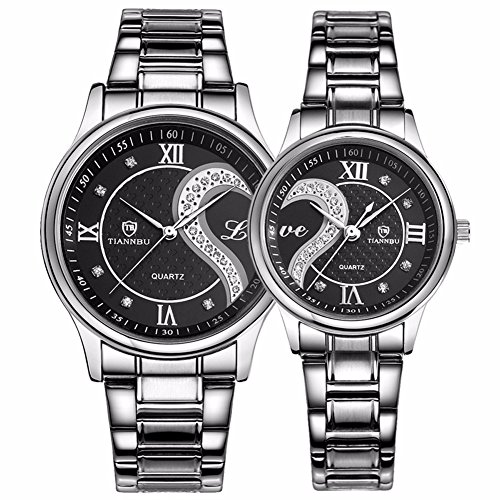
OLEVS Couple Watch His and Her Set Matching Watch Mens Womens Diamond Romantic Valentine’s Day


Dial colours and finishes that pair most reliably
Some dial treatments forgive the realities of production variation better than others, and couples choosing without the chance to compare physical examples should know the ranking. Matte black and deep charcoal sit at the forgiving end: their pigment is stable, their appearance barely shifts with viewing angle, and two examples from different batches will match to any reasonable eye. Silver and champagne sunray dials follow closely, their brightness varying slightly with light but their hue staying consistent. White lacquer dials look identical in photographs yet can diverge between a warm and a cool white in person, which is why jewellers recommend seeing both halves together before engraving a white dialled pair.
Saturated colours demand the most care. Sunray blue is the category’s best seller and its most variable finish, because the brushed base and tinted lacquer interact with light so strongly that two correct examples can appear a full shade apart under mixed lighting. Green dials behave similarly, and burgundy adds a further sensitivity to strap colour, reading brown beside tan leather and properly red beside black. None of this forbids a coloured pairing; it simply means the side by side daylight check described in the buying list is not optional for these finishes, and that ordering both watches in a single transaction, from a single retailer’s stock, measurably improves the odds of a true match.
Texture matching deserves the same attention as hue. A linen, guilloche, or brushed dial finish should appear on both watches at the same scale relative to dial size, and makers who redraw the texture for the smaller dial earn the premium they charge. When the smaller watch substitutes a flat printed texture for the larger one’s genuine relief, the pair will read as near relatives rather than twins, and a buyer who notices that in the shop should either embrace the complementary framing honestly or choose a different set altogether.
A final word on photographs, because for many couples the set will be seen in pictures far more often than in person. Matched watches reward a moment’s coordination before weddings, anniversaries, and family portraits: the same strap family on both wrists, clasps centred, crowns pushed home, and dials catching the same light. Photographers who shoot weddings professionally often ask couples to rest their hands together precisely because paired watches compose so naturally, the two dials echoing the two rings beside them. Keeping both watches clean, correctly set, and worn on the wrist each owner prefers sounds like a trivial instruction, yet it is the difference between a portrait where the pairing sings and one where a stopped, dusty smaller watch quietly steals attention for all the wrong reasons.
Storage between occasions deserves the same paired thinking as everything else in this guide. A shared two slot case keeps the watches from migrating into separate rooms and separate habits, and a silica gel sachet inside that case guards both against the humidity that fogs crystals and spots dial lacquer over years. Wind automatic pairs monthly if they rest unworn, feed quartz pairs a little daylight on a shelf rather than a dark drawer where a solar cell can starve, and glance at both dials whenever the case is opened, because a fault noticed early on one half of a cherished pair is almost always cheaper to put right than a fault discovered on the morning of the anniversary itself.