What's inside
- Key Takeaways
- Quick Picks
- How Did We Choose These Picks?
- What Does TLC Actually Mean Inside the Drive?
- How Do the Six Compare Side by Side?
- How Can You Tell a Drive Is Really TLC Before You Buy?
- Does TLC Endurance Deserve Its Worry?
- How Should You Match a TLC Drive to a Machine?
- What Happens During a Really Long Transfer?
- What Mistakes Do TLC Shoppers Make?
- Why Did the Industry Settle on TLC, Anyway?
- Final Recommendation
- Frequently Asked Questions
- Related Guides
As an Amazon Associate I earn from qualifying purchases. This post may contain affiliate links at no extra cost to you.
gizmoverdict.com is reader-supported. When you buy through links on our site, we may earn an affiliate commission.
Where to buy: Each TLC pick is linked twice over — once alongside its name in the Quick Picks list, and again inside the review devoted to that drive. This roundup’s subject is a NAND type, so the listings were chosen because their titles state that type outright — confirm the exact capacity and model code on the listing before ordering, since each family is sold in several sizes whose write figures differ in ways their own titles honestly disclose.
The best tlc ssds start from a simple fact of modern storage: TLC — triple-level cell — is the NAND flash that most of the world’s SSDs are built from, and shopping by it is really shopping for the mainstream done properly. Every pick in this roundup has the words TLC or 3D TLC NAND printed in its own listing title; that was the entry requirement, and it is stated here because the rule of this article is strict. Where a drive’s title confirms TLC, we say so. The pool contained no pick whose title was silent on NAND that we needed to include — all six passed the title test, which makes this the rare roundup where the headline technology is documented on every single listing.
Why does the cell type deserve a roundup of its own? Because the alternatives frame it. SLC stores one bit per cell and lives in caches and industrial niches; QLC stores four and trades endurance and sustained-write grace for capacity economics; TLC, at three bits per cell, is the balance the industry converged on — dense enough to be affordable, durable enough for years of ordinary service, fast enough that controller design, not the flash, usually sets the pace. Specifying TLC is not chasing an exotic feature. It is declining the compromises on either side of the mainstream, and that is a quietly sophisticated thing to do. It also future-proofs the purchase in a small but real way: because TLC is the technology the whole ecosystem — controllers, firmware, consoles, enclosures, support knowledge — is optimised around, a TLC drive is the one most likely to be understood by every machine and every technician it ever meets. Compatibility is a kind of longevity too, and it is the kind nobody prints on a box.
The six picks span the modern NVMe landscape: two TEAMGROUP designs at Gen3 and Gen4 price-conscious tiers, a pair of Crucial flagships at Gen4 and Gen5, a second TEAMGROUP family in two capacities, and FIKWOT’s FN955 flying the flag for the newer value brands. All are M.2 2280 sticks. Between them they cover the student laptop, the gaming desktop, the console expansion bay and the creator workstation — the four habitats where TLC NVMe drives now live and work, and where the difference between a documented drive and an assumed one quietly decides how the next five years go.
Key Takeaways
- Every pick’s listing title states TLC or 3D TLC NAND outright — no NAND guesswork anywhere in this roundup.
- TLC is the industry’s balance point: three bits per cell, between SLC’s niches and QLC’s compromises.
- Crucial’s T705 is the speed ceiling here, a Gen5 drive rated up to 14,500MB/s with TLC NAND in its title.
- Crucial’s T500 brings the same confirmed TLC to Gen4 at up to 7,400MB/s.
- TEAMGROUP covers the value tiers: the Gen3 MP33 and the Gen4 T-Force G50 in 512GB and 2TB.
- FIKWOT’s FN955 shows the newer brands now publish TLC in their titles too — check the code, buy the spec.
Quick Picks
| Pick | Badge | Why it earns its place |
|---|---|---|
| TEAMGROUP MP33 1TB | Gen3 TLC value | 3D NAND TLC stated in the title, with 1800/1500 MB/s read/write on a PCIe Gen3x4 interface. |
| TEAMGROUP T-Force G50 512GB | Compact Gen4 TLC | 3D TLC NAND and a graphene heat spreader at 5000/2500 MB/s, for smaller budgets and bays. |
| TEAMGROUP T-Force G50 2TB | Roomy Gen4 TLC | The same G50 design at 2TB, with write speeds rising to 4500 MB/s in the larger model. |
| Crucial T705 2TB | Gen5 TLC flagship | Up to 14,500MB/s and TLC NAND in the title — the fastest confirmed-TLC drive in the pool. |
| Crucial T500 2TB | Gen4 TLC all-rounder | Up to 7,400MB/s with TLC NAND stated, tuned for laptops and desktops alike. |
| FIKWOT FN955 2TB | Value-brand TLC | 3D TLC NAND in the title of a Gen4x4 2TB drive pitched at PS5 and PC. |
How Did We Choose These Picks?
The filter was the keyword itself, applied literally: a drive entered this roundup only if its listing title names TLC or 3D TLC NAND. That sounds like a small and almost pedantic rule, and it eliminates a surprising share of the market, because many excellent drives are sold under titles that never mention their flash at all. We accepted that cost deliberately. A guide to TLC SSDs that includes drives merely believed to be TLC would be asking for trust it had not earned; a guide restricted to title-confirmed drives can show its working on every line, and the six that passed still cover every realistic price and performance tier a TLC shopper shops among.
Within the filter, we weighted the spread a real buyer faces: a Gen3 value stick for older boards, Gen4 in three sizes and temperaments, and a Gen5 flagship for the newest platforms. We also kept the manufacturers honest in both directions — TEAMGROUP appears three times because its titles are unusually explicit about NAND, not because the roundup favours it, and the spec boxes quote each title’s figures exactly as printed, including where read and write speeds differ sharply between capacities of the same family.
What Does TLC Actually Mean Inside the Drive?
A NAND cell stores data as a charge level, and the cell types are named by how many bits those levels must distinguish. One bit needs two levels and forgives a great deal of wear; that is SLC. Two bits need four levels; that was MLC, now mostly retired to industrial shelves. Three bits need eight levels — TLC — and reading them correctly demands more precision from the controller, which is why TLC’s rise tracked controller intelligence. Four bits need sixteen levels; that is QLC, where the precision demands begin to tax endurance and sustained writes in ways ordinary buyers can feel during very long transfers.
Two consequences follow for shoppers. First, TLC’s reputation as the balanced choice is earned physics, not marketing: its cells endure far more rewriting than QLC’s while costing far less per terabyte than SLC’s or the old MLC’s. Second, nearly every modern TLC drive also carries a small, fast cache region — several titles here say SLC Cache outright — where the controller writes incoming data at high speed before folding it into the TLC at leisure. That is why these drives feel quick in bursts yet settle to a lower pace during enormous single transfers. Knowing the trick does not spoil it; it simply tells you which specification — headline speed or sustained behaviour — your workload should shop by. Keep that distinction in your pocket for the whole of this roundup, because every pick below implements the same trick at a different scale, and the differences in how they behave during your largest transfers will trace back to cache size, capacity and cooling far more than to the three letters they all share.
TEAMGROUP MP33 1TB — Gen3 TLC value
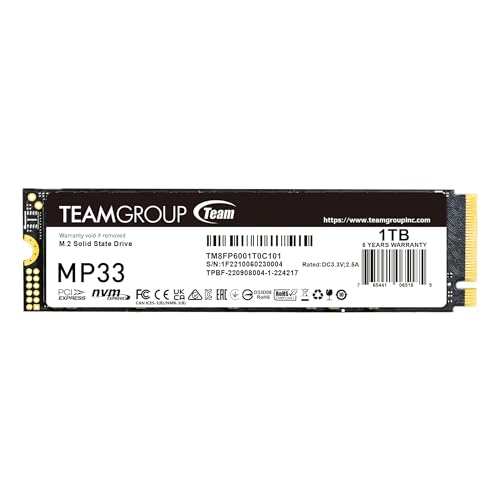
The MP33 is the elder statesman of this list: a PCIe Gen3x4 NVMe 1.3 drive whose title states its 3D NAND TLC outright and quotes read/write speeds up to 1800/1500 MB/s. Those figures belong to the Gen3 era and make no apology for it. Millions of laptops and desktops still run Gen3 slots — boards from the late 2010s, office fleets, hand-me-down gaming rigs — and for every one of them, a Gen4 or Gen5 drive’s extra headroom is unusable by definition. The MP33’s proposition is to serve that installed base with confirmed TLC flash at the value end of the market, and to do it without pretending to be anything else.
Its natural jobs are the classic upgrade jobs. A Gen3 laptop whose original 256GB drive is full gains a terabyte of TLC storage and the full speed its slot allows. A desktop built around an older motherboard gains a boot drive that transforms its manners. A secondary machine — the family PC, the workshop computer — gains storage whose flash type is documented rather than assumed, which at the value tier is a rarer courtesy than it should be. The SLC cache named in the title handles the bursts of everyday work, and the drive’s modest pace keeps it cool in machines with indifferent airflow.
The limits are the era’s limits, stated plainly so no one is surprised. Sustained transfers settle well below Gen4 figures; a creator moving footage daily will feel the ceiling within a week. The title offers no endurance figure, so the spec box records that silence. And a buyer building a new machine today should not choose Gen3 on purpose — the G50 and T500 below exist for that build. The MP33 is a drive for the machine you have, when the machine you have is Gen3, and judged on that honest brief it is exactly right.
There is a broader point in this pick’s favour, and it is about the value tier’s information problem. Cheap drives are where vague listings flourish, and a value drive that prints its NAND type, its cache arrangement and both speed figures in its title is practising a transparency the tier needs more of. Whatever else the MP33 is, it is a drive you can evaluate from its own listing — which, in this roundup’s accounting, is the first virtue.
Installation expectations should be set to the era as well. A Gen3 laptop may need its BIOS left entirely alone, or it may hide the new drive until a setting is changed; either way the MP33 itself is the standard 2280 shape every such bay expects, and the migration software question — clone the old drive or start clean — matters more to the outcome than any specification on this page. Owners who clone a healthy system will be working within the hour, on flash whose type they actually know, which at this tier and this age of machine is a better result than many newer purchases deliver.
- Capacity: 1TB
- Form factor: M.2 2280, PCIe Gen3x4 NVMe 1.3
- NAND: 3D NAND TLC, per the listing title
- Speeds: up to 1800/1500 MB/s read/write, per the listing title
- Cache: SLC Cache, per the listing title
- Endurance (TBW): Not stated in the listing title — verify with TEAMGROUP documentation
Strengths
- Confirmed TLC at the value end, with both speed figures printed in the title.
- Perfectly matched to the enormous installed base of Gen3 machines.
- Cool, undemanding operation suits older laptops and compact desktops.
Trade-offs
- Gen3 pace is a hard ceiling; new builds should look at the Gen4 picks.
- No endurance figure in the title for buyers planning by TBW.
- Long sustained transfers reveal the era’s limits quickly.
Best for: the owner of a Gen3 machine seeking documented TLC capacity at a value position. Not suited for: new builds, Gen4 boards, or daily large-transfer production work.

TEAMGROUP T-Force G50 512GB — Compact Gen4 TLC
The smaller G50 is where TEAMGROUP’s gaming line meets the Gen4 mainstream: 512GB of 3D TLC NAND, an InnoGrit controller, PCIe Gen4x4, read/write figures of 5000/2500 MB/s, and an ultra-thin graphene heat spreader, all stated in the title. The capacity is the deliberate part of the proposition. Half a terabyte is the size a boot drive needs to be when the games and the archive live elsewhere — in a console-adjacent build, a small-form-factor PC, or a laptop whose second slot takes the library. Buying the smaller drive on purpose, with its NAND type confirmed, is a legitimate strategy rather than a compromise.
The graphene spreader deserves its sentence, because in the machines this capacity suits — compact builds, laptops, console bays — there is often no room for a finned heatsink, and a label-thin spreader that flattens the worst thermal spikes is the difference between rated pace and throttled pace during a long install. The title also states PS5 compatibility, and the G50’s shape and speed fit that bay’s requirements; console owners should still confirm the console’s capacity and speed conditions on the listing before ordering, as with any expansion drive.
Read the write figure honestly: 2500 MB/s is the smaller capacity’s number, and the 2TB sibling below doubles it, because larger drives spread writes across more flash. That is not a defect in this unit; it is the physics of capacity, printed openly in both titles — one more reason this roundup insists on quoting titles rather than family reputations. Write-heavy work should take the hint the titles are offering and buy the bigger drive. A drive used mostly for reading — booting, loading, launching — will never show the difference.
As a package, the small G50 suits the deliberate minimalists of PC building: the operating system and the current game on fast confirmed-TLC storage, everything else on the big slow shelf. It is also a sensible first NVMe for a younger builder’s machine, where 512GB is a year of headroom and the documented specification teaches good shopping habits early.
One more habitat deserves naming: the home theatre and living-room PC, where a drive lives behind a television, runs warm in an entertainment unit, and is judged on silence and instant wake rather than on transfers. The small G50’s spreader, modest thermal appetite and quick Gen4 manners fit that quiet brief precisely, and its capacity matches a machine whose library streams from elsewhere in the house. Not every pick needs a dramatic role; some earn their place by disappearing into furniture.
- Capacity: 512GB
- Form factor: M.2 2280, PCIe Gen4x4 NVMe
- NAND: 3D TLC NAND, per the listing title
- Speeds: 5000/2500 MB/s read/write, per the listing title
- Cooling: ultra-thin graphene heat spreader, per the listing title
- Endurance (TBW): Not stated in the listing title — verify with TEAMGROUP documentation
Strengths
- Gen4 speed and confirmed TLC at the capacity tier budget builds actually use.
- Graphene spreader suits the tight bays where finned heatsinks cannot go.
- An honest specification, with the smaller model’s write figure printed plainly.
Trade-offs
- 512GB fills quickly if it must hold a whole game library alone.
- Its write ceiling is half the 2TB sibling’s — capacity physics, openly stated.
- No TBW in the title for endurance-led comparison shoppers.
Best for: the compact-build or console-adjacent buyer seeking a documented TLC boot drive at 512GB. Not suited for: sole-drive game libraries or write-heavy daily production.

TEAMGROUP T-Force G50 2TB — Roomy Gen4 TLC
The 2TB G50 takes the same formula — 3D TLC NAND, InnoGrit controller, Gen4x4, graphene spreader, PS5-ready positioning — and removes the smaller model’s one real constraint. Its title quotes 5000/4500 MB/s read/write, and the jump in the write figure tells the capacity story from the previous section in reverse: with four times the flash to spread across, sustained writing nearly doubles. Two terabytes is also, for most gaming and creator machines, the size at which storage stops being a negotiation. The library fits. The current projects fit. The drive stops appearing in your thoughts, which is the highest praise storage earns.
Its competitive position is the interesting part. The Crucial T500 below is faster on paper and carries a bigger name; the G50’s answer is capacity economics within the confirmed-TLC field — the tier where a buyer can hold out for documented NAND, a proper spreader and Gen4 pace without paying flagship tolls. For a games-first desktop or a console expansion that must swallow a modern library whole, that position is not a fallback. It is the sweet spot wearing its specification openly.
In service, expect the character the title describes: quick launches, level installs, and a drive that stays composed in a warm bay thanks to the spreader. Expect also the standard Gen4 caveat — on a Gen3 board it will run at the board’s pace, wasting none of your money but some of its headroom — and the standard TLC caveat about marathon single transfers settling below the headline once the SLC cache is spent. Neither caveat is a surprise, because this roundup prints them next to every pick rather than reserving them for the fine print.
The buyer this drive flatters most is the one building or upgrading for the long middle term: not chasing Gen5’s frontier, not nursing a Gen3 board along, simply speccing a machine to be forgotten about for four years. Confirmed TLC, two terabytes, documented figures, sensible cooling — the G50 2TB is the roundup’s quiet argument that the mainstream, bought carefully, is enough.
Consider the upgrade path it enables, too. A desktop built around this drive today can demote it gracefully in four years — to a second slot, a console, a family machine — because its specification will still read respectably then: Gen4, TLC, two terabytes, spreader fitted. Drives bought at the documented mainstream age well precisely because nothing about them was a fad. The G50’s resale and hand-me-down value is the unglamorous dividend of buying the centre of the market on purpose.
- Capacity: 2TB
- Form factor: M.2 2280, PCIe Gen4x4 NVMe
- NAND: 3D TLC NAND, per the listing title
- Speeds: 5000/4500 MB/s read/write, per the listing title
- Cooling: ultra-thin graphene heat spreader, per the listing title
- Endurance (TBW): Not stated in the listing title — verify with TEAMGROUP documentation
Strengths
- Two terabytes of title-confirmed TLC with a write figure that respects the capacity.
- Spreader-equipped for console bays and compact, warm desktops.
- The value-conscious way to hold out for documented NAND at Gen4.
Trade-offs
- The T500’s headline pace is higher for buyers prizing peak speed.
- Endurance is not stated in the title and needs a documentation check.
- Gen3 boards will cap it, as they cap every Gen4 pick here.
Best for: the gaming or creator desktop seeking roomy, documented TLC without flagship pricing logic. Not suited for: Gen5-platform builds chasing the current ceiling, or TBW-first shoppers.

Crucial T705 2TB — Gen5 TLC flagship
The T705 is the frontier pick, and its title reads like a frontier claim: PCIe Gen5, up to 14,500MB/s, TLC NAND stated in plain text, compatibility with Intel and Ryzen platforms named outright. Fourteen and a half gigabytes per second is a figure that needs context to mean anything, so here it is: that is roughly twice the Gen4 ceiling and twenty-five times the SATA ceiling, attainable only on a Gen5-capable motherboard, and visible in the real world chiefly during very large transfers and in the responsiveness of workloads that stream data relentlessly. The T705 exists for the machines — and they are a minority, and proud of it — that can actually feed it.
What earns it a place in a TLC roundup, rather than merely a speed roundup, is that the flash is confirmed in the title at the very tier where buyers might fear corner-cutting. Gen5’s early market included drives whose specifications required detective work; Crucial prints TLC NAND on the listing and lets the number speak. For a flagship purchase — the drive a new platform build will be judged by for years — that combination of the highest stated pace and the stated mainstream flash is the whole proposition.
The responsibilities of Gen5 ownership should be stated as plainly as the speed. These drives run hot under sustained load and expect the motherboard’s heatsink or a fitted solution to be present and correctly installed; a Gen5 stick in a bare slot in a warm case will protect itself by slowing down, and owners sometimes mistake that self-defence for a faulty drive. The platform must also be genuinely Gen5 at the slot used, since many boards offer Gen5 to only one slot. Meet those conditions and you get the current ceiling. Fall short of them, and the T500’s Gen4 maturity is the wiser purchase and lose nothing they would have used.
There is a longevity angle too, though this article states it carefully: a drive bought at the platform’s ceiling tends to stay in the machine through its whole life, because no later upgrade tempts. Two terabytes of confirmed TLC at Gen5 pace is, for the right build, a fit-and-forget decision — the most expensive pick in this roundup and, for its specific buyer, potentially the cheapest per year of service.
It is worth being precise about who that buyer is not. The T705 will not rescue a machine whose limits live elsewhere — an older processor, a starved memory configuration, a Gen4 slot — and its headline figure will not appear in a browser benchmark of daily life. Its kingdom is the workstation that streams large assets, the new platform built to be kept, the enthusiast who measures success in project-load times. Outside that kingdom it is a superb answer to a question the machine never asked.
- Capacity: 2TB
- Form factor: M.2 2280, PCIe Gen5 NVMe
- NAND: TLC NAND, per the listing title
- Read speed: up to 14,500MB/s, per the listing title
- Platform note: Intel and Ryzen compatible, per the listing title
- Endurance (TBW): Not stated in the listing title — verify with Crucial documentation
Strengths
- The fastest title-confirmed TLC drive in the pool, by a wide margin.
- Gen5 pace with the NAND type printed on the listing — no detective work.
- A fit-and-forget flagship for a platform’s whole service life.
Trade-offs
- Demands a true Gen5 slot and proper heatsinking to sustain its pace.
- Most machines and most workloads cannot use its ceiling yet.
- The flagship position carries the roundup’s flagship commitment.
Best for: the new-platform builder seeking the current speed ceiling with TLC confirmed in writing. Not suited for: Gen4 or Gen3 machines, sealed laptops, or value-led builds.

Crucial T500 2TB — Gen4 TLC all-rounder
If the T705 is the frontier, the T500 is the settled heartland — and for most buyers in this roundup, the heartland is the better address. Its title states up to 7,400MB/s on PCIe Gen4 with TLC NAND, names laptops and desktops as its habitats, and thereby describes the mature form of the modern SSD: fast enough that the interface, not the drive, is the conversation; documented enough that the flash is not. The T500’s reputation in the wild matches that framing. It is the drive reviewers reach for as a reference Gen4 stick, and reference hardware earns that status by having no interesting failures to discuss.
The all-rounder claim is worth unpacking, because it decides real purchases. In a desktop, the T500 is a boot and library drive that will not be the bottleneck of any task the machine attempts. In a laptop, its Gen4 pace arrives without Gen5’s thermal demands, which in thin machines is the difference between rated speed and theoretical speed. In a console-adjacent role it is capacious and quick. Few drives are genuinely at home in all three chassis; the T500’s title literally advertises two of them, and its service record covers the third.
Against its own sibling, the comparison is about platforms, not merit: Gen5 board, take the T705; Gen4 board — still the overwhelming majority of machines in service — take the T500 and spend the difference elsewhere in the build. Against the G50 2TB, the T500 offers the higher headline pace and the larger maker’s machinery, while the G50 counters on value positioning. Both print their TLC. A buyer choosing between them on documented specification rather than folklore is already shopping the way this roundup exists to encourage.
One practical note completes the picture: 2TB at this performance tier has become the size that ends storage management for most owners. Operating system, applications, the full current game library, a working set of creative projects — the T500 holds the whole ordinary digital life with margin, and its confirmed TLC flash is the mainstream technology doing exactly the job it became the mainstream by doing.
There is a reason drives like this become the default recommendation in forums and workplaces alike, and it is not fashion. A reference product accumulates a public record: every odd motherboard, every enclosure quirk, every firmware revision has been met by someone, documented, and indexed by a search engine. Buying the T500 buys that record along with the hardware. For an owner who will install the drive once and think about it never, the record is worth as much as the last few hundred megabytes per second.
- Capacity: 2TB
- Form factor: M.2 2280, PCIe Gen4 NVMe
- NAND: TLC NAND, per the listing title
- Read speed: up to 7,400MB/s, per the listing title
- Habitats: laptop and desktop compatible, per the listing title
- Endurance (TBW): Not stated in the listing title — verify with Crucial documentation
Strengths
- Reference-grade Gen4 pace with TLC confirmed in the title.
- Genuinely at home in laptops and desktops, as its own listing claims.
- Two terabytes ends storage juggling for the ordinary digital life.
Trade-offs
- Gen5 builders will find its ceiling a generation behind the frontier.
- No endurance figure in the title for TBW-led comparisons.
- Its all-rounder excellence costs more than the value tier’s adequacy.
Best for: the Gen4 laptop or desktop owner seeking the mature, documented centre of the TLC market. Not suited for: Gen5 flagship builds or the tightest budgets in this list.

FIKWOT FN955 2TB — Value-brand TLC
The FN955 represents the newest force in this market: the value brands that compete by publishing specifications the establishment sometimes leaves vague. Its title states 3D TLC NAND for a 2TB PCIe Gen4x4 2280 drive aimed at PS5 and PC, and adds two telling details — a dynamic SLC cache and a graphite heat-spreading label. A younger brand cannot trade on decades of reputation, so it trades on documentation instead, and this listing is a good example of the genre: the flash type, the cache behaviour and the cooling arrangement are all on the label, inviting the comparison shopping that vaguer listings discourage.
The dynamic cache phrase deserves translation, because it is the one specification here that changes how the drive feels. A dynamic SLC cache grows and shrinks with the drive’s free space: roomy when the drive is empty, tighter as it fills. In practice that means the FN955 is at its most responsive when its owner keeps a sensible margin free — the same habit this site’s other guides keep recommending — and that marathon transfers on a nearly full drive will settle to the TLC’s native pace sooner than on a fixed-cache design. None of this is hidden; the title names the mechanism, and an informed buyer can plan around it.
Who is it for? The PS5 owner expanding storage with documented flash rather than a mystery stick; the PC builder whose budget is real and who refuses, correctly, to let a budget become an excuse for unspecified NAND; the second-machine upgrader. The counterweight is the ordinary one for younger brands: the support machinery and multi-year track record behind the drive are thinner than Crucial’s or TEAMGROUP’s, and a buyer should weigh that honestly against the specification’s clarity. This roundup’s position is that a printed spec you can verify outweighs a reputation you must assume — while noting that backups matter doubly wherever any drive is an unknown quantity.
Judged within those terms, the FN955 is a genuinely welcome kind of product: proof that the TLC specification has become a selling point buyers ask for by name, powerful enough that even the market’s newest names lead with it. The mainstream, it turns out, is a standard — and standards are what let smaller makers compete on merit, and what let a buyer compare a famous flagship and an unknown newcomer on the same honest terms.
A practical closing note for this pick: because the title states no headline speeds, the buyer’s homework is one step longer — the maker’s page for the FN955’s exact code, checked before ordering, with the console’s or board’s requirements beside it. That step is not a punishment; it is the same documentation habit this entire roundup teaches, applied to the one listing that requires it most. Take it, and you will know more about your drive than most owners of famous brands ever learn about theirs.
- Capacity: 2TB
- Form factor: M.2 2280, PCIe Gen4x4 NVMe
- NAND: 3D TLC NAND, per the listing title
- Cache: dynamic SLC cache, per the listing title
- Cooling: graphite heat-spreading label, per the listing title
- Speed and endurance figures: Not stated in the listing title — verify with FIKWOT documentation
Strengths
- 3D TLC NAND printed in the title by a value brand — documentation as competition.
- Cache behaviour and cooling arrangement are both disclosed on the listing.
- Two terabytes at Gen4 for PS5 and PC roles, in the standard 2280 shape.
Trade-offs
- The title states no speed figures, so performance expectations need the documentation.
- A younger brand’s support history is necessarily shorter than the incumbents’.
- Dynamic cache rewards free space; a brim-full drive shows its native pace sooner.
Best for: the budget-realist buyer seeking verified TLC at 2TB for a console or PC expansion. Not suited for: buyers ranking maker heritage above printed specification, or TBW-led planning.
How Do the Six Compare Side by Side?
| Drive | Interface | Title-stated speeds | NAND evidence |
|---|---|---|---|
| TEAMGROUP MP33 1TB | Gen3x4 | 1800/1500 MB/s | 3D NAND TLC — stated |
| TEAMGROUP G50 512GB | Gen4x4 | 5000/2500 MB/s | 3D TLC NAND — stated |
| TEAMGROUP G50 2TB | Gen4x4 | 5000/4500 MB/s | 3D TLC NAND — stated |
| Crucial T705 2TB | Gen5 | Up to 14,500MB/s read | TLC NAND — stated |
| Crucial T500 2TB | Gen4 | Up to 7,400MB/s read | TLC NAND — stated |
| FIKWOT FN955 2TB | Gen4x4 | Not stated in title | 3D TLC NAND — stated |
The table’s last column is this roundup’s thesis: six drives, six printed confirmations. With NAND held constant by evidence, the remaining differences are the honest ones — interface generation, capacity, headline pace, cooling arrangement — and they sort buyers cleanly. Gen3 machine, MP33. Compact Gen4 need, the small G50. Roomy Gen4 value, its big sibling or the FN955. Gen4 maturity, the T500. Gen5 frontier, the T705. The flash question, for once, does not need to be part of the argument at all.
How Can You Tell a Drive Is Really TLC Before You Buy?
Start where this roundup started: the listing title and the manufacturer’s specification page for the exact model code. Makers who use TLC increasingly say so, because buyers ask; makers who use QLC at a given tier also, to their credit, often say so. The danger zone is the listing that says nothing at all about flash, where the honest conclusion is not that the drive is secretly one thing or the other, but that the seller has not told you — and an untold specification should be priced as a risk or resolved by documentation before money moves. Model codes are the key that unlocks the datasheet, and the datasheet is where NAND type, endurance and sustained-write figures live in their authoritative form.
Two supporting habits help. First, treat capacity variants as different drives: the same family name at 512GB and 2TB can differ in flash arrangement and always differs in write performance, as the two G50 titles in this very roundup demonstrate. Second, be suspicious of any secondary source that states a NAND type with total confidence while citing no datasheet; the internet’s spec folklore is full of drives mislabelled by confident repetition. Your standard should be the one applied throughout this article — if it is not in the title or the maker’s document, it is not yet a fact about the drive in your cart. That standard will occasionally cost you a tempting listing whose paperwork never resolves, and it will repay that small disappointment every time it steers you to a drive whose maker was willing to be specific. Specificity is a maker’s promise about their own confidence, and across six picks and three brands in this roundup, it has proven to be the most reliable buying signal of all.
Does TLC Endurance Deserve Its Worry?
Every few years the internet rediscovers anxiety about TLC endurance, usually by comparing cell-level rewrite ratings across generations and concluding that something has been lost. The comparison is real and the conclusion is mostly wrong, because a drive is not a cell. Modern TLC drives spread writes across vastly more cells than their ancestors had, manage them with controllers of an entirely different sophistication, and are sold at capacities that dilute any given workload across terabytes of flash. The result, visible in any manufacturer’s rated figures for exact models, is working endurance that exceeds what ordinary machines write in their service lives — often by an order of magnitude. The buyers for whom endurance is a genuine planning variable are the heavy writers this site’s long-lasting roundup addresses, and even they are usually shopping ratings, not cell types.
Where the anxiety does point at something real is the bottom of the market: unspecified drives, where neither the NAND type nor the endurance is published anywhere, and where a low figure in either would explain the price. That is not a TLC problem; it is a documentation problem, and it is precisely the one this roundup’s title test was designed to route around. A TLC drive with its flash named in the title and its figures in a datasheet is a known quantity. Judge drives by what their makers will put in writing, and the cell-type debate shrinks to its proper size — a preference, honestly held, between the mainstream and its neighbours.
How Should You Match a TLC Drive to a Machine?
Three questions, in order. First, the slot: which PCIe generation does the exact slot you will use actually run at, remembering that many boards mix generations across slots and that a laptop’s single slot is whatever the maker’s specification says it is. Second, the thermal reality: is there a motherboard heatsink, room for the drive’s own spreader, airflow of any kind — because Gen4 and especially Gen5 drives convert neglect into throttling with complete impartiality. Third, the capacity arithmetic: not the library you have, but the library eighteen months from now, because every drive in this roundup is cheapest on the day it prevents a second purchase.
Answer those three and the roundup sorts itself, as the comparison table showed. The matching exercise also has a quiet fourth question worth asking aloud: what will this drive become when the machine retires? A documented TLC stick in the standard 2280 shape has second careers — console, enclosure, family PC — lined up in advance. Buying the mainstream well is partly buying that future flexibility, and it is one more reason the flash type, confirmed in writing, matters more than a headline figure ever will.
What Happens During a Really Long Transfer?
It is the one moment every owner of a modern SSD eventually meets, so it deserves a plain description. You begin copying something enormous — a game library migration, a footage archive, a virtual machine collection. The progress bar flies at the headline speed while the drive’s SLC cache absorbs the flood. Then, somewhere into the transfer, the pace steps down to the TLC’s native write speed and stays there, steady, until the job finishes. Nothing has gone wrong. The cache did its work for as long as it was sized to, and the flash beneath it is now writing at the rate physics allows three-bit cells to be written.
The variables that decide how the moment feels are all visible in this roundup’s titles, once you know to look. Larger capacities carry larger caches and more flash to write across, which is why the 2TB picks sustain more than the 512GB one. Dynamic caches, like the FN955’s, trade some of that stamina for responsiveness when the drive is roomy. Cooling decides whether a second, thermal step-down joins the first. A life containing weekly transfers of hundreds of gigabytes should shop these variables deliberately — capacity first, cooling second, headline last. When the largest regular transfer is a game download handled by a launcher, the entire subject can safely be ignored, because the cache will always be big enough for the life they actually lead. The technology is honest about all of this; it simply asks to be read at the level of the workload rather than the advertisement.
What Mistakes Do TLC Shoppers Make?
The first is treating TLC as a performance grade rather than a flash type: a Gen3 TLC drive and a Gen5 TLC drive share a cell technology and almost nothing else, and the interface decides the experience far more than the cells do. The second is the mirror error — dismissing TLC as a budget compromise, when it is in fact the technology inside most of the finest drives sold, including this roundup’s Gen5 flagship. The third is ignoring the cache conversation entirely, then being surprised when a three-hundred-gigabyte single transfer settles below the headline speed; the cache is a feature with a size, and workloads bigger than the feature meet the flash beneath it.
The fourth mistake is filling any of these drives to the brim and keeping them there. TLC controllers need free blocks to work gracefully, dynamic caches shrink as space vanishes, and a drive at ninety-eight percent is a drive negotiating every write. The fifth is buying by family name across capacities — assuming the 512GB and 2TB versions of a drive are the same product at different sizes, when their own titles, as shown above, publish different write figures for good physical reasons. Read the title of the exact drive, at the exact capacity, every time.
Why Did the Industry Settle on TLC, Anyway?
Because it is where three curves cross. The first curve is cost: each added bit per cell multiplies the data a wafer of silicon can hold, and three bits captured most of that multiplication before the engineering difficulty turned steep. The second is controller capability: by the time TLC matured, controllers could correct its tighter error margins in real time, invisibly, at consumer prices. The third is workload reality: the overwhelming majority of drives live read-mostly lives in machines retired for other reasons long before their flash is spent, so a cell type optimised for the balance of density, pace and adequate endurance matched the actual world better than either extreme. SLC retreated to caches and industry, QLC took the capacity-economics frontier, and TLC took the desk, the laptop and the console — which is to say, it took the mainstream this roundup documents.
Understanding that settlement protects a buyer from two kinds of salesmanship: the kind that presents TLC as a premium feature deserving a premium toll, and the kind that presents it as a corner cut. It is neither. It is the standard engineering answer of its era, and the correct shopping posture toward it is the one this article has modelled throughout — require it in writing, then get on with choosing interface, capacity and cooling, which are where your money actually changes your experience.
Final Recommendation
Let the platform decide the shortlist and the budget decide within it. A Gen3 machine takes the MP33 and loses nothing it could have used. A Gen4 machine — most machines — chooses among the small G50 for a deliberate boot drive, the 2TB G50 or FN955 for roomy value with documented flash, and the T500 for the mature centre of the market. A Gen5 platform that can cool it takes the T705 and stops thinking about storage for the life of the build. If a single habit survives this article, let it be the title test itself, applied far beyond this page: whatever specification a purchase turns on — flash type today, endurance tomorrow, a speed class next year — require it in writing from the maker, at the exact model code and capacity in your cart. Listings that survive that test are a pleasure to shop from, and the market rewards makers who write them. Every one of those choices rests on NAND confirmed in the listing itself, which is the quiet luxury this roundup was built to provide: a specification you do not have to take anyone’s word for, printed by the maker, on the product, where it belongs.
Frequently Asked Questions
Is TLC better than QLC for an ordinary user?
For most ordinary users, yes, in the ways that accumulate: better endurance margins and more graceful behaviour during long writes, at capacities where the price difference has narrowed considerably. QLC has legitimate homes in read-mostly, capacity-first roles, but TLC remains the safer default recommendation — which is why this roundup’s buyers shop by its name.
Does TLC wear out faster than the old MLC drives?
Cell for cell, TLC endures fewer rewrites than MLC did, but modern controllers, larger capacities and smarter wear management mean a contemporary TLC drive typically outlasts the machine it is installed in. The honest measure is the drive’s rated endurance for the exact model, found in its documentation — another reason to shop by model code.
Why do two capacities of the same drive publish different write speeds?
Because writes spread across flash, and a larger drive has more flash to spread across. The G50 pair in this roundup shows the effect in its own titles: 2500 MB/s at 512GB, 4500 MB/s at 2TB. It is physics, not a trick, and titles that print both figures are doing buyers a service.
What is an SLC cache doing in a TLC drive?
It is a fast writing area — a portion of the flash operated in single-bit mode — that absorbs incoming data at high speed and folds it into the TLC during quiet moments. Bursts feel quick because of it; very long transfers eventually meet the TLC’s native pace. Several titles in this roundup name the feature outright, including the FN955’s dynamic version.
Can I use one of these drives in a PlayStation 5?
Several picks here are positioned for it — the G50 pair and the FN955 name the console in their titles — but console expansion has its own speed, capacity and heatsink conditions, and the console maker’s current requirements plus the exact listing should both be confirmed before ordering. The T500 and T705 are bought primarily for computers, whatever their titles’ breadth.
Is TLC the same thing as 3D NAND?
No — the terms describe different axes. TLC describes how many bits each cell stores; 3D NAND describes how the cells are physically stacked in layers rather than spread flat. Most modern drives are both at once, which is why titles in this roundup say things like 3D NAND TLC and 3D TLC NAND interchangeably. When a title says only one of the two, the other remains unconfirmed by that title.
Should I avoid a drive whose title does not mention NAND at all?
Not automatically — many fine drives are sold under silent titles — but you should resolve the question in the manufacturer’s documentation for the exact model code before buying, rather than assuming. If the documentation is also silent, price the uncertainty honestly or choose a drive, like every pick here, whose maker puts the answer on the listing.
Related Guides
NAND is one axis of the decision; the others live nearby. Our guide to long-lasting SSDs ranked by endurance evidence covers the stamina question in depth, the best small 2230 SSDs shrinks the same technology for handhelds and ultrabooks, and our under-100-dollars 1TB roundup handles the budget end of capacity.


