What's inside
- Key Takeaways
- Quick Picks
- How did we choose cards for a 100Mbps camcorder?
- What does 4K XAVC S recording actually demand from the card?
- Which cards hold up for AX700 4K recording, reviewed individually?
- How do the six cards compare side by side?
- How should AX700 cards be managed across a recording day?
- How does a long recording day test a card differently from a photo shoot?
- Why do units cause so much confusion in camcorder media?
- How should field videographers physically care for UHS-II media?
- What mistakes do AX700 owners make when buying memory cards?
- How does media choice interact with the AX700’s other recording modes?
- Final Recommendation
- Frequently Asked Questions
- Related Guides
As an Amazon Associate I earn from qualifying purchases. This post may contain affiliate links at no extra cost to you.
gizmoverdict.com is reader-supported. When you buy through links on our site, we may earn an affiliate commission.
Where to buy: All six cards below are linked from the Quick Picks table and from each detailed review, so you can check price on Amazon once you have chosen between the V90 and V60 tiers. Every pick is a UHS-II SDXC card of 128GB or 256GB; the camcorder itself is not a pick and appears only as the machine these cards must feed.
The best sd memory cards for sony ax700 are chosen against the most demanding recording mode in this entire cluster of guides: 4K XAVC S at 100Mbps. That bitrate is a sustained write that never pauses, never bursts and never forgives, and it converts card shopping from a matter of taste into a matter of certification. Sony’s own media guidance for this recording mode points to UHS-II cards carrying a U3 interface class and a video class of V60 or V90, and this guide follows that logic strictly: every pick is a UHS-II card, and each review judges its card by the class and the write figure its own title is willing to print.
The six titles divide into instructive camps. Sony’s own TOUGH cards print both read and write figures, a completeness no rival here matches. The PNY pair print their classes — V90 and V60 respectively — at the larger 256GB capacity, without printing speeds. ProGrade’s Iridium prints its V90 class and nothing else. Lexar’s 1800x Gold prints neither a speed nor a class, resting on a famous line name. A camcorder that records other people’s weddings, products and performances deserves better than resting on names, so the reviews below rank printed evidence first and reputation second, every time.
Capacity planning runs alongside certification. At 100Mbps, an hour of 4K footage consumes roughly forty-five gigabytes, so a 128GB card holds a long morning of recording and a 256GB card holds a working day. The right size depends on whether the AX700 is your ceremony camera, your documentary companion or your studio’s static wide shot — but the class beneath the size is not negotiable in the same way, and this guide treats it accordingly.
Key Takeaways
- For 4K XAVC S recording at 100Mbps, the AX700 needs UHS-II media with a certified class; all six picks are UHS-II, and the V90 and V60 cards print their classes in their titles.
- Sony’s TOUGH-G is the only title here stating a write figure near its read figure: up to 300MB/s read and 299MB/s write, with a V90 class.
- Sony’s TOUGH-M states 277MB/s read and 150MB/s write with a V60 class — the value-complete specification in the set.
- The PNY EliteX-PRO90 and PRO60 bring the certified classes to 256GB, the capacity a full recording day wants.
- ProGrade’s Iridium prints V90 and nothing else; Lexar’s 1800x Gold prints neither speed nor class, so both require documentation checks of different sizes.
- At 100Mbps, budget roughly forty-five gigabytes per recorded hour when choosing between 128GB and 256GB.
- Treat the reader as part of the purchase: the stated read figures on the Sony cards assume a UHS-II reader at the desk.
- Rotate a small fleet evenly across a season rather than wearing one hero card thin while its spares stay new.
- Convert the bitrate before comparing anything: 100Mbps is twelve and a half megabytes per second, and every certified floor in this guide clears it several times over.
- Keep filled cards in a separate case section, logged against the part of the event they hold, until their contents exist in two verified copies elsewhere.
- Never let a card’s first long 4K recording be a paid event; the rehearsal at home is part of the purchase, and it is the cheapest insurance in the whole production.
- Standardise on one maker where the budget allows, and mixed fleets become easier to document, warranty and replace in a hurry far from home.
- Judge every listing in this category by its certified floor first, its stated write figure second, and its read headline last of all.
- Capacity is time in this category: buy the hours your longest recording day actually contains, then defend them with copies made the same evening.
- Heat, duration and a nearly full card are the three quiet multipliers of recording risk, and certified media is the answer to all three at once.
- A spare card of equal certification belongs in every AX700 case, because the middle of an event is the worst possible place to discover a media problem.
Quick Picks
| Pick | Badge | Why it earns its place |
|---|---|---|
| Sony TOUGH-G series SDXC UHS-II Card 128GB, V90, CL10, U3, Max R300MB/S, W299MB/S (SF-G128) | Maker’s flagship | Sony’s own card for Sony’s own camcorder, with read and write figures both printed. |
| Sony TOUGH-M series SDXC UHS-II Card 128GB, V60, CL10, U3, Max R277MB/S, W150MB/S (SF-M128) | Complete value spec | V60 class with stated read and write figures, the honest middle of Sony’s TOUGH range. |
| ProGrade Digital SDXC UHS-II V90 Iridium Memory Card (128GB) | V90 by class alone | A V90 guarantee from a professional media maker, with speeds left to documentation. |
| PNY 256GB EliteX-PRO90 U3 V90 UHS-II SDXC Flash Memory Card, 4K Ultra HD | V90 at full-day size | The highest class at the largest capacity, for ceremonies and long recording days. |
| PNY 256GB EliteX-PRO60 U3 V60 UHS-II SDXC Flash Memory Card, 4K Ultra HD | V60 at full-day size | The certified floor the AX700 requires, doubled in capacity, without the V90 premium. |
| Lexar 128GB Professional 1800x UHS-II SDXC Memory Card (Gold Series) | Line-name contender | Lexar’s Gold Series UHS-II card, its title printing no speed and no class at all. |
How did we choose cards for a 100Mbps camcorder?
The first filter was the interface and the format: UHS-II SDXC, because the AX700’s high-bitrate 4K modes are specified against that media, and slower cards are not merely slower here — in the demanding modes they are simply not the specified tool. The second filter was certification evidence. A printed V90 or V60 class is a guaranteed sustained floor, and sustained floors are the entire ballgame for a recording that runs unbroken for an hour. Cards printing classes were ranked on that evidence; cards not printing them were kept in the list only where the maker’s line and documentation give the buyer a realistic path to verification.
The third filter was write figures, the rarest commodity in card listings. Two Sony titles print them, and those two reviews can discuss recording performance in numbers rather than in class inference alone. The rest of the field is judged by floor: a V90 card guarantees at least 90MB/s sustained, which is several times the 100Mbps stream’s requirement once units are converted — 100 megabits is twelve and a half megabytes per second — and that conversion is worth performing explicitly, because it shows how much certified headroom even the V60 tier carries for this camera, and why the contest between these cards is about margin, workflow and trust rather than about bare survival.
The final filter was capacity realism. A camcorder card is bought against hours, not against frame counts, so the shortlist keeps both the 128GB tier, sized for a long event, and the 256GB tier, sized for a day, and lets the recording pattern decide. No smaller cards were admitted, because a 4K camcorder chewing through media at this bitrate makes small capacities a false economy measured in mid-ceremony swaps.
What does 4K XAVC S recording actually demand from the card?
Translate the bitrate first. One hundred megabits per second is a continuous twelve and a half megabytes per second, sustained for as long as the record button is down, with no buffer holidays and no opportunity for the card to catch its breath. Against that demand, a V60 floor of sixty megabytes per second is nearly five times the requirement, and V90 is more than seven times. Those ratios explain a seeming paradox of this guide: the requirement is strict — certified UHS-II media — yet every certified card here clears it with room to spare. The strictness is about the guarantee, not the arithmetic; an uncertified card might also sustain the rate, on a cool day, when new, at half capacity, and a professional recording is not the place to test adverbs.
Heat and duration are the hidden multipliers. A camcorder recording 4K for hours warms itself and its media, and a card’s sustained behaviour late in a long, hot record is the behaviour that matters. Certified floors are measured as minimums the card must hold, which is precisely the property a four-hour recording day purchases. This is also why the guide is unimpressed by read headlines in this particular shortlist: the journey from card to computer matters at the day’s end, but the day’s footage exists only because the write floor held at hour three.
The AX700’s other modes relax the demand without relaxing the logic. Full HD recording and slower frame rates write at gentler rates, and slow-motion modes in this camera family record bursts that are then played back slowly, which changes the arithmetic again. A card certified for the 4K ceiling covers every lesser mode as a by-product, which is why buying to the ceiling is the simple, defensible policy for a camera that may be asked for any mode on any given day.
Which cards hold up for AX700 4K recording, reviewed individually?

Sony TOUGH-G series SDXC UHS-II Card 128GB, V90, CL10, U3, Max R300MB/S, W299MB/S (SF-G128) — Maker’s flagship
There is a particular confidence in the card the camera’s own maker sells for it, and Sony’s TOUGH-G title justifies that confidence with the most complete specification in this guide: V90, Class 10, U3, read up to 300MB/s and write up to 299MB/s, all printed in one line. The write figure is the headline that matters — a stated ceiling within a whisker of the read ceiling, behind a V90 certified floor — and it makes this the one card whose recording performance can be discussed entirely in its own published numbers. For the AX700’s 100Mbps stream, the margin is not merely adequate; it is architectural.
The TOUGH name denotes Sony’s ruggedised card line, built around a one-piece moulded design rather than the traditional two-shell construction; the listing title itself claims the name and the figures, and the physical durability details belong to Sony’s documentation, which a buyer for field work should read before relying on them. What can be said from the title is that Sony positions this card for exactly the punishment a working camcorder’s media absorbs — constant insertion cycles, location weather, pockets and cases — and charges accordingly.
At 128GB, the card holds a long event at 4K with room for the day’s HD work beside it. Pair it with the TOUGH-M as the second card and the AX700’s media becomes an all-Sony, all-documented system, which simplifies troubleshooting to a single maker’s paperwork. The premium is real, and this review’s position is that for paid recording work it is the easiest premium in the guide to defend: the card’s maker, the camera’s maker and the specification’s completeness all point the same way.
There is also a resale-of-attention argument for the flagship. A videographer running the TOUGH-G never has to wonder, mid-booking, whether the media question was settled; it was settled at purchase, in print, by the camera’s own maker. That absence of doubt has operational value on a wedding morning that a specification table cannot capture, and it is the honest core of this card’s appeal beyond its numbers — numbers which, to be fair, needed no help.
- Capacity: 128GB
- Interface: UHS-II, SDXC format
- Read speed: max 300MB/s, as stated in the listing title
- Write speed: max 299MB/s, as stated in the listing title
- Speed classes: V90, CL10 and U3, as stated in the listing title
Strengths
- Only title here stating a write figure rivalling its read figure, behind a V90 floor.
- Sony’s own media for Sony’s camcorder, simplifying support and documentation.
- TOUGH line positioning aimed at field punishment and heavy insertion cycles.
Trade-offs
- Flagship pricing for performance margins this camera only partly spends.
- 128GB still turns over within a very long 4K recording day.
- Durability specifics require Sony’s documentation beyond the title’s claims.
Best for: a professional recording 4K on the AX700 who requires the maker’s own fully specified flagship card. Not suited for: a casual HD-only shooter whose modes never approach the V90 tier’s purpose.

Sony TOUGH-M series SDXC UHS-II Card 128GB, V60, CL10, U3, Max R277MB/S, W150MB/S (SF-M128) — Complete value spec
The TOUGH-M performs the neatest trick in this shortlist: it tells you everything, at the tier below the flagship. V60 class, read up to 277MB/s, write up to 150MB/s — a complete, honest specification whose every number remains vastly beyond the AX700’s 100Mbps requirement. The write ceiling of 150MB/s is twelve times the stream’s demand, and the certified V60 floor is nearly five times it. A buyer could stop reading this entire guide at this card and make a defensible purchase, which is the highest compliment a value pick can earn.
The M sits under the G in Sony’s TOUGH hierarchy, and the differences live in the ceilings rather than in fitness for this camera. Both are UHS-II, both are TOUGH-line cards, both print their figures. For the AX700 specifically, the M’s specification is not a compromise at all, because the camera cannot spend the G’s extra headroom in any recording mode it offers. The G’s case rests on future cameras and on the psychology of buying the top shelf; the M’s case rests on arithmetic, and the arithmetic is not close.
As with its sibling, the physical TOUGH attributes are a documentation matter beyond the title, and the 128GB capacity suits an event-scale recording pattern with offloads between engagements. What the M offers the working videographer is a two-card system at a saner total: two TOUGH-M cards, rotated across a day, give the AX700 certified media with a genuine spare, for an outlay in the territory of a single flagship card used alone. Systems beat singletons in recording work, and this card is the system-builder’s pick.
Documentary shooters should hear their name called here in particular. A documentary day is a chain of unpredictable long takes in places where reshoots are fiction, recorded by a camera that may be the only one on location. Media for that work should be boring in the best sense: completely specified, multiply redundant, easily replaced in a strange city. The TOUGH-M is the most boring card in this guide, and in this sentence boring is the highest praise the category offers.
- Capacity: 128GB
- Interface: UHS-II, SDXC format
- Read speed: max 277MB/s, as stated in the listing title
- Write speed: max 150MB/s, as stated in the listing title
- Speed classes: V60, CL10 and U3, as stated in the listing title
Strengths
- Complete printed specification: class, read and write figures all present.
- Every figure exceeds the AX700’s 4K requirement by a wide multiple.
- Pricing logic supports a two-card rotation rather than a lone flagship.
Trade-offs
- Ceilings sit below the TOUGH-G for owners collecting flagship margins.
- 128GB capacity still requires mid-day management on the longest records.
- TOUGH durability details live in Sony documentation, not in the title.
Best for: a working videographer seeking a fully documented V60 card with stated write performance for the AX700. Not suited for: a specification collector who wants the highest ceilings regardless of the camera’s ceiling.

ProGrade Digital SDXC UHS-II V90 Iridium Memory Card (128GB) — V90 by class alone
ProGrade’s Iridium title is a study in minimalism: a format, an interface, a V90 class, a tier name, a capacity. No read speed, no write speed. Yet for this camera, the single printed fact is the decisive one, because V90 certifies the sustained floor that 4K XAVC S recording depends on, at the highest level the SD system offers. A class-literate buyer needs nothing else to know this card is qualified for the AX700’s hardest mode; a less practised reader will find the rest of this guide explains why the class outranks the missing numbers.
ProGrade sells exclusively to photographers and videographers, and the Iridium name marks a tier within that focused range. The absence of speed figures in the title should be read as the maker’s listing style rather than as concealment — the documentation exists and professionals are expected to consult it — but this guide scores titles, and on titles this card finishes its argument in five words while the Sony pair write essays. For offload planning especially, where the read figure decides how a 128GB card’s evening goes, the documentation trip is effectively compulsory.
In an AX700 kit, the Iridium’s natural role is the certified main card for an owner already standardised on ProGrade across cameras, where one maker’s behaviours and warranty channel simplify a working life. Bought as a pair, two Iridiums give the camcorder V90 media with a true spare. Bought singly against the TOUGH-G, it trades the Sony’s printed write figure for the class alone at what is often a friendlier price — a rational trade for the class-literate, and this review records it as such.
The Iridium also illustrates a healthy division of labour in a professional kit: some purchases are made on a listing page, and some are made on a relationship with a maker’s whole programme. ProGrade’s buyers tend to be the second kind, standardising media across bodies and years, and for them the sparse title is a shop window in front of a known warehouse. Newcomers to the brand should simply do the one documentation reading the regulars did long ago, after which this card’s case is as complete as any in the guide.
- Capacity: 128GB
- Interface: UHS-II, SDXC format
- Speed class: V90, as stated in the listing title
- Read speed: Not stated in the listing title — verify with ProGrade Digital documentation
- Write speed beyond the V90 floor: Not stated in the listing title — verify with ProGrade Digital documentation
Strengths
- V90 certification printed plainly — the decisive qualification for 4K XAVC S.
- Professional-only media maker with a focused reputation among videographers.
- Class guarantee covers every recording mode the AX700 offers.
Trade-offs
- No speed figures in the title, leaving offload pace undocumented here.
- Sony rivals print complete specifications at the listing page itself.
- Documentation check is required for a fully informed purchase.
Best for: a ProGrade-standardised videographer seeking V90 certification for the AX700 at 128GB. Not suited for: a buyer requiring read and write figures visible on the listing before deciding.

PNY 256GB EliteX-PRO90 U3 V90 UHS-II SDXC Flash Memory Card, 4K Ultra HD — V90 at full-day size
Capacity is a recording feature, and this PNY is where the shortlist’s highest class meets its largest size: V90 certification, U3, UHS-II, 256GB. At the AX700’s 4K bitrate that capacity is a full working day of footage on one card — the wedding with no mid-ceremony swap, the documentary day with no laptop until evening, the conference recorded entire. The class beneath the size is the same V90 floor as the flagship Sony and the ProGrade, so the day-long card carries the day-long guarantee, which is the only combination worth having at this capacity.
No speeds are printed in the title, so offload pace for a brimming 256GB card is a documentation question, and it deserves weight: a full card of this size takes a while through any reader, and through a slow one it takes a chapter of the evening. The working answer is procedural rather than technical — offload in stages during the day’s natural pauses, or accept the long evening transfer as the price of the swap-free day. Either way, the footage exists, certified from first minute to last, which is the point of the exercise.
The concentration warning applies at full strength: a day of unrepeatable recording on one card should be defended by copies at the first opportunity, and professionals will treat this PNY as a working vessel inside a same-day backup routine rather than as the day’s only home. Used that way, it is the production pick of the guide — the card for the AX700 that earns its living at events, where the cost of a swap at the wrong moment is measured in missed vows rather than in specifications.
Conference and performance work flatters this card for a second reason: predictability of the schedule. A programme that runs four hours with one interval wants exactly one planned media decision, at the interval, and a card that holds the whole day removes even that. The operator’s attention stays on framing, focus and audio — the places where an AX700 earns its fee — while the media question, answered in advance by capacity and class together, simply never comes up.
- Capacity: 256GB
- Interface: UHS-II, SDXC format
- Speed classes: U3 and V90, as stated in the listing title
- Video labelling: 4K Ultra HD, as stated in the listing title
- Read speed: Not stated in the listing title — verify with PNY documentation
Strengths
- Highest certified class at the largest capacity in the set.
- A full 4K recording day without a mid-event card swap.
- V90 floor guarantees the whole day, not just its first hour.
Trade-offs
- A day’s footage on one card demands a same-day backup routine.
- Read speed unstated; a full-card offload’s duration is undocumented.
- Capacity and class together command the set’s serious money.
Best for: an event videographer requiring V90 certification across a full swap-free recording day. Not suited for: a cautious recorder who prefers the day’s footage spread across several smaller cards.

PNY 256GB EliteX-PRO60 U3 V60 UHS-II SDXC Flash Memory Card, 4K Ultra HD — V60 at full-day size
The PRO60 is the PRO90’s argument minus the premium: the same 256GB capacity, the same UHS-II interface, a V60 class instead of V90. Run the conversion from this guide’s opening and the V60 floor — sixty megabytes per second sustained — stands at nearly five times the 100Mbps stream’s requirement. For the AX700, in every mode it possesses, that floor is not a compromise position; it is a certified excess. The buyer of this card is purchasing the full-day capacity and declining only the headroom reserved for cameras hungrier than this one.
That makes the PRO60 the rational centre of the shortlist for a single-camera owner. The money not spent on V90 funds the second card, the reader or the backup drive — the supporting cast that actually determines whether footage survives its first week. Two PRO60s, rotated, give an AX700 a media system; one PRO90 gives it a very good card. This guide has made the systems argument in every cluster it has covered, and a camcorder recording unrepeatable events is where the argument bites hardest.
Speeds are unstated in the title, as with its sibling, so the offload chapter is documentation homework, and the same staged-offload habit is recommended for full cards. What is stated — capacity, interface, U3, V60, the 4K Ultra HD positioning — is everything the recording decision itself needs. If the AX700 is your only 4K device and your recording days are long, this is arguably the most precisely fitted purchase in the guide: no figure missing that the camera can feel, no premium paid for figures it cannot.
Schools, houses of worship and community venues — the AX700’s natural habitats — should note the economics here. Such buyers record long, often, on budgets approved by committees, and they need media whose qualification can be shown in one line of a title rather than argued from a brand’s reputation. V60, printed, at a full day’s capacity, is a specification a committee can approve and a volunteer can operate, and that administrative fitness is a real feature in the life of this particular camcorder.
- Capacity: 256GB
- Interface: UHS-II, SDXC format
- Speed classes: U3 and V60, as stated in the listing title
- Video labelling: 4K Ultra HD, as stated in the listing title
- Read speed: Not stated in the listing title — verify with PNY documentation
Strengths
- Certified V60 floor at full-day 256GB capacity.
- Floor exceeds the AX700’s 4K requirement by a wide, stated multiple.
- Savings against V90 fund the second card a recording kit needs.
Trade-offs
- No printed speeds, so offload planning needs PNY’s documentation.
- Full-day concentration of footage demands disciplined same-day copies.
- Owners with a hungrier second camera may prefer V90 commonality.
Best for: a single-camcorder owner requiring certified performance and full-day capacity without the V90 premium. Not suited for: a multi-camera operator standardising on V90 media across hungrier bodies.
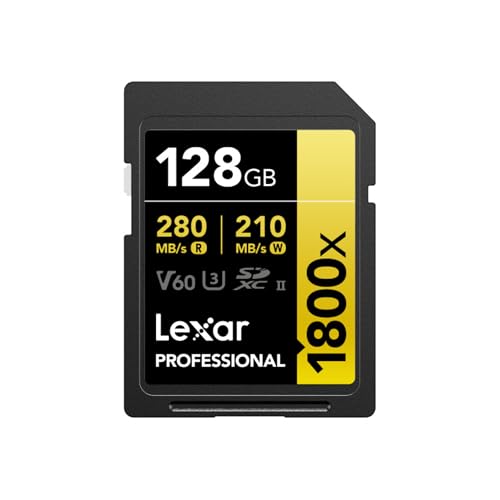
Lexar 128GB Professional 1800x UHS-II SDXC Memory Card (Gold Series) — Line-name contender
The 1800x arrives with the thinnest title in the guide: a Professional designation, an 1800x rating in the old multiplier notation, the UHS-II interface, the Gold Series name and 128GB — and no video class, no read speed, no write speed in modern units. The 1800x notation historically corresponds to read performance in the region of the other cards here, but this guide does not convert legacy marketing notation into specifications, and it does not borrow the V60 or V90 class that other Lexar listings print and this one does not. On title evidence, this is a UHS-II card from a major maker’s professional Gold line, full stop.
That restraint matters more for this camera than for any stills body in the cluster, because the AX700’s demanding mode is specified against certified classes. A card whose class must be established in documentation is not disqualified — Lexar’s documentation for the 1800x line exists and the buyer should read it before purchase, confirming the video class for this exact capacity — but until that reading is done, the card cannot be recommended for 4K XAVC S work on evidence, only on lineage. The review therefore places it last while acknowledging that the homework may well vindicate it completely.
For HD recording patterns, or as a stills and backup card in a wider kit, the calculus softens: the interface is right, the maker is serious, the capacity is the event tier. An owner who completes the documentation check and finds the class certified can promote this card to main duty with a clear conscience, and may have bought UHS-II Lexar media at a gentler price than the fully printed rivals for the trouble. The guide’s ordering simply refuses to let the trouble be skipped silently.
To be fair to the card one last time: Lexar’s Professional Gold line has served in more cameras than most of the titles in this guide combined, and the 1800x generation was a flagship in its day. Nothing in this review doubts the hardware; the doubt is procedural, about what a buyer is entitled to conclude from a listing page. Complete the one reading the listing asks for, and this section’s caution converts into an ordinary, confident purchase — which is all the guide ever wanted for it.
- Capacity: 128GB
- Interface: UHS-II, SDXC format
- Video speed class: Not stated in the listing title — verify with Lexar documentation
- Read speed: Not stated in the listing title — verify with Lexar documentation
- Write speed: Not stated in the listing title — verify with Lexar documentation
Strengths
- UHS-II interface and Gold Series professional positioning from Lexar.
- 128GB capacity matches the event-scale recording tier.
- Documentation may confirm full certification at a gentler price.
Trade-offs
- No class or speed figure appears anywhere in the listing title.
- 4K XAVC S suitability cannot be established from the listing alone.
- Every rival in this guide prints more decision evidence.
Best for: a Lexar loyalist seeking UHS-II media at 128GB and willing to verify the video class in documentation first. Not suited for: a videographer buying tonight for tomorrow’s 4K booking, where certification must be visible immediately.
How do the six cards compare side by side?
| Card | Capacity | Read in title | Write in title | Class in title |
|---|---|---|---|---|
| Sony TOUGH-G | 128GB | 300MB/s | 299MB/s | V90 |
| Sony TOUGH-M | 128GB | 277MB/s | 150MB/s | V60 |
| ProGrade Iridium | 128GB | Not stated | Not stated | V90 |
| PNY EliteX-PRO90 | 256GB | Not stated | Not stated | V90 |
| PNY EliteX-PRO60 | 256GB | Not stated | Not stated | V60 |
| Lexar 1800x Gold | 128GB | Not stated | Not stated | None stated |
Five of the six cards certify their floor in print; two of the six state their write performance; one states nothing beyond its lineage. For a camcorder whose hardest mode is a certified-class specification, the first column of virtues is the class column, and the table shows the shortlist is strong exactly where the camera is demanding. Choose capacity by the length of your recording day and class by your appetite for margin, and any of the five certified cards will serve the AX700 honourably.
How should AX700 cards be managed across a recording day?
Begin the day with formatted, empty, labelled cards, formatted in the camcorder itself after the previous day’s footage is copied and verified. Camcorder media discipline is stricter than stills discipline for one reason: a recording cannot be paused while a card problem is negotiated. The card that goes in at the ceremony’s start should be a known card, rehearsed, with its class confirmed and its capacity matched to the event’s length, and the spare in the case should be its equal rather than an antique pressed back into service.
During the day, treat a card change as a logging event. Note which card holds which part of the event, keep filled cards in a separate case or turned face-down in the wallet, and never format anything in the field. The write-protect tab can guard a finished card during handling. At the day’s end, offload through a UHS-II reader — the stated read figures on the Sony pair assume one — verify the copies by playing footage from the start, the middle and the end, and only then return the cards to the camcorder for formatting.
Rotation across a season matters as much as rotation across a day. Cards that record weekly accumulate write cycles quickly, and a small fleet rotated evenly ages evenly, avoiding the trap of one hero card worn thin while its spares stay new. Retire any card that produces a recording error, a mount hesitation or a file that will not play; in video work the first symptom deserves even less forgiveness than in stills, because the footage it threatens cannot be restaged at any price.
How does a long recording day test a card differently from a photo shoot?
A stills card lives a life of sprints and rests. A camcorder card lives a marathon: the write begins when the record light lights and may not meaningfully pause for hours, while the camera’s own electronics warm the slot from one side and a summer venue warms it from the other. Sustained behaviour under warmth is the least advertised and most decisive property in this entire category, and it is exactly what the video class system was built to certify. A V60 or V90 mark is a promise about the card’s floor under sustained load, which is why this guide keeps returning to those two syllables while treating every other number on the titles as supporting evidence.
Duration also changes the meaning of capacity. A photographer fills a card in bursts and can swap at any pause; a videographer’s swap is an edit point forced into the record, a gap in a ceremony, a restart in an interview. That is the human arithmetic behind the 256GB PNY pair: not greed for gigabytes, but the purchase of uninterrupted time. Conversely, the 128GB tier’s discipline — planned swaps at natural breaks, cards logged as they fill — is a professional skill in itself, and plenty of working AX700 owners run the smaller cards precisely because the rhythm keeps the day’s footage catalogued as it is created.
The end of the day is the third test, and it is administrative. Hours of 4K footage must move from card to computer to backup before anyone sleeps, because tomorrow the cards are needed again. Read figures — the Sony pair’s stated 300MB/s and 277MB/s — govern that transfer, and a UHS-II reader governs whether the figures are real. A production that buys certified cards and then offloads through a reader from another era has certified the morning and neglected the night, and footage is lost at night at least as often as it is lost at noon.
Why do units cause so much confusion in camcorder media?
Because two industries measure the same river in different units and print the results side by side. Camcorders state bitrates in megabits: the AX700’s demanding mode is 100Mbps. Cards state speeds in megabytes: a V60 floor is 60MB/s. Eight megabits make a megabyte, so the stream is twelve and a half megabytes per second — a figure that sounds modest beside the card classes until the second property of video is remembered, which is that the flow never stops. A stills camera’s card can be slow for a second and catch up during the photographer’s pause; a camcorder’s card that falls behind for a minute has lost a minute that existed exactly once.
The confusion cuts in both directions, and both errors cost money. Reading megabits as megabytes makes the requirement look eight times larger than it is, pushing buyers toward flagship tiers they do not need and occasionally toward doubting certified cards that are, in truth, loafing. Reading a card’s read figure as its write figure commits the opposite error, crowning a transfer sprinter for a recording marathon. This guide has therefore performed the conversion explicitly in its opening sections and repeated it in the FAQ, because the whole shortlist becomes calm and legible the moment the units are straight: the requirement is strict about certification and generous about arithmetic, and every certified card here is, by the numbers, overqualified — which is exactly where recording media should be.
A final unit worth translating is the hour. Forty-five gigabytes per hour at the top bitrate converts capacity into the only currency a videographer actually spends, which is time: three hours on the 128GB cards, a working day on the 256GB pair. Buy time the way the day demands it — ceremonies in whole hours, interviews in long unbroken stretches, documentary days in whatever the location gives you — and the capacity question answers itself without a single specification being consulted.
How should field videographers physically care for UHS-II media?
Camcorder cards lead harder physical lives than stills cards: they are swapped in venues, in vehicles, in weather, by hands that are also holding lights and cables. The disciplines are small and absolute. Cards travel in a hard case with a consistent orientation system — face up for empty, face down for full is the classic convention — so that state can be read at a glance in bad light. A card is never carried loose in a pocket, where lint, coins and bending forces wait, and never left in a hot vehicle between the ceremony and the reception, because heat is the silent tax on every figure in this guide.
Insertion cycles deserve respect as well. UHS-II’s second row of contacts is a precision interface, and a card slammed home at an angle, or seated with grit on its contacts, is a recording risk that no class certification can offset. Keep the case closed, keep contacts untouched, and let the camcorder’s slot stay clean by the simple habit of never leaving it open and empty in the field. The TOUGH line’s entire existence is Sony’s answer to this physical reality; the other cards answer it with the owner’s habits instead, which cost nothing and work nearly as well.
Retirement, in video service, should be unsentimental. A card that has interrupted one recording, hesitated at one mount, or produced one file that would not play has given its evidence, and the footage at stake in its next failure is worth a hundred replacements. Demote it to stills or transfer duty, label the demotion on the card itself, and promote a rehearsed spare. Media is the cheapest line in a video budget and the only one whose failure is measured in other people’s memories.
What mistakes do AX700 owners make when buying memory cards?
The gravest is buying on read speed for a recording problem, choosing the card with the heroic transfer figure while its sustained class goes unexamined — the exact inversion of the camera’s needs. The second is assuming a famous line name carries a certification the listing never printed, which is why the Lexar in this guide is reviewed on its silence rather than on its siblings’ credentials. The third is unit confusion: reading 100Mbps as 100MB/s and concluding that only the fastest cards survive, when the conversion shows certified V60 media holding nearly five times the requirement.
The fourth mistake is capacity bravado — one 256GB card, a full day aboard, no copies until the weekend — which converts the best card in the guide into the riskiest object on the shoot. The fifth is mixing media generations in the case without labels, so that an old, slow card from a stills camera ends up in the camcorder on the one day 4K is booked. Each of these errors is a failure of system rather than of shopping, and each is prevented by the same trio of habits: certify, label, offload.
How does media choice interact with the AX700’s other recording modes?
Not every AX700 day is a 4K day, and a fair question is whether certified UHS-II media is wasted on the camera’s gentler work. The answer is that the same card simply becomes unhurried. Full HD recording writes at a fraction of the 4K rate, so a V60 or V90 card in HD service is operating far inside its guarantee, with all the behavioural calm that implies: no thermal drama, no borderline moments, no difference between the first minute and the fourth hour. Buying to the ceiling means every lesser mode inherits certainty as a by-product, and an owner never has to remember which card is allowed to record which mode — a small operational mercy that prevents the classic field error of the wrong card in the camera on the one day the demanding mode is booked.
Slow-motion and high-frame-rate work in this camera family writes its bursts to the same media, and the certified floor is again the relevant figure, because a burst that the camera has captured must still be landed on the card at the card’s sustained pace. Stills, which the AX700 also takes, are trivial beside all of this. The unifying principle is the one this guide opened with: choose media for the hardest mode the camera offers, verify the class in print, and every other mode becomes a holiday the card takes in its stride. Media bought that way never has to be re-bought when a client’s brief changes from HD to 4K between the phone call and the shoot.
Final Recommendation
The Sony TOUGH-M is this guide’s centre of gravity: a complete printed specification, a V60 floor at nearly five times the requirement, a stated write figure, and pricing that invites buying two. The TOUGH-G crowns the range for those who want the maker’s flagship and its stated 299MB/s write ceiling. The PNY pair extends the same certifications to a full recording day, the PRO60 as the rational capacity pick and the PRO90 as the no-compromise one. The ProGrade serves its loyalists on class alone, and the Lexar waits on its documentation. A camcorder is a promise made to the people in front of it; the right card is the one whose floor was certified before the record light came on.
Whichever certified card you choose, let its first recording be the rehearsal described in the FAQ: two long 4K clips, the second on a half-full card, offloaded and played end to end before any client’s name is attached to it. That single habit separates a media purchase from a media system, and it costs one quiet evening. The AX700 will go on recording long after this year’s card prices are forgotten; the footage it makes on certified, rehearsed, honestly specified media is the part of the purchase that lasts.
Frequently Asked Questions
What class of card does the AX700 require for 4K XAVC S?
The demanding 4K mode at 100Mbps is specified against UHS-II SDXC media with a U3 interface class and a video class of V60 or V90. Every certified pick in this guide meets that description on its title’s evidence. The bitrate itself is twelve and a half megabytes per second, so a V60 floor carries nearly five times the requirement — the certification matters because it guarantees the floor, not because the arithmetic is tight.
Is V60 enough, or should I pay for V90?
For the AX700’s own modes, V60 is enough with wide margin, as the conversion above shows. V90 buys headroom for hungrier future cameras, for multi-device standardisation, and for the psychological comfort of the top shelf. Owners whose world begins and ends with this camcorder can buy V60 — the TOUGH-M or the PNY PRO60 — with the arithmetic entirely on their side.
How much 4K footage fits on these cards?
At 100Mbps, roughly forty-five gigabytes per hour, so a 128GB card holds close to three hours of 4K and a 256GB card holds most of a long recording day. Lower-bitrate modes stretch those figures considerably. Plan capacity by your longest unbroken recording commitment, and remember that a card should be offloaded long before it is full whenever the footage matters.
Why do only the Sony cards state a write speed?
Because their maker chose to print one, which remains uncommon in this category. The other cards communicate their sustained performance through the video class system instead — V90 guarantees a 90MB/s floor, V60 a 60MB/s floor — and those floors, not unstated ceilings, are the figures recording depends on. Where a buying decision needs the ceiling as well, each spec box names the documentation that holds it.
Can I use a UHS-I card in the AX700?
For gentler recording modes, UHS-I media can work, but the high-bitrate 4K XAVC S modes are specified against UHS-II cards with the classes described above, and this guide’s shortlist is built to that specification. A camcorder bought for its 4K should be fed the media its 4K was designed around; UHS-I cards belong in the kit as stills or backup media, not as the primary 4K vessel.
Should both of my AX700 cards come from the same maker?
There is no technical requirement, and mixed fleets of certified cards work perfectly well. The argument for standardising is administrative: one documentation source, one warranty channel, one set of behaviours to learn, and no possibility of confusing which card carries which class when both wear the same livery. The argument against is price flexibility. Choose either way consciously, label every card with its class and purchase date, and the fleet will behave as a system rather than as a drawer of strangers.
How should I verify a new card before a paid recording?
Format it in the camcorder, record a long unbroken 4K clip at the highest bitrate you will use, record a second one with the card half full, then offload and play both files end to end. A card that completes that rehearsal without a stutter has demonstrated the only performance that matters, in your camera, through your reader. Never let a card’s first long recording be a client’s ceremony.
Related Guides
Videographers building out the rest of a kit may also value our guides to camcorder media workflows, video speed classes decoded and event footage backup routines.


