What's inside
As an Amazon Associate I earn from qualifying purchases. This post may contain affiliate links at no extra cost to you.
gizmoverdict.com is reader-supported. When you buy through links on our site, we may earn an affiliate commission.
Where to buy: the film cameras with live listings are linked below lead to their Amazon listings, where you can check price on Amazon and confirm exactly what ships in the box, since some bundles include a starter roll and batteries while others do not. Read the film-economics section before judging any camera here by its ticket alone.
The best 35 film cameras of this moment are not competing with your phone, and judging them as if they were misses the entire revival. Film is back because a generation of photographers wanted slowness with evidence: thirty-six decisions, a wait, an envelope of negatives, and pictures whose imperfections were earned rather than filtered. The six cameras in this roundup span the honest range of that revival, from a genuinely engineered half-frame instrument to plastic reusable shooters that cost less than the roll of film you will put through them twice.
One distinction organises everything that follows, and it is the difference between a camera and a film holder with a lens-shaped hole. The Pentax 17 at the top of this list meters light, sets exposure, focuses in zones you choose and doubles your roll to seventy-two frames. The simple reusable models at the bottom do almost none of that: a fixed shutter, a fixed aperture, a lens that is sharp in the middle on a sunny day and forgiving everywhere else. Both kinds have delighted owners. They are simply different hobbies sharing a film canister, and this guide refuses to blur them.
The second organising truth is economic. With film, the camera is the cheap part of the relationship. Stock, developing and scanning recur with every roll, forever, so the right question is rarely which body costs least and almost always which body makes each frame worth its keep. A camera that wastes half a roll on missed focus or dead exposures is expensive at any price, while a serious camera that stretches thirty-six exposures into seventy-two good ones quietly pays its premium back. Keep that arithmetic in mind through every review below.
A note on expectations before the reviews. None of these cameras will match a modern phone for sharpness, dynamic range or convenience, and side-by-side comparisons on those terms miss why their owners smile. Film’s product is the process and the palette: a limited roll that makes you deliberate, colours rendered by chemistry rather than computation, and negatives that will outlive every file format you currently own. Buy any camera here for those things and it can succeed completely. Buy one hoping for a cheaper digital camera and it will disappoint you at lab prices.
Key Takeaways
- The Pentax 17 is the only new camera here with real metering and exposure control.
- Half-frame doubles a roll to about seventy-two frames and halves your cost per shot.
- Kodak’s H35, EC35 and Snapic A1 trade control for simplicity at descending prices of effort.
- The RETO PANO shoots wide cinematic frames rather than chasing sharpness or speed.
- Film, developing and scanning dominate lifetime cost, dwarfing differences between bodies.
- Reusable budget cameras suit daylight and flash parties, not dim rooms or careful work.
Quick Picks
| Pick | Badge | Why it earns a place |
|---|---|---|
| Pentax 17 Half-Frame Film Camera | Best serious new film camera | Real metering, zone focus and seventy-two frames per roll. |
| Kodak Ektar H35 Half Frame Film Camera | Best first half-frame | Seventy-two frames per roll with almost nothing to learn. |
| Kodak EC35 35mm Film Camera | Simplest full-frame reusable | Full-size frames, a sliding cover and nothing to set at all. |
| Kodak Snapic A1 35mm Film Camera | Best reusable with focus zones | Two focus settings lift it above pure point-and-hope rivals. |
| RETO PANO 35mm Film Camera | Best for panoramic frames | A switchable wide panorama mode with a very wide 22mm lens. |
| Reusable 35mm Film Camera with Built-in Flash | Cheapest way to test film | A 28mm f/8 fixed design that answers one question: do you like this? |
How did we pick these film cameras?
The first filter was honesty of format: every pick had to be a camera you can buy new today that loads standard 35mm film, because the revival’s beginners deserve a starting point that does not begin with auction anxiety, dead light seals and a seller’s optimistic grading. Vintage classics are wonderful second cameras. They are a miserable first purchase for someone who cannot yet tell a tired shutter from a healthy one, so this roundup deliberately stays with current production.
The second filter was spread of intent. A list of six near-identical plastic cameras would be useless, so the slots went to distinct answers: the serious half-frame, the beloved entry half-frame, the simplest full-frame reusable, the reusable with a whisper of focusing control, the panorama specialist, and the unbranded budget option that tests whether the whole idea appeals before real money moves. Each pick is reviewed against its own promise rather than against the Pentax, because a party camera judged as a precision instrument fails a test it never entered.
Finally, listings were read for what actually ships. Several of these cameras are sold in bundles that mention film and batteries in the title while the fine print varies, and a first-time buyer stranded with an empty camera and no roll learns an avoidable lesson. The reviews flag where bundle contents need confirming, and the buying guide prices the full first month of ownership, camera plus film plus processing, because that is the number a beginner actually spends.
One more selection note concerns colour and finish, which sounds frivolous until you watch beginners choose. These cameras are objects people carry daily, display on shelves and hand to friends, and the colourway that pleases its owner genuinely increases how often the camera leaves the house. Sage greens, ivory whites and retro chrome tops are not decoration on top of the product; for a hobby built on voluntary effort, they are part of the mechanism that keeps rolls moving. Choose the finish you will enjoy being seen with, unapologetically.
The list also respects a truth about how hobbies actually begin: almost nobody starts with the finest instrument, and almost nobody regrets starting with an honest one. Each pick here can be the whole hobby for a season or for good, and none of them punishes its owner for outgrowing it, because a simple camera that taught you film remains useful at parties long after a serious camera takes over the considered work.

Pentax 17 Half-Frame Film Camera — Best serious new film camera
The Pentax 17 matters beyond its own sales, because it is proof that a major manufacturer looked at the film revival and answered with engineering rather than nostalgia merchandise. Everything about it is newly designed: the half-frame transport, the fixed lens with modern coatings, the metering system and the zone-focus control on the lens barrel. It does not pretend to be a relic. It behaves like a compact camera from an alternate present where film never died, built with today’s optics and yesterday’s patience, and that confidence makes it the easiest recommendation in this entire roundup.
Half-frame is the format decision that defines it. Each exposure uses half a standard frame, so a thirty-six-exposure roll delivers roughly seventy-two photographs in a natural vertical orientation, the shape of phone photography and of most portraits. The cost per frame halves, which changes behaviour in a way owners consistently describe: you stop rationing. You shoot the second angle, the in-between expression, the experimental frame you would have saved with a full-frame camera, and the roll comes back denser with life because of that freedom.
Control is where the Pentax separates itself from every other camera in this list. A proper metering system drives program exposure, an exposure compensation dial sits ready for snow scenes and backlit portraits, and focusing is a zone system you select deliberately, including a close-up setting for tabletop and food photography. None of this is automatic in the phone sense, and that is the pleasure. The camera asks for small decisions, rewards them visibly on the negatives, and teaches photographic judgement faster than any fully automatic box can.
The lens deserves its own paragraph because half-frame sceptics always raise it. A smaller negative demands more of a lens, and Pentax answered with a modern design derived from its admired compact heritage, coated to keep contrast in the contrasty situations film handles gracefully. Scans from the 17 hold together at sizes that embarrass the reusable cameras in this roundup, and the rendering has a calm, contemporary character rather than a lo-fi fog. Grain still announces the medium, because the negative is small, but it reads as texture rather than as damage.
Ownership economics complete the case. Yes, the body costs many times the plastic alternatives. But the meter saves frames that fixed cameras ruin, the format doubles every roll, and the build is warranted, repairable and made to be serviced rather than landfilled. Spread across three years of regular shooting, the Pentax’s premium shrinks to a minor line in the film budget while its advantages appear in every single envelope of scans. Buy it as the camera equivalent of good boots: expensive once, correct daily.
Travel is where the 17’s design coherence shows most. The vertical frame matches the way cities actually present themselves, towers, doorways, people, and a single roll covers a long weekend without a mid-trip reload in a cafe. The meter’s reliability in mixed street light means the scans come back consistent enough to print as a set, and consistency, more than any single spectacular frame, is what turns a holiday roll into a small book on the shelf rather than a folder of almosts.
- Format: half-frame, about 72 exposures per 36 roll
- Lens: newly designed fixed wide lens, HD coated
- Focus: zone system with close-up range
- Exposure: program auto with compensation dial
- Orientation: vertical frames when held normally
- Power: single CR2 battery for meter and advance assist
Strengths
- Genuine metering rescues tricky light
- Half-frame halves cost per photograph
- Build quality far above the toys
Trade-offs
- Premium price against simple rivals
- Vertical default framing takes practice
- No interchangeable lens, ever
Best for: Committed shooters who want a new film camera to grow into for years.
Not suited for: Curious dabblers unsure film will survive their second roll.
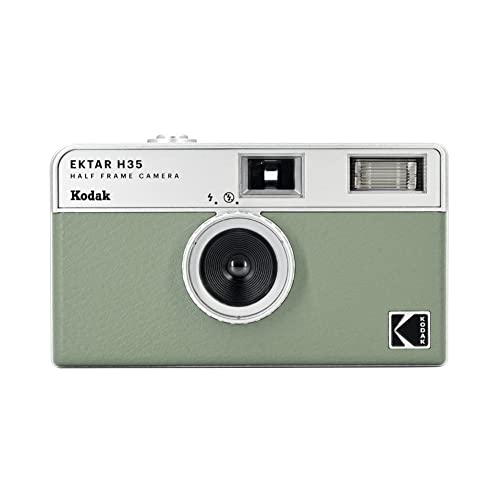
Kodak Ektar H35 Half Frame Film Camera — Best first half-frame
The Ektar H35 is the camera that turned half-frame from a vintage curiosity into the revival’s front door. Kodak’s insight was simple and commercially brilliant: the format’s economy is exactly what a curious beginner needs, because the terror of film is wasting money frame by frame. Seventy-two chances per roll changes the emotional maths completely. You experiment, you hand the camera to friends, you shoot the dog twice, and the roll still is not finished. By the time it is, you have learned more about light than a cautious thirty-six frames would ever have taught you.
Operation could not be simpler, and the review should not dress that up as a limitation to apologise for. The lens is focus-free, the exposure is fixed, and your entire creative control consists of framing, choosing your moment and deciding whether the flash goes on. In bright and middling daylight the results are genuinely charming: central sharpness is respectable, colours from a decent stock sing, and the vertical half-frame format suits the portraits and street details most owners actually shoot. This is a camera calibrated for happiness rather than for scrutiny.
The boundaries are equally clear and worth stating before money moves. Indoors without flash, the H35 guesses wrong in the direction of murk. At parties, the flash governs a circle a few metres wide and the room beyond it falls to amber gloom, which many owners love and some owners mourn. Edge softness is present in every frame if you go looking, and enlargements beyond modest sizes turn the look from characterful to tired. None of this is hidden by Kodak; it is simply the physics of a fixed plastic lens, priced accordingly.
Bundle literacy matters with this model. Listings frequently advertise film and a battery in the title, and the exact contents vary by seller and colour, so read the box-contents line before assuming your first roll is included. The camera runs its flash from a single AAA, cheap and available everywhere, which suits the travel life the H35 is built for. It is the sort of object that gets thrown in a tote for a festival weekend and comes home with the weekend on it.
Set against the Pentax 17, the H35 is not a failed attempt at the same camera; it is a successful attempt at an easier one. It shares the roll-doubling format and nothing else, and for a first season of film that is precisely the right trade. Many owners later graduate to the Pentax or to a vintage rangefinder, keeping the Kodak for parties. Many others simply stay, content with a camera that asks for nothing and returns film photographs with the reliability of a good habit.
Spec sheets cannot capture what the H35 does to a room. Because it looks like a toy and costs like a toy, people relax in front of it in a way they never relax before a serious camera. Portraits taken with it carry that ease visibly. Hosts pass it around at gatherings, strangers agree to pose, and the resulting roll documents a party as it felt rather than as it posed. Photographers with far more expensive equipment keep an H35 for exactly this diplomatic immunity.
- Format: half-frame, about 72 exposures per roll
- Lens: fixed, focus-free
- Exposure: fixed settings, flash for low light
- Flash: built-in, manual switch
- Power: one AAA battery for flash
- Body: lightweight plastic, several colours
Strengths
- Same roll-doubling trick as the Pentax
- Nearly zero learning curve
- Light enough to live in a jacket pocket
Trade-offs
- No metering, so light judgment is yours
- Lens softens away from centre frame
- Flash range is short indoors
Best for: Beginners and travellers wanting film’s look with a toy’s workload.
Not suited for: Anyone planning large prints or careful low-light work.

Kodak EC35 35mm Film Camera — Simplest full-frame reusable
The EC35 represents the purest form of the modern reusable camera: a full-frame 35mm box with a fixed lens, a flash, a sliding cover and a deliberate absence of everything else. There is no focus to set, no exposure to choose and no mode to misunderstand. You load the film, slide the cover open, wind, and press. For the person who received a disposable camera habit from festivals and weddings and wants the same feeling without the landfill, this is the direct, honest continuation of that story.
Full-frame is its quiet distinction from the Kodak half-frames in this list. Each negative is the classic size, which means scans carry more detail, modest enlargements behave better, and the horizontal frame suits landscapes and group shots the way decades of snapshots trained us to expect. The cost of that tradition is arithmetic: thirty-six frames per roll at full processing price, with no doubling trick. An EC35 owner pays roughly twice per photograph what an H35 owner pays, forever, which is worth knowing before the romance of the bigger negative settles the question by itself.
The sliding cover is a small design decision with outsized daily value. Reusable cameras live in jacket pockets, gloveboxes and tote bags among keys and coins, and an exposed plastic lens collects the scratches to prove it. The EC35’s cover turns the camera into a smooth pebble between uses, and it doubles as a safety against the shutter firing accidentally in a bag, wasting frames on the inside of a pocket. It also gives the object a satisfying fidget quality that owners mention surprisingly often; film cameras are handled constantly, and handling pleasure is real value.
Picture quality follows the class rules. Bright daylight delivers the best of it, with decent central definition and the soft vignetted edges that read as vintage charm right up until you want them gone. The flash rescues indoor gatherings within its short reach. Shade, dusk and windowless rooms push the fixed exposure past its competence, so pair the camera with a faster film stock if your life happens indoors, and keep expectations calibrated to the price of admission, which buys simplicity rather than optical ambition.
As a gift, the EC35 may be the strongest pick in this roundup. It arrives friendly, works immediately, needs no tutorial and introduces film without the half-frame orientation quirk that puzzles some recipients. Add a roll of colour film and a note naming a local lab, and you have given someone a summer of photographs. Just tell them the truth that this guide keeps repeating: the camera is the cheap part, and the second roll is where the hobby’s real price introduces itself.
The EC35 also makes an unexpectedly good camera for children old enough to be trusted with a roll of film. There is nothing to break by mis-setting, the sliding cover survives school bags, and the discipline of thirty-six frames teaches a young photographer to look before pressing in a way unlimited digital shooting rarely does. A parent who develops the roll with the child, negatives held to the light together, has handed over more than a gadget; they have handed over the founding ritual of photography itself.
- Format: full-frame 35mm, standard 36 exposures
- Lens: fixed, focus-free
- Flash: built-in for indoor use
- Cover: sliding lens cover design
- Power: one AA battery
- Controls: shutter button and film advance, that is all
Strengths
- Full frames suit bigger prints later
- Sliding cover protects the lens in bags
- Cheerful colours, giftable simplicity
Trade-offs
- No half-frame economy on film costs
- Fixed exposure struggles in shade
- Plastic build is not heirloom material
Best for: Gift buyers and beginners who want standard frames with zero settings.
Not suited for: High-volume shooters who feel every roll’s processing cost.

Kodak Snapic A1 35mm Film Camera — Best reusable with focus zones
The Snapic A1 is Kodak testing an interesting hypothesis: that reusable-camera owners might want exactly one more control than none. Its contribution is a two-zone focus switch on the lens, letting you nominate near or far subjects instead of accepting the fixed middle distance every rival imposes. It sounds like a small thing because it is a small thing, and yet near subjects are precisely where focus-free cameras fail most visibly. The close portrait at a dinner table, the selfie at arm’s length, the dog inspecting the lens: these are the frames the A1 exists to rescue.
Everything else remains faithful to the reusable formula, which is the right call. Exposure is fixed, the flash is built in, the body is light plastic in friendly colours, and the whole camera can be understood in the time it takes to load a roll. The zone switch adds a decision without adding a curriculum, and because the zones are generous, a rough guess still lands inside the depth of field. Think of it as the difference between a camera that hopes and a camera that aims, at a price that stays in gift territory.
Picture quality therefore splits by distance in a way rivals cannot match. Far subjects behave like any focus-free camera’s, with the familiar pleasant centre and softening edges. Near subjects gain a genuine edge in definition, enough that faces at conversational distance hold together in scans instead of dissolving into the genre’s usual watercolour. The flash still limits indoor range, the fixed exposure still surrenders at dusk, and no zone switch fixes a slow shutter’s motion blur, but within its daylight-and-flash envelope the A1 quietly out-shoots its simpler siblings.
There are honest caveats. The model is newer than the H35 and EC35, so the long tail of owner experience is still being written, and bundle contents around included film and batteries deserve the same careful reading as every Kodak listing. The ivory finish photographs beautifully and shows pocket grime with equal enthusiasm. None of these are disqualifications; they are the ordinary terms of buying the newest member of a young product family rather than its settled elders.
Choose the Snapic A1 if your film life is social and close: meals, markets, friends across small tables, the documentary clutter of real weekends. Its one extra control is aimed exactly at that life. Choose the EC35 instead if even one switch feels like homework, and choose the H35 if halving your cost per frame matters more than either. The A1’s virtue is not that it wins the category, but that it understood a specific frustration and fixed precisely that, which is rarer in product design than it should be.
The Snapic’s zone switch also helps in one unglamorous but common situation: photographing documents, artwork and objects for the record. Sellers photographing stock, students documenting projects and diarists copying a page of handwriting all work at the near distances where fixed-focus rivals smear text into suggestion. The A1 will not replace a scanner, yet its close zone renders a page legibly, and legibility is a form of sharpness that matters more, on those frames, than any aesthetic quality.
- Format: full-frame 35mm
- Focus: two-zone selection on the lens
- Lens: fixed wide angle
- Flash: built-in, with simple controls
- Power: AAA battery for flash
- Body: compact lightweight plastic
Strengths
- Zone focus sharpens near subjects
- Still nearly as simple as rivals
- Compact shape travels easily
Trade-offs
- Two zones are guidance, not precision
- Exposure remains fully fixed
- Newer model with thinner track record
Best for: Reusable-camera fans who shoot close subjects and selfies often.
Not suited for: Purists wanting either total simplicity or a real focusing system.
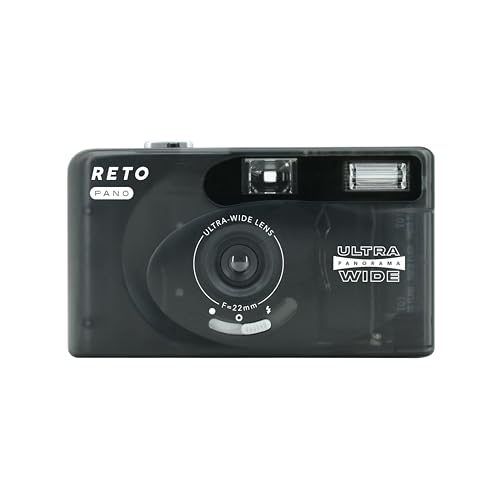
RETO PANO 35mm Film Camera — Best for panoramic frames
The RETO PANO begins from a different desire than every other camera here. It is not trying to take normal photographs cheaply; it is trying to take abnormal ones, wide cinematic slices of the world, on ordinary film that any lab can process. A switch masks the frame down to a panorama, and the very wide 22mm lens fills that letterbox with street scenes, interiors and landscapes that feel borrowed from a film still. Owners buy it the way musicians buy an effects pedal: not as their only instrument, but as the one that makes a particular sound nothing else in the bag makes.
The mechanics are reusable-camera simple. Exposure is fixed, focus is fixed, the flash is there for parties, and a sliding cover protects the lens between adventures. The switch between standard and panoramic framing can be thrown mid-roll, which invites a contact sheet that alternates ordinary frames with sudden widescreen vistas, a rhythm that suits travel diaries especially well. Labs handle the masked frames without complaint since the film itself is standard; just warn them, or choose scanning settings that keep the black borders the format intends.
That 22mm lens is both the magic and the warning. It sees more of a room than any other camera in this roundup, which makes it the surprise best choice for cramped interiors, markets and architecture. It also stretches faces near the edges into caricature, leans buildings into drunken diagonals and turns a group portrait into an experiment nobody requested. Keep people near the centre, embrace the drama for places and objects, and the lens rewards you with a sense of space that phone panoramas, stitched and sanitised, rarely match for character.
Economics take a small twist here. A panorama frame uses a masked slice of a full frame, so you are paying full-frame film prices for a fraction of the negative area, and the thirty-six frames of a roll vanish at the usual rate. Judged as cost per square millimetre, it is the worst bargain in this list. Judged as cost per photograph that makes someone stop scrolling, it may be the best. Specialty tools are allowed their own arithmetic, and the PANO’s owners tend to shoot it alongside a normal camera rather than instead of one.
Buy the RETO PANO as a second camera or a deliberate creative constraint for a trip, and it will earn its tiny weight many times over. Buy it as your only film camera and its fixed exposure, wild lens and letterbox habit will eventually chafe against ordinary subjects like family portraits and birthday cakes. The honest summary is that this is a toy in the best sense: a well-aimed piece of play that produces genuinely distinctive photographs, from a brand that understands film shooters collect experiences as much as equipment.
Think carefully about scanning before a PANO-heavy trip, because the letterbox frames confuse some automated lab settings and can return cropped to a standard shape by an inattentive operator. The defence is communication: tell the lab the roll contains panoramic masked frames, ask for scans that preserve the full masked area with borders, and check the first delivered file before the whole set is processed. Once that conversation has happened, the format flows through any competent lab without drama.
- Format: full-frame with switchable panorama mask
- Lens: 22mm very wide fixed lens
- Modes: standard and cinematic panorama
- Flash: built-in
- Cover: sliding lens cover
- Exposure: fixed, daylight and flash oriented
Strengths
- Panoramas from ordinary 35mm film
- Very wide lens suits interiors and cities
- Mode switch makes experimenting easy
Trade-offs
- Wide lens exaggerates edges strongly
- Panorama crops reduce negative area
- Fixed exposure limits dim scenes
Best for: City walkers and travellers who love letterbox-shaped photographs.
Not suited for: Portrait shooters or anyone wanting neutral, faithful rendering.
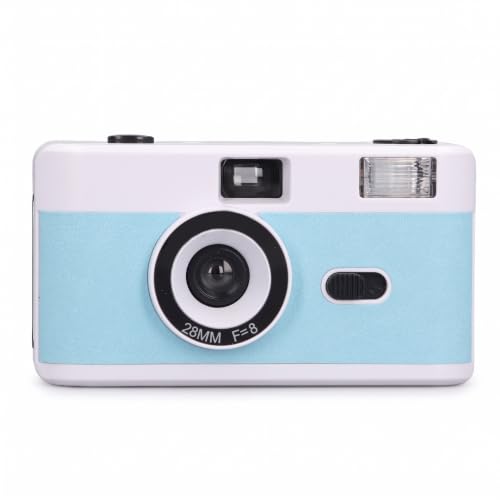
Reusable 35mm Film Camera with Built-in Flash — Cheapest way to test film
Every hobby needs a cheapest possible first step, and for film photography this unbranded reusable is currently it. The listing is unusually candid about what you are getting: a 28mm lens at a fixed f/8, a shutter around a 120th of a second, a built-in flash and a lightweight retro-styled body. Those numbers describe a daylight camera, full stop. In sunshine it will take recognisable, characterful photographs. In anything dimmer, the flash is not an accessory but the entire lighting plan, and its reach is a few steps at most.
That honesty makes the camera easy to recommend for exactly one job. Spend the small money, load a forgiving colour roll, shoot it across two bright weekends, and learn whether the wait for scans delights or infuriates you. Both answers are valuable, and discovering the second one at this price rather than at Pentax prices is the entire point. The experiment also teaches loading, winding and rewinding on hardware whose loss would not sting, which is a genuine curriculum before handling a camera you care about.
Set expectations with care, because this is where beginners get unfairly discouraged. The fixed focus is calibrated for middle distances in good light; selfies soften, dusk collapses, and indoor shots without flash are wishes rather than photographs. Quality control on unbranded production varies between runs in a way branded Kodaks largely avoid, so check the camera the day it arrives: advance the film, fire the shutter, confirm the flash charges, and return a dud immediately rather than discovering it at a birthday.
The retro styling deserves a sentence of defence. It is easy to sneer at cameras designed to look old, but an object people enjoy carrying gets carried, and a carried camera takes the photographs. This little box gets picked up on the way out of the house precisely because it looks like a holiday. If it converts one phone photographer into a film shooter who later buys the Pentax 17, it has performed a service to the whole revival out of all proportion to its price.
Do not, however, mistake it for a destination. There is no metering to learn, no focus to practise, no path upward inside the object itself, and its lens will not reward better film or better technique beyond a low ceiling. Treat it as a ticket to a screening rather than a seat for the season. If the screening thrills you, this roundup’s other five cameras are waiting with progressively more of everything this one lacks, and your cheap tutor can retire to the glovebox for sunny emergencies.
One more use redeems this little camera even for sceptics: it is the perfect loaner. Every film shooter accumulates friends who say they would love to try it, and handing them a Pentax is an act of faith few owners survive calmly. Hand them this instead, with a roll loaded and three sentences of instruction, and you have spread the hobby at no emotional risk. Some loaners come back with converts attached, which is how a revival sustains itself from kitchen table to kitchen table.
- Format: full-frame 35mm reusable
- Lens: 28mm f/8 fixed focus
- Shutter: fixed around 1/120 second
- Flash: built-in, battery powered
- Body: lightweight retro-styled plastic
- Support: unbranded, seller-dependent
Strengths
- Lowest commitment in the roundup
- Honest published lens and shutter figures
- Retro styling people enjoy carrying
Trade-offs
- f/8 lens demands bright light
- No brand support or warranty depth
- Quality varies between production runs
Best for: The film-curious who want a one-roll experiment before spending more.
Not suited for: Anyone whose first roll must succeed at an unrepeatable event.
How do the six film cameras compare?
| Model | Standout trait | Watch out for |
|---|---|---|
| Pentax 17 Half-Frame Film Camera | Metered half-frame instrument | Costs like a serious camera |
| Kodak Ektar H35 Half Frame Film Camera | Friendly half-frame for newcomers | Fixed everything, soft edges |
| Kodak EC35 35mm Film Camera | Full-frame simplicity, sliding cover | Full-price film habit |
| Kodak Snapic A1 35mm Film Camera | Two-zone focus reusable | Exposure still fixed |
| RETO PANO 35mm Film Camera | Switchable panorama specialist | Wide distortion is the look |
| Reusable 35mm Film Camera with Built-in Flash | Budget one-roll experiment | Bright light or flash only |
What should a first-time film shooter understand?
Why does half-frame change the economics so much?
A standard roll of 35mm film carries thirty-six full frames. A half-frame camera exposes half that area per shot, so the same roll yields around seventy-two images, each in a vertical orientation when the camera is held normally. Your cost per photograph halves at a stroke, which compounds beautifully across a year of shooting: the film budget that bought ten rolls of memories now buys twenty, or the same ten rolls now cover twice the birthdays, trips and ordinary Tuesdays that make a film archive worth having.
The trade is resolution per frame. Each half-frame negative holds half the information, so enlargements top out sooner and grain shows earlier, especially on faster film. For prints at modest sizes, for scanning to share online, and for the contact-sheet pleasure of a dense roll, the loss is trivial. For a wall-sized print of a landscape, it is not. The Pentax 17 and the Kodak H35 both live on the generous side of that trade for most shooters, which is why half-frame anchors this roundup.
What does a roll really cost across its whole life?
Price the habit, not the camera. A roll of colour film, the developing, and scans good enough to share form a repeating bundle that you will buy dozens of times. Black and white film processed at home cuts the recurring figure dramatically once a changing bag, a tank and chemistry join the household, and many revival shooters drift that way within a year. Colour home development is possible too, though its chemistry is fussier about temperature and freshness than the forgiving black and white process.
Against that background, camera prices rearrange themselves. The gap between the cheapest reusable here and the Pentax 17 equals a handful of rolls processed at a lab. If the serious camera’s metering rescues one frame in ten that a fixed-exposure box would have ruined, and its half-frame format doubles every roll, the premium dissolves within the first season of regular shooting. Conversely, if you will shoot two rolls a year at parties, the arithmetic flips completely and the simple camera is the rational buy. Volume decides.
Which film stock should a beginner load first?
Start with a forgiving colour negative film in the middle speed range, the class sold for general daylight use, because colour negative tolerates the exposure guesses of fixed cameras better than any other stock. Its latitude forgives a stop or two of error in either direction, the lab corrects colour as a matter of routine, and the results look like the film photographs that probably inspired the purchase. Save slide film, with its strict exposure demands, for a camera with a real meter and a shooter with a season of practice.
Pair the stock to the camera honestly. In a focus-free reusable with a small fixed aperture, a faster film buys shutter safety in shade and at indoor parties where the flash would otherwise carry every frame. In the Pentax 17, whose metering and program exposure handle slower film gracefully, a finer-grained stock rewards the lens. Either way, shoot the first roll somewhere unimportant, note what you did frame by frame in a notebook or phone note, and let that roll teach you the camera before a wedding or a holiday depends on it.
How do you get scans worth keeping?
The lab’s default scan is a starting point, not a verdict. Budget scanning tiers trade resolution for price, and the cheapest tier can make a good negative look like a webcam relic. For rolls that matter, pay for the middle tier, keep the negatives forever in sleeves away from heat and light, and remember that a negative can be rescanned at tomorrow’s quality while a deleted file cannot. Many revival shooters eventually add a home scanning setup using a digital camera and a macro lens, which turns the archive into an ongoing pleasure rather than a per-roll fee.
Handle the returned files like a photographer, not a downloader. Back them up in two places, name folders by date and place rather than by roll number alone, and resist heavy filtering that sands away the grain you paid for. A light touch in editing, mostly white balance and gentle contrast, keeps the images honest to the medium. The charm of these cameras is that they impose a look; honouring it is most of the point.
How should you carry and store a film camera day to day?
Film cameras forgive neglect better than digital ones in some ways and worse in others. There is no sensor to dust-spot and no battery draining in a drawer on most of these models, but film itself is a perishable passenger. Keep a loaded camera out of hot cars, steamy bathrooms and the bottom of a beach bag where sand explores every seam. A simple zip pouch keeps grit away from the lens and the film door, and for the plastic reusables it also prevents the advance wheel from being wound by friction against your other belongings, quietly eating frames you meant to spend on purpose.
Between rolls, store the camera empty with the shutter uncocked where the design allows, in a cool cupboard rather than an attic. Batteries for flashes and meters should come out during long storage, because a leaked alkaline cell can end a camera that would otherwise outlive its owner. The Pentax 17 rewards slightly more ceremony, a soft wrap and a silica gel packet in damp climates, while the Kodaks ask little beyond not being sat on. None of this is preciousness; it is the routine that keeps a twenty-roll-a-year habit free of preventable funerals.
What changes when you graduate to a vintage camera later?
Many readers will follow the classic revival path: a season with one of these new cameras, then a curious drift toward the vintage market where the famous names live. Go in educated. A used camera’s true price is its purchase plus a service: light seals crumble into sticky foam, shutters drift slow, meter needles lie with confidence. Budget for a professional CLA, the clean-lubricate-adjust visit that returns an old body to honesty, and buy from sellers who state shutter and meter condition plainly rather than praising cosmetics.
The skills transfer completely, which is the quiet argument for starting with a demanding new camera like the Pentax 17. Zone focusing, exposure compensation and reading light by eye are the exact crafts vintage shooting requires, practised here on hardware under warranty. Even the simple cameras teach the transferable disciplines of finishing a roll, logging frames and waiting. The revival’s healthiest pattern is a new camera as the reliable daily instrument and a vintage treasure as the weekend companion, each covering the other’s weaknesses.
Which mistakes waste a beginner’s first rolls?
Opening the back to check whether film is loaded
Every film forum holds the same heartbreak: a new shooter, unsure whether the roll caught, opens the camera in daylight to look. The frames near the back are fogged instantly, and the doubt that prompted the check usually turns out to have been groundless. Trust the rewind knob instead. If it turns when you advance, the film is moving. Finish the roll, rewind until the tension releases, and only then open the door, ideally in subdued light, with the patience the medium keeps asking for.
Judging a camera by its first roll
A first roll mixes three experiments at once: an unfamiliar camera, an unknown lab and a shooter learning new habits. Blaming the body for the whole result is statistics with a sample of one. Shoot a second roll in familiar light, change nothing except what the first roll taught you, and then judge. Many cameras condemned online were innocent; the actual culprits were a dying battery in the meter, a lab’s tired chemistry that week, or a thumbprint of exposures taken against the sun.
Buying the cheapest film for the dimmest rooms
Slow film in a fixed-exposure camera indoors is a recipe for a roll of grey soup. The little flash on a reusable camera reaches a few metres and no further, so a slow stock at a party records the nearest faces and abandons the room behind them. Match the film speed to the darkest place you honestly intend to shoot, and when in doubt choose the faster stock. Grain you can see beats detail that never made it onto the negative at all.
Loading in harsh midday sun
Film is tougher than beginners fear and not as tough as veterans pretend. Loading or unloading in direct blazing sun invites light piping through the cassette felt and edge-fog on the first frames, a flaw that looks like a mysterious red leak in scans. Turn your back to the sun, shade the camera with your body, or step into a doorway. The habit costs nothing and quietly protects the frames at both ends of every roll, which are often the ones shot at the start and end of a trip, exactly the pictures nobody wants to lose.
Final Recommendation
One closing piece of arithmetic for the undecided. Price your first season honestly: the camera, six rolls of film and six rounds of developing and scanning. Against that total, the difference between the cheapest and finest bodies in this list is a minority share, and the difference in what they teach you is enormous. Spend on the instrument if you suspect the hobby will hold, spend on the experiment if you do not, and let the first envelope of negatives, not a reviewer’s enthusiasm, cast the deciding vote.
If film is a hobby you intend to keep, the Pentax 17 is the answer this roundup keeps returning to: real metering, real focusing choices, a lens with ambition and a format that halves the cost of every memory after the purchase. If film is a flavour you want to taste first, the Kodak H35 offers the same seventy-two-frame generosity with training wheels welded on, and the EC35 and Snapic A1 serve anyone whose ambitions end at sunny days and party flash. The RETO PANO stands apart as a deliberate special effect, and the budget reusable is a lottery ticket that sometimes wins a convert.
Whichever you choose, load a forgiving roll, shoot it somewhere ordinary, and have it processed before deciding anything about the next camera. Film rewards the patient in its own currency. Somewhere around the second envelope of scans, when a frame you barely remember turns out better than the moment felt, the whole slow, costly, beautiful arrangement explains itself without a single word of help from a reviewer.
Start this weekend rather than after another month of comparison videos. Film knowledge is stored in finished rolls, not in research, and the first roll from any camera in this list will teach your hands more than the next ten articles could teach your eyes.
Frequently Asked Questions
Can these cameras use any 35mm film?
Yes, all six load standard 35mm cassettes sold by Kodak, Fujifilm, Ilford and others. Half-frame models expose half a frame at a time on the same film. Avoid cinema-remnant stocks with remjet backing in simple cameras if your lab objects to them, and never force a cassette that resists loading; a jammed budget camera usually means the leader was trimmed badly, not that the film is wrong.
Do I need a lab, or can I develop film at home?
A lab is the sensible start: no equipment, consistent results and scans included in many services. Home developing becomes attractive with volume, especially for black and white, where a tank, changing bag and chemistry repay themselves within a dozen rolls or so. Colour at home is entirely possible but demands tighter temperature control. Either way, keep every negative; they are the master copy of your archive.
Why are my reusable camera photos blurry at parties?
Three causes share the blame. The fixed shutter is slow enough that dancing subjects smear, the flash only reaches a few metres so distant friends are underexposed, and focus-free lenses are sharpest in bright light at middle distances. Move closer, brace the camera against something solid, keep subjects inside flash range and load faster film. The look improves immediately, though a little party blur is honestly part of the aesthetic.
Is the Pentax 17 worth it over the Kodak H35?
They share half-frame economy and little else. The Pentax meters properly, offers exposure control and zone focusing, and mounts a lens designed to be enlarged from. The Kodak asks nothing of you and forgives almost everything except darkness. If you already shoot digital manually and crave a film instrument, the Pentax is the honest step. If you want film’s look with a toy’s workload, the H35 is not a lesser choice, just a different one.
How long can I leave film inside a camera?
Finish a roll within a few months for the most faithful colour, and avoid leaving a loaded camera in a hot car, where heat ages film quickly. Exposed film waiting for the lab keeps best in a cool, dry place, and there is no prize for hoarding finished rolls; process them while you still remember the days they hold. Unopened film belongs in the fridge, out of the packet only when you are ready to load it.
Are reusable cameras better than disposables?
For the planet and eventually for your wallet, yes: a reusable body loads fresh rolls instead of being cracked open and discarded after one. Image quality sits in the same family, since both use simple fixed lenses, though a good reusable like the Kodaks tends to be more consistent than a disposable’s lottery. The honest difference is commitment. A disposable asks for one afternoon; a reusable asks whether you want a hobby, and gives you years to answer.
Related Guides
Continue with our companion guides for new film shooters: Film stocks explained for beginners Home developing black and white Scanning negatives without a lab scanner


