What's inside
- Key Takeaways
- Quick Picks
- How Were These Six Home Chargers Selected?
- How Do the Six Home Chargers Compare?
- What Does the Hardwired-versus-Plug Decision Actually Decide?
- How Should the Installation Be Planned With an Electrician?
- What Do Smart Features Earn Across a Year of Charging?
- How Does a Second Electric Car Change the Calculation?
- Which Home Charging Mistakes Cost the Most?
- What Should the First Month of Home Charging Teach?
- Final Recommendation
- Frequently Asked Questions
- Related Guides
As an Amazon Associate I earn from qualifying purchases. This post may contain affiliate links at no extra cost to you.
gizmoverdict.com is reader-supported. When you buy through links on our site, we may earn an affiliate commission.
Where to buy: All six home EV chargers below come from this site’s verified pool. Two facts are credited only where a listing title prints them: how the unit connects to the house — hardwired or plug — and the connector standard. Where a title is silent on either, the spec box says so instead of guessing.
The search for the best at home electric chargers is really a search for the right piece of house infrastructure, because a Level 2 home charger is not an accessory in the phone-charger sense. It is a permanently installed electrical appliance that will draw more current, for more hours, than almost anything else in the home — and it will do it overnight, unattended, for a decade. The six units in this pool are all Level 2 chargers from established names, and they divide along the lines that actually decide a purchase: stated amperage from 40A to 50A, hardwired installation stated outright on two of them, smart features distributed unevenly, and one connector standard — J1772 — named in five of the six titles.
Amperage is the headline figure and deserves an honest frame. A charger’s stated amps describe what it can offer; the car decides what it accepts, and the house decides what it may safely supply. The practical consequence is that the step from 40A to 48A or 50A matters most to cars with large batteries and high onboard acceptance, charged against a morning deadline — and matters hardly at all to a car that sits plugged in for twelve hours regardless. This guide therefore treats the amp figures as capacity to be matched against a household’s rhythm, not as a league table where the biggest number wins by default.
The second axis is the connection to the house, and here the titles divide cleanly. The ChargePoint HomeFlex and the Autel state “Hardwired” in so many words. The other four titles do not state their connection method at all — which does not make them plug-in units, and this guide does not call them that; it makes their installation method a documentation question, flagged in every spec box. That distinction, between what a title states and what a shopper assumes, is the difference between an installation planned with an electrician from facts and one replanned at the panel with the car already in the driveway.
Key Takeaways
- All six picks are Level 2 chargers; stated amperage runs from 40A (Wallbox, Grizzl-E) through 48A (EMPORIA, DEWALT) to 50A (ChargePoint, Autel).
- Hardwired installation is stated in exactly two titles — ChargePoint HomeFlex and Autel — while the other four leave connection method to their documentation.
- J1772 is the named connector in five titles; the Grizzl-E title does not state its connector, so compatibility there is a verification step, not an assumption.
- No title here promises a miles-per-hour charging figure, and this guide invents none — real speed depends on the car’s own acceptance rate.
- The Autel is the only pick whose title states a cable length: 25ft, which decides more real installations than any smart feature.
- Smart features are unevenly distributed: WiFi appears in the EMPORIA and Autel titles, app control with Bluetooth and Wi-Fi in the DEWALT’s, and “Smart” in the ChargePoint’s.
Quick Picks
| Pick | Badge | Why it earns the slot |
|---|---|---|
| ChargePoint HomeFlex Level 2 EV Fast Charger, J1772, Smart, Hardwired, 50A | Best stated hardwired spec | 50A, hardwired and smart, all declared in one title from the network operator that knows home charging at scale. |
| EMPORIA Level 2 EV Charger w/ J1772 Connector — 48 Amp, 240V WiFi Enabled | Best printed numbers | The only title that prints its voltage beside its amps — 48 Amp and 240V — with WiFi enabled stated outright. |
| Wallbox Pulsar Plus Level 2 Ev Charger 40A, Electric Car Charger EVSE J1772 | Best established 40A | A 40A J1772 unit from a maker whose home-charging line is its whole business. |
| Grizzl-E Classic Level 2 Electric Vehicle (EV) Charger up to 40 Amp, UL Certified | Best weather-ready brief | UL Certified and indoor/outdoor positioning in the title, for garages and carports that are not kind places. |
| Autel Level 2 EV Charger 50A, J1772 Hardwired Home Charger, WiFi, 25ft Cable | Best stated cable | 50A and hardwired like the ChargePoint, plus the pool’s only stated cable length — 25ft of placement freedom. |
| DEWALT Electric Vehicle Level 2 EV Charger up to 48 Amps 240V, App Control Bluetooth & Wi-Fi | Best app-control brief | App control with Bluetooth and Wi-Fi both named in the title, at a stated 48 Amps and 240V. |
How Were These Six Home Chargers Selected?
The pool was restricted to Level 2 home chargers from makers with a genuine presence in the category — the network operator ChargePoint, the energy-management maker EMPORIA, the charging specialist Wallbox, the rugged-equipment name Grizzl-E, the diagnostics giant Autel entering home charging, and DEWALT extending its electrical line to the driveway. Portable travel cords and no-name units were left out: a device that will pull tens of amps for thousands of unattended hours should come from a maker whose documentation, support and certification trail a household can actually inspect.
Evidence discipline shaped every line that follows. Amperage is credited exactly as titled — “up to 40 Amp” for the Grizzl-E and “up to 48 Amps” for the DEWALT keep their “up to” in this guide’s prose, because those words describe configurable ceilings rather than guaranteed delivery. Connection method is credited only to the two titles that state hardwired. Connector standard is credited to the five titles that print J1772. Charging speed in miles per hour is credited to nobody, because no title states it and the honest figure belongs to the car as much as to the charger.
The six were then arranged to cover the real decision space of a home installation. Maximum stated capacity with a stated hardwired connection: ChargePoint and Autel, separated by the Autel’s stated cable. Fully printed electrical figures: EMPORIA. The 40A tier: Wallbox on polish, Grizzl-E on ruggedness and certification. Connected control: DEWALT’s app-and-Bluetooth brief. A household reading the pool against its panel capacity, its parking geometry and its appetite for apps should find the decision narrowing to one or two names — which is what a shortlist is for.
One more selection note, on what is absent: no pick here is credited with a NACS connector, vehicle-specific compatibility or a utility rebate, because no title in the pool states them. J1772 is the standard the titles name, and households whose car carries a different inlet should treat adapter and compatibility questions as documentation work to complete before purchase, with the car’s maker as the authority — not as details to be settled by optimism after the box arrives.

ChargePoint HomeFlex Level 2 EV Fast Charger, J1772, Smart, Hardwired, 50A — Best stated hardwired spec
ChargePoint operates one of the largest charging networks in North America, and the HomeFlex is that operator’s home instrument — a fact that shapes the pick’s character. The title is a model of completeness: Level 2, J1772, Smart, Hardwired, 50A. Every question a household asks first — what standard, what connection, what capacity, whether it is connected — is answered before the listing is opened, and the answers describe the full-capacity end of home charging: a hardwired 50A installation is the configuration that asks the most of a home’s panel and returns the most headroom to the car.
Hardwired deserves its paragraph, because it is this pick’s defining commitment. A hardwired charger is joined directly to the circuit by an electrician — no receptacle, no plug — which suits the highest sustained currents, removes a connection point that can wear or overheat across years of daily cycles, and makes the unit a permanent citizen of the garage. The trade is permanence itself: the charger moves house only with professional help, and renters or the undecided should weigh the plug-in question carefully — noting, per this guide’s discipline, that none of the other titles here actually states a plug, so the comparison must be completed from documentation rather than assumed from silence.
The “Smart” in the title is the maker’s word for the connected layer — scheduling, monitoring and the utility-programme integrations that a network operator is positioned to offer. This guide credits the word and no more: the specific features live in ChargePoint’s documentation, and households for whom a particular utility rebate or demand-response programme is the deciding factor should confirm the HomeFlex’s current programme participation there, since programmes change faster than hardware does.
Fifty amps is capacity with a specific beneficiary: the large-battery car that arrives home late and leaves early, charged against the clock. For the household whose car sleeps twelve hours a night, the same unit simply finishes sooner and idles — harmless, but a reminder that the correct amp figure is the one matched to the household’s tightest night, not its average one. The HomeFlex’s pick rests on the completeness of its stated hand: where a household does need the headroom and the hardwired permanence, no other title in the pool declares the whole package so plainly.
- Stated output: 50A, per the title — the pool’s joint-highest figure
- Connection: hardwired, stated in the title
- Connector: J1772, stated in the title
- Connected features: “Smart”, the maker’s word in the title — specifics in ChargePoint documentation
- Cable length: the title gives no figure — ChargePoint documentation carries it
- Voltage: Level 2 class; the title does not print a voltage figure
Strengths
- The most completely stated title in the pool — standard, connection and capacity all printed.
- Hardwired 50A is the full-headroom configuration for large batteries and short nights.
- A network operator’s home unit, with the support depth that scale implies.
Trade-offs
- Hardwired permanence requires an electrician and resists relocation.
- Full capacity may demand panel work that a 40A installation would have avoided.
- Cable length is unstated in the title, and placement planning needs it.
Best for: a homeowner installing once, properly, with a large-battery car and a panel that can feed a hardwired 50A circuit.
Not suited for: a renter, a household planning to move the charger between properties, or a panel already at its limit.

EMPORIA Level 2 EV Charger w/ J1772 Connector — 48 Amp, 240V WiFi Enabled — Best printed numbers
The EMPORIA title does something none of its rivals managed: it prints the voltage. “48 Amp, 240V” is a complete electrical statement — the two figures whose product describes the charger’s appetite — and it signals a maker comfortable being read by people who calculate. EMPORIA’s wider business is home energy monitoring, and that heritage shows in the title’s other claim, WiFi Enabled: this is a charger conceived as a node in a measured home, where the car’s consumption is visible alongside everything else the panel feeds.
Forty-eight amps sits in the home-charging sweet spot that experienced installers recognise: the highest rate commonly delivered on a 60-amp circuit, fast enough that few cars and fewer nights can use more, and a figure many panels can accommodate with less surgery than a larger circuit demands. Paired with the printed 240V, the title lets a household and its electrician plan from the listing itself — a courtesy so rare in this pool that it earns the pick its badge on its own.
The title’s silence is the connection method. Hardwired or plug-in is not stated, and the spec box records the gap with its documentation direction; EMPORIA sells this charger in configurations the documentation describes, and the household’s choice between them — permanence versus flexibility — should be made deliberately, from the maker’s pages, before the electrician is booked. The same applies to cable length, unprinted here as in most of the pool.
The WiFi claim, unlike the connection, is printed and can be weighed. A connected charger’s durable value is scheduling — charging inside the cheap hours a utility’s tariff defines — and visibility into what the car actually costs to run. Households on flat tariffs with no time-of-use window gain less from the connection and should weigh the pick on its printed electrical completeness instead; households whose tariff swings by the hour will find the WiFi earning its keep every single night.
- Stated output: 48 Amp at 240V — both figures printed in the title
- Connector: J1772, stated in the title
- Connected features: WiFi enabled, stated in the title
- Connection method: Not stated in the listing title — verify with EMPORIA documentation
- Cable length: unprinted — an EMPORIA documentation lookup before placement is planned
- Maker’s ground: home energy monitoring, reflected in the connected brief
Strengths
- The pool’s most calculable title — amps and volts together, ready for an electrician’s eyes.
- 48A is the practical ceiling of the common 60-amp home circuit.
- WiFi scheduling suits time-of-use tariffs that reward overnight charging.
Trade-offs
- Connection method must be retrieved from documentation before installation planning.
- Cable length is likewise unstated, leaving placement geometry unconfirmed at title level.
- The connected layer’s value fades for households on flat electricity tariffs.
Best for: a household on a time-of-use tariff that wants its charger’s full electrical hand printed on the title and its schedule set by WiFi.
Not suited for: an installation method that must be settled by the listing alone, or a garage where WiFi never reaches.

Wallbox Pulsar Plus Level 2 Ev Charger 40A, Electric Car Charger EVSE J1772 — Best established 40A
Wallbox builds charging equipment and little else, and the Pulsar Plus is its home flagship’s name in driveways across several continents. The title is comparatively terse — Level 2, 40A, EVSE, J1772 — and the terseness itself carries information: this is a mature product whose listing no longer needs to argue. Forty amps is the tier this guide keeps returning to as the considered choice, the rate that covers the overwhelming majority of overnight needs while asking the least of the panel, the wiring run and the budget that feeds them.
The case for 40A deserves to be made plainly, because marketing pushes every buyer upward. A car parked for ten hours needs its overnight energy divided by ten; for most households’ daily mileage, that quotient sits far below what a 40A Level 2 charger offers. The surplus capacity of a 50A unit is real but rarely spent, while its costs — heavier cable, a larger breaker, a greater chance of panel upgrades — are spent immediately and in full. The Pulsar Plus’s pick is the argument that the correct size, confidently chosen, beats the maximum size defensively chosen.
What the title leaves out must be listed with the same plainness: no connection method, no cable length, no connected-feature claim. Wallbox’s documentation carries the Pulsar Plus’s connected and configuration specifics, and they are a genuine part of this product family’s reputation — but this guide’s rule is the rule, and the spec box sends readers to the maker’s pages for everything the title declined to print. A buyer comparing the Wallbox against the EMPORIA should note the asymmetry honestly: EMPORIA printed more, which is a fact about listings, not necessarily about chargers.
The Pulsar Plus suits the household that has done the overnight arithmetic, landed at 40A without anxiety, and wants the tier’s most established nameplate. Its compact reputation in the category — a quality the title does not state and this guide therefore does not credit as fact — can be assessed from the listing’s dimensions; its electrical brief, which is what this guide judges, is stated in full and is exactly what a decade of overnight charging requires.
There is a ownership texture to the specialist makers that rarely reaches reviews: firmware, applications and support processes that exist only to serve chargers, refined across a single product family’s lifetime. When a Wallbox unit misbehaves, the organisation answering has one trade to be good at. That focus does not appear in any title and this guide does not score it — but households choosing between a specialist’s terse title and a generalist’s generous one should know the trade exists, and that it cuts in the specialist’s favour precisely where the listing goes quiet.
- Stated output: 40A, per the title
- Connector: J1772, stated in the title — the title also names the unit an EVSE
- Connection method: Not stated in the listing title — verify with Wallbox documentation
- Cable length: no figure in the title — Wallbox documentation holds it
- Connected features: not claimed in the title — the maker’s documentation describes the current offering
- Maker’s ground: charging equipment as a specialism
Strengths
- The 40A tier’s established specialist nameplate, with a mature product line behind it.
- A right-sized rate that spares the panel, the wiring run and the budget.
- J1772 and EVSE function stated plainly in the title.
Trade-offs
- The title is the pool’s tersest — connection, cable and connected features all need documentation.
- Households with genuinely short charging windows may outgrow 40A headroom.
- Comparisons at title level flatter rivals that print more, whatever the hardware merits.
Best for: a household whose overnight arithmetic lands at 40A and wants the tier’s specialist maker, installed once and ignored for years.
Not suited for: a large-battery, short-night routine, or shopping that wants every installation fact settled by the title itself.

Grizzl-E Classic Level 2 Electric Vehicle (EV) Charger up to 40 Amp, UL Certified — Best weather-ready brief
The Grizzl-E’s title speaks in the accents of its Canadian origins: up to 40 Amp, UL Certified, and an indoor/outdoor brief that the listing’s full text completes. This is the pool’s rugged pick — a charger whose selling proposition is surviving the places chargers actually live: the unheated garage, the carport open to driven snow, the driveway post in a climate that tests everything left outside. UL certification printed in the title is the pick’s documentary anchor: the unit’s safety testing is a matter of record rather than a promise, and for a high-current appliance that will run unattended for a decade, that record is worth more than any feature list.
“Up to 40 Amp” keeps its qualifier in this guide’s reading, and the qualifier is informative rather than evasive: configurable-output chargers let the installer match the unit to the circuit the house can actually provide, which is a genuine virtue in older homes whose panels cannot feed a maximum circuit. A charger that can be set to the house, rather than demanding the house be rebuilt to the charger, widens the population that can charge at Level 2 at all — and the setting is an electrician’s commissioning decision, recorded at installation.
Two silences shape this pick’s homework. The title does not state the connector — the guide does not assume J1772 for the Grizzl-E, however standard it may be in this category, and compatibility with the household’s car must be confirmed from the maker’s documentation before purchase. Nor does the title state the connection method. Both gaps are single lookups, and a buyer drawn by the rugged brief should treat them as the price of admission: this listing sells durability and certification, and asks its other questions to be asked elsewhere.
The Classic’s natural home is the installation the other picks would find harsh: outdoors, in weather, on a post or an exterior wall, in the northern half of the continent where a charger is also a snow-shedding, ice-bearing object. Households charging in a benign suburban garage gain less from its brief; households whose charger will be rained on for ten winters have found the pick that was titled for them.
There is a final, unfashionable virtue in the configurable ceiling that deserves naming: it future-proofs the installation against the panel’s own biography. Houses gain loads across a decade — a heat pump, a workshop, a second car from this guide’s later section — and a charger that can be commissioned downward by an electrician, without replacement, absorbs those changes gracefully instead of becoming the load that breaks the calculation.
- Stated output: up to 40 Amp, per the title — a configurable ceiling
- Certification: UL Certified, stated in the title
- Environment: indoor/outdoor positioning, per the listing title
- Connector: Not stated in the listing title — verify with Grizzl-E documentation
- Connection method: the title is silent — Grizzl-E documentation settles it
- Cable length: unprinted — retrieve it from Grizzl-E documentation
Strengths
- UL certification printed in the title — safety evidence, not assertion.
- An indoor/outdoor brief aimed at carports, posts and unheated garages.
- Configurable output lets the charger fit the house’s real circuit capacity.
Trade-offs
- Connector and connection method both require documentation before purchase.
- The 40A ceiling is the pool’s joint-lowest for cars that can accept more.
- Benign indoor installations pay for ruggedness they will never test.
Best for: an outdoor or carport installation in a hard climate, where certification and weather indifference outrank connected features.
Not suited for: a purchase needing connector compatibility confirmed by the title, or a large-battery car on a short nightly window.

Autel Level 2 EV Charger 50A, J1772 Hardwired Home Charger, WiFi, 25ft Cable — Best stated cable
Autel arrives in home charging from professional automotive diagnostics, and its title reads like a technician wrote it: 50A, J1772, Hardwired, WiFi, and then the figure nobody else in this pool thought to print — 25ft Cable. That cable length is the pick’s quiet triumph. Installation reality is governed by geometry: where the panel is, where the car parks, which side the charge port is on, whether a second car might share the driveway. A stated 25 feet lets a household measure its garage with a tape and know, before any purchase, whether the unit reaches the car with slack to spare — the single most practical fact a charger title can carry, carried by exactly one title here.
The rest of the stated hand matches the ChargePoint at the top of the capacity table: 50A, hardwired, J1772, with WiFi named where the HomeFlex says Smart. The comparison between the two is the pool’s most direct: a network operator’s connected ecosystem against a diagnostics maker’s fully enumerated specification. Households embedded in ChargePoint’s public network may value the account continuity; households that plan from documents will find the Autel’s title the more complete instrument. Either way, the decision is made from printed facts on both sides, which is how this category should always be shopped.
Hardwired at 50A carries the same commitments detailed in the ChargePoint pick — an electrician’s installation, permanence, and a panel conversation that should happen before the purchase rather than after it. The Autel adds one consideration of its own: a 25ft cable invites mounting the unit where the panel run is cheapest rather than where the car is closest, and that freedom can pay for a meaningful share of the installation. Cable is cheaper than conduit, and length is options.
Cable stewardship is the corresponding duty. Twenty-five feet of heavy cable wants a holster and a habit — coiled clear of the drive path, never parked on, its connector capped against the garage’s dust and the driveway’s weather. The households that treat the cable as part of the appliance get a decade from it; the households that treat it as a rope get a replacement. The Autel gives its owners more cable to steward than most, and correspondingly more installation freedom to show for the care.
- Stated output: 50A, per the title — the pool’s joint-highest figure
- Connection: hardwired, stated in the title
- Connector: J1772, stated in the title
- Cable: 25ft, stated in the title — the only cable length printed in this pool
- Connected features: WiFi, stated in the title
- Voltage: Level 2 class; the title does not print a voltage figure
Strengths
- A fully enumerated title — capacity, connection, connector, connectivity and cable.
- 25ft of stated cable buys real placement freedom and cheaper panel runs.
- Hardwired 50A matches the pool’s maximum configuration for headroom.
Trade-offs
- Hardwired permanence and its electrician’s bill apply in full.
- A long heavy cable demands a holster habit to survive its decade.
- Autel’s home-charging line is younger than its diagnostics pedigree.
Best for: a garage whose panel and parking geometry are awkwardly separated, where 25 stated feet convert an expensive installation into an easy one.
Not suited for: a renter or a household unwilling to commit to a hardwired, permanent installation.
DEWALT Electric Vehicle Level 2 EV Charger up to 48 Amps 240V, App Control Bluetooth & Wi-Fi — Best app-control brief
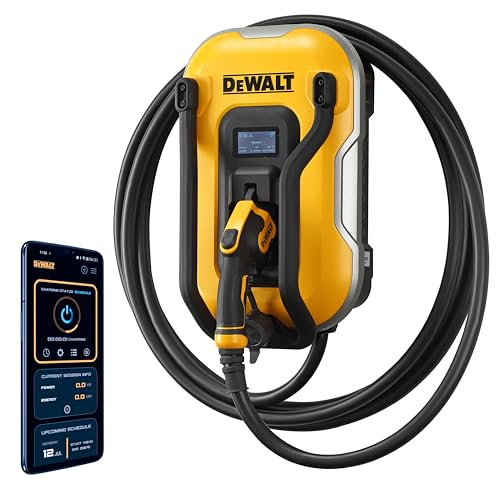
DEWALT’s arrival in home charging is the pool’s most interesting brand story: the toolmaker whose chargers filled an earlier guide in this series now offers to charge the truck itself. The title leads with connectivity — App Control, Bluetooth and Wi-Fi, both radios named — at up to 48 Amps and a printed 240V. The dual-radio detail is more thoughtful than it first appears: WiFi serves the house’s network and the tariff schedule, while Bluetooth serves the driveway, where a phone beside the car can talk to the charger even when the garage’s WiFi fades at the far wall. Naming both suggests the maker thought about where chargers actually live in a home’s radio geography.
The electrical statement keeps its qualifier: up to 48 Amps. As with the Grizzl-E, a configurable ceiling is a feature for real houses, letting the installer commission the unit at the rate the circuit supports — up to the 48A figure that matches the EMPORIA’s stated rate and sits at the practical top of the common 60-amp circuit. The printed 240V completes the calculable hand, one of only two titles in the pool to offer an electrician both numbers.
The silences are the familiar pair — connection method and connector standard are not stated in the title, and the spec box directs both questions to DEWALT’s documentation. The connector point deserves emphasis for this pick in particular, because brand familiarity can smuggle in assumptions: a household trusting DEWALT from its tools should still confirm, in documents, that this charger’s connector matches its car’s inlet before the purchase. Trust is a reason to read a maker’s documentation with confidence, not a reason to skip reading it.
App control is the pick’s wager about what home charging becomes: scheduled against tariffs, monitored from the sofa, integrated into the same phone habits as the rest of the house. Households that want the car managed like an appliance will find this title speaking their language most fluently of the six. Households that want the car simply charged — plugged in at night, ready at dawn, no account required — should weigh whether the connected layer is a feature or a toll, and the pool offers them the Wallbox and Grizzl-E temperaments as the alternative philosophy.
- Stated output: up to 48 Amps at 240V — ceiling and voltage both printed in the title
- Control: app control, stated in the title
- Radios: Bluetooth and Wi-Fi, both stated in the title — the pool’s fullest connectivity claim
- Connector: Not stated in the listing title — verify with DEWALT documentation
- Connection method: unaddressed by the title — DEWALT documentation is the source
- Cable length: no figure offered — a DEWALT documentation check
Strengths
- Bluetooth plus Wi-Fi covers both the network schedule and the driveway conversation.
- A calculable title — amps and volts printed together, ceiling honestly qualified.
- A toolmaker’s service network and documentation habits stand behind the unit.
Trade-offs
- Connector and connection method are documentation retrievals, not title facts.
- The app layer is a commitment; offline-minded households may prefer a dumber unit.
- DEWALT’s EV line is newer than its tool line, however deep the brand’s roots.
Best for: a connected household on a time-of-use tariff that wants the car scheduled, monitored and reachable by phone from anywhere in the house.
Not suited for: a purchase needing the connector confirmed in the title, or a preference for charging with no account and no app.
How Do the Six Home Chargers Compare?
| Pick | Stated amps | Connection in title | Connector in title | Notable stated extra |
|---|---|---|---|---|
| ChargePoint HomeFlex | 50A | Hardwired | J1772 | “Smart” connected brief |
| EMPORIA | 48A | Not stated | J1772 | 240V printed; WiFi enabled |
| Wallbox Pulsar Plus | 40A | Not stated | J1772 | Specialist maker’s flagship tier |
| Grizzl-E Classic | Up to 40A | Not stated | Not stated | UL Certified; indoor/outdoor |
| Autel | 50A | Hardwired | J1772 | 25ft cable; WiFi |
| DEWALT | Up to 48A | Not stated | Not stated | App control; Bluetooth and Wi-Fi |
The table rewards a second reading of its empty cells. Four connection methods and two connector standards must be retrieved from documentation before those four installations can be planned — a modest errand, but the errand on which the whole installation’s cost and compatibility turn. The two fully stated hardwired units and the two fully printed electrical statements show what titles in this category could routinely do.
What Does the Hardwired-versus-Plug Decision Actually Decide?
Strip away habit and the decision has four components. Current: hardwired connections are the standard route to the highest sustained rates, which is why both 50A picks in this pool state hardwired in their titles. Permanence: a hardwired unit is part of the house, moving only with professional help, while a plug-in unit on a suitable receptacle can be unplugged and taken along — a difference that matters to renters and to households whose next car may park elsewhere. Wear: a receptacle cycled daily for a decade is a wear point that a hardwired joint simply does not have. And code: local rules and the receptacle’s grade govern what a plug-in installation may draw, which is an electrician’s conversation, not a listing’s.
The honest complication, which this guide has maintained throughout, is that the pool only lets the decision be half-made from titles. Two units declare hardwired; four declare nothing, and households preferring a plug must verify from documentation which of the four can be installed that way, in what configuration, at what maximum setting. That is not a defect of the guide — it is the accurate state of the evidence, and planning an installation on assumed connection methods is how electricians end up re-quoting jobs in driveways.
Whichever way the decision lands, it should land before the purchase, in conversation with the electrician who will sign the work. The charger is the cheapest component of a home charging installation; the circuit, the panel capacity and the labour are the budget. Choosing the unit first and the circuit second inverts the economics and is the single most common planning error in the category — ahead of even the amperage maximalism the Wallbox pick argued against.
How Should the Installation Be Planned With an Electrician?
Begin with the panel, not the product. An electrician’s load calculation decides what the house can offer: many homes can add a 40A or 48A charging circuit directly, some need a panel upgrade or a load-management device, and a few need service work that dwarfs the charger’s price. That calculation, done first, converts the amp question from a preference into a fact — and the pool’s configurable picks, the Grizzl-E’s “up to” and the DEWALT’s “up to”, exist precisely for houses whose answer lands below the maximum.
Next, walk the geometry with a tape measure. Panel to mounting point gives the conduit run; mounting point to charge port gives the cable requirement — the measurement the Autel’s stated 25ft lets a household check from the listing, and the measurement every other pick requires from documentation. Note the port’s side on the car, the parking orientation the household actually uses, and whether a future second car should reach the same unit. Geometry decided on paper is cheap; geometry discovered with the cable in hand is a second installation.
Then settle the tariff and the schedule. If the utility offers time-of-use rates or an EV programme, the charger’s connected features — WiFi on the EMPORIA and Autel, Smart on the ChargePoint, app control on the DEWALT — become part of the installation’s economics, and any programme enrolment may carry its own equipment conditions worth confirming from the maker’s and the utility’s documents. A charger installed without its schedule set is a charger charging at the expensive hour by default, every night, for years.
Finally, permit and inspect where the jurisdiction asks it. A permitted installation is not bureaucracy for its own sake: it is the paper trail that insurers, future buyers and the household’s own electrician will rely on, and it is the moment a second professional verifies the circuit that will carry the house’s largest continuous load. The chargers in this pool are built to be infrastructure; the installation should be documented like it.
What Do Smart Features Earn Across a Year of Charging?
The connected layer’s first earning is scheduling, and its size depends entirely on the tariff. Where electricity costs two or three times more at dinner than at 2 a.m., a charger that waits for the cheap window repays its connected premium continuously; where the tariff is flat, the same feature is a screensaver. This is why the guide weighs WiFi and app claims per household rather than per product — the EMPORIA, Autel, ChargePoint and DEWALT connected briefs are worth real money in one postcode and nearly nothing in another, through no fault of their engineering.
The second earning is visibility. A household able to see what the car consumed — per night, per month, per tariff period — manages the car as part of the home’s energy budget rather than as a mystery inside the bill. EMPORIA’s monitoring heritage speaks directly to this use, and every connected pick here offers some version of it. Visibility also catches faults early: the night the car drew nothing is a night discovered in the morning’s report rather than at the morning’s departure.
The third earning is the subtlest: participation. Utilities increasingly offer programmes — managed charging, demand response, off-peak incentives — that connected chargers can join and unconnected ones cannot. Programme terms live outside listing titles and change faster than hardware, so this guide credits no pick with any programme; but a household in a region where such programmes are growing should weigh the connected picks’ option value honestly. A dumb charger is a finished decision; a connected one keeps a door open.
How Does a Second Electric Car Change the Calculation?
Many households buy the first charger as a single-car answer and meet the second car two years later, which is why the installation decisions in this guide keep glancing at the future. A second EV doubles the overnight energy the house must deliver and halves the slack in every assumption: the panel capacity that felt generous, the cable that reached one parking position, the schedule that had the whole night to itself. Households with any realistic prospect of a second car should let that prospect speak during the first installation — in conduit sized for a second run, in a panel decision made once rather than twice, in a mounting position chosen with the second parking space in view.
The chargers themselves answer the second car in different ways. Two cars can time-share one unit where their schedules interleave — one charged by midnight, the other by dawn, with the connected picks’ scheduling features doing the choreography. Or the household installs a second unit, which load management can keep within the panel’s original capacity by ensuring the pair never draw their maxima together. Neither arrangement can be evaluated from the titles in this pool — load-sharing behaviour is documentation territory for every pick here — but the question belongs on the first installation’s agenda, because retrofitting the answer costs multiples of planning it.
The deeper point is that home charging is a twenty-year decision wearing a product’s clothes. Cars will rotate through the driveway; the circuit, the conduit and the mounting position will outlast several of them. Installing for the driveway a household expects — two cars, perhaps a visiting third, a panel with headroom honestly calculated — makes the second and third chargers simple product purchases. Installing only for this year’s car buys every future car an electrician’s visit as a companion.
Which Home Charging Mistakes Cost the Most?
The costliest is buying the charger before the panel calculation — discovering, unit in hand, that the house needs a service upgrade the budget never met. The second is amperage maximalism: paying for 50A of capacity, and the heavier installation it demands, to serve a car and a schedule that would never have noticed 40A. The pool’s structure argues against both mistakes; its 40A picks are not consolations but considered answers for the majority of overnight arithmetic.
Third is assuming the silent fields. A connector taken for granted, a connection method guessed from a photograph, a cable length discovered at installation — each is a small fact that was available in documentation and expensive in the driveway. This guide’s spec boxes have flagged every silence in the pool; the mistake is not the silences themselves but skipping the single lookup each one asks for.
Fourth is neglecting the cable as a component. The cable is handled twice a day for a decade, dragged across concrete, occasionally driven over, coiled in cold that stiffens it. A holster, a sensible mount height and a route that keeps the cable out of the tyre path are the difference between a cable that ages with the charger and one that becomes the system’s first failure — a failure no amp rating in any title can compensate for.
What Should the First Month of Home Charging Teach?
The first month is the household’s calibration period, and it repays attention out of proportion to its length. Watch the actual pattern rather than the imagined one: when the car really plugs in, how much energy a real week consumes, whether the schedule set at installation matches the tariff’s true cheap window. Households routinely discover that their mileage is lower than feared — the 50A headroom argument quietly retiring itself — or that a second driver’s pattern collides with the first’s in ways the planning missed. Both discoveries are cheap in month one and expensive in year two.
Use the month to build the physical habits while they are still conscious choices. The cable’s coil, the connector’s holster, the plug-in sequence as part of the coming-home ritual rather than a separate chore — charging that integrates into the evening’s existing movements survives; charging that requires a special trip to the garage gets skipped on tired nights, and the skipped night is always the one before the long drive. The connected picks can report the household’s consistency back to it, and a month of unbroken overnight charges is the sign the ritual has set.
Close the month with the paperwork. The permit record, the electrician’s invoice, the charger’s documentation and the panel schedule updated to name the new circuit belong in the house file, where a future electrician, insurer or buyer will look for them. Note the commissioning settings too — the configured rate where the unit has one, the schedule chosen, the tariff enrolled in. A home charger is infrastructure, and infrastructure’s second requirement, after working, is being understood by the next person who has to touch it.
Final Recommendation
Match the pick to the house, in the order this guide has argued: panel first, geometry second, tariff third, brand last. The panel-rich homeowner installing permanently takes a stated hardwired 50A unit — the ChargePoint for its network pedigree, the Autel where its stated 25ft cable solves the geometry. The calculating household on a time-of-use tariff takes the EMPORIA’s printed 48A and 240V with WiFi. The right-sized majority takes a 40A pick — the Wallbox for the specialist’s polish, the Grizzl-E where the charger must live outdoors in a hard climate and show its certification. And the connected household that wants the car run from a phone takes the DEWALT, after the documentation confirms its connector and connection.
Every route through the shortlist ends at the same small ceremony: the maker’s documents open beside the electrician’s quote, the silent fields filled in, the schedule set before the first night’s charge. A home charger chosen that way becomes what it should be — a silent utility, noticed only in its absence — and the car it serves simply leaves full every morning, which is the whole promise of charging at home, kept. It is a modest promise compared with the category’s marketing — no revolutions, no futures — just a driveway appliance that quietly removes a weekly errand from a household’s life for a decade, and the six titles above, read at exactly the strength of what they print, are how that promise gets bought without surprises.
Frequently Asked Questions
Is 40A enough, or should every home install 50A?
For most households, 40A is enough with room to spare, because the binding constraint is the overnight window rather than the charger’s ceiling: a car parked for ten hours needs only its daily energy divided by those hours, and ordinary daily mileage divides into a modest figure. The 50A picks — ChargePoint and Autel — earn their capacity for large batteries, short windows and future headroom. Buy the rate the tightest night requires, not the largest rate the catalogue prints.
What does J1772 mean, and why does it matter?
J1772 is the standard connector named in five of this pool’s six titles — the common North American AC charging inlet shared across most non-Tesla vehicles and supported, via each maker’s arrangements, far beyond them. It matters because connector and car must agree before any other specification does. The Grizzl-E title does not state its connector, so its compatibility is a documentation confirmation rather than an assumption — and no title here states a NACS connector, so households with that inlet should complete the same verification for every pick.
Does a hardwired charger charge faster than a plug-in one?
The connection method does not itself add speed; it enables the highest sustained configurations, which is why both 50A titles in this pool state hardwired. A plug-in installation’s ceiling is set by its receptacle and circuit rules. The practical difference is that hardwired units — the ChargePoint and Autel here — declare for the top configuration permanently, while the four titles silent on connection must have their configurations and ceilings confirmed from documentation.
How many miles of range per hour will these chargers add?
No title in this pool states such a figure, and this guide prints none, because the honest number belongs jointly to the charger and the car: the car’s onboard acceptance caps what any charger can deliver, and efficiency varies by vehicle. The planning method that never lies is energy-based — the car’s battery size and the share to be replaced overnight, divided by the hours available, compared against what the chosen amperage offers. Any listing that promises a universal miles-per-hour figure is describing a car it has never met.
Can a renter install any of these chargers?
Only with the property owner’s agreement and, for hardwired units, an acceptance that the installation stays with the property. The two titles that state hardwired — ChargePoint and Autel — are commitments by design. For the other four, connection options live in documentation, and a renter’s realistic path runs through the landlord, an electrician’s assessment of the existing panel and circuits, and written permission — in that order, before any purchase.
What should be confirmed before ordering any pick here?
The panel’s capacity with an electrician; the cable length against the garage’s measured geometry — stated only by the Autel at 25ft; the connector against the car’s inlet — unstated for the Grizzl-E and the DEWALT; and the connection method where the title is silent — EMPORIA, Wallbox, Grizzl-E and DEWALT. Four confirmations, each a single lookup or conversation, separate an installation that proceeds once from one that proceeds twice.
Related Guides
Readers planning the rest of a home charging setup may also find our guide to electrical panel upgrades for EV charging useful, alongside the roundup of portable Level 2 chargers for travel and the guide to time-of-use tariffs and scheduled charging that the connected picks above are built to exploit. Together they cover the installation from the panel outward — the capacity, the journey and the clock — which are the three directions from which home charging projects usually go wrong.
Related guides
- Best Balancing Stabilizers for Mirrorless Cameras: Payload, Balancing and Native Vertical Shooting
- Best Canon Point and Shoot Digital Cameras: PowerShot Picks From Pocket Compacts to Travel Zooms
- Best Basic Phones Camera Buyers Can Trust: Flip Phones and Simple Handsets That Still Take a Photograph
- Best Sony Full Frame Cameras for Astrophotography: Sensitivity vs Resolution


