What's inside
- Key Takeaways
- Quick Picks
- What Separated These Six From the Rest of the Yellow Wall?
- How Do the Six Chargers Compare at a Glance?
- How Should a Rotation Be Planned Around a Charger?
- What Actually Happens Across a Single Charge Cycle?
- Where Should Chargers Live in a Workshop or a Truck?
- When Is the Real Answer a Second Charger?
- Which Charger Mistakes Cost Fleets the Most Money?
- What Do the Indicator Lights Know That Owners Ignore?
- Final Recommendation
- Frequently Asked Questions
- Related Guides
As an Amazon Associate I earn from qualifying purchases. This post may contain affiliate links at no extra cost to you.
gizmoverdict.com is reader-supported. When you buy through links on our site, we may earn an affiliate commission.
Where to buy: The six chargers below are all genuine DEWALT units drawn from this site’s verified pool, and each links to its own listing. Charge rates are quoted only where the listing title itself prints an amp figure; where a title says “rapid” or “fast” without a number, this guide repeats the word and leaves the number to DEWALT’s documentation.
Shopping for the best dewalt 20 max chargers sounds simpler than it is, because the yellow chargers all look alike on a shelf and behave very differently on a wall. A charger is the metronome of a cordless tool system: it sets the tempo at which dead batteries return to work, and a crew’s whole rhythm — two batteries rotating, three batteries rotating, a bank of packs charging overnight — is built around what the charger can actually do. DEWALT’s own catalogue spans gentle overnight units, fan-cooled rapid chargers and multi-bay stations, and all six picks in this guide are DEWALT’s own hardware, because a charger is the one accessory where the tool maker’s engineering and the battery’s protection electronics are designed as a pair.
The honest complication is that DEWALT prints its charge rates unevenly across listings. Three of the six titles below state an amp figure outright — 4 Amp, 6 Amp and 4 Amp again. The other three trade in adjectives: “Rapid”, “Fast”, and a dual-station design whose title spends its characters on its two USB ports instead. An amp figure is a promise that can be checked against a battery’s capacity with primary-school arithmetic; an adjective is a mood. This guide treats the two differently throughout, crediting numbers where numbers are printed and sending readers to DEWALT’s documentation where they are not.
The second axis is compatibility, and here the titles are generous. Every pick spans more than the 20V MAX name in the keyword: 12V MAX appears in four titles, FLEXVOLT in four, and one unit declares the full 20V/60V FLEXVOLT span. A mixed fleet — compact 12V tools for cabinet work, 20V MAX for the daily drivers, FLEXVOLT packs for the mitre saw — can live on one shelf of chargers if the chargers are chosen with the fleet in mind, and that fleet view is how the six picks below were arranged.
Key Takeaways
- All six picks are genuine DEWALT chargers; this guide does not treat third-party substitutes as interchangeable with the maker’s own charging electronics.
- Only three titles print a charge rate: the DCB1104 and the B0GQJR8RQB unit at 4 Amp, and the DCB1106 at 6 Amp — the highest stated figure in the pool.
- “Rapid” and “Fast” in the DCB118 and DCB1112 titles are the maker’s words, not measured rates; DEWALT’s documentation carries the numbers behind them.
- FLEXVOLT compatibility appears in four of the six titles, so a mixed 20V MAX and 60V fleet is well served by this pool.
- The dual charging station is the only pick that charges two packs at once, and the only one whose title mentions USB ports for phones and lights.
- Fan cooling, named in the DCB118’s title, is the feature that sustains rapid charging through back-to-back packs on hot days.
Quick Picks
| Pick | Badge | Why it earns the slot |
|---|---|---|
| DEWALT 12V MAX/20V MAX Lithium Ion Battery Charger, 4 Amp (DCB1104) | The stated-rate standard | A printed 4 Amp rate and dual 12V/20V compatibility make it the reference single-bay charger of the set. |
| DEWALT 20V MAX/FLEXVOLT Lithium-Ion, Fan Cooled Rapid Battery Charger (DCB118) | Best for hot, heavy rotation | Fan cooling and a rapid brief, with FLEXVOLT support, for packs cycling all day in summer heat. |
| DEWALT 12V MAX*/20V MAX*/FLEXVOLT 6 Amp Charger (DCB1106) | Highest stated rate | Six amps is the biggest number any title in this pool prints, across the widest stated voltage span. |
| DEWALT 12/20V MAX Battery Charger, Corded, Dual Charging Station, 2-USB Ports Included | Best two-pack station | Two bays charging at once plus two USB ports turn one outlet into a small charging bench. |
| DEWALT Battery Charger, 20V + Flexvolt Fast Charger (DCB1112) | FLEXVOLT fast brief | A fast charger whose title leads with 20V + FLEXVOLT, aimed at the big packs that take longest to refill. |
| DEWALT Battery Charger 12V MAX, 20V MAX, FLEXVOLT 20V/60V MAX, 4 Amp, Fast Charger | Broadest stated span | 12V, 20V and FLEXVOLT 20V/60V in one title, with a printed 4 Amp rate behind the fast claim. |
What Separated These Six From the Rest of the Yellow Wall?
The first decision was provenance. Every pick is a DEWALT charger, full stop. Aftermarket chargers exist in this category at tempting prices, and some behave well, but a buying guide that lines them up as equals against the maker’s units would be hiding the one fact that matters: DEWALT designs its chargers and its battery packs’ protection electronics together, and the warranty and diagnostic conversations that follow a battery failure run through the maker’s own hardware. The pool was therefore built entirely from DEWALT listings, and the comparison below is a comparison within the family — which yellow charger, not whether yellow at all.
The second decision was to rank evidence over adjectives. Where a title prints amps, the pick is discussed in amps. Where a title prints only “Rapid” or “Fast”, the pick is discussed as a design brief — fan cooling, FLEXVOLT focus — and its rate is recorded as unstated, with DEWALT’s documentation named as the source. That discipline produces a pool where the DCB1106’s plain “6 Amp” outranks flashier language, which is exactly the habit readers should carry into any charger listing, yellow or otherwise.
Third, the six were arranged to cover the real shapes of a tool fleet: the single-bay standard (DCB1104), the heat-proof rapid unit (DCB118), the fastest stated single bay (DCB1106), the two-bay station (the dual charging station), the FLEXVOLT-focused fast charger (DCB1112), and the broad-span 4 Amp unit (B0GQJR8RQB) whose title reads like a compatibility chart. A reader with any common fleet shape — solo tradesman, two-person crew, mixed-voltage workshop — should find the rotation they actually run somewhere in those six shapes.
Last, every pick had to serve the keyword’s core: 20V MAX charging. Each of the six titles names 20V MAX outright, and the additional voltages are treated as reach, not distraction. A charger that also handles the 12V compact line or the FLEXVOLT 60V packs earns its shelf space twice; a charger that somehow wandered in without 20V MAX support would not have survived the first filter, whatever else it offered.

DEWALT 12V MAX/20V MAX Lithium Ion Battery Charger, 4 Amp (DCB1104) — The stated-rate standard
Every charger family needs a reference point, and in this pool the DCB1104 is it: a single-bay DEWALT charger whose title does the two things a charger title should — it names the battery families it serves, 12V MAX and 20V MAX, and it prints its charge rate, 4 Amp, where everyone can see it. Four amps is the honest middle of the charging world. Against a compact 2.0Ah pack it is brisk; against a large 5.0Ah or 6.0Ah pack it is a measured, battery-kind pace that returns a pack in a lunch break rather than a coffee break, and the arithmetic is available to any reader because DEWALT printed the number.
That kindness to batteries is not a consolation prize. Lithium packs age by heat and by time spent at extremes, and a moderate charge rate is one of the gentlest things an owner can do for a fleet’s longevity. The DCB1104’s brief suits the overnight-and-rotate pattern: packs come off tools at the end of the day, go onto the charger, and are ready in the morning with minimal thermal stress accumulated across hundreds of cycles. Workshops that measure battery cost per year rather than minutes per charge tend to end up valuing exactly this temperament.
The dual-voltage span deserves its own note. The 12V MAX line survives in workshops because compact tools fit where 20V tools cannot — inside cabinets, above ceilings, in engine bays — and a fleet that runs both platforms usually ends up with two chargers cluttering the bench. A single unit whose title covers both families collapses that clutter, and for the one-person shop the bench space recovered is worth as much as the charging itself.
Where the DCB1104 does not pretend to compete is throughput. One bay, a moderate rate: a crew burning through packs on a framing day will outrun it by mid-morning. Its pick is aimed at the far larger population of users whose rotation is measured in packs per day rather than packs per hour, and who would rather have the rate printed on the box than discover it in the third week of ownership.
- Stated charge rate: 4 Amp, printed in the title
- Compatibility as titled: 12V MAX and 20V MAX lithium-ion packs
- Bays: single charging position, per the model’s standard format — confirm layout in DEWALT documentation
- FLEXVOLT support: Not stated in the listing title — verify with DEWALT documentation
- Fan cooling: not claimed in the title
- USB ports: none mentioned in the title
Strengths
- A printed 4 Amp rate that lets owners do their own charge-time arithmetic.
- 12V and 20V coverage collapses two benches’ worth of chargers into one unit.
- A moderate rate is gentle duty for packs expected to live for years.
Trade-offs
- One bay only — heavy rotations will queue behind it by mid-morning.
- FLEXVOLT support is not claimed in the title and must be verified before fleet planning.
- No fan cooling is claimed, so sustained summer throughput is the rapid units’ territory.
Best for: a one-platform-plus-compact fleet on an overnight rotation, where a stated rate and a kind pace matter more than raw turnaround.
Not suited for: a crew cycling large packs continuously through a working day, or a FLEXVOLT-first fleet that has not verified this unit’s coverage.

DEWALT 20V MAX/FLEXVOLT Lithium-Ion, Fan Cooled Rapid Battery Charger (DCB118) — Best for hot, heavy rotation
Two words in the DCB118’s title do the heavy lifting: fan cooled. Rapid charging is easy for the first pack and hard for the fourth, because every fast charge pushes heat into the battery, and a warm battery forces any responsible charger to slow down or pause. A fan that moves air through the charging bay attacks that problem directly, cooling the pack while it charges and keeping the rapid promise closer to honest across a string of packs on a July afternoon. That is why fan cooling, rather than the word “Rapid” itself, is the feature this pick is built on.
The FLEXVOLT support in the title widens the brief considerably. FLEXVOLT packs are the fleet’s heavyweights — the batteries that run the big saws and outdoor equipment — and they are precisely the packs whose long charge times stall a rotation. A rapid charger that accepts them turns the fleet’s slowest refill into a managed interval, and a fan-cooled one does it without cooking the most expensive batteries on the shelf in the process.
The title’s silence is its amp figure. DEWALT calls the DCB118 rapid and prints no number in the listing title, so this guide does not invent one. The rate lives in DEWALT’s documentation, and it should be retrieved before the unit is placed at the centre of a time-critical rotation — not because the charger is suspect, but because a rotation planned around an adjective is a plan with a hole in it. Owners who do that one lookup get a charger with a long service record in exactly the high-turnover role its title describes.
In practice the DCB118 is the charger that lives on the jobsite bench rather than the workshop wall: the unit crews plug in at break, the one that has a hot pack swapped onto it the moment a tool sputters. Its natural partner is a second, calmer charger at home base — a division of labour the comparison section returns to, because the best dewalt 20 max chargers answer is often two chargers with different temperaments rather than one charger asked to be everything.
There is also a diagnostic dividend to the fan that owners discover by ear. A fan-cooled charger announces its working state audibly — the bay is occupied, air is moving, a charge is under way — and a silent unit at a moment when the bench expected noise is an early, gentle alarm that a pack was never seated or a breaker has gone. It is a small thing, and small things are what uptime is made of. Crews come to read the bench by sound the way cooks read a kitchen, and the DCB118 is the only voice in this pool that joins that conversation.
- Cooling: fan cooled, stated in the title
- Brief: rapid charger, in the maker’s own word in the title
- Compatibility as titled: 20V MAX and FLEXVOLT lithium-ion packs
- Stated charge rate: Not stated in the listing title — verify with DEWALT documentation
- 12V MAX support: not claimed in the title
- Bays: single charging position in the model’s standard format — confirm in DEWALT documentation
Strengths
- Fan cooling defends the rapid rate across consecutive packs and hot days.
- FLEXVOLT acceptance covers the fleet’s largest, slowest-refilling batteries.
- A long-serving jobsite design brief: turnaround first, everything else second.
Trade-offs
- The title prints no amp figure, so rotation planning starts with a documentation lookup.
- 12V MAX packs are outside the title’s stated span.
- A fan is a moving part in a dusty world; the bay needs occasional cleaning to stay effective.
Best for: a working crew rotating FLEXVOLT and 20V MAX packs through hot days, where charge four must be nearly as fast as charge one.
Not suited for: a mixed 12V/20V bench seeking one charger for everything, or a silent-running indoor space where a fan’s murmur matters.
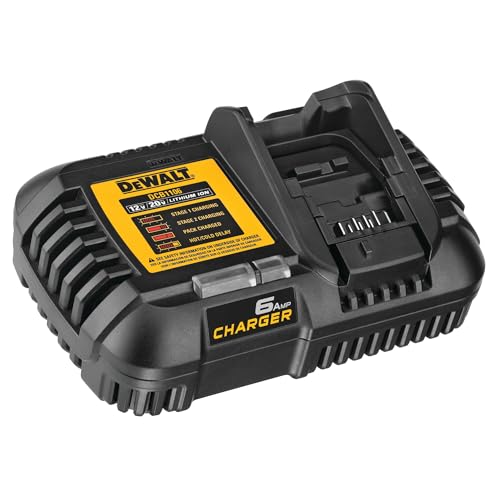
DEWALT 12V MAX*/20V MAX*/FLEXVOLT 6 Amp Charger (DCB1106) — Highest stated rate
Six amps is the largest charge rate printed anywhere in this pool, and the DCB1106 prints it in a title that also carries the widest compatibility span of the single-bay units: 12V MAX, 20V MAX and FLEXVOLT. That combination — the biggest stated number on the broadest stated span — makes this pick the arithmetic champion of the guide. A reader can take the 6 Amp figure, divide it into the capacity of any pack in the fleet, apply the usual allowance for the slower finishing stage of a lithium charge, and know within a useful margin when each battery will be ready. No other pick lets the planning run that cleanly across that many battery families.
The asterisks in the title are worth a sentence, because DEWALT’s MAX nomenclature has always carried them: the voltages are maximum initial battery voltages rather than nominal running voltages, a naming convention the whole industry shares and the asterisks honestly flag. They change nothing about compatibility — the packs named are the packs served — but a guide that explains the asterisk respects its readers more than one that pretends it is decoration.
Speed at 6 Amp changes how a fleet is bought, not just how it is charged. Rotations that needed three packs per tool can often run on two when the turnaround is short, and the money saved on the third pack funds the faster charger several times over across a crew. The counterweight is heat discipline: a high rate asks the pack and the charger to manage more energy per minute, and owners should give the unit the ventilation its manual specifies rather than entombing it in a gang box with four other heat sources.
The DCB1106 is the pick that argues with the DCB118 for the jobsite bench. The 118 brings a fan and a rapid brief with an unstated rate; the 1106 brings a stated 6 Amp and no fan claim in its title. Between a printed number and a cooling fan, the right choice depends on the climate and the rotation — sustained strings of packs in serious heat flatter the fan, while mixed-voltage fleets and planners who think in numbers will take the stated rate and the wider span every time.
- Stated charge rate: 6 Amp — the highest figure printed in any title in this pool
- Compatibility as titled: 12V MAX, 20V MAX and FLEXVOLT packs
- Fan cooling: not claimed in the title
- USB ports: none mentioned in the title
- Bays: single charging position in the model’s standard format — confirm in DEWALT documentation
- Charge-time basis: the printed rate supports direct arithmetic against pack capacity
Strengths
- The pool’s highest stated rate, printed where buyers can plan around it.
- The widest single-bay compatibility span here — three battery families in one title.
- Fast turnaround can shrink the pack count a rotation needs, saving real money.
Trade-offs
- No fan cooling is claimed, so back-to-back packs in high heat may throttle the pace.
- A high rate rewards owners who follow the manual’s ventilation guidance.
- Single bay still means one pack at a time, however quickly each finishes.
Best for: a mixed-voltage fleet planned by the numbers, where a stated 6 Amp rate anchors the rotation and two packs per tool must do the work of three.
Not suited for: continuous all-day cycling in extreme heat, where the fan-cooled DCB118’s sustained pace is the safer bet.

DEWALT 12/20V MAX Battery Charger, Corded, Dual Charging Station, 2-USB Ports Included — Best two-pack station
Every other pick in this guide charges one battery at a time. This station charges two, and its title spends the rest of its characters on the detail that makes it a bench rather than a charger: two USB ports, included. The proposition is a small charging headquarters — two tool packs refilling side by side while a phone and a work light sip from the USB ports — all from one corded unit on one outlet. For a solo operator or a two-person crew, that is not a luxury arrangement; it is the difference between a rotation that survives the day and one that collapses at three in the afternoon.
The corded detail in the title is easy to skim past and worth pausing on. A station is a fixed citizen of the bench or the truck bed’s power corner, and the cord is its terms of citizenship: it goes where an outlet or an inverter lives, and it stays there. Owners who picture it migrating around a site should picture the extension cord that will actually make that happen, and judge the setup as the two-part system it becomes.
The title does not print a charge rate for either bay, and the honest treatment is the one this guide has applied throughout: the figure belongs to DEWALT’s documentation, and it matters here in a specific way. Dual-bay units divide their talents differently — some charge both bays at full rate simultaneously, others sequence or share — and the documentation is where that behaviour is stated. A rotation built on this station should be built after that lookup, not on the assumption that two bays means two full-speed chargers in one housing.
The USB ports deserve neither hype nor dismissal. They will not fast-charge a modern phone the way a dedicated adapter does, but a station that tops up the phone, the headlamp and the site radio while the tool packs charge removes three small chargers from the bag and three cables from the tangle. In the economy of a working bench, that tidiness compounds daily.
- Bays: dual charging station, stated in the title — two packs at once
- Extras: 2 USB ports included, stated in the title
- Power: corded, stated in the title
- Compatibility as titled: 12V MAX and 20V MAX packs
- Stated charge rate: Not stated in the listing title — verify with DEWALT documentation
- FLEXVOLT support: Not stated in the listing title — verify with DEWALT documentation
Strengths
- Two packs charging simultaneously doubles the rotation’s breathing room.
- USB ports retire the phone and light chargers cluttering the same bench.
- One cord, one outlet, one fixed home — a station in the true sense.
Trade-offs
- Per-bay charge rates are unstated in the title; simultaneous behaviour needs the documentation.
- FLEXVOLT coverage is unclaimed in the title, narrowing its fleet span until verified.
- A corded station is furniture, not a traveller — it serves one location well.
Best for: a fixed bench or truck setup running a two-pack rotation, where the USB ports quietly absorb the day’s small-device charging too.
Not suited for: a FLEXVOLT-heavy fleet that has not confirmed coverage, or a roving workflow with no single powered home base.
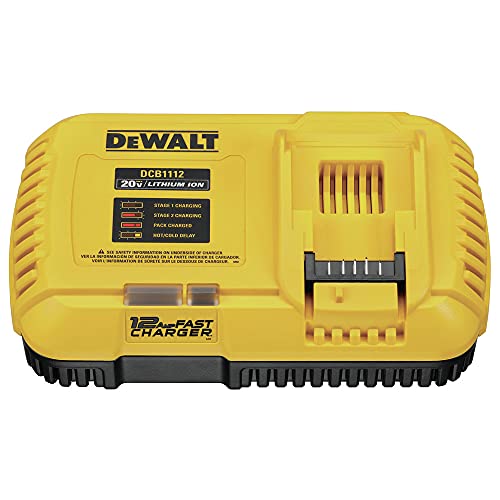
DEWALT Battery Charger, 20V + Flexvolt Fast Charger (DCB1112) — FLEXVOLT fast brief
The DCB1112’s title is built like a headline: 20V + Flexvolt, Fast Charger. The pairing is the story. FLEXVOLT packs are the largest in the DEWALT system — the batteries behind the 60V outdoor tools and the hungriest saws — and large packs are where charge time stops being an inconvenience and becomes a scheduling problem. A charger whose brief is speed, aimed squarely at the 20V and FLEXVOLT families together, addresses the exact corner of the fleet where a slow refill strands the most expensive tools.
The word “Fast” carries the same asterisk as every adjective in this category: the title prints no amp figure, so the rate is a documentation retrieval, not a number this guide will fabricate. What can be said from the title alone is intent and scope — DEWALT positions this unit as the fast option for the big-pack families, and an owner comparing it against the DCB1106’s stated 6 Amp should retrieve the DCB1112’s documented rate and compare figures, not vibes. That comparison, run honestly, is the entire decision between the two picks.
There is a fleet-economics angle that favours this charger’s brief. FLEXVOLT packs cost substantially more than compact 20V packs, so fleets own fewer of them, and each one spends a larger share of its life either working or charging. Shortening the charging share raises the working share of the most expensive assets on the shelf — the rare case where a faster charger pays for itself in asset utilisation rather than in anyone’s patience.
Owners whose FLEXVOLT use is occasional should weigh the pick differently. A fast charger bought for two big packs that cycle twice a week is solving a problem the calendar does not have; the stated-rate DCB1104 or the broad-span unit below will serve that fleet calmly. The DCB1112 earns its place where the big packs cycle daily and the schedule bends around their return — landscaping crews, timber framers, and the concrete trades know the feeling precisely.
- Brief: fast charger, in the maker’s own word in the title
- Compatibility as titled: 20V MAX and FLEXVOLT packs
- Stated charge rate: Not stated in the listing title — verify with DEWALT documentation
- 12V MAX support: not claimed in the title
- Fan cooling: not claimed in the title
- Bays: single charging position in the model’s standard format — confirm in DEWALT documentation
Strengths
- A fast brief aimed exactly at the families whose packs take longest to refill.
- Raises the working share of the fleet’s most expensive batteries.
- Keeps 20V MAX and FLEXVOLT on one unit, sparing a second charger purchase.
Trade-offs
- No printed rate in the title — the speed claim must be quantified from DEWALT documentation.
- 12V MAX packs sit outside the stated span.
- Occasional FLEXVOLT users may never feel the benefit the premium brief promises.
Best for: a crew whose FLEXVOLT packs cycle daily and whose schedule is built around getting them back.
Not suited for: a compact-tool fleet, or an occasional big-pack owner whose calendar has no charging bottleneck to relieve.

DEWALT Battery Charger 12V MAX, 20V MAX, FLEXVOLT 20V/60V MAX, 4 Amp, Fast Charger — Broadest stated span
Some titles are advertisements; this one is a compatibility chart. It lists 12V MAX, 20V MAX and FLEXVOLT 20V/60V MAX in sequence — the full staircase of the DEWALT cordless system — and then, unusually for a title that also says “Fast Charger”, it backs the adjective with a printed figure: 4 Amp. That combination makes this pick the generalist of the pool, the one unit a mixed fleet can buy first with the fewest open questions, because both of the things a buyer most needs to know — what it charges, and how fast by the numbers — are answered before the listing is even opened.
The 4 Amp figure invites the same reading as the DCB1104’s identical rate: a measured pace, kind to packs, adequate for overnight rotations and honest about its arithmetic. Where this unit parts company with the 1104 is reach. The FLEXVOLT span stated here — written out as 20V/60V, the dual-voltage identity that defines the FLEXVOLT idea — means the big outdoor and heavy-tool packs are inside the fence from day one, rather than awaiting a verification errand.
For a growing fleet, that reach is a form of future-proofing with an unusually concrete meaning. Tool collections grow toward opportunity: a FLEXVOLT blower arrives with a property, a 60V saw with a bigger job. A charger already spanning the full staircase absorbs those arrivals without a second purchase or a second bench position, and the fleet’s charging arrangements stay boring — which, in charging as in bookkeeping, is the highest compliment available.
The generalist’s tax is that specialists beat it in their specialities. The DCB1106 charges at a stated 6 Amp to this unit’s 4; the DCB118 brings a fan to sustained heat; the dual station charges two packs at once. A fleet with one dominant pattern should buy for that pattern. A fleet whose pattern is variety itself — a property maintenance kit, a farm workshop, a maker’s bench with a tool for every material — is the fleet this pick was titled for.
- Stated charge rate: 4 Amp, printed in the title alongside the fast claim
- Compatibility as titled: 12V MAX, 20V MAX and FLEXVOLT 20V/60V MAX — the full system staircase
- Brief: fast charger, the maker’s word, here supported by a printed figure
- Fan cooling: not claimed in the title
- USB ports: none mentioned in the title
- Bays: the title’s span suggests a multi-role unit — confirm bay layout in DEWALT documentation
Strengths
- The broadest compatibility span in the pool, stated family by family.
- A printed 4 Amp rate behind the fast claim — evidence and adjective together.
- Absorbs future FLEXVOLT arrivals without a second charger purchase.
Trade-offs
- Specialists outrun it: 6 Amp stated elsewhere, fan cooling elsewhere, two bays elsewhere.
- Bay configuration is not described in the title and needs a documentation check.
- A 4 Amp pace is a planning figure, not a rescue service, for big FLEXVOLT packs.
Best for: a mixed or growing fleet that wants one charger spanning the whole DEWALT staircase with its rate printed on the title.
Not suited for: a single-pattern fleet whose dominant need is maximum speed, sustained heat tolerance or simultaneous bays.
How Do the Six Chargers Compare at a Glance?
| Pick | Stated rate | Families in title | Cooling / bays | Defining trait |
|---|---|---|---|---|
| DCB1104 | 4 Amp | 12V, 20V | Not claimed / single | The stated-rate standard |
| DCB118 | Not stated — “Rapid” | 20V, FLEXVOLT | Fan cooled / single | Sustained pace in heat |
| DCB1106 | 6 Amp | 12V, 20V, FLEXVOLT | Not claimed / single | Highest printed number |
| Dual Charging Station | Not stated | 12V, 20V | Two bays + 2 USB | The bench headquarters |
| DCB1112 | Not stated — “Fast” | 20V, FLEXVOLT | Not claimed / single | Big-pack fast brief |
| 4 Amp Full-Span (B0GQJR8RQB) | 4 Amp | 12V, 20V, FLEXVOLT 20V/60V | Not claimed / confirm | Broadest stated span |
Read the table by its empty cells as much as its filled ones. Three printed rates, two adjectives, one silence — that is the true shape of the evidence, and the two documentation lookups it implies (the DCB118’s and the DCB1112’s rates, plus the station’s per-bay behaviour) are the homework that turns this comparison from a summary into a decision.
How Should a Rotation Be Planned Around a Charger?
Start from the work, not the charger. Count the packs the day’s tools genuinely consume, in amp-hours rather than in batteries, because a 2.0Ah compact pack and an 8.0Ah FLEXVOLT pack are both “one battery” only to a purchasing department. The day’s total consumption, divided by the hours the charger will actually run, gives the average rate the system must sustain — and that figure, compared against the stated rates in this guide, tells the truth about whether one charger suffices or the rotation needs a second unit or a second bay.
Then respect the finishing stage. Lithium charging is not linear: the bulk of a pack’s capacity returns at the charger’s full rate, and the final portion arrives more slowly as the pack’s management balances its cells. Planning that assumes a 5.0Ah pack on a 5 Amp charger takes exactly one hour will be disappointed by roughly the margin that makes crews late. Build the rotation with slack — a pack buffer of one beyond the arithmetic — and the system absorbs both the finishing stage and the day a charger is borrowed by another crew.
Heat is the third planner. Packs come off hard-working tools warm, and warm packs charge reluctantly; chargers and battery electronics protect the cells by waiting or slowing. A rotation that works in April can sag in August for reasons that look like charger failure and are actually physics. Shaded, ventilated charging positions, the fan-cooled pick for the hottest benches, and a habit of letting a hot pack rest before it charges are the unglamorous fixes that keep summer productivity where spring promised it would be.
Finally, label the system. A strip of tape naming each pack’s purchase season sounds like fussiness until the day one pack in six starts dying early and nobody can tell whether it is the old one or a pattern. Fleets that rotate deliberately — oldest pack first onto the tools, chargers matched to the day’s pattern — extract years more service from the same batteries, and the charger, as the fleet’s metronome, is where that discipline physically lives.
One more planning habit separates fleets that glide from fleets that lurch: charging ahead of the calendar. Weather days, inspection days and the Friday before a holiday all compress work into the days around them, and a rotation sized exactly for an average Tuesday collapses on the exceptional Thursday. Keeping one more charged pack than the arithmetic demands — the buffer the taper discussion already argued for — is what converts those compressed days from crises into merely busy ones. The charger shelf is a small place to store resilience, and resilience stored there is drawn on more often than any other kind.
What Actually Happens Across a Single Charge Cycle?
A lithium charge is a negotiation in three acts, and understanding the acts explains most charger behaviour that puzzles owners. The first act is assessment: the charger reads the pack’s voltage, temperature and identity through its contacts, and a pack that arrives too hot, too cold or too deeply discharged is refused or held at a trickle until it is safe to proceed. This is why a pack pulled from a freezing truck can sit on a charger showing no progress for twenty minutes — the system is not broken; it is waiting for the cells to enter the temperature window where charging does not damage them.
The second act is the bulk charge, where the charger’s stated rate does its work. Current flows at or near the rated figure and the pack’s capacity climbs quickly — this is the phase the amp number describes, and the phase that makes the difference between the DCB1106’s stated 6 Amp and the DCB1104’s stated 4 Amp a matter of simple division. Owners watching a charge indicator see this phase as the fast climb, and it is where a rotation’s turnaround time is mostly decided.
The third act is the taper, and it is the act that breaks naive arithmetic. As the pack approaches full, the charge rate falls deliberately while the cells balance, and the final portion of capacity arrives at a pace no charger can hurry without abusing the pack. A rotation planned on bulk-phase mathematics alone will always run late by this margin. DEWALT’s chargers signal the stages through their indicators, and crews who learn to read those signals — bulk, taper, full, fault — manage their rotations by evidence instead of by hope, which is the entire skill this category quietly rewards.
Where Should Chargers Live in a Workshop or a Truck?
Placement sounds like housekeeping and behaves like engineering. A charger wants a flat, ventilated home away from the dust plume of the saw station and the solvent shelf, with its vents unobstructed and its indicator visible from the room’s natural walking path. Visibility is a feature: a fault light noticed on a passing glance saves a morning, while a charger entombed behind offcuts announces its troubles only when the first tool of the day sputters. The dual charging station pick makes the strongest case for a permanent, deliberate home — it is furniture by design — but every unit in this pool benefits from the same consideration.
Power supply is the second placement question. Chargers draw modest current individually, but a shelf of them on one circuit alongside a running compressor or heater adds up, and a tripped breaker at midnight converts a fleet’s morning into an archaeology of dead packs. A dedicated circuit for the charging shelf is one of the cheapest upgrades a workshop can buy, and the one most directly repaid. In trucks and vans, where an inverter feeds the chargers, the inverter’s own capacity and the vehicle’s battery become part of the charging system, and the arithmetic of the rotation-planning section applies to the whole chain rather than to the charger alone.
The third question is human traffic. Charging belongs where packs naturally come to rest — beside the door the crew enters by, at the bench where tools are cleaned — because a system that requires a special trip is a system that will be skipped on tired evenings. The best charging station is the one that sits on the path people already walk, with a spare pack always sitting full on it, so the exchange of dead for charged becomes a reflex rather than a chore.
When Is the Real Answer a Second Charger?
More often than the catalogue suggests. The picks above divide naturally into temperaments — the calm stated-rate units, the rapid and fan-cooled units, the two-bay station — and real fleets usually contain two patterns at once: an overnight bulk rotation and a daytime top-up scramble. One charger asked to serve both patterns serves the second badly and the first expensively. A DCB1104-class unit holding the overnight line while a DCB118 or DCB1106 handles the day’s emergencies is a combination that costs less than the premium single unit it replaces and outperforms it in both roles.
The second charger also buys insurance that never appears in a spec box. Chargers fail rarely, but they fail completely, and a fleet with one charger and six packs is one failure away from a day of hand tools. Redundancy at the charger is the cheapest continuity plan in the cordless world — cheaper than a spare pack, and it protects every pack at once. Fleets that have lived through a charger dying on a Sunday evening tend to keep two ever after, and their reasoning deserves the respect of imitation.
Which Charger Mistakes Cost Fleets the Most Money?
The expensive mistake is treating chargers as interchangeable yellow boxes and buying on price within the brand — or worse, outside it. A slow charger at the centre of a fast rotation costs more in idle labour in a month than the price difference it saved, and a no-name charger that mishandles a pack’s protection electronics can cost a battery, which costs more than any charger in this guide. The picks above are all DEWALT’s own for a reason, and the reason is arithmetic, not brand loyalty.
The second mistake is planning from adjectives. “Rapid” and “Fast” describe intentions; amps describe behaviour. Two of this pool’s picks and the dual station ask for a documentation lookup before their pace can be planned, and fleets that skip the lookup discover the truth at the worst time — mid-job, with three packs down. The lookup takes minutes. The discovery takes a day.
Third comes the heat blind spot: chargers entombed in closed gang boxes, packs charged straight off sun-baked tools, benches against hot walls. Lithium cells keep the receipts for every hot charge in shortened lifespan, and the invoice arrives a season later as a fleet that mysteriously holds less charge than it used to. Ventilation and patience are the cheapest battery-preservation programme in existence.
The fourth mistake is subtler — buying the charger for the fleet as it was. Fleets drift: a FLEXVOLT tool arrives, a 12V line gets adopted for the van kit, pack capacities creep upward. A charger spanning the full staircase, like the final pick above, forgives that drift; a narrow charger punishes each arrival with a fresh purchase. The fleet a charger must serve is the one it will meet in its third year, not the one in the photograph on delivery day.
What Do the Indicator Lights Know That Owners Ignore?
Every charger in this pool communicates through a small vocabulary of lights, and fluency in that vocabulary is the cheapest diagnostic skill in the cordless world. A steady charge indication, a completed-charge indication and a fault indication divide the world into three states, but the fault state carries sub-messages — a pack too hot to charge, a pack the charger cannot revive, a problem with the contacts — and the manual’s chart decodes them. Owners who learn the chart catch the two failures that matter early: the pack that is quietly dying, announced by charges that end suspiciously soon, and the pack that has been damaged, announced by a fault the moment it is seated.
The dying pack deserves emphasis, because fleets usually discover it backwards. A pack whose capacity has faded gets rotated like its siblings, dies mid-task, gets swapped in frustration, and the pattern repeats until somebody counts. The charger is where the counting is easiest: a pack that reaches the full indication in a fraction of its usual time at a known rate — the stated-rate picks make this arithmetic possible — is a pack announcing its retirement. Marking it, demoting it to light duty or removing it from the rotation protects both the schedule and the crew’s temper.
Contacts are the unglamorous third lesson. Charger and pack terminals live in sawdust, drywall dust and metal filings, and a film of grime raises resistance, slows charging and generates heat at exactly the joint where heat is least welcome. A dry cloth and thirty seconds, monthly, is the entire maintenance programme, and it is skipped by nearly everyone. The chargers in this guide are built for dirty worlds; they merely ask that the dirt not be allowed to move in permanently.
Final Recommendation
Decide by rotation. The overnight fleet takes the DCB1104 and its printed 4 Amp calm. The planner with a mixed-voltage shelf takes the DCB1106, whose stated 6 Amp and three-family span make it the guide’s arithmetic champion. The hot, high-turnover crew takes the fan-cooled DCB118; the FLEXVOLT-heavy schedule takes the DCB1112 after one honest lookup of its documented rate; the fixed bench takes the dual station and its USB ports; and the fleet still growing into itself takes the full-span 4 Amp unit, which will not need replacing when the next voltage family arrives.
Whichever charger leaves with you, perform the small ceremony this guide has asked for throughout: open DEWALT’s documentation for the exact model, confirm the figures the title left out, and write the rotation plan from numbers rather than adjectives. A charger chosen that way disappears into the working day — packs ready when reached for, season after season — and the best compliment a DEWALT charger can earn is that nobody on the crew ever has to think about it again. That invisibility is earned in the first week — the documentation read, the bench placed on the crew’s natural path, the rotation rehearsed once in calm conditions — and it is kept by the small monthly habits of clean contacts and honest pack bookkeeping that this guide has argued for throughout.
Frequently Asked Questions
Do all DEWALT 20V MAX chargers charge at the same speed?
No, and this pool proves it from the titles alone: the DCB1104 states 4 Amp, the DCB1106 states 6 Amp, and the broad-span unit states 4 Amp, while the DCB118 and DCB1112 describe themselves as rapid and fast without printing a figure. Charge time follows the rate and the pack’s capacity, so a stated 6 Amp unit will return a given pack materially sooner than a stated 4 Amp unit, subject to the slower finishing stage every lithium charge includes.
Can one charger serve 12V MAX, 20V MAX and FLEXVOLT packs?
Yes — two picks in this guide state exactly that span. The DCB1106 lists 12V MAX, 20V MAX and FLEXVOLT in its title at a stated 6 Amp, and the B0GQJR8RQB unit lists all three families, writing FLEXVOLT out as 20V/60V MAX, at a stated 4 Amp. The DCB1104 covers 12V and 20V but does not claim FLEXVOLT in its title, so its coverage of the big packs is a verification question rather than an assumption.
What does fan cooling actually do for a charger?
It defends the charge rate. Fast charging warms the pack, and battery protection electronics respond to heat by slowing or pausing the charge. A fan moving air through the bay — the DCB118’s stated feature — carries that heat away, so consecutive packs charge closer to the unit’s full pace and hot-weather charging sags less. On a single overnight charge the fan is irrelevant; across a string of packs on a summer jobsite it is the feature that matters most.
Is a dual charging station twice as fast as a single charger?
It charges two packs in the time a single-bay unit charges one, which is not the same claim as charging each pack twice as fast. How the station divides its output between the bays — full rate to both, or a shared or sequenced arrangement — is stated in DEWALT’s documentation rather than the listing title, and a rotation should be planned from that documented behaviour.
Does a faster charger wear out batteries sooner?
Higher rates generate more heat, and heat is the currency lithium ageing is paid in — but the chargers here are DEWALT’s own, designed with the packs’ protection electronics, and their stated rates sit inside the envelope the battery system was built for. The larger lifespan risks in real fleets are charging hot packs immediately, storing packs fully charged in hot spaces, and deep daily cycling — habits that cost more life than the difference between a stated 4 Amp and 6 Amp charge.
Why does this guide contain no third-party chargers?
Because the comparison that matters for a DEWALT fleet is within the maker’s system. DEWALT designs its chargers alongside its packs’ protection electronics, and warranty and diagnostic support assume the pairing. Third-party units may charge a pack, but they stand outside that designed relationship, and a guide ranking them as equivalents would be concealing the distinction rather than informing the choice.
Related Guides
Readers speccing out the rest of a cordless platform may also find our guide to DEWALT 20V MAX battery packs and capacities useful, alongside the roundup of FLEXVOLT tools and their battery demands and the guide to jobsite power and charging stations that the dual-bay pick above anchors.