What's inside
- Key Takeaways
- Quick Picks
- How Did We Assemble This Everyday Shortlist?
- Six Everyday Desks, Judged on Ordinary Days
- How Do the Six Compare as Everyday Desks?
- What Makes an Everyday Desk Actually Work?
- How Do You Set Up a Work Space That Stays Tidy?
- What Mistakes Do Everyday Desk Buyers Make?
- How Does an Everyday Desk Handle Homework and Study?
- What If Two People Share the Everyday Desk in Shifts?
- How Should You Light an Everyday Work Space?
- Where in the Room Should the Everyday Desk Stand?
- How Long Should an Everyday Desk Last, and What Ages First?
- What Does a Child’s First Desk Owe the Household?
- How Do You Furnish the Rest of the Work Corner?
- How Do You Move an Everyday Desk Without Hating It?
- What Is the Everyday Desk’s Place in a Small Home’s Economy?
- How Do You Know the Desk Is Right After a Month?
- What Should Happen in the First Evening With the New Desk?
- Final Recommendation
- Frequently Asked Questions
- Related Guides
As an Amazon Associate I earn from qualifying purchases. This post may contain affiliate links at no extra cost to you.
gizmoverdict.com is reader-supported. When you buy through links on our site, we may earn an affiliate commission.
Where to buy: Every desk below links to a listing checked for this guide. Sizes, shelves, hutches, drawers and power outlets are taken from the listing titles; where a title leaves a feature out, the review notes it rather than decorating the desk with equipment it may not have.
Yes, the search really does say fir — and behind that small typo sits the most ordinary and most important furniture question in the modern house: what are the best desks fir computers and work space that actually fit the way people live now? Not the executive suite, not the gaming arena, just a proper surface where a computer lives, work gets done, homework happens and the household’s paperwork passes through. It is the desk almost everyone needs and almost nobody shops for carefully, because it looks too simple to get wrong.
It is not too simple to get wrong. The wrong everyday desk is a daily tax: a top too small for a monitor and a notebook at once, no shelf for the printer so the printer takes the chair’s place, cables strangling the wall because nobody planned power, knees meeting a drawer bank that looked charming in the photograph. The six desks in this guide cluster tightly in size — four of them at 55 inches, one standing desk at 48 by 24, one bedroom desk at 47 — because 55 inches has quietly become the standard answer for a single full workstation, and the interesting differences are in what each desk does with its inches: shelves above, a hutch, a power outlet, drawers, or the ability to rise.
Read them as six philosophies of the everyday. The Lufeiya and the IRONCK put storage shelves to work, the IRONCK adding a power outlet. The Aquzee builds upward with a hutch. The Tribesigns trades some openness for two drawers. The Cubiker is the group’s one standing desk, smaller and electric. And the DlandHome closes the list as the retro bedroom desk at 47 inches, for the room where the desk must be furniture first and workstation second.
Key Takeaways
- Fifty-five inches is this group’s standard size, enough for a monitor, a keyboard and a working notebook zone.
- Shelves are the common storage idea: the Lufeiya, Aquzee, IRONCK and Tribesigns all build storage into the desk’s frame.
- The Aquzee’s hutch moves storage upward, the right instinct when floor space is the scarce resource.
- Only the IRONCK names a power outlet in its title; plan a power strip for the other five.
- The Cubiker is the one standing desk here, at 48 by 24 inches and electric, the compact health-conscious option.
- The 47-inch DlandHome suits bedrooms where the desk must read as furniture, in a retro style.
Quick Picks
| Pick | Badge | Why it is here |
|---|---|---|
| Lufeiya 55 inch Computer Desk with Storage Shelves | Shelved all-rounder | Fifty-five inches with storage shelves for the home office that must hold books, files and gear. |
| Aquzee Desk with Hutch, 55 Inch | Storage goes up | A hutch and shelves on a 55-inch desk, storing vertically where floor space cannot spare a cabinet. |
| IRONCK Computer Desk 55″ with Power Outlet | Power built in | Storage shelves plus a power outlet in the title, ending the power-strip crawl for one desk in this guide. |
| Tribesigns 55 Inch Computer Desk with 2 Drawers | Drawers, rustic | Two drawers and storage shelves in a rustic office style for people whose clutter needs doors. |
| Cubiker Standing Desk, 48×24 Inches | Compact riser | An electric sit-stand desk at 48 by 24 for the work space that also cares about posture. |
| DlandHome 47 inches Medium Computer Desk | Bedroom retro | A 47-inch retro desk sized and styled for a bedroom that hosts work rather than housing an office. |
How Did We Assemble This Everyday Shortlist?
The brief was deliberately unglamorous: desks for a computer and a work space, in the sizes real rooms offer, with a storage answer of some kind. Pure tabletops with no shelves, drawers or hutch were set aside unless they brought something else — the standing mechanism that earns the Cubiker its place. Everything else here stores something, because the everyday desk’s true job is not holding a computer; it is absorbing the life that accumulates around one.
We kept the size discipline tight on purpose. A guide that mixed 40-inch laptop tables with 70-inch executive spans would answer nobody’s question. Between 47 and 55 inches, the differences that matter are organisational, and organisational differences can be matched to households: the reader with books, the reader with paper, the reader with a standing habit, the reader with a bedroom. Specifications come from the titles throughout, and silences — power on five desks, drawers on several — are reported as plainly as features.
Six Everyday Desks, Judged on Ordinary Days

Lufeiya 55 inch Computer Desk with Storage Shelves, Writing Work Study Desk for Home Office — Shelved all-rounder
The Lufeiya’s title tells a tidy story: 55 inches, storage shelves, a writing and study desk for the home office. That triple identity — computer desk, writing desk, study desk — is exactly how an everyday desk is actually used, and the shelves are what make the triple act possible. Books and reference material live on the shelves instead of in a stack beside the monitor; the printer or the household file box takes a shelf instead of the floor; the top stays a working surface rather than a storage unit with a keyboard in front of it.
Think of the shelves as the desk’s second dimension. A bare 55-inch top holds one activity at a time and stores nothing; a shelved 55 inches holds the current activity on top and the next three activities within arm’s reach. For students, that means textbooks in rotation. For home workers, it means the notebook, the headset and the reference folder have addresses. For households, it means the desk can change users at six o’clock without a full excavation, because each user’s clutter has somewhere to be swept that is not the other user’s chair.
The title’s silences are power and drawers. No outlet is claimed, so the power strip’s home must be planned — ideally fixed to the desk’s rear or in a basket on a low shelf, which the shelving conveniently provides. No drawers are named either, so small-item chaos needs a box or organiser on a shelf rather than a drawer to vanish into. Neither gap is unusual at this size; both are simply facts to furnish around.
As the guide’s opener, the Lufeiya sets the baseline honestly: the standard size, the standard storage idea, executed as the generalist’s choice. Households that cannot yet say what their desk must specialise in should start here, because a shelved all-rounder forgives almost every future the room might have.
One scenario deserves its own paragraph because it decides so many purchases quietly: the desk as the household’s only desk. Not a workstation for one professional, but the surface where bills are paid, forms are filled, the child’s project is glued and the laptop lives between all of it. For that desk, versatility outranks specialisation, and the Lufeiya’s combination — full size, open shelves, no strong styling opinion — is the safest pair of hands in this guide. It will not be the best desk for any single one of those jobs. It will be good at all of them on the same day, which is the actual job description.
- Listed size: 55 inches
- Storage: storage shelves
- Intended uses in title: writing, work, study, home office
- Power outlet: Not stated in the listing title — verify with Lufeiya documentation
- Drawers: Not stated in the listing title — verify with Lufeiya documentation
Strengths
- Shelves give the everyday clutter addresses off the work surface.
- Standard 55-inch size fits a full single workstation comfortably.
- Writing-and-study brief suits households whose desk changes users.
Trade-offs
- No power outlet is claimed; the power strip needs a planned home.
- Open shelves display their contents, tidy or otherwise.
- No drawers are named for small items that need hiding.
Best for: a general home office or study desk whose shelves will absorb books and gear.
Not suited for: a paperwork workflow that needs drawers and filing at the desk itself.

Aquzee Desk with Hutch, Computer Desk with Shelves, 55 Inch — Storage goes up
A hutch is a declaration that the floor has no more to give. The Aquzee takes the same 55 inches as its neighbours and builds upward instead: a desk with a hutch and shelves, storing books, boxes and display items in the vertical space that every other desk in this guide leaves empty. In a box room, a flat’s corner or a bedroom where a bookcase simply cannot stand, that vertical claim is the difference between storage and no storage.
The hutch changes the desk’s social geometry too. Shelves at eye level put the current book, the family photograph and the plant where you actually look, and they frame the workstation in a way that makes a small desk feel like a place rather than a surface. There is a reason the hutch desk was the standard study furniture for a century before minimalism exiled it: human beings like a nook. Working inside the hutch’s frame, many people find concentration easier to keep, the visual field bounded and the room’s distractions politely outside the shelves.
Two cautions ride along. A hutch limits monitor height and rules out the largest screens or tall monitor arms, so measure your screen against the listing’s hutch clearance before falling for the nook. And a hutch concentrates weight and visual mass at the top of the desk, which suits a wall-anchored corner better than a desk floating in the middle of a room. Neither caution is exotic; both are the ordinary physics of building upward.
Power and drawers go unmentioned in the title, so plan the strip and the small-item box as with the Lufeiya. What the Aquzee offers instead is the most storage volume per inch of floor in this guide, and for the space-starved reader that trade is not a compromise at all — it is the entire point of the purchase.
- Listed size: 55 inches
- Storage: hutch plus shelves
- Monitor clearance under hutch: Not stated in the listing title — verify with Aquzee documentation
- Power outlet: Not stated in the listing title — verify with Aquzee documentation
- Drawers: Not stated in the listing title — verify with Aquzee documentation
Strengths
- Hutch stores vertically, the most storage per inch of floor here.
- Shelved nook frames the workstation and aids concentration.
- Suits rooms where a separate bookcase cannot stand.
Trade-offs
- Hutch clearance limits the tallest monitors and arms.
- Top-heavy storage suits a wall corner better than mid-room placement.
- No drawers or power are claimed in the title.
Best for: a small room that needs bookcase-level storage inside the desk’s own footprint.
Not suited for: an extra-tall monitor setup that needs unrestricted height above the top.

IRONCK Computer Desk 55″ with Power Outlet and Storage Shelves, Study Writing Table — Power built in
One desk in this guide read the everyday brief and noticed the socket. The IRONCK pairs its 55 inches and storage shelves with a power outlet in the title, and that single feature rearranges the daily experience of a work space more than any styling could. The phone charges on the desk instead of on the floor across the room. The laptop brick lives at the desk instead of trailing to a distant wall. The power strip — that grey octopus every other desk here obliges you to house, hide and dust — is demoted to a single lead dropping from the desk to the wall.
Consider how many small frictions that removes across a year: the charger borrowed and not returned, the cable that must be fished from behind the desk weekly, the meeting joined from a laptop at nine percent because its brick was in another room. Built-in power is not a luxury feature; on an everyday desk it is the feature most tightly coupled to how the desk is actually used, which is by devices, all of them hungry. The shelves complete a coherent brief: store things above and beside, power them where they sit.
The remaining silences are drawers and any hutch, so the IRONCK’s storage is open — visible, reachable, and honest about its contents. Households with a tidiness blind spot should picture their real shelves, not the listing’s, before choosing open storage. The study and writing table language in the title confirms the everyday intent: this is a desk for the household’s workhorse corner, not a statement piece.
For the reader whose current desk sits in a thicket of extension leads, the IRONCK is the guide’s most practical recommendation: the standard size, the standard shelves, and the one upgrade that daily life will notice every single day.
There is a household-politics footnote to built-in power: it ends the charger diaspora. In houses without it, chargers migrate — to the kitchen counter, the bedside, the hallway socket — and are hunted weekly by whoever needs one most. A desk that powers everything in one place becomes the house’s charging station by gravity, and the migration stops because there is nowhere better for a charger to be. Visitors’ phones end up there too, which the IRONCK’s owner will either enjoy as hospitality or regulate with a house rule. Either way, the desk has quietly become infrastructure, and infrastructure is what the best everyday furniture always was.
- Listed size: 55 inches
- Power: outlet included, per the listing title
- Storage: storage shelves
- Drawers: Not stated in the listing title — verify with IRONCK documentation
- Hutch: Not stated in the listing title — verify with IRONCK documentation
Strengths
- Built-in power ends the extension-lead thicket at the desk.
- Shelves plus power cover the everyday brief completely.
- Standard 55-inch footprint fits the usual work corner.
Trade-offs
- Open shelving keeps contents on display.
- No drawers are named for paperwork and small-item hiding.
- The outlet’s position is fixed; your setup must come to it.
Best for: a device-heavy everyday desk where charging chaos is the current daily annoyance.
Not suited for: desk clutter with nowhere to hide — no drawers are named here, so every cable and paper stays on display.

Tribesigns 55 Inch Computer Desk with 2 Drawers and Storage Shelves, Rustic Office Desk — Drawers, rustic
Two drawers change a desk’s character out of proportion to their size. The Tribesigns keeps the guide’s standard 55 inches and its storage shelves, then adds the one thing the shelved desks cannot offer: a place where clutter goes to be invisible. The top drawer takes the day’s small archaeology — pens, cables, drives, the letter awaiting a stamp — and the second takes the personal stratum, the notebook and the private papers. A desk with drawers can be made presentable in the ninety seconds before a video call, and that small superpower compounds across a working life.
The rustic styling is the second half of the brief. Among this guide’s practical desks, the Tribesigns is the one dressing for a room with wooden floors and warm tones, an office desk that would rather be furniture. Rustic finishes also forgive the scuffs of an everyday desk gracefully; a surface expected to look lived-in ages more kindly than a glossy one expected to look new. For a home office in a living room or a farmhouse-leaning house, that manner matters as much as the drawer count.
Balance the account: two drawers are a ration, not a filing system, and households with serious paperwork should not mistake them for a cabinet. Power goes unmentioned, so the strip needs its planned home — a shelf basket serves well here. And drawers occupy knee territory at one side, so the taller user should sit their habits against the layout: the drawer side becomes the storage side, the open side becomes the leg side, and the desk works best when that assignment is made deliberately on day one.
For the reader whose desk must tidy itself fast and look warm doing it, the Tribesigns is the natural pick of the shelved four: same size, same shelves, plus doors behind which the day can be swept.
- Listed size: 55 inches
- Storage: 2 drawers plus storage shelves
- Style named in title: Rustic
- Power outlet: Not stated in the listing title — verify with Tribesigns documentation
- File cabinet: Not stated in the listing title — verify with Tribesigns documentation
Strengths
- Two drawers hide the daily clutter the shelves cannot.
- Rustic finish forgives scuffs and suits warm rooms.
- Shelves plus drawers cover both display and hidden storage.
Trade-offs
- Two drawers will not serve as a household filing system.
- No power is claimed; the strip still needs housing.
- Drawer bank claims knee space on its side of the desk.
Best for: an everyday desk that must tidy itself in ninety seconds before a call.
Not suited for: a paperwork-heavy household needing cabinet-scale filing at the desk.
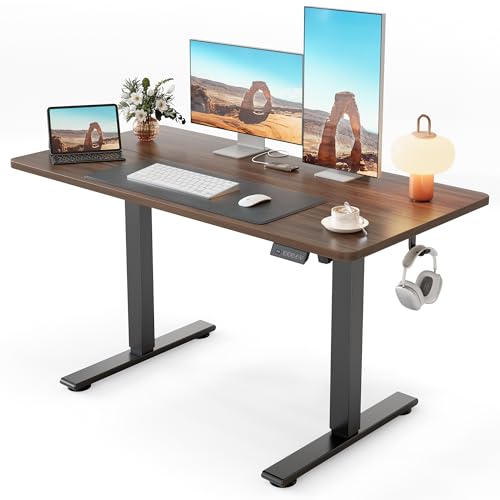
Cubiker Standing Desk, 48×24 Inches Sit Stand Home Office Desk, Electric Stand up Desk — Compact riser
Every guide needs one desk that breaks the pattern, and the Cubiker breaks this one twice: it is the smallest top here at 48 by 24 inches, and it is the only one that moves. An electric sit-stand desk in the everyday class answers the reader whose work space question is really a body question — the back that aches by three, the shoulders that climb toward the ears by five. Alternating posture across the day is the one ergonomic intervention almost everyone agrees on, and the Cubiker brings it to a footprint smaller than the standard 55-inch desks.
The size deserves honest framing. Forty-eight inches holds a monitor and a laptop, or a single generous screen with a notebook beside it; it does not hold the sprawling dual-monitor command centre, and its 24-inch depth asks monitors to sit at the back edge where they belong. For the laptop-plus-screen worker, the student with a standing habit, or the small flat whose desk corner is genuinely tiny, the trade is right: posture variety in exchange for sprawl the room never had.
Storage and power go unmentioned in the title, so the Cubiker’s owner furnishes those separately — a wall shelf above the desk is the natural partner, since it does not move when the desk rises, and a cable run with planned slack for the desk’s travel. That slack is the one installation detail standing desks demand: cables sized for the desk at its highest, so nothing snatches when it rises. Do that once, and the desk’s daily movement becomes invisible infrastructure.
Judged as an everyday desk, the Cubiker is the specialist of the group: fewer inches, no shelves, one remarkable ability. If your body has been filing complaints about your current desk, this is the pick that answers them.
The Cubiker also suits a particular season of life: the first flat, the new job, the body still young enough to believe posture is optional and wise enough to have started doubting it. A compact electric desk bought then teaches the standing habit while the habit is cheap to learn, and its small footprint moves house easily when the season changes. Buyers should simply know they are choosing a desk for the setup they have — one screen, one laptop, one person — and that a future of dual monitors will mean a future desk as well. Chosen with that honesty, the Cubiker is not the small option; it is the right-sized one.
- Listed size: 48 x 24 inches
- Type: electric sit-stand desk
- Storage shelves: Not stated in the listing title — verify with Cubiker documentation
- Power outlet: Not stated in the listing title — verify with Cubiker documentation
- Motor details: Not stated in the listing title — verify with Cubiker documentation
Strengths
- Only electric sit-stand option in the everyday class here.
- Compact 48-inch footprint fits corners the 55-inch desks cannot.
- Posture variety addresses the body’s complaints directly.
Trade-offs
- Smallest surface; dual-monitor sprawl will not fit.
- No storage is named, so shelves must be added separately.
- Cables need planned slack for the desk’s travel.
Best for: a compact work space whose owner wants to alternate sitting and standing daily.
Not suited for: a two-monitor setup with a printer that must all live on the top.

DlandHome 47 inches Medium Computer Desk for Bedroom, Retro — Bedroom retro
The DlandHome is the only desk here that names its room: the bedroom. At 47 inches, medium in its own title’s words, in a retro style, it is designed for the household reality that the spare room is a bedroom first — where the desk must host a computer without turning the room into an office that someone sleeps in. Retro styling is the instrument of that diplomacy: a desk that looks like a piece of bedroom furniture from an earlier, warmer era lets the room keep its identity after the laptop closes.
Forty-seven inches in a bedroom buys a focused station: a monitor or a laptop, a lamp, a notebook, the current book. It will not host the household’s printer, the filing and the second screen, and it does not pretend to. The bedroom desk’s job is narrower and more honourable — a place for the evening’s work, the morning’s emails, the letter that needs writing — and a compact, handsome desk performs it without annexing the room. Students in family homes and anyone whose work corner shares their sleeping space will recognise the brief exactly.
The title names no shelves, drawers or power, so storage expectations should be set by the room’s other furniture: the desk is a surface with a manner, and the wardrobe and chest of drawers carry the storage load. That division suits a bedroom, where too much office storage creeping in is precisely what the retro styling is holding at bay. Verify the listing for any storage the photographs suggest rather than assuming it.
As the guide’s closing pick, the DlandHome makes the case for restraint: the right desk for a room is sometimes the one that asks least of it. If your work space must live inside a bedroom and leave the bedroom intact, this is your desk.
- Listed size: 47 inches
- Intended room in title: Bedroom
- Style named in title: Retro
- Storage shelves or drawers: Not stated in the listing title — verify with DlandHome documentation
- Power outlet: Not stated in the listing title — verify with DlandHome documentation
Strengths
- Bedroom-first design keeps a sleeping room’s identity intact.
- Retro styling dresses as furniture rather than office equipment.
- Compact 47-inch size fits corners other desks in this guide cannot.
Trade-offs
- No storage is named; the room’s furniture must carry that load.
- One focused station only; no room for printer and second screen.
- No power is claimed in the title.
Best for: a bedroom that hosts a focused work station without becoming an office.
Not suited for: the household’s main administrative desk with filing, printer and dual screens.
How Do the Six Compare as Everyday Desks?
| Desk | Listed size | Storage idea | Power in title |
|---|---|---|---|
| Lufeiya Computer Desk | 55 inches | Shelves | Not stated |
| Aquzee Desk with Hutch | 55 inches | Hutch and shelves | Not stated |
| IRONCK Computer Desk | 55 inches | Shelves | Outlet included |
| Tribesigns Computer Desk | 55 inches | 2 drawers and shelves | Not stated |
| Cubiker Standing Desk | 48 x 24 inches | None stated | Not stated |
| DlandHome Computer Desk | 47 inches | None stated | Not stated |
The table shows a market that has converged: four desks at one size, differentiated by storage philosophy, flanked by a mover and a minimalist. That convergence is useful intelligence. It means the everyday question is no longer how big, but how organised — and the answer is written in your current desk’s failures. If your top is buried, buy shelves or a hutch. If your cables are a thicket, buy the outlet. If your back complains, buy the riser. If your bedroom resents your job, buy the retro. The size, the market has settled for you.
What Makes an Everyday Desk Actually Work?
Three unglamorous things. First, a defined place for the computer’s companions: the notebook, the headset, the charger, the current paperwork. Desks fail not at the centre, where the screen sits in state, but at the edges, where the companions colonise until no working surface remains. Every storage feature in this guide — shelves, hutch, drawers — is an attempt to give the companions addresses, and the right choice is whichever matches the companions you actually own.
Second, cable sanity. One power source, leads of honest length, nothing trailing across the floor to the chair’s castors. The IRONCK builds the answer in; the others need a strip fixed somewhere deliberate — under the rear edge, in a shelf basket — rather than dropped behind the desk to breed with the dust. Third, a chair that fits the desk’s height and your body, because the everyday desk is a system of two objects and the chair is the one your spine grades. Buy them as a pair in your planning even if they arrive months apart.
How Do You Set Up a Work Space That Stays Tidy?
Zone the top on day one and defend the zones. The centre belongs to the screen and keyboard. One side is the active zone: today’s notebook, today’s document, nothing older. The other side is the landing zone, deliberately small — a tray, a stand, a defined rectangle — where arriving items may pause for a day and no longer. Storage absorbs everything else: shelves for the reference life, drawers for the small life, the hutch for the book life. Tidiness systems fail when a category of object has no assigned home; they succeed when every object can be put away in under ten seconds without a decision.
Then keep a two-minute closing ritual. Companions back to their addresses, landing zone emptied to the tray, top wiped of the day’s rings. The ritual is the difference between a work space that resets nightly and one that archaeology could date by its strata. Everyday desks are not maintained by occasional purges; they are maintained by never letting a day end in debt. The ritual also protects the work itself: a desk reset nightly is a desk whose morning starts with the task, not with archaeology, and across a year those reclaimed mornings add up to whole extra days of unhurried, well-begun work that nobody had to schedule.
What Mistakes Do Everyday Desk Buyers Make?
The first is buying the photograph’s size rather than the room’s: a desk that fits the wall but leaves the chair no room to roll is a desk resented daily. The second is ignoring the companions — choosing a bare top for a life full of books, printers and paperwork, then storing them on the floor in a widening gyre. The third is forgetting power until the desk is against the wall, after which the power strip’s home is wherever it fell.
Fourth is the chair afterthought: the desk budget spent, the kitchen chair conscripted, the back invoicing its owner by October. And fifth is buying for a fantasy workflow — the minimalist desk for the maximalist worker, the vast desk for the laptop minimalist. The everyday desk’s whole virtue is fit between the object and the life, and the life, examined honestly for one week, will tell you exactly which of these six it needs.
How Does an Everyday Desk Handle Homework and Study?
In most houses the work desk moonlights as the study desk, and the moonlighting has requirements of its own. A student needs the textbook open beside the laptop, a lamp that lights the page without glaring the screen, and enough elbow room for handwriting — a posture that uses the desk differently from typing, spreading wider and leaning in. The 55-inch shelved desks handle the rotation gracefully: books live on the shelves between sessions, the top clears for the evening’s subject, and the same chair serves the parent’s morning emails and the child’s evening revision without either feeling like a guest.
The hutch deserves a study-specific word. Generations of students worked inside hutch desks because the nook works: reference books at eye level, the dictionary where a hand finds it without looking, distractions fenced out by the frame. If the desk’s second job is serious study — exams ahead, a degree in progress — the Aquzee’s shape is not nostalgia but equipment. Conversely, the DlandHome’s bedroom restraint suits the lighter study load, the occasional essay rather than the nightly campaign.
What If Two People Share the Everyday Desk in Shifts?
Shift-sharing is the everyday desk’s most common real arrangement and its least discussed. The morning person and the evening person each need the desk to become theirs quickly and become neutral again just as quickly. Storage is what makes the neutrality possible: a shelf or a drawer per person, however small, plus one shared zone for the household’s business. The Tribesigns’ two drawers practically draw that map unasked — one each — while the shelved desks divide by shelf instead.
The handover ritual matters more than the furniture: two minutes, surface cleared to the shared minimum, the next user’s things untouched. Households that keep the ritual find a shared desk cheaper and warmer than two desks in two cold corners. Households that skip it discover the desk becoming one person’s territory with a resentful tenant. Choose the desk whose storage divides most naturally for your pair, and let the ritual do the rest.
How Should You Light an Everyday Work Space?
Light is the work space feature nobody lists and everybody feels. The desk’s lamp should light the paper without reflecting in the screen, which usually means placing it to the side opposite your writing hand, slightly behind the screen’s plane. In a bedroom, the DlandHome’s lamp doubles as the room’s evening signal, and a warm bulb keeps the work corner from interrogating the bed. In a living-room corner, a shaded lamp contains the working light so the room’s other life can proceed in peace.
Daylight deserves the same planning. A desk facing a window invites glare and the squint that becomes a headache by three; a desk with the window to its side takes the light across the work kindly. If the only corner puts the window behind the screen, a sheer curtain is not décor but equipment. Spend the lamp-and-curtain thought before the desk arrives, because the corner that needs both is usually obvious the moment you sit in it — and by then the furniture is already arranged around the mistake.
Where in the Room Should the Everyday Desk Stand?
Placement decides more of an everyday desk’s success than its specification does. The classic corner by a window flatters the worker and fights the screen; the wall beside the window is usually the wiser seat, taking light from the side. In a living room, give the desk the wall that lets its user sit with their back to the room’s calmest view, so video calls get a composed background and the worker is not performing for the sofa. In a bedroom, the DlandHome’s corner should be the one furthest from the bed’s head, a small geography of mercy that keeps work’s glow and clutter at the room’s far end.
Sockets vote too, and their vote is binding. An everyday desk belongs within one honest cable length of power and, if the router matters to your work, within kind range of it. Extension leads across a room are how tidy intentions die. Walk the room with the tape measure and the socket map before ordering, and let the desk’s final position be chosen by light, background and power together — the three landlords every work space actually answers to.
How Long Should an Everyday Desk Last, and What Ages First?
A modest desk, honestly used, should serve a decade, and what ages is rarely the top. Drawers’ runners loosen, shelf fixings work at their holes, the feet scuff the floor’s finish in a small autobiography of the desk’s life. A ten-minute tightening tour twice a year — runners, fixings, feet — keeps a sound desk sound, and felt pads under the feet from day one protect both the floor and the desk’s dignity when it is dragged rather than lifted.
The deeper ageing is functional rather than mechanical: households outgrow desks when their companions multiply — the second screen, the printer, the filing that arrived with a mortgage. This is the final argument for buying storage with headroom: the Aquzee’s hutch and the shelved desks absorb a household’s growth for years, while a bare top meets the same growth with nowhere to put it. Choose the desk your life in three years will still fit, and the everyday purchase becomes the rare kind: the one you stop thinking about entirely.
What Does a Child’s First Desk Owe the Household?
Many everyday desks are bought twice in spirit: once for the adult’s work, once for the child’s future. A desk that will be inherited by a teenager should be judged partly as that teenager’s desk — sturdy enough for school years, neutral enough not to embarrass a fourteen-year-old’s taste, and sized for the adult the child is becoming rather than the child they are. The 55-inch desks serve that inheritance well; the DlandHome’s retro charm may or may not survive a teenager’s aesthetic referendum, which is a risk to price in honestly.
Safety and sanity details matter in the inheritance years: cables routed where small hands and chair castors cannot worry them, corners that forgive collisions, a surface that tolerates glue, paint and the chemistry set’s ambitions. The everyday desk that passes through a family — work, homework, first job applications, perhaps a grandparent’s letters — earns a kind of value no specification captures. Buy the desk that can hold all those seasons without looking tired, and it will be the cheapest furniture the house ever owns per year of service.
How Do You Furnish the Rest of the Work Corner?
The desk is the anchor, but the corner is the product. A small rug under the chair defines the work territory on the floor and saves the flooring from castor wear. A shelf or the desk’s own shelves hold the reference life. A plant earns its place out of all proportion to its cost, softening the equipment’s geometry and giving the eye somewhere kind to rest between paragraphs. And a clock — unfashionable, invaluable — lets the worker keep time without inviting the phone’s hundred other invitations onto the desk.
Storage beyond the desk should be bought last, after a month of living with the desk’s own capacity. Households routinely discover that the desk’s shelves were enough, or that the one missing piece is a small cabinet for the printer, or a box for the archive that no desk should hold. Let the lived month write that shopping list. The work corner assembled by evidence feels settled in a way the corner assembled by imagination rarely does, because every object in it answers a need the household actually felt.
How Do You Move an Everyday Desk Without Hating It?
Everyday desks get moved more than their owners predict: the room swap, the new flat, the corner that turned out to face the wrong light. A desk that disassembles into honest pieces and survives reassembly is worth a quiet premium in a renting life. Before ordering, glance at the listing’s assembly story with a mover’s eye — how many pieces, how heavy the largest, whether the shelves and hutch travel as units or as panels. The hutch desks ask the most of a move and give the most storage for it; the plain and compact desks, the Cubiker and DlandHome, are the light travellers.
On moving day, photograph the cable arrangement before unplugging anything, bag the fixings per section rather than in one heroic handful, and keep the desk’s own instructions with the fixings. The household that does these three small things reassembles its work space in the new home in an hour, on the first evening, which is when a moved house most needs one calm, working corner. Furniture that supports that evening is furniture designed for real life rather than for the showroom.
What Is the Everyday Desk’s Place in a Small Home’s Economy?
Step back and the everyday desk is a piece of household infrastructure, closer in spirit to the kitchen table than to the office suite. It is where the household’s administration happens, where its children study, where its members earn and apply and organise. Infrastructure rewards boring virtues: the right size, storage that matches the load, power where the devices are, a chair that respects the back. Every pick in this guide was chosen inside that philosophy, and the differences between them are differences of household, not of quality.
That is also why this guide resists crowning a single winner for everyone. The IRONCK’s outlet is decisive for the device-drowned and irrelevant to the paper household, which needs the Tribesigns’ drawers instead. The Aquzee’s hutch is salvation where floors are full and pointless where a bookcase already stands. Read your own household’s evidence — its clutter, its cables, its rooms, its bodies — and the right desk selects itself from the six with almost no argument left over.
How Do You Know the Desk Is Right After a Month?
Judge at a month, not at a day. The right everyday desk passes three quiet tests by then. The surface test: at the end of an ordinary day, the top holds the work and little else, because everything else has found its shelf, drawer or tray without a decision. The body test: shoulders and back end the day no worse than they began it, the chair and desk having made their peace with your height. The room test: the corner looks like part of the home rather than an occupation of it, and nobody in the house is negotiating with the desk’s presence.
If one test fails, fix that one thing — a shelf, a lamp, a drawer box, a chair — before blaming the desk. Everyday work spaces converge by small corrections, and the household that iterates kindly ends with a corner so fitted to its life that guests assume it was professionally planned. It was not; it was lived into shape, which is better. Keep the month’s lessons somewhere written — a note in the desk’s own drawer serves nicely — because the next furniture decision, whenever it comes, will go better for having this one’s evidence on paper rather than in fading memory.
What Should Happen in the First Evening With the New Desk?
Assemble it where it will live, sit at it before any equipment arrives, and spend ten unhurried minutes doing nothing but noticing: the light at that hour, the view, the sounds of the house, the feel of the surface under your forearms. That small ceremony is not sentimentality; it is calibration. The desk placed and first sat at attentively gets its lamp, its chair height and its zones arranged by evidence from the first day, rather than by a fortnight of accumulating annoyances. Then bring the computer, route the cables once and properly, and let the work begin in a corner that already feels like yours.
Final Recommendation
Start with the IRONCK if cables and charging are your current chaos, since its outlet and shelves answer the everyday brief most completely. Choose the Aquzee when storage must climb because the floor is spoken for, the Tribesigns when clutter needs drawers to disappear into, and the Lufeiya as the shelved all-rounder that forgives an undecided household. The Cubiker is the body’s pick, the DlandHome the bedroom’s. Measure the corner, count the companions, and buy the organisation your ordinary Tuesday actually needs — because an everyday desk chosen honestly disappears into the work, and the work, at last, is the only thing on it — which is the whole, unglamorous glory of the right desk: nobody praises it, nobody notices it, and everything the household needs to do simply gets done on it, day after ordinary day.
Frequently Asked Questions
Is 55 inches enough for a computer and paperwork?
For one person, yes: a monitor, a keyboard and an open notebook fit comfortably, which is why four of this guide’s six desks converge on that size. The fifty-five inches also leave a margin for the day’s extras — a mug with somewhere safe to stand, a phone face-down beyond the keyboard’s reach, a letter opened and read without shuffling the whole surface — and that margin, more than the headline number, is what makes the size feel generous rather than merely sufficient. Add a printer or a second monitor and the same 55 inches starts negotiating, at which point shelves or a hutch stop being storage and become survival.
Which of these desks has a power outlet?
Only the IRONCK names one in its title. The other five titles stay silent about built-in power, so plan a power strip with a deliberate home — fixed under the rear edge or in a basket on a low shelf — for any of them.
Hutch or shelves: which stores more?
The Aquzee’s hutch stores the most in the desk’s own footprint because it uses the vertical space above the top as well as beside it. Open shelves, as on the Lufeiya and IRONCK, are easier to reach and reconfigure. The Tribesigns adds drawers, which store less volume but hide it.
Can a 47 or 48 inch desk be a real work space?
Yes, for a focused setup: one screen, a keyboard and a notebook. The Cubiker adds sit-stand movement at 48 inches, and the DlandHome serves a bedroom station at 47. What the compact desks cannot do is host a printer, a second screen and the household filing all at once.
Can an everyday desk double as a dining or craft surface?
In small homes it often must, and the desks that double best are the ones whose storage lets the work clear away completely: drawers and shelves that swallow the day’s kit in minutes, leaving an honest empty top. The Tribesigns and Lufeiya change jobs fastest for that reason. Protect the top during craft work with a mat, and let the rule be absolute — the desk returns to empty before either job begins, so neither inherits the other’s mess.
What else should I budget for besides the desk?
A chair that fits your body, a lamp for the working hours after dark, and the small kit of cable management — a strip, clips and honest-length leads. The desk is the largest purchase in a work space, but the chair is the one your back will grade, so plan them together. Add a lamp that lights paper without glaring the screen, and the work space is functionally complete; everything bought after that is refinement, and refinement can wait for the evidence of a month’s real use.
Related Guides
Round out the room with our guides to dark wood L shaped desks, music studio desks for small spaces, and glass topped corner desks.
Related guides
- Best Enterprise SATA SSDs: Endurance Classes, Power-Loss Protection and Fleet Sense
- Best Color Product Label Printers: Six Desktop Machines for Short-Run Product Labels
- Best 1440p 165Hz Monitors: One Native 165Hz Pick, Three 180Hz Upgrades, an Overclock Headline and a 160Hz Ultrawide
- Best 13×19 Professional Printers


