Our Top Picks
 Amazon Basics Rechargeable Battery Charger for AA &1 Count (Pack of 1)4.5 x 2.75 x 1.5 inches0.23 poundsCheck on Amazon



What's inside
- What a solar AAA charging kit actually is
- The AAA NiMH cell: capacity, voltage, and what charging means
- Reading a panel rating without being misled by it
- The charge-time arithmetic, worked honestly
- Panel formats: rigid, folding, and pocket-sized
- The buffer battery: the component that fixes solar intermittency
- The charger dock: where most of the intelligence lives
- Cloud, shade, and the honest meaning of a bad day
- Matching the kit to the job: lanterns, remotes, headlamps, and outages
- The physical limits no kit can negotiate with
- Cell care: getting years out of a small investment
- A buying checklist grounded in the arithmetic
- Common mistakes that make good kits look bad
- Planning a household rotation across the seasons
- Safety, standards, and the limits of cheap electronics
- Check prices on Amazon
- Disclosure
As an Amazon Associate I earn from qualifying purchases. This post may contain affiliate links at no extra cost to you.
What a solar AAA charging kit actually is
A solar kit for recharging AAA batteries is not a single device but a small chain of components, and the quality of the result depends on every link in that chain. At the front sits a photovoltaic panel that converts sunlight into direct current electricity. Behind the panel sits some form of regulation, because raw panel output rises and falls with every passing cloud. Behind the regulator sits a charger dock with slots sized for AA and AAA cells, and inside those slots sits nickel-metal hydride chemistry that stores the energy for later use. When a product listing describes a kit, it may bundle all four elements together, or it may pair a folding USB panel with a separate USB-powered charger, and understanding which arrangement you are looking at matters more than any headline wattage figure.
The most common modern arrangement uses a folding panel with a regulated 5 volt USB output, exactly like the output of a phone charger, feeding a compact charger dock that accepts USB input. This design has become dominant for a practical reason: USB regulation is mature, inexpensive, and safe, and it lets the same panel charge a phone or a power bank when the battery dock is not connected. Older and simpler kits connect a small rigid panel more directly to a basic dock, sometimes with nothing more than a blocking diode between them. Those direct kits work in strong sun but behave unpredictably in weak light, because the panel voltage can sag below the level the cells need or spike above the level the dock expects. For a buyer comparing options, the regulated USB design is the more forgiving starting point.
It helps to set expectations before going further. A typical AAA rechargeable cell stores roughly one watt-hour of energy. That is a tiny amount compared with a phone battery, which commonly stores fifteen watt-hours or more, and it is the reason solar charging of AAA cells is genuinely practical while solar charging of a laptop from a pocket panel is not. Four AAA cells hold about four watt-hours in total. A modest panel producing five real watts in good sun can therefore refill a set of four cells in a few hours of decent light, even after conversion losses. The arithmetic is friendly at this scale, and most of this guide is about doing that arithmetic honestly, with real sunlight figures rather than laboratory ratings.
The jobs these kits serve are equally modest and equally real. AAA cells power camping lanterns, television and streaming remotes, headlamps, wireless mice, small radios, bathroom scales, LED candles, string lights, and the toys that seem to consume batteries at an alarming rate in any household with children. None of these devices is life-critical, but together they create a steady background demand for fresh cells. A solar kit turns that demand into a slow, free trickle of energy collected on a windowsill, a balcony, or a campsite table, and it keeps a stock of charged cells ready when the grid goes down and the lantern suddenly matters very much indeed.
The AAA NiMH cell: capacity, voltage, and what charging means
Almost every rechargeable AAA cell sold today uses nickel-metal hydride chemistry, usually shortened to NiMH. A standard NiMH AAA cell carries a rated capacity between 800 and 1,100 milliamp-hours, with low-self-discharge variants usually sitting between 750 and 950 milliamp-hours and higher-capacity standard variants reaching toward the top of the range. The nominal voltage is 1.2 volts, lower than the 1.5 volts of a disposable alkaline AAA, and a freshly charged cell actually leaves the charger at around 1.4 volts before settling toward 1.25 to 1.3 volts under light load. Devices designed for alkaline cells almost always tolerate this lower voltage without complaint, although battery gauges calibrated for alkaline discharge curves may report a NiMH cell as partially empty when it is not.
Capacity in milliamp-hours converts into energy with one multiplication. An 800 milliamp-hour cell at 1.2 volts stores 0.96 watt-hours, and an 1,100 milliamp-hour cell stores about 1.32 watt-hours. Charging, however, is never perfectly efficient. NiMH charging converts roughly 70 to 80 percent of the incoming electrical energy into stored chemical energy, with the remainder leaving as heat, especially near the end of the charge when the cell is nearly full. A realistic planning figure is that refilling an empty 900 milliamp-hour cell requires about 1.3 to 1.4 watt-hours of input energy. Multiply by four cells and a full dock needs roughly five and a half watt-hours delivered to the charger, before counting the losses inside the charger itself.
Charge rate is the other half of the picture. Manufacturers describe rates relative to capacity, so a 900 milliamp-hour cell charged at 450 milliamps is charging at 0.5C, and the same cell at 90 milliamps is charging at 0.1C, the gentle overnight rate used by simple timer chargers. Solar power naturally pushes a system toward the slower end of this scale, because panel output is limited and variable. That is not a defect. NiMH cells tolerate slow charging gracefully, generate little heat at low rates, and suffer far less stress than they do in aggressive one-hour fast chargers. The real risk at very low currents is different: smart chargers that detect a full cell by watching for a small voltage dip may miss that signal at very low rates, which is why timer backstops and temperature awareness still matter in a solar dock.
Self-discharge shapes how a solar household should manage its stock. Conventional NiMH cells can lose one percent or more of their charge per day when stored warm, which means a cell charged in a sunny week may be noticeably depleted a month later. Low-self-discharge cells, the type sold pre-charged and ready to use, retain most of their charge for many months and are the sensible choice for emergency lanterns and remotes that sip power slowly. For a solar rotation, the practical routine is simple: keep two sets per important device, one in service and one resting in or near the dock, and swap them on a schedule rather than waiting for a device to die at an inconvenient moment.
Reading a panel rating without being misled by it
Every solar panel carries a wattage rating, and every wattage rating is measured under standard test conditions that real weather rarely reproduces. Those conditions specify irradiance of 1,000 watts per square metre, a cell temperature of 25 degrees Celsius, and a defined spectrum of light. Irradiance is the power of sunlight arriving on a surface, and 1,000 watts per square metre corresponds to strong midday sun in clear air with the panel facing the sun squarely. A panel rated at 10 watts will deliver close to 10 watts only when all of those conditions coincide. Tilt the panel away from the sun, warm it up on a hot surface, put window glass or thin cloud between it and the sky, and the output falls, sometimes dramatically.
Physical size sets a hard ceiling that no marketing can repeal. Mainstream monocrystalline panels convert roughly 20 to 23 percent of incoming irradiance into electricity. At 1,000 watts per square metre, a panel with a tenth of a square metre of active cell area therefore produces around 20 watts at the very best, and small consumer panels are often less efficient than that figure suggests because frames, spacing, and less expensive cells eat into the active area. When a pocket-sized panel claims an output that would require efficiency beyond what the physics of its surface area allows, the claim is describing something else, perhaps the combined rating of a battery inside the product or a theoretical figure under conditions that never occur outdoors. Measuring a panel by its dimensions is the oldest sanity check in solar power, and it still works.
Temperature quietly taxes every panel. As photovoltaic cells heat up, their voltage falls, and a typical panel loses roughly 0.4 percent of its output for every degree Celsius above the 25 degree test temperature. A dark folding panel lying on hot tarmac in summer can easily reach 55 or 60 degrees at the cell surface, surrendering 12 to 14 percent of its rated output to heat alone. Airflow helps, which is one reason a panel propped at an angle on a stand often outperforms the same panel lying flat on a hot surface even before the angle itself is considered. Winter reverses this effect: cold cells are efficient cells, and a crisp clear January noon can produce surprisingly strong output per unit of sunlight, even though the day offers far fewer hours of it.
Angle and orientation decide how much of the available irradiance the panel actually intercepts. Sunlight arriving at a shallow angle spreads across the panel surface less effectively, following a cosine relationship: a panel tilted 60 degrees away from direct alignment collects about half the irradiance of a perfectly aligned one. In northern temperate latitudes, a fixed panel tilted roughly at the local latitude angle and facing south captures a good annual average. For a portable kit moved by hand, the practical rule is simpler: face the panel toward the sun, tilt it so the surface looks directly at the solar disc, and adjust it two or three times during a long charging session. Each adjustment is worth more than a small difference in rated wattage between two competing panels.
The charge-time arithmetic, worked honestly
With the cell figures and the panel figures in hand, charge time becomes a division problem rather than a guessing game. Start with the energy the dock must receive. Four empty 900 milliamp-hour AAA cells need about five and a half watt-hours at the charger input, as calculated above. Now estimate what the panel truly delivers. Take a folding panel rated at 14 watts. In strong midday sun, well aimed and reasonably cool, it might sustain 10 to 11 watts at its USB output after regulation losses. Divide 5.5 watt-hours by 10 watts and the answer is a little over half an hour, which sounds wonderful and is also misleading, because a charger dock rarely accepts energy that quickly, and the sun rarely holds still at midday strength for the whole session.
The dock imposes its own ceiling. A typical USB-powered AA and AAA charger draws at most 5 volts at 2 amps, which is 10 watts shared across all its bays, and many smaller docks draw only 5 watts in total. Spread across four bays, 5 watts means each cell receives a gentle rate well suited to NiMH health but incapable of sprinting. A realistic expectation for four empty AAA cells on a good dock fed by an adequate panel is three to five hours of solid sunshine. Shrink the panel to a 5 watt rating, delivering perhaps 3.5 real watts, and the same four cells need most of a sunny day, because the panel, not the dock, has become the bottleneck. Grow the panel to 21 or 28 rated watts and the dock ceiling dominates again, so the extra panel area buys consistency in weaker light rather than raw speed at noon.
A worked winter example shows how quickly the picture changes. Suppose a household at a northern latitude receives the equivalent of two peak sun hours on a clear December day, meaning the day delivers the same total energy as two hours at the full 1,000 watts per square metre. A 14 watt rated panel might harvest 20 to 25 watt-hours across that day if it is repositioned a few times and kept clear of shadow. That is still enough energy for three full docks of four AAA cells, with energy to spare. The same panel behind a south-facing window, where ordinary glass and the fixed angle cut output by a third or more, might harvest 12 to 15 watt-hours, which still covers two docks. Winter solar charging of small cells is slow but far from pointless, precisely because the loads are so small.
Summer reverses the constraint. Six or seven peak sun hours are common in dry sunny climates, and even a modest panel harvests far more energy than a single household dock can use in a day. This is the season when a second dock, a larger bay count, or a power bank used as a buffer starts to make sense, because surplus sunlight that is not captured is simply lost. Households that run lanterns nightly at a campsite, or that supply a whole drawer of remotes, game controllers, and headlamps, often find that midsummer production exceeds demand and midwinter production roughly matches it, which is a comfortable balance for cells that can be charged ahead and stored.
Panel formats: rigid, folding, and pocket-sized
Rigid panels in aluminium frames are the oldest format and remain the most durable. A small rigid panel mounted on a shed roof, a balcony rail, or a cabin wall can stay aimed and connected permanently, feeding a dock indoors through a cable run. The glass surface shrugs off rain and hail, the frame resists warping, and the panel asks for nothing except an occasional wipe. The cost of that durability is portability: a framed panel is awkward in a backpack and unhappy about being dropped on rock. For a fixed household backup station, though, rigid is hard to beat, and its stable output suits a charger that dislikes frequent interruptions.
Folding panels dominate the portable market for good reasons. Two to six segments of laminated cells unfold into a respectable area, then fold into a flat package that slides into a pack or a drawer. Kickstands or grommets for hanging from a tent or a branch add aiming options. The weaknesses live at the hinges and the cable junctions, which flex every time the panel is opened and closed, and in the fabric backing, which absorbs moisture if the panel is packed away damp. A folding panel rated between 14 and 28 watts is the natural partner for AAA charging, because it covers the dock ceiling in good light and keeps producing usefully under thin cloud. Larger folding panels aimed at laptops and power stations work perfectly well too, but their extra area mostly buys headroom for other devices.
Pocket panels, the kind built into a power bank case or sold as a single small sheet, deserve a clear-eyed assessment. Their cell area might be a few hundred square centimetres, which physics limits to a handful of watts in perfect sun and far less in ordinary conditions. Connected directly to a dock, such a panel may deliver so little current that a smart charger refuses to start, or starts and stops with every cloud. These panels are not useless; they can maintain a power bank over a long day or top up a single pair of cells on a multi-day hike where every gram counts. They are, however, the wrong tool for a household that expects a full dock of four cells charged reliably by evening. Buyers should match panel area to appetite, and appetite for AAA cells, while small, is not that small.
Owners of larger fixed arrays sometimes ask whether a small kit is even necessary, and the answer touches on voltage rather than power. A rooftop or off-grid array built around 12 volt storage follows different rules from a 5 volt USB dock, and the two meet through regulators and adapters rather than direct connection. Anyone comparing that world with the pocket kits in this guide will find the dedicated comparison of best 12v solar trickle chargers useful, because trickle charging lead-acid storage and charging loose NiMH cells solve different problems with different electronics, even though both begin with the same sunlight.
The buffer battery: the component that fixes solar intermittency
The single most effective upgrade to any solar AAA setup is not a bigger panel but a buffer. A USB power bank placed between the panel and the dock absorbs energy whenever the sun shines and releases it at a steady 5 volts whenever the dock asks. Clouds stop mattering minute to minute. The dock sees the stable input it was designed for, its charge termination logic behaves as its designers intended, and cells can finish charging in the evening from stored energy collected at noon. The panel, for its part, can be left aimed at the best average angle instead of being fussed over, because the buffer smooths every shortfall.
Buffering is not free. Energy passes through two extra conversions, once into the power bank’s lithium cells and once back out to USB, and each conversion keeps roughly 85 to 90 percent of what enters. A round trip therefore returns about 75 to 80 percent of the harvested energy to the dock. Against that loss sits a gain that is harder to quantify but easy to observe: docks fed directly by a variable panel often restart their charge cycles when input collapses, and some simple chargers respond to a restart by beginning their full timer again, which can leave cells undercharged after a day of broken cloud even though the total sunlight was adequate. A buffer converts an unreliable day into a complete charge, and a complete charge at 78 percent efficiency beats an interrupted one at 95 percent.
Sizing the buffer is straightforward. A power bank rated at 10,000 milliamp-hours at its internal 3.7 volts stores about 37 watt-hours, of which perhaps 30 watt-hours are usable at the USB output. That covers five full docks of four AAA cells, which is several days of ordinary household demand held in reserve. Smaller buffers still help; even a compact 5,000 milliamp-hour unit steadies the dock through an afternoon of passing cloud. The buffer also earns its place on dull days by accepting charge from a wall adapter, keeping the AAA rotation alive through a grey week without any change in household routine. In effect the buffer demotes the panel from a real-time power supply to a whenever-available harvester, which is the role small panels perform best.
The charger dock: where most of the intelligence lives
It is tempting to treat the dock as a passive holder, a piece of plastic with springs, but the dock decides how safely and completely each cell is charged. The most important design question is whether each slot is an independent channel. An independent-channel charger monitors and controls every cell separately, so a strong cell and a tired cell can sit side by side and each stops when it alone is full. A paired-channel charger, common in inexpensive docks, charges cells in twos and stops when the pair’s combined behaviour suggests fullness, which guarantees that one cell of the pair is overcharged or the other is undercharged whenever the two differ in age or capacity. Since AAA cells in real households always differ, independent channels are worth insisting on, and the broader landscape of mains-powered designs is covered in the companion guide to best aa and aaa battery chargers, whose channel logic applies unchanged when the power source is a panel instead of a wall socket.
Termination, the decision that a cell is full, is where NiMH charging earns its complexity. The standard smart method watches cell voltage for a tiny drop, called negative delta V, that occurs when a full cell begins converting extra energy into heat. At healthy charge rates this dip is clear and reliable. At the low and fluctuating currents a small panel provides, the dip can be faint or masked by input interruptions, so a well-designed solar-friendly dock layers additional safeguards: a maximum timer that ends the charge regardless, a temperature sensor that pauses a cell growing hot, and a voltage ceiling that catches anomalies the other methods miss. Any one safeguard alone has a failure mode; together they make slow solar charging safe rather than merely possible.
Input behaviour separates docks designed with portable power in mind from docks that merely happen to accept USB. A tolerant dock starts charging at low input current, resumes gracefully after an input collapse, and remembers roughly where each cell was in its cycle. A fussy dock refuses to start below a fixed threshold, treats every cloud as a brand-new charge, and may display a full indication for cells that received only a fraction of their capacity. When a product description mentions solar use, wide input tolerance, or resume behaviour, those phrases describe exactly these traits, and they matter more to real-world results than a small difference in maximum charge rate. Reading dock documentation for termination method, channel independence, and restart behaviour tells a buyer more than the photograph of the plastic shell ever will.
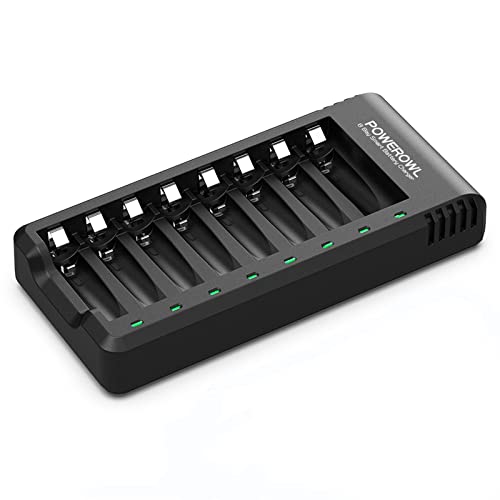
Bay count is a question of household rhythm. Four bays suit a couple of lanterns and a handful of remotes. Eight bays suit a family rotating headlamps, controllers, and toys through a weekly cycle. Households maintaining a serious outage reserve, or supplying a scout group, a rental cabin, or a workshop full of cordless gadgets, eventually look at the sixteen-bay class examined in the guide to best 16 bay battery chargers, where the challenge shifts from charging cells to labelling, rotating, and tracking them. Solar input scales to those larger docks through a buffer rather than through a giant panel, because the dock can draw steadily from stored energy long after the panel has been put away for the night.
Indicators, displays, and knowing what actually happened
A dock’s indicator lights compress a complicated process into a colour, and it pays to know what that colour does and does not promise. A simple two-state light says only that a charge ended, not that it ended for the right reason; a timer expiry and a genuine voltage-based termination can produce the same green light. Docks with per-cell bar displays or percentage estimates give a rougher but more honest picture, showing which cell lagged and which finished early. For solar use, the most informative habit costs nothing: note roughly how much sun a session received, and be suspicious when a dock declares deeply discharged cells full after an implausibly short or heavily overcast session. That suspicion, followed by swapping the cells into service and observing their runtime, teaches a household its own kit’s habits faster than any specification sheet.
Cloud, shade, and the honest meaning of a bad day
Cloud cover reduces irradiance on a sliding scale rather than by a single figure. Thin high cloud may trim output by a fifth, leaving a session mildly slower than planned. Broken cumulus creates the hardest conditions for direct-fed docks, swinging output between near-full and near-nothing every few minutes as shadows cross the panel. Solid overcast under a thick grey deck can cut irradiance to a tenth of its clear-sky value, at which point a 14 watt panel delivers one to two watts and a dock may need the entire day to finish a single set of cells. None of these outcomes represents a broken kit. They represent the atmosphere doing what it does, and the correct response is scheduling: charge ahead on bright days, lean on the buffer during grey ones, and keep the household’s expectations indexed to the sky rather than to the rating printed on the box.
Partial shade deserves special attention because its effect is disproportionate. In many panel constructions the cells are wired in series strings, so shading one small section can throttle the output of the whole string, the way pinching one point of a hose restricts the entire flow. A leaf, a railing shadow, or the edge of a window frame falling across a corner of the panel can therefore halve production even though most of the surface sits in full sun. When output disappoints, the first diagnostic is not the charger or the cells but a slow look at the panel surface for shadows, followed by repositioning so the whole area shares the same light. Angling the panel so that a unavoidable shadow falls evenly and briefly, rather than parked across one corner for hours, also softens the penalty.
Rain itself stops almost nothing electrically, since panels work in wet weather and light still arrives through storm cloud at reduced levels, but water on the surface scatters light and a panel left flat can pool droplets that act as tiny lenses and shades. The greater weather risk is wind moving a lightweight folding panel, changing its aim or folding it onto itself mid-session. A panel that has blown face-down charges nothing at all, and it usually does so silently. Weighing the corners, using the grommets, or propping the panel inside a sheltered frame keeps the harvest going through gusty bright days, which are otherwise among the most productive because moving air cools the cells while the sun shines between clouds.
Matching the kit to the job: lanterns, remotes, headlamps, and outages
Different loads forgive different weaknesses. A television remote draws microamps and runs for a year on a pair of cells, so it forgives everything; even a partially charged standard NiMH cell will serve, although low-self-discharge cells suit it best because the cell’s own leakage, not the remote, decides the service interval. A camping lantern is the opposite personality: it draws real current for hours, exposes weak cells quickly, and is usually needed after dark, when charging is impossible. Lantern duty therefore rewards the buffer strategy and a habit of charging the day before a trip rather than the morning of it. Headlamps sit between the two, sipping on low modes and gulping on high, and they reward carrying one spare charged set in a pocket, a trivial weight penalty for AAA cells.
Outage backup is the use case that justifies the whole exercise for many households. When mains power fails, the devices that matter run on exactly the small cells this guide discusses: lanterns for rooms, a radio for information, headlamps for moving safely, and remotes for everything else. A solar kit sized for ordinary weeks becomes, during an outage, a slow but genuine resupply line that does not depend on shops being open or disposable cells being in stock. The planning rule is to count the household’s outage-critical cells, keep that number charged and stored in the devices plus one full spare set, and let the panel maintain that reserve in normal times so the reserve exists without any last-minute effort when it is needed.
Travel and field use add constraints of weight and fragility rather than power. A folding panel in the 14 to 21 watt class, a four-bay USB dock, and eight cells cover a lantern, a headlamp, and a radio for an indefinite trip in decent weather, at a total weight that disappears into a pack. The discipline that makes it work is unglamorous: charge during lunch stops and in camp each evening from the buffer, rotate cells in fixed sets so they age together, and keep cells and dock dry even when the panel itself gets wet. Kits fail in the field far more often from a crushed dock or a corroded contact than from any shortage of sunlight.
The physical limits no kit can negotiate with
Every solar AAA kit operates inside boundaries set by physics, and recognising them prevents both disappointment and wasted money. The first boundary is solar flux itself: at the Earth’s surface under a clear noon sky, sunlight delivers about a kilowatt per square metre, and no panel of a given size can harvest more than its efficiency share of that flux. A panel the size of a paperback book will therefore never charge like a panel the size of a serving tray, whatever its packaging implies. The second boundary is conversion: panel to regulator to dock to cell chemistry involves at least three efficiency steps, and their combined effect means that roughly half to two-thirds of the energy the panel generates in a session ends up stored in the cells. Planning with a one-half rule, expecting half the naive figure, produces estimates that real days tend to meet or beat.
The third boundary is the cell itself. NiMH chemistry accepts charge eagerly when empty and reluctantly when nearly full, converting a growing share of input into heat as it approaches capacity. This is why the last fifth of a charge takes a disproportionate share of the time, and why a cell that feels distinctly warm in the dock is announcing that it is full or that it is being pushed too hard. It is also why solar trickle rates flatter the chemistry: at a gentle current the acceptance curve stays efficient for longer, and the heat that signals waste and stress barely appears. A household that understands this stops asking why a dock needs four hours to deliver one watt-hour per cell, because the honest answer is that chemistry, not electronics, sets that pace.
Night is the fourth boundary, obvious but worth stating in planning terms. A panel produces nothing for roughly half of every day, and in winter far more than half. Any routine built on solar charging must therefore be a routine built on storage: cells charged yesterday serve tonight, and the buffer carries energy across the dark hours exactly as the cells themselves do. Systems that respect this rhythm feel effortless. Systems that expect the panel to behave like a wall socket, delivering on demand at the moment of need, feel broken even when every component works perfectly.
Cell care: getting years out of a small investment
NiMH cells reward a few simple habits with long service lives. Keep sets together: cells bought together, charged together, and used together age at similar rates, and a matched set prevents the weakest cell in a device from being dragged into damaging deep discharge by its stronger partners. Label sets with a marker or coloured tape, because loose AAA cells in a drawer all look identical while differing enormously in age and health. When a device with several cells dies early, suspect one failed cell rather than the whole set; removing the weak member and re-pairing the survivors extends their usefulness and keeps a bad cell from masquerading as a charger problem.
Heat is the main enemy of stored charge and of cell lifespan. Cells stored in a hot car or on a sunny windowsill beside the panel age quickly, losing capacity that no charger can restore. The panel belongs in the sun; the charged cells belong in a cool drawer. Charging itself should happen out of direct sun where practical, with the dock in shade near the panel rather than baking beside it, because a hot cell accepts charge poorly and its termination signals distort. Cold, by contrast, merely slows cells down: a chilled NiMH cell delivers less capacity until it warms, which is why winter campers carry spares in an inside pocket and why a lantern that seems tired at a freezing dawn may recover by breakfast.
Capacity fades gradually over hundreds of cycles, and the fade announces itself as shorter runtime rather than sudden death. A household rotation makes this easy to spot, because one set begins needing the dock noticeably sooner than its siblings. Retiring tired cells to undemanding duty in remotes squeezes out their remaining value before recycling. What should never enter the dock is a cell that is leaking, dented, rusty at the terminals, or hot at rest; damaged cells belong in a battery recycling stream, not in a charger, and no saving on a replacement cell justifies the risk of a venting incident inside a plastic dock.
Cables, connectors, and the quiet losses between panel and dock
The cable between a panel and a dock looks like the least important part of the system and behaves like a tax collector. USB power travels at only 5 volts, so even modest resistance in a long or thin cable drops a meaningful share of the voltage before it reaches the dock. A drop of half a volt, unremarkable on a long bargain cable, can push a fussy dock below its starting threshold or slow charging across the whole session. Short, thick cables rated for charging rather than for data alone keep this tax small. Connectors matter too: a worn micro-USB plug that wobbles in its socket interrupts power with every vibration, and on a breezy day a panel setup can suffer dozens of silent interruptions that no one notices until the cells come out half charged. Where a kit offers a choice of input ports, the more mechanically secure connector is usually the wiser daily driver.
Readers who also charge cylindrical lithium cells will notice that the dock discipline described here, independent channels, layered termination, honest indicators, has a close parallel in the 18650 world covered by the guide to best 18650 chargers. The chemistries differ sharply in voltage and in the consequences of mistakes, and their chargers must never be interchanged, but the habit of judging a charger by its termination logic rather than its shell is transferable, and it is the habit that separates a reliable charging drawer from a drawer full of mysteries.
A buying checklist grounded in the arithmetic
Start with the panel’s honest credentials: a stated wattage that its physical area can plausibly deliver, monocrystalline cells where the format allows, and a regulated USB output with a stated current rating. Treat any rating that implies efficiency far beyond a fifth to a quarter of the sunlight striking the surface as a claim about something other than the panel. Check that the output specification is given at 5 volts with a current of at least 2 amps for a four-bay dock, because a panel that can only sustain 1 amp will starve the dock even in perfect sun. Look for kickstands, grommets, or other aiming hardware, since the best panel in the world underperforms when it lies flat in its own shadow line.
Judge the dock by its documentation. Independent channels, named termination methods with timer and temperature backstops, tolerance for interrupted input, and per-cell indicators are the four traits that predict satisfaction. Confirm that the dock accepts the input your panel or buffer provides, and that its stated charge current for AAA cells sits in the gentle few-hundred-milliamp region rather than at rates designed for rapid turnaround. Confirm also that AA slots genuinely charge AA cells at a sensible rate rather than merely holding them, since many households run both sizes and a dock that handles both well replaces two devices with one.
Finally, judge the system as a system. Panel, buffer, dock, and cells should be chosen together, with the panel sized to the household’s daily cell consumption, the buffer sized to bridge at least one dull day, and the cell stock sized at two sets per important device. A kit assembled to those proportions, from unremarkable components honestly specified, will outperform a flagship panel paired with a careless dock and a drawer of mismatched elderly cells. The sunlight is free and the physics is fixed; everything else is proportion and habit.
Common mistakes that make good kits look bad
The most frequent mistake is charging behind glass and blaming the panel. Window glass blocks a portion of the ultraviolet and infrared spectrum and reflects a share of the visible light, and the fixed angle of a windowsill rarely matches the sun, so a panel indoors may deliver half or less of its outdoor output. It still works, and for maintaining remotes it may be entirely sufficient, but a household judging a new kit should judge it outdoors first, where the panel can show what it actually does. The second mistake is mixing cells: dropping two fresh cells and two exhausted cells into a four-cell lantern guarantees a short evening, because the device stops when the weakest cell collapses, and repeated episodes of that collapse permanently damage the weak cells through over-discharge.
The third mistake is trusting the first charge. New NiMH cells, and cells that have sat in a drawer for months, often need two or three full cycles before they deliver their rated capacity, a conditioning behaviour documented by every major cell manufacturer. A kit judged on the behaviour of brand-new cells during their first afternoon is being judged at its worst. The fourth mistake is abandoning the dock mid-session repeatedly: pulling cells to check them, reseating them, and moving the panel every few minutes resets timers and confuses termination logic, so the session that felt attentive actually finishes later and less completely than a session left alone. Solar charging rewards a set-it-down temperament more than almost any other household technology.
The fifth mistake is storing the whole system assembled in the sun. A dock left connected to a panel on a windowsill for weeks subjects cells to endless micro-cycles of charge and self-discharge at elevated temperature, the exact conditions that age NiMH fastest. Charged cells should come out of the dock and go into a cool drawer; the panel can stay in the light if it must, but the cells have earned their rest. Households that adopt that one habit routinely report cell stocks lasting years longer than the same cells left baking in a permanently connected dock.
Planning a household rotation across the seasons
A workable annual rhythm follows the light. In spring, audit the cell stock: cycle every set through the dock, note which sets run short in their devices, retire the failures to remote duty or recycling, and standardise on matched sets for the important loads. Through summer, charge opportunistically and often, because energy is abundant and shallow cycles are gentle; this is the season to keep every set near full and the buffer topped up. Autumn is for preparing the outage reserve deliberately, charging the lantern and radio sets, confirming the headlamp spares, and making sure the panel’s storage place is somewhere reachable in the dark. Winter is for patience and positioning: grab the clear hours when they come, lean on the buffer, aim the panel at the low sun with more care than summer ever demands, and accept longer sessions as the normal price of the season.
None of this requires charts or apps, although households that enjoy measurement can learn a great deal from one inexpensive tool: a USB power meter placed between panel and dock. Watching real watts replace rated watts recalibrates every assumption in this guide against local reality, the actual latitude, the actual windows, the actual weather. A week of casual observation teaches more about a specific kit on a specific balcony than any general figure can, because solar charging is ultimately a local practice, shaped by one household’s sky.
That local character is also the honest answer to the question of whether a solar AAA kit is worth owning. For a household that uses a handful of cells a year, it is a pleasant hobby and little more. For a household with children, camping habits, outage anxiety, or a drawer full of hungry devices, it is a small piece of independence that pays for itself in avoided disposables and in the quiet satisfaction of lanterns that light on the darkest night of the year because the brightest days were not wasted. The technology asks only for sunlight, a little arithmetic, and the patience to let both do their work.
Safety, standards, and the limits of cheap electronics
Solar charging operates at gentle voltages and currents, which makes it one of the safer corners of home electronics, but gentle is not the same as risk-free. The hazards concentrate in the cells and in poor-quality docks. A dock with no temperature sensing and no timer backstop can cook a cell that fails to signal fullness, and a cell cooked repeatedly vents electrolyte, corrodes its contacts, and eventually leaks into the device it powers. Buying docks from manufacturers that publish their termination methods, and cells from manufacturers that publish datasheets, is the practical dividing line between equipment that manages these risks and equipment that ignores them. Certification marks from recognised electrical safety schemes add a further layer of assurance for anything that will also connect to mains-derived USB power, as most buffered setups eventually do.
Counterfeit and mislabelled cells deserve a specific warning, because the AAA format is a favourite target. A cell claiming two or three times the capacity that NiMH chemistry can physically fit into an AAA can is claiming the impossible; the genuine ceiling for the format sits near the top of the 800 to 1,100 milliamp-hour range discussed earlier, and anything far beyond it is fiction printed on a wrapper. Such cells are not merely disappointing. Their internal construction is often poor, their self-discharge is rapid, and their behaviour in a charger is unpredictable. Weighing a cell is a crude but effective check, since genuine NiMH AAA cells have a consistent, substantial heft that the emptiest imitations cannot match. The kit philosophy of this guide, honest numbers checked by simple arithmetic, protects buyers here as reliably as it does with panel ratings.
Environmental handling completes the safety picture. NiMH cells contain metals that belong in a recycling stream, not in household waste, and every cell retired from a rotation should travel to a battery collection point. Panels at the end of their life are electronic waste for the same reason. The environmental case for the whole system rests on displacement: each rechargeable cell that serves for hundreds of cycles replaces hundreds of single-use cells, and a kit that is maintained, honestly sized, and kept in service for years delivers that displacement in full, while a kit bought on inflated claims and abandoned in a drawer delivers none of it.
One last proportion is worth fixing in memory, because it summarises the whole guide. A single bright hour at midday is worth roughly three grey hours at the panel, one watt-hour is roughly one AAA cell, and one calm routine of charging ahead, buffering the gaps, and rotating matched sets is worth more than any single specification on any box. Buyers who internalise those three exchanges stop shopping for miracles and start assembling systems, and systems, unlike miracles, keep working season after season.
Check prices on Amazon
Live listings for the shortlist in this guide are pulled from Amazon below, so prices and availability are always current at the moment you look.


Disclosure
Transparency about how this guide is funded belongs in the open: our research draws on manufacturer specifications, published photovoltaic reference data, and charger documentation, and some outbound links on this page are affiliate links, which means the site may earn a commission when a reader buys through them. That commission never changes which specifications are quoted, which limits are stated, or which drawbacks are named, and the arithmetic in this guide is worked from published figures that any reader can check with a pencil. Where a number is an estimate, the guide says so and shows the working, because a charging kit bought on honest expectations is far more likely to still be in use next winter.
Charge on bright days, store cells cool and matched, and the smallest panel on the windowsill will quietly outwork every drawer of disposable batteries it replaces.