Our Top Picks


What's inside
- Why the factory visor runs out of reach
- How the three main designs differ
- Polarized panels versus tinted panels
- Measuring your visor and choosing a mounting style
- Safety boundaries every buyer should respect
- Materials, hinges, and what wears out first
- Matching an extender to real driving patterns
- Installation, adjustment, and the first week of use
- How to read a product listing like an engineer
- Putting the decision together
- The windshield itself: the hidden half of the glare problem
- Seasonal geometry and regional differences
- Comparing extender coverage with other shade options
- Common fitting mistakes and how to avoid them
- A note on price classes without the price tags
- Check prices on Amazon
- Disclosure
As an Amazon Associate I earn from qualifying purchases. This post may contain affiliate links at no extra cost to you.
Why the factory visor runs out of reach
Every production car leaves the factory with a sun visor, yet the most difficult driving light arrives in the narrow band that panel cannot cover. Early morning and late afternoon sun sits low enough to pass beneath the visor edge, across the dashboard, and straight into the drivers eyes. The visor itself is a compromise shaped by storage, not by optics. It must fold flat against the headliner, clear the rearview mirror, house a vanity mirror on many trims, and stay clear of curtain airbag deployment paths along the roof rail. Those packaging demands keep its lower edge high, often 250 to 350 millimetres above the drivers eye point when the seat is set mid-travel.
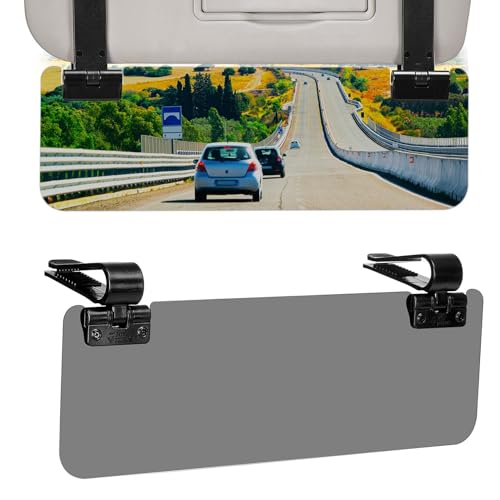
A visor extender exists to close that remaining gap. It attaches to the existing panel and adds a second surface that slides down, flips down, or travels sideways, sometimes combining two of those motions in one housing. The extra surface can be a neutral tinted sheet, a polarized film bonded to a rigid backing, or an opaque flap for the harshest conditions. None of these designs changes the car permanently when chosen well, which is part of their appeal for leased vehicles, shared family cars, and older models whose owners want relief without interior surgery.
Glare deserves more respect than it usually gets in accessory shopping. Bright low sun washes out contrast, and contrast is what lets a driver separate a pale silver car from a bright sky, read a faded lane marking, or spot a pedestrian stepping off a sunlit kerb. Squinting narrows the visual field. Leaning sideways to hide behind the A-pillar distorts posture and steering input. Raising one hand as a shade removes that hand from the wheel entirely. A properly fitted extender restores a shaded band across the eyes while the hands, seat position, and sight lines stay where they belong.
Our research draws on manufacturer specifications, published panel dimensions, and public road safety guidance concerning glare and visibility. That evidence base suits this product category because success here is measurable. Drop length in millimetres, slide travel, clip opening range, panel width, and visible light transmission are printed figures that any buyer can compare against a tape measure held up in their own cabin. This guide leans on those verifiable numbers rather than on styling impressions, and it flags the limits of add-on shading just as plainly as its benefits.
Drivers should also understand what an extender cannot do. It will not clean a pitted windshield, and fine scratches or interior haze scatter low sun far more than a new panel can correct. It will not substitute for sunglasses on a bright midday motorway, where light arrives from many angles at once. It does nothing for glare reflecting off a wet road surface behind the car or for headlight dazzle after dark, and in fact any tinted panel must be retracted at night, a point this guide returns to in detail. Think of the extender as a targeted tool for a specific geometry problem: sun below the visor line, ahead of the car, during the brightest edges of the day.
Vehicle type changes the size of that problem considerably. A low sports coupe places the driver close to the windshield base, so the factory visor covers a relatively generous arc. A tall SUV or pickup puts the eye point higher and farther from the glass, opening a wider unshaded wedge beneath the panel. Vans with upright windshields present yet another angle, since nearly vertical glass admits low sun with little of the filtering effect that a raked screen provides through reflection. Measuring your own cabin, rather than copying a recommendation written for a different vehicle class, is the single most reliable step in this entire purchase.
How the three main designs differ
Sliding panels that drop straight down
The sliding design stores a tinted or polarized sheet inside a slim housing clipped along the bottom of the factory visor. Pulling the exposed tab draws the sheet downward, typically by 90 to 160 millimetres depending on model, and friction rails hold it at intermediate positions. Because the motion is vertical and linear, deployment takes one fingertip and about a second, which matters when a road bends into the sun without warning. The housing adds roughly 12 to 20 millimetres of thickness to the visor stack, a figure worth checking against headliner clearance on cars where the visor already sits close to the roof trim.
Sliders carry two characteristic weaknesses. First, the sheet only shades the rectangle directly in front of the visor, so sun entering at an angle through the side glass escapes it entirely. Second, the friction rails depend on consistent tolerances, and inexpensive rails develop play after repeated heat cycles, letting the sheet creep downward over bumps until it intrudes on the view ahead. Better housings use metal-reinforced rails or detents at set intervals, and product listings that state rail material and rated cycle counts give buyers something concrete to compare beyond photographs.
Flip-down panels on a hinge
A flip-down extender works like a second, smaller visor hinged beneath the first. It rotates through roughly 90 to 120 degrees, swinging from flat storage against the factory panel to a near-vertical working position. The hinged layout often delivers a larger tinted area than a slider of similar class, and many versions add a secondary slide within the flipping frame, combining both motions. Hinge tension is the deciding quality factor. A joint that is too loose sags under its own weight on rough pavement, while one that is too stiff demands a firm two-stage pull that distracts at exactly the wrong moment.
Some flip designs incorporate an opaque section beside the tinted one, letting the driver block a small, intensely bright disc of sun while keeping the surrounding scene visible through the tint. That split layout echoes the way pilots and rally co-drivers manage glare, and it suits routes where the sun sits just above a ridgeline for long stretches. Buyers should confirm the opaque portion can reach the sun side of their usual seating position, because left-hand-drive and right-hand-drive cabins mirror the useful layout.
Side extensions for angled light
The third family addresses a different gap altogether. When a road curves, when the driver turns onto a cross street, or during the long shoulder seasons when the sun tracks far to the south or north, light enters beside the visor rather than below it. Side extensions slide or swing outward toward the centre mirror or toward the A-pillar, adding 70 to 130 millimetres of width. A few products combine a drop panel with a separate side wing in one clip-on unit, though the added hardware raises weight and the number of joints that can loosen over time.
Commuter cabins tend to accumulate several accessories at once, and placement conflicts are worth planning before anything is ordered. A phone running navigation, a dash camera behind the mirror, and an extender wing can all compete for the same few centimetres of windshield header space. Readers organising a tidy cockpit sometimes compare power accessories in parallel, including best 18w car chargers, so that cables, mounts, and shade hardware are planned as one layout instead of colliding one purchase at a time.
Polarized panels versus tinted panels
Polarization and tint solve related problems through different physics, and confusing the two leads to disappointing purchases. A tinted panel simply absorbs a fraction of all light passing through it. If a sheet transmits 35 percent of visible light, then road, sky, signals, and sun are all dimmed to roughly that proportion, and the relative contrast between them barely changes. The benefit is real but blunt: overall brightness falls to a tolerable level, and the eyes relax. A polarized panel instead filters by orientation. Light reflected from horizontal surfaces such as wet asphalt, standing water, bonnets, and other windscreens arrives predominantly horizontally polarized, and a correctly oriented polarizer blocks a large share of that reflected component while passing more of the unpolarized scene light.
In practice, polarized extenders earn their strongest advantage on wet roads after rain, on pale concrete highways, and across water-adjacent routes where reflected glare layers on top of direct sun. Drivers on those routes often describe the difference as the road surface becoming readable again, with lane paint and standing water separating visually instead of merging into one bright sheet. On dry rural roads with little reflective surface ahead, the advantage shrinks, and a good neutral tint performs nearly as well for considerably simpler construction.
Transmission figures deserve careful reading. Manufacturers quote visible light transmission as a single percentage, but that number is measured under standardised illumination and may not reveal how the panel behaves at steep viewing angles. Polarized film in particular loses efficiency when viewed obliquely, so a panel that performs beautifully straight ahead may leak glare at its far edge. Listings that publish transmission at several angles, or that state the polarizing efficiency percentage separately from overall transmission, are giving buyers genuinely useful engineering data rather than marketing shorthand.
Colour behaviour separates the two families further. A quality tint uses a neutral grey dye that dims all wavelengths fairly evenly, preserving the distinction between red, amber, and green signals. Cheaper tints skew brown or green, subtly shifting how signal colours and brake lights register, especially in peripheral vision where colour judgement is already weaker. Polarized panels tend toward neutral grey as well, though some carry a faint warm cast. Either way, any panel that visibly repaints the scene should be rejected, because traffic control devices depend on instant, unambiguous colour recognition.
Combining polarization with polarized sunglasses creates a special case worth knowing before purchase. Two polarizing filters stacked at crossed orientations can block nearly all light, producing dark bands or a completely black patch when the driver tilts their head. Most visor panels orient their film vertically to match typical sunglass orientation, which avoids the worst interference, but head tilts on winding roads can still produce shifting dark zones at the panel edges. Drivers who always wear polarized eyewear should favour either a plain tinted extender or a panel whose maker explicitly addresses sunglass compatibility in its documentation.
Durability also diverges. Tint is usually distributed through the bulk of an acrylic or polycarbonate sheet, so surface scratches do not remove the shading effect, though they still scatter light. Polarization lives in a thin film layer, often laminated between protective sheets, and deep scratches, delamination at the edges, or heat blistering can destroy the filtering effect in patches. Panels that specify hard-coated outer surfaces and sealed film edges will hold their performance longer in a hot cabin, where dashboard-top temperatures in summer sun can push past 70 degrees Celsius on parked afternoons.
Measuring your visor and choosing a mounting style
Fit begins with three measurements taken from the drivers seat with the visor swung down into its working position. First, measure the visors depth from its hinge axis to its lower edge; common values fall between 140 and 190 millimetres. Second, measure its width across the front face, typically 280 to 360 millimetres on passenger cars and wider on trucks. Third, measure thickness at the edge where clips will grip, which ranges from about 8 millimetres on thin vinyl visors to more than 22 millimetres on padded luxury versions with stitched coverings. An extender whose clip range does not span your measured thickness will either rattle loosely or strain its own housing trying to close.
Clip mounting is the most common arrangement. Two or more spring clips pinch the visor edge, usually with rubber or silicone pads protecting the covering material. Spacing matters as much as grip strength. Clips placed 120 to 200 millimetres apart distribute load across the panel and resist the twisting force that appears when the driver pulls a slide tab located off-centre. Single central clips, by contrast, let wide panels rock side to side, and the rocking works the clip loose over weeks. Look for listings that state clip count and spacing rather than describing the mount with adjectives.
Strap mounting suits the exceptions: visors too thick for clips, visors with irregular contours, and visors whose edges carry seams or piping that a clip would crush. Elastic or hook-and-loop straps wrap the full depth of the factory panel, trading a slightly bulkier profile for very secure retention. The trade-off appears at the vanity mirror, which straps may cross, and at visor-mounted garage remote buttons, which straps can press accidentally if routed carelessly. A strap layout that leaves a clear zone of about 40 millimetres around any button cluster avoids the embarrassing scenario of a garage door cycling because the shade shifted in its mount.
Drivers who upgrade several cabin systems at once should think about the visor as shared real estate. Faster power delivery for phones, for instance, often arrives with thicker cables that get routed along the A-pillar and header, exactly where extender wings travel. Planning that routing alongside resources such as best and fastest car chargers keeps cable runs behind trim and away from moving shade hardware, rather than draped across the very gap the extender is meant to cover.
Clearances that are easy to forget
Three clearances decide whether a well-measured extender still annoys daily. The first is mirror clearance: when the factory visor swings toward the side window, a thick extender housing can strike the rearview mirror stem or the mirror housing itself, so swing the visor through its full arc during a trial fitting before committing. The second is headliner clearance in the stored position, where housings adding 15 millimetres or more can scuff roof trim on cars with shallow visor pockets. The third is the vanity mirror cover, which needs roughly 10 millimetres of free space behind the panel to open without dragging across the extender surface.
Passenger-side fitting follows the same rules with one addition. Front passengers sit at varying distances from the glass and often recline further than the driver, which moves their eye point rearward and enlarges the unshaded wedge. A passenger extender with generous drop, around 140 to 160 millimetres, compensates for that reclined geometry. Because passengers face no steering duties, an opaque flip panel is also more acceptable on that side, provided it never crosses into the drivers peripheral field during conversation or when the passenger adjusts it mid-journey.
Safety boundaries every buyer should respect
An extender is a visibility aid, and any configuration that trades one visibility problem for another has failed. The shaded band should cover the sun and a margin around it, but it must not hide overhead traffic signals, hanging signs, or the upper portion of tall vehicles ahead. A practical check is to sit at a familiar signalised junction with the panel deployed and confirm that signals remain visible without ducking when the car stops at the legal stop line, not several metres behind it. If the panel edge crosses the signal at normal stopping distance, the drop is too long for that cabin, regardless of how comfortable the shade feels on open road.
Night driving imposes the clearest hard limit in this category. Any tint or polarizer that helps at sunset subtracts light after dark, when the visual system is already working with far less information. Pedestrians in dark clothing, unlit cyclists, animals at the road edge, and debris all present low-contrast targets that a 35 percent transmission panel renders dramatically harder to detect. The correct habit is absolute: tinted and polarized panels go fully away before dusk driving, in tunnels long enough to require headlights, and in underground car parks. Opaque panels obviously follow the same rule without exception.
Some products try to blur that boundary with yellow or amber night-driving panels marketed as glare reducers for oncoming headlights. Drivers should treat such claims cautiously. A yellow filter does not selectively remove headlight light; it removes blue wavelengths from everything, reducing overall illumination while creating a subjective impression of softness. Road safety organisations have repeatedly cautioned that tinted lenses at night reduce the light reaching the eye, and an extender panel is optically a lens in this respect. The shaded tools in this guide are daytime instruments, and keeping that boundary crisp is part of using them responsibly.
Airbag awareness is the other non-negotiable. Side curtain airbags deploy downward from the roof rail and along the A-pillar, and nothing should be mounted on the pillar trim or wedged between visor and headliner in a way that projects hardware into the cabin during deployment. A correctly fitted extender lives entirely on the factory visor body, within the visors own swing envelope, adding no rigid object outside the space the visor already occupies. If a mounting scheme requires attaching anything to the pillar, the header rail, or the mirror stem, that scheme should be abandoned no matter how secure it feels in a static test.
Legal context varies by jurisdiction, and drivers remain responsible for knowing their local rules. Many regions regulate how much of the windshield may be covered and restrict aftermarket tint films applied to glass, and while a removable visor accessory is a different matter from applied film, an extender left deployed in a way that blocks a substantial portion of the forward view can still attract attention during a traffic stop or inspection. Keeping the panel modest in size, deploying it only against actual glare, and retracting it when conditions change is both the safest and the most defensible pattern of use.
Children, older drivers, and medical light sensitivity
Certain passengers and drivers feel glare more acutely, and their needs adjust the priorities slightly. Older drivers experience increased intraocular light scatter as the lens of the eye changes with age, so a given sun angle produces more disability glare at sixty than at thirty; for them, a polarized panel on wet routes can restore meaningful contrast rather than mere comfort. Drivers with migraine triggered by bright light, or with conditions such as photophobia following eye surgery, often benefit from the opaque flip section that fully occludes the solar disc. Children in rear seats sit outside visor coverage entirely and need window shades rather than anything in this category, a distinction worth stating so the wrong product is not bought for the wrong seat.
Reaction time provides a sobering frame for all of this. At 90 kilometres per hour a car travels 25 metres every second, and even a brief glance away or a moment of glare blindness consumes a large share of the gap to the vehicle ahead. An extender that deploys in one second with one fingertip preserves attention; one that requires hunting for a stiff latch spends that attention at the worst possible time. Deployment effort is therefore a safety specification, not a convenience footnote, and it should weigh as heavily in a decision as panel size or optical type.
Materials, hinges, and what wears out first
Panel material determines how an extender ages under the twin stresses of ultraviolet exposure and cabin heat. Acrylic sheet is optically clear, inexpensive to mould, and moderately scratch-prone; it suits tinted panels where the colour runs through the material. Polycarbonate tolerates impact far better and resists the cracking that can start at clip points on brittle acrylic, but it scratches more readily unless hard-coated, and uncoated polycarbonate can yellow slowly under sustained ultraviolet load. Listings that name the sheet material and its thickness, commonly 1.5 to 3 millimetres for rigid panels, allow a more informed judgement than those describing the surface only as premium or crystal.
Scratches deserve attention out of proportion to their size. A scratch on a shaded panel sits directly in the line of sight, and each fine line scatters incoming sunlight into a faint halo around the sun itself. A panel covered in cleaning scratches can therefore increase veiling glare even while its tint still blocks direct light, an outcome owners often misread as their eyes changing. Prevention is mundane but effective: dust should be lifted with a soft brush or blown off before any cloth touches the surface, cleaning should use a clean microfiber cloth with mild soap solution, and paper towels, which are abrasive at this scale, should never be used. Some household glass cleaners also cloud certain plastics, so care instructions naming approved cleaners are a genuine specification.
Hinges and pivots are where inexpensive extenders usually fail. The joint cycles at least twice on every bright journey, accumulates dust, and operates across a temperature range from below freezing on winter mornings to severe heat in summer parking. Nylon pivots handle that range quietly but can develop slop as the pin bore wears. Metal pin hinges with a friction washer allow tension adjustment on better designs, sometimes via a small screw the owner can snug after a season of use. A stated cycle rating, where published, gives the clearest signal; a hinge rated for tens of thousands of cycles will outlast the car, while an unrated joint on a bargain panel may loosen within a single summer.
Weight quietly governs hinge life and visor behaviour. A complete extender typically weighs between 120 and 280 grams, and that mass hangs on the factory visors own hinge, which was engineered for the visor alone. On older cars with worn visor pivots, even a mid-weight panel can cause the whole assembly to droop toward the windshield over bumps. Owners of high-mileage vehicles should check for existing visor droop before adding any extender, and should favour the lighter end of the range or strap designs that spread load along the panel rather than concentrating it at two clip points near the hinge side.
Edge finishing is a small detail with daily consequences. A rounded edge radius of about 2 millimetres or more will not catch a sleeve, will not feel sharp when the driver reaches up without looking, and will not chip as readily if the panel knocks against the mirror housing. Flame-polished or moulded edges also resist the micro-cracking that starts at rough-cut corners. Photographs rarely reveal edge quality, so buyers should value listings that mention edge treatment explicitly, and should run a fingertip along every edge during the first fitting at home.
Matching an extender to real driving patterns
The east-west commuter
The classic use case is a commute aligned with the suns path: eastbound into sunrise, westbound into sunset, often on the same straight arterial for twenty minutes at a stretch. Here the sun stays near the centre of the windshield, low and relentless, and a straightforward drop panel with generous vertical coverage solves nearly the whole problem. Polarization earns its keep on this pattern during wet months. Side wings add little, because the light rarely arrives at an angle, and money spent on width would be better directed toward hinge quality and a hard-coated surface that survives daily deployment for years.
Winding rural and mountain routes
Routes that twist change the calculation completely. The sun swings across the windshield as the road bends, appearing first below the visor, then beside it, then behind the A-pillar, sometimes within a single minute. A combination unit with both drop and side travel suits this pattern, and deployment speed matters more than maximum coverage, because the shaded zone must be rearranged frequently. Drivers on such roads should also prefer panels with detents or firm friction that hold a chosen position through vibration, since a panel that migrates on washboard gravel becomes one more distraction competing with the road itself.
Professional and high-mileage drivers
Delivery drivers, sales representatives, and tradespeople who effectively live in their vehicles place the heaviest demands on this hardware. Their panels cycle dozens of times daily, share cabins with colleagues of different heights, and must tolerate being adjusted by unfamiliar hands. For this group, replaceable mounting pads, adjustable hinge tension, and the widest stated clip range are the features that translate into service life. A fleet buyer should also standardise on one model across vehicles, so that any driver stepping into any vehicle already knows exactly how the shade deploys without a moment of fumbling.
Cabin electronics interact with shade choices more than first-time buyers expect. A wireless charging mount placed high on the dashboard or windshield places a warm phone directly in the extenders swing path, and repeated contact can knock the phone from its cradle or scuff the panel edge. Reviewing placement guidance such as best car wireless chargers alongside visor measurements helps owners position the phone low enough to stay clear of the shade arc while remaining reachable at stops.
Installation, adjustment, and the first week of use
Fitting an extender correctly takes about ten minutes and repays patience. Begin with the factory visor detached from its retaining clip and swung fully down. Clean the visor edges where clips or straps will sit, because grit trapped under a pad becomes an abrasive that marks the covering every time the assembly vibrates. Attach the mount loosely, centre the housing relative to the drivers seated eye position rather than relative to the visor itself, then tighten progressively, alternating sides the way one would snug wheel fasteners, so the housing seats square instead of cocked.
Adjustment should happen from the normal driving posture, seat set, hands on the wheel, with a helper outside the car confirming what the panel covers. The top of the deployed panel should overlap the bottom edge of the factory visor by a small margin, roughly 10 to 20 millimetres, so no bright slit opens between them when the car pitches over speed bumps. The bottom edge should sit just below eye level at its working position, low enough to intercept sun near the horizon but high enough to leave traffic signals and the tops of large vehicles fully visible at junction distances.
Expect a short adaptation period. For the first few journeys the panel edge sits inside peripheral awareness and can feel intrusive, particularly the vertical edge of a side wing. Most drivers stop noticing the boundary within a week of regular use, much as they stop noticing the mirror housing. If the edge still draws attention after a week, the cause is usually placement rather than sensitivity: shifting the housing 10 millimetres upward or toward the centre of the car often moves the boundary out of the most sensitive part of the visual field.
Seasonal readjustment is normal and worth scheduling mentally. The suns noon altitude shifts by more than 40 degrees between solstices at mid-latitudes, and its rising and setting points migrate along the horizon by a similar magnitude. A panel position perfected in June may leave a gap in December, when sunrise arrives later, lower, and farther south for northern drivers. A brief check at each equinox, adjusting drop and side position for the new sun path, keeps the setup honest through the year without any new hardware.
Care routines that preserve optical clarity
Maintenance is light but not optional. Once a month, extend the panel fully and inspect both faces against a bright background; haze that is invisible in flat light shows immediately when backlit. Clean with lukewarm water, a drop of mild soap, and a dedicated microfiber cloth kept in a sealed bag so it does not collect grit in the door pocket. Work the slide rails or hinge through their travel after cleaning to confirm nothing has stiffened, and check clip pads for compression set, the permanent flattening that tells you grip force is fading. Replacement pads, where the maker offers them, restore the original hold for a fraction of a new units cost.
Storage habits matter during heat waves. A tinted panel left deployed in a parked car faces the full thermal load of the windshield zone, and repeated exposure at the top of its temperature range accelerates film delamination on polarized models and warps thin tinted sheets. Retracting the panel against the visor, where it sits shaded by the visor body itself, meaningfully reduces that load. Owners in very hot climates should also crack windows or use a windshield shade when parked, measures that protect every plastic component in the header area, not only the extender.
How to read a product listing like an engineer
A trustworthy listing answers specific questions in numbers. It states panel width and drop in millimetres, slide travel where applicable, transmission percentage, clip opening range, total weight, and the materials of sheet, hinge, and mounting pads. It shows the panel deployed and stored, photographed straight-on so proportions can be judged. It names the vehicle dimensions it suits rather than claiming universal fit, a phrase that in this category usually means the maker has not measured anything at all.
Warning signs are equally concrete. Listings that describe brightness reduction only with adjectives, that quote a transmission figure without saying whether it applies to the tinted or the clear portion, or that show the panel only at dramatic angles are withholding the data a buyer needs. Photographs showing the panel covering most of a windshield imply a size that would be unsafe in use. Claims about night use deserve particular scepticism, for the reasons covered earlier: any listing that presents a tinted panel as suitable for darkness is contradicting basic optics, and that contradiction should colour how much trust the rest of its claims receive.
Speaker and audio projects illustrate the same measurement discipline from another corner of the cabin. Owners researching door speaker sizes through guides such as best 6 5 coaxial car speakers already know that a stated diameter means little without mounting depth and cutout dimensions; visor hardware rewards exactly the same habit of reading the full dimensional table before ordering. In both categories, the products that publish complete figures tend to be the products engineered carefully enough to have figures worth publishing.
Returns policy is part of the specification in practice. Because fit depends on the interaction of one specific visor with one specific driver, even a well-measured purchase can disappoint in the small geometry of a particular cabin. A seller who accepts returns on opened accessories acknowledges that reality. Buying from such a seller, fitting the panel carefully without removing protective films until the geometry is confirmed, and keeping packaging for the first week converts an uncertain purchase into a low-risk trial.
Putting the decision together
The selection sequence that emerges from all of this is short enough to write on an index card. Measure the factory visor in depth, width, and edge thickness. Decide whether your glare arrives mainly from ahead, from the side, or both, based on the roads you actually drive at the hours you actually drive them. Choose tint for simple brightness reduction or polarization for routes with strong reflected glare, keeping sunglass compatibility in mind. Confirm clip or strap range against your measured thickness, check mirror and headliner clearances, and plan from the start to retract the panel before dark every single time.
Within that sequence, spend remaining budget on the mechanical parts rather than on extra tinted area. A slightly smaller panel on a firm hinge with clean edges and honest specifications will serve for years, while an oversized sheet on a sagging joint becomes an annoyance that drivers stop deploying, at which point its optical qualities no longer matter. The best extender is ultimately the one that is already in position, adjusted and forgotten, when the road turns into the light.
The windshield itself: the hidden half of the glare problem
No discussion of visor shading is complete without the glass in front of it. A windshield accumulates two kinds of damage that multiply low-sun glare. The first is exterior wear: sand pitting from highway driving, wiper arcs etched by grit dragged under worn blades, and fine scratches from ice scrapers used at impatient angles on winter mornings. Each defect is a tiny lens that bends a portion of the incoming sunlight out of its path and into the drivers eyes as diffuse brightness. The second is interior film, the slow deposit of plasticiser vapour from dashboard materials, cooking-oil aerosols in cars used for food delivery, and simple dust, which forms a haze layer that glows brightly when struck by low sun from ahead.
An extender cannot compensate for either condition, because both scatter light across the entire field rather than admitting it through one blockable band. Drivers who fit a panel and find the improvement smaller than expected should suspect the glass before blaming the accessory. A practical diagnostic takes one minute: on a bright day, view the windshield from outside at a shallow angle while an assistant shines a torch across the inner surface from the opposite side. Wiper arcs and haze patches appear immediately under raking light, and most interior haze yields to a two-stage clean using a cleaning solution followed by a dry microfiber pass in straight, overlapping strokes.
Wiper condition belongs in the same conversation. Blades older than about twelve months typically leave micro-streaks of uncleaned water and road film in their wake, and those streaks dry into glare-scattering lines precisely in the swept area the driver looks through. Replacing blades before winter, keeping the washer reservoir filled with a solution rated for the local temperature range, and lifting blades off the glass during overnight frost all preserve the optical quality that any visor accessory depends on. These are unglamorous interventions, but they address the physics of scatter at its source.
Seasonal geometry and regional differences
The suns path explains why glare complaints cluster in particular months and postcodes. At the equinoxes, sunrise and sunset align almost exactly with east-west roads, so grid-pattern cities experience their worst commuting glare in March and September, when the sun also rises and sets during peak traffic hours. In midwinter at higher latitudes, the sun may never climb above 15 degrees all day, turning every southbound journey into a low-sun journey and making an extender a daily necessity rather than an occasional aid. In midsummer the problem window narrows to the first and last hour of daylight, but those hours coincide with leisure trips on unfamiliar roads, where drivers can least afford degraded visibility.
Altitude and atmosphere modify the picture further. Mountain driving places the sun near ridgelines for extended periods, and the thin, dry air at elevation transmits more direct radiation than humid lowland air, sharpening glare. Coastal routes add reflection from water surfaces that can sit at exactly the angle a polarized panel handles best. Desert regions combine intense direct sun with pale road surfaces and light-coloured terrain that reflects upward into the cabin from below the visor line, a direction no visor product can shade, which is why desert drivers pair an extender with a dashboard mat in dark, non-reflective material to kill the upward bounce.
Snow deserves separate mention because it changes both the light and the road. Fresh snow reflects up to 80 percent or more of incoming sunlight, flooding the cabin from below and from the sides simultaneously, and a bright snowfield under a low sun produces some of the most disabling glare conditions ordinary drivers ever face. A visor extender handles only the direct component from ahead, so snow-country drivers should regard it as one layer among several, alongside quality sunglasses, a clean windshield, and reduced speed, rather than as a complete answer to winter brightness.
Comparing extender coverage with other shade options
Drivers cross-shopping shade solutions will encounter several alternatives, and an honest comparison clarifies where extenders sit. A tinted band applied across the top of the windshield shades only the uppermost portion of glass and does nothing for sun below the visor line, which is the precise zone this guide concerns. Static-cling films on the side windows help with lateral light but cannot move with the sun. A baseball cap shades the eyes from above yet fails equally against low sun and adds a brim that can obstruct the view upward toward signals. Sunglasses remain the most flexible tool of all, travelling with the drivers head, but they dim the whole scene including shaded dashboard instruments, they are forgotten, sat on, and left at home, and some drivers simply dislike wearing them for short trips.
The extenders distinctive contribution is that it blocks light before it reaches the eyes while leaving the rest of the cabin normally lit. Instruments stay readable, passengers stay unshaded unless they choose their own panel, and the device is always in the car, deployed in a second, with nothing to remember at the door. Its immobility relative to the head is the corresponding weakness: leaning forward at a junction moves the eyes out of the shaded band, whereas sunglasses would have moved with the driver. Understanding that trade, rather than expecting any single product to win everywhere, produces the most satisfied owners.
What about factory solutions on newer vehicles?
Some manufacturers have begun answering the same geometry problem at the design stage. Extended factory visors with built-in sliding panels appear on a growing number of models, and a few premium vehicles offer visors that telescope sideways on their mounting rod to cover the gap beside the mirror. These integrated solutions look cleaner than any accessory and move with factory smoothness, but they cannot be retrofitted to the existing fleet, which numbers in the hundreds of millions of vehicles worldwide. For everyone driving those cars and trucks, the clip-on and strap-on designs covered here remain the only route to the same coverage, and their removability is arguably an advantage when the vehicle is sold.
Electrochromatic and photochromic windshield technologies attract periodic attention as a future answer, darkening automatically in response to light. Their response time, measured in tens of seconds to minutes for large glass areas, is poorly matched to a road that swings into the sun in one second, and their cost places them far from the accessory market for the foreseeable future. The humble mechanical panel, instant and inexpensive, will likely remain the practical instrument for low sun long after such technologies mature, in the same way that a physical sunshade still outperforms every electronic alternative in a parked car.
Common fitting mistakes and how to avoid them
The most frequent error is mounting the housing centred on the visor rather than centred on the driver. Visors are wider than the seated eye position requires, and their midpoint often sits several centimetres outboard of where the drivers head actually rests against the head restraint. A panel centred on the visor therefore shades empty space near the A-pillar while leaving a bright slot beside the drivers nose. Sitting in the normal position and marking the visor edge with removable tape at the points directly above each eye gives a far better centring reference than any measurement of the visor alone.
Overtightening strap mounts ranks second. Hook-and-loop and elastic straps need only enough tension to prevent sliding under the panels own weight and deployment forces, which are small. Cranking them tighter bows thin visor cores, dimples soft coverings permanently, and on visors with internal vanity mirror wiring can press against components never designed for sustained load. If a strap mount slips at reasonable tension, the correct response is a wider strap or a thin silicone grip layer beneath it, not more force.
A third mistake is judging the panel indoors. Showroom and garage lighting arrives from above at steep angles, nothing like the near-horizontal assault of real sunrise, and a panel that looks reassuringly dark under ceiling lights may prove far too pale at 8 degrees of sun elevation, or, conversely, a panel that seems barely tinted indoors may be entirely adequate outside. Evaluation drives should happen at the actual problem hour on the actual problem road, with a passenger handling any adjustments so the driver never divides attention during the assessment.
Finally, many owners deploy the panel and leave it deployed all day out of simple inertia. Beyond the night-driving prohibition already covered, a permanently lowered panel narrows the upward field in multi-storey car parks, at steep uphill junctions where the road ahead rises into the shaded zone, and beneath low gantries carrying direction signs. Building the retracting motion into the same habit loop as fastening the seatbelt, shade down when glare appears and away when it passes, keeps the device a responsive tool instead of fixed cabin furniture.
Two-driver households should agree on a shared convention for the same reason. If one driver leaves the panel halfway down and the other sets off at dawn into a dark side street, the first minutes of the journey begin with an obstructed view and an annoyed adjustment at the first junction. A household rule that the panel is always parked fully retracted, like a rule that the seat is left in a neutral position, removes a small but real friction from shared driving and ensures each journey starts from a known, safe configuration.
A note on price classes without the price tags
Because models in this category span a wide spread of asking figures, buyers benefit from understanding what additional money actually purchases rather than hunting for the lowest number on a listing page. At the entry level, the money buys a tinted sheet and a simple clip, and little else: tolerances are loose, edges are plainly cut, and no figures beyond basic dimensions are published. The middle of the market adds hard coatings, metal-reinforced rails or adjustable hinges, stated transmission data, and replacement pads. The upper tier buys documented engineering: polarizing efficiency figures, cycle-rated joints, sealed film edges, and dimensional tables detailed enough to confirm fit before ordering. None of those upgrades changes the fundamental geometry of shading, which is why a modest panel that fits a particular cabin precisely will outperform an expensive one mounted approximately. Spend first on fit, second on mechanism, and only then on optical refinement, and the purchase will track real-world usefulness rather than catalogue drama. Drivers should also budget a few minutes, not money, for the tape-measure work described earlier, since that small investment of attention determines more of the outcome than any feature list printed on a box. Owners who keep the receipt, the dimensional notes, and the makers care instructions together in the glovebox also make warranty questions and replacement pad orders considerably simpler if anything loosens or clouds years later.
Check prices on Amazon
Live listings for the shortlist in this guide are pulled from Amazon below, so prices and availability are always current at the moment you look.


Disclosure
Readers should know that this website may receive affiliate commission when purchases follow outbound links from this guide, and that arrangement has no bearing on the measurements, safety boundaries, or material assessments presented here, which rest on published specifications and established principles of visibility and optics.
Fit the panel to your own visor, retract it before the light fails, and the lowest sun of the year becomes just another part of the road you already know how to drive.