What's inside
- Where to buy
- Key Takeaways
- Quick Picks
- How did we judge beauty in a metal box?
- Where will the case live? The room decides the design
- What size and compatibility checks keep a beautiful case practical?
- How do the best aesthetic PC cases compare side by side?
- How do you build inside a beautiful case without ruining it?
- Which mistakes make beautiful builds ugly by Christmas?
- How should lighting be handled in a case bought for its looks?
- How do real materials age, and what care do they actually need?
- Final Recommendation
- Frequently Asked Questions
- How do you colour-match components to a case with a point of view?
- What should the desk around the case be doing?
- Related Guides
As an Amazon Associate I earn from qualifying purchases. This post may contain affiliate links at no extra cost to you.
gizmoverdict.com is reader-supported. When you buy through links on our site, we may earn an affiliate commission.
Where to buy
The best aesthetic pc cases used to mean one thing — a glass box full of synchronised light — and the phrase has quietly grown up. The most interesting cases of the last few years treat a computer the way furniture designers treat a sideboard: real walnut where a hand might rest, mesh woven like a speaker grille, proportions that let the machine sit in a living room without apologising or glowing at the television. This guide follows that broader definition deliberately. It contains the walnut-fronted Fractal North in both its mesh and glass editions, a Lian Li that wraps genuine wood around a five-fan airflow chassis, a Lian Li that still believes in the light show and does it properly, a be quiet! flagship whose beauty is the beauty of a well-made German appliance, and a Corsair whose modular frame makes minimalism a system rather than a colour. Six cases, at least four distinct theories of what a beautiful computer is — because the reader who wants Scandinavian furniture and the reader who wants a jewel box are both right, and a guide that only serves one of them has not understood its own keyword.
Aesthetics, though, is where case marketing lies most fluently, so our ground rules deserve stating before the photographs seduce anyone. Materials are named precisely in this guide: when a front panel is real walnut, we say so; when a side is tempered glass, we say which side and how it is tinted; when a finish is paint over steel, we do not let the word “premium” smuggle it into the timber yard. Airflow is graded as a property of beauty too, because a case that cooks its components will be opened, propped and eventually replaced — and nothing is less aesthetic than a side panel leaning against the wall beside the desk. Every linked case below was verified in our pool with an official image. What remains is taste, and taste, unlike thermals, cannot be benchmarked — so each pick below argues its own theory of beauty as persuasively as it can, and the comparison section helps you decide which theory your room believes.
Key Takeaways
- Real materials are the new luxury: walnut fronts and woven mesh now outrank another strip of addressable light.
- The Fractal North exists in two editions — mesh side for airflow purists, dark tempered glass for display builds — and they suit different rooms.
- Wood on a case is not automatically a thermal crime: the Lancool 217 pairs walnut accents with five PWM fans and a mesh-first layout.
- Understated is an aesthetic too; be quiet!’s flagship and Corsair’s modular frame serve rooms that banish the light show entirely.
- Decide where the case will live before deciding how it should look — living room, studio desk and gaming den reward different designs.
- Cable discipline is half of every beautiful build; cases with real rear space and grommets make beauty achievable rather than theoretical.
- Judge every design in the least flattering light your own room offers, not in the listing’s studio photograph.
Quick Picks
| Pick | Badge | Why it earns its place |
|---|---|---|
| Fractal Design North (Mesh) | The furniture piece | Real walnut slats over a mesh side panel — the case that made PCs welcome in grown-up living rooms. |
| Fractal Design North Charcoal TG Dark | The display edition | The same walnut front, with a dark-tinted tempered glass side for builders who light their components like exhibits. |
| Lian Li LANCOOL 217 | The wood-clad performer | Walnut accents wrapped around a five-fan, mesh-first airflow chassis — beauty that never asks thermals to apologise. |
| Lian Li LANCOOL 216 RGB | The jewel box, done right | Two enormous ARGB fans behind mesh, a glass side, and airflow credentials the light shows of old never had. |
| be quiet! Silent Base 802 | The appliance aesthetic | Interchangeable silence and airflow panels inside a monolith of German restraint — beauty as absence of noise, visual and acoustic. |
| Corsair 4000D RS Frame | The modular minimalist | A frame-based design that strips, swaps and rebuilds — minimalism you can reconfigure rather than merely admire. |
How did we judge beauty in a metal box?
We judged it the way industrial designers judge anything: materials, proportion, coherence and honesty, in that order, with thermals as a veto rather than a category. Materials first, because a case is touched and seen at arm’s length for years, and the difference between walnut and walnut-effect is the difference between furniture and a photograph of furniture. Proportion next, because the mid-tower’s eternal trap is visual bulk — cases that look athletic in renders and wardrobe-like beside a desk — and the designs below each solve it differently, through slats that break up a facade, through glass that lends lightness, or through sheer monolithic confidence. Coherence means the inside agrees with the outside: a serene exterior hiding a cable rat’s nest behind clear glass fails its own premise, so we weighed rear cable space, grommets and the discipline of each case’s interior layout as aesthetic properties, not conveniences.
A word, too, about what this guide means by a case “suited” to a graphics card generation or a cooling style, since aesthetic shortlists are notorious for hiding incompatibilities behind mood photography. Every pick here is a genuine ATX mid-tower or larger with room for the standard furniture of a modern build — a full-size board, a long card, a tower cooler of normal ambition — and the individual sections flag the exceptions where they live: the North’s modest radiator scope, the 802’s sheer footprint, the 216’s unusual fan size. Beauty that requires a compatibility spreadsheet to survive the build is not beauty; it is a rendering. The six cases below were each checked against the builds their photographs invite.
Honesty is the criterion that eliminated the most candidates. A case that borrows the visual language of mesh while sealing it behind plastic, or that tints its glass so dark the components inside become rumours, is engaged in set design rather than design. The six survivors each commit to their premise — the mesh North really breathes through its side, the glass North really displays, the be quiet! really can be either silent or airy because its panels genuinely interchange, and the Corsair really does come apart into a frame. We also applied the veto without sentiment: any design whose looks depended on suffocating its contents was excluded regardless of its photography, because a beautiful case that owners run with the panel off has failed at the only job that matters. What remains is a short list where every entry can be the best-looking object in its room without making its owner pay for the compliment in degrees.
Where will the case live? The room decides the design
Consider also the household’s other citizens, who did not read this guide and will judge the case by their own criteria. A partner judges by whether the room still feels like theirs at nine in the evening. A cat judges by whether the top panel is warm and whether the front slats invite investigation — walnut survives feline review better than glass, and a top exhaust will be discovered as a heated seat within the week. A toddler judges by reach, which argues for the desk over the floor and for lighting that can be turned fully off. None of these reviewers is wrong, and the cases that thrive for years are the ones whose owners quietly consulted them in advance. Aesthetics, in a lived-in house, is a negotiated settlement — the designs in this guide are simply the ones with the most to offer the negotiation.
Start with the room, because rooms have veto power over cases. A living room shared with people who did not choose the computer rewards the furniture school — walnut, mesh, muted tones, no light after dark except what the television provides — and punishes the jewel box, whose glow reads as one more screen demanding attention. A studio or home office rewards coherence with the desk’s other objects: a case that rhymes with the monitor arm, the speaker fabric and the chair earns its place daily, and either the North’s timber or be quiet!’s monolith can be that rhyme depending on the furniture around them. A dedicated gaming room inverts the living room’s rules entirely; there, light is atmosphere, the glass side is a hearth, and the LANCOOL 216’s great ARGB fans are not showing off — they are decorating, in a room built for exactly that pleasure. None of these contexts is more legitimate than the others, but they are not interchangeable, and the commonest aesthetic regret we hear is a beautiful case bought for a room in the photograph rather than the room in the house.
Light deserves its own sentence in that calculation, because a case is lit twice — once by its own fans and strips, and once by the room’s windows. North-facing daylight flatters matte finishes and real wood grain, and turns dark-tinted glass into a mirror that hides the build it was bought to show. A desk lamp’s warm pool makes walnut glow and makes white cases yellow; direct sun makes every fingerprint on glass a exhibit. Walk the intended spot at the hour the machine will mostly be used, look at what already lives there, and let that honest reconnaissance choose among the theories of beauty below. The case will sit in that light for years. The listing photograph’s light is available to no one.

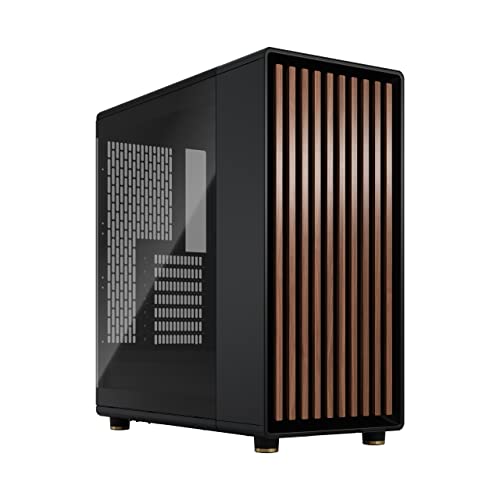
Fractal Design North (Mesh) — The furniture piece
There is a before and after in case design, and this is the after. The North’s front is a grille of real walnut slats — actual timber, with grain that varies from unit to unit the way wood does — set into a chassis whose side, in this edition, is a fine steel mesh rather than glass. The effect in a room is difficult to overstate: the machine stops reading as a computer that has been allowed indoors and starts reading as a piece of audio equipment or furniture that happens to compute. Fractal, a Swedish company, designed it with the discipline of its home tradition — the brass-toned accents are restrained, the proportions are those of a sideboard rather than a tower, and even the power button feels chosen rather than included. Builders pairing it with a desk of similar timber should know the walnut’s tone sits in a warm mid-brown that flatters oak and teak neighbours and argues gently with grey-washed woods.
The mesh edition is the connoisseur’s choice between the two Norths, and not only for thermals — though breathing through its side as well as its front makes it the cooler-running of the pair by a clear margin. Mesh also changes the object’s manners: there is nothing to display, so there is nothing to dust-spotlight, no lighting ecosystem to maintain, and no pressure to make the interior presentable beyond what good building already demands. The interior itself is a conventional, well-mannered Fractal layout — adequate rather than cavernous cable room, drive provision for a sane storage set, and support for full-size graphics cards and respectable air coolers, with radiator ambitions best kept modest. This is not the case for a sprawling custom loop or a storage farm, and it does not pretend otherwise. It is the case for the builder who wants the most beautiful object in the room to also be the quietest personality in it.
- Form factor: ATX mid-tower
- Front: real walnut slats over open intake
- Side panel: steel mesh (this edition)
- Cooling character: breathes through front and side; modest radiator scope
- Interior: conventional Fractal layout, tidy cable routing
- Palette: charcoal chassis with warm timber and brass-toned accents
Strengths
- Real walnut and mesh make it welcome in rooms that banish gaming aesthetics.
- The mesh side delivers the best thermals of the two North editions.
- Nothing to light, sync or maintain — beauty without an ecosystem.
Trade-offs
- Components are hidden, so showcase parts earn nothing here.
- Radiator and storage scope are modest by enthusiast standards.
- Wood grain varies by unit; exact tone matching to furniture is luck.
Best for: living rooms, studios and desks that want a computer disguised as furniture. Not suited for: display builds, big radiators or storage-heavy systems.

Fractal Design North Charcoal TG Dark — The display edition
Same walnut front, same charcoal discipline — and then the side turns to glass, and the case’s whole personality pivots from furniture to vitrine. The tempered glass on this edition is dark-tinted, a choice with real consequences a buyer should choose with open eyes: the tint lends the interior a smoked, gallery quality, muting component colours into a coherent dusk and making modest lighting look expensive, while also demanding that lighting exist — an unlit build behind dark glass is a rumour of a computer. Builders who enjoy the interior as a composition, who choose a cooler for its silhouette and route cables like calligraphy, will find this the most flattering frame Fractal makes. The charcoal chassis deepens the effect; where the mesh edition whispers, this one smoulders.
The honest costs of glass are the usual two, and neither should be waved away. Thermally, a solid glass side cannot breathe, so this edition leans entirely on its front intake and exhaust discipline — entirely adequate for sensible builds, measurably warmer than its mesh sibling for ambitious ones, and a genuine reason to prefer the mesh if the machine renders for a living. Practically, glass is a fingerprint archive and a fragility: it wants microfibre, care during moves, and a desk position where chair arms and vacuum cleaners hold no grudges. What it returns for that care is the thing mesh can never offer — the build itself as the room’s ornament, the walnut’s warmth answered by the interior’s glow. Choose between the Norths by asking which object you want to live with: the sideboard or the display cabinet. Both answers are respectable. Only one of them is yours.
- Format: ATX mid-tower
- Front panel: real walnut slats over open intake
- Side panel: tempered glass, dark tint (this edition)
- Cooling character: front-intake led; warmer than the mesh edition
- Interior: same disciplined Fractal layout, display-ready
- Palette: charcoal with smoked glass and warm timber
Strengths
- Dark glass turns a tidy build into a gallery piece beside the walnut.
- The tint unifies component colours into a single moody composition.
- Shares the mesh edition’s furniture-grade front and proportions.
Trade-offs
- Needs interior lighting to justify the glass at all.
- Runs warmer than the mesh edition under sustained loads.
- Glass collects fingerprints and demands careful handling.
Best for: display builds in living spaces that want warmth rather than spectacle. Not suited for: unlit interiors, heavy sustained rendering, or the fingerprint-averse.
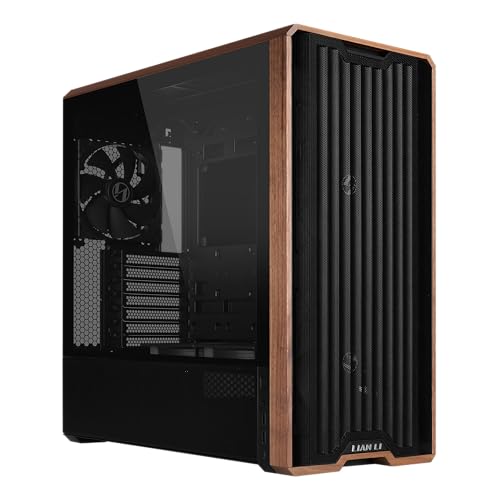
Lian Li LANCOOL 217 — The wood-clad performer
The LANCOOL 217 answers the question the North leaves hanging: what if the wood is beautiful but the build inside is a serious, hot, high-end machine? Lian Li’s answer wraps walnut wood accents around a chassis from its LANCOOL performance line — mesh-first, fan-rich, engineered for airflow before ornament — and ships it with five PWM fans already installed, a count that reads like a misprint beside the two and three-fan norms of aesthetic cases. The wood here is used as trim rather than as the whole facade, grain against black mesh, and the effect is less furniture, more tailored equipment: a performance case that has been to a good tailor. For builders whose aesthetic is “beautiful because it works beautifully”, this is the most convincing object in the guide.
Working beautifully is, in fact, its party trick. The fan complement and open panels give it thermal headroom the furniture-first cases cannot match, so a flagship graphics card and a hot processor can live here without the compromises — open panels, screaming curves, throttled afternoons — that quietly ruin prettier builds. The interior follows LANCOOL’s mature layout thinking, with room for large components and cable routes that respect the builder’s time. Its debits are matters of taste and scale: it is a bigger, more assertive object than the North, its wood is an accent in a composition dominated by mesh and black metal, and buyers seeking the full Scandinavian sideboard illusion will find it too mechanical. But as a demonstration that the aesthetic era and the airflow era are the same era, nothing else in this guide argues as completely. Beauty that sweats nothing is the rarest kind.
- Form factor: ATX mid-tower, performance-leaning
- Front/trim: walnut wood accents over mesh-first panels
- Fans: five PWM fans included
- Cooling character: the strongest airflow story among these picks
- Interior: LANCOOL layout with generous component room
- Palette: black mesh and steel with warm wood trim
Strengths
- Five included PWM fans and mesh panels give flagship-grade cooling.
- Walnut trim lifts it clear of the generic black-box crowd.
- Room for high-end components without thermal apologies.
Trade-offs
- Larger and more assertive than the furniture-first picks.
- Wood is an accent here, not the full facade some buyers want.
- Its performance wardrobe reads technical rather than domestic.
Best for: high-end builds that refuse to choose between beauty and airflow. Not suited for: small desks or rooms wanting the full furniture illusion.

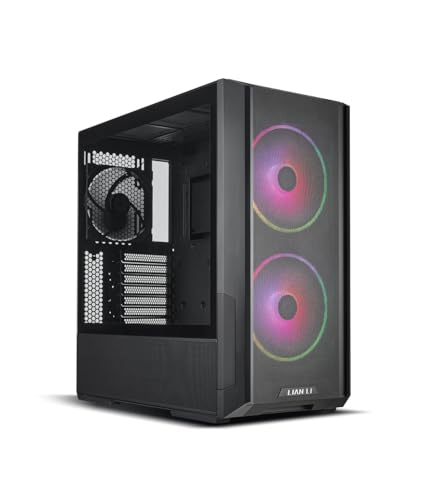
Lian Li LANCOOL 216 RGB — The jewel box, done right
Every aesthetic era needs its maximalist, and the LANCOOL 216 RGB earns the role by refusing the old maximalist sin. The classic light-show case sealed its components behind glass and cooked them for the privilege; this one puts two enormous 160mm ARGB fans behind an open mesh front, so the glow is also the cooling — light you can feel as moving air. The fans’ scale matters aesthetically as much as thermally: two large, slow-turning light sources read as lanterns where a crowd of small fast ones reads as a fairground, giving the 216 a composure most RGB cases never approach. A tempered glass side completes the display premise, and Lian Li’s interior — with its thoughtful motherboard tray arrangement and cable channels — keeps the exhibited side worthy of its window.
The case’s intelligence shows in its adaptability: its airflow layout can be reconfigured for different component priorities, its front fans can be tamed to a static warm colour for weekday respectability, and its mesh means the light show never has to choose between beauty and the graphics card’s wellbeing. Against that, the honest debits of the genre apply undiluted. It is unapologetically a gaming object — in a muted living room it will be the loudest personality present even with the lighting off, because its proportions and glass announce their intentions. The two big fans are proprietary in spirit; replacements should match their size to preserve the look. And a buyer whose taste runs to timber and restraint will find nothing here to argue with except the entire premise. For the gaming room, the streamer’s backdrop and the desk that treats light as décor, this is the aesthetic pick that never has to apologise to a thermometer — and that combination, historically, is rarer than walnut.
- Form factor: ATX mid-tower
- Front: mesh with two 160mm ARGB fans
- Side panel: tempered glass
- Cooling character: high-airflow layout, reconfigurable
- Interior: display-ready with disciplined cable channels
- Palette: black with full-spectrum addressable light
Strengths
- Huge ARGB fans that cool as impressively as they glow.
- Mesh front ends the classic light-show thermal compromise.
- Lighting can be calmed to a single warm tone for everyday use.
Trade-offs
- Unmistakably a gaming object in any room it enters.
- The signature fans are an unusual size to replace like for like.
- Glass side demands a tidy interior to earn its window.
Best for: gaming rooms, streaming backdrops and light-loving display builds. Not suited for: muted living rooms or timber-and-restraint tastes.

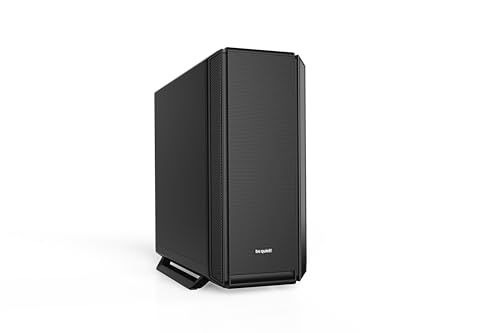
be quiet! Silent Base 802 — The appliance aesthetic
There is a beauty in objects that refuse to perform, and the Silent Base 802 is its PC-case expression: a tall, unbroken monolith from a German company whose entire brand is the absence of annoyance. No glass in its standard presentation, no light, no timber — just surfacing so clean and panel fit so exact that the eye reads quality the way a hand reads a well-made door closing. Its party trick is intellectual rather than visual: the case ships with interchangeable front and top panels, one set tuned for silence with sound-damping material, one set meshed for airflow, so the owner chooses the machine’s character per season or per workload. A case that can change its mind is a genuinely new idea in a category of fixed poses, and it makes the 802 the most grown-up object in this guide.
Inside, the engineering continues the theme — a spacious, modular interior that accommodates serious hardware including generous radiators, decoupled mounting where vibration might travel, and the company’s own quiet fans doing their namesake work. This is the aesthetic pick for the professional whose office hosts clients, the musician whose PC shares a room with microphones, the adult whose gaming happens after the household sleeps. Its costs are presence and price: it is a large case with a flagship’s footprint, its restraint can read as severity beside warmer designs, and buyers who want their build visible will find its standard panels a closed door. But beauty was never only display. Sometimes beauty is the object in the room that never once asks for attention — and by that measure, nothing else here is as beautiful as this.
- Form factor: ATX midi tower, generous proportions
- Panels: interchangeable silent and airflow front/top sets included
- Side panel: solid, sound-damped (standard presentation)
- Cooling character: owner-selectable — silence-first or airflow-first
- Interior: modular, radiator-friendly, vibration-conscious
- Palette: black monolith, near-zero ornament
Strengths
- Swappable panels let one case serve silent and airflow briefs.
- Panel fit and surfacing deliver genuine appliance-grade presence.
- Room for serious hardware and radiators inside the calm exterior.
Trade-offs
- Large footprint and flagship pricing.
- Standard panels hide the build entirely.
- Its severity can feel cold beside wood-fronted rivals.
Best for: client-facing offices, audio rooms and quiet-hours households. Not suited for: display builders or compact desks.

Corsair 4000D RS Frame — The modular minimalist
Corsair’s contribution to the aesthetic conversation is to ask why a case’s looks should be fixed at all. The 4000D Frame takes the beloved 4000D formula — a compact, high-airflow mid-tower with a mesh-led front — and rebuilds it around a modular frame concept, with panels and elements designed to strip, swap and reconfigure as the owner’s taste or hardware changes. It ships with three of Corsair’s RS fans, and its beauty is the beauty of a well-drawn diagram: nothing decorative, every line load-bearing, the whole object reading as engineered rather than styled. In a guide full of strong aesthetic opinions, this is the pick for the builder whose opinion is that they will have several opinions over the case’s life, and would like the case to keep up.
Practically, the modularity pays rent beyond looks. A case that comes apart intelligently is easier to build in, easier to clean — dust being the long-term assassin of every aesthetic build — and easier to adapt when a longer graphics card or a different cooling layout arrives. The 4000D lineage’s airflow manners carry over, so the minimalism is not the sealed-box kind; the front breathes, the interior is a known-good layout, and the RS fans give it a finished, matched starting point rather than a bare chassis awaiting a fan budget. Its limits are the inverse of the North’s: there is no material romance here, no timber or gallery glass moment, and buyers seeking an object with a point of view will find a system instead of a statement. But a system ages gracefully in a way statements sometimes do not, and for the tinkerer who rebuilds annually, this may be the most beautiful case in the guide precisely because it refuses to be finished.
- Form factor: ATX mid-tower, modular frame design
- Front: high-airflow mesh-led panel
- Fans: three Corsair RS fans included
- Cooling character: proven 4000D airflow lineage
- Interior: reconfigurable elements, builder-friendly access
- Palette: black, diagram-clean minimalism
Strengths
- Modular frame adapts as hardware and taste evolve.
- Disassembly makes cleaning — beauty’s maintenance — genuinely easy.
- Three matched fans and proven airflow from the first boot.
Trade-offs
- No material romance: no wood, no gallery moment.
- Its statement is a system, which statement-seekers may find quiet.
- Full modular ambitions may invite spending on future panels.
Best for: tinkerers and rebuilders who want minimalism that evolves. Not suited for: buyers seeking a finished furniture or display statement.
What size and compatibility checks keep a beautiful case practical?
Beauty has dimensions, and the tape measure is an aesthetic instrument. Before any case in this guide is ordered, three measurements decide whether the romance survives the build: the graphics card’s length against the case’s clearance with its front fans installed, the air cooler’s height against the side panel’s inner face — a measurement that changes character entirely between the North’s mesh and glass editions’ hardware — and the desk’s own depth, because a full-size mid-tower placed on a shallow desk consumes the space a monitor’s stand and a human’s forearms also applied for. Radiator ambitions deserve the same arithmetic in advance: the Silent Base 802 was built to host generous liquid cooling, the LANCOOL pair accommodate it gladly, the Corsair takes sensible sizes in stride, and the North editions ask their owners to keep liquid ambitions modest and air cooling proud. None of these checks is a criticism of any design. They are the difference between a case chosen and a case merely admired, and they take four minutes with the specification pages open.
Weight and handling complete the practical portrait, because a case is moved more often than its marketing admits — for cleaning, for upgrades, for the eventual house move in which glass panels travel like the fragile cargo they are. The be quiet! flagship’s substance is real mass; the North’s timber front wants a hand that respects it during a carry; the Corsair’s frame concept, alone here, treats disassembly as a feature and turns the move into a packing exercise rather than a prayer. Buyers who relocate annually, students above all, should weight that paragraph as heavily as any in this guide. A beautiful case that cannot survive its owner’s life will not remain beautiful, or a case, for long.
How do the best aesthetic PC cases compare side by side?
| Case | Theory of beauty | Side | Airflow story | Buy it when |
|---|---|---|---|---|
| Fractal North (Mesh) | Scandinavian furniture | Steel mesh | Breathes front and side | The room is a living room first |
| Fractal North TG Dark | Smoked-glass gallery | Tempered glass, dark tint | Front-led, warmer | The build deserves displaying, warmly |
| Lian Li LANCOOL 217 | Tailored performance | Panelled, mesh-first | Strongest here — five fans | Hardware is flagship and hot |
| Lian Li LANCOOL 216 RGB | Lantern-lit jewel box | Tempered glass | High airflow behind the glow | The room is a gaming room and proud of it |
| be quiet! Silent Base 802 | German appliance | Solid, damped | Swappable silent/airflow panels | Quiet is the luxury being bought |
| Corsair 4000D RS Frame | Modular diagram | Frame-system panels | Proven high-airflow lineage | The build changes every year |
The second column is the shopping, really. Every case in this table is well-made; they differ in what they believe beauty is, and a buyer who can name their own belief — furniture, gallery, tailoring, lantern light, appliance calm or the honest diagram — has finished the decision before the specifications begin. Let the table’s remaining columns arbitrate only between cases whose theories both appeal: mesh versus glass North is an airflow-and-display question, 217 versus 216 is a wood-versus-light question, and 802 versus everything is a question about whether the room wants the computer to be seen at all.
How do you build inside a beautiful case without ruining it?
The build is where aesthetic cases are won and lost, because every design in this guide assumes a builder who finishes the job. Begin with cables, the interior’s handwriting: route them once, deliberately, using the case’s channels and grommets, and resist the “temporary” bundle behind the motherboard tray that becomes permanent by Friday. In glass cases the standard is visible from across the room; in mesh and solid cases it still matters, because tidy cables are airflow, and airflow is the silence and longevity the exterior promised. Choose components as a composition where the case displays them — a cooler whose shape suits the interior, memory whose heatspreaders rhyme with the motherboard’s tones — and where the case hides them, spend the same money on capacity and quiet instead, which the furniture-school cases reward every day. Set fan curves for the room the case lives in: a living-room build should be inaudible at the sofa before it is cool at the sensor, and every case here has the thermal headroom to trade a few degrees for that silence if the curves are taught patiently.
Then maintain the illusion, because beauty in a working machine is a practice rather than a purchase. Dust is the aesthetic enemy with a schedule: it greys mesh, films glass, and mats the filters whose neglect slowly converts an airflow case into a sealed one. The modular Corsair and the panel-swapping be quiet! make the chore easy; the glass North makes it visible, which is its own reminder system. Photograph the finished build in its real light, at the hour it will mostly be seen, and adjust the small things the photograph notices before your eye does — a cable’s stray loop, a lighting tone a shade too cold for the timber, a fan curve audible in the room’s quietest hour. A beautiful case is not the end of the build. It is the standard the build is now held to, and meeting it is most of the pleasure of owning one.
Which mistakes make beautiful builds ugly by Christmas?
One preliminary error deserves naming before the catalogue, because it causes the others: measuring the case’s beauty in the currency of other people’s photographs. Social feeds reward the most saturated version of every design — the North photographed in a cabin it will never inhabit, the 216 at full spectrum in a darkened room with the exposure doing half the work. Your case will live in your light, beside your furniture, behind your monitor’s glow, and its beauty there is the only beauty on sale. Judge every design in this guide by imagining it in the least flattering photograph your own room would take, and buy the one that survives that imagination. The survivors are never the loudest entries. They are, consistently, the honest ones.
The first is buying for the render: choosing a case from listing photographs taken in studios, then discovering its proportions beside a real desk, its tint in real daylight, its glow in a real family’s evening. The second is the mixed metaphor — walnut furniture case, rainbow memory, a graphics card wearing a billboard — components chosen individually and composing accidentally, like furniture bought one argument at a time. Third is neglecting the rear view: in open-plan rooms the back of the case is a facade too, and a cable octopus exiting an otherwise serene North undoes the design for half the room’s seats. Fourth is thermal denial, the refusal to admit that the chosen glass, the chosen silence panels and the chosen flagship hardware sum to a compromise that a fan curve cannot repeal; the cases in this guide each publish their honest envelope, and builds that respect it stay beautiful because they stay closed. And fifth is forgetting the desk itself — a case of genuine beauty placed on carpet, in a corner, behind a monitor, where its design exists only in the owner’s memory of the unboxing. Placement is the final specification. Give the object its sightline and it will pay rent on the room for years.
How should lighting be handled in a case bought for its looks?
With restraint, and with the room as the reference rather than the rainbow. The single most effective lighting decision in any of these cases is a colour temperature: a warm static tone that rhymes with the room’s lamps flatters timber, components and human beings in the evening, while the full spectrum cycle flatters nothing except a product demonstration. Builders in glass cases should light the composition, not the inventory — one or two sources placed to graze the cooler’s face and the graphics card’s edge will model the interior like a photograph, where a strip in every corner flattens it into a shop window. The LANCOOL 216’s great fans are the exception that proves the discipline: their scale lets them glow like lanterns at low intensity, so even the maximalist pick looks best turned down. And every build benefits from a genuine off — a lighting profile for films, for guests, for the hours when the machine is working and nobody is watching it work. A case that can be dark on purpose is a case designed for a life, not for a launch.
There is a matching discipline for the furniture-school cases, where the temptation runs the other way — adding light to a design whose beauty is its absence. The mesh North needs none and asks for none; a single warm glow through its front slats on a winter evening is atmosphere enough, and more converts a sideboard into an appliance with ideas above its station. The be quiet! makes the decision for you, and its owners consistently report the same discovery: a room with one fewer light source is a calmer room, and calm, like quiet, is a luxury good. Whichever school your case belongs to, set its lighting once, photograph it in the real room, and then leave it alone for a season. Aesthetic confidence is mostly the refusal to keep adjusting.
How do real materials age, and what care do they actually need?
Walnut first, since two and a half of our picks wear it. Real timber in a case front lives an easy life — it is not a tabletop, so it suffers neither rings nor knives — but it does breathe with the room’s humidity and deepen slightly in tone across its first years, changes its owners should read as patina rather than damage. Care is correspondingly simple: dust with a dry or barely damp cloth, keep the case out of the direct sunbeam that would fade one slat faster than its neighbours, and never feed it furniture polish, whose residue in the slats’ gaps will outlast the impulse that applied it. Glass asks for the opposite temperament — frequent, light attention with a microfibre cloth, and the discipline to remove panels by their edges over a soft surface, because tempered glass’s one dramatic property is the suddenness with which it forgives nothing. Mesh and painted steel, the working materials of the rest of the list, age the most gracefully of all: a vacuum brush for the mesh, a damp cloth for the paint, and a filter-cleaning rhythm that the airflow sections of this guide have already prescribed.
The deeper point about materials is that they decide how a case looks in year five, which is the year that separates design from styling. Printed finishes peel in the imagination long before they peel in fact, because the eye learns their secret; real wood, honest mesh and well-finished steel keep their counsel. Every pick in this guide was chosen partly on that five-year test — what will this object look like when the build inside it has been upgraded twice and the photographs have stopped? The North will look like furniture that has lived in the room. The be quiet! will look like an appliance that has never been noticed failing. The 216’s lanterns will still be turning. Choose the five-year photograph, not the unboxing one, and the aesthetic decision tends to make itself.
Final Recommendation
For most readers, the Fractal North in mesh is the answer this guide would defend in any room: real walnut, honest airflow, and a silhouette that improves every space it enters without demanding the household reorganise around it. Take its glass edition when the build inside deserves an audience, the LANCOOL 217 when the hardware is hot enough to need beauty with a fan budget, and the 216 when light itself is the décor you are buying. The Silent Base 802 serves the rooms where quiet is the luxury, and the Corsair Frame serves the builder who is never finished. Whichever theory of beauty you choose, choose the one your actual room believes — because a case is the only component you will look at every single day, and the right one turns that daily glance into a small, renewable pleasure rather than a reminder of a photograph that lied. Buy the case your room has been describing to you all along — in its timber, its light, its tolerance for glow — and the machine inside it will finally look like it belongs to the life around it. That belonging, renewed daily, is the whole prize.
Frequently Asked Questions
Is the wood on these cases real or a printed finish?
On the Fractal North editions and as trim on the LANCOOL 217, it is real walnut — which is why grain and tone vary slightly between individual units, as timber does. That variation is the authenticity buyers are paying for; if an exact furniture match matters, expect a close rhyme rather than a photocopy.
Does a mesh side panel really cool better than glass?
Yes, in the specific sense that it adds a whole breathable surface the glass edition must do without. For mainstream builds both North editions run happily; for sustained heavy loads — long renders, flagship graphics under summer conditions — the mesh’s advantage is real and worth choosing deliberately.
Can an aesthetic case also be a quiet case?
It is one of this guide’s central arguments. The Silent Base 802 was designed for silence outright, the North’s mesh and restrained fan demands suit quiet curves, and even the LANCOOL 217’s five fans can turn slowly and silently thanks to their number. Beauty that shouts acoustically has misunderstood the brief.
Should an aesthetic case sit on the desk or under it?
On the desk, if the design budget was spent deliberately — that is where it is seen, where its filters breathe cleaner air, and where glass and timber earn their keep. Under-desk placement suits the Silent Base 802’s anonymity and any build whose owner values floor space over display, provided the case is raised off carpet and given an exhaust path that does not warm the occupant’s legs all winter. What placement should never be is an afterthought decided by cable length on build day.
Are these cases suitable for high-end graphics cards?
The LANCOOL pair and the Silent Base 802 welcome flagship hardware without qualification. The North editions fit full-size cards but ask for modest radiator ambitions, and the Corsair sits between — check the specific card’s length against the case’s clearance, as with any mid-tower, before ordering either.
Is white or black the safer aesthetic choice?
Black, for most rooms and most owners: it recedes, it rhymes with monitors and speakers, and it hides the dust between cleanings with a discretion white never manages. White cases photograph like sculptures and can be genuinely beautiful in bright, minimal rooms, but they demand their environment commit to the same palette, and they show every month of service on their surfaces. None of this guide’s six picks depends on white for its design idea, which is itself a quiet recommendation.
How do I stop a beautiful build from looking tired within a year?
Dust discipline and cable discipline, in that order. Clean filters and glass on a schedule the case makes easy, keep the rear cable run as tidy as the visible one, and resist adding components whose lighting language fights the original design. Aesthetic builds age by accumulation; editing is the maintenance.
How do you colour-match components to a case with a point of view?
Inside a glass case, component colours stop being specifications and become a palette, and the palette obeys the same rules as a room’s: two dominant tones, one accent, and no apologies. The North TG Dark’s smoked glass is the most forgiving canvas here — it deepens blacks, mutes whites into grey and forgives a motherboard whose designer chose a colour your build did not — so mixed component tones compose acceptably behind it, unified by the tint. The LANCOOL 216’s clearer presentation is less merciful: a white graphics card in its black interior will be the composition’s subject whether you planned it or not, and memory, cooler and card should be chosen as a set with the case open in a photograph beside you. For the hidden-interior cases, spend the colour budget where it can be seen — nowhere — and redirect it to the things the room actually experiences: quieter fans, a better chair, the desk lamp whose light the case will live in. Taste, in the end, is mostly the discipline of spending on what is perceived and declining to spend on what is merely listed.
One more composition rule saves more builds than any other in this section: match the metal tones. Brass-toned accents on the North, silver on a cooler, copper on a motherboard’s heatsinks and chrome on a card’s trim can coexist in a specification list and quarrel in a window. Pick the case’s metal as the build’s metal, let the other components defer to it, and the interior reads as designed rather than accumulated — which, in a display case, is the entire difference between an exhibit and a storage unit with lighting.
What should the desk around the case be doing?
A beautiful case in an unresolved desk setup is a soloist without an orchestra, so give the composition one paragraph of direction. The case’s neighbours should share its material language in at most one accent — a timber desk pad under a North, a black metal lamp beside the be quiet! — because echoing everything produces a showroom and echoing nothing produces an accident. Cable the desk itself with the same discipline as the case’s interior: a tray under the rear edge, one visible drop to the floor, and the power strip exiled from sight, since nothing in this guide can out-beautiful a visible nest of wall warts. Height matters more than buyers expect — a mid-tower on the desk occupies the visual field at eye level and earns its design budget hourly, while the same case under the desk becomes a footrest with a fan, in which case the honest purchase was the cheapest quiet box available. If the case must live below, at least raise it off carpet on a stand, for its filters’ sake and its dignity’s. And leave the design breathing room: a beautiful object crowded by storage boxes and spare monitors reads as storage itself. One clear sightline is the cheapest upgrade in this entire guide, and it costs exactly one afternoon of tidying.
Related Guides
Finish the build’s story with best all-glass PC cases and the airflow bargain, best motherboards for the Ryzen 7 2700X, and best 400 series motherboards for a value AM4 foundation.