What's inside
- Key Takeaways
- Quick Picks
- How did we rank gaming tablets when half the titles shout and half specify?
- Why do refresh rate and chip have to be bought as a pair?
- Which of these six should actually carry your game library?
- How do you set up an Android gaming tablet for its first serious session?
- How does sustained performance differ from the first five minutes?
- What about game streaming and cloud play on these tablets?
- Which games flatter which of these six machines?
- What accessories actually improve tablet gaming, and which are theatre?
- The six gaming tablets, measured against each other
- What does the second year of a gaming tablet look like?
- How should parents read this list when the player is younger?
- What gaming tablet mistakes do players repeat most?
- Final Recommendation
- Frequently Asked Questions
- Related Guides
As an Amazon Associate I earn from qualifying purchases. This post may contain affiliate links at no extra cost to you.
gizmoverdict.com is reader-supported. When you buy through links on our site, we may earn an affiliate commission.
Where to buy: Every machine reviewed here carries a link to its own Amazon listing. Gaming hardware is sold on numbers that deserve a second look, so compare the chip named in each listing against our review before ordering — in this category, the processor is the product and everything else is the packaging.
The best Android gaming tablets live or die by a single component, and this guide will keep returning to it: the chip. A gaming tablet is a screen, a battery and a cooling surface arranged around a processor and its graphics unit, and when the chip is a flagship, the games fly; when it is not, no refresh rate printed on a box can rescue the frame rate. That is why this list is led by machines built around the Snapdragon 8 Gen 3 and Snapdragon 8 Gen 2, why Samsung’s newest flagship tablet sits near the top, and why two of the six picks are reviewed with a raised eyebrow — their titles say gaming loudly while their processors whisper something more modest, and we will translate.
Screen size divides the list into two philosophies. The 8.8-inch machines — Lenovo’s Legion Tab Gen 3 and the BNCF — are handhelds in tablet clothing, built for thumbs, grips and sessions measured in matches. The 11-inch-and-up machines are arenas: bigger canvases for strategy, racing and spectacle, usually played propped or with a controller. Both philosophies are legitimate; the mistake is buying one while dreaming of the other. Around the edges sit the supporting numbers that matter in practice — refresh rates from 120Hz to a listed 165 frames per second, storage that must swallow modern game installs, and batteries that decide whether the session ends by choice or by percentage.
Honesty notes, because this category needs them more than most. Two listings quote memory figures that follow the extended accounting common among smaller makers — physical memory plus a virtual extension — and we report those numbers exactly as printed while telling you which part is physical where the title allows. One listing, the Xiaomi Pad 8 Pro’s, declines to name its processor at all, and we will not name it for them. And where a title claims a gaming identity for an entry-level chip, we say plainly which games that means: the vast, excellent library of lighter titles, not the flagship showcases. A tablet reviewed honestly can still be worth buying; it just gets bought for the right games.
Key Takeaways
- The chip decides everything: Snapdragon 8 Gen 3 in the Legion Tab and Snapdragon 8 Gen 2 in the Tab S9 are the proven gaming engines here.
- Size is a grip decision — 8.8-inch tablets are handhelds for thumbs, 11-inch and larger are controller-and-stand arenas.
- Refresh rates only matter when the chip can feed them; a 120Hz screen behind an entry-level processor is a promise the silicon cannot keep.
- Two listings use extended memory accounting in their headlines, so read the physical memory before comparing numbers across brands.
- The Xiaomi Pad 8 Pro’s title does not name its processor, so check the full listing if flagship gaming is the whole point.
Quick Picks
How did we rank gaming tablets when half the titles shout and half specify?
By grading the silicon first and the shouting last. A gaming tablet’s ceiling is set by its processor and graphics unit, full stop: the Snapdragon 8 Gen 3 in the Legion Tab Gen 3 is a flagship engine with a gaming pedigree, the Snapdragon 8 Gen 2 in the Tab S9 is its proven predecessor, Samsung’s 3nm processor in the Tab S11 sits in the same flagship conversation, and the Dimensity 8300 in the BNCF is a genuinely capable upper-tier chip. Below that line, the UNISOC T7280 in the Easerush is an entry-level processor, and no quantity of gaming in a title changes what it can render — a fact we state in its review with the respect the machine otherwise deserves.
Screens came second, judged as the chip’s partner rather than its costume. A high refresh rate is a real gaming feature when the processor can sustain the frames — the Legion’s listed 165 FPS ambition, the 144Hz panels on the Xiaomi and the class’s general 120Hz floor — and a decoration when it cannot. Storage came third, because modern flagship games are enormous and a tablet that must delete one title to install another fails its owner monthly; 256GB is this list’s sensible floor and the 512GB machines are its comfort zone. Memory we read with the accounting caveat from the introduction: where a headline number blends physical and extended memory, we say so in the review rather than letting the bigger figure win an unfair comparison.
Finally, we weighted the body. Gaming is held, propped and gripped for hours, and the 8.8-inch handhelds answer a different physical question from the 11-inch arenas. Cooling matters here too, though no listing in this set prints a cooling specification for us to quote, so we judge by class and chip rather than inventing vapour chambers. What we never did was rank by the word gaming in a title. Two of these six use it as a description; the others use it as an aspiration, and the reviews keep the two apart.
Why do refresh rate and chip have to be bought as a pair?
Because a screen can only show the frames the processor gives it. A 144Hz panel fed by a flagship chip displays a fluidity that genuinely changes competitive and fast-action games — tracking is cleaner, inputs feel connected, motion stops smearing. The same panel fed by an entry-level chip displays the interface beautifully and the game at whatever rate the silicon manages, which may be half the panel’s promise. Neither purchase is foolish — a fast screen also flatters scrolling, video and the whole interface — but the gaming value lives only in the pairing, and the pairing is what the top of this list sells.
Touch response rides along with the same logic. Fast games are played through the glass, and the better gaming tablets sample touches eagerly and predictably; it is a quality listings rarely print, which is one more reason to favour the machines whose makers build for gamers specifically. The Legion line exists for this audience, the Samsung flagships serve it from the premium side, and the value picks serve it approximately. Buy the pair — chip and screen together — or knowingly buy the screen for everything except flagship gaming, and no one is deceived.
Battery closes the triangle. High frames are thirsty work, and a gaming session drains a tablet in a way reading never will; the capacities listed here, from the BNCF’s 6300mAh in a small body to the Easerush’s 10000mAh in a large one, should be read against screen size and chip appetite rather than compared raw. The flagship handheld that lasts a tournament is a better gaming machine than a marginally faster one that dies in the semi-final.
Which of these six should actually carry your game library?
The reviews run from the most complete gaming machines downward, and each one names the games it is honestly for.

Lenovo 8.8″ Legion Tab Gen 3 Android Gaming Tablet Qualcomm — Best handheld gaming tablet
The Legion Tab Gen 3 is the only machine in this guide designed from the first sketch as a gaming handheld, and its specification reads like a love letter to the form: a Snapdragon 8 Gen 3 at 3.30 GHz, 12GB of LPDDR5X memory soldered for speed, 256GB of storage, and a listing that promises ultra-smooth 165 FPS and lag-free graphics. At 8.8 inches it is sized for hands rather than laps — thumbs reach, grips hold, and the whole device behaves like a controller that grew a flagship screen. For the player whose gaming happens in bed, on trains and in the twenty minutes between other things, this is the category’s purest answer.
The flagship chip is the substance beneath the slogan. The Snapdragon 8 Gen 3 runs the demanding end of the Android catalogue — the big shooters, the open worlds, the racers that make lesser tablets negotiate their settings — at the high frame rates the screen exists to show. Soldered LPDDR5X memory keeps the data path fast, and 256GB holds a serious library of modern installs without the deletion ritual. Lenovo’s gaming line also tends to think about sustained performance rather than benchmark sprints, which matters in the fortieth minute of a session more than the fourth.
Its compromises are the handheld’s own: an 8.8-inch screen is a personal canvas, too small for split-screen couch play or for strategy games that want a map at arm’s length, and a dedicated gaming machine is a narrower tool than a family tablet. Buy it as a games console that also does tablet things, in that order, and it is the strongest pick in this guide. Buy it as the household’s only screen and its focus will eventually argue with the household.
There is a collector’s logic to it as well: dedicated gaming hardware holds its purpose. A general tablet gets replaced when the household’s needs drift, but a machine bought to play, which still plays everything, keeps its job for years. The Legion’s focus, criticised above as narrowness, is also its longevity — it will be retired by game requirements, not by fashion, and that is the slowest retirement in consumer electronics.
- Display: 8.8 inches
- Processor: Snapdragon 8 Gen 3, 3.30 GHz
- Memory and storage: 12GB LPDDR5X (soldered), 256GB
- Performance claim: Up to 165 FPS as listed
- Brand line: Legion, Lenovo’s gaming family
Strengths
- Flagship gaming chip in a genuinely handheld body.
- Fast soldered memory matched to the processor.
- Purpose-built for gaming rather than adapted to it.
Trade-offs
- Small screen for shared or strategy-at-distance play.
- A focused machine, less versatile as a family tablet.
- Memory is soldered, so the configuration is final.
Best for: handheld players who want flagship performance in a grip-sized tablet.
Not suited for: households wanting one big screen for games, films and work alike.
Handheld players should check price on Amazon for the Legion Tab Gen 3 in this 256GB configuration, since storage cannot be chosen later.

Samsung Galaxy Tab S11 512GB WiFi Android Tablet, Galaxy AI, IP68, Gray — Best flagship arena
The Tab S11 is Samsung’s flagship argument at full size: an 11-inch Dynamic AMOLED 2X display, a 3nm MediaTek processor described in the listing as high performance, 512GB of storage, IP68 sealing and the Galaxy AI banner. As a gaming arena it offers what the Legion deliberately does not — a big, gorgeous canvas for spectacle games, racing titles and strategy, with the storage to keep a flagship library installed and the screen technology that makes dark scenes and bright effects equally dramatic. AMOLED contrast is a gaming feature in disguise; the night level and the neon city both live in it.
The processor deserves the precise reading this guide promises. Samsung’s title names the process generation and the maker rather than a model, and describes the chip as a high-performance 3nm part; in the Tab S11’s flagship context that places it in the top tier of current tablet silicon, and the machine is priced and positioned accordingly. Players who want a named Snapdragon for a specific game’s known behaviour should note the distinction and check the full listing; players who want Samsung’s flagship experience whole — screen, sealing, storage, ecosystem — will not feel short-changed by the silicon.
The IP68 rating earns a gaming mention of its own: this is the tablet that can live by the pool, in the kitchen and in a teenager’s bag without the usual flinch, and expensive gaming hardware that fears its environment gets played less. As an all-round flagship that games superbly among its other talents, the S11 is the arena pick of the list.
The Galaxy AI banner deserves its honest sentence: such features may organise screenshots, summaries and the spaces between games, but they do not render a single frame, and this guide’s gaming ranking neither rewards nor punishes them. Buy the S11 for its screen, sealing, storage and silicon, and let the intelligence be a houseguest rather than the host.
- Display: 11-inch Dynamic AMOLED 2X
- Processor: 3nm MediaTek, high performance as listed
- Storage: 512GB
- Sealing: IP68
- Extras: Galaxy AI features in the title
Strengths
- The finest screen technology in this guide for spectacle games.
- 512GB keeps a flagship library installed at once.
- IP68 sealing suits gaming anywhere in the house.
Trade-offs
- Processor model is not named in the listing title.
- Flagship positioning across every specification.
- Too large for true handheld thumb play.
Best for: players who want a premium big-screen arena that does everything else too.
Not suited for: handheld purists or anyone buying for one game on one named chip.
Arena-minded players can check price on Amazon for the Gray 512GB Tab S11, the configuration reviewed here.

Samsung Galaxy Tab S9 11” 256GB WiFi 7 Android AI Tablet, Snapdragon 8 Gen 2 Processor, AMOLED Screen, Durable Design, S Pen Included, Long Battery Life, Auto Focus Camera, US Version, 2023, Graphite — Best proven performer
The Tab S9 is the connoisseur’s shortcut: a Snapdragon 8 Gen 2 whose gaming behaviour is not a promise but a track record, an AMOLED screen, Wi-Fi 7, 256GB of storage, a durable design and an S Pen in the box. The 8 Gen 2 powered a generation of flagship gaming and still runs the demanding catalogue with the settings high and the frames steady; for a player, a known chip is worth more than a newer mystery, because every game’s behaviour on it has been mapped by millions of hours of other people’s play.
Around the chip, Samsung’s flagship habits apply: the AMOLED panel flatters games the way it flatters films, the long battery claim suits tournament evenings, and the S Pen gives the machine a second life in notes and drawing that pure gaming tablets never develop. The 2023 vintage is the honest caveat — its software support horizon is shorter than the S11’s, and Wi-Fi 7 in a 2023 US model listing is a reminder to read each listing on its own terms rather than by generation assumptions. As the proven-performer pick, it asks the player to trade novelty for certainty, a trade competitive players understand instinctively.
There is also a library argument: a player with years of progress, purchases and settings in Samsung’s ecosystem loses nothing moving to this machine, and its 256GB swallows the modern install sizes that make 128GB tablets feel like hotel rooms. Certainty, capacity and a known engine — the S9’s case is complete.
Competitive players should hear one more of its virtues: predictability. A chip with a mapped track record has known behaviour in known games — which settings hold which frame rates is public knowledge earned by a generation of players — and in ranked play, the absence of surprises is a performance feature no benchmark prints. The S9 is the tablet for players who read frame-rate graphs the way other people read weather forecasts.
- Display: 11-inch AMOLED
- Processor: Snapdragon 8 Gen 2
- Storage: 256GB
- Wireless: Wi-Fi 7 as listed
- Included: S Pen
Strengths
- A flagship gaming chip with a fully known track record.
- AMOLED screen and long battery for spectacle and stamina.
- S Pen adds a creative second life between sessions.
Trade-offs
- A 2023 model, so the update horizon is shorter than the S11’s.
- One generation behind the newest silicon.
- 256GB, generous but half the S11’s room.
Best for: players who value a proven engine and flagship polish over novelty.
Not suited for: players determined to stretch one purchase across the maximum years of software support.
Certainty seekers can verify the live price on Amazon for the Tab S9 in Graphite, US configuration, with the S Pen in the box as listed.
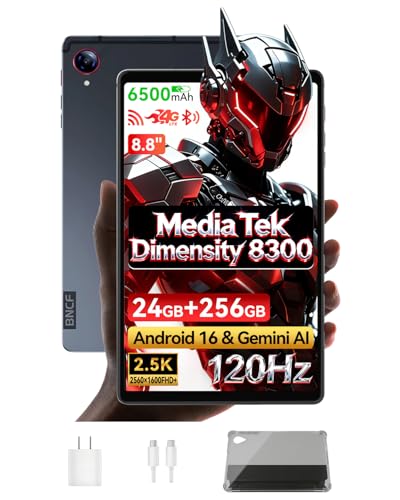
BNCF 8.8 inch Android 16 Tablet with Gemini AI, MediaTek Dimensity 8300 Octa-core 24GB RAM 256GB ROM, 2.5K 2560×1600 Display 120Hz BPad GT, 13MP Camera 4G LTE+Wi-Fi 6E 6300mAh with Protective Case — Best connected handheld
The BNCF BPad GT takes the Legion’s handheld insight and rebuilds it at a different position in the market: an 8.8-inch 2.5K display at 120Hz, a MediaTek Dimensity 8300, 256GB of storage, a protective case in the box — and one feature no other pick here offers, 4G LTE alongside Wi-Fi 6E, so the games continue where Wi-Fi ends. The Dimensity 8300 is a real gaming chip of the upper tier, capable of driving demanding titles at strong settings, if a step below the Snapdragon flagships above it in this list. In the handheld size, with that screen resolution, it makes a coherent and ambitious package.
The memory figure needs the translation promised in the introduction: the title’s 24GB follows the extended accounting used across this market corner, blending physical memory with a virtual extension, so compare it against other tablets by the storage and the chip rather than by that headline. The 6300mAh battery is the honest constraint of the small body — enough for solid sessions, shorter than the big tablets’ marathons — and Android 16 with Gemini AI features places the software at the current edge. The included case acknowledges what handhelds endure: travel, drops and life in bags.
Its audience is the connected player: the commuter whose matches happen on trains, the traveller who games in hotels and airports, anyone whose best gaming hours occur away from home Wi-Fi. For that player, LTE is not a bullet point but the entire proposition, and no flagship above can match it at any specification.
The 2.5K resolution at this size deserves a nod of its own: at 8.8 inches those pixels sit densely, so text in strategy interfaces and detail in distant scenery stay readable in a way larger, coarser panels cannot match. Handheld gaming rewards pixel density more than raw size, and the BNCF’s panel is specified by someone who appears to know it.
- Display: 8.8-inch 2.5K 2560×1600, 120Hz
- Processor: MediaTek Dimensity 8300 octa-core
- Memory and storage: 24GB RAM as listed (extended accounting), 256GB
- Connectivity: 4G LTE and Wi-Fi 6E
- Battery: 6300mAh, protective case included
Strengths
- The only LTE-connected gaming handheld in this guide.
- Capable Dimensity 8300 behind a sharp 120Hz screen.
- Case included for a life of travel.
Trade-offs
- Headline memory uses extended accounting; read it as such.
- 6300mAh is the smallest battery here, sized by the body.
- A step below the Snapdragon flagships in raw gaming power.
Best for: commuters and travellers who game away from home Wi-Fi.
Not suited for: players who want the absolute flagship engine above all.
Connected players should check price on Amazon for the BPad GT with its case, and confirm the LTE bands suit their network.

Easerush P12 2026 Latest Android 16 Gaming Tablet, 12 Inch 120Hz 2.4K Android Tablet with Gemini AI, UNISOC T7280 Octa Core, 48GB RAM+128GB, 10000mAh, Widevine L1, Tablet with Keyboard, Pen, Gray — Best for light gaming at size
Here is where this guide’s honesty policy earns its keep. The Easerush P12’s title leads with gaming, and its screen supports the pitch — 12 inches at 120Hz and 2.4K is a fine canvas — but its UNISOC T7280 is an entry-level processor, and entry-level silicon plays the lighter half of the Android catalogue: the puzzlers, the card and board games, the older and gentler titles, the casual racers at modest settings. The flagship shooters and open worlds that headline this category are not its country, and a review that pretended otherwise would be setting its readers up for a returned parcel. Within its true country, though, the P12 has real charms, and they deserve their paragraph.
The 10000mAh battery is the largest here, the Widevine L1 certification in the title means its second life as a streaming tablet plays in proper quality, and the bundle includes a keyboard and a pen, making it a light-work machine as readily as a light-gaming one. The 48GB memory headline follows the extended accounting pattern — read the 128GB storage as the solid figure — and Android 16 keeps the software current. Judged as a big, long-lived, light-gaming and media tablet with a full accessory kit, the P12 is a sensible machine. Judged as a gaming tablet in the Legion’s sense, it is a title in search of a chip, and we decline to complete the impersonation.
Its buyer, honestly described, is the casual player whose games are crosswords with graphics, whose films matter as much as their matches, and who wants one large screen to do all of it for a long weekend between charges. That player exists in millions, and for them this may be the smartest money in the list.
Families should note the shape of its value: one purchase covers the casual games, the streaming, the video calls and the light documents of a household’s second screen, with accessories already in the box. Spread across those jobs, the P12’s modest silicon stops looking like a limitation and starts looking like correct sizing — the error would be buying it for a job it never claimed the chip to do.
- Display: 12-inch 2.4K, 120Hz
- Processor: UNISOC T7280 octa-core
- Memory and storage: 48GB RAM as listed (extended accounting), 128GB
- Battery: 10000mAh
- Bundled: Keyboard and pen, Widevine L1 stated
Strengths
- The biggest battery and a big 120Hz screen for long sessions.
- Keyboard and pen make it a genuine all-rounder.
- Widevine L1 supports a quality streaming second life.
Trade-offs
- Entry-level chip limits it to lighter games.
- Memory headline uses extended accounting.
- The gaming title promises more than the silicon delivers.
Best for: casual players who mix light games, films and light work on one big screen.
Not suited for: anyone buying for demanding flagship games.
Casual players can check price on Amazon for the Gray P12 bundle, keyboard and pen included, with the gaming expectations set by this review.

XIAOMI Pad 8 Pro Ai WiFi Version Global (No Calls or Text) 11.2 inches 3.2K 144Hz 9200mAh Bluetooth 5.4 Four Speakers 50 Mp Cam Model 25091RP04G (Gray, 512GB + 12GB) — Best screen-and-storage spec sheet
The Xiaomi Pad 8 Pro’s title is a spec sheet with one eloquent silence. The stated figures are formidable: an 11.2-inch 3.2K display at 144Hz — the sharpest, fastest panel in this guide — four speakers, a 9200mAh battery, 512GB of storage with 12GB of memory, in a global Wi-Fi version. As a screen to game on, nothing here out-resolves it, and the speakers give games the audio stage that tablet speakers usually only promise. If the chip behind that panel is the flagship-class part Xiaomi’s Pro line usually carries, this is a top-three gaming machine wearing a modest badge.
But the conditional is the review. The listing title does not name the processor, and this guide does not name processors on a maker’s behalf — gaming is a chip category, and a chip we cannot verify from the listing gets a question mark rather than a coronation. The remedy is in the reader’s hands: the full product page will state the platform, and five minutes there converts this pick from a spec-sheet gamble into either a flagship bargain or a beautiful screen awaiting an engine. We flag, too, the global version’s usual footnotes — Wi-Fi only, no calls or texts as the title says, and warranty arrangements that follow the global model rather than a local one.
What can be said without condition: the display, speakers, battery and storage are all verifiably flagship-grade on paper, the size sits in the arena class, and Xiaomi’s performance-per-coin reputation in tablets is earned. Verify the one missing number and this may be the list’s stealth champion; skip the verification and you are buying a painting of a gaming tablet, however beautiful the frame.
The four speakers complete a pattern worth recognising: Xiaomi specified everything a reviewer can see — panel, sound, battery, storage, memory — at flagship level, which makes the single omission read less like concealment and more like a listing written by the marketing department rather than the engineers. The verification advice stands, but so does the benefit of the doubt, provisionally and in writing.
- Display: 11.2-inch 3.2K, 144Hz
- Speakers: Four speakers
- Battery: 9200mAh
- Memory and storage: 12GB, 512GB
- Processor: Not named in the listing title
Strengths
- The sharpest and fastest screen specification here.
- 512GB and four speakers complete the arena package.
- A large battery sized for long sessions.
Trade-offs
- Processor must be verified on the full listing.
- Global Wi-Fi version, so check warranty terms.
- No cellular option in this listing.
Best for: specification hunters willing to verify the chip before ordering.
Not suited for: players ordering tonight for a tournament this weekend, with no patience to open the full listing and confirm the unnamed processor line first.
Spec hunters should check price on Amazon for the Gray 512GB Pad 8 Pro and read the listing’s processor line before anything else.
How do you set up an Android gaming tablet for its first serious session?
Start by feeding the screen honestly: set the display to its highest refresh rate, then open your most demanding game and tune its graphics settings to hold a steady frame rate rather than a spectacular one — a locked, smooth rate beats a higher, stuttering one in every genre, because consistency is what hands learn. Download your core library while the tablet is new and the storage is empty, rather than discovering in month three that two flagship installs cannot coexist; the 512GB machines forgive this laziness, the 128GB ones do not.
Then arrange the physical session. A controller paired for the games that support one transforms the arena-sized tablets and rests the thumbs on the handhelds; a stand and a charger within reach turn the battery from a countdown into a non-issue for home play. Silence everything that is not the game — notifications are the cheapest frame drops in the building — and let the tablet’s gaming mode, where the platform offers one, do its small optimisations. Finally, play the first long session inside the return window at your real settings on your real games. Gaming tablets reveal themselves in hour two of your favourite title, not in any review, including this one.
How does sustained performance differ from the first five minutes?
Every tablet is fast in minute one; gaming is decided in minute forty, when the chip has warmed and the machine must choose between its frame rate and its temperature. Flagship silicon in a body designed for play — the Legion above all — holds its pace because the whole device was arranged around that moment. General-purpose flagships like the two Samsungs manage heat honourably within their thinner, prettier briefs, typically settling at a slightly negotiated level after a long session. Value machines with modest chips have less heat to shed and less performance to protect, which is its own kind of consistency.
The player’s part is placement and honesty: a tablet gaming on a bed, vents and back buried in a duvet, will throttle in any tax bracket, while the same machine on a stand in moving air keeps its promises. And settings are a dial, not a defeat — dropping one graphics tier to hold a flawless frame rate for two hours is the mark of a player who understands the hardware, whichever of these six is in their hands.
What about game streaming and cloud play on these tablets?
Cloud gaming rewrites the rankings in an interesting way, because a streamed game is rendered elsewhere and the tablet becomes a screen, a radio and a controller. In that world the chip matters least and the display, Wi-Fi and battery matter most — which rehabilitates several picks at once. The Xiaomi’s 3.2K 144Hz panel and big battery become a cloud player’s dream specification, the Easerush’s Widevine-friendly streaming credentials join the conversation, and the BNCF’s LTE turns anywhere into a games room, bandwidth permitting. The Samsungs’ Wi-Fi and AMOLED panels shine here too.
The honest caveat is that cloud play is a network product wearing a tablet’s clothes: latency and stream quality follow your connection, not your purchase, and competitive players will always prefer the local rendering of the Legion and its flagship peers for the games where milliseconds vote. Treat cloud as the library-expander — the way these tablets play titles beyond their silicon — and local power as the foundation, and the six sort themselves into a sensible order for both worlds.
Which games flatter which of these six machines?
Genre is the honest translator of every specification in this guide. Competitive shooters and fast racers live on frame rate and touch response, and they belong to the Legion first, the Samsungs second, the BNCF respectably behind. Open-world and spectacle titles live on graphics headroom and screen beauty — Samsung arena territory, with the Xiaomi’s panel awaiting its chip’s verification. Strategy and simulation live on screen area and patience, flattering every 11-inch-and-up pick and asking little of any chip. And the vast casual library — puzzles, cards, builders, gentle adventures — plays beautifully on all six, which is precisely why the Easerush’s honest country is larger than its critics would guess.
Cloud-streamed titles, as the previous section argued, redraw the map again toward screens and radios. The practical method is to list your five most-played games, find their known behaviour on the shortlisted chips, and let that evidence outrank every adjective in every title — including, we cheerfully admit, ours. A tablet chosen against a real library is a tablet that will not be returned.
What accessories actually improve tablet gaming, and which are theatre?
A controller is the one transformative accessory for the arena tablets, converting racers, platformers and action titles from touch compromises into console experiences, and a simple stand is its necessary partner. For the handhelds, a grip case can steady long sessions, though the BNCF already bundles protection and the Legion was shaped for hands from the start. Cooling fans and elaborate docks sit at the theatre end for most players — placement in moving air achieves most of the same mercy free — while a long, braided charging cable near the gaming chair outperforms every gadget in this paragraph by the simple virtue of ending the battery’s veto over the evening.
Headphones close the list with honours: games are mixed for them, tablet speakers are a compromise everywhere except the four-speaker machines, and a private audio field is the difference between playing in a shared room and performing in one. Buy the controller, the stand, the cable and the headphones, in that order, and skip the rest until a specific game proves a specific need.
The six gaming tablets, measured against each other
| Tablet | Chip | Screen | Storage | Gaming identity |
|---|---|---|---|---|
| Lenovo Legion Tab Gen 3 | Snapdragon 8 Gen 3 | 8.8 inches, up to 165 FPS as listed | 256GB | Purpose-built handheld flagship |
| Samsung Galaxy Tab S11 | 3nm MediaTek, model not in title | 11-inch AMOLED 2X | 512GB | Premium arena all-rounder |
| Samsung Galaxy Tab S9 | Snapdragon 8 Gen 2 | 11-inch AMOLED | 256GB | Proven flagship performer |
| BNCF BPad GT | Dimensity 8300 | 8.8-inch 2.5K 120Hz | 256GB | LTE-connected handheld |
| Easerush P12 | UNISOC T7280 | 12-inch 2.4K 120Hz | 128GB | Light gaming and media |
| XIAOMI Pad 8 Pro | Not named in title | 11.2-inch 3.2K 144Hz | 512GB | Flagship spec sheet, chip to verify |
What does the second year of a gaming tablet look like?
The first year is honeymoon: every game is new, the battery is at its best, the library fits. The second year is the audit. Games have grown — they always grow — settings that held at launch need one notch of negotiation on all but the flagship chips, and storage that felt infinite has developed a waiting list. The machines that pass the second-year audit gracefully are the ones bought with headroom: the Legion’s engine, the Samsungs’ polish and update support, the 512GB machines’ room. The machines bought exactly at their library’s ceiling begin the deletion-and-regret cycle, which is why this guide keeps steering readers one tier above their minimum. In gaming hardware, headroom is not indulgence; it is the second year, prepaid.
How should parents read this list when the player is younger?
With the genre lens first and the flagship lens last. Younger players’ libraries skew toward the casual and creative end, where every machine here performs happily, and the deciding factors migrate to durability, size in smaller hands and the household’s existing rules about screens — subjects our children’s tablet guide treats at the length they deserve. The 8.8-inch handhelds fit younger hands physically, the big screens suit shared and supervised play, and the flagship chips matter only when the library grows teeth, which it will, on its own schedule. Buy for the games actually played this year, keep the receipt of your reasoning, and let the upgrade arrive when the library demands it rather than when the marketing does.
What gaming tablet mistakes do players repeat most?
Buying the screen and forgiving the chip is the expensive classic, and this list contains its cautionary tale in both directions: a beautiful 120Hz panel behind an entry-level processor will play the interface like a champion and the flagship games like a slideshow. Read the processor line first, the refresh rate second, and let no title’s adjectives reorder them. The second mistake is storage denial. Modern games are not apps; a single flagship title can occupy the space of a hundred ordinary ones, and the tablet that seemed roomy at Christmas is deleting favourites by spring. In this category, storage is not a specification but a library policy.
Third is ignoring the memory accounting. A headline that blends physical and extended memory is not a lie, but comparing it directly against another tablet’s physical figure is an error the comparison tables of the internet commit daily. Compare chips with chips, physical memory with physical memory, and treat every extended figure as a footnote. Fourth, players forget the hands: a tablet gamed on for two hours is furniture for the arms, and the wrong size — arena glass bought for thumb play, handheld bought for the sofa — aches its way out of favour within a month. The final mistake is skipping the first-week stress test. Play your hardest game at your settings while the return window is open; a gaming tablet is a promise about frame rates, and promises should be audited promptly.
A last word on the word gaming itself, since two titles in this list lean on it harder than their silicon supports. Treat it the way experienced players treat a difficulty label: as the maker’s hope, not the machine’s measurement. The measurements are all in the reviews above — chip, screen, storage, size — and a tablet bought by measurement will still be earning its place when the adjectives have been forgotten by everyone except the box in the recycling.
Final Recommendation
Handheld players should buy the Legion Tab Gen 3 without a second thought — it is the only machine here designed as a gaming handheld around a flagship chip, and it plays like it. Arena players divide by temperament: the Tab S11 for the newest flagship whole, the Tab S9 for the proven Snapdragon with a track record, and the Xiaomi Pad 8 Pro for the spec hunter who verifies its chip and may land the list’s best screen in the bargain. The BNCF owns the connected niche outright, and the Easerush P12 serves the casual player honestly once its title is translated. Match the chip to your library and the size to your hands — and may your frame rate hold steady in the final, long after the lobby’s confidence has faded.
Players upgrading from a phone should expect one pleasant shock: the same games feel different at tablet scale with tablet cooling and a tablet battery, and titles that were chores on a hot, small phone become sessions. That transformation is the category’s founding promise, and the top half of this list keeps it completely.
Frequently Asked Questions
What makes a tablet a gaming tablet rather than just a fast one?
Three things in combination: a flagship or upper-tier chip with a strong graphics unit, a screen fast enough to display what that chip produces, and a body and battery designed for sustained play rather than short bursts. Any one alone is marketing. A fourth, quieter ingredient separates the machines players keep from the ones they tolerate: how the tablet behaves between games — the store, the downloads, the updates, the library management — and the flagship ecosystems polish that connective tissue in ways no specification prints. The Legion Tab Gen 3 is this list’s clearest example of all three arriving in the same box; the Easerush P12, with its fine screen and entry-level chip, is the clearest example of the combination coming apart.
Do you need 12GB of memory for Android gaming?
For flagship games at high settings, generous memory keeps textures loaded and background apps from evicting your session, and the 12GB configurations here — Legion, Xiaomi — are sized for exactly that. Lighter gaming is content with less. Be careful with headline figures that blend physical and extended memory, as two listings here do; the physical figure is the one to compare, and the chip matters more than either.
One more memory nuance deserves plain language: extended memory borrows from storage to give background apps somewhere to wait, which helps multitasking smoothness but does not give a game the fast, physical memory it renders with. A title quoting a very large memory figure alongside a modest chip is telling you, if you read it carefully, that its ambitions are in switching between apps rather than in driving the hardest games — useful information, honestly extracted.
Is an 8.8-inch tablet too small for serious gaming?
For handheld genres, it is the correct size rather than a compromise: thumbs reach everything, the device grips like a controller, and sessions happen anywhere. For strategy, spectacle and shared play, the arena sizes win. Seriousness lives in the chip and the frame rate, not the diagonal — the smallest tablet in this guide carries its strongest gaming engine, which settles the question empirically.
There is a comfort footnote to size that competitive players know and newcomers learn: a handheld session is measured in matches, an arena session in hours, and the wrists keep the accounts for both. Alternate postures, prop the arena machines, and let the handheld rest between rounds — the best gaming tablet is partly the one your hands still like in the second hour.
Does more storage really change the gaming experience?
Quietly and completely. A tablet with room keeps your whole rotation installed — the racer, the shooter, the comfort game — so play starts at the icon rather than at a download bar, and updates stop being evictions. The 512GB picks here hold a flagship library without negotiation; at 256GB the negotiation is occasional; at the Easerush’s 128GB it is a lifestyle, acceptable only because its games are smaller. In gaming, storage is not where files live — it is how many evenings begin instantly. Players who have watched a forty-minute download consume the exact hour they had free need no further argument, and they are the ones who buy the 512GB configurations without being sold.
Can these tablets use controllers and play on a television?
Bluetooth controllers pair with modern Android tablets as a matter of routine, and the arena-sized picks in particular become small consoles with one attached. Television output depends on each model’s ports and wireless casting support, which the listings here do not detail, so check the full product page if the big-screen setup is central to your plan rather than a bonus.
The controller question has a handheld footnote: on the 8.8-inch machines, touch is usually the intended instrument and the grip is the accessory, while on the arena tablets the controller is close to essential for the genres that made them famous. Buy the input your size assumes, and the session furniture takes care of itself.
How long will a gaming tablet stay capable?
The chip decides that too. A flagship engine like the Snapdragon 8 Gen 3 or 8 Gen 2 has years of demanding releases ahead of it at gradually negotiated settings; an entry-level chip is at its ceiling on arrival. Buy the strongest chip your budget reaches and the tablet ages like a console; buy below your library’s demands and it ages like a compromise, because that is what it was.
Software support writes the epilogue to that story: a tablet whose maker keeps the system current keeps receiving new versions of its games, while an abandoned platform can strand a capable chip behind an outdated store. Samsung’s mainstream support is the safest bet on this page, Lenovo’s gaming line is a committed niche, and the smaller makers ask for a little more faith — one more variable to weigh knowingly at purchase rather than discover in year three.
Whichever of the six lands in your bag, give it the first-week audit this guide keeps recommending — your hardest game, your real settings, one long session — because a gaming tablet is a promise about performance, and promises are cheapest to test while the box is still by the door.
How do you keep breathing room in storage as games grow with every update?
Treat storage as a garden rather than a cupboard, and walk through it once a season with honest eyes. The title you never launch but cannot bear to delete is the most expensive souvenir on the tablet, quietly paying rent in space a new favourite needs. Move gameplay recordings and screenshots off to a computer or a cloud album, because captured clips grow into a second, uncurated library while nobody is watching. Empty the caches of streaming and social apps before deleting anything you love, since those rebuild themselves overnight while a removed game returns only through a long and tedious download.
Protect your progress before you protect your installs: confirm the cloud save truly synchronised before removing any title, keep one small comfort game permanently installed, and leave a generous margin empty on purpose, because updates need room to land and a nearly full tablet downloads slowly and installs reluctantly.
Related Guides
Gaming is the most demanding of a tablet’s possible lives. Players whose sessions alternate with long reading should compare the dual-purpose roundup, and those whose tablet must also produce homework should weigh the keyboard-first guide before the flagship chip wins an argument it should lose. Begin with tablets balanced for ereading and browsing, then consider the homework tablet recommendations, and if the screen’s second job is films, finish with our streaming tablet comparison.


