What's inside
- Key Takeaways
- Quick Picks: Six Plug-In Headsets for the Switch Family
- What Did a Wired Switch Headset Have to Prove to Earn a Place Here?
- Licensed, Themed or Visiting: the Switch Six by Household Role
- How Does Voice Chat on the Switch Really Work, and What Can a Headset Change?
- How Should Parents Choose a Switch Headset for a Child Without Regretting It by Half-Term?
- What Changes When the Same Headset Must Serve Docked, Handheld and Travel Play?
- How Do the Six Divide a Household Budget Across a Whole Year of Play?
- What Should Happen in the First Week After a Switch Headset Arrives?
- Which Switch Headset Purchases End in a Drawer by Christmas?
- Final Recommendation
- Frequently Asked Questions
- Related Guides
As an Amazon Associate I earn from qualifying purchases. This post may contain affiliate links at no extra cost to you.
gizmoverdict.com is reader-supported. When you buy through links on our site, we may earn an affiliate commission.
Where to buy: all six headsets below are sold through their Amazon listings, so follow a pick’s link to its listing page, confirm the exact console wording in that title, since this pool spans the original Switch family and the newer Switch 2, and check the colour edition named there, because two of these picks wear game-themed finishes that are part of what you are paying for.
The best wired headsets for switch share a beautifully simple foundation: every member of the Switch family carries a 3.5mm headphone jack, and a wired headset plugs into it and works, with no pairing, no charging and no battery anxiety in the middle of a dungeon. That simplicity is the category’s whole charm in a wireless era, and it explains why the pool below is dominated by light, affordable, child-tolerant designs alongside two multiplatform headsets that visit the Switch from the PC world and behave impeccably while they are here.
One honesty note belongs at the front, because it shapes every purchase in this guide. Voice chat on the Switch depends on the game. Some titles handle chat through the console in a way a headset microphone serves directly, while others route voice through a phone application, and no headset in this pool, or anywhere, can change a game’s chosen arrangement. Every review below therefore separates two questions that listings love to blur: how well the headset delivers game audio and a microphone, and how the particular games in your library choose to carry voices at all.
The pool divides by allegiance. Four picks are licensed or designed squarely for the Switch family, two from Turtle Beach and two from PDP, spanning the current Switch 2 wording and the earlier Lite and OLED generations, with themed editions that speak directly to younger players. The other two, from Logitech and Razer, are PC-first multiplatform headsets whose 3.5mm connection makes them citizens of the Switch as well, a fact their titles state and this guide repeats plainly, because a family that also owns a PC or another console may rationally prefer one headset that serves every screen in the house. The wider Switch headset landscape in best headsets for gaming nintendo switch shows how crowded that dual citizenship has become.
Comfort in this category is measured in handheld hours. A Switch session happens on a sofa, in a car, in bed, on a train, with the console in the hands and the headset’s weight carried by a head that may belong to a nine-year-old or to the parent borrowing the console after bedtime. Light frames, forgiving cushions and microphones that mute with a flip rather than a menu are the virtues that survive that variety, and they recur through the reviews below more often than any driver specification.
Price expectations should be set by the category’s honest nature: these are mostly accessible headsets, bought as first gaming headsets, as travel companions and as the household’s shared pair. The guide judges them inside that brief, where surviving a school bag and sounding clear to a teammate outrank audiophile ambitions, and where a replaceable-by-repurchase price is sometimes a feature a parent actively shops for.
Key Takeaways
- Every pick connects through the 3.5mm jack the whole Switch family carries, so nothing here needs pairing or charging before a session.
- Voice chat depends on the game, with some titles routing voices through a phone application, and no headset purchase can override a game’s own arrangement.
- The Turtle Beach Airlite Fit and Recon 70 both use flip-to-mute microphones, the fastest mute gesture available to a young player mid-match.
- PDP’s two Airlite-family picks lean into themed editions, Zelda Hyrule Blue and Mario Neon, aimed squarely at the console’s younger audience.
- The Logitech G335 and Razer BlackShark V2 X are PC-first multiplatform headsets that serve the Switch through the same jack, stated plainly in their titles.
- Light weight is the pool’s shared religion, with the Razer naming 240 grams in its title and every rival competing on forgettable fit.
Quick Picks: Six Plug-In Headsets for the Switch Family
| Pick | Badge | Why it earned its place |
|---|---|---|
| Turtle Beach Airlite Fit | Current-generation licensed default | Licensed for Switch 2 and the Lite and OLED models in its title, with a flip-to-mute microphone and 40mm speakers. |
| PDP Airlite | Zelda-themed gift pick | A lightweight wired headset with a flexible noise-cancelling microphone and on-ear volume controls, in a Zelda Hyrule Blue edition. |
| PDP LVL40 Airlite | Mario-coloured younger pick | A stereo wired headset for Switch, Lite and OLED with a noise cancelling microphone and soft on-ear comfort, in Mario Neon colours. |
| Turtle Beach Recon 70 | Multiplatform in Switch livery | A wired multiplatform headset licensed for Switch in its title, with a flip-to-mute microphone, 40mm speakers and soft earpads. |
| Logitech G335 | Comfort-led PC visitor | A PC-first wired headset with a flip-to-mute microphone, memory foam earpads and a 3.5mm jack serving PC, PlayStation, Xbox and Switch per its title. |
| Razer BlackShark V2 X | Microphone-led PC visitor | A wired headset with TriForce Titanium 50mm drivers and a HyperClear cardioid microphone in its title, at a stated 240 grams, serving PC, PlayStation and Switch. |
What Did a Wired Switch Headset Have to Prove to Earn a Place Here?
Eligibility began at the jack. A pick had to connect by 3.5mm to the Switch family as its title states, which excluded the wireless and USB-dongle designs competing for the same searches and kept the guide honest to its keyword. Within that boundary, licensed Switch designs were balanced deliberately against multiplatform visitors, because real households contain both buying philosophies and a guide serving only one would mislead the other half of its readers.
Microphone manners formed the second sort. A Switch headset’s microphone serves game chat where the game allows it, calls on other platforms for the multiplatform picks, and the general dignity of being understood by teammates and family. Flip-to-mute designs earned their prominence here because the gesture is teachable to a child in one sentence and executable in a panic, while flexible and detachable-style booms were judged on how they survive being bent by small hands in approximately the wrong direction, repeatedly.
Comfort was assessed for the category’s actual postures: handheld play with the head tilted slightly down, docked play on a sofa, and passenger play in a moving car. Cushion material, clamp gentleness and total weight all matter more in those postures than in a desk chair, and the pool’s convergence on light frames, documented across the category in best gaming wired headsets with microphone, reflects years of returns teaching manufacturers the same lesson.
The last filter was household role. Each survivor owns one: the current-generation licensed default, the themed gift pick, the younger-child colour pick, the multiplatform family headset in Switch livery, the comfort-led PC visitor, and the microphone-led PC visitor. A model that duplicated a neighbour’s role without a sharper claim was released, because six slots is few enough that each must argue a distinct evening, car journey or birthday.

Turtle Beach Airlite Fit — Current-generation licensed default
The Airlite Fit is the pool’s most current answer to the simplest question: what should a Switch-first household buy today? Its title names the Switch 2 alongside the Switch Lite and OLED models, which places one purchase across the family’s generations, a genuine convenience in homes where a new console joined an older one rather than replacing it. Turtle Beach’s licensing relationship with the platform runs through the design’s assumptions: this headset was drawn for this console’s players, in this console’s postures, at this category’s accessible end.
The flip-to-mute microphone is the feature a family will use most. Raise the boom and the microphone silences; lower it and the player is heard, a gesture so legible that a child can be trusted with it in a living room where a parent’s conversation should not be broadcast to a lobby. That single mechanism does more for household harmony than any audio specification in this guide, and its presence on both Turtle Beach picks here is a philosophy, not a coincidence.
The title’s 40mm speakers describe the standard driver size of this class, tuned for game audio’s priorities: clear effects, present dialogue and enough low-end enthusiasm for an explosion to register through a handheld session. Comfortable ear cushions and a lightweight build complete a specification that reads modestly and behaves correctly, because the Airlite Fit’s ambitions are domestic rather than theatrical, and it meets them without remainder.
Handheld posture is where this pick quietly earns its name. The frame’s lightness matters more with every degree the head tilts toward a screen held in the hands, and the cushions are shaped for sessions that migrate from sofa to car to bed without a change of equipment. Parents buying for a player who games everywhere will recognise that itinerary as the actual product being purchased.
Choose the Airlite Fit as the default when the household is Switch-first, the console generation is current or mixed, and the buyer’s priorities are a licensed fit, a trustworthy mute gesture and no money spent on capabilities the console cannot use. It is the least complicated recommendation in this guide, which in this category is high praise.
One more household pattern flatters this pick: siblings at different console generations. A headset that serves the new console in the living room and the inherited Lite in a bedroom ends the accessory apartheid that otherwise doubles every purchase, and parents comparing the pool should count the number of consoles in the house, not just the newest one, before deciding that any rival’s narrower wording is good enough.
- Format: wired gaming headset for the Switch family
- Compatibility in title: Switch 2, Lite and OLED models
- Microphone: flip-to-mute design per the listing title
- Speakers: 40mm drivers stated in the title
- Build emphasis: lightweight frame with comfortable cushions
Strengths
- Current and previous Switch generations covered by one purchase
- Flip-to-mute gesture a child can be trusted with instantly
- Licensed design shaped for handheld postures
Trade-offs
- Wired tether is part of the deal, as with every pick here
- Tuning serves games first, music second
- No multiplatform ambitions beyond the Switch family wording
Best for: Switch-first households wanting the current licensed default for a young or family player.
Not suited for: buyers wanting one headset to serve a gaming PC and other consoles as well.
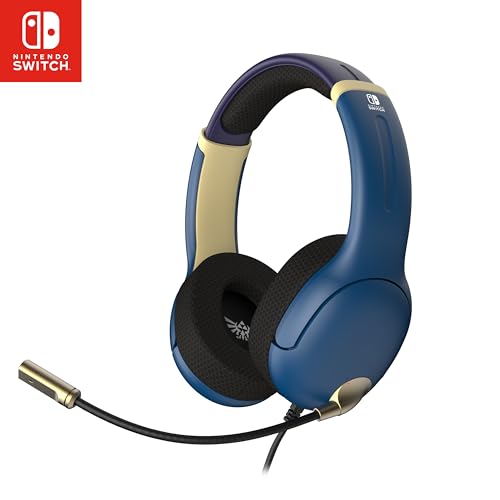
PDP Airlite — Zelda-themed gift pick
PDP’s Airlite understands that for a large share of Switch players, a headset is partly a costume. The Zelda Hyrule Blue edition named in its title dresses a sensible wired headset in the colours of the console’s most beloved adventure, and dismissing that as decoration misses how children actually adopt equipment: the headset that looks like their world is the headset that gets worn, cared for and remembered to be packed. PDP, a licensing specialist, builds its whole case on that understanding.
Beneath the livery sits a considered specification. A flexible noise-cancelling microphone, in the title’s wording, bends to position and survives the bending, which matters in the hands of its intended audience more than any laboratory figure. On-ear volume controls put the one adjustment a young player legitimately needs under their own fingers, sparing the household the shouted negotiation across a room that a console-side volume hunt produces. Lightweight design and soft cushions complete the child-shaped brief.
The noise-cancelling phrase deserves the guide’s standard translation: it describes the microphone’s design intention of favouring the player’s voice over the room, in the maker’s words, and its real value will be judged by teammates and family on ordinary evenings. Combined with the voice-chat caveat that governs this whole category, the honest promise is a clear microphone ready for the games that carry voice through the console, and a comfortable audio companion for the many games that keep voices elsewhere or nowhere.
Compatibility wording spans Switch 2, Lite and OLED in the title, matching the Turtle Beach default’s generational reach, so the choice between them is temperament rather than coverage: the PDP offers themed delight and a flexible boom, the Turtle Beach a flip-to-mute and a plainer face. Households know their own children well enough to call that contest without assistance.
Buy the Airlite when the gift dimension is real, when a Hyrule-blue unboxing will do more for a young player’s delight than any specification could, and rest assured that the underlying headset is a properly considered piece of equipment rather than a logo on a toy. The livery gets the attention; the flexible microphone and honest comfort earn the retention.
PDP’s accessory heritage shows in a detail adults overlook: the headset is designed to be found. Bright livery, a shape that reads as play equipment rather than fragile electronics, and packaging a child can open without a parent performing surgery all lower the friction of ownership for its actual user, and low-friction ownership is what separates equipment that lives on a head from equipment that lives in a drawer.
- Format: wired gaming headset for the Switch family
- Edition: Zelda Hyrule Blue finish named in the title
- Microphone: flexible noise-cancelling design per the title
- Controls: on-ear volume controls stated in the title
- Compatibility in title: Switch 2, Switch Lite and OLED
Strengths
- Themed edition a young Zelda fan will actually wear proudly
- Flexible boom tolerates the handling of its intended audience
- On-ear volume gives the player one useful, reachable control
Trade-offs
- Theme is Zelda-specific, which dates the gift to one fandom
- Flexible boom lacks the flip-to-mute gesture’s instant clarity
- Wired connection only, like the whole pool
Best for: gift buyers equipping a young Switch player who lives in Hyrule half the week.
Not suited for: players who have outgrown themed gear or households needing a platform-neutral look.
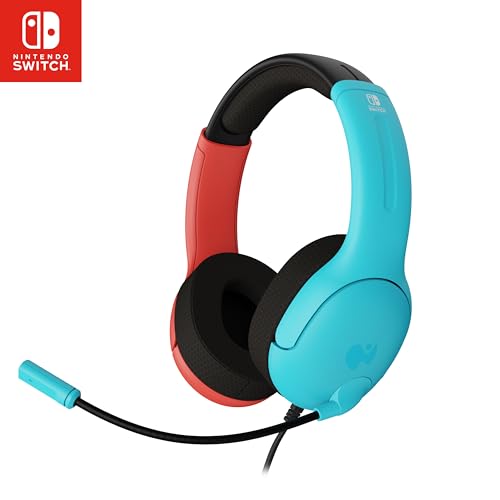
PDP LVL40 Airlite — Mario-coloured younger pick
The LVL40 Airlite is the pool’s elder themed design, from the earlier Switch generation’s accessory wave, wearing Mario Neon red and blue in its title and aimed at the family’s younger players with a directness the newer picks have refined. Its continued presence in this guide is deliberate: the original Switch, Lite and OLED remain the installed majority in many homes, and a headset designed in their era, for their jack and their players, still answers the keyword for those households without translation.
The specification follows the pattern its audience needs. A noise cancelling microphone, in the maker’s wording, on a wired stereo headset with lightweight soft on-ear cushions: everything in that sentence serves a child playing at home, where the microphone’s audience is family and the occasional game that carries voice, and where comfort across a rainy afternoon matters more than any tournament feature. On-ear cushions, rather than large over-ear cups, keep the apparatus proportionate to smaller heads.
Age honesty matters in this review. The LVL40’s design language, colours and proportions address younger players, and a teenager will feel the address. That is not a flaw; it is segmentation doing its work, and the pool contains the plainer and more multiplatform picks precisely for the player who has aged out of Mario livery. Buying the LVL40 for the child it describes, at the age it describes, is the whole instruction.
Its wired simplicity suits the realities of children’s equipment: nothing to charge before a car journey, nothing to pair after a sibling borrows it, and a replacement cost that does not turn a school-bag accident into a family summit. Parents who have replaced one games accessory already will read that sentence with feeling.
Choose the LVL40 for the younger player on the original-generation consoles, especially as a first headset whose job is comfort, colour and a microphone that introduces voice etiquette gently. It is the pool’s most openly child-first design, and it wears that brief with the confidence of a product that has had years to be right about it.
There is a hand-me-down dignity to this pick worth recording: a first headset outgrown by one child passes naturally to a younger sibling still inside its intended age, colours and all, which stretches the purchase across two childhoods. Few products in this guide can promise that second life as plausibly, and families with a queue of players should price it accordingly.
- Format: wired stereo headset for Switch, Lite and OLED
- Edition: Mario Neon red and blue finish in the title
- Microphone: noise cancelling design per the listing title
- Fit: lightweight with soft on-ear cushions
- Connection: 3.5mm wired, per the category pattern
Strengths
- Proportions and colours honestly aimed at younger players
- On-ear cushions suit smaller heads across long afternoons
- Nothing to charge or pair in a child’s daily routine
Trade-offs
- Earlier-generation wording does not name the Switch 2
- Themed design will be outgrown, by design
- Stereo game focus, with no multiplatform ambitions
Best for: younger players on the original Switch family consoles receiving a first headset.
Not suited for: teenagers wanting a neutral design or Switch 2 buyers wanting current wording.
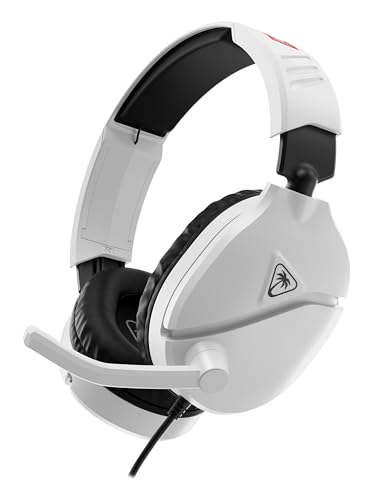
Turtle Beach Recon 70 — Multiplatform in Switch livery
The Recon 70 is Turtle Beach’s travelling design, a multiplatform headset whose title here wears its Switch licensing openly while the same family serves other consoles across the hall. That dual identity is the pick’s argument: a household with a Switch and another platform, or a Switch today and a different console on a birthday horizon, can buy one headset whose manners are already learned by the time the second screen arrives. The flip-to-mute microphone and 40mm speakers match its Airlite sibling’s core recipe, served in a slightly more grown-up frame.
Licensed-for-Switch wording in the title settles the compatibility question in the way parents actually ask it at a shelf: yes, this one is meant for that console. The multiplatform nature then adds reach rather than confusion, because the 3.5mm connection asks nothing of any host. A headset that can move from the Switch in the living room to a controller or laptop elsewhere in the house earns its drawer space several times a week in a busy family.
Comfort language in the title, lightweight with soft earpads, repeats the category’s shared religion, and the Recon frame’s slightly more substantial build suits older children and adults borrowing the console more than the Airlite’s child-first proportions do. Households where the same headset serves a parent’s late session and a child’s afternoon should weight that dual-audience fit heavily, since it is rarer in this pool than it sounds.
The microphone’s flip gesture keeps the family’s favourite safety feature, and the voice-chat caveat applies with the same force as everywhere here: the Recon 70 gives the Switch a good microphone wherever a game chooses to use one, and accompanies every other game as a comfortable audio headset without pretending otherwise.
Recommend the Recon 70 as the household’s one-headset answer where platforms multiply or loom, and where the wearer spans ages. It concedes the themed delight of the PDP picks and the PC pedigrees of the Logitech and Razer, and in exchange offers the broadest domestic citizenship available in Switch livery.
The Recon’s slightly older audience also changes its travel profile: it is the licensed pick most likely to be borrowed by a parent for a train film through a phone or laptop, and a headset earning that second income should be judged partly as family infrastructure rather than purely as a child’s accessory with aspirations.
- Format: wired multiplatform gaming headset, Switch licensed
- Compatibility in title: Switch 2, Lite and OLED named
- Microphone: flip-to-mute design per the listing title
- Speakers: 40mm drivers stated in the title
- Build emphasis: lightweight frame with soft earpads
Strengths
- Switch licensing with multiplatform reach in one purchase
- Flip-to-mute keeps the family’s trusted gesture
- Fit serves older children and borrowing adults alike
Trade-offs
- Plainer face than the themed PDP editions
- Jack-of-platforms design is nobody’s specialist instrument
- Wired tether remains, as across this entire guide
Best for: households with a Switch today and other platforms present or planned.
Not suited for: buyers wanting a themed gift or a PC-first pedigree headset.
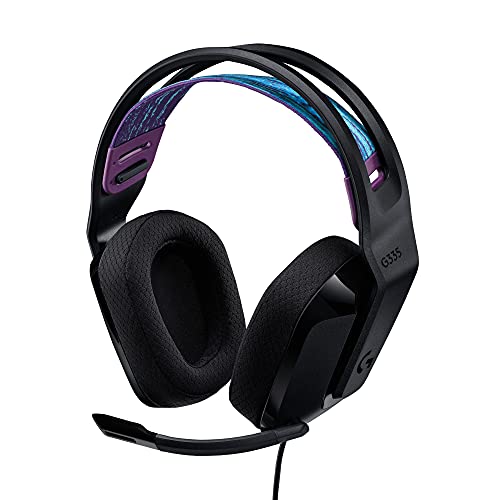
Logitech G335 — Comfort-led PC visitor
The G335 arrives from the PC world and says so in its title, which lists the Switch as one citizen among PC, PlayStation and Xbox. That honesty frames the pick correctly: Logitech designed this headset for the desk-and-controller universe, with memory foam earpads and a flip-to-mute microphone, and the Switch inherits all of it through the shared 3.5mm jack. A family whose gaming centre of gravity is a PC, with the Switch as the travelling console, will find this the most natural single purchase in the pool.
Memory foam is the comfort headline, and in this category it earns the billing. The G335’s wearing style, a light frame with a suspension-influenced fit in Logitech’s design language, was drawn for long PC sessions, and those manners translate gracefully to long handheld ones, where any pressure point is magnified by the downward tilt of the head. Glasses wearers in particular tend to vote for foam-and-lightness combinations with their own money, repeatedly.
The flip-to-mute microphone keeps the gesture this guide has praised throughout, executed here with PC-platform polish, and the microphone’s day job on other platforms, calls, classes and team chat, means a household may find the G335 working a second shift at a homework desk. Versatility of that kind is how a headset justifies a step up within an accessible category: not by one dramatic feature, but by being the right answer in three rooms.
Against the Razer below, the G335 argues comfort-first; against the licensed picks, it argues platform breadth and a more adult design language that a teenager will not outgrow by spring. Its Switch service is genuine but not bespoke, and a Switch-only household with a young player will usually be happier inside the licensed four. Know which household you are, and the G335’s place in your shortlist assigns itself.
Buy it as the family headset of a PC-centred home, and let the Switch enjoy the visiting privileges its title promises, with the wider PC context in best affordable gaming headsets pc explaining the neighbourhood this pick calls home when it is not travelling with the console.
Logitech’s colour and finish language for this line speaks to players who personalise their setups, and while this guide judges the black variant named in the pool title, the underlying point stands: a headset a teenager chooses the look of is a headset that stays on the desk rather than migrating to the floor, and domestic order is a legitimate, if unglamorous, purchasing criterion.
- Format: wired gaming headset, PC-first multiplatform
- Connection: 3.5mm audio jack per the listing title
- Microphone: flip-to-mute design named in the title
- Comfort: memory foam earpads stated in the title
- Compatibility in title: PC, PlayStation, Xbox and Switch
Strengths
- Memory foam comfort drawn from long-session PC design
- Platform breadth covers nearly every screen in a house
- Flip-to-mute gesture matches the pool’s best practice
Trade-offs
- Not Switch-licensed or Switch-shaped in its design language
- Adult sizing may swamp the youngest players
- Music and media tuning serve gaming first
Best for: PC-centred households wanting one comfortable headset that also serves the Switch faithfully.
Not suited for: young Switch-only players wanting a licensed, themed design.

Razer BlackShark V2 X — Microphone-led PC visitor
The BlackShark V2 X is the pool’s microphone maximalist. Razer’s title leads with its TriForce Titanium 50mm drivers and its HyperClear cardioid microphone, the vocabulary of a maker that treats voice pickup as a headline engineering discipline, and the cardioid pattern, favouring sound from the front where a mouth is, over sound from the sides where a room is, is a real design choice with real consequences for how a player is heard. For the older Switch player whose other life includes PC team chat, that microphone is the reason this pick exists.
The 240-gram weight stated in the title places the BlackShark among the lightest serious gaming headsets anywhere, and weight is the specification that handheld Switch sessions feel most. Noise-isolating earcups, again in the title’s wording, close the design’s argument: a sealed, quiet listening space for the player, in deliberate contrast to the open household awareness the younger picks assume. This is a headset for a player old enough to choose immersion and be trusted with it.
Its Switch service runs through the same 3.5mm jack as everything here, with the title naming the console among its platforms, and the voice-chat caveat applies with undiminished force: the BlackShark offers the Switch an excellent microphone for the games that carry voice through the console, and cannot reroute the games that chose a phone application instead. Where this pick truly multiplies its value is across a player’s whole estate, PC first, where its microphone and drivers were aimed.
Durability and intent place it at the pool’s grown-up end. This is not the headset to hand a seven-year-old for a car journey, not because it is fragile but because its virtues, microphone nuance, driver tuning, isolation, are wasted on an audience that needs colour, simplicity and replaceability instead. Matching pick to player age is this guide’s recurring drumbeat, and the BlackShark is its clearest case.
Choose it for the teenage or adult player whose gaming spans PC and Switch, whose voice carries tactical weight in their games, and whose sessions are long enough for 240 grams to feel like a feature. In that brief it is not merely the pool’s most serious headset; it is the one the other five would send if the question were purely about being heard.
Care for the BlackShark is the pool’s most adult contract: it will repay being stored on a hook, transported in a case and kept out of the school bag’s crush zone, and it will punish the opposite habits sooner than the child-first picks would. Buy it for a player ready for that contract and it behaves like equipment; buy it early and it becomes an expensive lesson in timing.
- Format: wired gaming headset, PC and console multiplatform
- Drivers: TriForce Titanium 50mm per the listing title
- Microphone: HyperClear cardioid design named in the title
- Weight: 240 grams stated in the title
- Compatibility in title: PC, PlayStation family and Switch via 3.5mm
Strengths
- Cardioid microphone is the pool’s most serious voice instrument
- Stated 240-gram weight suits long handheld sessions
- Noise-isolating cups serve players old enough for immersion
Trade-offs
- Grown-up intent wasted on the youngest players
- Isolation removes household awareness parents may prefer
- Switch is a served platform, not the design’s home
Best for: older players splitting time between PC and Switch who are judged by their voice in team games.
Not suited for: young children needing themed, forgiving and easily replaced equipment.
Licensed, Themed or Visiting: the Switch Six by Household Role
The comparison turns on allegiance and audience rather than on specifications, which in this pool are deliberately close. Find the row whose household sounds like yours, then let the reviews argue the details, because a themed pick bought for a teenager and a PC pick bought for a seven-year-old are the same mistake wearing different colours.
| Pick | Connection | Fit and form | Control style | Strongest suit |
|---|---|---|---|---|
| Turtle Beach Airlite Fit | 3.5mm to Switch family | Licensed current design | Flip-to-mute microphone | Switch-first family default |
| PDP Airlite | 3.5mm to Switch family | Licensed Zelda edition | Flexible boom, on-ear volume | Gift pick for a Hyrule fan |
| PDP LVL40 Airlite | 3.5mm to Switch family | Licensed Mario edition | Boom microphone | Younger player’s first headset |
| Turtle Beach Recon 70 | 3.5mm multiplatform | Licensed, plainer frame | Flip-to-mute microphone | One headset across platforms |
| Logitech G335 | 3.5mm multiplatform | PC-first comfort design | Flip-to-mute microphone | PC home’s family headset |
| Razer BlackShark V2 X | 3.5mm multiplatform | PC-first esports design | Cardioid boom microphone | Voice-led older player’s pick |
How Does Voice Chat on the Switch Really Work, and What Can a Headset Change?
The Switch’s voice arrangements are decided game by game, and understanding that sentence will save a buyer more disappointment than any other knowledge in this guide. Some games handle voice through the console itself in a way that lets a headset plugged into the jack carry both the game’s sound and the player’s voice. Others route voice through a companion application on a phone, in which case the conversation lives in the phone’s world and the headset at the console is carrying game audio alone. A small number of arrangements blend the two in ways that reward reading a specific game’s support page before a purchase is blamed.
A headset’s honest contribution is therefore threefold: it delivers the game’s audio privately and comfortably, it provides a good microphone wherever the console-side path exists, and it keeps working as an ordinary headset for every other device the player owns. What it cannot do is persuade a game to move its voice channel. Listings that imply universal chat are selling the blur this guide opened by correcting, and the correction protects younger players most, since they are the ones most likely to be promised a conversation with friends that the game’s design never scheduled.
Households can plan around the split without drama. For games using the phone route, a cheap single earbud for the phone under or beside the headset is the veteran workaround, inelegant and effective. For console-routed games, any pick in this pool serves immediately. The practical habit is to check the two or three games a player actually lives in, rather than the library’s whole catalogue, because voice arrangements only matter where voices are expected.
Players comparing the wider gaming-headset world in best gaming wired headsets with microphone will notice that other platforms standardised voice years ago, which is precisely why headsets there can promise chat without qualification. The Switch’s variety is a platform fact, not a headset flaw, and the six picks here were chosen to be excellent at everything a headset can control while remaining innocent of everything it cannot.
How Should Parents Choose a Switch Headset for a Child Without Regretting It by Half-Term?
Start with the child’s head and hands, not the console. A headset that fits a small head without clamping, survives being bent the wrong way, and can be muted by a gesture the child has rehearsed will outlast three technically superior purchases that fail those tests. The themed PDP picks exist because manufacturers learned that adoption is an ergonomic feature: equipment a child loves gets treated with a care that merely adequate equipment never receives.
Volume responsibility deserves a household policy rather than a product hope. None of these headsets should be run at maximum into young ears across long sessions, and the on-ear volume control on the PDP Airlite cuts both ways, empowering the player and obliging the parent to set expectations early. Agree the rule in daylight, demonstrate it once, and let the flip-to-mute and volume controls become part of the child’s own gaming manners rather than a site of negotiation.
Safety and awareness argue for the lighter, less isolating end of the pool for younger players, the same reasoning that shapes the children’s category surveyed in best headsets for kids. A child who can hear a parent call their name through the game is a child whose headset fits the household, while the isolating designs here are reserved, correctly, for older players whose sessions happen in their own space and time.
Finally, budget with the replacement reality in view. Children’s headsets lead adventurous lives, and a sensible-priced licensed pick that can be replaced without grief often serves a family better across three years than one precious purchase guarded anxiously. The pool’s accessible centre is not a compromise in this light; it is the category understanding its own customers with unusual clarity.
What Changes When the Same Headset Must Serve Docked, Handheld and Travel Play?
Each posture interrogates a headset differently. Docked play on a sofa is the gentlest: the cable reaches a controller or the console nearby, the head is upright, and sessions run long, which promotes comfort and microphone quality to the top of the list. Handheld play adds the downward tilt and the cable’s negotiation with hands and blanket, promoting lightness above all. Travel play adds noise, neighbours and the school-bag test, promoting durability, compactness and a volume discipline that respects a car full of people.
Cable management is the unglamorous skill that separates happy multi-posture households from tangled ones. A short coil of slack secured near the console, a headset stored in the same case as the Switch rather than in a separate bag, and a rule that the cable is unwound before the console leaves its dock will prevent most of the category’s daily irritations. Wired headsets reward these tiny systems out of proportion to their cost, because the wire is the whole interface.
The multiplatform picks earn a specific advantage in this section: the headset that travels with the Switch can stay on for a laptop film on the same journey, and the player who learns one microphone gesture carries it across every screen they own. Households should count those transitions when comparing a licensed specialist against a visiting generalist, because a week of real family life contains more transitions than any specification sheet admits.
Whichever pick travels, rehearse the journey once at home: console in hands, headset on, cable routed, mute gesture performed, volume set. The rehearsal takes four minutes and exposes every posture problem while the returns window is still open and the holiday is still hypothetical, which is the only order in which those two facts are useful.
How Do the Six Divide a Household Budget Across a Whole Year of Play?
Think of the purchase as a year’s equipment rather than a day’s. The licensed child-first picks will be outgrown or outlived on a child’s timetable, the themed editions will be loved at an intensity that justifies their specificity, and the multiplatform picks will amortise themselves across every screen in the house. A family that maps those timelines honestly rarely feels cheated by any of them, because each was bought for the job its timeline described.
Accessories and spares belong in the same arithmetic: a travel case for the headset that journeys, a spare cable where the design allows one, and a household rule about where the headset lives between sessions. These are small sums beside a console, and they decide whether the headset bought in spring is still the headset in service at Christmas, which is the only value measurement a family actually experiences.
The year’s end is the honest review date. Ask the player, not the purchaser, whether the headset disappeared into their play or remained a topic of complaint, and let that answer, rather than any specification, chair the meeting where the next accessory is chosen. Equipment judged by its wearer across a year is equipment a household learns to buy well.
What Should Happen in the First Week After a Switch Headset Arrives?
Unbox it as an event if the player is young, and as a fitting if the player is older; both rituals serve the same purpose of establishing the headset as the player’s own equipment with its own place. Set the storage home on the first day, a hook, a case or a drawer that is the headset’s and nobody else’s, because equipment with an address gets returned to it, and equipment without one migrates toward the floor and the underside of a sofa cushion.
Rehearse the three gestures that govern daily life: muting, adjusting volume, and stowing the cable. Perform each one yourself first if you are the adult, then watch the player perform them without coaching, and correct only what genuinely needs correcting. A player who owns those gestures owns the headset; a player who must ask for help with them will quietly stop using it for anything beyond the longest sessions.
End the week by asking the only review question that predicts the year: did the headset get chosen when it did not have to be, for a film, a call or a handheld session in another room? Voluntary use is the category’s true quality metric, and a headset passing that test in week one almost always passes the year, while one failing it has given its verdict early enough to act on.
Which Switch Headset Purchases End in a Drawer by Christmas?
Promising a child voice chat with friends before checking how their favourite game carries voice is the category’s signature heartbreak, and it is entirely preventable. The headset cannot move a game’s voice channel from a phone application to the console, so the adult’s job is to check the specific titles, set the expectation accurately, and let the headset be praised for the many things it genuinely does. A purchase introduced honestly is defended by its owner; a purchase introduced with a blur is resented by Christmas.
Buying an adult multiplatform headset for a small child, or a themed junior headset for a teenager, mistakes the pool’s segmentation for a quality ladder. These six are arranged by audience more than by merit, and the Razer’s microphone sophistication means nothing to a seven-year-old while the LVL40’s colours mean everything, with the reverse true at fifteen. Match the pick to the player’s actual age and vanity, both of which are legitimate specifications.
Ignoring the cable because wireless dominates the advertising is a quieter error. The wired connection is this category’s virtue, instant, uncharged and universal across the console family, but it does ask for a small amount of routing sense in handheld play. Households that cannot tolerate a cable at all should shop a different keyword honestly rather than buying wired and resenting physics, because no pick here can be argued into being wireless by disappointment.
Running any headset at high volume into young ears for long sessions is the mistake with the longest shadow, and it is a habit rather than a purchase, which makes it the easiest to prevent and the saddest to discover late. Set the household’s volume expectations when the headset arrives, revisit them when a new game turns out louder than the last, and treat the player’s hearing as the one component in this entire guide that cannot be replaced at any price.
Forgetting the second platform in the house closes the list. A Switch-only purchase made weeks before a gaming PC arrives for a birthday strands the family with two headsets where one multiplatform pick would have served, while a multiplatform purchase for a determinedly Switch-only child spends money on reach that will never be used. Look twelve months ahead down the household’s own road before choosing which allegiance to buy.
Judging a child’s headset by an adult’s review criteria completes the set. Driver size, surround vocabulary and esports lineage impress adults reading listings at midnight, while the child cares about colour, comfort in the first ten minutes and whether the microphone made their friends laugh for the right reasons. Buy for the wearer’s criteria and the equipment will be worn; buy for the reader’s criteria and it will be reviewed, once, and shelved.
Final Recommendation
One discipline ties the whole pool together: every pick here was judged as equipment for a particular player’s actual week, the school runs, sofa sessions, borrowed consoles and PC evenings that make up a real gaming life, rather than as a specification sheet photographed against a white background, and the reader who applies the same discipline will find the six-way choice collapsing into an obvious one with unusual speed.
For the Switch-first household, the Airlite Fit is this guide’s default: current-generation licensing, the trusted flip-to-mute gesture and proportions drawn for the console’s own players. The two PDP editions divide the younger audience by fandom and age with unusual honesty, the Recon 70 serves the household whose platforms multiply, and the Logitech and Razer visitors repay PC-centred and voice-led players respectively with comfort and microphone craft the licensed four do not attempt. Every one of them plugs into the same jack and works in the same instant, which remains the category’s founding pleasure.
Buy the headset whose audience is your player, rehearse the mute gesture and the cable route on the first evening, and check the voice arrangements of the two games that matter before promising anyone a conversation, and a modest wired headset will quietly become the most reliable accessory the console owns.
Frequently Asked Questions
Will any of these headsets let my child voice chat in every Switch game?
No, and any listing implying otherwise should be read with suspicion. Voice chat on the Switch is decided by each game: some titles carry voice through the console, where these headsets’ microphones serve directly, and others route voice through a phone application, where the headset at the console carries game audio while the conversation happens through the phone. Check the arrangement for the specific games your household plays, because that check, not the headset, determines whether chat happens. The same check protects birthdays: a game-specific answer given before the gift is wrapped turns a potential disappointment into a plan the player helped design.
Do these headsets work with the Switch 2 as well as the older models?
The titles divide honestly on the point. The Turtle Beach Airlite Fit, PDP Airlite and Turtle Beach Recon 70 name the Switch 2 alongside Lite and OLED in their listings, while the PDP LVL40 addresses the original family, and the Logitech and Razer serve the console through the same 3.5mm jack their titles describe for multiple platforms. Match the title’s wording to your console rather than assuming, since that wording is the manufacturer’s own compatibility statement. When a household owns two generations at once, that wording check takes thirty seconds and prevents the only compatibility disappointment available in an otherwise universal category.
Why choose wired when wireless headsets exist for the Switch?
Because the jack offers three things wireless cannot: instant connection with no pairing, no battery to charge before a journey, and identical behaviour on every model in the console family. The cost is a cable to route, which most households find a small tax for the reliability, particularly for children’s equipment. Wireless earns its place for players who truly cannot abide the tether, but it is a preference, not an upgrade, in this category. There is also a household dividend nobody lists: a wired headset is findable. It is attached to the console it serves, it cannot be in a pocket across town, and it never misses a session because it spent the night in a sibling’s bag.
What is the practical difference between the licensed picks and the Logitech and Razer?
Allegiance and audience. The licensed Turtle Beach and PDP designs were drawn for the Switch’s players, postures and, in PDP’s case, fandoms, while the Logitech G335 and Razer BlackShark V2 X are PC-first headsets whose titles include the Switch among several platforms served by the same jack. A Switch-only young household usually belongs with the licensed four; a player whose gaming spans a PC will extract more from the visitors, particularly the Razer’s microphone and the Logitech’s memory foam comfort.
How do I mute quickly during a game, and which picks make it easiest?
The flip-to-mute designs make it a single physical gesture: raise the boom and the microphone silences, lower it and you are heard. That mechanism appears on both Turtle Beach picks and the Logitech G335 in this pool, and it is the easiest mute for a young player to learn and the hardest to trigger accidentally in the wrong direction. The PDP models and the Razer manage muting through their own controls, which work well once located, but ask a fraction more attention the first few times. Teach the gesture during the unboxing, while the player’s attention is at its yearly peak, and it will still be automatic by the time the packaging is forgotten.
Is a themed headset like the Zelda or Mario edition a serious purchase?
Yes, provided the theme matches the player. Beneath the Hyrule Blue and Mario Neon finishes sit properly specified wired headsets with flexible or noise-cancelling microphones in their makers’ wording, soft cushions and lightweight frames, aimed at the players those games raised. The theme’s real function is adoption: a child who loves how a headset looks wears it correctly, packs it carefully and keeps it longer, which are practical virtues disguised as decoration. Judge the theme by the player’s current devotion rather than by last year’s, since fandom in a young household moves at a speed that humbles gift buyers annually.
Related Guides
Players weighing the wider gaming shelf should compare the multiplatform thinking in best affordable gaming headsets pc and the budget tier in best 50 dollar gaming headsets before deciding how far a Switch headset’s duties should stretch, while parents will find the children’s category in best headsets for kids a useful check on fit and volume habits for the youngest players in the house.
A cable is a cable, whether it ends at a console or a call queue, and our guide to the best call center biaural headsets respects the same plug.
Wired certainty at the console and open-ear comfort at the television are two answers to one question, and our guide to the best bluetooth headsets for hearing aids argues the second.


