What's inside
- Key Takeaways
- Quick Picks: Six Cab-Ready Headsets at a Glance
- How Did We Sort the Serious Trucking Headsets From the Office Cast-Offs?
- Which of These Six Earns the Passenger Seat on a Long Route?
- What Should a Driver Actually Check Before Trusting a Headset With a Working Week?
- How Do You Set Up and Use a Trucking Headset Well, Day After Day?
- Which Cab Habits Separate a Headset That Lasts From One That Disappoints by Spring?
- How Should a Fleet Buyer or Owner-Operator Compare These Six on Total Cost of Working Life?
- What Does a Good Test Call Reveal That a Specification Sheet Never Will?
- What Mistakes Do Drivers Make When Buying Their First Cab Headset?
- Final Recommendation
- Frequently Asked Questions
- Related Guides
As an Amazon Associate I earn from qualifying purchases. This post may contain affiliate links at no extra cost to you.
gizmoverdict.com is reader-supported. When you buy through links on our site, we may earn an affiliate commission.
Where to buy: the six headsets below all sold through their Amazon listings when this guide was prepared, so follow a pick link to its listing page, read the variant notes in that title carefully, and confirm whether a charging cable, a dongle or a carry case sits inside the particular box on offer before you place an order.
Finding the best wireless headsets for truckers starts with a cab, not a desk. A driver works inside a rolling room full of engine drone, tyre roar, wind leaking past door seals and a heater fan that never quite switches off, and the headset has to win against all of that while leaving one ear available for mirrors, horns, weigh-station instructions and the sound of something going wrong with the load. Shoppers who arrive here from general lists such as best driving headsets usually discover quickly that office headsets fail this job in predictable ways: the microphone hears the road louder than the driver, the battery fades somewhere in the second day, and the controls demand a glance the road will not forgive.
Talk time is therefore the first honest divide in this class, and the listings here state it plainly, from a full working day up to figures that cover several shifts between charges. The second divide is the microphone story. Several titles advertise very high noise-cancellation percentages, and those numbers deserve a cool head: they are microphone-side marketing claims made by the brands, presented in this guide as claimed figures rather than anything measured on an independent test bench. What a driver can actually judge is boom length, microphone placement near the mouth, the presence of a physical mute control, and whether owners describe being understood by dispatch on a motorway rather than in a quiet kitchen.
Fit carries unusual weight on the road because a headset worn for ten hours becomes part of the uniform. Single-ear designs dominate this pool for sound reasons, since an uncovered ear keeps the driver connected to the vehicle and to anyone speaking through the passenger window. One pick below converts between single and dual ear coverage, which suits drivers who take calls in the cab but want both ears covered during rest-stop paperwork. Weight, headband padding and how the ear cushion behaves against glasses all matter more than any fashion finish, and none of these six pretends to be a music-first headphone, even where a music mode appears in a title.
Connection habits split the pool as well. Most of these headsets pair straight to a phone, which is where a trucker’s calls, messages and navigation prompts already live. A smaller number speak happily to a laptop too, useful when the evening involves a video call home from the cab or a training module on a depot computer. Hands-free rules differ between jurisdictions and change over time, so this guide stays general on the law: a headset removes the handset from your hand, and knowing the exact rule where you drive remains your own homework before the wheels turn.
One more framing point before the picks: a truck is an unusually honest testing room. There is no soft furnishing to absorb echo, no colleague to repeat a missed instruction, and no second chance at a junction direction called out once over a crackling line. Headsets that survive this room tend to be overbuilt for every other room, which is why several models here also court office and call-center buyers in their titles. Read the reviews that follow with your own loudest hour in mind, because that hour, not the quiet test call in a showroom, is the one your purchase has to win.
Key Takeaways
- The LEVN headset claims the longest working stretch in this pool at 65 hours in its title, which suits drivers who charge weekly rather than nightly.
- BlueParrott fields two picks here, and the B350-XT adds an IP54 rating that the softer-padded B450-XT does not claim.
- Every cancellation percentage quoted in these listings is a brand claim about the microphone, not a laboratory result reproduced by this guide.
- A physical mute button appears across most of the pool, and on the road that button earns its keep during fuel stops and yard conversations.
- The TECKNET pick is the shape-shifter of the six, converting between one-ear driving wear and two-ear listening at rest.
- Phone pairing is the default across the pool; laptop-friendly multipoint behaviour is the exception worth checking pick by pick.
Quick Picks: Six Cab-Ready Headsets at a Glance
| Pick | Badge | Why it earned its place |
|---|---|---|
| LEVN Bluetooth Trucker Headset | Longest claimed endurance | Its title promises 65 hours of working time, the largest endurance claim in this pool by a wide margin. |
| BlueParrott B350-XT | Weather-sealed road veteran | An IP54 rating and a 24-hour talk claim make it the pick shaped for drivers who load in the rain. |
| BlueParrott B450-XT | Padded comfort choice | The same trucking lineage as its sibling, traded toward cushioning for drivers who wear a headset from departure to shutdown. |
| Trucker Bluetooth Headset 55Hr | Dual-microphone value pick | A dual noise-cancelling microphone arrangement and a 55-hour claim at the value end of the pool. |
| Sarevile Trucker Bluetooth Headset | Office-crossover single ear | Bluetooth 5.2 and an upgraded microphone pitch aimed at drivers who split time between cab and call-center style work. |
| TECKNET Bluetooth Trucker Headset | Convertible one-or-two-ear design | It converts between single and dual ear wear and adds three music EQ modes beside a 50-hour battery claim. |
How Did We Sort the Serious Trucking Headsets From the Office Cast-Offs?
The pool began with a hard filter: a pick had to be designed or explicitly marketed for drivers, which removed the parade of ordinary office headsets that merely added the word trucker to a listing title. Models that survived had to state a talk-time figure, carry a boom microphone rather than a bead on a wire, and offer some form of deliberate mute control. That screen left a field where genuine cab tools such as the BlueParrott pair stand next to newer value brands making aggressive battery claims, and the guide keeps both because real purchasing decisions happen between exactly those shelves.
Microphone behaviour received the closest reading, because a trucker’s headset lives or dies on whether the person at the other end hears words instead of weather. Boom geometry, dual-microphone arrangements and the brands’ own cancellation claims were weighed together, with claims recorded as claims throughout. Readers comparing this class with the lighter commuter category covered in best mono bluetooth headsets will notice how much longer the booms grow and how much larger the batteries become once a cab enters the picture.
Comfort evidence came from design rather than adjectives. A padded headband counts for more than a padded sentence, an ear cushion that sits on the ear behaves differently across a long shift than one pressing through a thin pad, and a rotating boom that parks out of the way matters when a driver eats, drinks and talks to yard staff between calls. Ingress protection earned a mention only where a title states it, since dust and rain at loading bays are real but rarely certified in this price territory.
Finally, each pick had to justify a distinct seat at the table. Two BlueParrott models stayed because their comfort and protection trade genuinely differs, not because the brand is famous. The remaining four each own a clear argument: longest claimed endurance, dual-microphone value, a recent Bluetooth version with an office crossover, and convertible ear coverage. Anything that duplicated a neighbour’s argument without beating it on some axis the reader can verify was cut, however handsome its listing photographs looked.
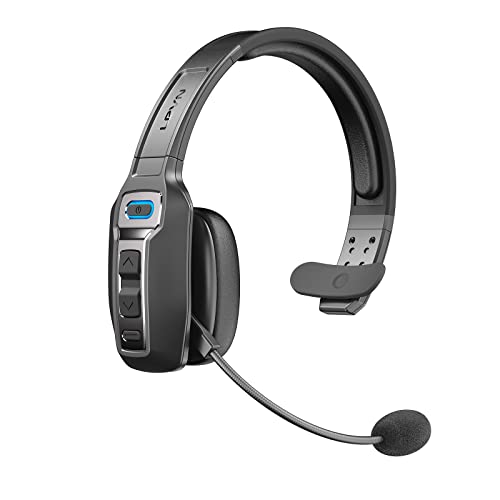
LEVN Bluetooth Trucker Headset — Longest claimed endurance
The LEVN headset builds its entire pitch around stamina, and for a long-haul driver that pitch lands on the right nerve. Sixty-five hours of working time, as the title states it, translates into a working week of calls, navigation prompts and dispatch check-ins between charges for many drivers, which changes the charging habit from a nightly ritual into an occasional one. Fewer charging sessions also means fewer mornings discovering a dead headset at the exact moment the first load call arrives, a small misery every experienced driver has lived through at least once.
Around that battery sits a fairly complete road feature set. The listing describes AI noise cancelling on the microphone, which this guide reports as the brand’s description of its processing rather than a verified measurement, plus a dedicated mute button placed where a thumb can find it without a mirror check. The on-ear single-sided format keeps the road ear open, and the headset is pitched at home-office and remote work as well as trucking, so a driver whose week mixes cab days with paperwork days is not buying two different tools for two halves of the same job.
Where the LEVN asks for trust is longevity of the claim itself. A big battery figure in a title is easy to print and harder to honour after a year of heat cycles in a parked cab, so the sensible reading is to treat 65 hours as the ceiling the brand asserts and to value the headset because even a generous discount on that figure still leaves a multi-day reserve. Drivers who pair to a phone only, want the fewest charging interruptions on offer here, and prefer a mute control they can stab blind will find this the most straightforward recommendation in the set.
Ownership details reward a look before the first route. Keep the charging cable in the cab rather than at home, because a headset with this much claimed reserve tempts you to forget charging until the reserve is suddenly gone, and the day it happens will be the day dispatch cannot stop calling. The on-ear cushion will also collect the dust of a working cab faster than an office cushion ever does, so a weekly wipe keeps both comfort and microphone openings honest. Drivers upgrading from a basic earpiece will feel the difference most in call endings: a physical control you trust ends conversations cleanly instead of leaving you fishing for a phone screen at a junction.
- Format: single-ear on-ear Bluetooth headset
- Claimed working time: 65 hours in the listing title
- Microphone: boom design with brand-described AI noise cancelling
- Controls: dedicated mute button on the headset
- Stated roles: trucking, home office, remote work and video calls
Strengths
- Largest endurance claim in this pool, reducing charging to a weekly habit for many drivers
- Physical mute button suits quick privacy during yard and fuel-stop conversations
- Single-ear layout preserves awareness of traffic, load noises and spoken instructions
Trade-offs
- Battery figure is a title claim, so real-world life will vary with call volume and temperature
- On-ear cushion presses on the ear itself, which some drivers feel more by hour eight
- No ingress-protection rating appears in the title for wet loading-bay work
Best for: drivers running multi-day routes who charge at home weekly and want a phone-first headset with a proper mute button.
Not suited for: drivers who want a certified dust and water rating, or anyone who prefers a cushion that surrounds the ear completely.

BlueParrott B350-XT — Weather-sealed road veteran
BlueParrott built its name in cabs long before Bluetooth headsets became office furniture, and the B350-XT shows that heritage in its priorities. The title states an IP54 rating, which speaks directly to the parts of trucking that happen outside the cab: coupling trailers in drizzle, checking straps in a dusty yard, walking a load in wind that carries grit into everything. Most headsets in this pool say nothing about sealing at all, so a stated rating, modest as it is, marks a genuinely different design brief rather than a marketing garnish.
The brand’s headline cancellation figure, quoted in its title as 96 percent, belongs to the microphone story and should be read exactly that way: a claim about how much surrounding noise the microphone system intends to reject before your voice reaches the call. This guide repeats it as the manufacturer’s claim, not as a bench result. What supports the claim structurally is the long, deliberate boom that places the microphone close to the mouth, the geometry that has always separated serious voice headsets from earbuds pretending at the job.
Talk time is stated at 24 hours, one full day of heavy calling rather than a week of light use, so this headset suits a nightly or every-other-night charging habit. The lightweight build the title mentions matters at hour ten, and the single-ear format keeps the traffic ear available. Choose the B350-XT when your working day regularly leaves the cab, when weather and dust are part of the job description, and when a proven trucking brand’s boom design reassures you more than a giant battery number printed by a newcomer.
Think about the B350-XT as equipment rather than electronics and its choices make sense. The sealing, the boom and the day-long battery all serve a driver whose workplace includes a yard, a dock and a fuel island in all weathers. It will not pamper you with the plushest padding in the family, and it will not pretend to entertain you at night, but it answers the conditions that actually damage headsets in service: water, grit and being knocked off a seat onto a cab floor. For fleets buying for several drivers, that durability-first brief also simplifies training, since the controls and wearing style stay consistent from one unit to the next across the whole pool of spare headsets.
- Format: single-ear Bluetooth headset for drivers
- Claimed talk time: 24 hours in the listing title
- Protection: IP54 rating stated in the title
- Microphone claim: brand-stated 96 percent noise cancelling, microphone side
- Build emphasis: lightweight frame for all-day wear
Strengths
- Stated IP54 sealing answers dust and rain exposure that rivals here leave unaddressed
- Long boom geometry gives the microphone its best chance against cab noise
- A full day of claimed talk time covers the heaviest calling schedules
Trade-offs
- Twenty-four hours means regular charging, unlike the multi-day claims elsewhere in this pool
- Single-ear audio will not satisfy drivers wanting music in both ears at rest stops
- The utilitarian styling is workwear, plain and simple, with no lifestyle finish
Best for: drivers whose shifts include regular outdoor loading work in poor weather and who value sealing over battery bragging rights.
Not suited for: drivers chasing the longest possible interval between charges or wanting stereo listening on breaks.

BlueParrott B450-XT — Padded comfort choice
The B450-XT answers a different complaint from its B350 sibling. Where that headset spends its design budget on sealing, this one spends it on padding, and the title says so directly with its padded comfort wording. Drivers who keep a headset on through driving, waiting, loading supervision and paperwork feel pressure points as the day’s dominant problem, and a plusher headband and cushion arrangement addresses the ache that makes people tear a headset off before the call that matters arrives.
Its noise-cancelling claim matches the family figure, again quoted in the title as 96 percent and again a microphone-side brand claim rather than a measurement this guide can stand behind. The boom, the control layout and the general road intent mirror the sibling model, which makes the choice between them unusually clean: same brand philosophy, same claimed talk time of 24 hours, different answer to whether weather or wear comfort threatens your day more often. Few product families offer so tidy a fork, and the guide keeps both precisely because the fork is real.
Consider how the two would age in service. The padded model invites being worn constantly, which suits owner-operators who take every business call personally and dispatch themselves from the driver’s seat. The absence of a stated ingress rating does not make it fragile, but it does mean the brand chose not to certify the point, so a driver regularly soaked at flatbed work should weigh the sibling more heavily. For cab-based long-haul work where the headset rarely leaves your head, this is the BlueParrott that treats comfort as the specification that decides satisfaction.
A detail worth weighing is how padding changes behaviour. Drivers who find a headset comfortable stop removing it between calls, which means they answer faster, miss fewer instructions and stop leaving the headset on the bunk where it gets sat on. Comfort is therefore not a luxury line in this review but an operational one, and the B450-XT is the pick that treats it that way. If your current headset gives you a sore spot by lunch, this is the model in the pool aimed squarely at your complaint, and the fair test is a full week of shifts rather than a five-minute try-on at a counter.
- Format: single-ear Bluetooth headset with padded build
- Claimed talk time: 24 hours in the listing title
- Microphone claim: brand-stated 96 percent noise cancelling, microphone side
- Comfort emphasis: padded headband and cushion arrangement per the title
- Brand line: BlueParrott XT trucking headset family
Strengths
- Padding-first design targets the pressure fatigue of truly all-day wear
- Shares the family’s long-boom microphone approach for cab voice pickup
- Clear, honest differentiation from its sibling makes the buying decision simple
Trade-offs
- No ingress rating is stated, so wet-weather confidence rests on general build quality
- Claimed talk time still asks for charging every day or two of heavy use
- Drivers wanting the lightest possible frame may prefer the sibling’s leaner build
Best for: owner-operators and long-haul drivers who wear one headset through the whole working day and feel fit before features.
Not suited for: flatbed and tanker drivers regularly working outside in rain who need a stated sealing rating.

Trucker Bluetooth Headset 55Hr — Dual-microphone value pick
This unbranded-by-design listing competes on a simple spreadsheet: dual noise-cancelling microphones, a mute button, and 55 hours of working time claimed in the title, aimed at drivers who want the specification sheet of the premium names without paying the premium. The dual-microphone idea is sound in principle, since comparing signals between two pickup points is one legitimate way to separate a voice from a background wash, though the title’s phrasing remains a brand claim about performance rather than a result anyone has published from a test rig.
The listing also reaches beyond the cab, naming cell phones and computers among its intended partners, which hints at the double life many of these value headsets lead as call-center and home-office gear. That breadth cuts both ways. A headset tuned to be acceptable everywhere rarely receives the cab-specific obsession of a BlueParrott boom, yet for a driver whose calls are frequent but short, and whose budget decision is genuinely tight this month, acceptable everywhere may be the correct purchase rather than a compromise to apologise for.
Think of this pick as the pool’s measuring stick for value. It forces the honest question the expensive names must answer: what exactly does the extra money buy beyond this feature list? Sometimes the answer is sealing, sometimes padding, sometimes dealer support when a boom snaps in month nine. Drivers who already know they treat headsets as consumables, replacing them when they tire rather than repairing them, will find the arithmetic here persuasive, and pairing it with the desk-side perspective in best call center mono wired headsets shows how similar hardware serves a very different room.
There is also a sensible fleet argument hiding in this value pick. Small operators equipping several drivers often cannot justify premium headsets for seats that change hands, and a capable dual-microphone model at the value end lets every driver have a personal headset instead of sharing one, which is better hygiene and better accountability. Keep expectations set at purchase: record the order details, keep the packaging through the first month, and treat the first unit as a trial before buying for the whole yard. That cautious pattern turns a budget gamble into a measured procurement decision.
- Format: single-ear wireless headset with boom microphone
- Claimed working time: 55 hours in the listing title
- Microphone: dual noise-cancelling arrangement per the title
- Controls: mute button included on the headset
- Stated partners: cell phones and computers
Strengths
- Dual-microphone layout is a credible structural answer to cab background noise
- Long claimed endurance rivals headsets costing considerably more
- Mute button included, which is not guaranteed at the value end of this market
Trade-offs
- Value-brand support and spare-part availability are thinner than the established names
- Cancellation performance is asserted by the listing, not independently documented
- Materials and hinge durability are the usual places value engineering quietly shows
Best for: budget-conscious drivers who replace headsets as consumables and want long claimed battery life with a mute control.
Not suited for: drivers who keep equipment for years and value a deep dealer and accessory network behind the purchase.

Sarevile Trucker Bluetooth Headset — Office-crossover single ear
Sarevile’s headset wears its crossover openly: the title addresses the driver, the office and the call center in one breath, and backs the claim with Bluetooth 5.2, a newer radio generation than much of this pool advertises. A newer Bluetooth version generally promises steadier pairing behaviour and better power manners, though the practical difference a driver feels is mostly in reconnection speed when climbing back into the cab and the phone wakes the link before the door closes.
The microphone story leans on upgraded AI noise cancelling, the listing’s own words for its processing, and as with every similar phrase in this guide that is a description of intent rather than a verified outcome. The on-ear single-sided shape keeps the standard trucking bargain: one ear for the call, one ear for the world. A mute function is included for the moments a dispatcher should not hear the yard, the customer or the radio commentary you were enjoying between calls.
This is the pick for the driver whose employment shape is hybrid. Regional drivers who finish the day handling customer calls from a home desk, agency drivers who sit in call queues between assignments, and anyone whose employer issues a laptop for evening administration will appreciate a headset that never looks out of place in either setting. It concedes the sealing of the B350-XT and the giant battery claims of the LEVN, and in exchange offers the most desk-plausible face in the pool while remaining, at heart, a single-ear road tool.
The Sarevile also deserves credit for restraint in its promises. Beyond the upgraded-microphone wording it does not chase the pool’s biggest battery number or invent a sealing rating it does not claim, and its specification reads like a tool for people who move between a steering wheel and a desk chair in the same shift pattern. Pair it once with the phone and once with the laptop, learn which device wins when both are nearby, and the crossover life becomes routine rather than a daily pairing argument. For agency drivers whose assignments change weekly, that flexibility may outrank every other virtue in this guide.
- Format: single-ear on-ear Bluetooth headset
- Radio: Bluetooth 5.2 stated in the listing title
- Microphone: upgraded boom with brand-described AI noise cancelling
- Controls: mute function included
- Stated roles: driver, office and call center work
Strengths
- Newer Bluetooth generation supports quick, tidy reconnection habits
- Crossover styling and function suit drivers with desk-based evening duties
- Mute control included for professional call handling in noisy places
Trade-offs
- No talk-time headline as dramatic as the pool’s endurance leaders
- No stated ingress protection for outdoor loading work
- AI cancellation wording is the brand’s own and should be read as aspiration
Best for: regional and agency drivers whose work alternates between driving and desk-based calling in the same day.
Not suited for: drivers wanting a certified weather rating or the longest claimed battery in the class.

TECKNET Bluetooth Trucker Headset — Convertible one-or-two-ear design
TECKNET’s entry refuses the pool’s central assumption. Every other pick here commits to one ear covered and one ear open, permanently. This headset converts, wearing as a single-ear trucking tool on the road and adding the second earpiece when the setting changes, which answers a real pattern in drivers’ lives: the same person who needs traffic awareness at noon wants full music or a film’s dialogue at a rest stop at night, and carrying two headsets for those two moods is clutter a cab does not need.
The title claims 50 hours of battery, a strong figure that sits just behind the pool’s endurance leader, and adds three EQ music modes, the only explicit music-tuning feature among the six. That detail signals the intended double life clearly. During calls the noise-cancelling microphone handles the voice work, and the listing positions the headset across PC, trucking and call-center use, so the convertible frame is asked to satisfy three rooms with one set of compromises, a harder brief than any sibling here attempts.
Judge it by whether the conversion will genuinely happen in your routine. A driver who never listens through a headset off duty gains nothing from the second earpiece and carries its extra parts for nothing. A driver who lives in the cab several nights a week, streaming entertainment where they sleep, gains a real second product inside the first. The mechanism’s long-term sturdiness is the fair question to bring to owner reviews, since moving parts earn their keep or become the failure point, and no title can settle that argument in advance.
One more scenario flatters the convertible design: team driving. When two drivers share a cab on alternating shifts, the resting driver often wants genuine two-ear listening to rest against engine noise while the working driver needs the same unit back in single-ear form at the changeover. A convertible headset serves both halves of that arrangement without a second purchase rattling around the cab. Just agree between you who owns the charging cable discipline, because shared equipment fails on shared assumptions faster than on any electronic fault this guide could name.
- Format: convertible single and dual ear Bluetooth headset
- Claimed battery: 50 hours in the listing title
- Audio extras: three EQ music modes stated in the title
- Microphone: noise-cancelling design for calls
- Stated roles: PC, truck driving, office and call center
Strengths
- Two wearing formats in one purchase cover driving and rest-stop listening
- Strong claimed battery life supports multi-day cab living
- Music EQ modes acknowledge the entertainment half of a driver’s week
Trade-offs
- Conversion hardware adds parts that a fixed single-ear design never risks
- Jack-of-all-trades tuning may satisfy purists in neither mode completely
- Heavier brief than rivals: it must prove itself as two products, not one
Best for: drivers who sleep in the cab several nights weekly and want one headset for calls and evening entertainment.
Not suited for: drivers who never listen off duty and prefer the simplicity of a fixed single-ear frame.
Which of These Six Earns the Passenger Seat on a Long Route?
Read across the rows and the pool’s personality shows itself: endurance claims climb from a single heavy day to a working week, sealing appears exactly once, and only one headset changes its physical shape. The right choice follows from which scarcity rules your week, charging opportunities, dry shelter or off-duty entertainment.
| Pick | Connection | Fit and form | Control style | Strongest suit |
|---|---|---|---|---|
| LEVN Bluetooth Trucker Headset | Phone-first Bluetooth | Single ear, on-ear | Dedicated mute button | Multi-day claimed endurance |
| BlueParrott B350-XT | Phone-first Bluetooth | Single ear, lightweight frame | Boom headset controls | Stated IP54 weather sealing |
| BlueParrott B450-XT | Phone-first Bluetooth | Single ear, padded build | Boom headset controls | All-day wearing comfort |
| Trucker Bluetooth Headset 55Hr | Phone and computer Bluetooth | Single ear, on-ear | Mute button on headset | Dual-microphone value package |
| Sarevile Trucker Bluetooth Headset | Bluetooth 5.2 pairing | Single ear, on-ear | Mute function included | Cab and desk crossover duty |
| TECKNET Bluetooth Trucker Headset | Bluetooth for phone and PC | Convertible one or two ears | Headset controls with EQ modes | Driving plus rest-stop listening |
What Should a Driver Actually Check Before Trusting a Headset With a Working Week?
Start with your charging reality rather than the largest number on a box. A driver home every night can treat 24 hours of claimed talk time as generous, while a driver out for six days should either chase the multi-day claims in this pool or build a cab charging habit around a 12-volt socket and a cable that lives in the door pocket. Battery claims are stated by brands under their own test conditions, so compare them as relative signals between these six rather than as promises engraved for your exact call volume, temperature and Bluetooth distance.
Next, rehearse the controls with gloves and motion in mind. The mute button, the answer control and the volume rocker should be findable by shape alone, because the moment you need them is the moment your eyes belong elsewhere. Boom adjustment deserves the same rehearsal: the microphone should sit near the corner of your mouth, return to that spot after being swung away for a drink, and hold its position over rough road surfaces rather than drifting south an inch every hundred miles.
Pairing behaviour is the third check, and it is where cheaper headsets often betray their owners. Watch how the headset behaves when the phone leaves the cab and returns, when a second device tries to claim the link, and when the truck’s own Bluetooth system competes for the same phone. Drivers researching the wider category often start from roundups like best bluetooth headsets for making phone calls and then narrow to cab-specific models for exactly these behaviours, since an office pairing routine that needs three menu dives is merely annoying at a desk and genuinely unusable at a fuel island.
Finally, interrogate the comfort story with your own head, glasses and cap in the picture. On-ear cushions interact with spectacle arms over hours, headbands share space with hat bands, and a rotating ear hook either suits your ear shape or quietly torments it. The only honest test is a full shift, so buy from a listing whose returns policy lets a headset fail that test without punishing you, and keep the packaging until the verdict is in.
How Do You Set Up and Use a Trucking Headset Well, Day After Day?
Setup begins before the first call. Charge the headset fully, pair it with the truck stopped and the parking brake set, then place a test call to a patient human and ask the only question that matters: how do I sound, honestly, at idle and then with the heater fan running? Adjust the boom during that call until your listener reports the clearest version, and note the boom’s position so you can find it again by touch. A two-minute ritual in a quiet yard buys clearer calls for the life of the headset.
During the driving day, let the headset handle calls and keep the phone mounted and untouched, which is both the legal spirit of hands-free rules in most places and the practical route to fewer distractions. Use the mute control deliberately during stops, since a live microphone broadcasts yard conversations, customer names and load details to whoever waits on the other end. When a call ends, swing the boom up rather than removing the whole headset each time, and the fit you adjusted in the morning survives until evening.
Care habits decide whether a headset reaches its second year. Wipe the cushion after hot shifts, keep the charging port clear of the dust that cabs generate in industrial quantities, and store the headset on a hook or in a case rather than on the dashboard where summer heat cooks batteries. Once a month, unpair and re-pair the connection if small glitches accumulate, and check the maker’s page for firmware notes. None of this is glamorous, and all of it is the difference between a tool and a recurring annoyance.
Rest-stop listening deserves one boundary: keep entertainment volume low enough that alarms, announcements and a knock on the cab door still reach you, especially overnight in unfamiliar parking. Drivers who also keep a wired backup for dead-battery days will find the thinking in best wired headsets for truck drivers useful, because the cheapest insurance in trucking audio is an old cable in the glovebox that asks for nothing and works every single time.
Which Cab Habits Separate a Headset That Lasts From One That Disappoints by Spring?
Heat is the silent enemy nobody lists in a title. A headset left on a dashboard through a summer afternoon ages its battery faster than a year of careful use, and the same applies to a unit stored against a hot engine tunnel. Give your headset a shaded hook or a case in the door, and its second year will sound much like its first. Cold works the opposite trick, shrinking available charge on winter mornings until the cab warms, which is another reason to prefer claims with headroom over claims that merely cover a fair-weather day.
Voice habits matter as much as hardware. Speak across the microphone rather than directly into it, keep the boom a finger’s width or two from your mouth, and resist shouting over road noise, since a noise-cancelling system handles a steady voice better than a loud one and dispatch hears shouting as distortion. If your calls involve long reference numbers, slow down for those specifically; no microphone in this pool can rescue digits spoken at auction speed over a motorway.
Lastly, review your own setup every season. Routes change, phones change, and a headset bought for regional work may be asked to cover cross-country weeks it was never chosen for. The six picks here were sorted by the scarcities they answer, so when your scarcest resource changes, the right answer may change with it, and there is no shame in promoting a faithful headset to spare duty and choosing again with fresh eyes.
How Should a Fleet Buyer or Owner-Operator Compare These Six on Total Cost of Working Life?
Purchase price is the smallest honest number in a headset decision, because the working costs arrive later: the replacement cushion in month nine, the second unit bought after the first one’s boom loosened, the dispatch misunderstandings that cost a redelivery. A driver who answers forty calls a day should weight microphone clarity and control reliability as revenue equipment, while a driver who takes three calls a week can reasonably let battery convenience lead. Neither is wrong; they are simply running different businesses from similar-looking seats.
Warranty and support channels belong in that arithmetic even though listings rarely headline them. An established brand with a dealer network offers a route back when hardware fails mid-season, while a value listing offers a lower entry price and a more disposable logic. Decide which contract you are signing before the failure, not during it, and keep proof of purchase somewhere other than the cab, since cabs have a talent for swallowing paperwork exactly when a claim needs it.
There is also the question of standardising. A small fleet that settles on one model simplifies spares, training and driver swaps, and this pool offers two natural standards: the BlueParrott pair for durability-led operations and the long-battery LEVN pattern for endurance-led ones. Solo drivers face no such pressure and can indulge the convertible or crossover picks freely. Either way, write down why you chose what you chose; future you, standing in a truck stop in the rain with a dead headset, deserves to know what past you was thinking.
What Does a Good Test Call Reveal That a Specification Sheet Never Will?
Make the test call harder than a chat in a parked cab. Ask your listener to score you in three conditions: engine idling with the fan off, fan running hard, and a window opened a crack at low speed in a safe place such as an empty yard road. The differences between those three scores tell you where the microphone’s limits live, and whether boom adjustments move the score or merely move your optimism. A headset that holds its clarity across all three has earned its place for the motorway hours you cannot rehearse.
Listen in the other direction too. Incoming voices compete with the cab, so judge whether dispatch sounds present and intelligible at a volume that does not leave your ear ringing by evening. A single-ear headset concentrates all of that work into one ear, which makes per-call volume discipline a hearing habit worth building early. If you finish test calls with the volume pinned at maximum, the fit or the seal around that one ear deserves attention before the hardware takes the blame.
Finish the rehearsal with the paperwork of real life: end a call, redial, mute and unmute, and reject an incoming call, all without looking at the headset once. Every fumble you find in a quiet yard is a distraction you have just deleted from a rainy motorway. Drivers who skip this rehearsal tend to discover their headset’s control layout at the worst available moment, and the discovery is never remembered fondly by anyone sharing the road with them that day.
What Mistakes Do Drivers Make When Buying Their First Cab Headset?
The classic error is importing an office shortlist into a cab. A headset praised in a quiet open-plan office may fold completely against motorway drone, and its dainty controls may be unusable with work gloves. Buy for the loudest room you actually work in, which for a driver is a moving vehicle with the window cracked, and treat any review written from a desk chair as evidence about a different product’s natural habitat.
Believing the biggest printed percentage is the second error. Cancellation figures in titles are the brands’ own microphone claims, reached under conditions the listings do not describe, and two headsets claiming similar numbers can behave very differently against your engine note and your voice. Use the figures to sort marketing confidence if you like, but let boom design, microphone placement and owner reports from other drivers carry the real weight in the decision.
Ignoring the second ear’s job is subtler. New drivers sometimes buy stereo headsets for richer sound and then drive all day with one cup slid back, defeating the fit and the seal while gaining nothing. The single-ear format exists because the uncovered ear is safety equipment. If you truly want both ears covered at rest, the convertible TECKNET pattern solves the problem honestly instead of asking you to improvise with a stereo frame at motorway speed.
The last mistake is forgetting the ecosystem around the headset: the charger that lives in the cab, the case that keeps the boom straight in a door pocket, the spare cushion when the first one splits in month eight. Headsets rarely die dramatically; they fade through small neglects. Budget a little attention for the accessories and habits at purchase time and the pick you chose will still be the pick you would choose a year later.
A quieter mistake is buying for the truck you wish you drove. Drivers in new, well-sealed cabs can forgive a modest microphone that would disgrace itself in an older vehicle with tired door seals and a louder idle, while the reverse purchase wastes money on armour a quiet cab never needed. Be honest about your actual vehicle, its age and its noise at motorway pace, because the headset has to serve that truck, on that road, with your voice, and no listing photograph knows any of those three things about you.
Finally, do not let a headset become a reason to take calls you should park for. Complex load disputes, paperwork problems and anything needing notes deserve a stopped vehicle and a free hand for writing, whatever the headset promises. The best use of good hands-free gear is making simple calls effortless, not making complicated calls mobile, and experienced drivers draw that line firmly long before an employer or an officer has to draw it for them.
Final Recommendation
Whichever of the six you choose, give it one full working week before judging it, because first-day impressions in this category are dominated by unfamiliar fit while the real virtues, battery rhythm, control memory and microphone manners, only declare themselves across several shifts of ordinary work in ordinary weather with ordinary dispatchers.
If one recommendation must stand for most drivers, the LEVN takes it on the strength of its 65-hour claim and a control set shaped for blind use, because charging friction is the complaint that quietly kills more headsets than sound quality ever does. Drivers working outdoors in weather should step sideways to the B350-XT and its stated sealing, while those who feel every gram by evening should take the padded B450-XT just as seriously. The value dual-microphone pick, the crossover Sarevile and the convertible TECKNET each own a narrower but genuine brief, and none of the six requires you to pretend a percentage in a title was measured in your cab.
Match the headset to the scarcest thing in your working week, whether that scarcity is charging chances, dry weather, patience for pressure points or room for a second device, and the purchase will feel obvious in hindsight. When the boom sits right and dispatch hears your words instead of your engine, a good cab headset disappears into the working day so completely that you only notice it on the rare morning you leave it behind.
Frequently Asked Questions
Can I legally take calls on a headset while driving a truck?
Hands-free calling rules for commercial drivers are strict in many places and the details differ between jurisdictions, so treat this as general orientation rather than legal advice: a Bluetooth headset removes the handset from your hand, which is the behaviour the rules aim at, but your employer’s policy and the law where you drive decide what is permitted. Check both before relying on any headset as your compliance answer.
Why do the listings quote such high noise-cancellation percentages?
Those figures describe the microphone side of the headset and come from the brands’ own testing descriptions, so this guide repeats them strictly as claims. They signal that a maker has invested in separating voice from background noise, but they cannot tell you how the headset handles your engine, your wind leak and your voice together. Boom position and owner reports from drivers remain the practical evidence.
How long should a trucking headset battery really last me?
Compare the stated figures relatively: 24 claimed hours covers a day of heavy calling with nightly charging, while the 50 to 65 hour claims in this pool aim at multi-day routes. Real life trims every claim through call volume, cold weather and Bluetooth distance, so choose a claim with headroom over your longest stretch between reliable charging and you will rarely be caught out. As a planning habit, treat the longest gap in your route without a dependable socket as the true specification, then pick the claim that covers that gap twice over, because batteries age and a reserve that felt generous in the first month should still feel adequate in the twelfth.
Is a single-ear headset really better for driving than a stereo one?
For the driving hours themselves, yes, because the uncovered ear keeps you aware of traffic, the vehicle’s own warning sounds and people speaking outside the cab. Stereo listening has its place at rest stops and overnight, which is why the convertible pick in this guide exists. What you should not do is wear a fixed stereo headset half-on while moving and call the compromise safe.
What should I do when callers say I sound distant or muffled?
Work through the cheap causes first: reposition the boom closer to the corner of your mouth, confirm the microphone opening is not clogged with dust, and test again at a standstill to separate fit problems from road noise. Then re-pair the headset and check for firmware updates. If the complaint survives all of that, the microphone itself is the limit and a different pick from this pool is the honest fix.
Does an IP54 rating mean I can wear the headset in heavy rain?
An IP54 rating, as stated for the B350-XT, speaks of protection against dust and splashing water rather than immersion or driving rain, so read it as confidence for drizzle, spray and dusty yards rather than a licence to work a storm in it. Dry the headset before charging, and remember that no other pick in this pool states a rating at all.
Related Guides
Drivers weighing formats should read the desk-side counterpart in best call center mono wired headsets to see how the same one-ear idea serves a room that never moves, then compare the lighter commuter class in best mono bluetooth headsets before deciding how much battery and boom their own route truly demands.
Long attention is a skill both articles respect — the driver on the interstate and the pupil at the kitchen table — and our guide to the best tablets for 5th graders builds for the younger of the two.
After a day of dispatch voices, the evening version of the headset question is about cinema sound, and our guide to the best wireless tv headsets dolby 5.1 takes it from there.


