What's inside
- Key Takeaways
- Quick Picks
- How Did We Choose the Best Bluetooth Speakers to Fill a Large Room?
- How Do the Best Bluetooth Speakers to Fill a Large Room Compare?
- What Actually Makes a Speaker Fill a Large Room?
- Where Should You Place a Speaker in a Large Room?
- What Are the Most Common Mistakes When Buying a Speaker for a Big Space?
- How Do You Know Your Room Is Actually Filled?
- When Does a Large Room Need Two Speakers Instead of One?
- How Should You Set Up a New Speaker During Its First Evening?
- What About Bluetooth Range, Walls and Interference in a Big Space?
- Final Recommendation
- Frequently Asked Questions
- Related Guides
As an Amazon Associate I earn from qualifying purchases. This post may contain affiliate links at no extra cost to you.
gizmoverdict.com is reader-supported. When you buy through links on our site, we may earn an affiliate commission.
Where to buy: Each of the six speakers in this guide links to a listing checked against this site’s verified product pool, so the model name, finish and feature set on the page you land on match the speaker described here. This guide prints no prices and no star ratings; battery figures and weather ratings are the makers’ own published numbers, quoted so you can compare like with like.
The best bluetooth speakers to fill a large room solve a problem that has nothing to do with Bluetooth itself. A big room — a vaulted living space, a long open-plan kitchen and lounge, a hall you rent for birthdays — swallows sound. A small speaker that sounds full on a desk turns thin and shouty when you ask it to cover forty square metres, because the air volume, the distance to the far wall and the number of soft bodies absorbing midrange all work against it. Filling that space takes driver area, amplifier headroom and a cabinet voiced to project, and the six speakers below earn their places by delivering those things in six different shapes: two plug-in Marshall home speakers, a light-show party box from JBL, a wheeled boombox from Sony, a proper PA cabinet from Bose and a rugged portable that punches far past its size.
Notice what this list is not. It is not a ranking of the loudest speakers money can buy, and it is not a set of near-identical cylinders separated by colour options. The Woburn III never leaves the house and never wants to; the SoundLink Max is built to be carried out of it. The S1 Pro+ is a working musician’s tool that happens to stream Bluetooth beautifully. Choosing between them is really choosing how your large room gets used — film nights and records on a sideboard, garden parties that drift indoors, rehearsals, events — and the detailed sections below take each speaker on those terms, with the trade-offs stated plainly rather than smoothed over.
Key Takeaways
- Room-filling output comes from driver size and headroom, not from a wattage number on a box — every pick here was chosen for how it behaves at the far end of a long room, not at arm’s length.
- The list splits cleanly into plug-in home speakers (both Marshalls), battery portables (JBL, Sony, Bose SoundLink Max) and one true PA system (Bose S1 Pro+); decide which family your room belongs to before comparing models inside it.
- Placement does half the work: a speaker on a sideboard near a wall gains free low-end reinforcement that the same speaker loses standing in the middle of the floor.
- Party features — light shows, microphone inputs, stereo pairing links — are worth having only if your gatherings actually use them; two picks here omit them entirely and spend the money on tone instead.
- Weather ratings matter only for the rooms that are not rooms: the Sony and the Bose portable carry real IP ratings for patios and halls with open doors, while the Marshalls are indoor furniture and should be treated that way.
- A large room rewards a speaker you can adjust from your seat — physical tone knobs, an app, or a remote habit — because nobody fine-tunes a system they have to cross the room to touch.
Quick Picks
| Pick | Badge | Why it earns its place |
|---|---|---|
| Marshall Woburn III | The sideboard flagship | The largest home speaker in this guide, with physical bass and treble controls, HDMI for the television and output that treats a big lounge as its natural habitat. |
| JBL PartyBox Encore Essential 2 | The party engine | AI Sound Boost, a dynamic light show, microphone and guitar inputs and Auracast linking — built for rooms full of people, not people listening quietly. |
| Sony SRS-XG500 | The indoor-outdoor boombox | IP66 sealing and a 30-hour battery claim in a carry-handle boombox that can anchor a hall party and then move outside without a second thought. |
| Bose S1 Pro+ | The working PA | A multi-position PA cabinet with wireless microphone and instrument transmitters — the pick for rooms where someone performs, presents or teaches. |
| Bose SoundLink Max | The rugged mover | IP67 waterproofing, a rope handle and 20 hours of playtime in the most carryable shape here, yet voiced to hold a large room together. |
| Marshall Acton III | The smaller room-filler | The Woburn’s recipe in a compact cabinet — same controls, same plug-in manners — for large rooms that are large by apartment standards rather than hall standards. |
How Did We Choose the Best Bluetooth Speakers to Fill a Large Room?
We started from the physics of the problem rather than from brand catalogues. A speaker fills a large room when it can move enough air at low frequencies to keep bass present at distance, hold its midrange together when the volume rises, and spread sound wide enough that the far corners are not a different, duller concert. That ruled out the entire class of pocket and desktop speakers regardless of how impressive their specifications look on paper, and it pushed us toward cabinets with real woofer area: home speakers with multi-driver layouts, party boxes built around large woofers, and PA designs whose horns are made to throw.
From there we sorted candidates by the job they would actually do in the room. A speaker that lives on a sideboard for a decade should be judged on tone controls, wired inputs and how it behaves at the modest volumes of daily listening as much as at full tilt. A speaker bought for events should be judged on battery endurance, inputs for microphones, and whether it survives being moved weekly. Mixing those criteria into one score would have produced a mushy ranking, so each pick below is presented as the strongest answer to a distinct version of the large-room question, and the comparison table later in this guide lines their stated features up side by side.
Finally, every model here was checked against the verified pool for this batch: the listing title, feature set and model variant were confirmed before any link was attached, so the speaker described in each section is the speaker its link leads to. Where a maker publishes a figure — a battery hour count, an IP rating, a playtime — we quote it as the maker’s figure. Where a detail is not stated, we say so rather than filling the gap with a plausible guess, and the buying-guide sections explain the general principles you can apply to any large-room speaker, including ones that did not make this list.

Marshall Woburn III — The sideboard flagship
The Woburn III is the speaker this guide would hand to a large room that behaves like a room: four walls, a television, a sofa at distance, and music that matters. It is Marshall’s biggest home cabinet, plug-in powered, with the brand’s guitar-amp styling worn openly — and underneath the styling sits a three-way layout with dedicated amplification for its drivers, which is precisely the architecture that keeps a big space sounding composed. Lesser Bluetooth speakers go harsh when pushed because one small driver is asked to do everything; the Woburn splits the work, so a film soundtrack at evening volume and a Saturday-afternoon record both arrive with their low end intact at the far sofa.
The controls deserve their own paragraph because they change how the speaker ages in your home. Brass-feel bass and treble knobs on the top panel let you correct for your room — tame the boom of a corner placement, lift the top end in a carpeted, curtain-heavy space — without opening an app or digging through menus. Add the HDMI input, which turns the Woburn into a television speaker that wakes with the set, plus RCA for a record player and a 3.5mm aux for anything else, and the cabinet quietly becomes the room’s entire audio system. Bluetooth is the everyday path, but it is not the only path, and in a large room that permanence is the point: this is furniture-grade audio that happens to stream.
- Format: plug-in home speaker, Bluetooth streaming
- Controls: physical bass and treble knobs on the cabinet
- Wired inputs: HDMI, RCA and 3.5mm aux, per the listing title
- Record player compatible, per the listing title
- Battery: none — mains powered
Strengths
- Three-way output with real headroom keeps big rooms full at both low and high volume, where single-driver speakers thin out or shout.
- HDMI television connection plus RCA turntable input makes it a complete living-room system rather than a streaming accessory.
- Hands-on tone knobs correct for placement and furnishings in seconds, with no app account or firmware ritual involved.
Trade-offs
- It goes where the furniture goes and no further — no battery, no weather sealing, no carrying it to the garden.
- The amp-stack styling is a strong visual statement that will either anchor your room’s look or fight it.
- Its size demands a proper sideboard or stand; perched on a narrow shelf it is both wasted and faintly precarious.
Best for: a large lounge or open-plan living space that wants one permanent, television-friendly speaker with room-filling authority.
Not suited for: a rented hall, a patio, or any room whose speaker has to travel — this cabinet’s whole design assumes it stays home.

JBL PartyBox Encore Essential 2 — The party engine
Some large rooms fill with people before they fill with sound, and the Encore Essential 2 is built for that order of events. JBL’s PartyBox line treats a speaker as event equipment: a dynamic light show that reacts to the music, inputs for a microphone and a guitar, app control, and AI Sound Boost, which the listing describes as the speaker’s way of pushing output while managing distortion. In a hall or a long living room with thirty guests absorbing sound with their coats and conversations, that combination — output, presence, and something for the person holding the microphone — is what “filling the room” actually means on the night.
The battery claim of up to 15 hours matters less for its length than for what it removes: the cable. A party speaker that must sit beside a socket dictates the room’s layout; this one can stand where the crowd is thinnest and the sound is needed most, then move outside for the last hour because the cabinet is splash proof. Auracast stereo linking lets a second compatible speaker join wirelessly, which is the honest route to filling a genuinely big space — two moderate speakers placed apart will always beat one heroic speaker in a corner, because the distance any listener sits from a source shrinks. If your large room regularly hosts gatherings, this is the pick that treats that as the main job rather than an edge case.
- Format: portable party speaker, battery powered
- Battery: up to 15 hours, per the listing title
- Extras: dynamic light show, microphone and guitar inputs, app control
- Linking: Auracast stereo link, per the listing title
- Protection: splash proof, per the listing title
Strengths
- Event features are genuinely integrated — lights, live inputs and app control — rather than bolted onto a home speaker as an afterthought.
- Wireless linking to a second unit scales the system to halls and double rooms without new cables or a mixer.
- Cordless placement freedom lets you put the sound where the room needs it instead of where the sockets happen to be.
Trade-offs
- The light show and party tuning are wasted on quiet, critical listening; its voicing aims at energy before subtlety.
- Splash proof is not waterproof — it shrugs off drinks and drizzle, not a dunking or a downpour left unattended.
- As a permanent living-room fixture it looks like what it is: event gear waiting for the next event.
Best for: hosts whose large room earns its size at parties, karaoke nights and family events with live microphones.
Not suited for: a reading room, a study, or a minimalist lounge where a glowing party box would be visually and sonically out of place.
Sony SRS-XG500 — The indoor-outdoor boombox
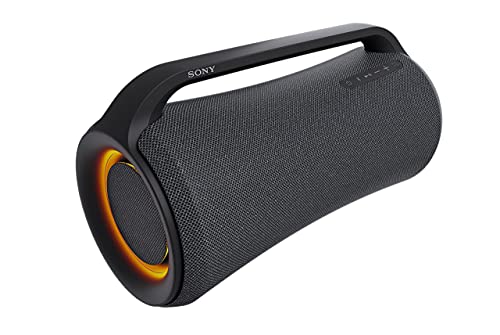
The XG500 revives the boombox idea at modern scale: a horizontal cabinet with a carry handle, built to be picked up and put down wherever the gathering currently is. Sony rates it IP66 for water and dust resistance and claims up to 30 hours of battery — the longest endurance figure in this guide — and pairs that with LED ring lighting for evening use. In a large room context, its talent is commitment-free coverage. It can sit in the kitchen end of an open-plan space all week as the house speaker, then walk out to the terrace, the garage or a hired hall without anyone asking whether it will survive the trip or outlast the event.
What separates it from the JBL above is temperament. The PartyBox is a performer; the Sony is a workhorse. Its boombox form spreads drivers across a wide front face, which suits long rooms where listeners sit along both sides rather than in one sweet spot, and the absence of microphone-and-guitar party framing makes it an easier housemate day to day. The ring lighting is present but the design reads as equipment rather than entertainment centre. For a big household space that doubles as a workshop, a games room or a covered outdoor area, that steadiness — huge battery, real sealing, grab-and-go shape — is a more useful kind of room-filling than raw spectacle.
- Format: portable boombox, battery powered, carry handle
- Battery: up to 30 hours, per the listing title
- Protection: IP66 water-resistant and dustproof, per the listing title
- Extras: LED ring lighting
- Inputs beyond Bluetooth: not stated in the listing title — verify with the maker’s documentation
Strengths
- The 30-hour battery claim dwarfs every rival here, making multi-day events and forgetful charging habits non-issues.
- IP66 sealing covers dust as well as water, which suits garages, workshops and beach-house rooms that defeat indoor speakers.
- Wide boombox stance fills long, narrow rooms evenly instead of beaming sound down a single axis.
Trade-offs
- Boombox proportions need a table, bench or floor space of their own; it is not a shelf-friendly object.
- No television input path is stated in the listing, so it should not be bought as a living-room TV speaker.
- Its utilitarian styling suits utility spaces better than a formal lounge.
Best for: big multi-use spaces — open-plan kitchens, games rooms, covered terraces — where the speaker migrates with the activity.
Not suited for: a dedicated listening room chasing refinement, or a TV-centred lounge needing an HDMI sound solution.

Bose S1 Pro+ — The working PA
The rest of this guide’s line-up centres on speakers built purely to play music; the S1 Pro+ is a public-address system that also plays music superbly, and in certain large rooms that distinction decides everything. Church halls, dance studios, classrooms, wedding venues, a big living room that hosts rehearsals and presentations — these spaces need a voice to reach the back wall clearly, a guitar or keyboard to sit properly in the mix, and a cabinet that can stand upright, tilt back or lie as a floor monitor depending on the hour. Bose builds the S1 Pro+ as a multi-position PA with wireless transmitters for microphone and instrument, so the performer is not tethered to the box by a cable across the floor.
As a pure Bluetooth music speaker it is, frankly, overqualified and slightly austere — there is no light show, no party theatre. What you get instead is projection: PA voicing is designed to throw intelligible sound across distance, which is exactly the failure mode of large rooms, where domestic speakers dissolve into ambience at the far end. Run it on its battery away from sockets, stream backing tracks over Bluetooth while a singer uses the wireless microphone, then pack it into a car boot. If your “large room” is a place where people gather to listen to someone, rather than a place where music accompanies something else, this is the honest professional answer in a consumer-sized cabinet.
- Format: multi-position portable PA system, battery capable
- Wireless: microphone and instrument transmitters included, per the listing title
- Positions: upright, tilted and monitor orientations in one cabinet
- Streaming: Bluetooth playback alongside live inputs
- Weather rating: not stated in the listing title — verify with the maker’s documentation
Strengths
- PA projection keeps voices and instruments clear at the back of halls where home speakers blur into background wash.
- Included wireless transmitters remove stage cables, speeding setup for teachers, celebrants and gigging singers alike.
- Multiple cabinet positions adapt one box to speeches, floor monitoring and room playback across a single event.
Trade-offs
- You pay for live-sound capability that a music-only household will never switch on.
- No stated weather rating in the listing, so outdoor use needs more caution than the sealed Sony or Bose portable.
- Its workmanlike appearance belongs on a stage or a classroom floor, not on a styled sideboard.
Best for: halls, studios and event rooms where speech, teaching or live performance share the space with streamed music.
Not suited for: a lounge wanting television HDMI and furniture styling, or a party host who wants lights and spectacle built in.

Bose SoundLink Max — The rugged mover
The SoundLink Max is the smallest cabinet in this guide and the argument that room-filling is about voicing and courage, not just bulk. Bose rates it IP67 — waterproof and dustproof to a standard that survives genuine outdoor life — gives it a rope handle, up to 20 hours of playtime and a built-in 3.5mm aux input beside its USB-C charging. It is the speaker you carry into the large room rather than the speaker the large room is built around: into the rented hall, the warehouse birthday, the big echoing kitchen of a holiday house where the installed audio is a television and optimism.
Its low end is the surprise guests comment on, because Bose tunes its portable line to sound bigger than the enclosure, and in practice that means a long room gets an even, warm coverage rather than a loud spot near the speaker and a thin zone at the back. No, it will not match the Woburn’s authority at full volume in a forty-metre lounge — physics keeps its vote — but it reaches the level where conversation has to rise, which is the practical definition of filling most real rooms. And when the event ends it goes back in a bag, shrugs off the rain on the way to the car, and asks nothing of the house it visited.
- Format: portable Bluetooth speaker, rope handle
- Battery: up to 20 hours of playtime, per the listing title
- Protection: IP67 waterproof, per the listing title
- Connections: USB-C charging, built-in 3.5mm aux input
- Party extras: none stated — no light show or microphone input in the listing title
Strengths
- IP67 sealing is the strongest weather rating here, suiting poolside rooms, boats and genuinely wet venues.
- Twenty hours of playtime covers a full event day without a charger hunt or a socket negotiation.
- The aux input rescues older sources — projectors, laptops, mixers — that lack reliable Bluetooth.
Trade-offs
- In the very largest lounges its small cabinet reaches its ceiling sooner than the Woburn or the party boxes.
- No stereo pairing or light features are stated in the listing, so spectacle seekers should look at the JBL.
- Premium portable pricing buys ruggedness and battery that a stay-at-home speaker simply does not need.
Best for: people whose large room changes weekly — hired halls, holiday houses, workshops — and who carry their sound with them.
Not suited for: a fixed lounge wanting the deepest, most effortless bass at reference volume from a permanent installation.

Marshall Acton III — The smaller room-filler
Not every large room is a hall. In a city apartment, “large” means an open-plan living and dining space that would swallow a bookshelf speaker whole yet has no sideboard long enough for the Woburn. The Acton III is Marshall’s answer at that scale: the same plug-in, amp-styled design in a compact cabinet, with the same physical bass and treble controls and a 3.5mm aux input beside Bluetooth. It fills its intended rooms — twenty to thirty square metres of living space — with the same composed, three-dimensional manner as its bigger sibling, just with a lower absolute ceiling.
The honest way to choose between the two Marshalls is by the far wall. Sit where you actually listen and measure the distance in your head: if the speaker must serve a sofa six or seven metres away across an open floor, the Woburn’s extra driver area earns its keep every single evening. If your listening happens within a typical apartment’s geometry, the Acton delivers the family’s sound, the tone-knob convenience and the record-player-friendly aux input in a footprint that fits a credenza, a kitchen worktop’s end or a wide shelf. It is also the natural second-room speaker in a house that already owns the Woburn — same controls, same character, no relearning.
- Format: plug-in home speaker, Bluetooth streaming
- Controls: physical bass and treble knobs on the cabinet
- Wired input: 3.5mm aux, per the listing title
- Battery: none — mains powered
- Television HDMI: not stated in the listing title — verify with the maker’s documentation
Strengths
- Marshall’s home-speaker voicing and hands-on tone controls in a cabinet that fits apartment furniture.
- Plug-in permanence means it is always ready — no charging rota, no dead battery before a dinner party.
- Aux input keeps turntables, CD players and older televisions in the system without adapters.
Trade-offs
- Its ceiling is real: in a hall-sized space it will sound strained where the Woburn still sounds relaxed.
- No battery and no weather sealing confine it to the home, full stop.
- Buyers wanting app-based multiroom features will find the Marshall approach deliberately old-school.
Best for: large-by-apartment-standards living spaces that want permanent, great-sounding Bluetooth without a giant cabinet.
Not suited for: a double-height loft or hired hall, where its output runs out before the room does.
How Do the Best Bluetooth Speakers to Fill a Large Room Compare?
| Speaker | Format | Power | Stated endurance / rating | Signature extra |
|---|---|---|---|---|
| Marshall Woburn III | Home speaker | Plug-in | No battery; indoor use | HDMI, RCA, tone knobs |
| JBL PartyBox Encore Essential 2 | Party speaker | Battery | Up to 15 hours; splash proof | Light show, mic/guitar inputs, Auracast |
| Sony SRS-XG500 | Boombox | Battery | Up to 30 hours; IP66 | LED ring lighting, carry handle |
| Bose S1 Pro+ | PA system | Battery capable | Rating not stated in listing title | Wireless mic/instrument transmitters |
| Bose SoundLink Max | Portable speaker | Battery | Up to 20 hours; IP67 | Rope handle, aux input |
| Marshall Acton III | Home speaker | Plug-in | No battery; indoor use | Tone knobs, aux input |
Read the table as a map of intentions. The two Marshalls trade mobility for permanence and tonal control; the JBL and Sony trade tonal subtlety for event stamina; the two Bose designs split the difference in opposite directions, one toward professional live work and one toward go-anywhere convenience. None of the six is a failed version of another — each is the right answer to a different large room, which is why the detailed sections above spend more time on use than on rankings.
What Actually Makes a Speaker Fill a Large Room?
Three physical factors decide whether a room feels full, and understanding them will save you from the two classic buying errors: paying for wattage theatre, and buying a lovely small speaker for a job it cannot do. The first factor is displacement — how much air the drivers can move. Bass frequencies are long waves that need volume of air shifted to register at distance, which is why every pick in this guide has either a large woofer, multiple drivers, or a cabinet engineered around passive radiators and porting. There is no software trick that repeals this; equalisation can rebalance a small speaker’s output, but it cannot manufacture the low-frequency energy the driver never produced.
The second factor is headroom, meaning the gap between the level you listen at and the level where the speaker begins to strain. A large room tempts you to keep turning up, and a speaker working near its limit hardens in the treble, compresses dynamics and fatigues listeners within the hour. Speakers with headroom sound relaxed at the same measured loudness, which is why a big plug-in cabinet like the Woburn feels effortless in a lounge while a compact portable at the same volume feels busy. When you audition or compare, the question is never “how loud does it go” but “how calm does it sound at the loudness my room actually needs.”
The third factor is dispersion — how widely the speaker spreads its midrange and treble. In a small room you sit in the beam and all is well; in a large room, listeners are scattered, cooking, talking, sitting at angles, and a narrow-dispersion speaker gives half of them a muffled version of the music. Wide-fronted designs like the Sony boombox, and PA cabinets whose horns are built to cover an audience, exist precisely to widen that beam. This is also why two smaller speakers placed apart so often beat one large speaker in a corner for real gatherings: coverage, not volume, was the missing ingredient.
Where Should You Place a Speaker in a Large Room?
Placement is the cheapest upgrade in audio, and in a large room it is worth more than the difference between most models. Start with boundaries: a speaker placed near a wall gains low-frequency reinforcement from that wall, and in a corner from two walls and the floor — free bass that costs nothing. The trade is precision; corners can boom. The tone knobs on the two Marshall picks exist for exactly this negotiation, letting you keep the reinforcement and trim the excess. As a rule, begin with the speaker on a solid surface, back near a wall, at roughly the ear height of seated listeners, then walk the room and adjust in small steps.
Height matters more than most buyers expect. Treble is directional, so a speaker on the floor firing at shins will sound dull everywhere except the front row, while the same speaker raised on a stand or sideboard opens up. This is why the S1 Pro+’s multi-position cabinet and pole-friendly PA design are practical features rather than spec-sheet decoration, and why boomboxes like the Sony assume a table or bench. For parties, raising the speaker above head height when the room is packed — safely, on a proper stand — lets sound travel over the crowd instead of being absorbed by the first row of bodies.
Furniture is part of the system whether you plan it or not. A speaker firing down the long axis of a room with a sofa at the end behaves differently from the same speaker firing across the short axis into curtains, and neither is automatically better — the long axis gives bass more distance to develop, the short axis gives listeners a nearer, clearer midrange. Try both orientations during your first evening if the furniture allows it; large rooms reward experimentation because their geometry varies so much from house to house, and a rotation that looks odd on a floor plan can be the one that evens out the corners where sound used to die.
Finally, think in zones. A long open-plan space often wants the speaker near the end where people gather longest, not centred mathematically in the room. Kitchen-diner layouts usually resolve to the dining end; lounge layouts to the seating end. If your gatherings split between two zones that neither serves well, that is the genuine use case for a linking system like the JBL’s Auracast — not louder sound, but nearer sound, with a speaker in each zone playing the same programme at civilised levels.
What Are the Most Common Mistakes When Buying a Speaker for a Big Space?
The most common mistake is buying for the room you wish you had. A speaker chosen for the one huge party of the year, then endured at arm’s length for the other 364 days, is the wrong speaker; conversely, a delicate desktop favourite asked to cover a wedding is equally wrong. Be honest about the room’s ordinary life and its exceptional days, and notice which picks above serve both: the portables earn their keep precisely because they can be ordinary house speakers most weeks and event speakers when it counts.
The second mistake is trusting a single number — watts, hours, or the size of the box in a photograph. Wattage figures are measured on each maker’s own terms and say little about room coverage; battery hours are quoted at moderate volume and shrink when the room demands more; and product photographs routinely make compact speakers look monumental. The checks that do predict satisfaction are the ones this guide leans on: driver layout, stated protection ratings, input selection, placement flexibility and the maker’s own description of what the speaker is for.
The third mistake is ignoring the source chain. Bluetooth from a phone across a long room, through a crowd, can stutter at the exact moment the room is fullest — which is why the aux inputs on the Bose portable and both Marshalls, and the HDMI path on the Woburn, are worth more than they appear. A wired fallback turns a potential party failure into a non-event. Relatedly, buyers often forget the room itself: hard floors, bare walls and high ceilings create echo that no speaker purchase fixes, while rugs, curtains and upholstered furniture do more for clarity than an upgrade tier ever will.
How Do You Know Your Room Is Actually Filled?
There is a simple field test that cuts through specification talk, and it works with any speaker you already own or any pick from this guide once it arrives. Put on a track you know well — something with a walking bassline, a centred vocal and some air in the recording — and set the volume so the music sits comfortably at your main seat. Then walk. Go to the far corner, the doorway, the kitchen end, the spot where guests actually end up standing with drinks. In a genuinely filled room, the vocal stays intelligible everywhere, the bassline remains a line rather than a suggestion, and no position sounds like a different, worse speaker. Where the sound collapses tells you what to fix: loss of bass at distance points to driver area and placement; loss of clarity points to height and dispersion; a boomy seat near the wall points to tone control, not volume.
Repeat the test with the room occupied if you can. People are soft, absorbent and numerous, and a gathering can eat several decibels of midrange that were present in the empty room — which is why event speakers like the JBL and the S1 Pro+ are voiced with a forwardness that seems assertive in an empty shop and exactly right in a full hall. If your speaker passes the empty-room walk but fails the full-room one, the answer is rarely a different single speaker; it is placement higher up, a second linked unit in the far zone, or accepting a PA-style design whose projection was built for crowds in the first place.
Also test at low volume, because large rooms live most of their lives there. Morning radio in a big kitchen, background music during dinner, a podcast while you work at the far end of the studio — these ask for bass that survives turning down. Many speakers quietly thin out at low levels as their tuning chases loudness, while the better home designs, the Marshalls especially, keep their balance because their amplifiers and tone controls were designed around domestic listening rather than demonstration volume. A speaker that only impresses loud will spend its life being apologised for.
When Does a Large Room Need Two Speakers Instead of One?
Length is the usual trigger. Once a room stretches past roughly ten metres, a single source at one end must be loud enough at the far end to overcome distance, which makes it too loud at the near end — the classic long-room trap of a hall, a barn conversion or an L-shaped open plan where the seating wraps a corner. Two speakers, each covering its own half at moderate level, give every listener a nearer source and a calmer overall sound. That is the scenario the JBL’s Auracast linking was designed for, and it is also why the S1 Pro+ is so often deployed in pairs at events even though one unit is impressively capable alone.
Shape can trigger it too. Rooms with alcoves, a kitchen island splitting the space, or a mezzanine create acoustic shadows that no single cabinet reaches without punishing the open areas. In those homes, a permanent speaker for the main zone plus a portable for the shadow zone — a SoundLink Max that also serves the garden — is a more flexible system than one giant fixed installation. The portable earns its keep twice, and the main room stops being a compromise.
What two speakers do not fix is a room whose problem is echo. A reverberant hall with hard walls will blur two speakers as happily as one, and the money is better spent on soft furnishings, rugs and curtains first, with the speaker choice made afterwards. Diagnose before you duplicate: clap once, sharply, in the empty room. If the clap rings and flutters, treat the room; if it dies quickly but the music still sounds distant, treat the coverage.
How Should You Set Up a New Speaker During Its First Evening?
Begin with the unglamorous steps. Charge battery models fully before the first real use, update nothing in a panic, and place the speaker where you honestly expect it to live — not in a flattering test position it will never occupy again. Connect the source you will use daily, whether that is a phone over Bluetooth, a television over HDMI on the Woburn, or a turntable through the aux or RCA path, and play the three recordings you know best: one vocal, one bass-heavy, one quiet and detailed. Familiar music exposes a new speaker’s character in minutes, while unfamiliar music mostly exposes the recording.
Then adjust in the right order. Placement first, in hand-span steps, listening from your real seat after each move. Tone controls second, in small turns, one knob at a time — the Marshalls make this tactile and quick, and the same discipline applies to app-based equalisers on the party models. Volume last: set the level where the room feels full during a chorus, then check that a whispered passage is still present rather than lost. Write down or photograph the settings that work; rooms get rearranged, speakers get moved for parties, and a note saves you re-deriving your own preferences every season.
Finish with the failure drills nobody does. Walk to the far end of the room with your phone in your pocket and confirm the Bluetooth link holds through the distance and the crowd positions; plug in the wired fallback once so you know the cable exists and works; and, for battery models, learn where the charge indicator sits before an event teaches you. Ten minutes of this turns the first real gathering from a technical debut into a non-event, which is the highest compliment a room speaker can earn.
What About Bluetooth Range, Walls and Interference in a Big Space?
Bluetooth range claims are measured in open air, and a large room is rarely open air in the ways that matter. The signal from your phone must cross the room’s longest diagonal, pass bodies at a party, and survive competition from the household’s other radios — Wi-Fi routers, microwave ovens, neighbours’ networks bleeding through party walls. In a small flat the speaker is never more than a few metres from the source and none of this registers; in a long lounge or a hall, the far-seat listener with the phone in a back pocket is a genuine test, and dropouts at the musical climax are the classic large-room complaint that has nothing to do with the speaker’s drivers.
Practical habits fix most of it. Keep the source in the same zone as the speaker when the room is full — a phone on the sideboard beside a Woburn will hold its link through an evening that defeats a phone carried around a crowd. Raise the speaker, because a cabinet at table height or on a stand has a cleaner radio path over furniture and people than one sitting on the floor behind a sofa. And know your wired escape routes before you need them: the aux inputs fitted to the Acton III and the SoundLink Max, the RCA and HDMI paths on the Woburn, exist partly as insurance, and a three-metre cable bought in advance costs less than the embarrassment of a silent room.
Codec talk deserves a cooler head than it usually gets. In a quiet small room with a revealing speaker, differences between Bluetooth codecs can be part of the listening experience. In a large, lively room — conversation, kitchen noise, the room’s own reflections — those differences sink below the threshold of what anyone can hear, while placement, headroom and coverage remain obvious to every guest. Spend your attention, and your money, in that order: coverage first, then placement, then the source connection, and only then the fine print of wireless formats. The picks in this guide were chosen on exactly that hierarchy, which is why a rugged portable with humble wireless specifications can out-serve a specification-rich speaker that cannot throw its sound across your floor.
One last large-room reality: volume etiquette scales with space. A speaker that fills a hall will also fill your neighbours’ evening if the room is a thin-walled apartment’s open plan, and the same headroom that makes the Woburn or the PartyBox glorious at a celebration makes them antisocial at midnight. The tone controls and app volume limits that look like minor features in a listing become the difference between a speaker the household loves and one it negotiates about — another reason the guide favours models whose control is immediate and physical wherever possible.
Final Recommendation
Match the speaker to the room’s real life and this decision becomes simple. For a permanent lounge system, the Marshall Woburn III is the guide’s first recommendation: it has the driver area, the tonal control and the television connection to serve a large room every day without drama, and the Acton III covers the same brief one size down. For rooms that host, the JBL PartyBox Encore Essential 2 brings the lights, inputs and linking that gatherings actually use, while the Sony SRS-XG500 is the tireless boombox for spaces that blur indoors and out. The Bose S1 Pro+ stands alone for rooms where people perform or present, and the SoundLink Max is the carry-in champion for spaces you do not own.
If the decision still feels tangled, reduce it to one question: where will this speaker be on an ordinary Tuesday? The model that fits that Tuesday — on the sideboard, in the kitchen, by the studio door — will also be the one within reach when the room fills for its biggest night, and a speaker that is present and understood beats a theoretically perfect one stored in a cupboard. Buy for the room’s habits, and the room’s occasions will take care of themselves.
Whichever you choose, spend the first evening on placement before you judge it — an hour of moving, raising and listening will teach you more about your room than any specification. A large room does not need the loudest speaker in the shop; it needs a speaker whose strengths are the room’s weaknesses, placed where the geometry helps instead of fights.
Frequently Asked Questions
Can one Bluetooth speaker really fill a hall-sized room?
One speaker can fill a hall for background music and speeches if it has genuine projection — a PA design like the S1 Pro+ or a large party box. For energetic party coverage in a true hall, two linked speakers placed apart will outperform any single unit, because listeners end up closer to a source and the level can stay civilised in both zones.
Is a plug-in speaker better than a battery speaker for a large room?
For a fixed room, usually yes: plug-in designs like the Marshalls spend their entire budget on drivers, amplification and cabinet, with no battery weight or cost, and they are always ready. Battery models win when the room changes, the sockets are in the wrong places, or the speaker also works outdoors — the choice is about your room’s habits, not a universal ranking.
What does an IP rating mean for a room speaker?
IP ratings describe protection against dust and water. IP66 on the Sony means dust-tight construction and resistance to powerful water jets; IP67 on the Bose SoundLink Max means it can survive immersion as rated by the maker. For purely indoor rooms the rating is irrelevant, but for conservatories, pool rooms, garages and covered terraces it is the difference between a speaker that lives there and one that visits.
Why does my current speaker sound loud nearby but weak across the room?
Sound level falls with distance, and small drivers lose low-frequency energy fastest, so the far end of a long room receives a thin, midrange-only version of the music. Raising the volume mostly makes the near end louder and harsher. The cure is a speaker with more driver area and headroom, better placement near a wall, or a second speaker serving the far zone.
Should I use the tone controls or leave them flat?
Use them — that is what they are for. Rooms impose their own tonal balance through size, furnishings and placement, and the flat setting is only a starting point. Small adjustments at the bass and treble knobs, made from your listening seat, correct most placement compromises. Change one control at a time and live with each change through a full track before deciding.
Can these speakers connect to a television?
The Woburn III states an HDMI input in its listing, which is the cleanest television path here, waking and playing with the set. The Acton III and SoundLink Max offer 3.5mm aux, which works with televisions that have a headphone or line output. The party and PA models are aimed at events and performance; check the maker’s documentation for any television use before assuming it.
How big is a “large room” for speaker purposes?
Think in terms of listening distance rather than floor area alone. Once your main seat sits more than about four metres from the speaker, or the room stretches past thirty square metres, small speakers start losing bass and composure at the levels the room asks for. Open-plan spaces count double: a kitchen-lounge may measure modestly on paper yet behave like a hall because sound escapes into the connected volume instead of being contained by four walls.
Does a speaker with a light show sound worse than a plain one?
Not inherently — the JBL in this guide is a serious output device — but the budget inside any product is finite, and lights, inputs and linking hardware are bought with the same money that could have gone to drivers. The right question is whether you will use the features. A host who runs karaoke nights gets full value from the PartyBox formula; a listener who never will is paying for a show that plays to an empty room.
Can I leave a plug-in speaker switched on all the time?
The Marshall home speakers are designed as always-available furniture audio, and standby convenience is part of their appeal — the television wakes the Woburn over HDMI without a separate power ritual. Battery models are the opposite case: they prefer to be charged, used and recharged rather than kept permanently tethered, and their makers’ guidance on long-term storage charge is worth following if an event speaker will sit idle between seasons.
Related Guides
Keep exploring speaker setups for other rooms and budgets: best computer speakers with subwoofer under 200 for desk systems with real low end, best tower speakers for music without a seperate sub if your large room suits floorstanding cabinets, and best desktop computer speakers with bluetooth under 100 for smaller spaces that still want wireless freedom.


