What's inside
- Where to buy
- Key Takeaways
- Quick Picks
- How Did We Judge Dash Cameras Meant to Be Witnesses?
- Why Do Sensors and Channels Matter More Than the 4K Badge?
- What Do Insurers and the Law Make of Dash Camera Footage?
- Which Dual-Channel Systems Guard Front and Rear?
- Which Cameras Serve the Front View, the Cabin, or the Connected Driver?
- How Do the Six Compare, Channel by Channel?
- What Do Dash Camera Buyers Most Often Get Wrong?
- What Powers the Camera While the Car Sleeps?
- How Should You Install and Live With a Dash Camera?
- How Should You Test a Dash Camera Before You Trust It?
- Which of These Cameras Fits Which Kind of Driver?
- Final Recommendation
- Frequently Asked Questions
- Related Guides
As an Amazon Associate I earn from qualifying purchases. This post may contain affiliate links at no extra cost to you.
gizmoverdict.com is reader-supported. When you buy through links on our site, we may earn an affiliate commission.
Where to buy
The best automobile dash cameras 4k uhd are bought for a moment their owners hope never happens, which makes them the most honesty-dependent purchase in this entire batch of guides. A dash camera’s specification sheet is written in peacetime; its value is decided in two seconds of wet road and bad decisions, when the only questions that matter are whether the plate of the other car is legible, whether the recording survived the impact, and whether the camera was awake at all. So this guide reads the six verified listings below the way an insurer would: channel by channel, because a system advertised as 4K may record its rear view at far less, and sensor by sensor, because the current generation of night sensors — STARVIS 2, named in four of these six titles — is the difference between a silhouette and a registration number. One pick below is not a 4K camera at all, and it is included, clearly labelled, because its maker chose field of view and connected features over resolution; a guide that hid that would be lying by shelving.
Everything quoted here traces to a listing title. Where a title states a channel’s resolution, that figure is used for that channel and no other; where a title is silent — on a rear camera’s existence, for instance — the spec boxes say so. Parking modes, radar, voice control, and card ceilings are all treated the same way, because a dash camera is a witness, and a witness whose testimony was embellished by its own buying guide helps nobody at the roadside. Hold that thought as the price of admission to everything below: this is a category where the marketing and the evidence are supposed to be the same document, and the six cameras here were chosen because their listings, read closely and literally, already behave that way — stating their sensors, separating their channels, and leaving their silences where a careful buyer can see them and ask the listing page to fill them.
Key Takeaways
- Read resolution per channel, never per box: the VIOFO A229 Pro’s title states 4K front and 2K rear, and the Vantrue N4 Pro S states three different figures for its three channels — 4K, 1080P, and 2.5K across front, inside, and rear.
- The Garmin Dash Cam 67W is a 1440p camera with an extra-wide 180-degree field of view, not a 4K model; it earns its place on connected features and coverage, and this guide labels it accordingly everywhere.
- STARVIS 2 sensors appear in the titles of both VIOFO picks, the Vantrue, and the THINKWARE — the night-legibility generation — with the A229 Pro naming its two sensors outright as the IMX678 and IMX675.
- Parking surveillance divides the field: buffered parking modes are stated by both VIOFO models and the Vantrue, while the THINKWARE U3000 adds a radar-based buffered parking mode per its title.
- Card ceilings matter at 4K bitrates: the Vantrue’s title states support up to 1TB, the largest storage figure in this guide, while the Garmin includes a memory card in its listing — two opposite philosophies of the same problem, one trusting the buyer to provision generously, the other refusing to let the camera leave the shop unable to record its very first journey home.
Quick Picks
| Pick | Badge | Why it earns its place |
|---|---|---|
| VIOFO A229 Pro 4K | The dual-sensor benchmark | 4K front and 2K rear recording on two named STARVIS 2 sensors, with buffered parking cover for the long hours the car spends alone and unwatched in the world every night. |
| VIOFO A119M Pro 4K | The discreet front camera | A mini 4K body on the STARVIS 2 IMX678, with Wi-Fi 6 and a supercapacitor built for the hard climates where ordinary cameras quietly die young. |
| Garmin Dash Cam 67W | The connected wide-eye | 1440p recording across a 180-degree view, with connected features, voice control, and a card included in the box from day one. |
| Nextbase 622GW | The feature flagship | Full 4K recording with image stabilisation, what3words location naming, slow-motion review, and Alexa built in for hands-free control on the move. |
| Vantrue N4 Pro S 4K | The three-channel guardian | Front, cabin, and rear coverage on triple STARVIS 2 sensors, with room for a 1TB card and infrared eyes for the dark interior on the longest night of the year. |
| THINKWARE U3000 | The radar-sentry flagship | 4K front and rear channels with radar buffered parking mode, a glare-cutting filter, and camera alerts for the road ahead on every journey, near or far. |
How Did We Judge Dash Cameras Meant to Be Witnesses?
We judged them as evidence machines. The first test was legibility: can this system, per its own title, record the front scene at 4K with a modern night sensor, because plate capture at dusk is the discipline’s defining exam. The second was coverage: how many directions does the system watch — front only, front and rear, or front, cabin, and rear — and at what stated resolution per channel, since a rear impact is exactly as common as a front one and considerably harder to argue about without footage. The third was vigilance: what the camera does while parked, because a large share of the incidents owners actually claim for — the car-park scrape, the overnight knock — happen with the engine off and the driver absent.
The fourth test was survival and civility: whether the design suits the climate it will bake and freeze in, and whether its connected features — Wi-Fi generations, voice control, alerts — serve the driver or merely decorate the box. Throughout, figures are quoted only where titles state them, per channel, per feature. A dash camera guide that rounds a 2K rear channel up to the headline 4K would be committing, in prose, the same offence these cameras exist to document.
We also weighted the unglamorous evidence of care in a listing itself. A title that names its sensors, states its channels separately, and admits its parking mode’s mechanism — as the strongest listings here do — is a maker describing a product it expects to be cross-examined. A title that shouts a resolution and hides everything else is asking to be believed rather than checked. Dash cameras are bought for the day belief runs out; this guide has consistently preferred the listings that behave as if they know it.
Why Do Sensors and Channels Matter More Than the 4K Badge?
Resolution is a count of pixels; legibility is what those pixels contain. At night, on a wet road, under sodium lights, the sensor decides legibility — and the current STARVIS 2 generation, named across four of these listings, exists precisely because its predecessors turned night plates into white flares. A 4K badge on an older, less sensitive sensor can lose the plate that a well-sensored 2K channel keeps, which is why this guide names sensors wherever titles state them and treats the IMX678 and IMX675 in the A229 Pro’s title as the most informative words in this entire comparison. Dynamic range rides with the sensor story: the camera must hold a dark cabin’s shadows and the oncoming headlights’ glare in the same frame, and HDR — stated in the Vantrue’s triple-sensor title — is the technology that attempts it.
Channels are the second half of the argument, because incidents have directions. A front-only camera tells half of most stories — the half where the other driver braked, not the half where yours was struck from behind at the lights. Rear channels record at lower resolutions almost everywhere, and honestly so: the A229 Pro’s stated 4K front and 2K rear pairing is the class’s sensible settlement, spending pixels where plates approach fastest. The cabin channel, the Vantrue’s third eye, serves a different master — rideshare and family accountability — and its infrared night vision, stated in that title, is the feature that makes a dark interior legible. Judge every system in this guide by asking, for each direction your life actually travels, which stated sensor and which stated resolution are watching it.
Field of view completes the triangle, and the two front-only flagships here stake its opposite ends: the Nextbase’s 140 degrees, chosen to keep plates near the edges readable, and the Garmin’s 180, chosen to lose nothing at the edges at all. Neither is the correct number in the abstract. The correct number is the one whose compromise matches your roads — the wide rural junction and the tight urban crossing will vote differently, and both votes are honest.
What Do Insurers and the Law Make of Dash Camera Footage?
A dash camera’s footage earns its keep in rooms the driver never enters: the insurer’s liability review, the police report, the small-claims hearing where two honest memories disagree. In those rooms, the qualities this guide has graded become legal qualities. Legibility decides whether the footage is evidence or merely atmosphere. A continuous, timestamped record — GPS-stamped where the titles state GPS, as four of these six do — corroborates speed, place, and sequence in a way a driver’s recollection cannot. And the buffered parking recording, which captures the approach before the impact, often supplies the single fact liability turns on: who moved first, and from where.
The obligations run the other way as well, and a responsible guide states them. Recording laws for audio vary by place, and cabin cameras — the Vantrue’s third channel above all — record passengers who did not choose to be witnesses; professional drivers should know their local rules and their platform’s policies, and private drivers should tell their passengers the camera is there. Mounting position has a legal dimension too: a camera that intrudes into the swept, visible area of the windscreen can itself be an offence in some jurisdictions, which is one more argument for the high, behind-the-mirror placement the installation section recommends. None of this diminishes the purchase; it disciplines it, the way the camera disciplines everyone else’s driving merely by being visibly present.
Which Dual-Channel Systems Guard Front and Rear?
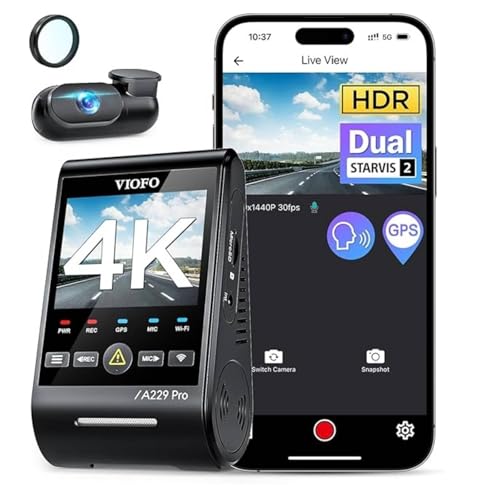
VIOFO A229 Pro 4K — The dual-sensor benchmark
The A229 Pro’s title is a model of how a dash camera should be described: 4K HDR front and rear system, dual STARVIS 2 sensors, 4K front and 2K rear, the sensors named as IMX678 and IMX675, 5GHz Wi-Fi, GPS, voice control, buffered 24H parking mode, and Night Vision 2.0. Every clause is a buying fact. The front channel gets the larger sensor and the full 4K, because that is where closing speeds are highest and plates must be read at distance; the rear channel gets its own STARVIS 2 sensor at 2K, which is the honest, sufficient settlement for the view behind. HDR on the front channel addresses the headlight-glare problem that decides night legibility. This is the system against which the rest of this guide is measured, because its title alone teaches a buyer how to read every other title here.
The buffered parking mode deserves translation, since it is the feature owners use most after the incident they bought it for. Buffered means the camera, when it senses an impact or motion while parked, saves footage from before the event as well as after — the approach of the other car, not merely its departure. Combined with the 5GHz Wi-Fi for faster transfers to a phone and GPS for the speed and location record, the A229 Pro covers the full evidentiary brief: what happened, where, how fast, and what led up to it, in both directions.
Its demands are the dual-channel class’s own: a rear camera to mount and a cable to route, an installation afternoon rather than a five-minute stick-on, and a card budget sized for two channels of high-bitrate recording. Owners who do the installation properly — cable tucked, rear camera centred, lenses cleaned — get the benchmark system of this guide. Owners who want the front view only, at the same sensor standard, should read the next pick before deciding they need less.
A note on its HDR, since the title leads with it and buyers deserve the translation: high dynamic range in a dash camera means each frame is built to hold the brightest and darkest evidence at once — the white van ahead in full sun and the plate in its shadow, the tunnel exit and the car emerging from it. Night is where HDR is marketed, but the tunnel mouth at noon is where it quietly earns its money, and the A229 Pro’s pairing of HDR with the IMX678 is the current class’s answer to that oldest of dash camera failures.
- Channels: front and rear, per the listing
- Resolution: 4K front, 2K rear — as stated per channel in the title
- Sensors: dual STARVIS 2, IMX678 front and IMX675 rear, named in the title
- Parking: buffered 24H parking mode, per the title
- Also stated: 5GHz Wi-Fi, GPS, voice control, Night Vision 2.0
Strengths
- The most completely specified system in this guide — sensors, channels, and resolutions all stated.
- STARVIS 2 at both ends gives the rear view night legibility most systems reserve for the front.
- Buffered parking recording captures the approach, not just the aftermath.
Trade-offs
- Dual-channel installation is an afternoon’s cable routing, not a stick-and-go job.
- The rear channel is 2K rather than 4K — the class’s honest settlement, stated plainly.
- Two channels of high-bitrate footage consume cards at twice the front-only rate.
Best for: drivers wanting the complete front-and-rear evidence system at the current sensor standard.
Not suited for: anyone unwilling to route a rear cable, who should take the front-only pick below.

THINKWARE U3000 — The radar-sentry flagship
The U3000’s title reads like a flagship’s manifesto: 4K dash cam, front and rear two-channel, STARVIS 2 sensor, super night vision, 5GHz Wi-Fi, GPS, a radar buffered parking mode, a CPL filter, red light and speed camera alerts, and an OBD cable in the proposition. Take the items in the order a driver feels them. The two channels on a STARVIS 2 sensor put it in the A229 Pro’s sensor class for night legibility, with the rear channel’s resolution not separately stated in the title — the spec box records that, and the listing page carries the figure. The CPL filter is a connoisseur’s inclusion: a polariser over the lens cuts windscreen reflections and dashboard glare from the recorded image, which is the difference, on a bright day, between a plate and a mirror of the sky.
The radar parking mode is the U3000’s signature idea. Conventional parking modes wake on motion or impact and spend the car’s battery doing it; a radar-based system watches for approaching movement with a fraction of the power draw, then buffers the event — the title’s phrase is radar buffered parking mode — so the camera can stand sentry for days rather than hours without flattening the battery it protects. For cars parked on streets, in shared garages, or at trailheads for a weekend, that endurance is the feature that decides whether parking cover exists in practice or only in the brochure.
The alerts and the OBD cable complete a flagship’s brief: red light and speed camera warnings serve the driver’s licence as the camera serves the insurance claim, and OBD power simplifies the hardwire that parking modes require. This is the most feature-complete listing in the guide, priced by its class accordingly, and aimed at the driver who wants the sentry, the witness, and the co-pilot in one windscreen unit — and who will read the listing page for the rear channel’s resolution before ordering, as this guide’s discipline requires.
The radar idea deserves one more sentence of appreciation, because it solves the parking mode’s oldest contradiction: a camera vigilant enough to matter is usually thirsty enough to strand you. By letting radar — a sense that sips — stand watch and waking the camera only for events worth filming, the U3000 extends the sentry’s shift from a night to a long weekend. Cars that sleep outdoors will feel that difference in the only currency parking modes trade in: incidents caught in month three, when lesser systems’ batteries gave up in week one.
- Channels: front and rear, two-channel, per the listing
- Front resolution: 4K, as stated; rear resolution not separately stated in the title — see the listing page
- Sensor: STARVIS 2, with super night vision, per the title
- Parking: radar buffered parking mode, as stated
- Also in the title: CPL filter, red light and speed camera alerts, OBD cable, 5GHz Wi-Fi, GPS
Strengths
- Radar parking surveillance watches for days at a fraction of conventional parking modes’ power draw.
- The included CPL filter fights the windscreen reflections that ruin bright-day footage.
- Camera alerts and OBD power make it the most complete single purchase in this guide.
Trade-offs
- The title does not state the rear channel’s resolution — confirm it on the listing page.
- Flagship completeness carries the flagship class’s cost and setup effort.
- Alert features depend on databases and regions; check coverage for where you drive.
Best for: street-parked and garage-parked cars needing a parking sentry that outlasts the weekend.
Not suited for: minimalists who want a front camera, a card, and nothing else to think about.
Which Cameras Serve the Front View, the Cabin, or the Connected Driver?

VIOFO A119M Pro 4K — The discreet front camera
The A119M Pro is the A229 Pro’s front channel, distilled into a mini body and aimed at the driver who wants the witness without the installation project. Its title states a 4K HDR mini dash cam on the STARVIS 2 IMX678 sensor — the same front sensor its dual-channel sibling carries — with Wi-Fi 6, quad-mode GPS, voice control, a buffered 24H parking mode, Night Vision, and one word that climate veterans will circle: supercapacitor. A supercapacitor power design replaces the lithium battery that swells and dies in hot windscreens; in cars that bake in southern summers or freeze in northern winters, it is the difference between a camera that lasts five years and one that lasts two. For a front-only camera, that endurance engineering is the specification that matters most after the sensor itself.
Wi-Fi 6 and voice control serve the same philosophy of low friction: footage off the camera quickly, settings changed by speaking rather than by menu-diving at a red light. The buffered parking mode carries over from its sibling, giving the parked car an event record with the moments before impact included — though a front-only camera’s parking witness faces one way, and owners should park with that in mind, nose toward the risk where the choice exists.
Choose the A119M Pro when the front view is the brief: the commuter whose risks approach from ahead, the second car in the family, the driver who will actually install a simple camera this weekend rather than a dual system never. Its ceiling is written in its format — nothing behind the car is recorded, ever — and within that ceiling it is arguably the most rational purchase in this guide: the benchmark front sensor, the hard-climate power design, and no cable routed to a rear window you did not need watched.
There is a fleet logic to this camera that private buyers can borrow: when an organisation outfits dozens of vehicles, it chooses exactly this profile — one excellent front channel, climate-proof power, fast wireless transfer, nothing else to break, train, or explain. A family with two cars and a teenager’s runabout is a small fleet with the same mathematics, and standardising on one simple, durable front camera across all three windscreens is a more professional decision than one flagship and two apologies.
- Channels: front only (no rear channel stated in the title)
- Resolution: true 4K with the IMX678 sensor, as stated in the title
- Sensor: STARVIS 2 IMX678, named in the title
- Power design: supercapacitor, per the title — the hot-windscreen endurance choice
- Also stated: Wi-Fi 6, quad-mode GPS, voice control, buffered 24H parking mode
Strengths
- The same IMX678 front sensor as the dual-channel benchmark, in a mini body.
- Supercapacitor power suits cars that bake or freeze where they park.
- Wi-Fi 6 and voice control keep the daily friction of ownership near zero.
Trade-offs
- Front only: a rear impact is witnessed by nobody.
- Parking cover faces forward only, so parking direction becomes a decision.
- Mini body means a small screen or none — check the listing for the interface you prefer.
Best for: front-view drivers in hard climates who value endurance and simplicity.
Not suited for: anyone whose incident history involves being struck from behind.

Vantrue N4 Pro S 4K — The three-channel guardian
The N4 Pro S is the maximalist of this guide: a 4K three-channel system on triple STARVIS 2 HDR sensors, with its title stating the full channel arithmetic — 4K plus 1080P plus 2.5K across front, inside, and rear — plus IR night vision, a 24/7 buffered parking mode, GPS, Wi-Fi, and support for cards up to 1TB. The three-channel layout serves the drivers whose risks genuinely come from all directions: rideshare and taxi work, where the cabin camera is both protection and professional standard; family cars, where the interior view settles every dispute about who did what; and any vehicle whose rear window has already met one uninsured bumper. The per-channel honesty of the title deserves the praise this guide keeps giving: three resolutions, all stated, none rounded up to the headline.
The cabin channel’s infrared night vision, stated in the title, is what makes the interior view real rather than theoretical — a dark cabin records as shapes without it, and as evidence with it. The 1TB card ceiling is the other quietly decisive figure: three channels of high-resolution footage consume storage at a rate that turns lesser ceilings into a day’s loop, and a card that holds weeks of driving is the difference between footage that exists when a letter arrives a fortnight later and footage the camera politely overwrote. The 24/7 buffered parking mode extends the same logic to the parked hours in all three directions at once.
The costs are the maximalist’s own: three cameras to mount, cables in two directions, the largest card budget in this guide, and a windscreen presence nobody would call discreet. For the professional driver those are overheads of the trade, amortised across every shift. For the private commuter they are probably a channel too far — which is exactly the kind of sentence a guide owes its readers, about the most capable system in its own roundup.
One constituency deserves a direct word: parents of new drivers. A three-channel record of a teenager’s first year — the road ahead, the road behind, and the cabin where the phone either was or was not in a hand — is the most effective driving instructor most families will ever employ, precisely because it says nothing at the time and everything afterwards. The N4 Pro S’s completeness, bought for that purpose, tends to pay for itself in habits rather than claims.
- Channels: three — front, inside (cabin), and rear, per the listing
- Resolutions as stated: 4K front, 1080P inside, 2.5K rear (in the title’s stated order of front, inside, rear)
- Sensors: triple STARVIS 2 with HDR, per the title
- Storage: supports cards up to 1TB, as stated
- Also stated: IR night vision, 24/7 buffered parking mode, GPS, Wi-Fi
Strengths
- Complete directional coverage — front, cabin, and rear — on current-generation sensors.
- The 1TB card ceiling keeps weeks of three-channel footage alive.
- Infrared cabin vision makes the interior channel genuine evidence after dark.
Trade-offs
- The most installation and the largest storage budget in this guide.
- A three-camera presence is the opposite of discreet.
- Private commuters will likely never use the cabin channel they paid for.
Best for: rideshare, taxi, and professional drivers, and families wanting total coverage.
Not suited for: drivers who value a clean windscreen and a five-minute install.
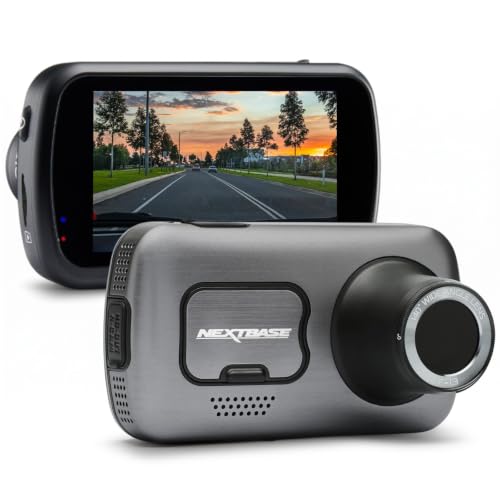
Nextbase 622GW — The feature flagship
The 622GW’s title announces a different philosophy of flagship: full 4K/30fps UHD recording, a 140-degree front view, Wi-Fi, GPS, Bluetooth, super slow motion at 120fps, image stabilisation, what3words, night vision, and Alexa built in. Two of those features are unique in this guide and both serve the incident itself. Image stabilisation steadies the recording against the vibration that a rigidly mounted camera transmits from the road — and a plate that vibrates is a plate half-read. What3words divides the world into addressed squares, so the camera’s location record can name a precise spot on an unmarked road — the difference, when reporting, between a stretch of dual carriageway and the exact three metres where it happened. The slow-motion mode serves the analysis afterwards, stretching the decisive second so the sequence can be read frame by frame.
Alexa built in and the Bluetooth and Wi-Fi pairing speak to the connected half of the brief — hands-free control in a car where the driver’s hands have a prior engagement, and footage that moves to a phone without a card reader. The 140-degree front view is a considered settlement: wide enough to hold the junction and both kerbs, narrower than the Garmin’s 180-degree extreme below, and therefore less stretched at the edges where plates live. Its title does not claim STARVIS sensors or a rear channel, and the spec box records those absences in this guide’s usual way — the 622GW’s case rests on its stated features, which are considerable, rather than on sensor branding it does not use.
Buy it as the polished, connected front camera of the group: the one whose incident workflow — stabilised capture, precise location, slow-motion review, voice control — has been thought about as a whole. Drivers who need a rear channel should pair that thinking with the dual systems above; drivers whose world is the front windscreen and the phone in their pocket will find the 622GW the most considered single camera here.
The slow-motion mode deserves its own honest paragraph, because it sounds like a toy and behaves like an expert witness. At 120 frames per second, the half-second in which a light changed, a wheel turned, or a pedestrian stepped becomes eight seconds of readable sequence — the order of events, which is what every disputed incident is actually about, laid out slowly enough for an insurer or a magistrate to follow without imagination. Few drivers will use it monthly; the one who needs it once will understand why it headlined this camera’s design.
- Channels: front (140-degree view); no rear channel stated in the title
- Resolution: full 4K/30fps UHD recording, as stated
- Distinctive features in the title: image stabilisation, super slow motion at 120fps, what3words
- Connectivity per the title: Wi-Fi, GPS, Bluetooth, Alexa built in
- Sensor branding: the title names none — the full listing carries the sensor details
Strengths
- Image stabilisation protects plate legibility against road vibration.
- What3words location naming makes incident reporting precise anywhere.
- Slow-motion review and voice control complete a thought-through incident workflow.
Trade-offs
- Front only as listed; rear coverage requires a different system or an add-on path to confirm.
- The title names no sensor generation, so night buyers should read the full listing.
- Connected features reward an app habit some drivers will never form.
Best for: connected drivers wanting the most polished front-camera incident workflow.
Not suited for: a driver who needs a rear channel in the same purchase.

Garmin Dash Cam 67W — The connected wide-eye
Now the honest outlier. The 67W’s title states 1440p recording — not 4K — across an extra-wide 180-degree field of view, in a compact and discreet body, with voice control, connected features for monitoring the vehicle while away, and a memory card included in the listing. In a guide titled by a 4K keyword, this camera’s presence needs its justification stated as plainly as its resolution: field of view is the other axis of evidence, and 180 degrees sees the junction entire — the car entering from the left kerb and the cyclist on the right in the same frame — where narrower cameras, however sharp, record a smaller world in finer detail. Some incidents are decided by what happened at the edge of the frame, and for those, width is the resolution that matters.
Garmin’s connected features are the second half of the case: a camera that can be checked and that can alert its owner while the car is parked elsewhere serves the anxiety that parking modes exist to answer, backed by the navigation company’s location pedigree. Voice control keeps hands where they belong. The included memory card, stated in the listing, means the camera records from the day it is mounted — a small completeness the other listings leave to the buyer. And the compact, discreet body suits drivers who dislike a windscreen that advertises its electronics.
The trade is stated without varnish: at 1440p, a distant plate at speed is a harder read than the 4K systems above will give, and no connected feature changes that arithmetic. What the width buys in exchange deserves equal plainness: the sides of the story. Junction incidents — the disputed light, the car that came from the side street, the cyclist at the edge — are precisely the incidents where liability is argued hardest and where a narrower camera’s frame simply ends before the evidence begins. Garmin built this camera for the argument, and city drivers lose that argument often enough to make the trade a rational one. Buy the 67W when coverage, connectivity, and discretion outrank ultimate legibility — city drivers in junction-dense traffic are its natural constituency — and buy any of the STARVIS 2 systems above when the plate at dusk is the whole point. A guide that pretended this camera was 4K would fail its readers; a guide that excluded it would fail the ones whose incidents happen at the edges.
- Resolution: 1440p — NOT 4K — as stated in the listing title
- Field of view: extra-wide 180 degrees, per the title
- Connected features: vehicle monitoring while away, per the title (app and services per the listing page)
- Included: memory card, as stated in the title
- Also stated: voice control, compact and discreet body
Strengths
- The widest view in this guide — whole-junction coverage in a single frame.
- Connected monitoring answers the parked-car anxiety directly.
- A memory card in the box makes it a complete purchase on day one.
Trade-offs
- 1440p legibility trails the 4K systems on distant plates, irreducibly.
- Front only as listed; no rear channel is stated in the title.
- Connected features depend on Garmin’s app and service terms — read the listing.
Best for: city drivers who value total junction coverage, connectivity, and discretion over ultimate resolution.
Not suited for: plate-at-distance purists, who should take any STARVIS 2 4K system above.
How Do the Six Compare, Channel by Channel?
| Camera | Channels | Stated resolutions | Sensor story | Parking story |
|---|---|---|---|---|
| VIOFO A229 Pro | Front + rear | 4K front, 2K rear | Dual STARVIS 2 (IMX678 + IMX675) | Buffered 24H mode |
| VIOFO A119M Pro | Front | 4K | STARVIS 2 IMX678, supercapacitor | Buffered 24H mode |
| Garmin 67W | Front | 1440p (not 4K), 180-degree view | Not stated in title | Connected monitoring features |
| Nextbase 622GW | Front | 4K/30fps, 140-degree view | Not stated in title | Not stated in title |
| Vantrue N4 Pro S | Front + cabin + rear | 4K + 1080P + 2.5K | Triple STARVIS 2 HDR | 24/7 buffered mode |
| THINKWARE U3000 | Front + rear | 4K front; rear not stated in title | STARVIS 2 | Radar buffered mode |
The table rewards a slow read. Four systems state STARVIS 2 sensors; three state a parking technology; exactly one states all of its channels’ resolutions in full — and the single 1440p entry sits there honestly labelled, because a comparison that cannot show a camera’s real figure cannot be trusted with anyone’s money. Choose your row by the direction your risks approach from, then by the hours your car spends parked.
What Do Dash Camera Buyers Most Often Get Wrong?
The classic error is trusting the headline resolution and never asking about the other channels — discovering, after a rear impact, that the camera that said 4K on the box kept its only 4K eye facing forward and a lesser one, or none, facing the direction the incident actually came from. The second is starving the camera of storage: 4K footage loops over a small card in days, so the incident from last week — the one the letter is about — has been politely overwritten by this week’s school run. Size the card to the system, as the Vantrue’s 1TB ceiling invites, and treat the card as a consumable that ages and should be replaced before it fails.
The third mistake is mounting for the driver’s view instead of the evidence’s: a camera hung low behind the mirror’s clutter, aimed at the bonnet’s shine, or left with a protective film ghosting its lens. Mount high, centre the horizon, clean the glass inside and out, and format the card in the camera on a rhythm. The fourth is forgetting the parked hours — buying a fine driving witness with no parking plan for the car-park reality where most minor incidents live. And the fifth, quietest mistake is never reviewing footage until the day it is needed, when a month of recordings of the headlining is discovered instead. Review a clip monthly; a witness should be cross-examined before the trial.
A sixth mistake has arrived with the connected era: assuming the app is the archive. Clips that live only in a phone app or a cloud trial are tenants, not owners, of your evidence; the card in the camera and a copy on your own drive are the freehold. Export the incidents that matter to storage you control, the same day, and let the connected features be the messenger rather than the vault.
What Powers the Camera While the Car Sleeps?
Every parking promise in this guide is, underneath, a power arrangement, and buyers should interrogate it as one. A camera plugged into a socket that sleeps with the ignition is a driving witness only, whatever its parking menu claims. True parking cover needs a supply that stays awake: a hardwire kit that draws from the fuse box with a voltage guard to protect the starter battery, an OBD connection of the kind the THINKWARE listing includes, or a dedicated battery pack for cars whose own battery must not be touched. Each route has its constituency — the hardwire for the permanent install, OBD for the reversible one, the pack for leases and warranties — and each deserves the same question: at what voltage does it stop, and how many nights of sentry duty does that buy in February?
The camera’s own power design writes the other half of the answer. Supercapacitor models, the A119M Pro being this guide’s example, tolerate the parked car’s thermal extremes that murder battery-based cameras in their second summer. Radar sentry modes stretch a finite battery across days by refusing to film an empty street. And every system here benefits from the oldest power discipline of all: a card and a camera checked often enough that a silent failure is discovered by its owner before it is discovered by an incident. Power is the least glamorous section of any dash camera guide and the one that decides whether the glamorous sections ever happen.
How Should You Install and Live With a Dash Camera?
Install once, properly. Choose the position behind the mirror where the camera sees through the wipers’ swept arc and sits inside the windscreen’s cleanest glass; route cables along the headlining and down the pillar with the airbag’s path respected — a cable draped across an airbag is a safety feature defeating another. For parking modes, the hardwire or OBD connection is the real installation, and it deserves either a careful hour or a professional’s; a parking mode that flattens the battery protects the car into immobility. Set the date, time, and time zone before the first drive, because testimony with the wrong timestamp argues with itself.
Living with the camera is a rhythm of small habits. Glance at its recording light or screen weekly. Pull one clip a month and read a plate from it at dusk, so legibility is verified rather than assumed. Clean both the windscreen patch and the lens when you clean the car. Replace the card on the maker’s rhythm rather than its failure’s. And after any incident, however minor, save the clip off the camera the same day — loop recording is a loyal servant with a short memory, and evidence, like the light in a landscape, belongs to whoever is organised enough to keep it.
How Should You Test a Dash Camera Before You Trust It?
Trust, for a witness, is earned in rehearsal. In the first week, drive one familiar route at dusk and pull the footage the same evening: pause on the plates of cars ahead at a realistic following distance, then oncoming, then at the junction where the light is worst. You are not grading the camera against a laboratory; you are learning what your witness can actually swear to, at your speeds, on your roads, behind your windscreen. Check the rear and cabin channels the same way, check a parking-mode clip for the buffer doing its stated job, and confirm the timestamp and GPS record against a journey you remember. Any disappointment found in rehearsal is a setting, an angle, or a card away from fixed; the same disappointment found after an incident is permanent.
Repeat the rehearsal seasonally, because the witness’s world changes: low winter sun attacks the lens from angles summer never uses, rain writes its own optics on the glass, and a card that was fast in spring can slow with age. The drivers who get their two seconds’ worth from these cameras are, without exception, the ones who already knew exactly what their camera could see — which is a sentence about rehearsal, not about resolution.
Which of These Cameras Fits Which Kind of Driver?
Guides end with recommendations, but drivers begin with lives, and the matching deserves one explicit pass. The commuter, whose risk is the twice-daily negotiation of the same junctions, is served by legibility ahead and reliability above all: the A119M Pro’s front sensor and climate-proof power, or the 622GW’s stabilised, connected polish. The professional — rideshare, delivery, the rep whose car is the office — lives in all three directions at once and parks in public: the Vantrue’s three channels or the U3000’s sentry, with storage sized like a business expense, because for this driver the footage is not protection but paperwork.
The family driver splits the difference: two channels for the school-run realities, a parking mode for the supermarket’s diplomacy, and a card big enough to survive the fortnight between the scrape and the letter — the A229 Pro’s exact brief. The rural driver, finally, should weight night legibility above everything, because their defining incident happens on an unlit road against an animal, a tractor, or a car on the wrong side of it: STARVIS 2 and HDR are their specification, whichever badge carries them. Read your own driving honestly against those four portraits and the shortlist in this guide usually shortens itself to one name.
Final Recommendation
Let the directions of your risk decide. For the complete two-direction witness at the current sensor standard, the VIOFO A229 Pro is this guide’s benchmark — 4K front, 2K rear, STARVIS 2 at both ends, buffered parking cover. The THINKWARE U3000 matches its sensor class and adds the radar sentry and the reflection-cutting filter for cars that live parked. Take the Vantrue N4 Pro S when the cabin is part of the brief and storage can be sized to match; take the VIOFO A119M Pro when the front view, a hard climate, and a simple install are the whole requirement; take the Nextbase 622GW for the most polished connected front-camera workflow. And take the Garmin 67W knowingly — for its whole-junction width and its connected calm, at 1440p, with its resolution stated as plainly in your decision as it has been in this guide. Whichever camera you mount, mount it this week and review its first dusk clip before the month turns: a dash camera’s value is never in its specification, only in the two seconds when the road stops being predictable — and on that day, the best camera is simply the one that was awake, honest, and watching in the right direction. Buy it before the journey you cannot repeat, install it like you mean it, and then do the hardest thing this entire category asks of its owners, which is to forget it completely — to drive for years beneath a small, patient witness you never think about, until the one afternoon it thinks for you, and hands you the truth about two seconds that everyone else at the roadside is already remembering differently.
Frequently Asked Questions
Is the Garmin 67W a 4K camera?
No. Its listing states 1440p recording, and this guide has labelled it that way throughout. It earns its place with an extra-wide 180-degree view, connected monitoring features, voice control, and an included memory card. If 4K legibility is your priority, choose one of the STARVIS 2 systems above it in this guide.
What does a buffered parking mode actually record?
When the parked camera detects an event, a buffered mode saves footage from before the trigger as well as after it — the other car’s approach, not only the impact and departure. Both VIOFO picks and the Vantrue state buffered parking recording in their titles; the THINKWARE uses a radar-based version that watches with far less power draw.
Why do rear channels record at lower resolution than front channels?
Because the industry spends its pixels where closing speeds and plate distances are greatest — ahead. The A229 Pro’s stated pairing of 4K front and 2K rear is the class’s typical settlement, and honest titles state both figures. Judge a dual system by both numbers, never by the headline alone — and remember that a 2K rear channel on a modern sensor still out-reads, at night, the 4K front channels of only a few model years ago, which is why this guide grades sensors beside resolutions rather than beneath them.
How big a memory card does a 4K dash camera need?
Bigger than intuition suggests. Multi-channel 4K systems can loop over a modest card in days, erasing older incidents. The Vantrue’s stated support for cards up to 1TB exists for exactly this reason. Buy the largest high-endurance card the camera supports, format it in the camera, and replace it on a rhythm rather than after a failure.
What is a supercapacitor, and why does one pick advertise it?
It is a power design that replaces the small lithium battery inside many dash cameras. Batteries swell and die in hot windscreens; supercapacitors endure heat and cold far better. The VIOFO A119M Pro states one in its title, which is why this guide recommends it for cars that bake or freeze where they park.
Do I need a cabin camera?
Professional drivers usually do: rideshare and taxi work treats the interior view as protection and as a professional standard, and the Vantrue’s infrared cabin channel records it legibly at night. Private commuters rarely need one, and for them the cabin channel is cost, cabling, and windscreen presence spent on a direction their incidents do not come from. Families sit between the two: a cabin view of a car carrying children, grandparents, or the dog is less about liability than about the household’s own peace of mind, and only the household can price that.
Related Guides
Finish the car’s electronic armoury before the next long journey: compare our guide to parking sensors and reversing cameras, add the best car chargers and power accessories for long drives, or browse our roundup of GPS trackers and connected car gadgets for the rest of the connected kit that modern driving quietly expects every vehicle to carry.


