What's inside
- Key Takeaways
- Quick Picks
- How We Chose These Picks
- The Six Picks in Detail
- What Does a Client Hear? The Microphone Test That Matters
- How Should an Agent Set Up a Headset Routine That Survives a Showing Day?
- One Headset or Two? The System Most High-Volume Agents Arrive At
- Driving Between Showings: The Car as a Call Centre of One
- What About Open Houses, Auctions and Other People’s Rooms?
- Battery and Charging, Read Against a Showing Calendar
- Earpiece, Stereo or Open-Ear: Reading the Three Silhouettes
- Comparison Table
- What Are the Most Common Mistakes When Agents Buy a Bluetooth Headset?
- Final Recommendation
- Frequently Asked Questions
- Related Guides
As an Amazon Associate I earn from qualifying purchases. This post may contain affiliate links at no extra cost to you.
gizmoverdict.com is reader-supported. When you buy through links on our site, we may earn an affiliate commission.
Where to buy: You will find all six through Amazon; follow the table links or the ones heading each review to land on the precise model and variant under discussion — several of these headsets exist in UC and non-UC versions with different dongles in the box, so the variant is part of the purchase.
The best bluetooth headsets for real estate agents serve a working day that never sits still. An agent’s office is a car, a lockbox, a stranger’s kitchen and a title company’s conference room, and the phone is the business: buyers calling from a listing sign, sellers asking for feedback before the open house ends, lenders, inspectors and photographers all expecting to be reached now. The headset that wins this job is not the one with the best sound in a quiet room. It is the one that is already in your ear when the phone rings, that makes you sound calm and expensive on a windy driveway, and that never once makes a client feel like they are talking to someone wearing a call centre.
That last point shapes this whole guide. Real estate is a trust business conducted face to face, so discretion is a specification here: four of the six picks are single-ear designs that disappear into a professional appearance, one is an open-ear model that leaves you looking entirely headset-free, and the single stereo pick earns its visibility by serving the agent’s desk hours rather than their showings. Noise canceling is judged by the agent’s actual environments — a car cabin, a street outside a listing, a echoing empty house — and voice controls matter because an agent’s hands are carrying folders, keys, a phone and a coffee in some combination at nearly all times.
There is also a generational point worth making for agents returning to this category after years away: the modern professional earpiece is no longer a phone-only accessory. The UC models in this guide treat the laptop as a first-class citizen, the team model treats the brokerage as a radio network, and the open-ear model treats the client’s perception as a design input. An agent whose last headset was a free-with-the-phone earbud is not shopping in the same category anymore, and the six picks below are organised to make the new map legible — by the hours of the agent’s day, not by the alphabet of brand names.
Battery claims are read against the agent’s calendar rather than the lab: a headset that survives a day of back-to-back showings and an evening of follow-up calls without a charger in the car has passed the only endurance test that matters in this profession. Where a listing does not state a figure, the spec boxes say so rather than borrowing a number from a sibling model.
Key Takeaways
- The Poly Voyager 5200 is the classic agent’s earpiece: single-ear, discreet, with voice controls that suit a life lived between the car and the front door.
- The Shokz OpenComm2 UC leaves your ears completely open — the only pick a client will never notice, and the safest for walking unfamiliar properties.
- The Jabra Perform 45’s push-to-talk is a team tool: it suits brokerages where agents and coordinators talk in short bursts all day.
- The Jabra Evolve2 65 Flex is the desk-hours pick — stereo, hybrid ANC and a foldable frame for the agent’s admin days.
- The Poly Voyager 4310 UC bridges phone and computer with its USB-C adapter, for agents whose CRM and calls live on a laptop.
- The Jabra Talk 45 is the simplest route in: dual-mic noise cancellation and one-touch voice activation without a professional price posture.
Quick Picks
| Pick | Badge | Why it is here |
|---|---|---|
| Poly Voyager 5200 | Best classic agent earpiece | Single-ear discretion, voice controls and a noise-canceling mic proven over years of professional use. |
| Jabra Talk 45 | Best simple hands-free | Dual-mic noise cancellation and one-touch voice activation for calls and media alike. |
| Jabra Perform 45 | Best for brokerage teams | Push-to-talk for instant team communication in a discreet, IP54-rated earpiece. |
| Jabra Evolve2 65 Flex | Best for desk and admin days | Stereo hybrid ANC and ClearVoice mic in a foldable frame, certified for Teams. |
| Poly Voyager 4310 UC | Best phone-and-laptop bridge | A USB-C Bluetooth adapter for the computer plus direct phone pairing, Teams and Zoom ready. |
| Shokz OpenComm2 UC | Best invisible option | Open-ear bone conduction with a proper boom mic and Zoom certification — nothing in your ears at all. |
How We Chose These Picks
We mapped the agent’s day first and the market second. The day has four audio environments: the car, where calls must be hands-free and road noise is constant; the showing, where the headset must vanish socially and leave the agent’s hearing open to the clients beside them; the street and the empty property, where wind and echo attack the microphone; and the desk, where the same agent becomes an administrator on a laptop for hours. A pick had to excel in at least one of those environments without embarrassing itself in the others, and the six below divide the day between them deliberately.
Professional signalling was treated as a real feature. A bulky gaming-style headset sends the wrong message at a listing appointment, so small, single-ear and open-ear designs were favoured for client-facing work, and the one stereo headset in the group had to justify itself on desk performance — which the Evolve2 65 Flex does with hybrid ANC and a foldable, bag-friendly frame. Microphone noise canceling was required of every pick, because an agent’s voice is their storefront. Finally, platform breadth mattered: agents live on phones first, so every pick pairs with a phone natively, and the UC models add the computer through a bundled adapter rather than a second purchase decision.
The Six Picks in Detail

Poly Voyager 5200 — Best classic agent earpiece
The Voyager 5200 is the headset that real estate’s neighbouring professions — sales, field service, executive assistance — converged on years ago, and agents adopted it for the same reasons. It is a single-ear Bluetooth earpiece with an ergonomic design that disappears against the head, a noise-canceling microphone on a proper boom, and voice controls that let you answer and manage calls without touching the phone. For an agent, that combination reads as: professional in appearance, clear in a driveway, and operable with hands full of listing paperwork.
The microphone is the heart of its reputation. Poly built its name on making one voice intelligible in bad environments, and the 5200’s noise canceling serves the agent’s worst rooms: the echoing empty house where every word bounces, the street outside a listing with traffic passing, the car with the window cracked. Your clients hear a calm professional; the environment stays your secret. The lightweight build matters across a showing schedule — an earpiece worn for six appointments must be forgettable by the second one — and the voice-control layer suits the profession’s rhythm, where the phone rings while you are locking a door with both hands committed.
Its limits are the classic earpiece limits. One ear means one channel: this is a calls tool, not a media headset, and agents who want music between appointments will look at the stereo Flex or carry the Talk 45’s streaming-friendly design instead. It is also a mature design in a fast-moving category, which cuts both ways — proven and understood everywhere, but without the newest tricks of the Perform 45 or the OpenComm2. For the agent whose business is voice, conducted in person, the Voyager 5200 remains the reference the others are measured against.
One practical note for agents who wear glasses or sunglasses through the showing day: the over-ear wearing style of the 5200 coexists with spectacle arms more gracefully than in-ear buds do, and its fit can be adjusted on the move without a mirror — small mercies that compound across a season of appointments. Pair it with the habit of charging in the car between showings and the earpiece simply becomes part of the uniform, like the lockbox key and the measuring tape.
- Connection: Bluetooth to mobile and tablet, per listing
- Format: single-ear, ergonomic over-ear design
- Microphone: noise-canceling, per listing
- Controls: voice controls, per listing
- Design aim: lightweight professional wear
- Battery figure: missing from the listing title; the maker’s documentation supplies it
Strengths
- The professional earpiece archetype: discreet, proven and client-safe in appearance.
- Noise canceling that handles the echoing empty house and the windy driveway.
- Voice controls fit a job where hands are permanently occupied.
Trade-offs
- Single-ear calls only — no stereo media between appointments.
- A mature design without the newest team or open-ear features in this guide.
- Computer use is not its home ground; the 4310 UC below serves the laptop better.
Best for: client-facing agents whose day is calls, cars and showings. Not suited for: agents wanting one headset for calls and stereo media alike.

Jabra Talk 45 — Best simple hands-free
The Talk 45 is the guide’s argument that an agent’s headset does not have to be a professional-system purchase. Jabra’s listing promises high-definition hands-free calls with dual-mic noise cancellation, one-touch voice activation and streaming multimedia — a compact feature set aimed squarely at the phone in your pocket rather than the IT department. For a new agent, a part-time agent, or a seasoned agent buying a second earpiece for the car, that simplicity is the entire pitch, and it lands.
The dual-mic arrangement is the specification to respect here: two microphones let the headset compare your voice against the environment and subtract the environment, which in agent terms means the buyer on the other end hears you instead of your car. One-touch voice activation keeps the interaction to a single press — summon the assistant, place the call, keep your eyes on the road and your hands where they belong. And the streaming support quietly covers the between-appointment hours: podcasts, messages read aloud, the market-update audio your brokerage circulates, all through the same discreet earpiece.
Against the Voyager 5200, the Talk 45 trades pedigree for accessibility — Poly’s boom-mic professionalism against Jabra’s consumer-friendly polish. Against the Perform 45, it lacks the team push-to-talk and the rated ruggedness. What it never lacks is a reason to exist: it is the pick for the agent who wants the core job — clear hands-free calls from a discreet earpiece — done well, without researching an ecosystem first. In a profession where the first headset is often bought in a hurry the night before a busy weekend, that is a genuinely valuable design brief.
It also makes the natural backup. Agents whose primary headset is a premium earpiece still lose it, leave it or flatten it on the worst morning of the month, and a Talk 45 living in the glovebox — inexpensive posture, instantly paired, perfectly clear — converts that morning from a crisis into an anecdote. Several of the picks in this guide justify themselves as primaries; the Talk 45 justifies itself twice, as a primary for the pragmatist and as the spare for everyone else.
- Connection: Bluetooth to phone
- Microphone: dual-mic noise cancellation, per listing
- Controls: one-touch voice activation, per listing
- Media: streaming multimedia supported, per listing
- Call quality: high-definition hands-free, per listing
- Battery figure: left out of the listing title — consult the maker’s documentation
Strengths
- Dual-mic noise cancellation keeps the car out of your client calls.
- One-touch voice activation is genuinely hands-free between showings.
- Streams media as well as calls — one earpiece for the whole day.
Trade-offs
- No push-to-talk or team features for brokerage coordination.
- Consumer-tier build next to the professional Poly and Perform models.
- Single-ear format still rules out true stereo listening.
Best for: new agents and pragmatists who want clear hands-free calling without an ecosystem. Not suited for: teams needing push-to-talk coordination or agents wanting a certified UC desk setup.

Jabra Perform 45 — Best for brokerage teams
The Perform 45 answers a question the other picks do not ask: what if the headset is not for clients, but for the team behind the agent? Its headline feature is push-to-talk — press, speak, and your coordinators, your showing assistant and your fellow agents hear you instantly, walkie-talkie style, without dialling, ringing or voicemail. In a brokerage running a launch weekend, an auction day or a multi-agent open house, that immediacy is operational gold: the lockbox code, the late arrival, the buyer who just pulled up, all transmitted in the second they matter.
Jabra built the Perform 45 for frontline work and the listing shows it: a noise-canceling microphone for loud environments, an IP54 rating against dust and water — read: rain at a rural listing, dust at a construction-site property — and a discreet design that keeps the earpiece socially invisible when the mode flips from team to client. The Face2Face mode in the listing is the thoughtful detail: it lets the wearer bring their attention and audio back to the person physically in front of them, which for an agent mid-showing is the difference between a tool and an embarrassment. Push-to-talk headsets usually look like site equipment; this one was designed to survive a client meeting.
Its specialisation is also its boundary. An agent working solo, without a team to talk to, buys the Perform 45 for a feature they will never press, and should take the Voyager 5200 or Talk 45 instead. The PTT ecosystem also works best when the team standardises — one agent’s Perform is a gadget; a brokerage’s fleet of them is a communications system. For the team-based operation, though, nothing else in this guide does its job at all, and that uniqueness earns its place outright.
Brokerage managers should note the deployment logic: because the Perform 45 is discreet and rated for weather, it can be issued as standard kit for open-house teams without changing how the team presents to the public. The same earpiece that coordinates parking and arrivals in the morning takes the agent’s client calls in the afternoon — one device across the event, which is exactly how a launch day actually flows.
- Connection: Bluetooth
- Headline feature: push-to-talk (PTT), per listing
- Microphone: noise-canceling, per listing
- Modes: Face2Face mode per listing
- Rating: IP54, per listing
- Design: discreet, per listing
Strengths
- Push-to-talk turns a brokerage team into an instant radio network.
- IP54 rating shrugs off rain and construction-site dust.
- Discreet enough to stay in during the client conversation it helps coordinate.
Trade-offs
- Solo agents pay for a team feature they cannot use alone.
- PTT value multiplies with team adoption; a single unit is underused.
- Frontline tuning prioritises voice clarity over media richness.
Best for: brokerage teams, launch events and agents working with coordinators daily. Not suited for: solo agents whose calls are clients only.

Jabra Evolve2 65 Flex — Best for desk and admin days
Every agent has two jobs, and the second one — the CRM updates, the contract paperwork, the lender calls, the marketing hour — happens at a desk, in stereo, for hours. The Evolve2 65 Flex is the pick for that job: a wireless stereo headset with hybrid active noise canceling, a foldable lightweight frame, Jabra’s ClearVoice microphone technology and Microsoft Teams certification in its listing. It is the one headset in this guide that covers both ears, and it earns the exception by being aimed at the hours when no client is watching.
Hybrid ANC is the headline for the home-office reality most agents now live in: the doorbell, the dog, the household continuing around the work. The Flex’s canceling quiets that world for the agent, while ClearVoice works the other direction, keeping the agent’s voice clean for the lender on the other end. The foldable design is the travel detail — the headset collapses into a bag for the agent who splits the week between home, brokerage office and a co-working desk — and Teams certification means the brokerage’s platform of choice treats it as a first-class citizen, with call controls behaving as the software expects.
Draw its boundary clearly: this is not the showing headset. Stereo cups at a listing appointment announce “call centre” to exactly the clients an agent most wants to impress, and the Flex’s virtues — immersion, focus, stereo media — belong to the desk. Agents who buy it as their only headset should expect to leave it in the car during showings, which many will find perfectly workable: car for the Flex’s commute calls is fine at a stretch, but its natural habitat is the chair. Paired with any single-ear pick here for client hours, it completes the two-headset system that high-volume agents quietly standardise on.
The admin-day framing deserves one more emphasis, because agents chronically under-invest in it. The desk hours are where deals are documented, compliance is satisfied and next month’s pipeline is built, and they are long. A headset that makes those hours measurably calmer — ANC against the house, a microphone that flatters terse lender calls, a frame that folds into the bag for office days — is not an indulgence. It is the productivity tool of the profession’s invisible second job.
- Connection: wireless (Bluetooth family — verify adapter details in maker documentation)
- Format: stereo, over-ear
- Noise canceling: hybrid ANC, per listing
- Microphone: ClearVoice technology, per listing
- Certification: Microsoft Teams, per listing
- Design: foldable, lightweight, per listing
Strengths
- Hybrid ANC builds a quiet office anywhere the agent sits down to work.
- ClearVoice mic keeps lender and client calls crisp from a noisy home.
- Folds flat for the bag — the desk headset that travels between desks.
Trade-offs
- Too visible for showings; clients should never meet this headset.
- Stereo coverage is wrong for driving awareness and walking properties.
- Desk-first design means a second, single-ear pick for client hours.
Best for: agents with heavy admin, CRM and lender-call hours at a desk. Not suited for: wearing at showings or as an agent’s only headset.
Poly Voyager 4310 UC — Best phone-and-laptop bridge
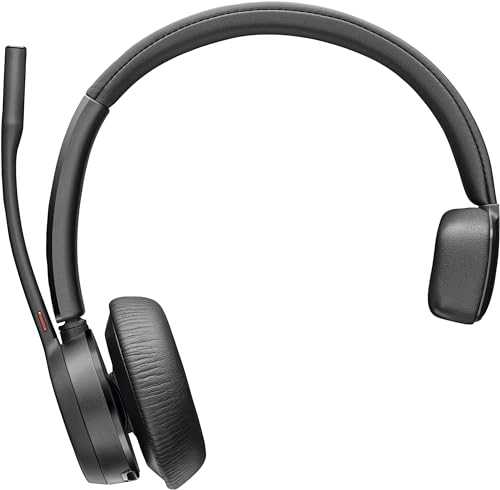
The Voyager 4310 UC solves the two-device problem that defines the modern agent’s desk-and-car life. Its listing describes a single-ear headset that connects to a PC or Mac through a USB-C Bluetooth adapter and to a cell phone by Bluetooth directly, certified for Teams and working with Zoom — which is to say, the same discreet earpiece takes the client call in the car and the brokerage Zoom at the desk, without re-pairing rituals or a second headset living in the office drawer.
The UC adapter is the detail to understand. A computer’s built-in Bluetooth is a generalist; a bundled UC adapter is a specialist, giving the headset a stable, pre-paired link to the laptop with the call-control behaviour the meeting platforms expect. For an agent whose laptop hosts the CRM, the e-signature queue and three video calls a day, that reliability converts the earpiece from a phone accessory into the office’s primary audio device. The single-ear format, unusual in the UC world of stereo headsets, is precisely its real-estate virtue: the agent keeps the room audible during calls — the doorbell, the colleague, the client arriving early — in a way stereo UC headsets forbid.
Against its sibling the Voyager 5200, the 4310 UC trades some of the classic earpiece’s road-warrior minimalism for computer citizenship; against the Evolve2 65 Flex, it trades stereo immersion for single-ear awareness and a far more client-safe silhouette. It is the bridge pick in the truest sense — the one headset an agent can buy when the budget allows exactly one and the work refuses to choose between phone and laptop. Brokerages standardising remote-work kit for agents could do much worse than to standardise here.
One more working pattern flatters it: the agent who hot-desks at the brokerage. The USB-C adapter moves with the earpiece, the laptop recognises the pair instantly, and the agent’s audio setup is identical at any desk in the building — a small consistency that removes a daily friction most agents have stopped noticing they endure.
- Connection: USB-C Bluetooth adapter for PC/Mac, Bluetooth for phone — as listed
- Format: single-ear with microphone boom
- Certification: Teams certified, works with Zoom, per listing
- Platforms: PC, Mac and cell phone, per listing
- Variant: UC version — the adapter is in the box per the listing’s description
- Battery figure: unstated in the listing title; the maker’s documentation carries it
Strengths
- One earpiece serves phone and computer with a proper UC adapter link.
- Single-ear awareness suits an office where the doorbell matters.
- Teams and Zoom readiness out of the box.
Trade-offs
- The adapter is a small part to keep track of between car and desk.
- Single-ear audio only — no stereo for media or focus work.
- Less minimal than the 5200 for pure on-the-road use.
Best for: agents splitting the day between car calls and laptop meetings. Not suited for: agents who never take calls at a computer.
Shokz OpenComm2 UC — Best invisible option
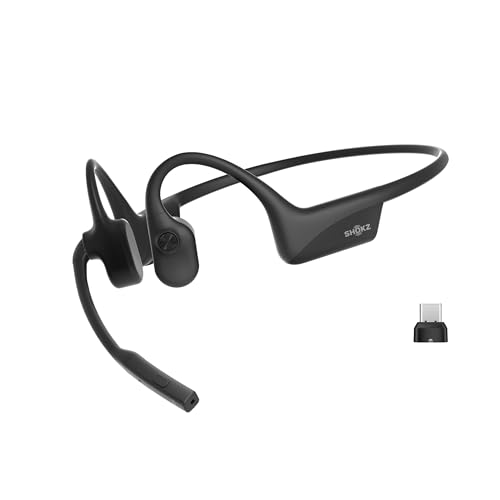
The OpenComm2 UC removes the headset from the client’s view entirely. Shokz’s design is open-ear bone conduction: the speakers rest on the cheekbones, the ear canal stays completely open, and the only visible apparatus is a slim band and a proper noise-canceling boom microphone. Its listing adds the professional credentials — a USB-C dongle for the computer, Zoom certification, a mute button for calls and meetings, a 16-hour battery with quick charge. For an agent, the translation is simple: you hear every word of every call, your clients see no equipment at all, and your ears remain fully open to the room, the street and the conversation in front of you.
That openness is a working feature, not a novelty. At a showing, an agent wearing the OpenComm2 can take the lender’s call without the social rupture of an earpiece — clients read it, if they notice it at all, as closer to glasses than to a call centre. Walking an unfamiliar property, both ears stay available for the creak, the drip and the neighbourhood sounds that are literally the agent’s professional information. And for agents who find in-ear and over-ear devices uncomfortable across a long day, bone conduction sidesteps the entire category of ear fatigue: nothing is in or on the ear to ache by the fifth appointment.
The honest trade-offs of bone conduction must be stated. In loud environments — a busy road, a construction site — open ears admit the noise that sealed headsets exclude, and audio fidelity for music is a step behind conventional drivers; this is a voice tool, not a listening pleasure. The boom microphone, though, is the design’s saving professional grace: unlike the button mics of consumer bone-conduction models, the OpenComm2’s boom puts a noise-canceling capsule near the mouth, which is why it can hold Zoom certification credibly. For the agent whose brand is presence — fully here, fully listening, technology invisible — it is the most thoughtfully matched pick in this guide.
It also future-proofs the agent’s day in one specific way: as video calls colonise even the showing schedule — remote buyers touring by phone, relocation clients on another continent — a headset that looks like nothing on camera while delivering a boom microphone’s voice is precisely the tool those calls reward. The OpenComm2 was early to that realisation, and agents building a remote-buyer practice will feel the fit immediately.
- Connection: Bluetooth with USB-C dongle (UC), per listing
- Design: open-ear bone conduction — nothing in the ear canal
- Microphone: noise-canceling boom with mute button, per listing
- Certification: Zoom certified, per listing
- Battery: 16-hour life with quick charge, as stated in the listing
- Use focus: work calls and meetings, per listing
Strengths
- Completely open ears: clients, rooms and streets stay fully audible.
- Virtually invisible on the agent — the most client-safe silhouette here.
- A real boom microphone and Zoom certification keep it professionally credible.
Trade-offs
- Open ears admit loud environments; construction noise will compete.
- Music fidelity trails conventional drivers — this is a voice instrument.
- Bone conduction feel is unfamiliar for the first days of wear.
Best for: agents whose brand is presence, and remote-buyer specialists living on video calls. Not suited for: agents working loud sites daily or wanting stereo media between appointments.
What Does a Client Hear? The Microphone Test That Matters
An agent’s headset should be auditioned from the client’s chair, not the agent’s ear. The test costs one phone call: ring a colleague, walk the route of a real working hour — car park, street, empty echoing house, car again — and ask them to rate not your loudness but your calm. Does the wind arrive before your words do? Does the empty house make you sound like you are calling from a cave? The picks in this guide were chosen because their noise canceling is designed for exactly that itinerary; the Voyager line and the Jabras cancel with the environment in mind, and the Shokz answers with boom placement and an open ear that keeps your own voice naturally modulated — people speak more quietly and clearly when they can hear themselves properly, a subtlety clients register as professionalism without knowing why.
There is a subtler layer to the same test: pacing. Clients decide how competent an agent sounds partly from the silences — the pause that is thinking, versus the pause that is a headset reconnecting. Bluetooth links in this guide’s professional picks are chosen for stability across the car-to-door transition precisely because a dropped two seconds at the wrong moment reads as hesitation about a price. When you run the colleague test, have them note not just clarity but continuity; a voice that never glitches is a voice a client trusts with a negotiation.
Do the test again on a video call if your practice includes remote buyers, because laptop audio paths differ from phone paths — the UC picks exist precisely to keep that second path as strong as the first. An agent’s technology should be boring in the best sense: the client remembers the house and the conversation, never the equipment.
How Should an Agent Set Up a Headset Routine That Survives a Showing Day?
Build the routine around the car, because the car is the agent’s true office. The headset charges there, lives there between appointments, and gets its one deliberate check there: before the first showing, confirm charge, pairing and fit while the day is still forgiving. Voice controls and one-touch answering should be configured before they are needed — the first call answered by voice, parked, teaches your hands the sequence they will use under pressure later.
Configure the technology for the profession’s interruptions. Set your phone so the headset announces or answers in the way your jurisdiction and your judgement allow while driving, record your voicemail greeting through the headset itself so clients hear the same voice quality in the greeting as in the call, and test the mute on both phone and laptop paths — an agent discussing one client’s offer must be able to seal a call instantly when another client walks into the room. That mute reflex, practised parked, is a confidentiality tool as much as a courtesy.
Set the social rules too, because they are part of the setup. Decide in advance when the earpiece comes out — many agents remove any visible headset for the first handshake and the negotiation conversation, keeping it for logistics calls only — and let the discreet picks here stretch that rule as far as your clientele allows. A headset routine that respects the client’s reading of the room will never cost a deal; one that ignores it eventually will, and no noise-canceling specification can buy that back.
One Headset or Two? The System Most High-Volume Agents Arrive At
Read the six picks as a map and a pattern emerges: the profession’s centre of gravity is a single-ear client-facing earpiece, and everything else is specialisation around it. High-volume agents commonly settle into a two-device system — a discreet earpiece for the road and the showing (Voyager 5200, Talk 45 or OpenComm2), plus a desk tool for the admin hours (Evolve2 65 Flex or the 4310 UC’s laptop link) — with the Perform 45 added where a team needs coordinating. That is not upselling logic; it is the shape of a day that contains both a client’s kitchen table and a CRM database, two environments with opposite audio requirements.
Teams should read the same map at brokerage scale. A brokerage that issues one model to every agent gains training simplicity and spares commonality, and the Perform 45 and Voyager 4310 UC are the two picks designed for that issue — one for the coordinated field team, one for the hybrid desk-and-road agent. A brokerage of strong individual brands may do better to set a standard of discretion and let agents choose within this guide’s client-facing four. Either policy beats the unexamined default, in which every agent arrives wearing whatever the phone shop sold them, and the firm’s voice sounds different from every car.
The one-headset buyer should therefore choose by the hours that dominate. If the week is eighty percent road and relationships, buy the earpiece and let the desk make do. If the week has quietly become half administration — as successful agents’ weeks do — the bridge and desk picks deserve first money, with a Talk 45 as the inexpensive road companion. Either way, buy for the calendar you actually keep, and the headset will feel chosen rather than endured.
Driving Between Showings: The Car as a Call Centre of One
The car is where an agent’s headset earns its money, and it imposes three demands no other room in the day makes together. The first is legal and moral rather than technical: the interaction must be genuinely hands-free, which is why voice controls on the Voyager 5200 and one-touch activation on the Talk 45 are treated in this guide as headline features rather than conveniences. The second is acoustic: a car cabin at highway speed is a steady roar with a voice-shaped hole in it, and dual-mic and boom-based noise canceling exist to find that hole. The third is transitional: the call that starts in the car continues on the driveway and into the house, and the headset must travel that route without a re-pair, a re-fit or a dropped syllable.
One more car-specific habit separates the professionals: the two-call test at the start of each season. Tyres, road surfaces and even a new phone change the cabin’s noise signature, and the noise canceling that flattered last season’s setup deserves a fresh verdict from a colleague’s ear. It takes one call, made from the motorway stretch of your regular route, and it catches the slow drift — a microphone boom bent a fraction, a fit changed by new sunglasses — before a client hears it during a negotiation.
Set the car up like the office it is. A charger lives there permanently — not borrowed from the house on busy mornings — and the headset’s home is a fixed spot within reach of the driver’s seat, so the pre-showing check takes seconds. Agents who run this routine stop thinking about their headset entirely, which is the correct end state for a tool whose entire purpose is to make the phone disappear from a day spent in motion.
What About Open Houses, Auctions and Other People’s Rooms?
Public-facing events sharpen every judgement in this guide. At an open house, the agent is simultaneously a host, a salesperson and a security presence, and the headset’s job narrows to silent logistics: the colleague at the door, the late photographer, the seller calling for an update. The discreet single-ear picks handle that traffic without changing the room’s temperature, and the Perform 45’s push-to-talk was practically designed for the open-house team’s choreography. The rule of the room still applies — substantive conversation with a visitor happens headset-free in spirit even when the earpiece stays in, and Face2Face-style awareness is the professional posture.
Photography and inspection days deserve a footnote of their own, because they are the working hours agents forget to plan audio for. You are walking a property with a photographer or an inspector, your phone is the coordination tool, and your hands are holding doors, moving furniture and pointing at the defect being documented. A voice-controlled earpiece earns its entire price in those hours — calls answered without a free hand, updates dictated while carrying on with the task — and the IP54-rated Perform 45 in particular treats a dusty, half-renovated property as its natural habitat rather than an edge case.
Auctions and launch events add noise and pace. This is where consumer earpieces run out of noise canceling and where the professional microphones in this guide justify themselves in a single afternoon. It is also where the open-ear Shokz earns a specific credit: in a crowd, hearing the room is situational awareness, and an agent who can take a call without sealing themselves off from a fast-moving event holds a genuine operational advantage.
Battery and Charging, Read Against a Showing Calendar
Headset battery claims are measured in talk hours under laboratory politeness; an agent’s day is measured in appointments, and the conversion between the two is where disappointment lives. A showing day is not eight hours of talking — it is ninety minutes of calls scattered across six hours of wearing, plus standby, plus the car rides where the headset stays in and ready. Against that pattern, the honest question is not “how long is the battery” but “does the routine hold”: a headset charged nightly and topped in the car survives any calendar in this guide, including the OpenComm2’s stated 16 hours, which maps comfortably onto the longest realistic showing day with its quick charge as the safety net.
Standby behaviour deserves a mention too, because an agent’s headset spends most of its life waiting rather than talking. A device that holds its charge patiently across a quiet weekend and answers Monday’s first call at the same readiness it had on Friday is worth more to this profession than a marginally longer talk figure achieved by aggressive sleeping that delays the first connection of the day. Test yours across one ordinary weekend in the first month; the result tells you whether your charging routine can be weekly-and-car, or must be nightly without exception.
The failure mode to design against is not the long day but the forgotten night — the headset left in a coat after an evening event, discovered at eight in the morning with a season’s biggest tour at nine. Quick-charge capability, car chargers and the glovebox-spare strategy built around the Talk 45 all exist in this guide’s thinking because that morning happens to every agent eventually. Battery specifications start the conversation; the routine finishes it.
Earpiece, Stereo or Open-Ear: Reading the Three Silhouettes
Clients read an agent’s headset before they hear it, so it is worth naming what each silhouette in this guide communicates. The single-ear earpiece — Voyager 5200, Talk 45, Perform 45, Voyager 4310 — reads as professional availability: this person takes calls for a living and is currently giving you their attention with one ear politely on the world. It is the silhouette the business world has normalised over two decades, and it is safe in every room an agent enters. The stereo headset reads as office immersion; in a brokerage or a home office it signals focus, and at a showing it signals absence, which is why this guide confines the Flex to the desk with complete confidence in both directions.
The open-ear silhouette barely reads at all, and that is its message: the Shokz wearer appears simply present, and in luxury and relationship-led segments of the market that invisibility is becoming a deliberate brand choice. None of the three is superior in the abstract. Each is a sentence about how the agent works, spoken silently at every meeting — and the agent who chooses theirs deliberately, rather than inheriting whatever was in the phone box, has understood something about this profession that no microphone specification can teach.
Comparison Table
| Pick | Format | Connection | Standout trait |
|---|---|---|---|
| Poly Voyager 5200 | Single-ear | Bluetooth | The classic professional earpiece |
| Jabra Talk 45 | Single-ear | Bluetooth | Dual-mic clarity, one-touch voice activation |
| Jabra Perform 45 | Single-ear | Bluetooth | Push-to-talk for brokerage teams |
| Jabra Evolve2 65 Flex | Stereo | Wireless | Hybrid ANC for desk days, folds flat |
| Poly Voyager 4310 UC | Single-ear | USB-C adapter plus Bluetooth | Phone-and-laptop bridge, Teams certified |
| Shokz OpenComm2 UC | Open-ear bone conduction | Bluetooth with USB-C dongle | Invisible on the agent, Zoom certified |
What Are the Most Common Mistakes When Agents Buy a Bluetooth Headset?
The first is buying for the ears instead of the audience: a headset that sounds rich to the agent but sends a thin, windy voice to the client fails the only test that pays. The second is wearing stereo cups to client-facing work, where the call-centre silhouette taxes trust before a word is spoken. The third is ignoring the car routine — a headset without a charging home between appointments dies on the day of the big closing. The fourth is buying a team tool alone: the Perform 45’s push-to-talk needs a team on the other end of the button. The last is forgetting the second device in the agent’s life — the laptop — and discovering at the first brokerage Zoom that the phone earpiece’s computer manners were never the point of it; the UC picks exist to close exactly that gap.
A quieter error is treating the headset as a one-agent decision in a two-agent transaction: your clients and colleagues hear the result, so let a colleague’s ear arbitrate the final choice between two finalists. Ten minutes of test calls between two headsets you are torn between will settle what a month of spec-sheet reading cannot, because the difference between these six picks lives in voices and rooms, not in tables.
Final Recommendation
Start with the classic unless your day says otherwise: the Voyager 5200 remains the agent’s earpiece against which the category is judged. Solo agents on a budget should take the Talk 45 without a moment’s embarrassment, and teams should standardise on the Perform 45 for the coordination it alone provides. If your week is half desk, bridge it with the Voyager 4310 UC or give the admin hours their due with the Evolve2 65 Flex — and if your entire brand is being fully present while technology disappears, the OpenComm2 UC was designed as if Shokz had interviewed your clients. The right headset for an agent is the one a client never remembers, attached to a voice they always do.
Buy it before the busy season, break it in on ordinary weeks, and let it be boring — in a profession where the product is trust and the office has wheels, boring audio equipment is the highest compliment a headset can earn.
Frequently Asked Questions
Is it rude to wear a headset during a showing?
It depends on the headset and the moment. Clients are remarkably consistent in what they forgive: a small earpiece that clearly serves logistics, acknowledged with a word — “my coordinator may ring about your offer time” — is forgotten within a minute, because it signals an agent whose machine is working for them. What clients remember is the agent who seemed elsewhere, and that impression comes from behaviour, not hardware: eyes on the room, headset serving the conversation rather than competing with it, and the device will never be the story of the showing. A discreet single-ear or open-ear design worn for logistics is widely accepted, especially if you remove it for the substantive conversation; stereo cups read as checked-out at any moment. The picks here were chosen with that social reading in mind — when in doubt, out for the handshake, in for the lockbox call.
Which pick is best if I take most calls in the car?
The Voyager 5200 and Talk 45 are the car specialists: voice controls and one-touch activation keep hands and eyes where driving needs them, and their noise canceling is tuned for cabin and road wash. Pair the routine with a car charger and the setup runs itself.
What is push-to-talk and does my brokerage need it?
Push-to-talk turns headsets into an instant voice network — press and your team hears you, no dialling. It earns its keep wherever agents coordinate in real time: launch days, auctions, multi-agent open houses. The Jabra Perform 45 is the pick built for it; a solo practice gains nothing from the feature.
Can one headset really serve my phone and my laptop?
Yes — that is the UC pattern. The Voyager 4310 UC links to the computer through its USB-C adapter and to the phone by Bluetooth; the OpenComm2 UC does the same with its USB-C dongle. Both keep a single-ear, client-safe format while covering the laptop’s Teams and Zoom life.
Does bone conduction actually work for client calls?
For voice, yes — and the OpenComm2 UC’s boom microphone is the reason it works professionally rather than as a novelty. Your callers hear a proper noise-canceling boom; you hear them through your cheekbones with your ears open. Loud sites remain its weakness, as the review states plainly.
I work solo but my brokerage is growing — which pick grows with me?
The Voyager 4310 UC is the natural growth pick: it covers today’s solo phone-and-laptop life completely, and its UC manners fit the brokerage systems you will plug into as the team formalises. If the growth is toward a team you will coordinate daily, buy the Perform 45 when the second agent arrives — push-to-talk needs its team, and timing the purchase to the team is the economical move.
What should I check during my first week with a new agent headset?
Make the colleague test call through your real environments — car, street, empty house — and judge your voice from their side. Wear it through a full showing day to test both comfort and how clients react to it. Confirm the car-charging routine holds the battery across your longest day, and practise voice answering while parked until it is reflex.
One closing piece of advice for agents replacing a headset mid-season: migrate on a quiet week, not the morning of a launch. Pairing, voice-control habits and fit are small learnings that deserve ordinary days to settle on, and every pick in this guide rewards a week of low-stakes use with the reflexes a high-stakes Saturday demands. The busiest agents are the ones who can least afford an unfamiliar tool — which is exactly why their upgrades should be scheduled like their closings, in advance and in ink.
Related Guides
An agent’s audio kit connects to a wider set of professional communication choices, and the same discretion-first logic — be heard clearly, be seen barely, and never let the equipment interrupt a relationship — runs through all of them, from the car kit to the conference room. Continue with our guide to headsets for conference calls for the meeting-heavy side of the business, compare the options in our roundup of wired headsets for drivers and field work if your territory is measured in highway hours, and read our guide to Bluetooth earpieces for sales professionals for the neighbouring profession’s take on the same working day, the same ringing phone and the same crowded, double-booked spring selling season diary entries.


