What's inside
- Key Takeaways
- Quick Picks
- How Were These Six Towers Chosen?
- Why Does the Each-Versus-Pair Question Decide This Whole Category?
- What Does a Tower Actually Buy You Over a Bookshelf Pair?
- The Six Towers, Reviewed in Turn
- Reading the Six Towers Against Each Other
- How Should a New Tower Pair Be Positioned and Run In?
- Which Receiver and Amplifier Mistakes Ruin Good Towers?
- Should Towers Anchor a Stereo System or a Home Theatre?
- What Are the Common Mistakes When Buying Tower Speakers?
- How Does Your Room’s Size and Shape Rewrite This Shortlist?
- What Should You Verify in the Week Before You Order?
- How Do These Towers Divide by Listening Habit?
- How Should Towers Be Matched With a Centre and Surrounds Later?
- Final Recommendation
- Frequently Asked Questions
- Related Guides
As an Amazon Associate I earn from qualifying purchases. This post may contain affiliate links at no extra cost to you.
gizmoverdict.com is reader-supported. When you buy through links on our site, we may earn an affiliate commission.
Where to buy: Each of the six towers below links to the exact listing checked for this guide, and the listing matters more than usual here — three of these speakers are priced per single cabinet and three per pair, so the listing’s unit basis is part of the recommendation.
Anyone searching for the best 8 home tower speakers is really asking a simpler question: which full-size floorstanders deserve the floor space, the amplifier channels, and the money? Tower speakers are the least forgiving purchase in home audio to get wrong on paper, because the headline details mislead in a way bookshelf listings rarely do. A tower sold individually can look half as expensive as a rival sold as a pair while costing exactly the same for a stereo set. A tall cabinet can promise bass it only delivers in a corner. And a famous name can sit on a design that wants a bigger room than the one you have. This guide works through six verified towers with those traps named openly, pick by pick.
A note on the count, because honesty is cheap and useful: the shortlist below holds six towers, not eight. Six is what survived a check for current, verifiable listings across the main tower philosophies — the budget all-rounder, the high-resolution mainstream design, the slim European-styled pair, the high-sensitivity horn design, the big modern flagship-from-a-big-brand, and the understated Japanese tower. Padding the list to a rounder number with two listings that could not be verified would have made the headline tidier and the guide worse. What follows is the six, each with its selling unit stated in plain words, because that single detail changes every price comparison in this category.
One more framing thought before the picks. A tower speaker is a decade-scale purchase in most homes: amplifiers come and go, televisions rotate, but a pair of floorstanders tends to stay, get moved between rooms, and anchor two or three successive systems. That longevity is exactly why the boring details in these reviews — unit basis, footprint, port direction, sensitivity of temperament if not of specification — matter more than any single sonic adjective. Choose the tower whose compromises fit your room and your habits, and it will still be earning its floor space when the rest of the system has been replaced around it twice.
Key Takeaways
- Three of these towers are sold each and three as pairs — the Polk T50, Polk Monitor XT70 and Yamaha NS-F150 are singles; the Sony SS-CS3, Jamo S 809 and Klipsch R-610F listings here are pairs. Double the singles before comparing anything.
- The Klipsch R-610F’s horn-loaded design plays loudest on modest amplifier power, which makes it the forgiving pick for entry receivers and lively rooms.
- The Polk Monitor XT70 is the scale pick: the largest cabinet here, sold singly, built for big rooms and film-first systems.
- The Jamo S 809 is the placement diplomat — front-firing port, slim cabinet, a pair that tolerates the wall-adjacent positions real lounges impose.
- The Sony SS-CS3 pair is the mainstream all-rounder, a three-way, four-driver design per its title, aimed at mixed music and television duty.
- Every pick here is passive: budget for a receiver or amplifier and speaker cable as part of the same purchase decision.
Quick Picks
| Pick | Badge | Why it is here |
|---|---|---|
| Polk Audio T50 | The budget cornerstone — sold each | The tower that starts more first systems than any other here; price two cabinets, not one, when comparing. |
| Sony SS-CS3 | The mainstream pair | A three-way, four-driver pair with high-resolution ambitions, sold as a pair and voiced for ordinary rooms. |
| Jamo S 809 | The slim diplomat — pair | Front-firing port and a narrow footprint let this pair live close to walls without the usual bass penalty. |
| Klipsch R-610F | The easy drive — pair | Horn-loaded efficiency means real volume from modest receivers; the liveliest voice in the six. |
| Polk Monitor XT70 | The big-room single | Polk’s large tower, sold each, with twin woofers and passive radiators for rooms that swallow smaller speakers. |
| Yamaha NS-F150 | The quiet professional — sold each | An understated, even-handed tower sold singly, for listeners who want neutrality over theatre. |
How Were These Six Towers Chosen?
The first filter was verifiability: each pick had to resolve to a current listing whose title states what is actually being sold, and in this category that means the unit basis above all. Listings that left the each-versus-pair question ambiguous were passed over, however attractive the speaker, because a guide that cannot tell you whether the price buys one cabinet or two has failed at its first job. The second filter was spread. Towers are bought for different reasons — first systems, film fronts, stereo music, big rooms, small rooms with ambition — and a shortlist of six near-identical designs would serve none of those buyers well. The six below deliberately disagree with each other about size, voicing, and placement demands.
The third filter was temperament honesty. Every tower here has a known character in the wider world of owner experience, and the reviews describe those characters as they are: the Klipsch is lively and forward, the Yamaha is restrained, the big Polk is built for scale, the small Polk is built for value. Where a design asks something of the buyer — floor space, amplifier channels, distance from walls, a second cabinet purchase to complete the pair — that ask is printed in the pick’s own section rather than buried in a footnote. A tower bought with its demands understood is a tower that stays bought.
Why Does the Each-Versus-Pair Question Decide This Whole Category?
Because tower speakers straddle two retail traditions. Hi-fi separates have historically been priced per cabinet, on the assumption that a buyer might want one, two, three, or five; consumer pairs are priced per box of two, on the assumption that stereo is the default. Both traditions are alive in the listings above, sometimes within one brand — Polk sells the T50 and the XT70 here as singles while Sony, Jamo, and Klipsch sell their towers as pairs. Nothing about either approach is a trick. The trap is purely arithmetical: a single priced at a friendly figure is not cheaper than a pair priced at twice that figure, and shoppers comparing headline numbers across the two traditions routinely misjudge a tower’s true cost by a factor of two.
The unit basis also changes how a system grows. Singles let a home-theatre builder buy three identical towers for the front stage — left, centre-vertical, and right — or add one cabinet at a time as a room evolves. Pairs assume the stereo default and price it cleanly. Neither is better; they suit different plans. What matters is that the plan and the purchase match, which is why every review below opens its specification list with the selling unit, in words, before any discussion of sound. Read those lines first. They are the most consequential specifications in this guide.
What Does a Tower Actually Buy You Over a Bookshelf Pair?
Three things, and only three, but they are real. The first is bass extension without a subwoofer: a tower’s larger cabinet volume and longer internal path let its woofers reach lower with less effort, so a stereo pair of towers can carry music — including the bottom octaves of piano, organ, and electronic production — that a bookshelf pair hands off to a subwoofer or simply omits. The second is output headroom: bigger cabinets and more driver area move more air before strain, so towers hold their composure at the volumes a large room or an action film demands. The third is ergonomic: a tower stands at ear height on its own, no stands to buy, fill, or knock over, and its drivers arrive pre-aimed at the seated listener by the simple fact of its height.
Against those gains, towers ask for floor space permanently, they are harder to reposition casually, and in a small room their extra bass can overwhelm the space rather than enrich it. The honest summary is that towers are the right answer when the room is medium or larger, when stereo music matters, or when a subwoofer is unwanted — and an indulgence when the room is tiny, the listening is nearfield, or the budget would stretch further across a good bookshelf pair plus a subwoofer. The six below span that judgement: the T50 and S 809 behave almost like bookshelf speakers that brought their own stands, while the XT70 is a tower in the full, room-committing sense.
The Six Towers, Reviewed in Turn

Polk Audio T50 — The budget cornerstone, sold each
The T50 is the tower that value systems are built on, and its listing states its station plainly: a home theatre floorstanding speaker, sold as a single cabinet. Inside that cabinet sits a simple, well-understood recipe — a soft-dome tweeter, a midrange-woofer, and passive bass radiators that let the modest enclosure produce more low-end weight than its driver count suggests. Polk voices the result for the rooms it will actually live in: warm-leaning, forgiving of ordinary recordings and ordinary receivers, with enough bass presence that a first system can skip the subwoofer for a year without feeling cheated.
There is also a roommate-and-neighbour dimension to the T50 that its specification never mentions. Its bass, while generous for the cabinet, is the kind that stays inside the room at civilised volumes rather than announcing itself through party walls, and its forgiving treble keeps late-evening television free of the sibilant edge that makes households reach for the remote. First-system buyers are disproportionately renters and flat-dwellers, and a tower that respects thin walls at nine in the evening while still sounding full is solving the problem its buyers actually have.
Its role in a system is flexible in a way the pair-sold picks cannot match. Because it is sold singly, a buyer can start with two for stereo, then add a third as a vertical centre, then two more as surrounds, building a fully matched five-tower theatre in instalments — an upgrade path almost no other format allows at this tier. The limits are the tier’s own: the cabinet finish is utilitarian, fine detail and soundstage precision trail the dearer picks here, and the radiators’ bass, while generous, is less tightly controlled than the XT70’s larger implementation of the same idea. None of that dents its case as the cornerstone: judged per pair — two cabinets, remember — it remains the least expensive route in this guide to real tower sound.
- Selling unit: ONE single tower — a stereo pair means buying two
- Configuration: floorstanding tower with passive bass radiators assisting the low end
- Power class as titled: 150W in the listing’s own words
- Voice: warm, forgiving, bass-generous for its size
- Growth path: buy singly, up to a fully matched five-tower theatre
Strengths
- Instalment-friendly: singles let the system grow one cabinet at a time
- Radiator bass spares a first system the immediate subwoofer purchase
- Undemanding of amplifiers and of mediocre recordings alike
Trade-offs
- Headline price buys one cabinet — the pair costs double the first impression
- Finish and fine detail are workmanlike rather than luxurious
- Bass generosity can bloom in small rooms placed in corners
Best for: a first tower system bought in stages, or a matched-tower theatre built gradually. Not suited for: a buyer who reads the single-cabinet price as the pair price, or a small room that will corner-load it.
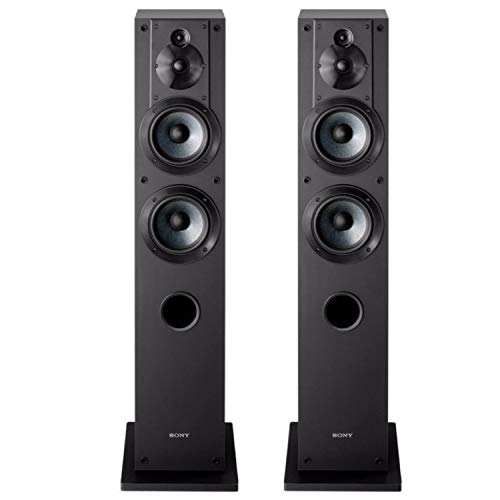
Sony SS-CS3 — The mainstream pair
Sony’s SS-CS3 arrives as a pair — the listing says so — and brings the most ambitious driver layout in this guide’s mainstream tier: three-way, four drivers per cabinet, in Sony’s long-running CS series of home speakers. The thinking behind that layout is division of labour. With separate drivers handing the treble, the high treble, the midrange, and the bass their own territories, each works within the band it handles most comfortably, and the audible dividend is clarity: voices stay intelligible inside dense film mixes, and the top end carries the airy detail Sony packages under its high-resolution audio banner without turning hard or splashy at the volumes living rooms actually use.
In practice the SS-CS3 pair is the pick for the household that does a bit of everything — streaming series on weeknights, records or playlists on weekends, a film on Saturday — and wants one pair of towers that refuses to specialise badly at any of it. It is not the loudest here, nor the deepest; the Klipsch out-projects it and the big Polk out-scales it. Its argument is balance at a pair price, from a brand whose voicing is tuned for the mainstream ear rather than the hobbyist’s. Owners stepping up from a soundbar or a television’s own speakers tend to find the jump startling, which is precisely the experience this pair is engineered to deliver.
- Selling unit: PAIR — two cabinets in the listing, stereo-ready out of the box
- Configuration as titled: 3-way, 4-driver floorstanding design
- Series positioning: high-resolution audio is part of the listing’s own description
- Included as titled: foot pads for the cabinets
- Voice: balanced and clarity-led, tuned for mixed television and music duty
Strengths
- Four-driver layout keeps dialogue and detail separated in busy mixes
- Pair pricing makes the true stereo cost the headline cost
- Mainstream voicing flatters the widest range of content
Trade-offs
- Out-scaled by the XT70 and out-projected by the Klipsch at party volumes
- Bass is tidy rather than theatrical; film-first rooms may still add a subwoofer
- Sold only as a pair, so a matching third tower for the centre is not its path
Best for: a mixed-use living room wanting one balanced pair for television, film, and music. Not suited for: a very large room, or a builder planning a three-identical-tower front stage.

Jamo S 809 — The slim diplomat, sold as a pair
The S 809 is Jamo’s answer to the room that wants tower sound without tower bulk, and its title reads like a placement manifesto: aluminized polyfiber woofers, WaveGuide tweeter technology, a soft dome tweeter, and — the detail that defines its domestic life — a front-firing tube port. Most towers vent their bass energy backwards, which obliges them to stand well clear of the wall behind them. The S 809 vents forward, into the room, so the pair can live close to a wall or either side of a media unit without the bass thickening into boom. In apartments and modest lounges, that single design decision is worth more than any specification on the page.
Ownership details suit the same domestic brief. The cabinets are light enough to reposition without a second pair of hands when a room is rearranged, the finish wipes clean rather than demanding polish, and the grilles sit flush enough that the pair reads as part of the furniture whether they are on or off. Small things, certainly — but towers are lived with at arm’s length for years, and livability compounds.
The cabinet itself is slim and tall, with a row of woofers stacked down its front giving it a distinctly Scandinavian, furniture-adjacent look that reads as intentional in a styled room rather than apologetic. Sonically it is neat and composed: the WaveGuide shapes the tweeter’s output for a wide, even spread, the multiple smaller woofers keep the midrange articulate, and the overall balance favours clarity over chest-thump. Film systems will want a subwoofer beneath it eventually, and very large rooms will find its ceiling. But as a pair of towers that fit the room first and impress within it, the S 809 has the clearest domestic logic of the six.
- Selling unit: PAIR — the listing sells the two cabinets together
- Port: front-firing tube port, as titled — the wall-friendly detail
- Drivers as titled: aluminized polyfiber woofers with WaveGuide tweeter technology
- Tweeter as titled: 1-inch soft dome
- Form: slim, tall cabinet that reads as furniture rather than equipment
Strengths
- Front port permits near-wall placement that defeats most rival towers
- Slim footprint suits apartments and styled rooms
- Composed, articulate balance for television and acoustic music
Trade-offs
- Bass depth is modest; a subwoofer completes it for film
- Output ceiling arrives earlier than the big Polk’s in large spaces
- Its neatness can read as restraint to listeners raised on Klipsch energy
Best for: an apartment or styled lounge where towers must sit close to walls and look deliberate. Not suited for: a big open-plan space or a bass-first film room without a subwoofer.
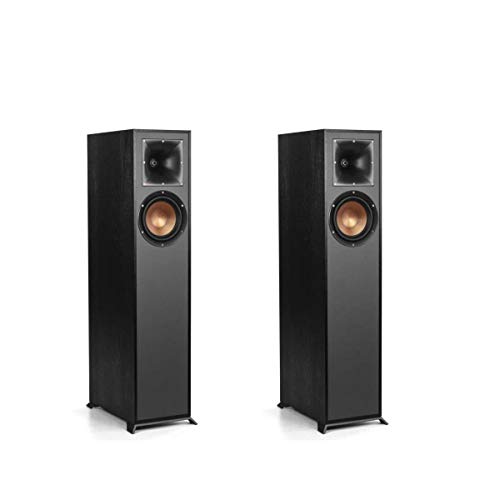
Klipsch R-610F — The easy drive, sold as a pair
Klipsch builds towers around a horn, and the R-610F — sold here as a pair, per its title — is the accessible expression of that century-old idea. A horn-loaded tweeter couples the driver to the room’s air far more efficiently than a bare dome can, and the practical consequence reaches every part of ownership: the speaker plays louder on fewer watts, stays composed when an entry-level receiver would strain driving lesser designs, and projects a vivid, forward sound that puts performers and film effects in the room with you rather than behind a curtain. For households whose amplifier budget is modest — or whose receiver is a hand-me-down — that efficiency is not a specification. It is the difference between a system that cruises and one that labours.
The character that comes with the horn divides listeners, and this guide will not pretend otherwise. The R-610F is lively, detailed, and unapologetically present in the treble; rock, live recordings, and film soundtracks leap from it, while listeners who prefer a laid-back, lights-low presentation can find its energy fatiguing across a long evening. Its single-woofer format also means its bass, while punchy, is the tightest rather than the deepest here. Judge it as what it is: the pair for lively rooms, lively music, and modest amplifiers — and the wrong pair for anyone whose taste runs to mellow.
- Selling unit: PAIR — both cabinets in one listing
- Design: horn-loaded tweeter in Klipsch’s Reference series tradition
- Drive character: high efficiency — real volume from modest receiver power
- Format: single-woofer tower, the compact end of the floorstanding idea
- Voice: forward, vivid, detail-forward — a personality, not a neutral canvas
Strengths
- Loudest clean output per watt in this guide — kind to small amplifiers
- Projection and clarity that flatter film effects and live recordings
- Compact tower footprint for a horn design
Trade-offs
- Forward treble divides taste; mellow listeners should audition mentally first
- Bass is punchy rather than deep — a subwoofer still earns its place for film
- Revealing of bright rooms with hard floors and bare walls
Best for: a lively room, a modest receiver, and a listener who wants music and film to arrive with energy. Not suited for: a treble-sensitive listener in a reflective room, or a bass-first brief.

Polk Monitor XT70 — The big-room single
The XT70 is the largest speaker in this guide and the clearest statement of what the format can do, and its title says the essential thing twice: this is a large home tower speaker, and it is sold as a single. Polk loads the tall cabinet with twin woofers and passive radiators, a configuration that trades the simplicity of a port for bass that stays composed when the volume climbs — radiators cannot chuff or boom the way an overworked port can, and in a big room, at film volumes, that composure is the whole ballgame. The XT70 fills spaces that make the other five picks sound like they are trying, and it does so without demanding an exotic amplifier to get there.
Music listeners sometimes overlook big towers like this on the assumption that scale means coarseness, and the XT70 argues otherwise. Its radiators and twin woofers divide the low-frequency work so no single driver is straining, and strain — not size — is what makes bass sound crude. A double-bass line in a jazz recording or the left hand of a piano stays pitched and placed rather than blooming into a general warmth, and orchestral crescendos hold their layers apart at volumes where the smaller cabinets here begin to compress into a single loud event. Scale, done this way, is a form of calm.
Buying it correctly is an exercise in arithmetic and honesty. Arithmetic, because a stereo pair is two purchases and a five-tower theatre is five, and the totals should be written down before the first cabinet is ordered. Honesty, because this speaker needs its room: placed in a small lounge it will dominate the furniture, the budget, and the bass balance all at once. Given the space it asks for, though, it is the most complete tower here — the one that handles a full-range film soundtrack, a loud rock record, and a quiet string quartet with the same unforced scale, and the natural front anchor for a serious Monitor-series theatre built cabinet by cabinet.
- Selling unit: ONE single tower — the title says Single outright; multiply for pairs
- Scale as titled: Polk’s large tower format, the biggest cabinet in this guide
- Bass system: twin woofers with passive radiators, composed at high output
- Role: front anchor for large rooms and film-first systems
- Amplifier ask: mainstream receivers suffice; it rewards headroom without requiring it
Strengths
- Genuine large-room scale the other five cannot counterfeit
- Radiator bass stays clean at the volumes where ports complain
- Single-sale format suits cabinet-by-cabinet theatre building
Trade-offs
- Pair and system totals climb fast — two or five singles, not one purchase
- Physically dominant; small rooms should look at the T50 or S 809 instead
- Its strengths are wasted at background-listening volumes
Best for: a large lounge or dedicated film room building a serious system in stages. Not suited for: a compact room, a tight total budget, or background-music duty.
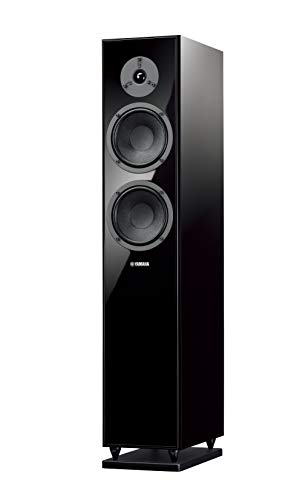
Yamaha NS-F150 — The quiet professional, sold each
Yamaha sells the NS-F150 the way it sells its pianos’ younger cousins: plainly, one at a time, with the word Each printed in the title and no adjectives hired to shout. The speaker matches the listing. This is an even-handed, two-way tower in the Japanese hi-fi tradition — a design that aims to add as little of itself as possible between the recording and the listener. Where the Klipsch performs the music at you, the Yamaha presents it to you: balanced across the range, unexaggerated in the bass, and notably easy to live with across long listening sessions and the wildly varying quality of everyday sources, from pristine recordings to compressed television audio.
That restraint defines both its audience and its limits. Listeners whose collections run to classical, jazz, acoustic, and vocal music — and whose priority is hearing what is on the recording rather than what the speaker thinks of it — will find the NS-F150 the most grown-up sound in this guide. Home-cinema thrill-seekers will find it polite: effects are rendered accurately rather than theatrically, and the bass, while honest, does not reach for the cinematic. Sold singly, it also suits the staged builder, though its natural home is a stereo pair in a calm room, fed by a decent amplifier, doing its undemonstrative work for years.
- Selling unit: ONE single tower — Each, as the title states; two for stereo
- Design: two-way tower in Yamaha’s even-handed hi-fi tradition
- Voice: neutral and unexaggerated, the long-session temperament
- Finish as titled: black, understated to the point of invisibility
- Natural partners: a clean stereo amplifier and acoustic-leaning collections
Strengths
- The most neutral balance here — kind to long sessions and poor sources
- Understated looks that disappear into a calm room
- Single-sale format allows staged purchase and a matched centre-vertical
Trade-offs
- Polite where film fans want theatre; effects lack the Klipsch’s leap
- Bass is honest rather than generous — radiator Polks dig with more weight
- Neutrality reads as plainness to listeners who want a speaker with flair
Best for: a stereo listener with acoustic tastes who values balance over spectacle. Not suited for: an effects-first cinema room or a listener who wants their speakers to perform.
Reading the Six Towers Against Each Other
| Pick | Sold as | Defining design | Room it suits | Watch out for |
|---|---|---|---|---|
| Polk Audio T50 | Single | Woofer plus passive radiators | Small to medium, first systems | Pair costs twice the headline |
| Sony SS-CS3 | Pair | Three-way, four drivers | Medium mixed-use lounges | Scale ceiling in very large rooms |
| Jamo S 809 | Pair | Front-firing port, slim cabinet | Apartments, near-wall placement | Modest bass depth for film |
| Klipsch R-610F | Pair | Horn-loaded tweeter | Lively rooms, modest amps | Forward treble in bright rooms |
| Polk Monitor XT70 | Single | Twin woofers, passive radiators | Large rooms, film-first systems | Totals multiply per cabinet |
| Yamaha NS-F150 | Single | Two-way neutrality | Calm stereo rooms | Polite for effects-first tastes |
How Should a New Tower Pair Be Positioned and Run In?
Begin with geometry, because geometry is free and most placement sins are committed in the first ten minutes. Form a triangle: the two towers and your main seat should sit at roughly equal distances from each other, with the cabinets pulled at least a little into the room rather than shoved against the wall — the Jamo’s front port forgives wall proximity, but even it sounds more open with breathing space. Angle the cabinets inward so their tweeters aim near, or just behind, the listening position; small changes in that toe-in angle trade image focus against soundstage width, and the right answer is the one your favourite recording prefers. Keep the tweeters near ear height when seated — towers are designed around that assumption, which is one of their quiet advantages.
Then run the system, not the speakers. Play familiar music at ordinary volumes for the first days rather than staging an immediate maximum-volume demonstration; drivers and suspensions settle, but more importantly your ears calibrate to the new balance, and judgements made in week two are worth ten made in hour one. If your receiver offers automatic room calibration, run it after the speakers have lived in their positions for a few days, then live with its result for a week before overriding anything — and if the bass sounds thick, move the cabinets a few inches before reaching for equalisation, because placement fixes what processing only disguises. Finally, check the unglamorous details: spikes or pads firmly planted so the cabinet does not rock, cable runs that do not cross power leads at length, and grilles on or off by preference rather than by accident.
Which Receiver and Amplifier Mistakes Ruin Good Towers?
The classic error is pairing by price tag instead of by job. A tower does not need an expensive amplifier; it needs an honest one — an amplifier or receiver whose power is specified conservatively, that can drive the load the speaker presents without protection circuits joining the performance, and that offers the inputs and channels the system will actually use. The Klipsch in this guide will thrive on remarkably little; the big Polk rewards headroom without demanding it; all six will expose an amplifier that was bought for its feature list rather than its power supply. When the budget forces a choice, the amplifier’s quality outranks its channel count for stereo listeners, and its room-calibration quality outranks both for film systems.
The second error is forgetting the ecosystem around the amplifier. Speaker cable of adequate gauge for the run length, a subwoofer lead if one joins later, and ventilation space above a hard-working receiver all belong in the same purchase plan as the towers themselves. The third error is subtler: setting a receiver’s speaker configuration carelessly, so towers are crossed over as though they were satellites and their bass is discarded to a subwoofer that may not exist. Tell the receiver the truth — these are large, full-range speakers — and let the towers do the work they were bought to do.
Should Towers Anchor a Stereo System or a Home Theatre?
Both, but the decision changes which tower you should buy, so make it before the shortlist rather than after. A stereo-first system spends its whole budget on two cabinets and an amplifier, and it rewards the picks with the most refined music manners: the Yamaha’s neutrality, the Jamo’s composure, the Sony’s balance. A theatre-first system spreads money across five or more channels and a receiver, and it rewards scale, dialogue clarity, and growth paths — the XT70’s staged singles, the T50’s instalment plan, the Klipsch’s easy drive under a receiver working five channels at once. Many households genuinely do both, in which case the front pair should be chosen by the music test and the rest of the system built around them, because stereo listening is where a speaker’s character is least forgiven.
There is also a middle path worth naming, because tower buyers often miss it: start with the stereo pair and a receiver rather than an amplifier, even if no surround speakers are planned for a year. The receiver costs little more, brings room calibration and television switching that a stereo amplifier lacks, and leaves the theatre door open. The towers will not know the difference, and the household that discovers film nights will not have to start again. Whichever path is chosen, resist buying a centre channel from a different family than the front towers when the theatre stage arrives — voices pan across those three speakers, and matched designs keep a moving voice the same size and colour as it travels.
What Are the Common Mistakes When Buying Tower Speakers?
The first is the arithmetic mistake this guide has flagged from its opening lines: comparing a single-cabinet price against a pair price and concluding the single is a bargain. It is the most expensive misreading in the category, and the easiest to avoid — always convert to cost per stereo pair before ranking anything. The second mistake is buying for the room you wish you had. A large tower in a small room does not sound like a large room; it sounds like a small room with too much bass and furniture that crowds the seating. Match the cabinet to the cubic space it must fill, which is why this guide includes genuinely different sizes rather than six variations on large.
The third mistake is auditioning by specification — chasing the deepest printed bass figure or the highest power number as though either predicted satisfaction. Printed figures are measured differently by every brand, and the towers here were chosen for how their designs behave in rooms, not for league-table numbers. The fourth is neglecting placement until after purchase: a tower that must stand in a corner or hard against a wall should be chosen for that life from the start, which is the Jamo’s entire reason for being in this list. The fifth is forgetting the second purchase — amplifier, cable, and possibly a subwoofer — until the towers are already standing in the hall, at which point the budget for those essentials has been spent on the cabinets. Price the system, not the speaker.
How Does Your Room’s Size and Shape Rewrite This Shortlist?
Room volume is the silent specification that outranks every printed one. A tower radiates into a space, and the space decides whether the speaker’s output arrives as fullness or as congestion. In a compact lounge — the kind where the sofa nearly touches the television wall — the honest candidates are the T50 and the S 809, cabinets whose bass output a small volume can absorb without turning every film explosion into a room-wide event. The Sony pair stretches comfortably into medium rooms, and the Klipsch fills medium spaces with less amplifier effort than any rival here. The XT70 only begins to make sense when the room is large enough that the other five would be working visibly hard: long listening distances, high ceilings, open-plan layouts where the kitchen shares the speakers’ air.
Shape matters alongside size. Long, narrow rooms flatter towers placed on the short wall, firing down the length; square rooms punish careless placement because their equal dimensions reinforce the same bass notes from both walls, and they reward the designs with tidier low ends — the Jamo and the Yamaha — over the generous Polks. Rooms with one open side, the classic open-plan problem, leak bass energy into the adjoining space and often need the tower with more low-end authority than the seating area alone suggests. None of this requires measurement equipment to apply. It requires walking your own room with the shortlist in mind and asking which cabinet’s strengths answer the room’s actual behaviour, rather than which cabinet won an argument on a forum.
Furnishing is the third variable, and the cheapest acoustic treatment you will ever own. A room with a rug, upholstered seating, curtains, and bookshelves forgives the Klipsch’s forward treble and lets the Yamaha’s neutrality read as clarity. The same speakers in a bare room with hard floors, glass, and parallel empty walls will sound harder, brighter, and more confused — and the fault will belong to the room, not the purchase. If your room is acoustically bare and likely to stay that way, weight your choice toward the forgiving voicings in this guide and plan a rug before you plan an upgrade. Towers are bought once; rooms can be softened any weekend, and softening the room improves every speaker you will ever own.
What Should You Verify in the Week Before You Order?
Begin with the listing itself, on the day, not from memory: confirm the selling unit in the title and the quantity selector, because marketplace listings are revised and a guide’s check is a snapshot. If you are buying singles, decide the full cabinet count for your plan — two for stereo, three for a matched front stage, five for the full theatre — and write the total down, so the staged path stays a plan rather than becoming an accident. Then measure your floor: the footprint each tower will occupy, the distance between the cabinets your furniture allows, and the clearance behind them that your room can spare. A tower that fits the tape measure but blocks a walkway or a door swing will be resented daily and enjoyed rarely.
Next, audit the amplifier you already own before budgeting for a new one. Many households discover a serviceable receiver in a cupboard or a relative’s spare room, and towers are undemanding enough that yesterday’s mainstream receiver often drives today’s shortlist perfectly well — the Klipsch especially. Check its speaker terminals, its ventilation space in your unit, and whether its remote and inputs still suit your sources. Then plan the cable: measure the actual runs along walls and under rugs rather than across the room in a straight line, and buy lengths with slack, because a cable that barely reaches dictates placement more tyrannically than any acoustic rule.
Finally, decide the subwoofer question in advance, even if the answer is later. Knowing whether a subwoofer joins in six months changes today’s choice: a film-first household on that path can favour the Jamo’s placement gifts or the Sony’s clarity and let the subwoofer supply the depths, while a household committed to subwoofer-free stereo should weight the radiator Polks’ low-end generosity more heavily. Write the decision down with the cabinet count. Tower purchases fail on unwritten assumptions far more often than on sound.
How Do These Towers Divide by Listening Habit?
Consider the vinyl listener first, because that habit exposes a tower’s midrange honesty. Records reward the Yamaha’s even hand and the Jamo’s composed tweeter; surface noise and vintage pressings are rendered without the extra treble emphasis that turns a worn record into a tiring one, and the Sony’s detailed top end flatters well-kept pressings. The Klipsch, by contrast, is the rock-and-live-album tower: its horn puts a drum kit’s attack and a crowd’s roar into the room with a physicality the others politely decline, and listeners whose shelves lean that way should not let neutrality arguments talk them out of the speaker that makes their records exciting.
Gamers are tower buyers more often than the hobby admits, and their needs are specific: dialogue clarity for story-heavy titles, positional honesty for competitive ones, and the discipline to sound good at the moderate volumes of a long session. The Sony pair’s separation of voices from effects serves story games beautifully, the Klipsch’s projection serves competitive clarity, and any of the six will shame a television’s speakers so completely that the upgrade tends to end the search rather than start one. Sports and broadcast viewing, the most underrated tower duty, rewards the same dialogue clarity — commentary sits in the centre of the mix, and a tower pair with an articulate midrange keeps it there without the volume riding that soundbar owners know too well.
Classical and jazz listeners should read the list from the Yamaha down: neutrality, composure, and the Jamo’s even spread serve recordings that were made in real spaces and mixed to preserve them. Electronic and hip-hop listeners should read it from the Polks up: radiator bass gives synthesiser low end and programmed drums their weight without a subwoofer’s placement puzzles, and the XT70 in a big room is the closest thing here to a club system with manners. None of these divisions are laws. They are the accumulated shape of owner satisfaction in this category, and they exist to be consulted alongside your own shelves and playlists, not instead of them.
How Should Towers Be Matched With a Centre and Surrounds Later?
The front three speakers of a film system share one job — carrying voices and effects across the screen — and they share it best when they share a designer. A voice that begins in the left tower, crosses the centre, and exits through the right should not change size, height, or tonal colour mid-journey, and the surest way to guarantee that is a centre channel from the same family as the towers, voiced by the same team around the same tweeter. Every brand in this guide fields matching centres within its own series, so the tower choice made today quietly chooses the centre bought next year. That is one more reason the staged, single-sold picks are so convenient: a third identical tower, stood vertically where space allows, is the theoretically perfect centre, and the T50, XT70, and NS-F150 can each be bought that way without negotiating a pair listing.
Surrounds forgive more. They carry ambience, weather, crowd noise, and the occasional orbiting effect rather than sustained dialogue, and a different brand or a smaller model from a neighbouring tier rarely betrays itself in real content. Households building in stages routinely run their previous bookshelf pair — or the pair the towers replaced — as surrounds for years, and the money saved is better spent on the centre and the subwoofer. What surrounds do demand is placement honesty: at or slightly above ear height, to the sides or slightly behind the seats, rather than wherever the remaining wall happens to be. A matched system placed carelessly loses to a mixed system placed well, in surround as in everything else this guide has covered.
Final Recommendation
Start every tower decision with the unit basis
, and the rest of this guide falls into place. For most households building a first real system, the Sony SS-CS3 pair is the calmest recommendation: two cabinets, one purchase, a balanced three-way design that handles television, film, and music without specialising badly at any of them. The staged builders should look to the singles — the Polk T50 for value grown cabinet by cabinet, the Yamaha NS-F150 for a neutral stereo pair bought in two steps, and the Polk Monitor XT70 when the room is large and the ambition is a serious film system assembled over time. The Jamo S 809 owns the near-wall apartment brief outright, and the Klipsch R-610F owns the lively room with the modest amplifier. Buy the tower whose demands your room already meets, double any single before you compare it, and the pair you choose will still be the right answer when the rest of your system has changed around it.
Frequently Asked Questions
Why are some tower speakers sold individually and others as pairs?
Two retail traditions meet in this category. Hi-fi separates are priced per cabinet so buyers can assemble stereo pairs, matched front stages of three, or full theatres from identical speakers; consumer pairs are priced per box of two for buyers who simply want stereo. Neither signals quality — but the per-pair total is the only honest basis for comparison, which is why this guide states the unit for every pick.
Do tower speakers still need a subwoofer for films?
For music, the towers here can stand alone respectably, the radiator-equipped Polks especially. For films, a subwoofer still adds the dedicated low-frequency channel and the deepest effects that even large towers reproduce less authoritatively. Many owners start without one and add it later; the towers lose nothing by the delay.
How much amplifier power do these towers actually need?
Less than marketing suggests. Ordinary rooms at ordinary volumes use modest power, and the Klipsch’s horn efficiency lowers the requirement further. What matters is an amplifier or receiver with an honestly specified output and a healthy power supply, matched to the channels your system will run — quality of watts over quantity, every time.
Can tower speakers work in a small room?
The right ones can. Compact towers like the Polk T50 and the slim, front-ported Jamo S 809 behave well in modest spaces, especially pulled slightly from corners and kept at sane volumes. Large cabinets like the XT70 overwhelm small rooms with bass and physical presence; match the cabinet’s scale to the room’s volume, not to your ambition.
Is one tower from a pair-sold listing usable as a centre channel?
Generally it is not sold that way — pair listings mean buying two — which is why theatre builders planning a vertical centre tower should start from the single-sold picks: the T50, XT70, or NS-F150 can each be bought as a third identical cabinet. A horizontal centre from the same family is the alternative the pair-sold brands intend.
Are tower speakers a good buy second-hand instead?
They can be, since passive towers have no batteries, firmware, or lasers to age out, and a cared-for pair loses little over a decade. The cautions are inspection-based: check driver surrounds for cracking, tweeters for pushed-in domes, and cabinets for water damage at the base, and factor in that a used pair’s true cost includes collecting two large boxes. New purchases from this guide trade that homework for warranty and returns, which many buyers reasonably prefer.
Should new towers be run in before judging them?
Give any pair a few days of ordinary listening before final judgement. Driver suspensions settle slightly, but the larger change is perceptual: your ears recalibrate from your previous speakers to the new balance. Placement experiments and receiver calibration are both more reliable after that settling period than in the first excited hour.
Related Guides
Towers rarely live alone for long, and these companion guides cover the purchases that surround them: our affordable surround sound speaker systems for the full theatre build, the 8 ohm bookshelf speakers that pair with the same receivers, and complete 7.1 home theatre speaker systems for the largest rooms.


