What's inside
- Key Takeaways
- Quick Picks
- What Separated These Six From the Rest of the Shelf?
- Why Does the Input List Matter More Than the Bluetooth Version?
- Six Powered Pairs, Each in Its Own Words
- Desk Pairs, Room Pairs, and the One Table That Sorts Them
- How Should You Place a Powered Pair for Television and Music?
- Which Setup Mistakes Do Powered-Speaker Owners Keep Making?
- What About Latency, Codecs, and the Numbers on the Box?
- How Long Should a Powered Pair Last, and What Fails First?
- Should You Choose Powered Speakers or a Receiver and Passive Pair?
- How Do Powered Pairs Behave as Everyday Television Furniture?
- What Should You Check During the First Week of Ownership?
- Stands, Shelves, or the Television Unit Itself?
- A Source-by-Source Walk Around the Six
- Do Powered Pairs Need Room Correction or Apps to Sound Right?
- What Happens When Two People Share One Pair?
- How Should You Think About Price Inside This Category?
- Final Recommendation
- Frequently Asked Questions
- Related Guides
As an Amazon Associate I earn from qualifying purchases. This post may contain affiliate links at no extra cost to you.
gizmoverdict.com is reader-supported. When you buy through links on our site, we may earn an affiliate commission.
Where to buy: All six pairs below link to the listings checked for this guide. Every one is a powered design with its amplifier built in, so the price of entry includes the electronics a passive system makes you buy separately.
The appeal of the best bluetooth bookshelf speakers is easy to state: real stereo, from real cabinets, with no receiver, no speaker wire, and no rack. A phone connects in seconds, a television connects once and stays connected, and a turntable — on the models with the right inputs — joins without a separate phono stage. What the category quietly contains, though, is two different products wearing one name. Some of these pairs are compact desktop monitors that happen to stream; others are living-room speakers that aim to replace a soundbar and a stereo system at the same time. Buying the wrong one of those two for your room is the main disappointment in this market, and it has nothing to do with Bluetooth itself.
Bluetooth, in fact, is the least interesting specification here. Every pair in this guide streams competently from a phone across a room. The differences that decide satisfaction live elsewhere: whether the optical input wakes the speakers when the television turns on, whether a subwoofer output exists for the day you want one, whether the remote is a proper remote or an afterthought, and whether the amplifier inside was sized for the cabinet it drives or borrowed from a smaller product. Those are the questions the reviews below keep returning to, because they are the ones owners live with.
One more framing note before the picks. Powered bookshelf speakers split into active pairs, where each cabinet carries its own amplification, and powered pairs, where one cabinet houses the electronics and feeds its partner through a cable. Both approaches appear below, and neither is inherently superior — but the distinction explains cable runs, weight differences between the two cabinets, and where the controls and inputs physically live. Check which side of the pair the inputs sit on before you plan furniture around them.
Key Takeaways
- All six pairs are self-powered; no receiver or separate amplifier belongs on your shopping list.
- The Klipsch The Fives II is the television-first pick, with Dolby Atmos support in its title; the Audioengine A2+ is the desk-first pick, and the two should never be swapped.
- Turntable owners should look at the Kanto YU4 first: its built-in phono preamp is stated right in the listing title.
- Subwoofer outputs appear on the Fluance Ai41 and shape its value; if film bass matters, that socket is worth more than extra watts.
- The Edifier S1000MKII is the audiophile-leaning flagship here, with aptX HD streaming named in its title.
- The Edifier R1280DB remains the sensible entry point: optical input, remote control, and a wood-grain cabinet at the friendly end of the range.
Quick Picks
| Pick | Badge | Why it is here |
|---|---|---|
| Edifier R1280DB | The sensible starting point | Optical input, Bluetooth, a remote, and near-field manners in a wood-grain cabinet that suits desks and small rooms. |
| Klipsch The Fives II | Television’s stereo answer | A powered pair built for TV duty, with Dolby Atmos in the title and Klipsch dynamics in a walnut cabinet. |
| Kanto YU4 | Turntable owner’s favourite | Built-in phono preamp, Bluetooth, a proper remote, and gloss white styling with genuine amplifier headroom. |
| Fluance Ai41 | The grow-with-you pair | A 90-watt powered design with Bluetooth 5, optical, RCA, and a subwoofer output for later expansion. |
| Edifier S1000MKII | The flagship streamer | Edifier’s audiophile-tier active pair, with aptX HD Bluetooth and a Class D amplifier in substantial cabinets. |
| Audioengine A2+ | The desktop specialist | Tiny cabinets, 24-bit Bluetooth streaming, and near-field tuning made for a monitor-side seat. |
What Separated These Six From the Rest of the Shelf?
The first filter was input honesty. A powered speaker lives or dies by its connections, so each pick had to offer a credible path for at least two sources — typically Bluetooth plus optical, or Bluetooth plus a proper analogue input — without dongles or workarounds. Models that streamed well but left the television to a flaky analogue cable, or that offered Bluetooth and nothing else, fell away. The survivors cover the realistic spread: televisions, turntables, computers, phones, and the occasional games console.
The second filter was amplifier seriousness. Titles in this category quote power figures in incompatible ways — peak, RMS, per channel, per pair — so raw numbers were treated as advertising weather rather than climate. What counted instead was each maker’s track record of sizing amplification to the cabinet, and the presence of the supporting cast: remote controls that actually reach the features, standby behaviour that does not waste electricity or patience, and build quality that survives being dusted, moved, and occasionally knocked.
Finally, the six were chosen to disagree about the room. Two are desk natives, two are living-room pairs, and two straddle the line. A reader with a study and a reader with a sofa should be able to finish this guide with different answers, and both answers should be defensible. That spread matters more than any single specification, because powered speakers cannot be upgraded in halves — the amplifier and cabinet you buy are the system you keep.
Why Does the Input List Matter More Than the Bluetooth Version?
Because Bluetooth is the input you use casually, while the wired inputs carry the sources you use deliberately. A television through optical behaves like furniture: it wakes, it plays, its volume follows the TV remote in a well-mannered setup, and it never asks you to open an app. A turntable through a phono input is a ritual you chose. Bluetooth, by contrast, is interruption-prone by design — calls arrive, notifications chirp, a partner’s phone pairs first — and those are properties of the phone ecosystem, not faults of the speaker. Judge a powered pair by how gracefully it handles the sources that stay plugged in, and let Bluetooth be the convenient extra it is.
Codec support sits one rung below inputs in importance, and it is worth understanding without fetishising. The S1000MKII’s title names aptX HD, which benefits listeners whose phones support it and whose ears and rooms can reveal the difference; for many owners, the honest answer is that a well-implemented standard connection in a quiet room beats a superior codec heard over a dishwasher. What genuinely degrades streaming is distance and obstruction — a speaker in a cabinet behind a door will stutter on any codec — so placement guidance in the reviews deserves as much attention as the wireless specifications.
Latency deserves a sentence of its own. Music forgives delay; video does not. Every pair here is routinely used with televisions, and the optical path is the reliable route for lip-sync peace of mind. If you plan to stream films over Bluetooth from a laptop, expect to occasionally notice what the optical cable would have prevented, and choose your connection accordingly rather than blaming the speakers.
Six Powered Pairs, Each in Its Own Words

Edifier R1280DB — The sensible starting point
The R1280DB is the pair that defined this category for a generation of buyers, and its formula remains instructive: a compact wood-grain cabinet, a four-inch woofer aimed at near-field listening, an optical input for the television or computer, Bluetooth for the phone, and a remote that covers the functions owners actually reach for. Its title quotes a modest RMS figure, and that modesty is honest — this is a speaker for desks, bedrooms, and kitchen counters, where listening happens a metre or two away and clarity at low volume matters more than room-filling force.
Within that brief it is genuinely accomplished. Voices are clear, the tone controls on the cabinet let you tame a bright room or a dull recording, and the whole system asks nothing of its owner beyond a power socket and a pairing. Where it reaches its edge is scale: a large lounge, a party, or a film soundtrack played at cinema enthusiasm will find the small cabinet’s limits, and there is no subwoofer output to recruit help. Buy it for the room it was designed for and it is one of the easiest recommendations in powered audio; buy it as a soundbar replacement for a big television and the mismatch is yours, not its.
- Form: powered bookshelf pair, four-inch near-field design, wood grain finish as titled
- Power: the title quotes its RMS output — a modest figure suited to close listening
- Inputs: Bluetooth and optical headline the title; analogue sources join by cable
- Control: remote included in the model’s standard kit
- Expansion: no subwoofer output, so the pair is the whole system
Strengths
- Optical input makes it a well-mannered television and PC partner
- Compact cabinet fits desks and counters that reject larger pairs
- Tone controls on hand for quick room and recording fixes
Trade-offs
- No subwoofer output closes the upgrade path
- Small-cabinet bass limits film and party ambitions
- Amplifier headroom is sized for near-field, not for filling halls
Best for: desks, bedrooms, and first powered systems where the television is modest and the listening seat is close. Not suited for: large living rooms or film nights at full enthusiasm.

Klipsch The Fives II — Television’s stereo answer
The Fives II starts from a question soundbars cannot answer: what if the television’s speakers were a real stereo pair, with separation, dynamics, and cabinets deep enough to matter? Klipsch’s answer pairs its horn-loaded house sound with amplification built for living-room duty, and the second-generation model’s title leads with Dolby Atmos — a signal that this pair is engineered as television equipment first and a music system second, rather than the other way round. The walnut finish in this listing is the one to choose if the speakers will sit visibly flanking a screen for a decade.
Musically, the Klipsch character applies: lively, forward, and dynamically fearless, with dialogue that stays intelligible at the low volumes of late-night viewing. That same energy asks for a little care with placement and with bright recordings, and the cabinets are deeper than their photographs suggest, so measure the media unit before ordering. Owners stepping up from a television’s built-in speakers tend to describe the change as the largest single upgrade their viewing ever received, and the Fives II is built precisely for that step — a stereo pair that behaves like an appliance when the TV is on and like a hi-fi when it is off.
- Form: powered bookshelf pair in walnut, as titled, with a larger woofer than the desk picks
- Headline feature: Dolby Atmos support stated in the listing title
- Role: television-first powered stereo, music second
- Amplification: built in; no receiver required or possible
- Placement note: cabinet depth needs measuring against your media furniture
Strengths
- Stereo separation and dynamics no soundbar at its level matches
- Dialogue clarity at low, late-night volumes
- Furniture-grade finish that justifies its visible position
Trade-offs
- Deep cabinets crowd shallow media units
- Forward voicing can energise already-bright recordings
- Commits you to the powered path; no later amplifier upgrade
Best for: a main television in a living room where music matters too much for a soundbar. Not suited for: desktop duty, where its scale and voicing are wasted.

Kanto YU4 — Turntable owner’s favourite
One line of the YU4’s title does more work than any other in this guide: built-in phono preamp. That phrase removes an entire box, an entire set of cables, and an entire category of forum questions from a vinyl setup — plug a turntable straight into the YU4 and play records, with Bluetooth waiting for everything else. Kanto rounds the offer out with a proper remote, automatic standby and wake behaviour named in the title, and a gloss white finish in this listing that suits bright, modern rooms better than the wood grains surrounding it here.
The amplifier behind the title’s peak power figure is a serious one for the cabinet size, and it shows in the YU4’s composure: this small pair plays louder and cleaner than its dimensions promise, with a balanced voicing that flatters the midrange warmth vinyl listeners came for. Its limits are the familiar small-cabinet ones in the bass, and Kanto’s own ecosystem answers them with subwoofer pairing for owners who grow into that need. As a complete, tidy, record-friendly system that also streams, the YU4 is the most thoughtfully specified pick in this guide.
- Form: powered pair in gloss white, as titled, remote included
- Distinction: built-in phono preamp stated in the title — turntables connect directly
- Power: the title quotes a peak figure; treat it as headroom intent, not a promise
- Behaviour: automatic standby and startup are named features
- Streaming: Bluetooth on board for phone and tablet duty
Strengths
- Phono preamp removes a whole component from vinyl setups
- Composed, balanced sound that plays beyond its size
- Standby and wake behaviour that suits always-plugged living
Trade-offs
- Gloss finish shows dust and fingerprints in bright rooms
- Bass depth still belongs to the subwoofer you may add later
- Premium positioning within this group of six
Best for: a turntable-centred room that also streams, kept tidy and box-free. Not suited for: owners who prefer wood finishes or who will never spin a record and would rather spend the phono budget elsewhere.

Fluance Ai41 — The grow-with-you pair
Read the Ai41’s title as a checklist and its strategy becomes clear: five-inch drivers, a 90-watt amplifier, Bluetooth 5, RCA and optical inputs, and — the line that matters most over years of ownership — a subwoofer output. Fluance is selling a starting point that does not become a dead end. The pair arrives ready for turntable, television, and phone on day one, and when the owner eventually wants the bottom octave that a bookshelf cabinet cannot produce, the socket for it is already on the back panel.
The sound follows Fluance’s house instinct toward warmth and ease, in a natural walnut cabinet that sits comfortably in living rooms. Five-inch drivers give it more midrange body than the four-inch desk picks, and the amplifier’s headroom keeps that body composed at the volumes a lounge actually demands. What the Ai41 does not chase is the last word in treble sparkle or desktop precision; it is a room speaker with a growth path, and judged on those terms — sources covered, expansion ready, finish honest — it is the most future-proofed value in the six.
- Form: powered two-way pair, five-inch drivers, natural walnut as titled
- Amplifier: the title states its output class; sized for room listening
- Inputs named in the title: Bluetooth 5, RCA, and optical
- Expansion: subwoofer output stated in the title — the group’s clearest growth path
- Sources envisaged by the maker: turntable, TV, and PC, per the title
Strengths
- Subwoofer output keeps the system open-ended
- Full input set covers the realistic sources in one box
- Warm, room-friendly voicing in a furniture finish
Trade-offs
- Larger cabinet than the desk picks; measure the shelf
- Treble polish trails the flagship S1000MKII
- Walnut-only character may not suit monochrome rooms
Best for: a living room or large bedroom where a subwoofer may join later and sources are many. Not suited for: a tight desktop, where the R1280DB and A2+ are shaped for the job.
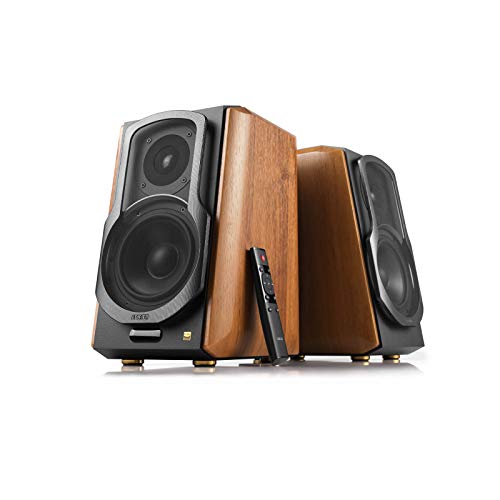
Edifier S1000MKII — The flagship streamer
The S1000MKII is Edifier arguing that a powered pair can be the destination rather than the stepping stone. Its title reads like a specification sheet for that argument: a substantial amplifier figure, Bluetooth 5.0 with aptX HD named outright, optical input, a Class D amplifier, and a near-field monitor heritage scaled up into cabinets with genuine presence. Everything about the pair — its weight, its angled baffle, its finish — announces that it expects to be the best-sounding object in the room.
It largely delivers on that announcement. The S1000MKII plays with an authority the smaller picks cannot imitate: bass with actual foundation, a soundstage that stays stable as volume climbs, and streaming quality that rewards a good source and a quiet room. The costs are literal and spatial. It is the heavyweight of this guide in every sense, its cabinets demand stands or a serious desk, and its talents are wasted within arm’s reach at whisper volume, where the little A2+ is happier. Buy it as the system, not as an accessory to one.
- Form: active bookshelf pair, substantial cabinets, near-field monitor lineage as titled
- Streaming: Bluetooth 5.0 with aptX HD stated in the title
- Amplifier: Class D design with the output figure quoted in the title
- Inputs: optical named in the title alongside the wireless path
- Placement note: weight and size argue for stands or a reinforced desk
Strengths
- Authority and scale beyond the rest of this group
- aptX HD streaming for listeners equipped to use it
- Build and finish that present as a flagship, not an accessory
Trade-offs
- Largest and heaviest pair here; furniture must agree
- Over-specified for background listening at a desk
- Sits at the top of this group’s price territory
Best for: a dedicated listening seat where one powered pair is the whole ambition. Not suited for: casual placement, small desks, or rooms where it will mostly play quietly.

Audioengine A2+ — The desktop specialist
The A2+ — in its current generation, titled here as the A2 GEN3 wireless — is the answer to a specific geography: the few feet between a monitor, a keyboard, and your ears. Audioengine built the smallest cabinets in this guide and tuned them for that distance, where the goals are clarity at low volume, a coherent stereo image at arm’s length, and a footprint that leaves room for the work the desk exists for. Its title leads with modern Bluetooth and 24-bit streaming, which suits a computer source perfectly: one wireless link, no interface box, no cable nest.
Judged at the desk, it is superb; judged anywhere else, it is out of its element, and Audioengine’s honesty about that is part of its charm. The little cabinets cannot fill a room, and their bass is a suggestion rather than a foundation — owners who want more add a subwoofer or move up the range, and the A2+ makes no pretence otherwise. In white, as listed here, it disappears into a bright workspace in a way the walnut pairs cannot. For the single most common powered-speaker job in modern life — making a computer sound like a system — it remains the specialist to beat.
- Form: compact powered desktop pair in white, as titled
- Streaming: Bluetooth 5.3 with adaptive support and 24-bit audio, per the title
- Role: computer speakers for PC, Mac, gaming, and music, per the title
- Scale: the smallest cabinets in this guide, tuned for arm’s-length listening
- Expansion: bass is deliberately modest; plan a subwoofer if the desk grows ambitions
Strengths
- Near-field clarity and imaging at the distance desks demand
- Tiny footprint that leaves the workspace usable
- Modern wireless specification matched to computer sources
Trade-offs
- Cannot fill a room; it was never meant to
- Bass is a suggestion without a subwoofer
- Premium pricing for its physical size
Best for: a computer desk where space is precious and listening is close. Not suited for: television duty across a lounge, or any room-sized ambition.
Desk Pairs, Room Pairs, and the One Table That Sorts Them
| Pick | Natural seat | Signature input | Subwoofer path | Character |
|---|---|---|---|---|
| Edifier R1280DB | Desk or counter | Optical | None — closed system | Clear, modest, near-field |
| Klipsch The Fives II | Across the lounge | Television-first, Atmos in title | System-dependent; check panel | Lively, forward, dynamic |
| Kanto YU4 | Small room, record shelf | Phono preamp built in | Designed to pair with a sub | Balanced, composed |
| Fluance Ai41 | Living room | Optical plus RCA | Output stated in the title | Warm, easy, room-filling |
| Edifier S1000MKII | Dedicated listening seat | Optical, aptX HD streaming | Cabinets carry real bass alone | Authoritative, flagship scale |
| Audioengine A2+ | Monitor-side desk | 24-bit Bluetooth | Add a sub for foundation | Precise, compact, close-up |
The pattern the table exposes is that this category sells one product in two sizes. The desk pairs — R1280DB and A2+ — optimise for clarity at a metre, tiny footprints, and computer sources. The room pairs — the Fives II, the Ai41, the S1000MKII — optimise for scale, television behaviour, and expansion. The YU4 stands between the camps with a turntable in its hand. Almost every disappointed owner in this market bought across that line; almost every delighted one bought within it. Decide which product you are shopping for before comparing specifications, and the specifications suddenly sort themselves.
How Should You Place a Powered Pair for Television and Music?
Start with the screen. For television, the pair should flank the display at roughly its height, angled slightly toward the main seat, so dialogue anchors to the picture instead of floating above the furniture. Keep the cabinets’ fronts flush with or ahead of the media unit’s edge; a speaker pushed back on a deep shelf plays into a wooden cave of its owner’s making. If the unit is low, small angled stands or foam wedges that tilt the tweeters toward ear level recover most of what height would have given.
For music, the classic triangle returns: speakers and listener at the corners, distances roughly equal, adjusted by ear in small steps. Powered pairs add one wrinkle — the master cabinet carries the inputs and often the controls, so plan which side it lives on before the cables are dressed, and leave enough slack to experiment. The connecting cable between the pair also sets a maximum spread; check its length against your furniture rather than discovering the limit mid-installation.
Power deserves the same forethought as placement. Each pair here needs a mains socket, and the master cabinet’s standby behaviour determines whether the system feels invisible or needy. Models with automatic wake on signal — the YU4 advertises exactly that discipline — can be switched at the wall of your patience the least. Whatever the model, route the power and signal cables separately where you can; it costs nothing and prevents the faint hum that owners otherwise chase for weekends.
Which Setup Mistakes Do Powered-Speaker Owners Keep Making?
The most common is buying for the wrong seat, covered above. The second is judging a pair in its first hour, perched on a cardboard box at ear-wrong height, streaming a compressed track over a Bluetooth link shared with three other devices — then writing the review that warns the world. Placement and connection method are half of what a powered speaker sounds like; give the pair its intended position and its best input before forming the verdict you will live with.
A third mistake is volume-matching by the dial. Powered pairs calibrate their controls differently, so identical knob positions mean nothing across models; owners comparing two pairs routinely crown the louder one. A fourth is forgetting firmware and app layers where they exist — several modern powered pairs receive meaningful fixes and feature changes through their makers’ apps, and a pair judged on launch software may not be the pair you own a year later. Register the product, update it once, and then ignore the app happily.
The last mistake is treating the pair as the end of the room. A television on a bare wall between two speakers, a hardwood floor, and a leather sofa will make any of these six sound harder than they are. A rug, curtains, and a bookshelf or two are acoustic equipment in everything but name, and they improve the speakers you already own more reliably than the next model up would.
What About Latency, Codecs, and the Numbers on the Box?
Three specifications dominate powered-speaker marketing, and all three deserve deflation. Wattage figures mix peak and continuous ratings so freely across brands that comparing them between makers is close to meaningless; within one maker’s range they rank models, and that is all they reliably do. The reviews above therefore treat each title’s figure as a statement of intent — this pair is built for a desk, that one for a room — rather than as a measurement you can bank.
Bluetooth versions and codecs matter at the margins of hearing and not at all to convenience: every pair here pairs quickly and holds a connection across a room. Where a codec like aptX HD earns its mention is in a quiet room, from a compatible phone, through a revealing speaker — the S1000MKII’s natural habitat. Latency, the third number, rarely appears on boxes at all, yet it decides whether streamed video feels right; the wired optical path sidesteps the question entirely, which is one more reason the input list outranks the wireless specification when you choose.
How Long Should a Powered Pair Last, and What Fails First?
The cabinets and drivers in a powered pair age like passive speakers — slowly, gracefully, over decades. The electronics age like electronics. Capacitors, standby supplies, and wireless modules are the components with clocks on them, and the practical consequence is that a powered pair should be bought as a ten-year appliance rather than a lifetime heirloom. That is not an argument against the category; it is an argument for buying the pair whose electronics you will not outgrow, because the amplifier side cannot be replaced when tastes change.
Heat is the enemy you control. Powered cabinets tucked into enclosed media furniture, stacked under other warm equipment, or left in standby through summers in hot rooms age faster than their owners expect. Ventilation is free longevity. So is surge protection, since the same power supply that feeds the amplifier is exposed to every spike on the line. Treat the pair like the computer it partly is — air, clean power, occasional dusting — and the electronics will usually outlast the furniture they sit on.
Should You Choose Powered Speakers or a Receiver and Passive Pair?
The honest answer depends on where your system ends. If the destination is one room, two speakers, and a handful of sources, the powered route wins on simplicity, space, and the absence of a rack — and the best pairs here lose nothing in sound to a comparably priced separates system. If the destination is a growing home theatre with centre and surround channels, or a shelf of sources that multiplies yearly, the receiver route’s flexibility eventually repays its clutter. Many households run both: separates in the main room, a powered pair at the desk or in the bedroom, each where it belongs.
Budget arithmetic favours powered pairs at the start and separates at scale. A powered pair bundles amplification that would otherwise consume a third or more of a small system’s budget, and it spends that money inside a cabinet the maker tuned for exactly those drivers. The crossover point arrives with expansion: the day a centre channel or a second room enters the plan, the bundled amplifier’s value stops compounding. Knowing which side of that line your ambitions sit on is the real purchasing skill in this category.
How Do Powered Pairs Behave as Everyday Television Furniture?
The test of a television speaker is not the film you demo it with; it is the Tuesday news, the weather, the panel show half-watched over breakfast. Powered pairs pass that test when three behaviours align. First, they wake when the television wakes, without a second remote hunt. Second, their volume follows the television’s remote or their own without a daily negotiation. Third, they return to standby quietly, without pops, hums, or a glowing panel of lights in a dark room. The pairs in this guide were chosen with those behaviours in mind, and the YU4’s title even advertises its standby discipline outright.
Where owners get surprised is usually the optical connection’s manners. Some televisions keep their optical output live in standby, which can keep speakers awake or wake them at odd hours; the fix lives in the television’s audio settings, not the speakers. Others mute game consoles or apps unexpectedly through format settings. A powered pair connected by optical is a two-device system, and the television’s menu is half its manual. Spend ten minutes there on installation day — output format, volume behaviour, standby sync — and the system disappears into the furniture, which is the highest compliment television equipment can earn.
Dialogue deserves its own paragraph in this context, because it is where powered pairs most clearly outclass the television they replace and most soundbars they rival. A stereo pair places voices between two real cabinets at screen height, and the brain locks them to the picture effortlessly. Viewers who struggle with mumbling in modern mixes — which is to say, most viewers — usually find a bookshelf pair at moderate volume clearer than a television speaker at high volume, because clarity, not loudness, was the missing ingredient.
What Should You Check During the First Week of Ownership?
Unbox like an inspector before you listen like a fan. Photograph the cabinets, check corners and edges for transit damage, and confirm that grilles, remotes, cables, and manuals all match the maker’s list. Power the pair up and run through every input you own — Bluetooth, optical, analogue — because a fault on the input you test in month three is a warranty conversation you could have had in week one. Listen for hum at idle with the volume raised and no source playing; a faint mains whisper from a badly routed cable is fixable, but you want to know which problem you have while returns are painless.
Then place them properly before judging them at all. Powered pairs are routinely reviewed by their owners in the worst acoustic position they will ever occupy — straight out of the box, on the floor or a crowded shelf, tweeters aimed at knees. Give the pair its intended height and a sensible distance from walls, stream a recording you know by heart, and only then form the opinion you will repeat to friends. Most powered speakers improve noticeably across that first week of placement experiments, not because the drivers change character, but because the room finally gets its say.
Finally, test the habits, not just the sound. Does the pair reconnect to your phone without a ritual? Does it wake with the television every time, including the time the television updated overnight? Does the remote work from the actual sofa, at the actual angle? These small fidelities decide whether a powered system feels like furniture or like equipment, and they are all testable inside a returns window if you deliberately look for them.
Stands, Shelves, or the Television Unit Itself?
Powered pairs complicate the stand question with cables: each installation needs mains power at the master cabinet and a link cable to its partner, so the elegant floating-shelf photograph in the brochure hides a small logistics exercise. Stands remain the acoustic ideal — correct height, isolation from furniture, freedom to angle — and they suit the room pairs here, particularly the S1000MKII, whose cabinets deserve better than a crowded media unit. Route the cables down the stands’ channels if they offer them, and leave service slack; a cable stretched drum-tight is a connector waiting to fail.
A television unit is the pragmatic choice for the Fives II and the Ai41, provided the unit is rigid and the speakers sit near its front edge with their tweeters lifted toward ear height by pads or short risers if needed. The enemy is the hollow, resonant unit that sings along with the bass; a hand pressed flat on its top during a loud passage will tell you whether yours does. Shelves suit the desk pairs, where the listening distance is short and the shelf is effectively the desk by another name — though even there, isolation pads earn their tiny cost by decoupling the cabinet from a surface that otherwise joins the band.
Wall mounting is the option this category mostly declines, and the reason is weight plus cabling: a powered cabinet carries an amplifier, needs a mains feed, and rarely ships with bracket hardware. If wall mounting is non-negotiable in your room, that requirement belongs at the top of the shopping list, ahead of every specification in this guide, because it will eliminate most powered pairs before sound quality gets a vote.
A Source-by-Source Walk Around the Six
Start with the television, the source most of these pairs will serve daily. The Fives II was designed for it outright, the Ai41 and S1000MKII take it through optical with room-filling results, the YU4 handles it as one input among several, and the two desk pairs serve small screens in bedrooms and studies perfectly well. If the television is large and the room is larger, let cabinet scale arbitrate: a small pair straining at film volume will sound worse than its specifications, while a big pair idling at desk volume wastes its talents in the opposite direction.
The turntable narrows the field fastest. Only the YU4 connects a deck directly, thanks to the phono preamp in its title; every other pair here needs a turntable with a built-in phono stage or a small external one in the chain. That is not a disqualification — many modern decks carry their own preamp — but it belongs in the purchase arithmetic, because the tidy one-box promise of a powered pair quietly becomes two boxes for vinyl on five of these six.
The computer is the A2+’s home fixture and the R1280DB’s second job, and both are excellent at it. The phone belongs to everyone equally. And the games console, increasingly the loudest source in the house, follows the television’s path through optical, with the same latency logic applying: wired for responsiveness, wireless for convenience. Lay your own sources across that map and the shortlist usually shortens itself to two pairs, at which point finish, footprint, and price can settle what specifications could not.
Do Powered Pairs Need Room Correction or Apps to Sound Right?
Mostly, no — and the simplicity is part of the category’s charm. A few modern powered systems offer app-based tuning, and it can help in awkward rooms, but the traditional tools remain the effective ones: placement, distance from walls, tweeter height, and the tone controls several of these pairs carry on the cabinet itself. A bass control turned down two notches cures more living-room boom than any software routine, because the problem was never measurement — it was a port six inches from a wall.
Where apps genuinely help is logistics rather than acoustics: input naming, standby timers, firmware updates, and occasionally a night mode that compresses dynamics for late listening. Treat those as conveniences when comparing the pairs, not as sound-quality features. The speakers in this guide were voiced by their makers on the assumption that they would sit in real rooms and be adjusted by ear, and that assumption has aged well. Your ears, a familiar recording, and twenty minutes of small adjustments will get any of the six within reach of its best; the remaining distance is the room’s, and no app fully crosses it.
What Happens When Two People Share One Pair?
Households, not individuals, own most powered speakers, and sharing exposes design decisions that solo listening never touches. The pair that wins the living room is the one whose connection logic is legible to everyone: the television input that simply works, the Bluetooth button a guest can find without a manual, the remote that lives in one obvious place. Every pair here can be operated by a determined visitor, but they differ in how much explanation they demand, and that difference compounds across years of evenings.
Pairing behaviour is the friction point. A speaker that clings to the last phone connected will stage a small domestic negotiation every time the other partner wants music; a speaker that accepts a fresh pairing gracefully ends it. Test this during the first week with both phones in the house, at the distance of the actual sofa, and learn the sequence before guests arrive. Volume habits matter too: a pair that powers up at its last, loud setting will eventually startle someone at midnight, while pairs that wake at a moderate level are forgiven everything else.
There is a quieter social dimension as well. A powered pair in a shared room becomes the household’s default instrument — for calls on speaker, for a child’s streamed story, for the news while cooking. Versatility across those unglamorous jobs, rather than brilliance at any single one, is what makes a pair beloved rather than merely owned. The all-rounders in this guide — the YU4 and the Ai41 especially — earn their keep exactly there, in the accumulation of ordinary days.
How Should You Think About Price Inside This Category?
A powered pair’s price bundles three products — speakers, amplifier, and streamer — so comparing it against a passive pair’s ticket alone misleads. The fair comparison is system against system: the passive pair plus the amplifier it needs, against the powered pair complete. Run that arithmetic and the powered route usually wins at the modest end, which is precisely where this guide’s R1280DB and Ai41 sit, and roughly breaks even at the flagship end, where the S1000MKII’s price buys amplification quality a separates buyer would struggle to match in the same total.
Within the category, money buys three things in a reliable order. First, cabinet and amplifier scale — the physical ability to fill a room without strain. Second, inputs and behaviours: the phono stage in the YU4, the subwoofer socket on the Ai41, the television manners of the Fives II. Third, refinement — finish, remote quality, the smoothness of the treble at the top of the range. Notice that streaming sophistication sits low on that list, because it is cheap to implement well; any pair whose price is justified mainly by its Bluetooth specification is asking you to pay for the wrong thing.
There is also a hidden saving to count: the powered pair deletes the receiver’s standby draw, the speaker cable run, and usually one remote from the coffee table. Across a decade of evenings those small absences add up to a tidier room and a simpler system, which for many households is worth as much as any specification in this guide — simplicity, unlike wattage, gets used every single day.
The resale and longevity angle cuts the other way and deserves honesty.
A passive pair can be sold, gifted, or re-amplified for decades; a powered pair’s electronics cap its second life, and its resale value reflects that. Buy the powered pair for the decade of convenience in front of you, at the size your room actually needs, and the arithmetic is sound. Buy two sizes up, for a room you might move to someday, and you have paid flagship money for optionality the electronics may not live to use.
Final Recommendation
Match the pair to the seat and the decision makes itself.
For a main television, the Klipsch The Fives II is the stereo answer with the fewest regrets. For a turntable, the Kanto YU4’s built-in phono stage makes it the tidy champion. The Fluance Ai41 is the living-room value with a future, thanks to the subwoofer output waiting on its back panel, while the Edifier S1000MKII is the flagship for listeners who want one pair to be the whole story. At the desk, the Audioengine A2+ owns the near field, and the Edifier R1280DB remains the wise first purchase for everyone else. Six pairs, six different rooms — choose the room first, and the right pair is the one still standing when the furniture, the sources, and your own habits are all described honestly.
Frequently Asked Questions
Can powered bookshelf speakers really replace a soundbar?
For stereo content and dialogue clarity, yes, and the Fives II exists to prove it. What a pair cannot reproduce is a soundbar’s virtual surround trickery or a dedicated centre channel’s anchoring; what it returns is genuine stereo separation and music performance. Most viewers who switch describe the trade as an upgrade within a week.
Do I need a special cable to connect a turntable to the Kanto YU4?
An ordinary RCA interconnect and a ground wire if your turntable provides one. The phono preamp built into the YU4, stated in its title, does the amplification and equalisation a turntable requires, so no separate phono box sits between deck and speaker.
Why does one cabinet of a powered pair weigh more than the other?
Because the amplification, power supply, and input board usually live in one cabinet, which then feeds its partner through a speaker cable. The asymmetry is normal and invisible in use; it only matters when you are carrying the pair upstairs or planning which side the sockets should face.
Is Bluetooth good enough for films?
For casual viewing, generally yes; for critical viewing, the optical connection is the safer habit, since it removes wireless latency from the equation entirely. Every pair in this guide offers a wired path for exactly that reason — use Bluetooth for music and convenience, and the cable for the cinema.
Can I add a subwoofer to any of these pairs later?
Only where the pair provides for it. The Fluance Ai41 states a subwoofer output in its title, and Kanto designs the YU4 with sub pairing in mind; the R1280DB is a closed system with no such socket. Check the back panel before assuming, because that single socket decides whether the system can grow.
How close can I sit to a large powered pair like the S1000MKII?
You can sit close, but you will not hear what you paid for. Big cabinets need distance for their drivers’ outputs to blend and their bass to develop; at arm’s length the A2+ or R1280DB will sound more coherent. Match cabinet scale to listening distance and both ends of this guide will serve you better.
Should the master cabinet go on the left or the right?
Whichever side puts the inputs, controls, and power cable closest to your sources and socket — the stereo image does not care, because the pair is voiced symmetrically. What does matter is keeping the inter-speaker cable untangled from the mains lead and leaving enough slack to angle both cabinets toward your seat. Decide the side during installation, write it into your cable layout once, and the question never needs asking again. Owners who plan to add a wired source later — a CD player, a streamer, a console — should also leave one analogue input free rather than filling every socket on day one; powered pairs reward a spare input the first time a new source arrives at Christmas.
Related Guides
Still deciding between powered convenience and passive flexibility? Compare these neighbouring guides: the passive 8-ohm bookshelf pairs that need a separate amplifier, bookshelf speakers chosen for bass response above all, and affordable surround systems for a first home theatre.


