What's inside
- Where to buy
- Key Takeaways
- Quick Picks
- How We Chose These Picks
- Best Business Projectors: The Six Picks in Detail
- Comparison Table
- What brightness do best business projectors actually need?
- Which resolution suits slides, spreadsheets and calls?
- How should a room be set up for hybrid meetings?
- Lamp, LED or laser: which light source should a business choose?
- How do you install and commission a meeting-room projector?
- What Are the Most Common Mistakes?
- What else should you know before choosing?
- Final Recommendation
- Frequently Asked Questions
- Related Guides
As an Amazon Associate I earn from qualifying purchases. This post may contain affiliate links at no extra cost to you.
gizmoverdict.com is reader-supported. When you buy through links on our site, we may earn an affiliate commission.
Where to buy
The best business projectors below can each be ordered through the Amazon listing linked from its name, and that route matters because business models splinter into near-identical variants with different lamps, lenses and warranty terms. Buy the exact listing named here rather than a lookalike suggested on the page, check whether the seller is the manufacturer or an authorised reseller, and confirm the return window before the projector is ceiling-mounted, because a mounted unit with the wrong throw distance is an awkward conversation with facilities.
A meeting room projector fails in ways a home cinema model never has to consider. It gets switched on by whoever arrives first, often someone who has never touched the remote. It fights fluorescent light, glass walls and a whiteboard glare that no screen fully tames. It must make a spreadsheet legible from the far end of a twelve-seat table, then handle a video call, then a visiting client’s laptop with an unknown resolution. The six models in this guide were chosen for that unglamorous reality: readable text, honest brightness, forgiving setup and connections that cover the laptops people actually carry into rooms.
One warning belongs at the front. Brightness figures in this class are not measured on a level field. Epson quotes both colour brightness and white brightness for its 3LCD models, while DLP brands generally quote white brightness only, so a DLP model and an Epson model carrying similar headline numbers may not look equally vivid with colourful slides. Treat every lumen figure in this article as the manufacturer’s own number for its own model, compare within a brand more confidently than across brands, and weight resolution, throw and lamp life alongside brightness rather than ranking this list by lumens alone.
Resolution is the second quiet divide. WXGA, at 1280 by 800, is the working norm in this class and matches the shape of most presentation content well enough. One pick here, the Epson Pro EX9270, steps up to full 1080p, which suits rooms where detailed dashboards and small type fill the screen. The rest trade that extra sharpness for shorter throw, lower running costs or simpler upkeep. None of that makes any of them wrong; it means the right choice depends on whether your room is a huddle space, a boardroom or a training room with rows of seats.
Key Takeaways
- The Epson Pro EX9270 is the sharpest tool here, the only 1080p pick, and the natural boardroom choice when small text matters.
- Short-throw models from ViewSonic put a big image into small rooms without anyone’s shadow crossing the slides.
- The ViewSonic LS560WH trades lamp changes for an LED light source, which suits rooms nobody wants to maintain.
- Epson’s colour-plus-white brightness figures and DLP white-only figures are not directly comparable, so never rank across brands by lumens.
- Every pick offers HDMI, and most offer two, because the second port is the one that saves a meeting.
Quick Picks
| Pick | Badge | Why it earns its place |
|---|---|---|
| Epson EX3290 | Dependable all-rounder | Equal colour and white brightness at 4000 lumens makes slides look as vivid as the numbers suggest. |
| ViewSonic PS502W | Small-room specialist | A 0.5 short throw fills the wall from a desk-length distance, ending shadow puppets during presentations. |
| Epson Pro EX9270 | The 1080p step-up | Full HD resolution plus wireless streaming makes it the boardroom pick for detailed content and cable-free guests. |
| ViewSonic LS560WH | Low-maintenance LED | An LED light source and LAN control suit organisations that would rather never schedule a lamp change. |
| BenQ MW560C | Straightforward value | Auto keystone, VGA for legacy kit and BenQ’s SmartEco lamp management make it an easy room refresh. |
| ViewSonic PA503W | Proven fleet favourite | A long-running, widely deployed WXGA model with optical zoom and every legacy port a mixed estate needs. |
How We Chose These Picks
We started from the rooms, not the spec sheets. A business projector earns its place by surviving mixed content: dense slides at nine in the morning, a hybrid call at ten, a training video after lunch. So each candidate was judged on text legibility at its native resolution, the brightness its maker claims for lit rooms, how much keystone and zoom correction it offers when the mount is imperfect, and whether its inputs cover both the installed room PC and a guest laptop without a drawer full of adapters.
Running costs carried real weight. Lamp models ask for replacement lamps and filter cleaning on a schedule somebody must own; the LED and laser-leaning entries reduce that burden but usually give back some brightness or money. We also favoured models with built-in speakers that can carry a video call in a small room, while being honest that no projector speaker fills a large training space. Warranty and brand support networks mattered too, because a failed projector before a client pitch is a business problem, not a hobby problem.
Finally, we excluded the generic high-lumen home projectors that flood marketplace search results. Inflated brightness claims, vague native resolutions and absent support make them poor fleet purchases even when a single unit looks tempting. Everything below comes from Epson, ViewSonic or BenQ business lines, with listings verified against the manufacturers’ own product families, so an IT buyer can order a second identical unit next year with reasonable confidence.
Best Business Projectors: The Six Picks in Detail

Epson EX3290 — Dependable all-rounder
The EX3290 is the projector a facilities manager would pick if nobody were watching, and that is a compliment. Its 3LCD engine produces 4000 lumens of colour brightness alongside 4000 lumens of white brightness in Epson’s own figures, which means the blue in a bar chart and the red in a warning slide arrive with the same force as a white slide does. In a lit room that equality is the difference between a deck that looks designed and one that looks washed pale by lunchtime.
Two HDMI ports sound like a footnote until the day a visitor’s laptop and the room PC both need the screen inside the same ten minutes. The EX3290 handles that switch from the remote without cable swapping behind a credenza. Its WXGA panel will not render a dense financial model with the crispness of the 1080p pick below, yet for the ordinary diet of slides, documents and video calls it is sharp enough that nobody in the room will think about resolution at all, which is precisely the point of a workhorse.
- Native resolution: WXGA, 1280 by 800, widescreen shape
- Light source: lamp-based 3LCD engine
- Brightness: 4000 lumens colour and 4000 lumens white, per Epson
- Inputs: two HDMI ports plus legacy computer connections
- Audio: built-in speaker for call audio in smaller rooms
Strengths
- Colour brightness matches white brightness, so charts keep their saturation
- Two HDMI ports cover a room PC and a guest laptop together
- 3LCD design avoids the rainbow artefacts some viewers see on DLP
Trade-offs
- Lamp will eventually need replacing on a maintenance schedule
- WXGA softens very fine spreadsheet type at large sizes
- Fan noise is present, as with most bright lamp models
Best for: general meeting rooms that show colourful slides all day. Not suited for: rooms screening detailed 1080p dashboards as their main content.
Mount it so the lens sits square to the screen and lean on the optical adjustments before touching digital keystone, which trims resolution at the edges. Pair it with a simple ceiling mount, label the remote’s input buttons for guests, and log the lamp hours quarterly so a replacement is ordered before the old lamp dims past usefulness rather than after a presenter complains.

ViewSonic PS502W — Small-room specialist
Short throw changes the politics of a small room. With a throw ratio around 0.5, the PS502W sits close to the wall and throws a large WXGA image from a distance where a conventional projector would manage a postage stamp. Nobody walks through the beam on the way to the whiteboard, nobody’s head eclipses the quarterly figures, and the presenter can stand at the screen pointing at details like a teacher rather than hovering at the back with a laser pointer and hope.
ViewSonic rates this model at 4000 lumens, a white-brightness figure from a DLP engine, so colourful slides will look a touch less saturated than on the Epson picks at the same headline number; for text, documents and the muted palettes of corporate templates the difference rarely decides anything. Vertical keystone correction helps when the unit sits on a credenza rather than a mount, though using a little care with placement keeps more of the panel’s resolution in play than leaning on correction.
- Native resolution: WXGA, 1280 by 800
- Throw: short throw, rated 0.5, for close placement
- Brightness: 4000 lumens, per ViewSonic
- Inputs: dual HDMI
- Correction: vertical keystone adjustment
Strengths
- Huge image from very close range suits huddle rooms
- Presenter can stand beside the screen without casting shadows
- Dual HDMI keeps a spare input ready for guests
Trade-offs
- Short throw demands careful placement to keep geometry square
- WXGA resolution, not full HD, for fine detail
- Close placement puts fan noise nearer the table
Best for: small meeting rooms and classrooms short on depth. Not suited for: large boardrooms where a standard throw mount already exists.
Place it on a low, stable surface or a short-throw wall mount, centre the lens on the screen’s midpoint, and level the unit before reaching for keystone. Because the projector lives close to the audience, route cables tidily along the wall so nobody trips a power lead mid-pitch, and keep the remote in the room rather than in a drawer three floors away.

Epson Pro EX9270 — The 1080p step-up
The EX9270 is where this class stops apologising for resolution. Its 1920 by 1080 panel shows a full dashboard without the subtle softness WXGA imposes, and that matters in rooms where the screen carries engineering drawings, analytics views or contracts read aloud line by line. Epson quotes 4100 lumens for both colour and white brightness, so the extra sharpness does not arrive at the cost of punch; under ordinary office lighting the image holds together from the far seats.
Wireless streaming is the other half of its boardroom case. A guest can share from a phone or laptop without the ceremonial hunt for the right cable, and the built-in speaker covers call audio in a mid-sized room respectably. It remains a lamp model, so the maintenance calendar still applies, and wireless performance will always lean on the quality of the building’s network. Judged as a complete meeting tool rather than a spec sheet, though, this is the most rounded projector in the guide.
- Native resolution: 1080p, 1920 by 1080
- Brightness: 4100 lumens colour and white, per Epson
- Light source: lamp-based 3LCD engine
- Wireless: streams from phone or laptop per the listing
- Inputs: HDMI alongside wireless casting
Strengths
- 1080p panel renders small type and dashboards crisply
- Wireless streaming removes the guest-laptop cable ritual
- Highest brightness figure in this Epson pair
Trade-offs
- Lamp upkeep remains part of ownership
- Wireless casting quality depends on the room’s network
- More capable than huddle rooms genuinely need
Best for: boardrooms showing detailed documents and hybrid calls. Not suited for: buyers wanting the lowest-maintenance light source available.
Connect it to the room’s network during installation, not during the first client visit, and test casting from both a Windows laptop and a phone before declaring victory. Set the wired HDMI input as the fallback and label it, because the day the network misbehaves is always the day the chief executive presents. Keep lamp hours in the same asset register as the room’s other kit.

ViewSonic LS560WH — Low-maintenance LED
The LS560WH answers a question the other picks do not ask: who is going to maintain this thing? Its LED light source is rated for long service without lamp swaps, which turns the projector from a consumable with a ticking clock into something closer to a fixture. For a school, a clinic or a company fitting out a dozen rooms at once, that difference compounds into real money and, more importantly, into rooms that never sit dark waiting for a part.
The trade is brightness. At 3000 lumens in ViewSonic’s figures it is the gentlest engine here, and it belongs in rooms where blinds exist and lights can be dimmed for video. In exchange it keeps the short-throw convenience of its PS502W sibling, adds horizontal as well as vertical keystone correction for imperfect placement, and offers LAN control so an IT team can check status across a fleet without visiting each room. It is a fleet manager’s projector, bought with the head rather than the heart.
- Native resolution: WXGA, 1280 by 800
- Light source: LED, no lamp to replace
- Brightness: 3000 lumens, per ViewSonic
- Throw: short throw, rated 0.49
- Control: LAN connection for network management
Strengths
- LED source removes lamp purchases from the budget
- Short throw suits compact rooms and training corners
- LAN control lets IT monitor and manage remotely
Trade-offs
- 3000 lumens is the dimmest claim in this guide
- WXGA resolution limits fine-detail work
- LED models rarely match lamp rivals for raw punch
Best for: organisations standardising many rooms with minimal upkeep. Not suited for: bright, glass-walled rooms needing maximum brightness.
Standardise the mount position across rooms so any unit can be swapped for a spare in minutes, connect the LAN port during installation, and record each unit’s network address in the asset register. Because there is no lamp to track, the maintenance rhythm becomes a simple filter and vent cleaning each term, which is a task that actually gets done.

BenQ MW560C — Straightforward value
Plenty of real rooms still contain a desktop PC old enough to offer VGA and nothing else, and the MW560C is the pick that respects that fact. Alongside HDMI it keeps a VGA input, so a refresh of the projector does not force a refresh of every machine that feeds it. BenQ quotes 4000 lumens and a 20,000:1 contrast figure, both manufacturer numbers for a DLP engine, and in practice the image is crisp and businesslike with text that stays clean at WXGA.
Auto keystone is its quiet kindness: set the unit down, and it squares its own picture, which makes the MW560C friendly to rooms where the projector travels between spaces on a trolley. SmartEco mode trims lamp power when the content allows, stretching the interval between lamp purchases. It offers no wireless tricks and does not pretend otherwise. As a dependable, comprehensible projector for ordinary meetings, it makes very few enemies, and rooms full of non-technical users value exactly that.
- Native resolution: WXGA, 1280 by 800
- Brightness: 4000 lumens, per BenQ
- Contrast: 20,000:1 claimed by the manufacturer
- Inputs: HDMI and VGA for older computers
- Features: auto keystone and SmartEco lamp mode
Strengths
- VGA input keeps older room PCs and laptops working
- Auto keystone squares the image without menu diving
- SmartEco stretches lamp life when content allows
Trade-offs
- DLP white-brightness figure, so colour punch trails 3LCD rivals
- WXGA panel, like most of this class
- No wireless streaming built in
Best for: rooms with a mix of new and legacy computers. Not suited for: wireless-first rooms where guests always cast from phones.
If the projector will move between rooms, fit a small trolley with the power lead, an HDMI cable and a VGA cable permanently attached, so the kit travels as one object. Run SmartEco as the default picture mode, and show two or three regular users where the auto keystone button lives; that five-minute lesson prevents most support calls.
ViewSonic PA503W — Proven fleet favourite
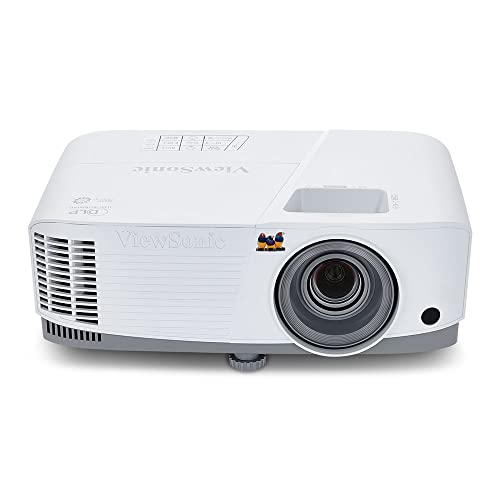
The PA503W has been installed in more meeting rooms and classrooms than most projectors ever meet, and longevity like that becomes a feature in itself. Every installer knows it, spare lamps are easy to source, and its behaviour is a known quantity: 4000 lumens in ViewSonic’s figures, a WXGA DLP image, optical zoom to fit the screen from wherever the mount had to go, and a port selection that assumes the world contains both brand-new laptops and venerable desktops.
Its 120Hz support and low-latency claims, carried in the listing, are surplus to a slideshow’s needs but harmless, and they hint at the model’s second life in training rooms that show motion content. What it does not offer is novelty: no casting, no LED source, no 1080p panel. Buy it when the brief is reliability across an estate rather than delight in a single flagship room, and it will repay that trust in the least dramatic way possible, by simply working every morning.
- Native resolution: WXGA, 1280 by 800
- Brightness: 4000 lumens, per ViewSonic
- Lens: optical zoom for flexible mounting distance
- Inputs: HDMI, VGA and USB among its connections
- Refresh: 120Hz support with low-latency behaviour per listing
Strengths
- Optical zoom forgives imperfect mount positions
- Broad port selection covers old and new sources
- Long production run means parts and knowledge are plentiful
Trade-offs
- Design has been around for years, with matching modesty
- No built-in wireless casting
- DLP colour brightness trails the headline white figure
Best for: buyers wanting a known quantity across many rooms. Not suited for: rooms wanting the newest streaming features built in.
Use the optical zoom to fill the screen from a sensible ceiling position rather than mounting at an extreme and correcting digitally. Because this model is a common fleet choice, buy one spare lamp per several installed units and store it with a note of which rooms run this model; standardisation only pays when the spares match.
Comparison Table
| Pick | Badge | Best for |
|---|---|---|
| Epson EX3290 | Dependable all-rounder | general meeting rooms that show colourful slides all day |
| ViewSonic PS502W | Small-room specialist | small meeting rooms and classrooms short on depth |
| Epson Pro EX9270 | The 1080p step-up | boardrooms showing detailed documents and hybrid calls |
| ViewSonic LS560WH | Low-maintenance LED | organisations standardising many rooms with minimal upkeep |
| BenQ MW560C | Straightforward value | rooms with a mix of new and legacy computers |
| ViewSonic PA503W | Proven fleet favourite | buyers wanting a known quantity across many rooms |
What brightness do best business projectors actually need?
Brightness advice for offices is usually given as a single number, which is unhelpful because the right figure depends on the light you cannot control. A windowless internal room behaves kindly even at the lower end of this guide’s range. A glass-walled boardroom at noon is a different country. As a working rule, the picks here cluster around the level their makers aim at lit-room presentation, and the honest move is to match the projector to the worst lighting the room regularly presents in, not the best.
Remember also whose number you are reading. Epson publishes colour brightness alongside white brightness for its 3LCD models, and the two match on the Epson picks here. DLP manufacturers publish white brightness, and colour output sits lower in practice. A colourful slide deck is therefore the fairest test: if your content is mostly white slides with dark text, any pick here will look strong; if your brand templates run saturated colour all day, weight the 3LCD models more heavily than a bare lumen ranking suggests.
Which resolution suits slides, spreadsheets and calls?
WXGA earns its dominance honestly. Most presentation content is built at shapes that map comfortably onto 1280 by 800, text at normal slide sizes stays legible across a room, and the projectors cost less to buy and to lamp. The case for the 1080p EX9270 is narrower and real: content that arrives already dense. Analytics dashboards, design reviews, legal documents and engineering drawings all carry detail that WXGA softens, and in a room where that content is the daily work, the sharper panel is not a luxury.
What resolution cannot fix is font size. A spreadsheet projected at a size where its smallest figures are physically tiny will defeat any panel, and the professional habit is to zoom the content rather than blame the projector. Buy resolution for the content you show weekly, set the room’s default zoom sensibly, and the arguments about panels mostly disappear.
How should a room be set up for hybrid meetings?
The projector is only the picture; a hybrid room also needs the far end of the call to hear and be heard. Place the room’s microphone near the talkers rather than the projector, because projector fans and ceiling positions conspire against clarity. Keep the camera at seated eye level facing the table, with the projected image beside it, so local participants look toward remote colleagues instead of at a wall ninety degrees away from the camera.
Test the full chain with an actual call before the room hosts anything important: a guest laptop joining wirelessly, the room PC sharing a deck, the projector switching inputs mid-call. Every failure you find in rehearsal is a failure your chief executive does not find live. Label the remote, leave a one-page instruction card in the room, and write the support number on that card in large type.
Lamp, LED or laser: which light source should a business choose?
Lamp models, four of this guide’s six, remain the brightness-per-money champions and their lamps are a known, budgetable consumable. The discipline they demand is administrative: someone must watch lamp hours and order replacements before dimming becomes visible in a client meeting. The LS560WH’s LED source removes that chore almost entirely, at the cost of a lower brightness ceiling, which is why it suits fleets of ordinary rooms rather than one difficult showcase space.
Whichever source you choose, heat and ventilation decide real-world lifespan more than brochures do. A projector sealed into an unventilated ceiling void will age quickly whatever its technology. Leave air around the unit, clean filters on the schedule the manual sets, and treat a projector that regularly overheats as an installation problem to fix rather than a faulty product to replace.
How do you install and commission a meeting-room projector?
Begin with the screen, because its size and position dictate everything else. The farthest viewer should sit no more than roughly six screen-heights away for detailed content, and the screen’s bottom edge should clear seated heads. Once the screen is fixed, the projector’s throw distance follows from its lens: the short-throw ViewSonic models live close to the wall, while the standard-throw picks need their rated distance to fill the same image, so measure before any mount is ordered.
Mount the unit level and centred on the screen’s vertical midline, then use lens zoom and shift, where fitted, before touching keystone correction. Every degree of digital keystone spends panel resolution to buy geometry, and a carefully aligned projector keeps that budget unspent. Focus at the centre of the image with real text on screen, not a test pattern, because text is what the room will judge.
Connect the room PC to the first HDMI input and leave the second dressed and reachable for guests, with the cable’s end parked in a table brush or a labelled clip rather than coiled behind furniture. Set the projector to wake on signal if it offers the feature, name the inputs in the menu where the firmware allows, and disable any eco timer that would blank the screen during a long workshop.
Commission the room like a sceptic. Sit in the farthest chair with the lights in their normal meeting state, open the smallest document the team genuinely uses, and read it. Run a video call with a colleague in another building. Cast from a phone if the pick supports it. Only when all of that works from the worst seat in the room is the installation finished, whatever the calendar said.
What Are the Most Common Mistakes?
- Ranking by lumens across brands, when 3LCD colour figures and DLP white figures measure different things.
- Mounting first and measuring throw afterwards, then living with an image that never fills the screen.
- Buying a single HDMI input for a room that hosts guests, and improvising the second connection weekly.
- Forgetting lamp hours until the picture dims during the meeting that mattered most.
- Leaving the remote, spare batteries and instructions in three different buildings.
- Projecting onto a glossy whiteboard and blaming the projector for the glare.
Training rooms deserve their own paragraph in any business guide, because their duty differs from the boardroom’s. Sessions run for hours, content mixes slides with video and whiteboard capture, and the audience sits in rows that stretch the legibility budget. In that room the EX9270’s sharper panel earns its keep across a long day, while the LS560WH’s freedom from lamp anxiety suits a space booked back to back with no technician in the building.
Reception and showroom projection is the business class’s public face, looping brand films where visitors wait. There the calculus shifts toward brightness stability and unattended reliability: a projector that wakes on schedule, plays its loop and never asks a receptionist to become a projectionist. Standardising such spaces on the PA503W’s proven behaviour, with a spare lamp on the shelf, is the kind of boring decision that marketing departments later describe as effortless.
Hot-desking floors create a peculiar demand: rooms booked by the hour by people who have never seen them before. Forgiveness becomes the specification, which means auto keystone, obvious input labelling and a picture that looks right at default settings. The MW560C was practically drawn for that brief. Facilities teams should walk such a room as a stranger would, remote in hand, and time how long the first successful slide takes to appear.
Procurement should price the whole room, not the projector. Mount, screen, cabling, a spare lamp where lamps apply, installation time and the inevitable second visit to adjust what the first visit revealed together outweigh small differences between these six models. A buyer comparing bare projector figures is comparing the visible tip of the invoice, and the models here are close enough in spirit that the room’s other costs should arbitrate the final choice.
Accessibility belongs in the room’s specification too. Captioning on video calls, sufficient contrast for low-vision colleagues and a screen height that wheelchair users can read comfortably are not embellishments; they decide whether the room works for the whole company. Brighter, sharper picks serve accessibility directly, and the commissioning check should include reading the smallest standard slide from the room’s accessible seating positions.
Energy and heat accumulate across an estate. A single projector’s appetite is trivial; forty rooms running ten hours a day is a facilities line item, and eco modes like BenQ’s SmartEco, plus sensible auto-off timers outside booking hours, trim it without touching the meeting experience. The LED LS560WH builds that thrift into its light source, another reason fleets lean toward it despite its gentler brightness.
Security reviews increasingly include projectors, because a networked or wireless model is an endpoint like any other. The EX9270’s casting convenience should be configured with the same care as a guest WiFi network: named clearly, separated appropriately and updated when firmware arrives. Convenience and exposure are the same feature viewed from two departments, and the wise rollout lets both departments have their say before the first client casts.
Finally, plan the replacement cycle on the day of purchase. Business projectors age into different jobs: the boardroom’s retired unit becomes the training room’s spare, and a standardised fleet makes that cascade painless. Record each unit’s model, lamp hours and mount type in the asset register, and the estate will renew itself in orderly steps instead of lurching from emergency to emergency whenever a lamp dies before a pitch.
Consider who presents most often when choosing between these models. A room used by its own staff daily rewards familiarity: the same remote, the same input names, the same wake behaviour every morning. A room used by visitors rewards forgiveness: auto keystone, obvious input buttons and a picture that looks right without adjustment. The MW560C and PA503W lean toward forgiveness, the EX9270 toward capability, and neither instinct is wrong; they simply describe different diaries for the same four walls.
Sound deserves one honest paragraph. Every pick here carries a built-in speaker adequate for speech in a small or mid-sized room, and none of them turns a training suite into a cinema. If the room regularly plays video with music or hosts calls where remote voices must fill a long table, budget for a simple soundbar or ceiling speakers as a separate line item, and judge the projector purely on its picture.
Security and management rarely appear in projector reviews, yet a networked projector is a network device. The LS560WH’s LAN connection lets administrators monitor status and restrict access, and any model placed on the office network should receive the same basic care as a printer: sensible passwords, firmware kept current, and casting features configured so that only the room’s occupants can put pictures on its wall during a meeting.
Think about the second unit before buying the first. Organisations that standardise on one or two models gain spare lamps that fit everywhere, remotes that work in every room and users who learn one menu system. This guide deliberately stays within three manufacturers’ business ranges for that reason. A mixed fleet of bargains looks cheaper on the first invoice and more expensive in every month that follows it.
Ambient light deserves measurement rather than vibes. Stand in the room at the brightest hour it hosts meetings, hold up the deck you present most, and ask whether a screen of the planned size could carry it. If the answer is doubtful, the fix is usually blinds or a smaller, punchier image rather than a heroic brightness figure, and the money saved on lumens is better spent on the screen itself.
What else should you know before choosing?
Consider the humble remote control as a piece of business infrastructure. In a well-run estate every room’s remote is the same model, labelled with the room’s name, tethered or stored in a marked dock, and paired with spare batteries in the same drawer as the whiteboard pens. The projector that wins the specification argument can still lose the Tuesday argument if its remote is missing, and standardising on the families in this guide keeps remotes interchangeable across rooms, which quietly rescues more meetings than any brightness figure ever published.
The screen’s gain deserves a decision rather than a default. A standard matte white surface with gain near unity suits most of these projectors and most rooms, spreading light evenly to wide seating. Higher-gain surfaces punch harder toward the centre seats while dimming toward the edges, a trade that punishes the wide boardroom table where the people at the ends are often the people deciding. Buy gain for the seats you have, not for the brochure photograph, and let the far corners of the table cast the deciding vote.
Acoustic ceilings and projector fans share the same air, and in a small room the fan can become the loudest participant. Lamp models at full brightness work their fans honestly, and the person booking a room for a confidential call should know which of these picks runs gentlest at the settings that room uses. Eco picture modes usually quieten the fan along with the lamp, so a room that can afford the eco brightness gets a double dividend of calm and lamp life.
Think about the first thirty seconds of every meeting, because that is where projector choice becomes culture. A model that wakes on signal, lands on the right input and shows a picture before the chairs have settled teaches a company that its rooms simply work. A model that demands a remote hunt and a menu expedition teaches the opposite lesson, and staff respond by arriving late, bringing printed copies and quietly ceasing to trust the building. The technology is identical in spec; the experience is opposite in effect.
Colour accuracy sounds like a cinema concern until the marketing team projects the brand’s signature shade and watches it drift. The 3LCD picks here hold saturated colour at full brightness in a way single-chip DLP designs structurally cannot match at the same headline figure, which is why this guide keeps returning to the colour-brightness distinction. If your decks carry heavy brand colour, weight that fact. If your decks are spreadsheets and documents, release yourself from caring and buy on throw, ports and upkeep instead.
A word about warranties and support networks, the least glamorous line in any comparison. Business projectors from Epson, ViewSonic and BenQ sit inside service organisations that understand a dead projector before a board meeting is an emergency, with advance replacement and loan arrangements varying by region and contract. A cheaper unknown model may match a pick here on paper while standing alone in a crisis. Estates should ask the support question before the fleet order, not during the first failure.
Installation day rewards the buyer who ordered the boring extras in advance: the correct mount for the ceiling type, cables long enough to dress properly rather than stretch, a power point where the projector actually lives and a spare input plate at the table. Every one of those items is inexpensive beside the projector and miserable to retrofit with a lift in a finished room. The six picks here all assume that professionalism; meeting it halfway is the buyer’s half of the bargain.
Do not overlook the projector’s menu language when the estate spans countries or the support team is remote. A screenshot of a familiar menu, talked through over the phone, resolves most user errors in minutes, and standardised models make that screenshot universal across the fleet. Mixed estates multiply the dialects a support technician must speak. This is another quiet dividend of choosing from a short list of business ranges rather than chasing a different bargain for every room that needs equipping.
The humble ceiling tile hides a structural question: can the ceiling grid and the structure above it carry the projector and its mount safely, with the safety cable the installer should always fit? Older buildings and long drops demand proper fixings into structure, not optimism into plasterboard. Any of these six picks deserves that respect, and a facilities team that photographs each installation for the asset file will thank itself at every future audit, insurance renewal and refurbishment.
Plan for the presenter who arrives with only a phone. It happens weekly now, and the rooms that cope are the ones where casting is configured, the network name is printed on the wall card and the fallback cable still exists for the day the network declines. The EX9270 builds that welcome in; the other picks accept it through the room’s own streaming puck if one is fitted. Either way, the decision belongs in the room’s design, not in a presenter’s rising panic.
Meeting equity has become a genuine purchasing criterion. When half the room is remote, the local picture must be good enough that shared content reads clearly on a laptop at the far end of the call, which depends on the camera’s view of the screen as much as the projector itself. Commission the room from the remote participant’s chair as well as the local ones, and let that second viewpoint arbitrate brightness and screen position before the installers leave the building.
There is a temptation, when a room disappoints, to blame the projector and order a brighter one. Resist it until the cheap suspects are cleared: a dusty filter throttling the lamp, a picture mode left in a dim eco setting by a previous user, a screen greyed by years of sunlight, a cable negotiating a lower signal than the source sends. Any of these can halve a good projector’s apparent performance, and all of them cost less to fix than a replacement unit.
Standardise the picture settings across the fleet and write them down. Brightness, contrast, colour temperature and eco behaviour set identically in every room mean a deck looks the same wherever it is shown, presenters stop adjusting, and support can talk a user home from a photograph. The settings page of each installed unit, photographed and filed, is a small document with an outsized effect on how professional an estate feels to the people who work in it.
Finally, remember that the projector is bought for the meetings of the next several years, whose shape nobody fully knows. Hybrid habits will deepen, content will grow denser, and the guest’s laptop will keep changing its ports. Headroom in resolution, a spare input and a light source with life in reserve are the forms of future-proofing that actually pay. The picks here were chosen with that horizon in view, favouring honest capability over this quarter’s novelty.
A short note on throw distances in ordinary offices, because the standard-throw picks here are often misjudged by buyers who measure the room and forget the furniture. The projector’s distance is counted to the screen, not to the wall behind the table, and the image must clear the heads of people standing to present. A ceiling mount placed a little further forward than instinct suggests usually serves both the geometry and the presenter, and the zoom range on models like the PA503W exists to absorb exactly that judgement call gracefully.
The boardroom’s table is a mirror nobody ordered: glossy surfaces bounce the projector’s light back into eyes and wash the screen’s lower edge with reflected glare. A matte table finish, or even a runner during important presentations, improves the perceived picture more than a model upgrade would. Facilities teams evaluating these picks should judge them in the room as furnished, because the room as furnished is the only version the company’s guests will ever meet.
Procurement cycles in larger companies reward the buyer who documents why a model was chosen. A short note in the asset file, recording the room’s dimensions, its light problem and the pick that answered them, prevents a future refresh from relitigating settled questions or, worse, replacing a considered choice with an incompatible one because the original reasoning left with an employee. The six models here each answer a recognisable room type, which makes that documentation easy to write honestly.
Do not forget the humble VGA cable’s retirement party. The MW560C and PA503W keep the port alive for the estate’s older machines, but every refresh should count how many VGA-only devices remain and plan their exit. The day the last one leaves, the room’s cabling simplifies, the input plate shrinks and a whole category of adapter faults leaves with it. Until that day, the legacy-friendly picks in this guide are the bridge that keeps the old fleet useful.
Meeting rooms accumulate remote controls the way kitchens accumulate mugs. A standardised fleet fights the entropy: one remote design, labelled per room, with a printed card showing the three buttons that matter. The support calls that remain after that discipline is imposed are the genuine faults, and they are few. Any of these six projectors will behave inside such a system; none of them can substitute for the system itself, which is built from labels, cards and one afternoon of organisation.
When a room’s projector finally retires, its mount, screen and cabling usually remain, and the replacement that fits the existing geometry saves a second installation. That is another argument for the standard-throw families that dominate this guide: their successors tend to honour similar throw ranges, so an estate can refresh room by room across years without reopening ceilings. Future-proofing, in the unglamorous real world, is mostly the art of not moving the holes.
One more consideration belongs to the buyer who inherits a room rather than building one: measure what is already there before ordering anything. The existing mount’s position, the screen’s size and the cabling’s route will quietly eliminate some of these six picks and crown others, and discovering that after delivery helps nobody. A tape measure, a photograph of the ceiling and ten minutes in the room are worth more at that moment than another hour of comparison shopping, because compatibility with a real room beats superiority in an imaginary one every single time.
And a closing thought on people rather than machines: the best business projector is the one the least technical person in the building can use at eight in the morning with a client already seated. Every judgement in this guide, about ports, keystone, light sources and remotes, ultimately serves that person’s composure. Choose the model that protects it, label everything that can be labelled, and the technology will repay the company in the only currency meetings understand, which is time that starts when it was supposed to start.
There is one final, unfashionable test that separates a good fleet decision from a lucky one: unplug the expert. Send the person who specified the room on holiday, hand the building to the newest starter, and watch the first meeting of the week. If the picture appears, the inputs behave and nobody phones anybody, the estate is genuinely well bought. Every pick in this guide can pass that test inside a labelled, documented room, and passing it, quietly and repeatedly, is the whole return on the money a business spends on the ceiling.
Final Recommendation
Match the pick to the room you actually have. The EX9270 belongs in the flagship boardroom where documents are dense and guests arrive with phones full of slides. The two short-throw ViewSonic models rescue small rooms from shadow theatre. The LS560WH is the fleet decision, the EX3290 the unflustered all-rounder, the MW560C the legacy-friendly refresh, and the PA503W the known quantity an estate manager can order without a meeting about it.
Whichever of these six lands on your ceiling, the room around it decides whether it shines: a matte screen, controlled light, labelled cables and a lamp plan written down somewhere. Get those unglamorous things right and presentations stop being a topic of conversation at all. A projector that nobody mentions, in a room that simply works every single morning, is the finest verdict any business machine can earn.
Frequently Asked Questions
Can one of these projectors replace a meeting-room TV?
For rooms seating more than about eight people, usually yes, because the projected image can grow far beyond a sensibly priced panel while staying readable. The trade is light control: a TV ignores sunshine, while a projector negotiates with it. In a dimmable room the projector wins on size and cost of ownership; in a glass box that never darkens, a large display may serve better despite the smaller picture.
How long do projector lamps last in office use?
Lamp life depends on the picture mode, the room’s heat and how the unit is powered down, so treat any single figure as a range rather than a promise. Eco modes stretch intervals considerably, and hard power cuts at the wall shorten lamp life by denying the fan its cooling run. Track hours in the menu, budget a spare once the fleet grows, and the question stops being urgent.
Do we need a screen, or is a wall enough?
A smooth matte wall works better than sceptics expect, provided it is genuinely flat and painted a neutral white or light grey. A proper screen adds a defined border that makes images look sharper than they are, gain that helps in lit rooms, and a surface that does not show every trowel mark at grazing angles. For a flagship room, buy the screen; for a training corner, the wall will serve honestly.
Will these projectors work with our video-call system?
Yes, in the way projectors always have: they are displays, and any call system with an HDMI output can feed them. The EX9270 adds wireless streaming that suits ad-hoc sharing from phones and laptops. Keep the call’s camera and microphone decisions separate from the projector decision, because audio quality, not the picture, is what remote participants complain about when hybrid meetings disappoint.
What does WXGA mean for our existing slides?
WXGA is a widescreen resolution of 1280 by 800, close in shape to the 16:10 and 16:9 templates most slide software defaults to now. Older 4:3 decks will show with bars at the sides rather than distortion if the projector is set to keep aspect ratio, which is the setting to choose. Nothing needs rebuilding; the library of existing presentations will simply work.
How many HDMI ports should a meeting room have?
Two is the practical minimum this guide recommends: one permanently wired to the room’s own computer, one waiting for whoever walks in with a laptop. Every pick here except the most minimal configurations respects that logic, and the rooms that ignore it are the rooms where meetings start seven minutes late while someone kneels behind a cabinet with a cable.
Related Guides
Keep exploring: start with best church projectors for its neighbouring angle, continue to best golf projectors for a contrasting room, and finish with best affordable gaming projectors when the flagship room is next on your list.
Related guides
- Best 1080p IP Cameras: PoE Domes, Turrets, Bullets and a PTZ That Earn Their Cable
- Best 43 1080p TVs: Why 43 Inches Went 4K — and Where True Full HD Survives
- Best Doorbell Cameras No Subscription: Local Storage Picks, and the Ring/Blink Truth
- Best AC Powered Wireless Security Cameras: Wi-Fi Data, Mains Power, Zero Sleep


