What's inside
- Key Takeaways
- Quick Picks
- How We Chose These Picks
- Which of the best cameras to film children’s sports fits your situation?
- Why does optical zoom matter more than resolution on the touchline?
- Phone or camcorder: what is the honest fork?
- How do you film a match parents will actually watch?
- What stamina does a full match actually demand?
- How do you film in bad weather and worse light?
- What should you film besides the match itself?
- How do you share footage fairly across a whole team?
- How do you look after a sideline camera across a season?
- How do you film two children in two places on the same morning?
- What do coaches actually want from parent footage?
- What should you check before you buy?
- How do you film indoor sports when the season moves inside?
- What should the end-of-season film include?
- Field Notes From Real Sessions
- Comparison Table
- What are the most common mistakes buyers make?
- Final Recommendation
- Frequently Asked Questions
- Related Guides
As an Amazon Associate I earn from qualifying purchases. This post may contain affiliate links at no extra cost to you.
gizmoverdict.com is reader-supported. When you buy through links on our site, we may earn an affiliate commission.
The best cameras to film children’s sports are bought by a very specific person: a parent standing on a touchline, a bleacher or a pool deck, trying to keep a fast small human in frame from a long way away. Every pick in this guide is judged from that parent’s spot — optical zoom reach to close the distance, stabilisation that survives handheld telephoto work, and battery and recording stamina that outlasts a full match, warm-up included.
Where to buy: links on each pick lead to its Amazon listing, where you can confirm the current bundle and recording media for yourself. One clarification before the picks, offered in a single line as promised: the search results for this topic are flooded with toy cameras made for children to play with, and those are a different product entirely, excluded from this guide completely.
A camcorder may seem like a deliberate throwback in the phone era, and the how-to-choose section below faces that fork honestly. What the phone cannot do is also simple: it cannot optically zoom across a full-size pitch, hold a match’s worth of footage without devouring its storage, or be handed to a grandparent with one instruction. That is the ground these six cameras stand on.
A note on how to read the zoom numbers below: this guide compares optical zoom only, because optical zoom is glass doing work, while the digital figures printed in large type on listings are cropping doing arithmetic. Where a listing leads with a digital number in the hundreds, treat it the way you would a weather forecast in a fortune cookie.
Key Takeaways
- Optical zoom is the whole argument: digital zoom crops and softens, while a real lens brings the far goal to you.
- Stabilisation matters most exactly where parents shoot — at full zoom, handheld, often one-handed.
- A full match plus warm-up is the battery test; every pick is judged against a whole game, not a highlight.
- The Panasonic V900’s Full HD route trades resolution for lighter files and simpler sharing.
- Toy cameras for children are a different product and appear nowhere in this guide’s picks.
Quick Picks
| Pick | Badge | Why it earns its place |
|---|---|---|
| Canon VIXIA HF G70 | The enthusiast parent’s 4K camcorder | Reach and image quality cover big pitches convincingly. |
| Panasonic VX3 4K Camcorder | Lightweight 4K for all-afternoon carrying | Light enough to carry through a full tournament day. |
| Panasonic X2100 4K Camcorder | Longest optical reach with a director’s handle | Longest optical zoom covers the far corner without moving. |
| Sony AX43A 4K Handycam | Gimbal-style stabilisation for walking the line | Level footage while walking the touchline. |
| Panasonic V900 Full HD Camcorder | The sensible Full HD workhorse | Files edit and share easily on ordinary computers. |
| Sony HDR-CX405 Handycam | The tiny budget Handycam that still zooms properly | Real optical reach at the gentlest commitment here. |
How We Chose These Picks
We filtered for camcorders a parent can operate cold: power on, zoom, record, with no menu archaeology while the match happens without them. Optical zoom range came first, then the stabilisation system’s reputation at the long end, then practical stamina — battery options, recording time and how the camera behaves across two halves and a half-time of milling around.
Phones were treated as the rival to beat rather than a pick, because the honest comparison belongs in the guide where parents can weigh it. Dedicated action cameras were set aside for the opposite reason from toy cameras: their fixed wide lenses are built for being inside the action, and youth sports, for safety and sanity, are filmed from outside it.
One listing note applies to the Sony HDR-CX405: it also exists in a renewed listing, and the pick here is the plain listing only. The two should never be merged in your mind at checkout — confirm which one is in your basket, because condition and warranty expectations differ between them.
Which of the best cameras to film children’s sports fits your situation?
These six are sequenced by the parent you recognise yourself in: the archivist, the pacer, the volunteer, the grandparent, the realist. Specifications matter in this class, but they matter second, because a camera whose habits match yours will film forty matches while a technically finer one films four and retires to a drawer. Read for temperament first; the zoom numbers will keep.

Canon VIXIA HF G70 — The enthusiast parent’s 4K camcorder
The G70 is the pick for the parent who has become, somewhere around the third season, the family’s unofficial broadcast unit. Its twenty-times optical zoom covers a full-size pitch from the halfway line with room to spare, the sensor is larger than the budget class below, and the whole camera carries the control layout of Canon’s more serious video line — a proper tool that still starts recording with one press when the counterattack starts without warning.
Streaming is its modern party trick: the same camera that records the match can feed a laptop for relatives who live an ocean away, which turns a Sunday fixture into a family event across time zones. Grandparents who cannot work a video call can often still open a link, and the G70’s owner becomes quietly beloved for reasons that have nothing to do with zoom ratios.
It asks the most of your wallet and your commitment in this line-up, and its digital zoom figure in the listing should be ignored the way all digital zoom figures deserve — the optical twenty is the real instrument. Parents filming one season of casual football may find it more camera than the job needs; parents filming a decade of a child’s sporting life will amortise it happily.
- Video: 4K UHD recording from a larger sensor than the budget class
- Zoom: 20x optical zoom; digital figures beyond that are cropping
- Stabilisation: optical image stabilisation for handheld telephoto
- Extras: HDMI output and USB live streaming for remote family
- Handling: enthusiast control layout with fast record access
Strengths
- Reach and image quality cover big pitches convincingly
- Streaming turns away fixtures into shared family viewing
- Serious controls reward parents who film every week
Trade-offs
- Priciest route in this guide by a clear margin
- More camera than a single casual season justifies
- Digital zoom headline should be disregarded entirely
Best for: Committed family videographers filming older children on full-size pitches.
Not suited for: Parents who only need a few clips from one tournament.
A season with the G70 rearranges a family’s media life around it: the camera bag lives by the door, the streaming link lives in the family chat, and the end-of-season film becomes an event with snacks. Its owner tends to become the club’s unofficial historian, which brings requests — could you film the final, could the coach have the second half — that should be accepted selectively, because the camera’s stamina is finite and so is the parent’s, however flattering the asking.

Panasonic VX3 4K Camcorder — Lightweight 4K for all-afternoon carrying
The VX3’s argument is endurance of a different kind: not the battery’s, but yours. A lightweight body that hangs from a wrist strap through a whole tournament day, comes up to the eye without ceremony, and goes back down again between plays is a camera that actually attends every match. Heavier rigs get left in the car by October; this one is still on the touchline in the rain in February.
Panasonic’s camcorder lineage shows in the details parents use without noticing: a zoom rocker shaped for cold fingers, stabilisation tuned for the long end where youth sports live, and a screen that stays readable when the low sun turns a pitch into a glare field. The 4K recording gives editors room to crop a goalmouth scramble into a shareable clip without the frame falling apart.
Lightness has a physics tax, and honesty requires naming it: a featherweight body moves more in wind and in excited hands, so the stabilisation works harder and the steadiest results still come from bracing against a fence or a monopod. For most parents that trade is the right one, because the best footage belongs to the camera that was present, raised and recording.
- Video: 4K recording in a lightweight body
- Handling: designed for one-handed, all-day carrying
- Stabilisation: hybrid system tuned for zoomed handheld work
- Screen: bright display for outdoor fixtures
- Role: the present-at-every-match option
Strengths
- Light enough to carry through a full tournament day
- Quick, simple handling suits distracted sideline filming
- 4K files crop into shareable clips without collapsing
Trade-offs
- Very light bodies transmit more hand and wind movement
- Fewer enthusiast controls than the Canon above
- Small body means smaller batteries to manage
Best for: Parents filming long tournament days who value presence over bulk.
Not suited for: Filmmakers who want manual control over every setting.
The VX3’s owners are the ones still filming in the season’s last month, and that is its entire review in one sentence. Heavier, cleverer cameras are at home in bags; this one is on a wrist at a windswept away fixture, raised in one motion when the break starts. Its files fill the family drive steadily rather than spectacularly, and its footage has the great virtue of existing — the archive’s first law, from which all other virtues follow.

Panasonic X2100 4K Camcorder — Longest optical reach with a director’s handle
The X2100 is built for the parent who has graduated to filming the whole team — the volunteer whose footage becomes the season review, the recruitment clip and the grandparents’ archive. Its twenty-four-times optical zoom is the longest real reach in this guide, spanning from a wide team huddle to a far-corner flag without a step, and the detachable handle gives the two-handed, elbows-in grip that keeps telephoto footage calm.
Heat management sounds like a spec-sheet yawn until you have filmed a summer tournament: bodies that overheat stop, and matches do not. This camera’s heat-dispersing design is aimed squarely at long continuous recording in warm conditions, which is the exact failure mode that ruins a final. Reliability across a two-hour recording is a feature, and here it is an engineered one.
The honest cost is presence. A handled camcorder reads as equipment, draws glances from officials and other parents, and asks for a bag rather than a coat pocket. For the designated team videographer that visibility is practically a uniform; for a parent who wants to disappear into the crowd, the smaller picks below wear the invisibility better.
- Video: 4K recording built for long continuous sessions
- Zoom: 24x optical, the longest reach in this guide
- Grip: detachable handle for stable two-handed filming
- Cooling: heat-dispersing body design for summer tournaments
- Stabilisation: hybrid optical system for telephoto work
Strengths
- Longest optical zoom covers the far corner without moving
- Handle grip steadies the footage other parents envy
- Engineered to keep recording through hot, long days
Trade-offs
- Most conspicuous camera on any touchline
- Needs a bag rather than living in a pocket
- Capability exceeds what casual filming requires
Best for: Team videographers filming full matches for squads and families.
Not suited for: Parents who want to film unnoticed from the crowd.
X2100 ownership comes with a title, whether or not anyone says it aloud: team videographer. The handle, the reach and the all-day recording make its owner the person the squad’s group chat pings on Sunday nights, and the role brings its own etiquette — film every child, not just your own; share the footage freely; never let the archive become a selection argument. Parents who enjoy that citizenship will find this camera the making of their seasons.

Sony AX43A 4K Handycam — Gimbal-style stabilisation for walking the line
Sony’s answer to the sideline problem is mechanical elegance: a gimbal-style stabilisation system in which the lens and sensor move together as a balanced unit, producing footage that stays level while you walk the touchline following play. Parents who pace — and youth sports manufacture pacers — get watchable film instead of a seasick record of their own anxiety.
That steadiness changes what a parent can attempt. Tracking a breakaway down the wing while walking, filming a warm-up drill while circling it, capturing a medal presentation through a crowd on tiptoe: all of these are moving shots, and moving shots are where ordinary stabilisation surrenders. The AX43A’s balanced optics were designed for exactly this restless use.
The compromises are the familiar Sony ones of price position and ecosystem: it sits toward the premium end of the parent class, and its menus reward a week of practice before the season starts. Buy it for the walking footage, learn it during friendlies, and by the first league match the camera will feel like an extension of the pacing you were going to do anyway.
- Video: 4K Handycam recording
- Stabilisation: gimbal-style balanced optical system
- Handling: built for filming while walking and tracking play
- Audio: directional microphone arrangement for field sound
- Role: the moving-parent specialist
Strengths
- Level footage while walking the touchline
- Excellent for tracking breaks, drills and presentations
- Calm horizon makes long watches genuinely pleasant
Trade-offs
- Premium positioning among parent camcorders
- Menus take practice to navigate at speed
- Best talents are wasted on tripod-only filming
Best for: Parents who walk, pace and track play as they film.
Not suited for: Static tripod filmmakers who never move during a match.
The AX43A changes its owner’s filming style within a month: the pacing becomes deliberate, the walk-alongs become a technique, and footage from presentations and warm-ups — the moving shots other parents abandon — becomes the family’s favourite material. Its steadiness also forgives the filmer’s excitement, which at a child’s first goal is not a small mercy. Owners describe the sensation as the camera keeping its composure so they do not have to.

Panasonic V900 Full HD Camcorder — The sensible Full HD workhorse
The V900 makes the unfashionable, intelligent case for Full HD in a 4K world. Its files are smaller, its editing is kinder to ageing laptops, its sharing is faster on touchline Wi-Fi, and on the screens families actually watch — phones, tablets, the living-room television from three metres — a well-shot Full HD match looks like the match. For many households that is not a compromise at all; it is the correct specification.
Panasonic aims this body at exactly the sports-and-holidays brief, with the long optical zoom the touchline demands and stabilisation for the handheld reality of a parent also holding a coffee, an umbrella or a younger sibling’s hand. It starts fast, behaves predictably, and never asks its owner to think about codecs when the penalty shootout begins.
Choose it with clear eyes about the future: if you plan to crop aggressively, project onto a huge screen or keep footage as a decades-long archive, 4K’s extra resolution is a genuine asset the V900 cannot offer. If the footage’s destiny is this season’s group chat and the family’s shared drive, the V900’s simplicity is the feature, and its owners are usually the ones who actually send the clips.
- Video: Full HD recording with smaller, friendlier files
- Zoom: long optical zoom for pitch-side distances
- Stabilisation: hybrid system for one-handed realities
- Handling: lightweight, fast-starting, simple controls
- Role: the share-it-tonight option
Strengths
- Files edit and share easily on ordinary computers
- Simple handling suits occasional and stand-in filmmakers
- All the zoom a touchline actually requires
Trade-offs
- No 4K headroom for heavy cropping
- Archive value trails the 4K picks over decades
- Fewer advanced features for growing enthusiasts
Best for: Families who share clips the same evening and edit on ordinary laptops.
Not suited for: Archivists building a decades-long, crop-heavy record.
V900 households develop the healthiest media habits in this guide: film the match, cut three minutes on the train home, send it before tea. The camera’s simplicity keeps the whole loop light, grandparents receive clips they can actually open, and nobody’s laptop fans scream over a timeline. Its owners rarely upgrade, not because they cannot imagine better, but because the loop their family loves is already closed, and closed loops are underrated technology.
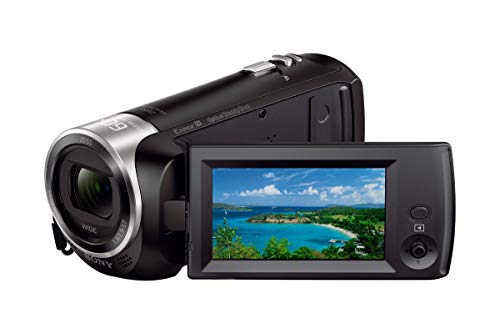
Sony HDR-CX405 Handycam — The tiny budget Handycam that still zooms properly
The CX405 is the elder statesperson of this line-up, a palm-sized Handycam whose continued presence rests on one unbeatable fact: it offers a genuine long optical zoom in a body smaller than most phones are wide, at the friendliest commitment in this guide. For a parent testing whether dedicated filming suits them, or a grandparent who wants one simple device, that combination remains undefeated.
Its zoom is the story to hold onto. Across a pitch, optical reach turns distant specks into your child, recognisably, with their number readable — the thing phone digital zoom promises and delivers as watercolour. Stabilisation keeps that reach usable, and the camera’s simplicity means the learning curve is an afternoon, not a season.
Age must be stated plainly. This is an HD camera from an earlier generation: no 4K, modest low-light grace under floodlights, and a renewed listing also exists in the wild — the pick here is the plain listing, so check your basket. As a first, small and honest sideline camera it still earns its place; as a ten-year archive machine, spend more above.
- Video: HD recording from an earlier-generation design
- Zoom: long optical zoom in a palm-sized body
- Stabilisation: optical system for handheld telephoto
- Listing note: plain listing only; a renewed version exists separately
- Role: the low-commitment starter camcorder
Strengths
- Real optical reach at the gentlest commitment here
- Small enough to live in a jacket pocket
- Simple enough for any family member to operate
Trade-offs
- HD only, with no 4K future-proofing
- Evening floodlight footage shows its generation
- Buyers must avoid confusing it with the renewed listing
Best for: First-time filmers and grandparents who want reach without complexity.
Not suited for: Families planning a long-term 4K archive.
The CX405 often arrives as a grandparent’s camera or a family’s experiment, and its biography splits: either the hobby does not take, and it retires to a drawer having cost little, or it takes completely, and it becomes the beloved first instrument whose footage — grain, wobble and all — the family would not trade for a professional archive. Either outcome justifies it. Few purchases in this guide can say as much.
Why does optical zoom matter more than resolution on the touchline?
Stand at the halfway line of a full-size pitch and the far penalty area is a long way from your lens. Resolution cannot rescue distance: a 4K frame of a tiny player crops into a soft portrait, while a modest HD frame through a long optical zoom arrives already filled with your child. Zoom is magnification performed by glass before the sensor; cropping is magnification performed afterwards on whatever detail happened to be recorded, and the difference is visible in every frame.
Digital zoom deserves its poor reputation in one sentence: it enlarges the middle of the image and invents nothing, so the listing figures that run into the hundreds are marketing confetti. Compare only optical numbers when you shop this class, and treat any headline that mixes the two as a reason to read the specification twice.
Reach also buys position. A parent with a long zoom can film from the least obstructive spot — behind the rope, at the fence corner, up the bank — instead of crowding the official’s line. Good manners and good footage turn out to be the same purchase.
Phone or camcorder: what is the honest fork?
The phone wins on presence: it is already in your pocket, its screen is superb, and for close action — a toddler’s first kickabout, a finish-line moment you are standing beside — it is genuinely excellent. If your child’s sport happens within a few metres of you, stop reading and enjoy the device you own.
The camcorder wins on distance, duration and delegation. Optical zoom covers the pitch; swappable batteries and cards cover the double-header; a single record button covers the grandparent, the stand-in parent and the older sibling press-ganged into filming. A phone filming a full match also returns home with a hot battery, a full storage and a hundred notifications interrupting the second half.
Many families land on the hybrid honestly: phone for the near and spontaneous, camcorder for fixtures. The mistake is expecting either to do the other’s job and concluding, wrongly, that filming itself is disappointing.
How do you film a match parents will actually watch?
Film wider than your instincts suggest. New sideline filmmakers zoom to the ball and produce ninety minutes of frantic panning; experienced ones hold a frame that contains the play’s shape and let action move within it, zooming in only for set pieces, celebrations and the walk off at the end. Watchable footage is mostly restraint.
Sound is half the memory. A cheap wind muff over the microphone, a position away from the loudest spectator, and the discipline not to narrate every kick will make your footage the family’s favourite. Your future selves want to hear the whistle, the teammates and the small voice calling for the ball — not a close-miked commentary recorded in embarrassment and regretted forever.
Edit like a highlights editor, not an archivist, when sharing. The full match belongs in the family archive untouched; the three-minute cut — goals, saves, the funny fall, the handshake line — is what relatives watch twice. Cameras like the V900, whose files move easily, quietly encourage this habit, and the habit is worth more than a resolution step.
What stamina does a full match actually demand?
Add the warm-up you film, the match itself, the presentations afterwards and the second game of a tournament day, and a sideline camera’s real shift is three to five hours. Judge every pick against that shift: battery swaps or a USB power bank in the pocket, card capacity for the whole day, and a body you can hold or wear without your shoulders filing a complaint by the final.
Weather is the silent stamina test. Cold drains batteries on winter touchlines; heat stresses bodies at summer tournaments, which is why the X2100’s heat-dispersing design earned its paragraph above. A camera that stops at the seventy-minute mark of a final has failed at the only moment that mattered, and no specification headline compensates.
Build the routine before the season: charge the night before, format the card at home, pack the spare in the same pocket every week. Sideline filming is a logistics hobby wearing a creative hat, and the families with the great archives are simply the ones whose logistics never made the news.
How do you film in bad weather and worse light?
Youth sport is scheduled by optimists and played in reality, so the sideline camera must survive drizzle, glare and the floodlit gloom of a winter evening. Rain strategy is mostly choreography: film from the shelter of a stand or a car tailgate where the venue allows, keep a cloth on the lens between plays, and accept that the umbrella held by a kind volunteer is part of the production team. None of the cameras in this guide should be treated as waterproof, whatever their composure.
Glare is the summer problem: a low sun behind the far goal turns players into silhouettes and autofocus into a philosopher. Repositioning along the line so the sun crosses the frame rather than filling it, and locking exposure once the light is honest, rescue more footage than any setting buried in a menu. Parents learn their home ground’s light the way sailors learn a harbour, and the knowledge compounds every season.
Floodlit evenings are the honest limit of the budget class. Small sensors and long zooms make hungry combinations, and footage will grain as the light fails — the correct response is to film anyway, closer to the action if the venue permits, and value recognisable faces over pristine pixels. The alternative archive, the one not filmed because conditions were imperfect, has never once been watched with nostalgia.
What should you film besides the match itself?
The warm-up is where shy children are briefly unguarded: the drill done well, the joke with a teammate, the new skill attempted without a scoreboard watching. Two minutes of it, filmed while other parents are still parking, becomes the footage families rewatch when the match films have blurred into one another. Arrive early enough to be bored; boredom is the videographer’s secret ingredient.
Half-time and the walk off carry the social archive — the huddle, the oranges, the consoling arm around a shoulder after a miss. These are the frames that describe a childhood in a team rather than a sequence of results, and they ask nothing of the camera but presence and discretion. Film them wide, film them briefly, and never let the lens become the reason a coach’s quiet word stops being quiet.
Presentations, medals and the end-of-season gathering are the third act. The light is kind, the subjects are stationary and smiling, and even the humblest camera in this guide produces keepsakes there. Parents who film only the sport discover, years later, that they archived the competition and missed the childhood; the fix costs four minutes a month.
How do you share footage fairly across a whole team?
Decide the sharing rules before the first match, in the group chat, in plain language: where the footage lives, who can see it, and how any family can ask for a clip to be removed. Youth sport involves other people’s children, and the camera that films a team operates on consent that should be explicit rather than assumed. Clubs increasingly have their own policies; the team videographer’s first job is to know them.
Edit even-handedly. A highlights cut that follows only the goalscorers teaches the goalkeeper’s family to stop watching, while the save, the tackle and the selfless pass are the moments those children’s grandparents crossed time zones of streaming to see. The X2100’s owner, filming for a squad, holds a small editorial power, and the squads that love their archive are the ones where it is exercised generously.
Keep the original files. Phones change, chats expire, and the three-minute cut that delighted everyone in October is not the footage a sixteen-year-old will want at her graduation. One boring folder per season, backed up once, outlives every platform the highlights will ever be posted to.
How do you look after a sideline camera across a season?
The camera that films forty matches a year lives a harder life than its specification imagines: car boots, damp grass, the occasional fall from a bench. A padded bag that lives in the same place, a lens cloth in the same pocket, and a strap that is actually used are the whole secret of longevity at this level — boring equipment habits, repeated without exception, like the charging routine they accompany.
Cards and batteries are consumables with memories. Rotate two sets, retire the card that ever misbehaves without a second chance, and keep the contacts clean and dry, because the final deserves better than a corrupted third act. A small notebook in the bag — which card holds which match — saves the archive from archaeology later.
At season’s end, give the camera an hour: clean the lens properly, check the zoom’s smoothness, charge everything, back up the year’s folders twice, and write the season’s one-page story while it is still true. The families who do this own archives; the families who do not own a drawer.
How do you film two children in two places on the same morning?
The clash fixture is youth sport’s true final boss: one child at the hockey across town, one at the football you can see from your kitchen, and one parent-camera unit to divide between them. The working solutions are delegation and honesty — a stand-in filmer armed with the simplest camera you own, a streaming setup left in trusted hands, or the frank family decision that this week one match becomes photographs and a written report, and next week the honour rotates.
This is where the simple picks earn a second life in a household that also owns an enthusiast camera. The CX405 or V900 can be handed over with thirty seconds of instruction and returned with usable footage, which no menu-deep flagship has ever managed at a rainy crossroads with the kettle of departure whistling. Fleets beat flagships on clash mornings, every season, in every family with more than one fixture list on the fridge.
Keep a shared family calendar of who filmed what, because the archive’s gaps are otherwise discovered years later and misread as favouritism. The rotation, written down, is fairness you can prove — and the child whose tournament was filmed by the deputy with the little camera will, experience says, defend that footage’s honour ferociously at eighteen.
What do coaches actually want from parent footage?
Coaches want the whole pitch and the whole play: the shape of the team, the run off the ball, the goalkeeper’s starting position — the things a ball-chasing highlight reel edits out. This is the practical argument for the wide-framing discipline described earlier, and for the team videographer’s full-match archive: the footage that develops players is the footage that looks least like a trailer.
They also want it promptly and plainly: the file, not the edit; this week, not at the reunion. A parent who can hand over a clean full match by Monday — the X2100 owner’s natural product — becomes a quiet part of the coaching staff, while the beautiful three-minute film with music serves a different, also honourable, purpose in the family’s own archive. Know which product you are making before you press record.
And they want discretion above all. Footage shared for development stays in the spaces agreed, clips of other people’s children are not content, and the camera that respects the squad’s trust gets welcomed pitch-side for years. The technical specification fades; the reputation compounds.
What should you check before you buy?
- Measure your pitch before your zoom: Stand where you will actually stand and pace the distance to the far action; then let optical zoom — and only optical zoom — answer that number honestly.
- Decide the footage’s destination: Group chat tonight, family archive, coach’s review or all three — the destination chooses between the simple sharers and the 4K archivists more reliably than any specification.
- Count the whole match day: Warm-up, two games, presentations: total the hours and buy battery and card capacity for the day you actually live, not the ninety minutes on the fixture list.
- Name the deputy: Decide now who else will film when you cannot, and let that person’s learning curve argue for at least one simple camera in the household fleet.
- Read the club’s filming policy: Consent, sharing spaces and any league rules belong in your knowledge before the season, because the camera operates on the squad’s trust as much as on its battery.
- Rehearse at a friendly: One low-stakes match to learn the controls, the bag, the pockets and the routine — so the league game is filmed by a parent, not by a tutorial.
How do you film indoor sports when the season moves inside?
Indoor sport trades the touchline’s weather for the hall’s lighting, and the exchange is not obviously kind: mixed artificial light, echoing sound, and distances that shrink while shutter speeds must not. The zoom that seemed extravagant outdoors becomes merely adequate across a sports hall, and the exposure that forgave everything under the sky now argues with flickering lamps and orange floors in every frame.
Position becomes the indoor craft. A raised corner, where the venue allows one, flattens the hall’s chaos into readable play, and a spot near the team’s bench captures the social archive at its richest — the substitutions, the timeout huddles, the small negotiations of a season. Sound, meanwhile, needs humility: halls amplify everything, including the filmer, so the quiet parent produces the watchable film.
Files from indoor fixtures reward the simple workflows again, because the season inside is dense — two fixtures a week, tournaments in the holidays — and the family that shares promptly and archives plainly survives it with the habit intact. The camera that emerges from the indoor season still charged, still simple and still loved is the one that was specified for the household rather than for the highlight.
What should the end-of-season film include?
Begin it with the warm-up of the first friendly, because nobody will believe how small they were, and end it with the walk off after the final, because nobody will believe how much they grew. Between those bookends, the season’s honest shape: a goal and a save, a mistake survived, a teammate helped up, the huddle’s noise and the presentation’s shine — the mixture that makes a team a team rather than a results service.
Keep it shorter than your pride wants. Eight minutes that a family watches whole, twice, beats forty that are endured once, and the outtakes and full matches live in the archive for the graduation edit, where length will finally be the point. The end-of-season film is a trailer for a childhood, and trailers are a discipline of mercy.
Show it together if you can — a screen, a sofa, the squad if the club agrees — because the communal viewing is the archive’s dividend, the moment forty weekends of standing in weather convert into an evening of everybody laughing at the same frame at the same time. That evening is what the camera was for, all along, on every wet touchline of the year.
Field Notes From Real Sessions
At a cup final going to penalties, the photographer swapped the battery at full time out of habit and missed nothing of the shootout. The habit, formed in September, paid out in May when it mattered most. Habits are just equipment you cannot drop.
At the far-corner flag on a full-size pitch, the photographer let the longest zoom in the bag do the walking and stayed behind the rope. From behind the rope the whole far corner came to the lens, and the official never knew he had an audience. Good manners, it turned out, had excellent reach.
At a rainy February league fixture, the photographer kept the light body under a coat between plays and filmed through the worst of it. By February the light body had filmed in weather that had retired two umbrellas and one flask. Two umbrellas retired; the filming did not.
At grandparents three time zones away, the photographer streamed the second half live and took the phone call of the season afterwards. The link travelled further than the team bus ever had, and so did the applause afterwards. Applause travels well when somebody presses record.
At a summer tournament’s third match, the photographer trusted the heat-shedding body while other cameras rested in the shade. While rival cameras napped in the shade, the third match got its archive too. Shade is for cameras that were not built for July.
At the medal presentation through a crowd, the photographer walked slowly with the gimbal-steady lens and kept the horizon honest. The horizon stayed level, the presenters stayed framed, and nobody watching later felt the crowd at all. Composure, borrowed from a lens, is still composure.
At a younger sibling press-ganged into filming, the photographer handed over the simplest camera and got usable footage anyway. The stand-in’s footage needed no apology, which is the true definition of a family camera. A family camera is defined by its stand-ins.
At the winning goal from the halfway line, the photographer had been filming wide, so the whole move — not just the finish — survived. Because the frame was wide, the assist — the best pass of the season — survived alongside the goal. The assist finally got its share of the glory.
At a floodlit evening semi-final, the photographer accepted grainier footage and valued that the faces were still recognisable. Grain and all, the faces were the faces, and the family group chat agreed that was the point. Faces beat pixels in every generation’s vote.
At the group chat that same night, the photographer sent a three-minute cut before dinner because the files moved easily. The cut reached the grandparents before the kit reached the washing machine. Dinner was served; the cut had already landed.
At a first season testing the hobby, the photographer started with the pocket Handycam and upgraded only when the habit proved real. A season later the little camera’s footage opened the end-of-year film, to general and unreasonable affection. Affection, unreasonable and entirely justified, followed.
At the end-of-season team review, the photographer screened the volunteer’s full-match archive to a room of delighted families. Twenty families watched a season become a story, and the volunteer took a bow he had not expected. A bow was taken, and thoroughly earned.
Comparison Table
| Pick | Defining fact | Signature strength | Best for |
|---|---|---|---|
| Canon VIXIA HF G70 | Video: 4K UHD recording from a larger sensor than the budget class | Handling: enthusiast control layout with fast record access | Committed family videographers filming older children on full-size pitches. |
| Panasonic VX3 4K Camcorder | Video: 4K recording in a lightweight body | Role: the present-at-every-match option | Parents filming long tournament days who value presence over bulk. |
| Panasonic X2100 4K Camcorder | Video: 4K recording built for long continuous sessions | Stabilisation: hybrid optical system for telephoto work | Team videographers filming full matches for squads and families. |
| Sony AX43A 4K Handycam | Video: 4K Handycam recording | Role: the moving-parent specialist | Parents who walk, pace and track play as they film. |
| Panasonic V900 Full HD Camcorder | Video: Full HD recording with smaller, friendlier files | Role: the share-it-tonight option | Families who share clips the same evening and edit on ordinary laptops. |
| Sony HDR-CX405 Handycam | Video: HD recording from an earlier-generation design | Role: the low-commitment starter camcorder | First-time filmers and grandparents who want reach without complexity. |
What are the most common mistakes buyers make?
Zooming to the ball for ninety minutes
Constant tight framing makes unwatchable footage and guarantees you miss the pass that mattered. Hold a wider frame, follow play calmly, and save full zoom for set pieces and celebrations.
Trusting digital zoom numbers
A headline figure in the hundreds is cropping, not reach. Compare optical zoom only, and let any listing that blurs the two teach you something about its honesty.
Arriving with one battery and hope
Matches overrun, tournaments stack games, cold drains cells. The spare battery and the second card are the cheapest insurance in this entire guide.
Filming over the official’s shoulder
Crowding the technical area earns you a conversation and worse footage. A long zoom exists precisely so you can film well from where parents belong.
Narrating every moment
Your commentary will embarrass everyone, including you, within a year. Let the match make its own soundtrack; future viewers want the whistle and the teammates.
Becoming the parent who only watches through a screen
The camera should attend the match so you can attend your child. Set the frame, trust the stabilisation, and watch the big moments with your own eyes over the top of the camera — the footage will survive, and so will the memory.
Posting other people’s children publicly without agreement
A public highlight reel is a publication, with everything that implies. Keep team footage in the spaces the families agreed on, and treat consent as part of the kit, checked as regularly as the batteries.
Deleting the originals after making the cut
The highlights are for now; the originals are for later. Storage is cheaper than regret, and the graduation film is compiled from the files somebody almost deleted in October.
Final Recommendation
Match the camera to your touchline reality. The parent filming a decade of sport should look hardest at the Canon G70 or the Panasonic X2100; the pacer should take the Sony AX43A’s walking steadiness; the all-day carrier the featherweight VX3; and the household that shares clips tonight, or is simply starting out, will be served with surprising honour by the V900 or the little CX405.
Whichever you choose, learn it during a friendly, pack the spare battery without being asked twice, and film wider than feels natural.
If you film one child on big pitches for years, the enthusiast picks repay their commitment in reach, steadiness and the quiet confidence of a tool that never misses the moment it was bought for. Buy once, learn it in friendlies, and let the seasons amortise it.
If you film a whole team, your specification is stamina and fairness: long recording, long zoom, and the temperament to point the lens at everyone’s child. That is the X2100’s job description, and the role will find you as surely as you find the camera.
If you film a family — some matches, some holidays, a grandparent deputised twice a season — the honest picks are the simple ones, and their simplicity is not a discount on quality. It is the feature your household will actually use.
One last touchline note, because it decides whether the archive gets made at all: make the routine smaller than your motivation. A bag that packs itself, pockets that never change, a camera that starts in one press and a card routine that takes ninety seconds at home — these are the true specifications of a season-long filming habit, and they matter more than the difference between any two cameras in this guide. Motivation is weather; routine is climate. The families with the great archives are not the most enthusiastic ones on the first Saturday of September — they are the ones whose system still works on the last wet Saturday of February, when enthusiasm has gone home early and the routine is standing on the touchline alone, filming.
Years from now nobody will ask what it was filmed on; they will ask whether you were there, and the footage will answer.
Frequently Asked Questions
Can I just use my phone for youth sports?
For nearby action, yes, happily. For full-size pitches, the phone’s lack of optical zoom, its storage and battery limits, and its talent for interrupting itself with notifications all argue for a camcorder. Many families use both, each where it is strong.
Is 4K worth it for children’s matches?
If you crop clips, archive for decades or watch on a large screen, yes. If footage lives in the family chat and on laptops, a good Full HD camera like the V900 is honestly sufficient, and its files are far easier to handle.
Which pick suits a grandparent?
The HDR-CX405 or the V900: both start simply, zoom properly and forgive inexperience. Set the camera up once, label the record button if needed, and let them enjoy being the family’s most reliable archivist.
How do I keep footage steady at full zoom?
Brace elbows against your body or a fence, hold the camera with both hands where the design allows, and avoid walking while zoomed far in. Stabilisation helps enormously, but physics still votes.
What about filming in the rain?
None of these cameras should be treated as waterproof. A small umbrella, a plastic cover or filming from shelter between downpours is the parent standard; wipe the lens often, because one droplet at full zoom becomes a weather event of its own.
Where am I allowed to stand and film?
Behind the rope or line your club designates for spectators, always. Officials can ask any filmer to move, and the correct response is instantly and cheerfully — the long zoom exists precisely so that good manners and good footage can coexist. Check your club’s safeguarding policy before the season, not during a final.
How much storage does a season need?
More than feels reasonable in September. A tournament day of 4K can consume what a month of family photographs once did, so the working rule is a card per match day, an archive drive per season, and a cull of the hopeless footage while the memory of the match is still warm enough to judge it.
Should I film every match?
Film the ones you attend, and forgive yourself the rest. An archive with gaps is a family’s real history; a parent who experiences the whole childhood through a viewfinder has traded presence for footage, and no camera in this guide is worth that exchange rate.
Can I livestream our matches for family abroad?
Where your club and league allow it, the G70’s streaming route makes it straightforward. Announce it in the group chat first — other families share the pitch and the consent question — and keep the stream unlisted rather than public, because the audience is grandma, not the internet.
Related Guides
Other families working through this camera cluster have open, in neighbouring tabs: best cameras to take pictures at night best cameras to watch your pets best cameras jewelry photography.
Parents filming junior golf rather than football will find the specialist version of this problem in best cameras to record golf on course.
The other sideline in this cluster points its long lenses at feathers instead: best birding cameras and lens.
Related guides
- Best 1080p IP Cameras: PoE Domes, Turrets, Bullets and a PTZ That Earn Their Cable
- Best Basic Phones Camera Buyers Can Trust: Flip Phones and Simple Handsets That Still Take a Photograph
- Best Sony Full Frame Cameras for Astrophotography: Sensitivity vs Resolution
- Best Affordable Android Tablets: Five True Android Slates and One Fire OS Specialist, Clearly Labelled


