What's inside
- Where to buy
- Key Takeaways
- Quick Picks
- How did we choose the best on wall speakers home theater walls can carry?
- Where do on-wall speakers beat in-wall and in-ceiling alternatives?
- How do the six wall picks divide a theater’s duties?
- How should on-wall speakers be placed and mounted well?
- What mistakes do on-wall theater builders make?
- Final Recommendation
- Frequently Asked Questions
- How does a mixed system come together around on-wall fronts?
- What should you check on the wall itself before ordering?
- How do on-wall speakers handle music when the film is over?
- What does the second year of an on-wall system teach its owner?
- How should you budget across a whole on-wall theater?
- Why has the flat television made this class permanent?
- What should a first on-wall theater buy, in what order?
- How do you keep an on-wall system looking intentional rather than added?
- What changes when the screen grows?
- Related Guides
As an Amazon Associate I earn from qualifying purchases. This post may contain affiliate links at no extra cost to you.
gizmoverdict.com is reader-supported. When you buy through links on our site, we may earn an affiliate commission.
Where to buy
Six models make up this guide, every one of them listed on Amazon for the United States market. The packaging splits in a way that shoppers hunting the best on wall speakers home theater channels can use must respect: four picks are sold as pairs, while the MartinLogan and the Klipsch are priced per single speaker because they serve as individual front or centre channels. A five-channel wall of sound might therefore arrive as two pair-boxes plus one single, or as five singles, and the order should be assembled from the channel plan rather than from habit.
The best on wall speakers home theater buyers choose exist because of a television. As screens became flat panels hung on walls, the deep cabinets of traditional speakers began to look like furniture parked in front of a picture, and a new class answered: slim loudspeakers in shallow cabinets that mount directly on the wall’s surface, flanking the screen like part of its frame. No hole is cut, no cavity is needed, and the speaker can be removed with a screwdriver and a small tube of filler, which makes this class the renter’s and the cautious renovator’s route to real home theater sound. Every pick here is a surface-mounted cabinet of that kind, and every one is passive, needing an AV receiver to power it; there are no amplifiers hiding in these slim enclosures.
Depth, measured in inches, is the specification that defines the class, and it is the first number to compare in each review below. A speaker that projects two inches from the wall sits in the television’s own visual plane; one that projects five begins to cast shadows and collect dust like a shelf. But depth is a trade rather than a virtue in isolation, because cabinet volume is part of how a speaker makes bass, and the slimmest designs hand more work to the subwoofer that any serious theater needs anyway. One clarification before the picks: wall mounts, brackets and stands filled the search results for this category, and they are accessories, never speakers; nothing in this guide is a bracket looking for a product.
Key Takeaways
- On-wall speakers are slim surface-mounted cabinets: no cutting, no cavity, and fully removable, which suits renters and finished rooms.
- Depth in inches is the headline specification; the slimmest picks sit almost in the television’s own plane.
- Every pick is passive and needs an AV receiver, and every theater built from them needs a subwoofer for the lowest octave.
- The MartinLogan and Klipsch picks are sold per single speaker for front and centre duty; the rest are pairs.
- On-wall designs can serve as fronts, centres mounted under a screen, surrounds and even height channels in a pinch.
- Speaker brackets and mounts are accessories, not picks, and no bracket can turn a deep cabinet into a slim one.
Quick Picks
| Speaker | Badge | Why it is on the wall |
|---|---|---|
| Polk Audio OWM3 | Most versatile mount | A curved compact pair that can hang on a wall, sit in a corner or flank a screen at almost any angle a room invents. |
| ELAC Debut 2.0 OW4.2 | Best dedicated on-wall design | Purpose-built for wall mounting with the Debut line’s aramid woofer and a voicing tuned for its shallow cabinet. |
| MartinLogan Motion SLM | Slimmest premium channel | An ultra-flat LCR speaker, sold singly, that nearly vanishes beside a large television. |
| Klipsch RP-240D | Best Klipsch wall channel | Reference Premiere horn clarity in a flat on-wall cabinet for front or centre duty, sold singly. |
| Acoustic Audio SLM1W | Best surround pair value | A slim white pair that gives surround and secondary positions a discreet, simple answer. |
| Rockville RockSlim 5.25 | Thinnest pair profile | A pair barely over an inch deep, for walls where every fraction of projection matters. |
How did we choose the best on wall speakers home theater walls can carry?
The first test was categorical: the product had to be a loudspeaker in a slim cabinet designed to mount on a wall, full stop. Bookshelf speakers that can be wall-mounted with effort, soundbars wearing a theater’s clothing, and the brackets and mounts that clutter this category’s search results were all excluded. What remained were designs whose cabinets, drivers and mounting systems were conceived for the wall from the first sketch, because a speaker designed for a shelf and screwed to a plasterboard wall is a compromise its maker never tuned for.
The second test examined the wall’s effect on the sound. A speaker mounted flat against a boundary gains reinforcement in the bass from that boundary, and honest on-wall designs are voiced with that reinforcement in mind rather than pretending it away. We favoured models whose makers describe them as on-wall products with that tuning intent, and we treated depth as a genuine engineering budget: every fraction of an inch is spent either on looks or on cabinet volume, and the reviews below say plainly which way each pick spends it. As everywhere in this batch, headline wattage figures were read as seller marketing and given no role in the ranking.
The third test was theater practicality. A home theater needs matched front channels, a centre that can live horizontally under a screen, and surrounds that disappear against side and rear walls. The six picks divide those duties between them: two single LCR-class channels for the front stage’s heavy lifting, pairs for fronts in smaller rooms and surrounds everywhere, and slim profiles throughout so a five or seven-channel room does not become a gallery of boxes. All are passive, all expect a receiver, and all assume a subwoofer joins the system, because no cabinet this shallow tells the truth below the crossover on its own.
Where do on-wall speakers beat in-wall and in-ceiling alternatives?
The comparison that matters is not sound in the abstract but commitment in the particular. In-wall and in-ceiling speakers ask for holes, and holes ask for a house you own, a ceiling or wall whose insides you know, and a layout you are willing to marry. On-wall speakers ask for screws. A renter can run a genuine five-channel theater from them and leave with a tube of filler and a clean conscience; a homeowner mid-renovation can install them now and cut them into a future media wall later, reusing the same speakers as surrounds; a household whose seating keeps migrating can move a surround in an afternoon instead of replastering a ceiling.
Sound, honestly compared, gives the on-wall class a different edge than expected. A cabinet, even a shallow one, is a designed enclosure, and its designer controlled the air behind the drivers in a way no ceiling cavity allows. Front channels at ear level, flanking a screen, also image the way theater sound is mixed to image, which ceiling front stages concede in every guide on this site. The on-wall class’s true concession is visual and physical: a cabinet on the wall is present in the room in a way a flush grille is not, and in a minimalist interior that presence must be chosen deliberately rather than discovered.
The classes combine well, which is how most real theaters end up built. On-wall fronts and centre at the screen, where imaging matters; in-ceiling heights above, where the Atmos guide’s picks belong; in-ceiling or on-wall surrounds depending on the room’s walls and the household’s appetite for holes. This guide’s picks were chosen to play their positions in such mixed systems without voicing arguments, because a theater is an ensemble and the wall speakers are its front row.

Polk Audio OWM3 — Most versatile mount
The OWM3 is the class’s great improviser. Its curved cabinet, a shape Polk chose so the speaker can sit in places rectangles cannot, mounts on a wall, tucks into a corner, lies on a shelf or stands at an angle, with a menu of mounting arrangements longer than some speakers’ feature lists. For home theater that versatility has a specific value: surround channels live where the room permits, often in corners, often at odd heights, and a speaker that accepts the room’s geometry instead of negotiating with it gets installed correctly instead of approximately.
As a pair of compact speakers with a 4.5-inch woofer and a one-inch tweeter, the OWM3’s honest territory is surround duty, front duty in small rooms and secondary zones in larger ones. Its sound is the Polk house balance, clear and forgiving, which suits the effects and ambience surrounds carry and the dialogue-adjacent work of a small room’s fronts. In white, the finish of this listing, a pair against a light wall reads as part of the room’s fittings rather than as equipment, and the curved profile softens what little shadow the cabinet casts.
Buy it with its limits in view. It is not the front stage for a large dedicated theater, where the MartinLogan and Klipsch singles below exist for that purpose, and it needs the subwoofer every pick here needs. But as the speaker that solves the awkward positions, the corner surround, the angled rear, the small room’s everything, the OWM3 has been the class’s utility answer for years, and nothing in the current field has retired it.
- Format: compact on-wall pair with curved cabinet, white finish
- Drivers: 4.5-inch woofer and 1-inch tweeter per speaker
- Mounting: wall, corner, shelf and angled arrangements supported
- Role: surrounds, small-room fronts and flexible positions
- Power: passive, requires an AV receiver channel per speaker
- Depth note: shallow cabinet, deep enough to remain a real enclosure
The OWM3’s corner talent deserves one more illustration, because corners are where surround plans go to be compromised. A rectangular speaker in a corner must choose between aiming across the room and sitting flush, and it does neither well. The Polk’s curved back lets it nestle into the corner’s angle and fire along the diagonal the room actually needs, which turns the worst position in the house into a working one. Whole theaters have been rescued by that small geometric kindness, particularly in the square, door-ridden rooms that real flats and family houses are made of.
Strengths
- Mounting versatility solves corners and awkward surround positions.
- Curved cabinet looks deliberate rather than boxy on a wall.
- Forgiving voicing suits effects channels and small rooms alike.
Trade-offs
- Not a large theater’s front stage, whatever the listing implies.
- Compact drivers lean on the subwoofer earlier than bigger picks.
- Its flexibility tempts buyers into positions no speaker can save.
Best for: surrounds in real rooms with corners and compromises, and complete small-room theaters. Not suited for: anchoring a big screen’s front channels in a dedicated room.
Map your awkward positions first, the corners and angles a rectangle would refuse, then check the OWM3 pair listing for its mounting options against them.

ELAC Debut 2.0 OW4.2 — Best dedicated on-wall design
The OW4.2 is the pick that never pretended to be anything else. Where many slim speakers are bookshelf designs flattened in a hurry, the Debut 2.0 on-wall model was drawn for the wall from the start, its shallow bass-reflex cabinet and its voicing developed together for the boundary reinforcement a wall provides. Its four-inch aramid-fibre woofer carries the Debut line’s engineering signature, a cone material chosen for stiffness and a controlled break-up, and the one-inch cloth dome tweeter keeps the top end civilised in the reflective environment of a hard wall and a big screen.
In a theater, a pair serves as fronts in a modest room or as surrounds in a grander one, and the design’s wall-first tuning shows in both: the sound arrives balanced rather than boomy, the fault that wall placement visits on speakers voiced for open stands. The black finish and the plain, flat cabinet suit the darkened end of a media room, where the speakers’ job during a film is to be forgotten entirely. ELAC’s Debut line has a long reputation for engineering seriousness at sane cost, and the on-wall member inherits it without dilution.
Its conditions are the class’s conditions, stated once more because they matter: a receiver is required, a subwoofer is assumed, and the shallow cabinet’s bass is a partnership with that subwoofer rather than a solo performance. Within those terms, the OW4.2 is the connoisseur’s answer in this guide, the speaker for the buyer who reads cabinet design as carefully as driver size and wants the wall treated as an acoustic fact rather than a mounting inconvenience.
- Format: dedicated on-wall pair in shallow bass-reflex cabinets, black
- Drivers: 4-inch aramid-fibre woofer, 1-inch cloth dome tweeter
- Tuning: voiced for on-wall boundary reinforcement
- Role: fronts in modest rooms, surrounds in larger systems
- Power: passive, one receiver channel per speaker
- Depth note: slim profile designed to sit in the screen’s visual plane
There is a second ELAC virtue that only appears over months: restraint. Speakers voiced to impress in a shop often fatigue at home, where the same ears meet them nightly. The OW4.2’s Debut tuning, civilised at the top and honest in the middle, is the kind that disappears into films and leaves the listener remembering the story rather than the system. In surround duty that restraint is doubly valuable, because effects channels that draw attention to themselves break the very illusion they are paid to create. The ELAC never grandstands, and a theater full of such manners sounds expensive beyond its parts.
Strengths
- Purpose-built wall tuning avoids the boom of adapted bookshelf designs.
- Aramid woofer brings the Debut line’s engineering to the wall.
- Plain cabinet disappears in a darkened media room.
Trade-offs
- Four-inch woofer hands bass to the subwoofer early and often.
- Black-only finish limits light-walled room schemes.
- Less mounting improvisation than the Polk’s curved cabinet.
Best for: buyers who want an on-wall speaker engineered as one, in fronts or surrounds. Not suited for: rooms wanting a white or paintable finish, or corner-mount gymnastics.
If wall-first design is your criterion, review the OW4.2 pair listing and plan its positions at ear level beside or behind the seats.
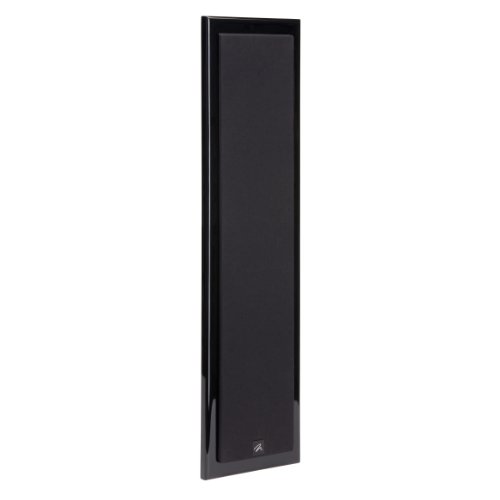
MartinLogan Motion SLM — Slimmest premium channel
The Motion SLM exists for the wall where a large television has already made its statement and any visible speaker is an intrusion to be minimised. It is an ultra-slim flat-panel speaker, gloss black, that mounts beside or beneath a screen and reads as part of the television’s own furniture, a sliver rather than a box. Inside that sliver, MartinLogan fits its folded-motion tweeter technology, a design that squeezes a large radiating surface into a compact folded form, giving the speaker a clarity and speed in the treble that conventional domes in this thickness class struggle to approach.
The buying reality must be stated as plainly as the design praise: the SLM is sold as a single speaker, because it is an LCR channel, and a front stage is three of them, left, centre and right, each bought individually. That arithmetic surprises buyers who meet the model through a pair-shaped expectation, and it belongs in the open rather than in a footnote. In return, three SLMs give a big screen a matched, ear-level front stage of genuine refinement without a single hole cut or a single cabinet deeper than a picture frame, which for design-led living rooms is a combination nothing else in this guide quite reaches.
Its bass, as the class’s physics dictates, is a subwoofer’s job, and its slim cabinet should be crossed over accordingly in the receiver’s setup. What the SLM does with the frequencies it keeps is the point: dialogue with texture, effects with edges, music in a film score presented as music. For the household whose theater is also its best room, and who refuses to choose between the two identities, this is the front channel that refuses with them.
- Format: ultra-slim flat-panel LCR speaker, gloss black, sold individually
- Tweeter: folded-motion design for treble clarity in a thin cabinet
- Role: left, centre or right front channel beside or under a screen
- Mounting: wall-mounts flush in the television’s visual plane
- Power: passive, one receiver channel per unit
- Quantity note: a full front stage means buying three units
One installation note is specific to the SLM’s slenderness: because the cabinet is so flat, its wire connection and mount must be planned to the millimetre, since there is no depth in which to hide a bulky connector or an untidy cable loop. Done properly, the speaker appears to float on the wall with no visible means of support or signal, an effect that draws more comment than any grille in this guide. Owners report that guests assume the television itself sounds miraculous, which is perhaps the purest compliment a speaker designed to vanish can collect.
Strengths
- Nearly vanishes beside a large flat-panel television.
- Folded-motion tweeter gives dialogue unusual clarity for the depth.
- Matched three-channel front stage from one design.
Trade-offs
- Per-unit pricing makes the front stage a serious line item.
- Subwoofer partnership is mandatory, not optional.
- Gloss finish shows dust and fingerprints in bright rooms.
Best for: design-led living rooms with large screens wanting a refined, invisible front stage. Not suited for: buyers expecting a pair in the box, or bass without a subwoofer.
Count three for the front stage before admiring the profile, then confirm the Motion SLM single-speaker listing so the order matches the arithmetic.

Klipsch RP-240D — Best Klipsch wall channel
Klipsch’s Reference Premiere line carries the brand’s horn philosophy into better rooms, and the RP-240D wraps that philosophy in a flat on-wall cabinet for front and centre duty. The horn-loaded tweeter is the substance: it projects dialogue and effects with the efficiency and focus Klipsch is known for, which in a living-room theater translates into clarity at the sofa without the receiver working hard, and into centre-channel speech that stays attached to the screen even when the room is wide and the seats are spread.
Like the MartinLogan, this is a single-channel product sold individually, and the front-stage arithmetic is the same: left, centre and right are three purchases, each a deliberate one. The cabinet’s matte black flatness sits comfortably under or beside a screen, and its on-wall design assumes the boundary it mounts to rather than apologising for it. In a mixed system, an RP-240D centre with Klipsch fronts is the classic arrangement, but its clarity also lets it anchor a front stage whose other channels come from elsewhere in this guide, provided levels are calibrated with care.
The Klipsch character is the one condition to accept knowingly. Horns divide listeners: many hear immediacy and life, a few hear forwardness over long sessions. In theater duty, where the content is dialogue and effect rather than hours of critical music listening, the balance of opinion runs strongly in the horn’s favour, and the RP-240D is the most direct way to put that character on a wall without a cabinet’s depth. It is passive, it wants a receiver, and it wants a subwoofer beneath it in the system plan.
- Format: flat on-wall LCR speaker, matte black, sold individually
- Tweeter: horn-loaded Reference Premiere design
- Role: front left, right or centre channel at a screen
- Mounting: slim cabinet sits in the television’s plane
- Power: passive, one receiver channel per unit
- Quantity note: three units make a front stage; one makes a centre
The RP-240D also earns a word as a centre-only purchase, the single most effective upgrade available to a soundbar-weary household moving toward separates. A system can begin with this Klipsch at the centre and a modest pair at the fronts, grow surrounds later, and keep the centre’s voice constant throughout, because dialogue quality is the thread a theater’s whole life hangs on. Starting at the centre and building outward is the opposite of how most systems are bought, and for clarity-led households it is frequently the wiser order of operations.
Strengths
- Horn projection keeps dialogue clear across wide seating.
- Reference Premiere build suits serious living-room theaters.
- Equally capable as a single centre or a matched front trio.
Trade-offs
- Sold singly, so front-stage cost must be assembled honestly.
- Klipsch forwardness is a taste not everyone shares.
- Needs a subwoofer for the bottom of any soundtrack.
Best for: Klipsch-voiced front stages on a wall, especially a strong centre under a big screen. Not suited for: listeners who prefer a laid-back treble, or pair-shaped budgets.
Decide whether you need the centre alone or the full trio, then look over the RP-240D listing and its mounting details before the screen wall is drilled.

Acoustic Audio SLM1W — Best surround pair value
Surround channels have the most forgiving job in a theater and the least forgiving placement constraints, and the SLM1W is built for that intersection: a slim, mountable pair in white that goes on a side or rear wall, does its atmospheric work and declines to be noticed. Acoustic Audio’s approach is plainness as a feature. The cabinets are simple, the mounting is simple, and the pair format means a surround upgrade arrives in one box with both channels matched, which is how most households actually expand a system.
The sound brief for surrounds is envelopment rather than detail: rain that wraps, crowds that murmur, a score that widens the room. A slim pair at the correct height, slightly above ear level and angled by placement toward the seating, delivers that brief without drama, and the white finish suits the light walls of the living rooms where most surround systems actually live. The set can also serve as fronts in a small room or as a secondary room’s pair, though its design centre of gravity is the supporting role, and this guide recommends it in that role without embarrassment.
Expectations should match the tier. The SLM1W’s listing carries the brand’s customary generous power language, which should be read as marketing and set aside; the speakers’ real credentials are their slimness, their pair convenience and their suitability for the channels that ask least and matter more than newcomers think. A theater whose surrounds are an afterthought sounds like it; a theater whose surrounds are this pair, placed with care, sounds finished.
- Format: slim mountable on-wall pair, white finish
- Role: surround and rear channels; small-room fronts at a pinch
- Mounting: simple surface mounting for side and rear walls
- Drivers: compact two-way arrangement per cabinet
- Power: passive, one receiver channel per speaker
- Depth note: shallow profile keeps surrounds visually quiet
The SLM1W pair has a domestic virtue beyond its channels: it is the pick least likely to start an argument about the room. Slim, white and inexpensive in its demands on attention, it can be proposed in a shared living room without the negotiation that black boxes and visible brackets provoke. Home theater is a household hobby conducted in communal space, and the equipment that respects the room’s other citizens gets installed, kept and used. Many theoretically superior surrounds have lost that vote; this pair was designed to win it.
Strengths
- Pair format makes a surround upgrade a single purchase.
- White slim cabinets blend with living-room walls.
- Undemanding channels get an appropriately undemanding speaker.
Trade-offs
- Not voiced or built for front-stage heroics.
- Plain finish and fittings rather than premium detailing.
- Relies on the subwoofer like every slim pick here.
Best for: adding or upgrading surround channels in a living-room theater. Not suited for: front channels in a large or dedicated room.
Place the pair just above ear height on the seating’s flanks, and check the SLM1W pair listing before the front stage’s glamour absorbs the whole budget.

Rockville RockSlim 5.25 — Thinnest pair profile
The RockSlim’s name is its specification: a pair of 5.25-inch on-wall speakers in cabinets barely an inch and a half deep, among the thinnest real enclosures in the class. That thinness serves the walls other speakers cannot use, the narrow return beside a screen, the wall a door swings against, the rental wall where even a modest cabinet’s shadow feels like a claim on the room. Rockville keeps the design honest with a real woofer of useful size rather than a token driver, so the pair can serve as small-room fronts as well as surrounds.
The listing quotes both a peak power figure and a more meaningful continuous one, and the guide’s standing rule applies: marketing numbers do not rank speakers. What ranks the RockSlim is geometry and adequacy, a 5.25-inch driver’s worth of midrange and presence in a cabinet that nearly paints itself onto the wall. In black, the pair flanks a screen with a low, wide discretion that suits modern televisions particularly well, and the easy wall mounting keeps the installation in the class’s screwdriver-and-filler territory.
Thin cabinets make their bass bargain openly, and the RockSlim’s is the same bargain as the MartinLogan’s, paid to the same subwoofer. The difference is the audience: where the SLM is a premium single channel, the RockSlim is an accessible pair, and for a first on-wall theater in a flat or a small house, that pair format and that profile are often the whole argument. It asks for a receiver, it asks for a subwoofer, and it gives back a room that still looks like a room.
- Format: slim on-wall pair, black, around an inch and a half deep
- Drivers: 5.25-inch woofer with a compact tweeter per cabinet
- Role: small-room fronts, surrounds and tight-wall positions
- Mounting: easy surface mounting, renter-friendly
- Power: passive, one receiver channel per speaker
- Depth note: among the thinnest genuine enclosures in this guide
Rockville’s thin pair also suits a layout the other picks serve awkwardly: the long, narrow room where the screen sits on a short wall and the surrounds must mount on walls that pass close by the seating. A deep surround cabinet in such a room is an elbow hazard and a visual pinch; the RockSlim’s near-flat profile lets the channels sit where the mix wants them without narrowing the room further. Geometry, again, is destiny in this class, and the thinnest cabinet owns the geometries the others must decline.
Strengths
- Minimal projection suits doors, returns and narrow walls.
- Useful woofer size keeps small-room front duty credible.
- Pair format suits a first on-wall system.
Trade-offs
- Thin cabinet leaves bass entirely to the subwoofer.
- Finish and fittings are functional rather than luxurious.
- Large rooms will outgrow its output as fronts.
Best for: flats, small rooms and walls where depth is the deciding constraint. Not suited for: filling a large theater from the front positions.
Measure the wall’s tolerance for projection before anything else, and if the answer is almost none, review the RockSlim pair listing and its exact depth.
How do the six wall picks divide a theater’s duties?
| Model | Best duty | Sold as | Defining trait |
|---|---|---|---|
| Polk Audio OWM3 | Surrounds, awkward positions | Pair | Curved cabinet, many mounting options |
| ELAC Debut 2.0 OW4.2 | Fronts or surrounds | Pair | Wall-tuned Debut engineering |
| MartinLogan Motion SLM | Premium front stage | Each | Ultra-slim, folded-motion tweeter |
| Klipsch RP-240D | Front or centre channel | Each | Horn clarity in a flat cabinet |
| Acoustic Audio SLM1W | Surrounds | Pair | Slim white simplicity |
| Rockville RockSlim 5.25 | Tight walls, small rooms | Pair | Thinnest profile here |
Assemble a theater from the table by duty rather than by brand loyalty: singles where the front stage needs authority, pairs where channels come in twos, the thinnest cabinets where the wall is tight, and the versatile Polk wherever the room’s geometry refuses to be standard. The receiver and subwoofer underneath it all matter as much as any row.
How should on-wall speakers be placed and mounted well?
Front speakers belong at ear level when seated, flanking the screen at a width that forms a sensible triangle with the main seats, and the centre belongs directly above or below the screen, as close to the screen’s vertical centre as the furniture allows, angled if the mount permits toward the listeners’ ears. Surrounds sit slightly above ear level on the side or rear walls, where their sound arrives as atmosphere rather than as a point. These are the same rules every theater follows; the on-wall class simply makes obeying them a matter of screws and a spirit level instead of a building project.
Mounting deserves the care the speakers’ slimness invites you to skip. Find the studs where the wall offers them, use proper fixings where it does not, and remember that a speaker’s weight hangs on its mount through every bass note of every film for years. Run the wire with the same foresight: surface channels painted to match the wall are the renter’s friend, in-wall runs are the homeowner’s, and both beat a cable draped over a door frame. Level each cabinet before the final tightening, because a screen wall of slightly crooked speakers will catch the eye in every quiet scene.
Calibration closes the job. Set the receiver’s crossover so the slim cabinets hand their lowest work to the subwoofer, run the room correction from the main seat, and verify dialogue from the centre seat and the cheap seats alike. On-wall systems reward this hour disproportionately, because their speakers are easy to place almost correctly, and the difference between almost and exactly is where a theater’s polish lives.
What mistakes do on-wall theater builders make?
The first is mounting the fronts at television height rather than ear height, leaving the sound floating above the seating because the screen looked lonely. The second is skipping the subwoofer on the theory that five speakers must add up to bass; five shallow cabinets add up to five shallow cabinets, and the lowest octave still needs its own device. The third is buying pairs and singles by assumption, discovering at installation that the centre channel’s box contained one speaker, exactly as listed, and the front stage is a trio short.
Two quieter errors follow. Mixing wildly different voicings across the front three channels breaks the pans that make a theater believable, which is why this guide steers fronts toward matched singles or matched pairs. And mounting surrounds at ceiling height in imitation of a cinema’s scale leaves home listeners, in a far smaller room, with effects arriving from a balcony that does not exist. Ear level, plus a little, is the home rule, and it is free.
Final Recommendation
Build the front stage from singles if the screen is large and the room is serious: three MartinLogan SLMs for the design-led wall, or Klipsch RP-240D channels where horn clarity leads. Build it from the ELAC pair where engineering purity in a modest room is the brief. Give surrounds to the Polk OWM3 wherever the room is awkward, to the Acoustic Audio pair wherever it is straightforward, and let the RockSlim take the walls that refuse everything else. Screws, a receiver, a subwoofer and an hour of calibration: that is the whole price of a theater that leaves the walls intact.
Frequently Asked Questions
Do on-wall speakers sound as good as in-wall speakers?
They sound different rather than worse. A shallow cabinet is a controlled enclosure at ear level, which helps imaging; an in-wall speaker disappears visually and uses the wall cavity as its volume. Many theaters mix both, on-wall at the front and in-ceiling above.
Can renters really use these?
Yes, with the landlord’s permission for screw holes. Mounting leaves small fixable holes rather than cutouts, which is precisely why this class is recommended for temporary homes and finished rooms.
Do I still need a subwoofer with five wall speakers?
Yes. Slim cabinets cannot reproduce the lowest octave of a film soundtrack, whatever their count. A subwoofer is part of the system design for every pick in this guide.
Why are some picks sold as single speakers?
Front and centre channels are bought by the channel: one for a centre, three for a full front stage. The MartinLogan SLM and Klipsch RP-240D follow that convention, so order quantities should come from the channel plan.
Can on-wall speakers serve as Atmos heights?
They can be mounted high or on the ceiling in some layouts, and several home systems do exactly that. The dedicated Atmos guide covers in-ceiling height channels in depth for rooms able to cut.
What receiver do these speakers need?
Any AV receiver with enough powered channels for your layout and a subwoofer output. All six picks are passive, so the receiver is the system’s engine, and its room calibration is worth using.
How does a mixed system come together around on-wall fronts?
Most real theaters are hybrids, and the on-wall front stage is the hybrid’s natural anchor. With fronts and centre on the wall at ear level, the ceiling is freed for the two positions it does best, the Atmos heights, and the surrounds can be chosen per wall: on-wall pairs where the walls are solid and the household prefers no cutting, in-ceiling units where a side wall is all glass or doors. The receiver does not care which technology fills which channel, and the listener cares only that the front three agree with each other, because pans across the screen are where mismatched voicing confesses.
Subwoofer placement completes the hybrid’s freedom. Released from any duty to sit near the screen for appearance’s sake, the subwoofer can go where the room’s acoustics flatter it, often a corner, sometimes beside the seating, and its cable is the only evidence. A system whose visible parts are three slim cabinets and a screen, and whose invisible parts do the heavy lifting from the ceiling and the corner, is the modern living-room theater in its settled form. The picks in this guide were chosen to staff that form without a single cut in a wall.
Expansion follows the same forgiving logic. A stereo pair this year becomes a front stage with a centre next year, surrounds the year after, heights when the receiver is upgraded, each step a matter of screws and wire rather than plaster. On-wall systems grow the way households actually fund them, gradually and reversibly, and a speaker bought for the front today can retire honourably to surround duty when a grander channel arrives. Few product classes in home audio forgive the future so completely.
What should you check on the wall itself before ordering?
Walls are not the uniform surface product photographs assume. Plasterboard over studs is the friendly case, offering studs for the heavy fixings and hollow sections that demand proper anchors. Masonry and concrete take any fixing a drill can offer but punish improvisation. Lathe and plaster in older houses crumbles around careless screws and rewards patience and the right plugs. The speaker does not care which wall it hangs on, but the fixing must, and an hour spent learning your wall’s construction is worth more than any bracket upgrade sold alongside the speakers.
What is inside the wall matters as much as what it is made of. Stud finders that sense pipes and cables earn their keep above any entertainment wall, where power, aerial and network runs congregate behind the screen. A screw through a cable converts a pleasant Saturday into an electrician’s invoice, and the check takes minutes. Renters should add one more item to the list: the landlord’s written permission for the fixings, which protects the deposit and, not incidentally, the relationship that a good reference depends on.
Finally, look at the wall as the room sees it. A screen wall with a door swing, a radiator or a window close beside the screen constrains the front speakers’ width, and discovering that before ordering decides whether the slim singles or the compact pairs are the right shape for the space. The wall is the one component of the system that cannot be returned, upgraded or moved, so it gets the first measurement and the last word.
How do on-wall speakers handle music when the film is over?
A living-room theater spends most of its hours as a music system whether its owner planned that or not, and the wall picks divide honestly on the duty. The ELAC pair, voiced from a respected stereo lineage, makes the most complete music case of the pairs here, with the Klipsch and MartinLogan singles offering their brands’ characters to anyone running them as a front pair. Surround-oriented picks like the Acoustic Audio pair will play music pleasantly in their rooms without pretending to be a hi-fi’s main event. The subwoofer, so essential to film, should be blended more gently for music, and most receivers allow separate trims per input for exactly that reason.
The wall itself helps music in one underappreciated way: speakers at ear level in a furnished room, firing across its length, use the room the way stereo was always meant to be used, which no ceiling system can claim. A household that listens seriously may find its on-wall fronts, bought for films, quietly becoming its favourite music source, displacing a portable speaker that never stood a chance. That accidental promotion is common enough in this class to be worth planning for: buy the fronts as if music matters, because within a year it will.
What does the second year of an on-wall system teach its owner?
That the screws were the right decision. The system’s speakers have survived a redecoration by coming off the wall in minutes and returning to fresh paint without a plasterer; a surround has migrated six inches to accommodate a bookcase; the centre has been re-angled after the sofa was replaced. None of these ordinary events required a tradesperson, and each would have been a project in an in-wall house. Reversibility, dismissed as a renter’s concern at purchase time, reveals itself as a universal household virtue, because all homes change and only the degree is negotiable.
The second year also teaches the value of the calibration hour. Settings drift as furniture moves and households adjust levels by feel, and a fresh pass with the receiver’s correction, run from the seat the family actually uses now, restores the balance the system was installed with. Owners who repeat that ritual yearly keep a theater that sounds maintained; owners who never do slowly blame their speakers for their furniture’s decisions. The wall picks in this guide will serve either household, but they were chosen for the first.
How should you budget across a whole on-wall theater?
Allocate by audibility. The centre channel carries the dialogue that every viewer judges the system by, so it earns the first claim on quality, followed by its front partners, whose agreement with the centre matters more than their individual brilliance. Surrounds earn competence rather than splendour, which is why this guide can recommend an unpretentious pair for them without apology. The subwoofer deserves a larger share than newcomers expect, because it is doing the work five slim cabinets declined, and the receiver deserves enough to power the layout you actually plan rather than the one you describe today.
Wire, fixings and a proper spirit level are the budget’s smallest lines and its most regretted omissions. Cable of sensible quality, run generously with slack at every speaker for future repositioning, costs little against the system’s total and pays out at every rearrangement. The same is true of keeping the fixings’ packaging and a note of which anchor type each wall took. A theater is a system of small decisions compounding, and the households that enjoy theirs for a decade are the ones that treated the cheap decisions as seriously as the expensive ones.
Why has the flat television made this class permanent?
Because the screen’s form is not going back. Televisions will remain thin panels on walls for as far ahead as product design can see, and sound must either live in that plane, disappear into the architecture, or clutter the room in protest. On-wall speakers chose the plane, and their continuing refinement, thinner cabinets, better small drivers, wall-aware tuning, tracks the television’s own. For households unwilling to cut and unwilling to clutter, that makes the class not a compromise of the moment but the settled answer, and the six picks here its current best expression at every duty a theater assigns.
What should a first on-wall theater buy, in what order?
Sequence the purchases the way the sound is judged. Begin with the front pair or trio and the receiver, because stereo and then a centre are the foundation every later channel decorates. Add the subwoofer next, before any surround, because the front stage without its foundation sounds unfinished in a way no rear channel can disguise. Surrounds follow, chosen from this guide’s pairs, and heights come last, when the receiver and the room are ready for them. Each stage is a complete, enjoyable system in itself, which matters in a hobby where the finished state may be two birthdays away.
Buy the centre earlier than instinct suggests. Households routinely run a phantom centre, letting the front pair fake the middle, and then discover on adding a real one that dialogue had been the system’s weak point all along. If the budget forces a choice between surrounds this year and a centre this year, the centre wins for film and the surrounds win for nothing except the specification sheet. The singles in this guide exist to make that choice purchasable one channel at a time, which is the deepest reason their per-unit format is a feature rather than an inconvenience.
How do you keep an on-wall system looking intentional rather than added?
Symmetry is the whole secret, and it is free. Front speakers at identical heights, identical distances from the screen’s edges, level to the same line, read as architecture; the same speakers an inch apart in height read as an accident that repeats at every viewing. Measure from the screen, not from the floor or the ceiling, because the screen is the composition’s centre and the eye forgives everything except disagreement with it. Cable entries aligned, channels hidden or painted, and cabinets dusted on the same schedule as the screen complete an effect that costs nothing but attention.
Colour discipline helps where the room allows it. Black speakers belong to the darkened screen wall’s world, white ones to light living rooms, and mixing the two across one system draws the eye to the equipment at exactly the moments the film wants it elsewhere. Where a system’s duties force mixed finishes, surrounds in the room’s wall colour and fronts in the screen’s black is the accepted treaty. The goal is a wall that looks designed on the first glance and sounds designed on the second, and in that order, because the first glance happens every day.
What changes when the screen grows?
Large screens rearrange the front stage’s geometry in ways worth anticipating. As the panel widens, the front speakers move outward with its edges, the stereo triangle broadens, and the centre’s job grows harder, because dialogue must hold the middle of a wider stage from a single point beneath it. This is where the stronger singles in this guide justify themselves: a centre with genuine projection keeps speech planted at screen sizes where a small pair’s phantom centre would smear. Households planning a screen upgrade within the system’s life should buy the centre for the screen they intend, not the one they have, since it is the channel least forgiving of being outgrown.
Projection screens push the logic one step further, toward acoustically transparent material with speakers behind it, which is a different guide’s territory entirely. For the flat-panel world this guide serves, the discipline is simpler: as the screen grows, keep the fronts at its edges and at ear height, resist the temptation to mount them high in the corners like a pub’s system, and let the subwoofer and calibration absorb the room’s new scale. The wall will still be intact, the cabinets still slim, and the theater will have grown by the only dimension that was ever free.
Before the first film night, walk the room at seating height and look at the screen wall as a guest will: if your eye travels to a crooked cabinet or a wandering cable before it reaches the screen, fix that, because the room’s first impression is the system’s first review. Then dim the lights, sit in the least favourite seat, and play the opening of a film you know by heart. If the dialogue belongs to the faces and the room has disappeared, the wall has done everything this guide asked of it.
Keep the fixings’ details, a spare anchor or two and the receiver’s channel notes in an envelope taped inside a cupboard near the screen. A system designed to be rearranged will be rearranged, and the household that can find its own hardware treats each small change as a pleasure instead of an excavation through forgotten drawers.
Related Guides
For the flush alternative at the front of the room, compare the approach in best ceiling speakers; for true overhead channels see best dolby atmos ceiling speakers; and for the tier where ceilings become architecture, read best high end ceiling speakers.


