What's inside
- Where to buy
- Key Takeaways
- Quick Picks
- How did we sort the best bluetooth ceiling speakers?
- What does the installation actually involve?
- How do the six kits compare at a glance?
- When should you choose a receiver system instead of a Bluetooth kit?
- What mistakes do buyers of Bluetooth ceiling kits make?
- Final Recommendation
- Frequently Asked Questions
- How do you keep a Bluetooth ceiling system reliable day to day?
- Which rooms gain the most from a ceiling Bluetooth kit?
- How should you plan the wiring for a kit in a finished house?
- What should you expect from the sound of a ceiling kit?
- How do these kits handle guests, renters and temporary living?
- What should a small business or studio take from this guide?
- Related Guides
As an Amazon Associate I earn from qualifying purchases. This post may contain affiliate links at no extra cost to you.
gizmoverdict.com is reader-supported. When you buy through links on our site, we may earn an affiliate commission.
Where to buy
All six systems in this guide to the best bluetooth ceiling speakers reach United States buyers through Amazon, packaged as kits, and the kit contents are the whole story: a set of flush-mount ceiling speakers, lengths of speaker wire in some cases, and a small amplifier with a Bluetooth receiver inside it. Read each listing for what the amplifier is and where it lives, because the six kits divide sharply between wall-plate amplifiers that sit in a wall box like a light switch, compact in-wall units hidden behind a plate, and larger multi-zone amplifiers that belong in a cupboard or equipment shelf.
Now the truth that has to open any honest guide to the best bluetooth ceiling speakers: no speaker in a ceiling is truly wireless. Every pick in this roundup is a passive flush-mount speaker connected by ordinary speaker wire to a small Bluetooth amplifier mounted in or on the wall. Bluetooth is the input to that amplifier, carrying music from your phone across the room without a cable; it is not, and cannot be, the connection between the amplifier and the speakers, because a ceiling speaker has no battery and no power supply of its own. The wire run is short and the amplifier is small, so the installation is far simpler than a full receiver system, but anyone promising you a ceiling speaker with no wires at all is describing a product that does not exist in this guide or anywhere else.
Once that premise is settled, the category becomes easy to judge. The real questions are how many speakers the bundled amplifier can drive, how many rooms or zones it can serve independently, where the amplifier physically mounts, and whether the speakers tolerate the moisture of the room you have in mind. The wattage numbers splashed across these listings, some of them very large indeed, are seller peak claims with no shared standard behind them; this guide states that once, plainly, here, and then never ranks anything by them, because an amplifier that comfortably fills a kitchen with background music has done its job regardless of the number printed on its box.
Key Takeaways
- Bluetooth is the input, never the speaker connection: every kit wires passive ceiling speakers to a small wall or in-wall amplifier.
- Judge kits by speaker count, zone count and amplifier placement, not by the peak wattage figures in listing headlines.
- A single-zone kit suits one room; the four-zone system in this guide exists for houses that want independent areas.
- Moisture tolerance decides bathroom and kitchen suitability, and only some kits here are built for damp rooms.
- The amplifier needs mains power at its mounting point, so an electrician’s visit may be part of a wall-plate installation.
- These systems are for music and background listening, not for television surround sound or Atmos height duty.
Quick Picks
| Kit | Badge | What makes it worth shortlisting |
|---|---|---|
| Herdio 6.5-Inch Bluetooth Ceiling System (2 Pairs) | Best complete room kit | Four speakers and a wall amplifier cover a generous single room in one purchase with nothing else to source. |
| Pyle 6.5-Inch Bluetooth Ceiling Pair | Best simple pair | A long-running two-speaker kit with changeable round or square grilles for an uncomplicated one-room install. |
| Pyle 8-Inch Bluetooth Ceiling Set | Best for larger single rooms | Four eight-inch speakers give an open-plan space more coverage from the same simple formula. |
| STUDIOFINIX 6.5-Inch Bluetooth 4-Zone System | Best multi-room system | An eight-channel amplifier with four switchable zones serves several rooms from one cupboard. |
| VEVOR 6.5-Inch Bluetooth Ceiling Set | Best for damp rooms | Four speakers positioned for humid kitchens, bathrooms and covered porches where moisture rules out fussier kits. |
| Herdio 8-Inch Bluetooth Ceiling Speakers | Best big-cone pair route | Eight-inch Herdio speakers with an in-wall amplifier for rooms wanting fuller sound from fewer holes. |
How did we sort the best bluetooth ceiling speakers?
The first requirement was that the kit be a genuine system: speakers and a Bluetooth amplifier sold together to work together, rather than a speaker listing that mentions Bluetooth in its keywords and leaves the buyer to discover the missing electronics. Every pick here includes its amplifier in the box. The second requirement was clarity about what that amplifier does: how many speakers it drives, whether volume is controlled at the wall, from a remote or only from the phone, and how it receives power. Kits whose listings could not answer those basic questions were set aside, however impressive their headline numbers looked.
The third filter was room fit. A kit for a bathroom must tolerate steam; a kit for a studio or small business must cover its floor area without strain; a kit for a whole house must think in zones rather than in one loud room. The six survivors divide the territory cleanly between them: simple pairs, four-speaker room kits, a damp-room set and one genuine multi-zone system. Sound expectations were calibrated to the category throughout: these are background and casual listening systems, judged on evenness, clarity at modest volume and reliability of the Bluetooth connection, not on hi-fi heroics.
Finally, we paid attention to the amplifier’s physical life. A wall-plate amplifier is elegant but needs a wall box and mains power at that exact spot; a shelf amplifier is flexible but needs somewhere to sit. Listings that glossed over where their amplifier goes were marked down, because the mounting question decides whether installation is a Saturday job or a project involving an electrician, and buyers deserve to know which they are purchasing before the ceiling comes open.
What does the installation actually involve?
The work divides into three runs. Speaker wire goes from each ceiling position back to the amplifier’s location, exactly as in a receiver system, though usually over shorter distances. Mains power must reach the amplifier, which for a wall-plate unit means a suitable electrical box and, in many homes, a qualified electrician to provide it safely and legally. The speakers themselves mount in cutouts with the usual rotating clamps, and their grilles sit flush like any other ceiling speaker. None of this is exotic, but the power run is the step that distinguishes these kits from a battery gadget, and planning it first prevents the common disappointment of speakers installed and an amplifier with nothing to plug into.
Bluetooth range deserves a practical word. The connection runs from the phone to the amplifier, and its reliability depends on what lies between them: stud walls are kind, masonry and metal ducting are not, and a cupboard full of equipment can shadow a signal surprisingly well. Wall-plate amplifiers, sitting in the room they serve, generally enjoy the easiest connection, which is one of their underappreciated advantages. Multi-zone shelf amplifiers trade some of that ease for centralisation, and their owners typically leave a phone or tablet in the same room as the amplifier or accept occasional dropouts from the far end of the house.
Control habits form quickly around whichever system you choose. Households tend to settle on one phone as the house remote, or connect the amplifier to a voice-controlled ecosystem through the phone’s Bluetooth, and the kits differ in how gracefully they accept that routine. What none of them offers is the multi-room synchronisation of a true networked audio platform; each amplifier is its own island, playing its own source, and the multi-zone pick below manages several islands from one box rather than merging them into a single stream.

Herdio 6.5-Inch Bluetooth Ceiling System (2 Pairs) — Best complete room kit
Herdio’s two-pair system is the archetype of this category done sensibly: four 6.5-inch two-way ceiling speakers and a wall amplifier with Bluetooth built in, sold as one kit for one generous room or two adjoining spaces. Four speakers change the character of a room compared with two, because coverage evens out; music in a large kitchen-diner no longer has a loud end and a quiet end, and conversation-level volume at every seat comes from speakers working gently rather than one pair working hard. The wall amplifier keeps control in the room, on the wall, where guests and family can reach it without hunting for a phone.
The speakers themselves are straightforward flush-mount units with paintable grilles, wired back to the amplifier in the ordinary way, and the system’s appeal is precisely that ordinariness: no receiver, no rack, no speaker selector boxes, just a plate on the wall and sound from the ceiling. Herdio’s listing leads with a large peak wattage figure, which should be read the way this guide reads all such figures, as marketing. What matters is that the amplifier is matched by its maker to the four speakers in the box, and for background and everyday listening in a domestic room, that matched combination is the entire requirement.
Plan the wall position with care, because the amplifier’s plate becomes a permanent feature. Near the room’s entrance, at light-switch height, is the natural spot, and it needs the electrical provision discussed earlier. Households that think that through in advance end up with the tidiest result in this guide: a room that plays music from the ceiling at the touch of a wall control, with the phone merely choosing what plays. As a single-zone answer, it is complete in a way the pair kits below deliberately are not.
- Format: four 6.5-inch two-way ceiling speakers plus wall amplifier, one zone
- Amplifier: wall-mounted unit with Bluetooth input and in-room controls
- Speakers: passive flush-mount, wired to the amplifier
- Grilles: paintable finish across all four speakers
- Power: amplifier requires mains power at its wall position
- Coverage: four speakers suit a large single room or two adjoining spaces
One habit separates happy Herdio households from annoyed ones: decide whose phone is the room’s default source before the first dinner party, not during it. Because the wall amplifier pairs in the ordinary Bluetooth way, a phone that wanders out of range takes the music with it, and the elegant fix is a household tablet or an older phone that lives near the room and serves as its permanent jukebox. The wall control still handles volume for everyone else. Small social logistics like this, thought through once, are what make a simple system feel polished rather than provisional.
Strengths
- Four-speaker coverage evens out sound across a big room.
- Wall control keeps volume in the room rather than on one phone.
- Everything needed arrives in one kit with matched components.
Trade-offs
- One zone only, so the whole kit always plays the same source.
- Wall amplifier installation may need an electrician for power.
- Four cutouts is a real commitment in a finished ceiling.
Best for: a kitchen-diner, studio or open living space wanting complete, simple ceiling music from a single kit. Not suited for: houses wanting different music in different rooms at the same time.
Measure the room and pick the amplifier’s wall spot before ordering, then check the Herdio two-pair kit listing for exactly what the box contains.

Pyle 6.5-Inch Bluetooth Ceiling Pair — Best simple pair
Pyle’s pair kit is the elder statesman here, a two-speaker system that has been putting music into kitchens and bathrooms for years with minimal fuss. Two 6.5-inch speakers with polypropylene cones wire to a compact Bluetooth amplifier, and the kit includes both round and square grille options, a small cosmetic freedom that matters more than expected: matching the grille shape to a room’s light fittings and vents is the difference between speakers that look installed and speakers that look added. The amplifier is small enough to hide in a cupboard, a ceiling void where permitted, or behind the scenes generally, leaving the room itself uncluttered.
The sound brief is modest and met honestly. A pair of this size covers a bathroom, a bedroom or a small kitchen with clear, pleasant background music and spoken content, and the quick-connection terminals speed up the fiddly overhead part of the installation. Nobody should ask this kit to energise a party in a double-height living room, and its maker does not really ask that either; the listing’s power figure, like all in this category, is a peak claim to be noted and set aside. Judged as a one-room, one-pair, phone-driven music system, it remains a rational and proven shape.
Its longevity in the market carries a practical benefit: installation videos, replacement parts and answers to common questions are easy to find, and the quirks of the amplifier are documented by years of owners rather than discovered by you. For a first ceiling-music project in a single room, where the goal is to learn how much the household enjoys the result before committing further, this pair is the lowest-drama way to find out.
- Format: two 6.5-inch two-way ceiling speakers plus compact Bluetooth amplifier
- Grilles: both round and square options included for a matched look
- Speakers: passive flush-mount with quick-connection terminals
- Amplifier: small unit suited to a cupboard or concealed mounting
- Power: amplifier needs a mains supply at its location
- Coverage: one modest room at background and everyday levels
The Pyle pair also deserves credit as a renovation-friendly retrofit. Because the amplifier is compact and the speakers are a single pair, the whole kit can be added to a finished room with just two cutouts and one short wire path, often fished through a single joist bay from an airing cupboard or wardrobe wall. That low invasion factor explains much of its endurance: it is the kit people actually install in houses they already live in, rather than the kit they admire during a rebuild and postpone. Two holes, an afternoon, and a bathroom that finally has music is a compelling arithmetic.
Strengths
- Simplest path in this guide from box to playing music.
- Grille shape choice helps the speakers blend with existing fittings.
- Long market history means abundant installation guidance.
Trade-offs
- A single pair cannot cover a large or open-plan room evenly.
- No wall control, so volume lives on the connected phone.
- Not the pick for steamy rooms unless the space is well ventilated.
Best for: bathrooms, bedrooms and small kitchens wanting one tidy pair and a phone-driven system. Not suited for: open-plan spaces or households wanting wall-mounted control.
For a one-room project, review the Pyle pair listing, decide where the little amplifier will live, and plan the wire run to meet it there.

Pyle 8-Inch Bluetooth Ceiling Set — Best for larger single rooms
Where the Pyle pair covers a room, this Pyle set covers a space. Four eight-inch speakers spread across an open-plan ceiling deliver the even, low-effort background sound that large areas need, with the larger cones keeping voices and music full at the gentle volumes such rooms use all day. Cafes working from home, large family kitchens, garden rooms and studio flats are the natural habitats. The formula is otherwise the familiar one: passive flush-mount speakers, a compact Bluetooth amplifier, changeable grille shapes, and wire doing the honest work between them.
The eight-inch size brings a placement discipline of its own. Four large cutouts must be distributed with intention, spaced for coverage rather than clustered for convenience, and kept clear of the joist and duct congestion that big ceilings accumulate. Done well, the result is the most room-filling sound in this guide’s single-zone group, the kind of system that lets a large room hold a conversation everywhere at once under a ceiling of music. Done lazily, with all four speakers in one half of the room, it is merely loud in one place, so the tape measure matters as much as the kit.
As with its smaller sibling, read the headline power figure as a peak claim and move on; the amplifier is matched to its speakers by the maker, and the combination’s real specification is the area it covers gracefully. Households with one big multifunctional space, rather than several small rooms, will find this set answers their actual geometry better than any pair, and better than a multi-zone system whose zones would all sit in the same open space anyway.
- Format: four 8-inch two-way ceiling speakers plus Bluetooth amplifier, one zone
- Grilles: round and square options included
- Speakers: passive flush-mount, wired to the amplifier
- Amplifier: compact unit for concealed or cupboard mounting
- Power: mains supply required at the amplifier position
- Coverage: large single spaces and open-plan rooms
Owners of the eight-inch Pyle set should think about listening positions in an open-plan room more carefully than the kit’s simplicity suggests. In a space that combines cooking, dining and sitting, the temptation is to centre all four speakers on the room’s geometric middle, but the better layout biases coverage toward where people actually linger: two over the sitting and dining area, two over the working kitchen, none wasted on the hallway corner nobody occupies. The amplifier does not care where its speakers hang, so the ceiling plan is free to follow the furniture instead of the architecture.
Strengths
- Four eight-inch speakers fill big rooms at relaxed volume.
- Same simple one-zone formula as the smaller Pyle kit.
- Grille options help a large installation stay visually calm.
Trade-offs
- Four large cutouts demand careful, spread-out placement.
- Still a single zone playing a single source.
- Oversized and wasteful in a small room.
Best for: open-plan living areas, large kitchens and studio spaces needing broad, even coverage. Not suited for: small rooms or multi-room independence.
Sketch the four positions across the whole ceiling, not just the easy half, then confirm the Pyle eight-inch set contents before the order goes in.

STUDIOFINIX 6.5-Inch Bluetooth 4-Zone System — Best multi-room system
Every other pick in this guide thinks in rooms; this one thinks in houses. The STUDIOFINIX system pairs its 6.5-inch ceiling speakers with an eight-channel amplifier organised as four zones, each zone switchable on or off independently, with volume shared across the system. That architecture answers the most common multi-room reality: the kitchen wants music in the morning, the office wants quiet, the bedroom wants the radio in the evening, and nobody wants to run four separate systems to achieve it. One amplifier in a cupboard, wire home-run to each zone, and the house divides into areas that can be included or excluded at the amplifier.
The shared-volume design is the honest limitation to understand before buying. Zones can be switched in or out, but they play the same source at a system volume, so this is a distribution system rather than four independent streams. For background music through a house, a studio with several work areas, or a small business with a floor and an office, that is usually exactly the requirement, and the Bluetooth 5.4 input keeps the connection to a phone or tablet stable within the amplifier’s room. Speaker counts per zone can vary within the amplifier’s channel plan, which lets a large room take four speakers while a small one takes two.
Installation is the most involved in this guide, because four zones mean four sets of wire runs converging on one location, and that location needs power, ventilation and a sensible place in the house’s geography. It is still far simpler than a receiver-based multi-room system, and for a renovation where ceilings and walls are already open, it is arguably the most capability per unit of effort available in the category. Buy it when the house, not the room, is the project.
- Format: 6.5-inch ceiling speakers with an eight-channel, four-zone amplifier
- Zones: four areas, each independently switchable on or off
- Volume: shared system volume across active zones
- Input: Bluetooth 5.4 to the central amplifier
- Power: amplifier needs mains power and ventilation at its shelf location
- Coverage: multiple rooms from a single central system
The STUDIOFINIX arrangement rewards one piece of foresight above all: label the zones by room name at the amplifier the day they are wired, with a printed strip rather than a memory. Six months later, faced with four identical switches, nobody remembers whether zone three is the office or the spare bedroom, and the system’s elegance depends on that knowledge being physical. The same applies to the wire runs in the ceiling. A distribution system lives or dies by its documentation, because its whole value is control, and control you have to guess at is not control at all.
Strengths
- Genuine multi-room distribution from one amplifier and one source.
- Zone switching matches how houses actually use background music.
- Channel count lets big and small rooms be served differently.
Trade-offs
- One source and one volume for every active zone.
- Most demanding wiring plan of any pick here.
- Bluetooth range is measured from the central amplifier’s room.
Best for: whole-house background music, studios and small premises with distinct areas. Not suited for: households wanting different music playing in different rooms simultaneously.
Draw the zone map first, room by room, and only then examine the STUDIOFINIX system listing to match speaker counts to each zone.

VEVOR 6.5-Inch Bluetooth Ceiling Set — Best for damp rooms
Steam is the silent killer of ceiling audio plans. A bathroom fills with vapour twice a day, a working kitchen breathes grease and humidity, and a covered porch lives with the weather’s moisture even when the rain never touches it. The VEVOR set is the pick positioned for exactly those rooms: four 6.5-inch speakers built and marketed for damp and humid environments, covering kitchen, living areas, bedrooms and covered outdoor spaces where moisture is a design condition rather than an accident. Its Bluetooth amplifier follows the category’s usual pattern, wired to passive speakers and fed by a phone.
Four speakers give placement flexibility that damp rooms particularly need, because the ideal acoustic position is often occupied by an extractor, a shower enclosure’s steam plume or a run of downlights. With four units to place, the installer can keep speakers out of the wettest air paths while still covering the room, a practical advantage that a pair cannot offer. The set’s power figure is, as ever in this category, a seller’s peak number to be acknowledged and ignored; coverage and moisture tolerance are the specifications doing real work here.
Set expectations about what damp-rated means in practice. It means the speaker materials tolerate humid air and splashes of vapour over years of service; it does not make the amplifier a bathroom device, and the amplifier should still live in a dry location with its mains supply properly provided. Households that respect that division, speakers in the steam and electronics out of it, get the longest service from any kit in this guide, and the VEVOR is the one designed around the division from the start.
- Format: four 6.5-inch ceiling speakers plus Bluetooth amplifier, one zone
- Environment: positioned for damp and humid rooms, including covered porches
- Speakers: passive flush-mount, wired to the amplifier
- Amplifier: compact unit to be mounted in a dry location
- Power: mains supply required at the amplifier
- Coverage: four speakers allow placement around extractors and wet zones
Bathroom installers choosing the VEVOR set should still observe the oldest rule of wet-room audio: keep the speaker out of the direct steam path of a shower head and away from the extractor’s immediate airflow, not because the speaker cannot tolerate humidity, but because years of condensing vapour deposit their residue on any surface in that path. A position over the bath or the dry end of the room ages far better. Tolerance buys forgiveness for the room’s general climate; placement buys freedom from its worst microclimate, and the two together are what long service is made of.
Strengths
- Moisture tolerance suits bathrooms, kitchens and covered outdoor ceilings.
- Four speakers give placement freedom around steam and fittings.
- Covers several damp-prone rooms from one kit if wired as one zone.
Trade-offs
- Amplifier still needs a dry home and proper power provision.
- Single zone, single source, like the other room kits.
- Utilitarian finish rather than a premium grille design.
Best for: bathrooms, busy kitchens and covered porches where humidity is a daily condition. Not suited for: exposed outdoor positions in direct weather, or multi-zone houses.
Plan the amplifier’s dry location as carefully as the speaker positions, then look over the VEVOR set listing to confirm the kit matches your room count.
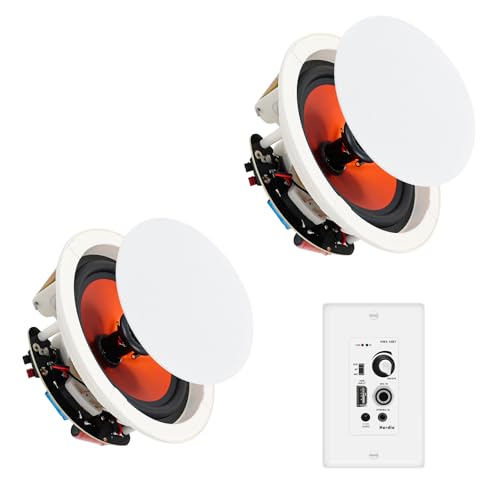
Herdio 8-Inch Bluetooth Ceiling Speakers — Best big-cone pair route
Herdio’s eight-inch route answers a different preference: fewer, larger speakers instead of several smaller ones. An eight-inch pair fills a medium-to-large room with a fuller low end than 6.5-inch kits manage, which suits living rooms and bedrooms where the system will play at conversational and slightly above levels for music with some body to it. The kit follows the Herdio pattern of an in-wall amplifier receiver with Bluetooth input, keeping control at the wall and the speakers passive in the ceiling, wired in the ordinary way.
The rooms Herdio names for this set tell its story: home theater adjunct spaces, bathrooms, living rooms, kitchens and offices. Read home theater there as casual television and music in a living space rather than surround duty, because a stereo Bluetooth pair is not a substitute for a receiver system and this guide will not dress it as one. What it does well is give a single room a simple, permanent, good-sounding music source with no visible equipment beyond a wall plate and two grilles, and the eight-inch cones give that source more presence than the smaller pairs in this guide.
The headline power figure on the listing is a peak marketing number, as with every kit here, and the meaningful comparison is cone area and coverage. Two eight-inch speakers will not spread sound as evenly across a very large room as four smaller ones, so the choice between this set and the four-speaker kits is geometric: depth of sound from two positions, or evenness from four. For the medium rooms most buyers have, depth from two well-placed eight-inch speakers is a satisfying answer.
- Format: 8-inch two-way ceiling speakers with in-wall Bluetooth amplifier
- Amplifier: in-wall receiver unit with wall-level control
- Speakers: passive flush-mount, wired to the amplifier
- Grilles: paintable finish
- Power: amplifier requires mains power at its wall position
- Coverage: a medium to large single room from two positions
The eight-inch Herdio pair has a particular gift for the evening listening that living rooms actually host. At the modest volumes of conversation and a film’s quieter passages played through a television’s own speakers elsewhere, a music system with some low-end body can play genuinely quietly without turning thin, because the larger cones do not need to be pushed to produce a complete sound. That low-volume completeness is the quality households end up valuing most, long after the novelty of ceiling music fades, and it is the strongest argument for choosing cone size over speaker count in a room of ordinary dimensions.
Strengths
- Eight-inch cones give music more body than the 6.5-inch kits.
- Wall amplifier keeps everyday control simple and visible.
- Only two cutouts for a room-filling result.
Trade-offs
- Two positions cannot match four for evenness in a very large room.
- Wall amplifier power provision may need an electrician.
- Stereo music only; not a path to surround sound later.
Best for: living rooms and large bedrooms wanting fuller sound from a simple two-speaker kit. Not suited for: very large open spaces needing four-point coverage, or future theater plans.
Decide whether your room wants depth from two holes or evenness from four, and if it is depth, check the Herdio eight-inch listing and its amplifier’s wall requirements.
How do the six kits compare at a glance?
| Kit | Speakers | Zones | Amplifier home | Standout trait |
|---|---|---|---|---|
| Herdio 6.5-Inch System | Four 6.5-inch | One | Wall plate | Complete large-room kit |
| Pyle 6.5-Inch Pair | Two 6.5-inch | One | Compact, concealed | Grille shape choice |
| Pyle 8-Inch Set | Four 8-inch | One | Compact, concealed | Broad open-plan coverage |
| STUDIOFINIX 4-Zone | 6.5-inch set | Four | Central shelf unit | Independent zone switching |
| VEVOR 6.5-Inch Set | Four 6.5-inch | One | Compact, dry location | Damp-room tolerance |
| Herdio 8-Inch | Two 8-inch | One | In-wall unit | Fuller sound, fewer holes |
Every row shares the same skeleton: passive speakers, real wire, a small amplifier and a phone as the source. The differences that matter are the count of speakers, the count of zones and the tolerance of the room. Choose on those three axes and the category becomes simple; choose on headline wattage and it becomes a lottery.
When should you choose a receiver system instead of a Bluetooth kit?
These kits optimise for one thing: permanent ceiling music with minimum equipment. The moment your ambitions include television sound through the ceiling speakers, multiple streaming services without a phone in the middle, synchronised music across rooms, or a path toward surround sound, a receiver or a networked amplifier platform becomes the honest recommendation. A Bluetooth kit also ties playback to one phone’s presence and battery, which households feel on the evening the usual phone goes out for dinner. None of that diminishes the kits for their intended job; it defines the job’s edges, and buyers who can see the edges clearly rarely regret the purchase.
There is also a longevity question to weigh soberly. A passive ceiling speaker can serve for decades, while the small amplifier in a kit belongs to a faster-moving world of wireless standards and app support. The comforting news is that the speakers remain ordinary passive speakers whatever happens: if a kit amplifier eventually fails or its Bluetooth version ages out, any small amplifier can take its place on the same wire. Install with that future swap in mind, keeping the amplifier accessible rather than sealed into a wall void, and the system’s weakest link stays replaceable.
What mistakes do buyers of Bluetooth ceiling kits make?
The founding mistake is expecting wireless speakers and being surprised by wire; this guide opened with the truth for a reason. The second is placing the amplifier where its Bluetooth signal must cross the whole house, then blaming the kit for dropouts that geometry caused. The third is forgetting the amplifier’s power supply until the speakers are already in the ceiling, at which point a simple job acquires an electrician’s waiting list. The fourth is buying a single-zone kit for a house that plainly wanted zones, and the fifth is installing non-tolerant speakers in a steamy bathroom because the listing’s photographs showed one there.
A quieter mistake is volume planning: expecting a background-music kit to serve a party. These systems are engineered for the level at which people talk over music happily, and asking one to fill a crowded room at celebration volume exposes every limitation at once. If parties are a real use case, the answer is more speakers and a more powerful amplifier architecture, which points back toward the receiver systems discussed above rather than toward any kit’s headline wattage claim.
Final Recommendation
Start from the room, not the listing. A single modest room wants the Pyle pair; a large single space wants four speakers, from Pyle’s eight-inch set for coverage or Herdio’s two-pair system for wall control; a damp room wants the VEVOR set with its amplifier kept dry; a whole house wanting background music by area wants the STUDIOFINIX zones; and a room wanting the fullest sound from two holes wants Herdio’s eight-inch pair. All of them ask for wire, a powered amplifier and honest expectations, and all of them repay that honesty with music that simply lives in the ceiling.
And when the system is playing and the room is full, notice how little there is to look at: a plate, a few quiet grilles, and music arriving from nowhere in particular. That restraint is what the wire, the amplifier hunt and the ceiling dust were buying all along.
Frequently Asked Questions
Are these speakers really wireless?
No. The speakers are wired to a small amplifier with ordinary speaker cable. Bluetooth carries the music from your phone to that amplifier; it does not connect the amplifier to the speakers, which have no power source of their own.
Do I need an electrician to install one of these kits?
The speakers and wire are ordinary low-voltage work. The amplifier needs mains power, and providing a new mains supply at a wall plate is electrical work that many households should hand to a qualified electrician, both for safety and for code compliance.
Can I play different music in different rooms?
Only by installing separate kits, or by accepting the STUDIOFINIX arrangement, which switches zones on and off but plays one shared source. Systems that stream independently to many rooms are networked platforms, a different category from these kits.
Why do the listings claim such large wattage?
Those figures are peak marketing numbers without a shared measurement standard, so they cannot be compared between brands and should not drive a decision. Judge a kit by its speaker count, zones and room fit instead.
Can a Bluetooth ceiling kit handle my television?
These kits are designed around a phone as the source for music. Television sound, lip-sync behaviour and surround formats belong to receiver territory, and buyers wanting TV through the ceiling should start there instead.
What happens if the little amplifier fails in five years?
The speakers are standard passive units on standard wire, so a replacement amplifier of suitable size can take over the same installation. Keep the amplifier accessible when you install it, and the swap stays simple.
How do you keep a Bluetooth ceiling system reliable day to day?
Reliability in these systems is mostly about the last few metres between phone and amplifier. Keep the amplifier out of metal enclosures, away from the back of a refrigerator or a boiler, and not buried behind a wall of tins in a larder, because metal is where Bluetooth signals go to die. Where the amplifier hides in a cupboard, the cupboard door’s material matters: timber passes signal kindly, mirrored and foil-backed doors do not. A system that drops out once a day will be abandoned within a month no matter how good it sounds, so a few minutes spent choosing the amplifier’s home is worth more than any specification on the box.
Pairing discipline helps too. These amplifiers typically remember a small number of devices and connect to the last one they saw, which produces the familiar household comedy of the kitchen ceiling joining a phone upstairs. The households that stay happy with a kit tend to standardise: one device is the music source, other phones connect deliberately and disconnect when done. Voice assistants and smart speakers can join the routine through the phone, but the amplifier itself remains a simple Bluetooth endpoint, and treating it as such, rather than as a smart device that failed to be clever, keeps expectations and behaviour aligned.
Finally, protect the installation from its environment. Ceiling voids collect dust, and an amplifier mounted in one needs ventilation rather than a burial in insulation. Wall plates should sit where splashes and steam do not reach them, even when the speakers themselves tolerate moisture. None of this is demanding, but all of it is the difference between a system that is still playing in ten years and one that became a ceiling ornament in three. Simple systems reward simple care, reliably given.
Which rooms gain the most from a ceiling Bluetooth kit?
The bathroom is the category’s founding use case, because it combines a small space, a daily routine and a total absence of anywhere to put a countertop speaker that steam will not eventually claim. Music or radio in the ceiling turns a functional room into a pleasant one, and the morning news at shower volume is a luxury people describe with surprising affection once they have lived with it. The kitchen follows closely: a cook’s hands are wet, occupied or both, surfaces are precious, and a phone-driven ceiling system asks for nothing but a spoken request or a tap before the onions go in.
Home offices and studios gain a different benefit, which is separation. A ceiling system keeps music present without headphones isolating the worker or a desktop speaker cluttering the desk, and at background level it masks household noise in a way that helps concentration. Garden rooms, summer houses and workshops share that logic outdoors-adjacent: one small amplifier, speakers in a ceiling that has no furniture against it, and a space that feels finished. Covered porches extend the idea furthest, provided the speakers tolerate the damp air and the amplifier lives inside the house’s dry envelope.
The rooms that gain least are the ones with other ambitions. A living room being groomed for film nights will outgrow a Bluetooth kit’s stereo ceiling pair and start wanting the receiver system this guide keeps pointing toward. A household of teenagers with divergent tastes will find one shared source a source of conflict rather than music. Recognising those households in advance is not a criticism of the kits; it is the buyer’s half of the bargain, and it is why the category’s honest premise, stated at the top of this guide, matters more than any single pick in it.
How should you plan the wiring for a kit in a finished house?
Retrofitting wire into a finished ceiling is the part of the job that decides whether a kit feels like a weekend project or a building works saga, so plan the route before the speakers are ordered. The friendliest ceilings have an attic above them, where runs can be laid by hand and dropped through the cutouts. Below another floor, the route must follow joist bays, and a stud finder plus a knowledge of which way the joists run becomes the map. Runs along a bay are straightforward fishing work; runs across bays mean either a series of small access holes that will need filling, or a reconsidered amplifier position that keeps everything inside one or two bays.
The amplifier’s location should be chosen to serve the wire as much as the room. A wall plate on a wall that backs onto a cupboard, a wardrobe or the attic’s edge gives the installer somewhere forgiving to work behind the plate. A shelf amplifier near an existing power socket removes the electrical question entirely for many households, at the price of a visible box that needs a home. Neither choice is wrong; the error is choosing the amplifier’s spot for looks alone and discovering the wire cannot reach it without crossing three joists and a steel beam.
While the route is open, run one spare cable. It costs almost nothing, it can coil in the ceiling as insurance against a damaged run, and it future-proofs the room for a second pair or a centre position if the household’s ambitions grow. Label every end, photograph the open work, and note which cable feeds which speaker on a card kept with the amplifier. Retrofits are forgotten fastest of all installations, because they were never part of the house’s original plans, and the documentation is the only memory the system will ever have.
What should you expect from the sound of a ceiling kit?
Calibrate expectations to the words background and everyday, and these kits will exceed them; calibrate to the word hi-fi, and they will disappoint through no fault of their own. A well-installed kit sounds clear, warm and present, with enough body for music to feel like music and enough clarity for speech, podcasts and radio to survive the clatter of a kitchen. What it will not do is image like a pair of speakers at ear level, resolve the fine detail a quiet listening room reveals, or produce bass that registers in the chest. The ceiling is a wonderful place for music to live and a poor place for it to perform.
Volume expectations follow the same curve. Within their rooms, these systems play louder than conversation and comfortably fill the space they were sized for; the failures happen when a kit sized for a bathroom is asked to entertain a garden party through an open door, or a pair is stretched across an open-plan floor that needed four speakers. Sizing honestly at purchase time, using the speaker counts this guide assigns to each room type, is the whole secret. The kits are not hiding spare capability behind their modest amplifiers, and their headline power claims, those peak numbers again, describe a laboratory instant rather than a listening experience.
There is one more pleasure worth naming, because owners mention it constantly and specifications never do: the sound has no visible source. Guests look for the speaker that is not there, children assume the house itself is musical, and the room keeps its surfaces and its calm. That invisibility, combined with the absence of a countertop box to dust, charge or knock into the sink, is the real product these kits sell. The music is almost incidental to the magic trick, and households that buy the trick knowingly are the ones still delighted by it years later.
How do these kits handle guests, renters and temporary living?
Not every ceiling is yours to cut forever, and the kits divide by how gracefully they treat a temporary home. In a rental, the honest answer is usually that ceiling speakers of any kind wait for a property you own, because cutouts are alterations a landlord rarely welcomes. Where permission exists, the pair kits are the least invasive route back out again: two holes can be patched, a small amplifier leaves with you, and the room returns to silence without a trace beyond two plaster repairs. The multi-zone system, by contrast, is a homeowner’s commitment, its value realised over years of living with the wiring rather than months.
Guest use exposes a friendlier difference between the kits. A wall-plate amplifier with a visible volume control is the only arrangement a visitor can operate without instructions, because everything else depends on pairing a phone, and pairing is a small ceremony nobody wants to perform in someone else’s kitchen. Households that host often, or that run a small guest house or rental property where permission and wiring are already settled, should weight that wall control heavily. A system the guest cannot use is, for the guest, a silent ceiling with mysterious grilles.
There is also the question of what happens when the household’s phones change. Bluetooth pairing survives handset upgrades with a few minutes of re-pairing, and the amplifiers here ask for nothing more exotic than that. No account, no subscription and no cloud service stands between the kit and its music, which is a genuine virtue in a category of home technology increasingly rented rather than owned. The ceiling will still play when the phone is three models newer, and that plain durability of concept is worth remembering when comparing these kits against smarter, more fragile alternatives.
What should a small business or studio take from this guide?
Cafes, salons, waiting rooms and small studios are heavy users of exactly this category, because the requirement is background music that nobody trips over, steals or knocks off a counter. The four-speaker single-zone kits cover a typical small floor well, and the STUDIOFINIX zones suit premises divided into a public floor and private rooms. Two commercial cautions apply that homes escape. Music licensing for public performance is the business’s own responsibility and no speaker kit includes it. And duty cycles are longer in a business, eight or ten hours a day rather than a home’s two or three, which argues for the amplifier having ventilation and the speakers being played at the modest levels they were sized for rather than pushed to fill a noisy room at lunchtime.
Businesses should also think about who controls the music. A phone-paired system in a shop effectively belongs to whichever staff member paired first, and a wall control or a dedicated house tablet solves the rota problem before it starts. That small operational thought, like the zone labels in a house, is the sort of unglamorous planning that separates a system the staff enjoy from one they quietly switch off. The ceiling does not care either way, but the business will.
One final test before any kit is declared finished: play the system at the volume the room will actually use, from the seats and worktops where people actually sit and stand, with the extractor fan, the kettle or the studio’s own machinery running. Ceiling music succeeds or fails against the room’s real noise floor, not in a silent showroom hush, and a kit that holds its clarity against a working kitchen’s clatter has passed the only audition that matters. Adjust the speaker positions in your plan, not your expectations, if it has not.
Related Guides
If a receiver-based system sounds more like your project after all, the foundation is laid out in best ceiling speakers, the overhead film layer is covered by best dolby atmos ceiling speakers, and commercial ceilings follow different rules entirely in best drop ceiling speakers.
Where the ceiling is a suspended grid rather than plaster, best drop ceiling speakers is the companion read.


