What's inside
- Where to buy
- Key Takeaways
- Quick Picks
- How did we choose the best ceiling speakers?
- What should you measure before choosing a ceiling speaker?
- How do the six picks compare side by side?
- How should you wire and power a passive ceiling system?
- What mistakes do first-time ceiling installers make?
- Final Recommendation
- Frequently Asked Questions
- How do you install ceiling speakers step by step?
- Which ceiling speaker suits which room in the house?
- What should you realistically expect ceiling speakers to sound like?
- How should you plan zones and volume controls across a house?
- What should you check when a finished system sounds wrong?
- Related Guides
As an Amazon Associate I earn from qualifying purchases. This post may contain affiliate links at no extra cost to you.
gizmoverdict.com is reader-supported. When you buy through links on our site, we may earn an affiliate commission.
Where to buy
All six models in this roundup of the best ceiling speakers are sold through Amazon in the United States, and the first thing to check on any listing is how many speakers actually arrive in the box. Some of these products ship as matched pairs, two of them are priced per single speaker, and one is a five-speaker bundle built for a complete surround layout. Counting boxes instead of speakers is the most common ordering mistake in this category, and it is entirely avoidable if you read the unit line before anything else.
The best ceiling speakers share one trait that surprises first-time buyers: none of them makes a sound on its own. Every pick in this roundup is a passive loudspeaker, which means it needs a separate AV receiver or stereo amplifier, speaker wire run through the ceiling cavity, and a hole cut to a stated diameter before it plays a single note. That is not a drawback so much as the architecture of the whole category. A receiver-driven ceiling system lasts for decades, lets you upgrade the electronics without touching the speakers, and spreads music or movie sound across a room with no visible cabinets at all. This guide is the general residential map of that world: family rooms, kitchens, bedrooms and covered porches where ordinary eight-ohm home audio belongs.
Two neighbouring topics sit outside this guide on purpose. Constant-voltage commercial systems for shops and offices follow different wiring rules, and compact six-inch models for tight joist bays have their own trade-offs; both are covered elsewhere on the site. Here the question is simpler and broader: which flush-mount speakers deserve a permanent hole in your ceiling, and how do you match driver size, cutout diameter and mounting depth to the room above the plaster? The answers turn on measurements you can take with a tape and a stud finder, not on the inflated power figures printed on retail boxes, which we treat throughout as seller marketing rather than engineering fact.
Key Takeaways
- Every speaker below is passive, so budget for a receiver or amplifier and a spool of in-wall rated wire alongside the speakers themselves.
- Cutout diameter and the depth of clear space above the ceiling decide what physically fits; driver size printed on the box is a poor substitute for either measurement.
- Eight-inch woofers move more air and suit larger rooms or open-plan spaces, while six-and-a-half-inch models disappear more easily in bedrooms and hallways.
- Two picks here are sold as single speakers, so a stereo pair means ordering two units, and the five-speaker bundle only makes sense as a matched surround set.
- Paintable grilles matter more than they sound: a grille you can match to the ceiling paint is the difference between discreet and distracting.
- Plan speaker positions around joists, light fittings and insulation before cutting anything, because relocating a ceiling hole is a plastering job.
Quick Picks
| Pick | Badge | Why it earns its place |
|---|---|---|
| Polk Audio RC80i | Best all-round pair | A long-running eight-inch pair with a moisture-tolerant build that works from living rooms to covered outdoor spaces. |
| Yamaha NS-IC800 | Best for big rooms | Yamaha’s eight-inch pair voices cleanly at low volume and keeps its composure when a film soundtrack swells. |
| Yamaha NS-IC600 | Best mid-size pair | The six-and-a-half-inch Yamaha suits bedrooms and kitchens where an eight-inch cone would look and sound oversized. |
| Micca M-8C | Best single-speaker value | Sold individually with a stated 9.4-inch cutout, this eight-inch Micca lets you build a system one ceiling at a time. |
| Micca M-6C | Best for tight ceilings | A 7.6-inch cutout and modest depth make this the easiest fit in crowded joist bays and shallow soffits. |
| Acoustic Audio CS-IC83 5-Speaker Set | Best surround bundle | Five matched three-way speakers in one box give a home theater matched voicing at every position. |
How did we choose the best ceiling speakers?
We started from the installed base rather than the launch calendar. Ceiling speakers stay in a house for a very long time, so models with years of listings, stable specifications and a manufacturer that still publishes cutout templates tell you more than a freshly announced product with no track record. Each candidate had to be a genuine flush-mount in-ceiling design for residential eight-ohm systems, available as a verifiable listing, and sized for standard ceiling construction. Exotic commercial constant-voltage models and ultra-thin novelty speakers were set aside, because they answer different questions than the one a homeowner cutting a first ceiling hole is asking.
The second filter was documentation. A ceiling speaker is a building product as much as an audio product: the maker should state the cutout diameter, the mounting depth, the grille diameter and the impedance plainly, and all six picks do. Where a listing leads with a giant wattage figure and buries the dimensions, we treated that as a warning sign rather than a selling point, because the wattage printed on retail ceiling-speaker boxes is a peak marketing number with no shared measurement standard behind it. No pick in this guide was ranked by that figure, and none should be bought by it either.
Finally, we weighted the unglamorous ownership details: whether the grille can be painted, whether the mounting clamps swing out cleanly in a shallow cavity, whether the tweeter can be aimed or at least is angled sensibly, and whether the speaker is sold as a pair or a single unit. Those details decide whether an installation afternoon feels satisfying or miserable, and whether the finished ceiling looks intentional. Sound character matters, of course, and the individual reviews below describe each model’s voicing in plain terms, but a ceiling speaker that fights its installer rarely gets heard at its best anyway.
What should you measure before choosing a ceiling speaker?
Three measurements govern everything. The first is the cutout diameter: the hole you saw into the ceiling must match the template, because a quarter-inch too small means trimming plaster in an awkward circle overhead, and a quarter-inch too large means the mounting clamps have nothing solid to bite. The second is mounting depth, the clear distance from the ceiling surface to whatever sits above it, which can be a floor joist, a duct, a pipe or the roof deck in a single-storey room. The third is lateral clearance: joists in most homes sit sixteen inches apart on centre, which sounds generous until a recessed light, a smoke alarm and an air vent all claim the same bay you wanted.
A stud finder and a small inspection hole in an inconspicuous spot will tell you more than any product page. Many installers drill a tiny pilot hole and probe with a bent wire to feel for obstructions before committing to the full cutout, a habit worth copying. Insulation deserves a mention too: loose-fill insulation will pour through a fresh ceiling hole with real enthusiasm, so clearing a small working pocket above the cutout and keeping the speaker’s rear clear of packed insulation both protects the driver and keeps the sound from being muffled by a wool blanket pressed against the cone.
Room size then decides driver size. In a bedroom or study, a six-and-a-half-inch woofer at modest volume is balanced and articulate, and its smaller grille reads as a deliberate design choice rather than a dinner plate in the ceiling. In an open-plan kitchen and living area, or a room with high ceilings, an eight-inch woofer’s extra cone area keeps dialogue and music full at the lower volumes people actually use for background listening. Neither size is better in the abstract; each is better in a specific room, which is why this guide carries both sizes from three different makers.

Polk Audio RC80i — Best all-round pair
The RC80i has been a default answer in this category for so long that its strengths are easy to understate. It is an eight-inch two-way design sold as a matched pair, with a mineral-filled polymer cone and a soft-dome tweeter that can be swivelled toward the listening area, a small feature that matters more in ceilings than anywhere else because the speaker fires straight down while people rarely sit straight underneath it. Aiming the tweeter even modestly toward the sofa lifts vocal clarity in a way that turning the volume up never quite achieves. The overall voicing is warm and forgiving, which suits the mixed diet of television dialogue, streamed music and the occasional film that most family rooms actually play.
Polk also built this model for the rooms other ceiling speakers fear. The materials tolerate humidity well enough for covered outdoor use and steamy bathrooms, within the limits the manufacturer describes, so the same pair can serve a kitchen that fills with pasta steam every evening or a porch ceiling that never sees direct rain. The grille is paintable, the mounting system is a straightforward rotating-clamp arrangement that pulls the frame snug against the plaster, and the pair format means stereo imaging arrives balanced out of the box with no second order to place. For a first installation, that completeness is worth real money in avoided hassle.
- Format: eight-inch two-way in-ceiling speaker, sold as a pair
- Tweeter: swivel-mounted soft dome, aimable toward seating
- Grille: paintable, low-profile round design
- Environment: moisture-tolerant construction for humid rooms and covered outdoor ceilings
- Power: passive design, requires a separate receiver or amplifier
- Fit check: confirm the published cutout template and cavity depth against your ceiling before ordering
Ownership over years is where the RC80i quietly scores. The design has been in production long enough that replacement grilles, templates and advice are easy to find, and installers know the model by name, which shortens any conversation with a professional you hire for a larger project. In daily use it asks for nothing: no settings at the speaker, no maintenance beyond an occasional dusting of the grille, and no tendency to draw the eye once painted. Longevity in a ceiling product is not a luxury trait, because swapping a ceiling speaker means enlarging or adapting a hole, so a model with a long production run protects the hole as much as the listener.
Strengths
- Aimable tweeter genuinely improves dialogue clarity from an overhead position.
- Humidity tolerance opens up kitchens, bathrooms and covered porches.
- Sold as a matched pair, so stereo balance needs no extra ordering thought.
Trade-offs
- The eight-inch footprint is visually substantial in a small bedroom ceiling.
- Warm voicing will not satisfy listeners chasing a bright, analytical top end.
- Like every pick here, it is silent until you supply a receiver and wire.
Best for: households wanting one dependable pair that can serve a living room today and a humid room later without changing models. Not suited for: listeners building a dedicated critical-listening room who want the last word in treble precision.
If the RC80i sounds like your fit, check the pair listing carefully for the current box contents before you order, then measure your ceiling bay twice. See the Polk RC80i on Amazon and confirm the cutout template matches the space you probed.

Yamaha NS-IC800 — Best for big rooms
Yamaha’s eight-inch pair takes a different route to the same job. The woofer uses a polypropylene mica cone and the tweeter is a fluid-cooled soft dome that can be swivelled, and the combined result is a speaker that sounds composed at the low background levels where ceiling speakers spend most of their lives. That composure is harder to engineer than loudness: many budget ceiling speakers turn thin and shouty when turned down, while the NS-IC800 keeps voices rounded and intelligible under conversation. In a large open-plan room, where a pair of ceiling speakers may be the only sound source across a wide area, that low-volume manners-first tuning is exactly right.
The physical design helps the installer as well. A paintable grille with magnetic attachment on this generation of Yamaha design makes the final cosmetic step quick, and the frame’s sealed back helps keep dust and insulation fibres away from the driver in an open attic cavity. Yamaha’s background in musical instruments shows in the voicing choices: acoustic guitar, piano and voices sit naturally, and the speaker never draws attention to itself, which is the highest compliment a ceiling speaker can earn.
- Format: eight-inch two-way in-ceiling speaker, sold as a pair
- Cone: polypropylene mica woofer with fluid-cooled soft-dome tweeter
- Tweeter: swivel design for directing treble toward listeners
- Grille: paintable finish for colour-matching the ceiling
- Power: passive, driven by an external receiver or zone amplifier
- Fit check: verify grille diameter against your lighting layout so fittings do not crowd each other
Consider the NS-IC800 for the way it handles television as much as music. Overhead placement can smear dialogue when a speaker’s off-axis response is ragged, because listeners are almost never on the speaker’s axis. Yamaha’s voicing keeps the midrange tidy off to the sides, so a newsreader stays understandable from a kitchen island even though the speakers are behind and above. That behaviour, repeated across thousands of ordinary evenings, is worth more than a dramatic first impression in a showroom, and it is the main reason this pair leads the large-room end of the guide rather than simply sharing the eight-inch category with the Polk.
Strengths
- Even, natural voicing that stays pleasant during long background sessions.
- Treble can be aimed rather than left to fire at the floor.
- Sealed-back construction keeps attic dust away from moving parts.
Trade-offs
- Deep bass is beyond any open-back ceiling design, this one included.
- The restrained treble may feel polite in a dedicated theater room.
- Two speakers share one box, so odd channel counts need a second pair.
Best for: open-plan living spaces and kitchens where one pair must cover a wide area gracefully all day. Not suited for: bass-led listening or anyone expecting subwoofer weight from a ceiling cutout.
For a big room that hosts everything from morning radio to film night, the Yamaha pair is the calm choice; look over the NS-IC800 listing and match its template against your joist spacing before committing.

Yamaha NS-IC600 — Best mid-size pair
Everything the NS-IC800 does in a large room, its smaller sibling does in the rooms where most ceiling speakers actually end up: bedrooms, kitchens of ordinary size, hallways, home offices and bathrooms. The six-and-a-half-inch woofer and swivelling soft-dome tweeter share the family’s design language, including the paintable grille and the sealed-back thinking that keeps the driver clean in a dusty cavity. In a modest room the smaller cone is not a compromise at all. It integrates more easily at the moderate volumes those rooms use, and the smaller grille looks proportionate above a bed or a desk instead of looming.
There is also a systems argument for this model. Whole-home audio usually means several zones, and zones multiply cost and amplifier channels quickly. A pair format at this size makes it simple to spec the same speaker for a bedroom zone and a bathroom zone, keeping voicing consistent as you walk through the house, which is a subtle pleasure that mismatched bargain speakers never deliver. Dialogue from a bedroom television, podcasts while cooking, music in the office: the NS-IC600 covers that everyday ground with an even hand, driven by whatever receiver or compact zone amplifier you already own or plan to add.
- Format: six-and-a-half-inch two-way in-ceiling speaker, sold as a pair
- Tweeter: fluid-cooled soft dome on a swivel mount
- Grille: paintable round grille sized for smaller ceilings
- Construction: sealed-back design suited to insulated cavities
- Power: passive, needs an external amplifier channel per speaker
- Fit check: smaller cutout eases placement between crowded joists and light fittings
The NS-IC600 also makes a thoughtful gift to future owners of your house, which sounds odd until you consider how ceiling speakers are inherited. A matched set of the same mid-size Yamaha across several rooms reads as a deliberate system to anyone who later buys the property, and its standard sizing means a future replacement drops into the same holes. In your own tenure, the practical delight is consistency: the same remote, the same amplifier behaviour and the same sonic character in the bedroom as in the study, so the whole house feels like one instrument rather than a shelf of unrelated gadgets.
Strengths
- Proportions suit the smaller rooms where ceiling audio is most used.
- Consistent Yamaha voicing pairs happily with the eight-inch model in bigger rooms.
- Forgiving at the low volumes bedrooms and offices live at.
Trade-offs
- Will sound thin if asked to fill a vaulted great room alone.
- No provision for stereo from a single unit in a tiny ensuite.
- Still a two-speaker box, which complicates a three-speaker layout.
Best for: multi-room projects that want one consistent mid-size speaker across bedrooms, kitchens and studies. Not suited for: a single pair expected to energise a double-height living space.
Planning a few zones at once? Review the NS-IC600 pair details, count your amplifier channels honestly, and order the pairs room by room rather than all at once.

Micca M-8C — Best single-speaker value
Micca built its reputation by publishing honest specifications and charging plainly for them, and the M-8C is the clearest example in this guide. It is an eight-inch two-way speaker with a polypropylene cone and a pivoting silk-dome tweeter, sold as one speaker per box. That single-unit format is the headline: it lets you add a centre channel to an existing pair, fill an odd-shaped room with three speakers instead of forcing four, or start with one room and expand later without hunting for a matching model. The listing states a 9.4-inch cutout diameter, which is the number your saw needs to agree with, and the grille is paintable so the finished result can vanish into the ceiling.
Sonically the M-8C aims for balance over fireworks. The woofer and tweeter cross over smoothly enough that voices do not change character as an actor moves across a scene, and the pivoting tweeter gives you a modest but real ability to steer presence toward the seating. Micca’s own guidance about amplifier power is refreshingly plain, and like every passive pick here the M-8C needs a receiver or amplifier channel of its own. Buyers should simply be deliberate about quantity: one box on the doorstep is one speaker, so a stereo pair is two boxes, and a five-channel ceiling layout is five. Ordered with that clarity, it is one of the most flexible building blocks in residential ceiling audio.
- Format: eight-inch two-way in-ceiling speaker, sold individually
- Cutout: 9.4-inch diameter stated in the listing
- Tweeter: pivoting silk dome for steering treble
- Grille: paintable white finish
- Power: passive design requiring a separate amplifier or receiver
- Quantity note: order two units for a stereo pair, five for a full surround layout
One more M-8C virtue deserves recording: it is the pick least likely to strand you with a spare speaker. Pair-based buying quietly wastes money in real houses, where a layout needs three speakers in an L-shaped room or a single centre above a television. Because the Micca is priced and sold as a unit, the budget follows the plan instead of the packaging. Installers who wire multi-room systems professionally lean on exactly this kind of single-unit model for that reason, and the home buyer copying their logic gets a system shaped by the rooms rather than by the contents of a carton.
Strengths
- Single-unit sales make odd channel counts and centre channels easy.
- Published cutout figure removes guesswork before the saw comes out.
- Balanced voicing that flatters dialogue as much as music.
Trade-offs
- Per-speaker pricing looks cheap until you multiply by the room count.
- Plain styling offers no premium grille options or trim kits.
- Bass extension is honest but modest, as with all open ceiling designs.
Best for: builders of gradual systems, centre-channel additions and rooms needing an odd number of speakers. Not suited for: anyone who wants a matched pair in a single box with zero counting.
Count your channels, then count them again, and check the M-8C listing for the template dimensions before the first unit goes into the cart.

Micca M-6C — Best for tight ceilings
The M-6C answers the question the M-8C cannot: what fits when the ceiling will not cooperate? Its six-and-a-half-inch driver needs a 7.6-inch cutout, and that smaller circle threads between joists, pipes and recessed lights in ceilings that would reject an eight-inch model outright. Soffits above kitchen cabinets, low basement ceilings with ductwork hard against the plaster, and narrow hallway bays are its natural territory. It shares the family formula of a polypropylene woofer and pivoting silk tweeter, so its voicing stays recognisably Micca: clear in the midrange, tidy at the top, and unwilling to pretend it can move subwoofer air.
Used where it belongs, the M-6C is deeply satisfying. Background music in a kitchen, talk radio in a laundry room, a pair flanking a bathroom mirror where steam rules out a countertop radio: these are jobs about presence and clarity, not scale. The paintable grille keeps the small footprint visually quiet, and the single-unit format again lets you buy exactly the count the room needs, including a lone speaker for a small ensuite fed by a summed mono signal from a suitable amplifier. Just keep the arithmetic front of mind, because one box still means one speaker, and a stereo pair still means two.
- Format: six-and-a-half-inch two-way in-ceiling speaker, sold individually
- Cutout: 7.6-inch diameter stated in the listing
- Tweeter: pivoting silk dome
- Grille: paintable, compact round profile
- Power: passive, requires an amplifier or receiver channel
- Quantity note: sold each; a stereo pair means ordering two
The M-6C rewards a particular kind of planning: measure the rooms nobody else thinks about. Laundries, dressing rooms, porches with shallow framed ceilings and the small study under the stairs are the spaces where music is missing precisely because standard speakers never fitted. A 7.6-inch cutout changes that map. Fed at modest levels, the little Micca makes those in-between rooms feel finished, and because each unit is bought singly, extending sound into one more forgotten corner later is a small decision rather than a project. That expandability is the quiet argument for keeping this model on the shortlist even when the main rooms take larger speakers.
Strengths
- Smallest cutout here, ideal for soffits and crowded joist bays.
- Clear midrange suits speech, podcasts and background music.
- Buy-exactly-what-you-need format wastes nothing on spare speakers.
Trade-offs
- Physics limits its low end in larger or open-plan rooms.
- A single unit cannot reproduce stereo by itself.
- Shallow rooms with big volume demands will outgrow it quickly.
Best for: kitchens, bathrooms, hallways and low ceilings where an eight-inch hole simply will not fit. Not suited for: anchoring the main listening area of a large family room.
Measure the bay you actually have, and if the numbers are tight, confirm the M-6C dimensions on its listing before you mark the ceiling.
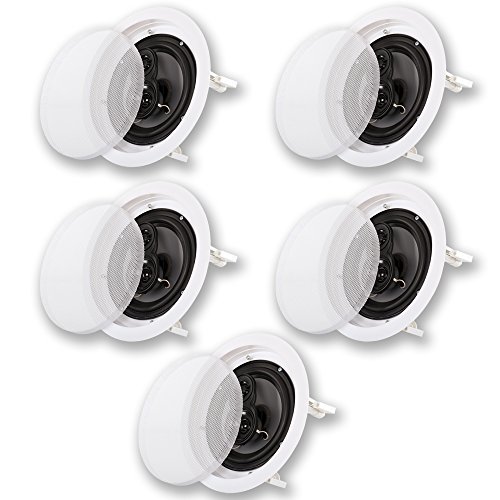
Acoustic Audio CS-IC83 5-Speaker Set — Best surround bundle
Most ceiling-speaker shopping is stereo shopping, but a home theater needs five matched voices, and that is the gap this bundle fills. The CS-IC83 set puts five eight-inch three-way speakers in one box, intended to cover the front left, centre, front right and two surround positions of a ceiling-based theater layout. Matched voicing across all five positions is the real product here: when a sound pans from the front of the room to the back, its character stays constant, and that continuity is what makes a surround mix feel like one space rather than five unrelated speakers taking turns.
The three-way design adds a dedicated midrange driver to the woofer and tweeter, which helps dialogue sit forward when the centre speaker carries a film’s conversation from above. Buyers should keep two honest caveats in view. First, the set’s headline power figure is a seller’s peak claim for marketing, not a measurement to plan around; your receiver’s ordinary output is what matters, and any mainstream AV receiver will drive these speakers comfortably. Second, five ceiling speakers still need that receiver, five wire runs and five correctly placed cutouts, so the bundle simplifies purchasing, not installation. Within those truths, it is a coherent way to voice a whole room in one order.
- Format: five eight-inch three-way in-ceiling speakers in one set
- Layout: intended for front, centre and surround positions in a 5-channel room
- Drivers: woofer, midrange and tweeter per speaker
- Grilles: paintable white finish across all five units
- Power: passive set, requires a multi-channel AV receiver
- Fit check: five identical cutouts demand a careful ceiling plan before cutting begins
The CS-IC83 set also changes the conversation about the centre channel, the speaker that carries most of a film’s dialogue. In mixed systems the centre is often an afterthought bought later and voiced differently from its neighbours, and the mismatch shows every time speech pans. Here the centre is the same three-way design as the fronts and surrounds, so a voice moving across the screen keeps its body and size. That coherence, more than any specification on the box, is what a matched set buys, and it is why the bundle exists as a single product rather than five separate listings that happen to share a brand.
Strengths
- Matched voicing at every position keeps pans smooth and believable.
- Dedicated midrange helps overhead dialogue stay intelligible.
- One purchase covers the full five-channel layout.
Trade-offs
- No flexibility to mix sizes for awkward individual positions.
- A ceiling-only front stage will never image like ear-level speakers.
- Five cutouts raise the installation stakes considerably.
Best for: dedicated media rooms planned as a complete five-channel ceiling system from the start. Not suited for: gradual builds, renters, or rooms where only the surround channels belong overhead.
If the whole room is going overhead, examine the CS-IC83 set listing, sketch all five positions around your joists, and price the receiver the set still needs.
How do the six picks compare side by side?
| Model | Size and format | Sold as | Notable trait | Room fit |
|---|---|---|---|---|
| Polk Audio RC80i | 8-inch two-way | Pair | Aimable tweeter, humidity tolerant | Living rooms, kitchens, covered porches |
| Yamaha NS-IC800 | 8-inch two-way | Pair | Composed low-volume voicing | Large and open-plan rooms |
| Yamaha NS-IC600 | 6.5-inch two-way | Pair | Sealed-back, even manners | Bedrooms, offices, bathrooms |
| Micca M-8C | 8-inch two-way | Each | 9.4-inch stated cutout | Flexible counts, centre channels |
| Micca M-6C | 6.5-inch two-way | Each | 7.6-inch stated cutout | Soffits, hallways, tight bays |
| Acoustic Audio CS-IC83 | 8-inch three-way | Set of five | Matched surround voicing | Dedicated media rooms |
Read the table as a sizing chart rather than a league table. The two Yamahas and the Polk compete for the same pair-shaped jobs at two sizes, the Miccas win whenever the channel count or the ceiling geometry is awkward, and the Acoustic Audio set only enters the conversation when the whole room is planned as surround. Every row shares the same foundation: passive drivers, an external amplifier, in-wall rated wire and a hole you should measure twice.
How should you wire and power a passive ceiling system?
Start at the amplifier and work outward. A stereo zone needs one pair of wire runs, a surround room needs five or more, and every run should use cable rated for in-wall use, with enough slack at each end to work comfortably. Keep runs away from mains cabling where the layout allows, cross electrical lines at right angles when crossing is unavoidable, and label both ends of every cable before the ceiling closes up, because future-you troubleshooting a silent rear channel will be grateful. At the speaker end, leave a service loop of spare cable coiled in the cavity; it costs nothing and makes any later repositioning far less painful.
Amplifier matching is simpler than the marketing suggests. Ordinary receivers and zone amplifiers are built for eight-ohm speakers like these, and normal listening levels in a home draw a tiny fraction of any headline wattage figure, which is another reason those figures deserve no role in your decision. What does matter is channel count: a multi-room setup needs either a receiver with powered zone outputs or a dedicated multi-channel amplifier, and a five-speaker ceiling theater needs a genuine multi-channel AV receiver with room for a subwoofer later, since no ceiling speaker in this guide pretends to cover the lowest octave of a film soundtrack.
Placement completes the triangle. Stereo pairs belong roughly over the main seating, nudged a step toward the screen, spaced to form a triangle with the listeners; surround channels sit behind and to the sides of the seats; a centre channel lives above the screen position. Aimable tweeters, where fitted, should be angled toward the seats during installation, not left pointing at the carpet by default. Ten minutes with a tape measure at this stage outperforms any amount of equaliser fiddling afterwards.
What mistakes do first-time ceiling installers make?
The classic error is cutting before checking, and it takes many forms: a hole centred lovingly on a joist, a cutout that clips a duct, a pair spaced for the room you wish you had rather than the seating you own. The second error is arithmetic, ordering pairs when the design needs singles or assuming a single-speaker box contains two because the photograph showed a pair. The third is wire: using thin leftover cable, forgetting in-wall rating, or running every zone back to an amplifier with too few channels, discovered only when the plaster dust settles.
Two quieter mistakes deserve equal billing. Painting a grille with thick paint and clogging its perforations dulls the sound permanently, so use light sprayed coats if you paint at all. And skipping the subwoofer conversation in a theater room leaves films sounding weightless no matter how good the ceiling speakers are; plan a floor subwoofer position from the start. Finally, photograph your open ceiling before it closes. A phone picture of joist positions and wire runs is the cheapest insurance an installer can buy.
Final Recommendation
For most homes the Polk RC80i pair is the safest first cut: forgiving sound, an aimable tweeter, humidity tolerance and a matched pair in the box. Large open rooms should look at the Yamaha NS-IC800, smaller rooms at its NS-IC600 sibling, and anyone whose ceiling geometry or channel count is awkward will find the Micca M-8C and M-6C, sold singly, easier to plan around. The Acoustic Audio five-speaker set earns its place only when the entire room is committed to overhead surround. Whichever you choose, the receiver, the wire and the measurements matter as much as the badge on the grille. Cut once, after measuring twice, and the ceiling will reward you quietly for years.
Frequently Asked Questions
Do ceiling speakers need a separate amplifier?
Yes. Every pick in this guide is passive, so it draws power from an AV receiver or a stereo or multi-zone amplifier. There is no battery or mains connection at the speaker itself, just the two conductors of a speaker wire run.
Can one speaker play stereo in a small bathroom?
A single standard speaker plays one channel. Some systems sum stereo to mono at the amplifier for a lone speaker, which works well for background listening, but a normal single pick here should be planned as one channel of a layout.
How much ceiling depth do I need?
It varies by model, which is why each review stresses checking the published mounting depth against your cavity. Shallow soffits and floors with low joists above them are the tight cases, and probing with a pilot hole before cutting is the reliable way to know.
Will ceiling speakers give me strong bass?
They give honest, tidy low end for music at normal levels, but an open ceiling cavity is not a tuned enclosure, and no pick here replaces a subwoofer for film effects or bass-heavy listening. Plan a subwoofer for theater use.
Can I paint the grilles to match my ceiling?
Yes, all six picks use paintable grilles. Apply thin sprayed coats and keep paint out of the perforations; heavy brushed paint can block the holes and muffle the sound.
What wire should I run?
Use speaker cable rated for in-wall installation, in a gauge sensible for your longest run, and label both ends. Longer runs benefit from heavier gauge cable to keep resistance low.
How do you install ceiling speakers step by step?
Begin with the amplifier switched off and the room measured on paper. Mark each proposed position on the ceiling in pencil, then check every mark from below with a stud finder and from above, if you have attic access, with your own eyes. Attic access changes everything about this job: you can see ducts, junction boxes and insulation before they become surprises, and you can feed wire by hand instead of fishing blindly. Without attic access, the pilot-hole and bent-wire probe method described earlier becomes your main source of truth, and patience matters more than any tool.
Cutting comes next, and it is the step people rush because it feels like progress. Use the template supplied with the speaker, trace it, check the circle against joist marks one final time, and cut with a drywall saw in short strokes, keeping the blade shallow until you know the cavity is clear. Vacuum the dust as you go if a helper is available, because plaster dust in the eyes while standing on a ladder is how simple jobs turn unpleasant. Test-fit the frame before any wire is connected; a frame that seats cleanly now will seat cleanly at the end, and discovering a tight cutout at this stage costs two minutes instead of twenty.
Wiring follows the plan you made earlier, with each labelled run pulled to its position and a service loop left coiled above the ceiling. Connect the conductors with attention to polarity, keeping the same colour convention at the amplifier end, because a single reversed speaker in a pair thins the bass and smears the stereo image in a way that is hard to diagnose later. Most ceiling speakers use spring terminals or push connectors that accept bare wire; make sure no stray strand bridges the two terminals, and give each connection a gentle tug to confirm it is seated.
Mounting is a clamp exercise. The frame goes into the cutout, the screws turn, and rotating clamps swing out and draw the frame against the plaster. Tighten evenly, a little at each screw in rotation, rather than fully seating one clamp at a time, which can rack the frame and crack a plaster edge. Aim the tweeter toward the seating now if the model allows it. Then, before the grille goes on, play something familiar at low volume and walk the room. A channel wired to the wrong position announces itself immediately at this stage and is a five-minute fix; after the grilles are painted and fitted, the same fix becomes an afternoon.
Grilles go on last, and painting, if you plan it, happens before fitting, with the grille off the speaker, sprayed in light coats and left to dry fully. Once fitted, run the receiver’s setup routine if it has one, set sensible crossover values that hand the lowest bass to a subwoofer where one exists, and then live with the system for a week before judging it. Ears adjust, rooms reveal their quirks at different volumes, and the installer who tweaks endlessly on day one often ends up back at the settings that patience would have chosen anyway.
Which ceiling speaker suits which room in the house?
The kitchen rewards durability and clarity over scale. Steam, grease vapour and the clatter of pans argue for a moisture-tolerant model with a grille that wipes clean, placed away from the direct plume above the hob. A six-and-a-half-inch pair usually covers a family kitchen without strain, and the NS-IC600 or M-6C fit that brief neatly, while the Polk’s humidity tolerance earns it a place where cooking is a daily event rather than a weekend hobby. Position the pair over the working area rather than the dining corner if the room does both jobs, because the cook spends more hours there than anyone.
Bedrooms ask for restraint. Nobody needs concert volume above a pillow, and the smaller grilles of six-and-a-half-inch models suit the visual calm a bedroom wants. What matters is low-volume intelligibility for late-night television and morning radio, which is a voicing quality rather than a size quality. Bathrooms shrink the question further: a single channel fed with a summed signal, or a compact pair in a larger ensuite, in a model whose materials tolerate daily steam. The M-6C’s small cutout is a genuine asset here, because bathroom ceilings are crowded with extractors, lights and soil pipes.
Living rooms divide by ceiling height. A standard flat ceiling in a modest room behaves like a big bedroom and thrives on the same mid-size pairs. A vaulted or double-height space swallows sound, and the eight-inch models, the RC80i and NS-IC800, hold their composure there because their larger cones keep voices full at the distance involved. Open-plan spaces add a different wrinkle: one pair rarely covers a combined kitchen, dining and sitting area evenly, so planning two pairs on separate zones from the start beats stretching one pair to shout across all three.
Media rooms are the one place where the bundle logic wins. Five matched speakers overhead, a receiver with enough channels, and a subwoofer on the floor produce a coherent bubble of sound that stereo pairs cannot imitate. The compromise is real, because ear-level speakers image more precisely, but for rooms where wall space belongs to art, doors and windows, an all-ceiling layout is a legitimate design rather than a surrender. Hallways, landings and utility rooms, finally, need only presence: the smallest pick that fits the bay, fed quietly, turns a silent corridor into part of the house’s soundtrack.
What should you realistically expect ceiling speakers to sound like?
Honest expectations make for satisfied owners. A good ceiling speaker sounds clear, even and unobtrusive, with voices that sit naturally and music that fills a room without demanding attention. It will not produce the stereo image of two cabinets at ear level, because geometry forbids it: sound arriving from above spreads generously but localises loosely. For background music, television and film surround duties that trade is usually worth making, and many households find they listen more, not less, once music is available everywhere without furniture being rearranged around it.
Bass deserves its own paragraph of honesty. A ceiling speaker’s woofer works into whatever cavity the building gives it, and that cavity is not a designed enclosure. The result is tidy low end that supports music convincingly at domestic volumes, plus a firm ceiling on how deep the sound can reach. This is physics, not a flaw in any particular model, and it is why theater rooms pair ceiling speakers with a subwoofer and why nobody should choose between these six picks by hunting for the one that promises the deepest bass on a listing page. Judge instead by clarity, evenness and how the speaker behaves at low volume, because that is where ceiling audio earns its keep.
Volume expectations need the same calibration. These speakers are designed for rooms, not for parties in gardens or for drowning out a house full of teenagers. Within a room, a mainstream receiver drives any pick here to levels well past comfortable conversation. If your plan involves very large spaces or genuinely high sustained volume, that is a different system design conversation, one that starts with more speakers per room rather than with a search for a single heroic model with an impressive number printed on its box.
How should you plan zones and volume controls across a house?
A zone is any area that can play its own source at its own volume, and zoning is where ceiling audio turns from a novelty into a household utility. The simplest useful layout gives the kitchen and the main living space separate control, because those two areas want different things at the same hour more often than any other pair of rooms. Bedrooms usually join happily as a shared quiet zone, while a bathroom is best treated as an extension of the bedroom it serves rather than a zone of its own. Each zone needs its own amplifier channels, so the zoning plan and the amplifier budget are the same conversation held in two vocabularies.
Control options divide into three generations. The oldest is the wall-mounted volume knob wired into the speaker line, which is limited but wonderfully reliable and needs no network, no app and no updates. The middle generation is the multi-zone receiver, which centralises sources and amplification and suits a single equipment rack. The newest is the streaming amplifier per zone, which gives every room independent access to streaming services from a phone. None of these is automatically correct; a house that mostly plays the radio in two rooms is over-served by the newest option, and a house of teenagers with separate tastes will find the oldest option a daily frustration.
Wire for the future even if you cannot afford it today. Running an extra cable to a blank wall plate where a volume control might one day sit costs almost nothing while ceilings are open and a great deal once they are closed. The same logic applies to speaker positions: if a room might gain a second pair later, noting the joist layout and photographing the cavity preserves the option. Ceiling audio rewards this kind of modest foresight more than almost any other home technology, because the expensive part was never the speaker itself but the access to the space above the plaster.
One planning trap deserves a warning of its own. Do not wire several pairs of speakers in parallel onto a single amplifier channel to save money unless the amplifier is explicitly designed for that load or impedance-matching controls are fitted. Stacking pairs lowers the impedance the amplifier sees, and an amplifier driven into a load it dislikes will run hot, distort early or shut down protectively in the middle of a dinner party. The correct answers are more channels, a proper multi-room amplifier, or impedance-matching volume controls chosen for the job, and all three are cheaper than replacing a cooked receiver.
What should you check when a finished system sounds wrong?
Thin, hollow sound from a pair almost always means one speaker is wired with reversed polarity. The fix is to swap the two conductors at one end of one run, and the diagnosis is easy: play a mono recording, stand between the speakers, and listen for whether the voice sits solidly in the middle or seems to come from everywhere and nowhere. A solid centre means the wiring is right. This single check resolves more disappointing installations than every other adjustment combined, which is why it belongs at the top of any troubleshooting list.
A silent channel is usually a connection problem rather than a dead speaker. Work from the amplifier outward: confirm the channel plays into a known speaker, check the terminals at both ends for a loose strand or a conductor clamped on its insulation instead of the copper, and only then suspect the speaker itself. A channel that crackles at certain volumes often has a strand of wire touching the neighbouring terminal, creating an intermittent short that the amplifier tolerates until it does not. Rattles from the ceiling, by contrast, are mechanical: a grille not fully seated, a clamp screw a quarter-turn loose, or a cable resting against the back of the driver where bass can buzz it against the frame.
Uneven volume between rooms on the same zone is a placement and aiming issue more often than an equipment fault. A speaker firing into a hallway from directly above a doorway will always sound louder in the corridor than its partner sounds across a furnished room, because soft furnishings absorb what hard corridors reflect. Aimable tweeters can rebalance some of that difference, receiver channel trims can correct the rest, and expectations should absorb what is left: a house is not a studio, and gentle variation between a tiled kitchen and a carpeted lounge is the natural behaviour of sound in real rooms.
One last piece of housekeeping applies whichever model you choose: keep the templates, the spare grille if one is supplied, and a note of which amplifier channel feeds which room, all in one envelope near the receiver. Ceiling systems outlast phones, routers and televisions, and the person who services the system in ten years, quite possibly you, will be glad the paperwork survived in one obvious place rather than in a loft box.
Related Guides
Once the general layout makes sense, the specialised questions branch off naturally: dedicated height channels are covered in best dolby atmos ceiling speakers, amplifier-included systems are compared in best bluetooth ceiling speakers, and the premium tier is judged in best high end ceiling speakers.
Commercial grids follow their own voltage rules, which best drop ceiling speakers works through separately.


